




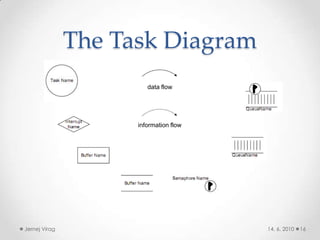


The document discusses task-oriented design for embedded programs. It describes tasks as basic execution units that can run in parallel with separate time domains and different priorities. Tasks should have loose coupling and a single task is recommended for each piece of functionality, especially periodic functions. Methods for inter-task communication include shared variables, event buffers and queues, and synchronization techniques for concurrent access. The task diagram can depict information flow between tasks.


![[QE 2017] Michał Buczko - DevTest Pairing w DevOps](https://cdn.slidesharecdn.com/ss_thumbnails/michabuczko-170726070031-thumbnail.jpg?width=640&height=640&fit=bounds)


