The Success of
Deep Generative
Models
Jakub Tomczak
AMLAB, University of Amsterdam
PASC, 2018
What is AI about?
What is AI about?
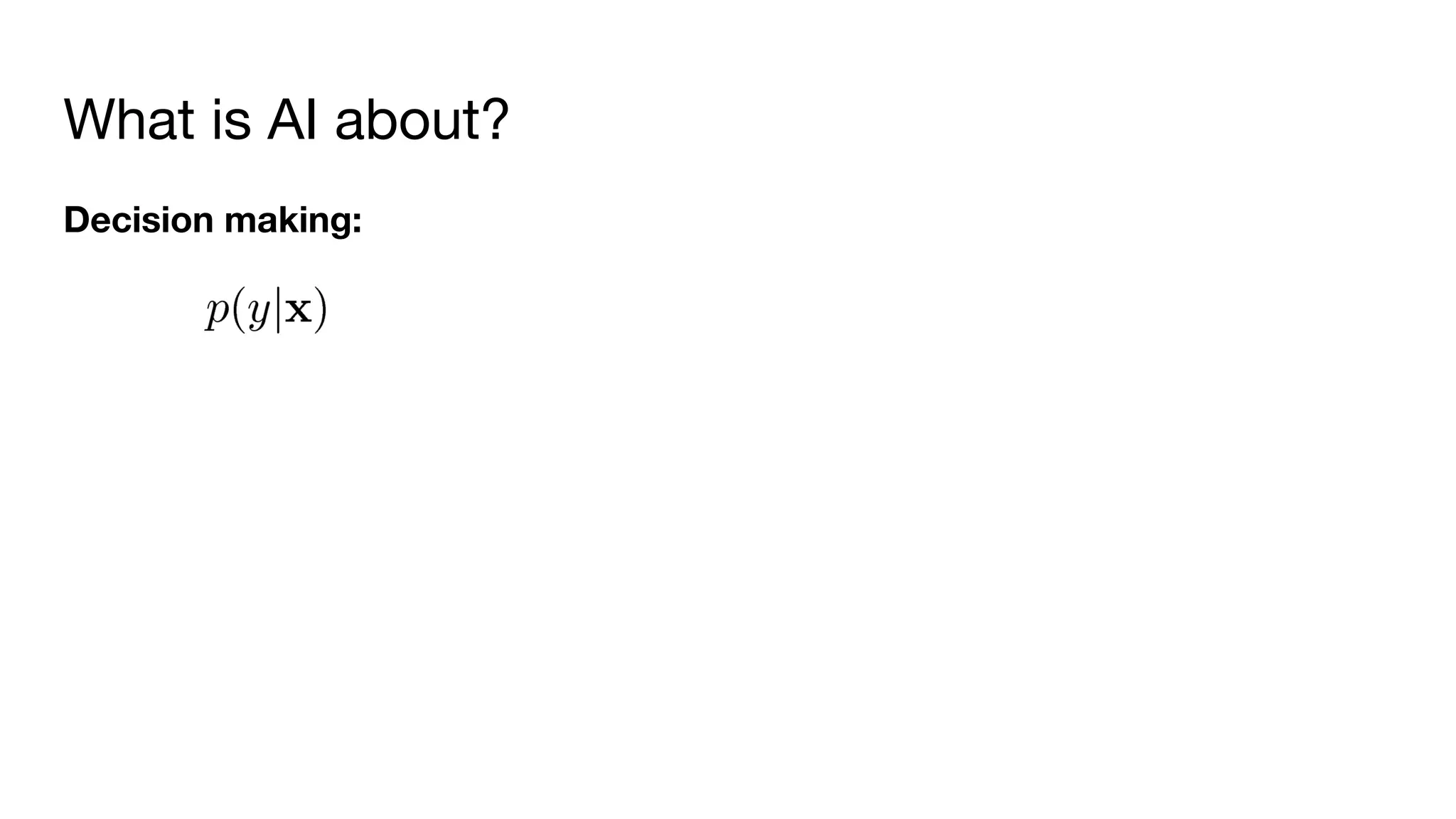
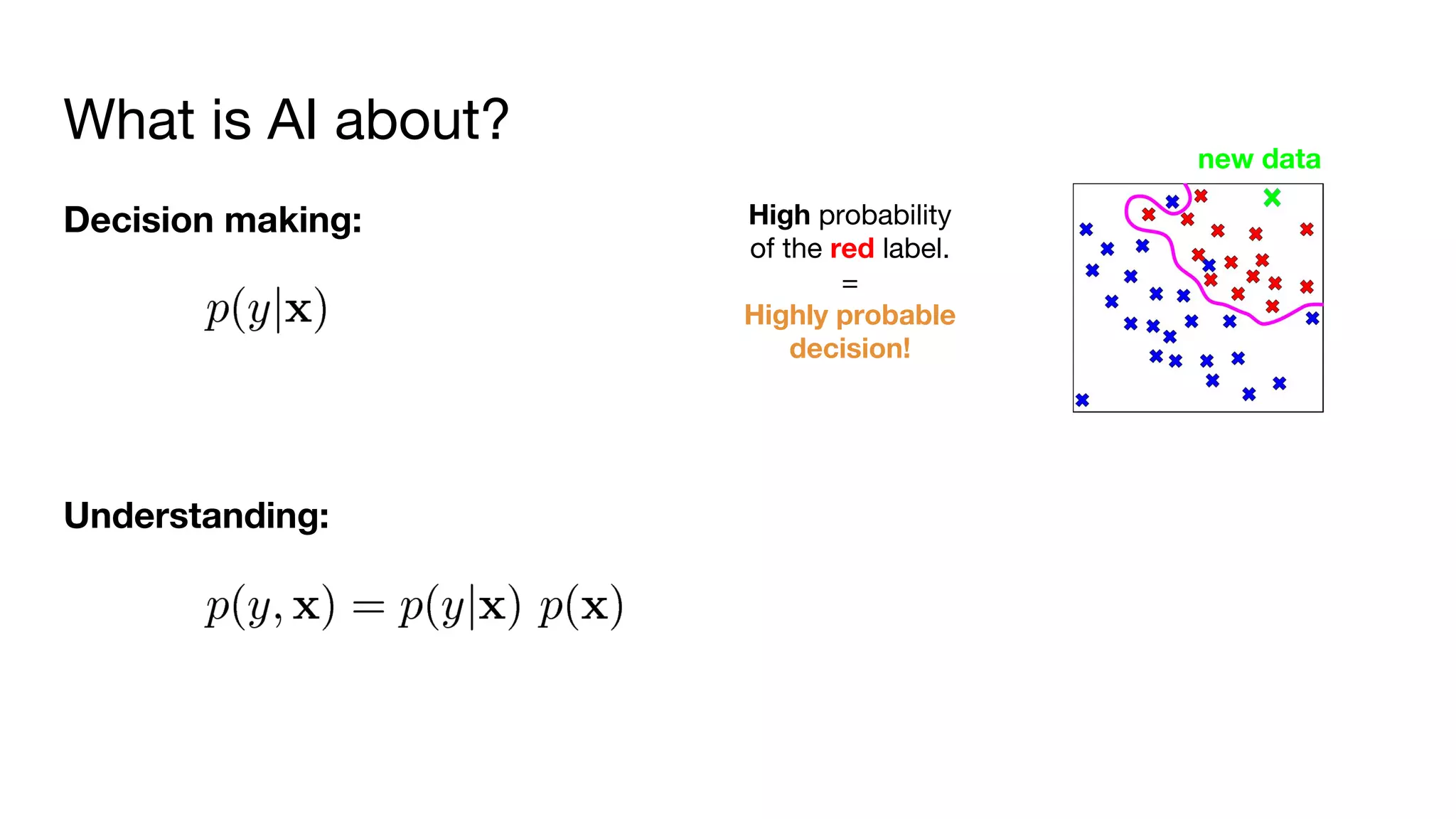
Decision making:
What is AI about?
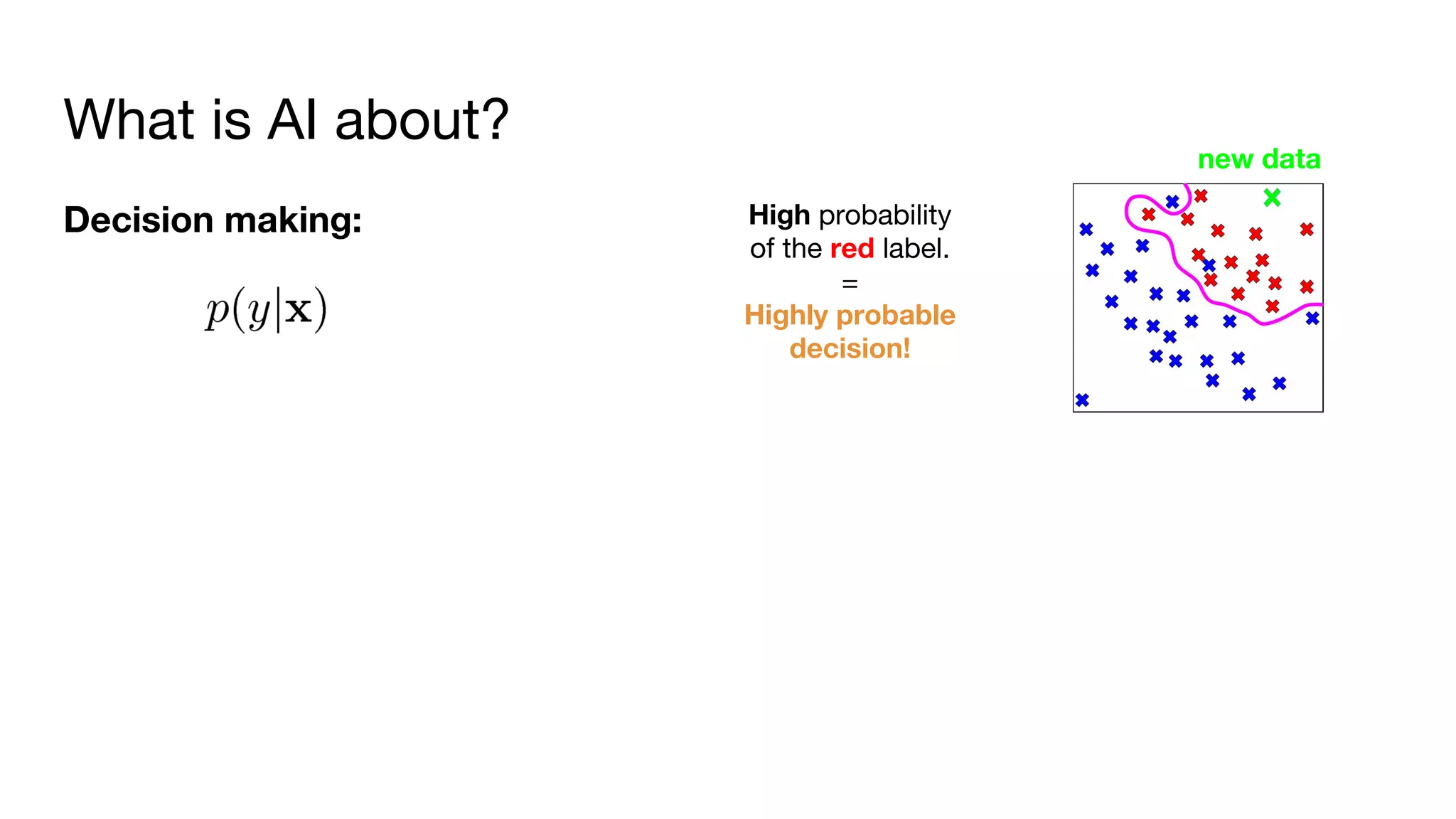
Decision making: High probability
of the red label.
=
Highly probable
decision!
new data
What is AI about?
Decision making:
Understanding:
High probability
of the red label.
=
Highly probable
decision!
new data
What is AI about?
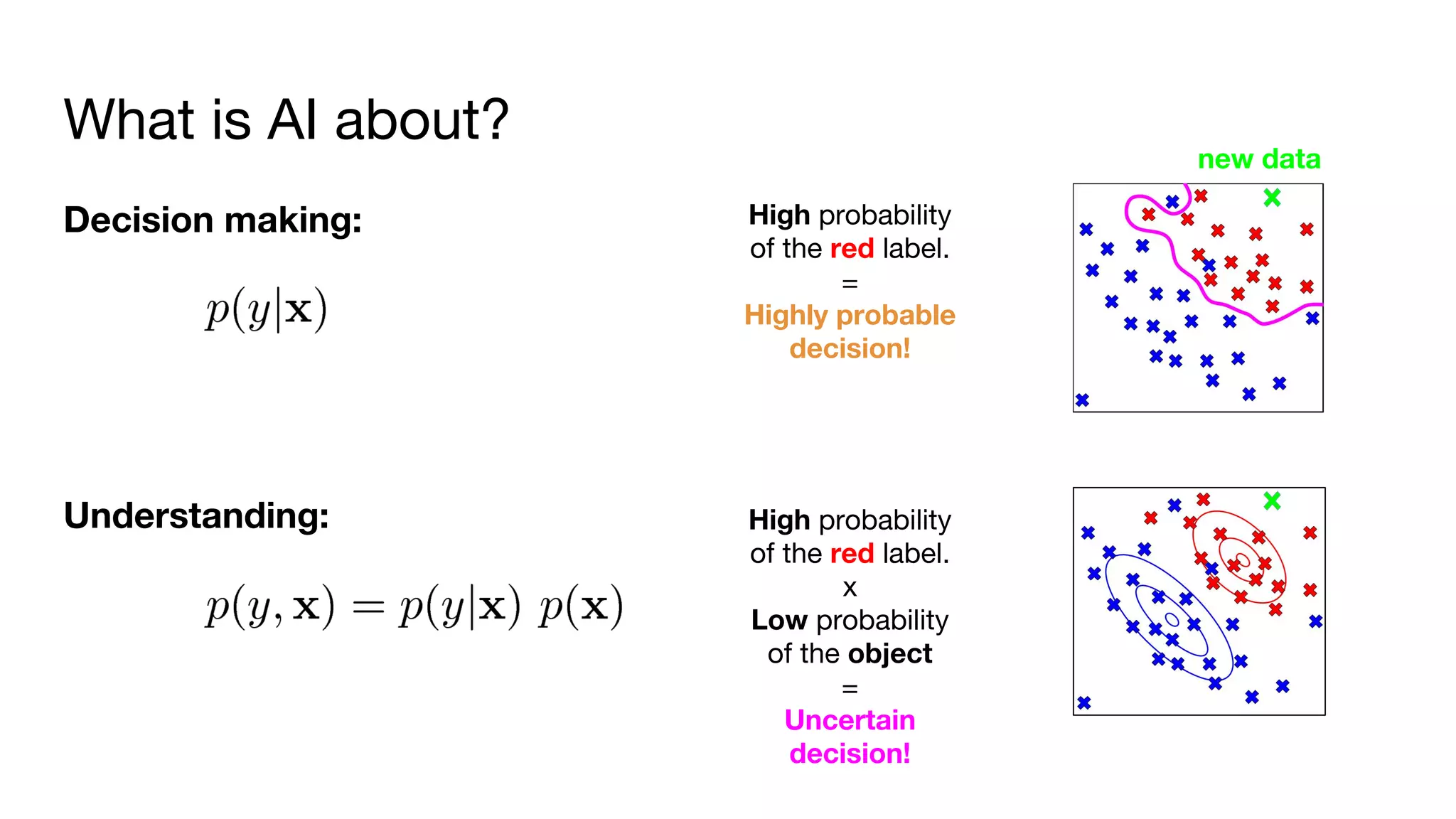
Decision making:
Understanding:
new data
High probability
of the red label.
=
Highly probable
decision!
High probability
of the red label.
x
Low probability
of the object
=
Uncertain
decision!
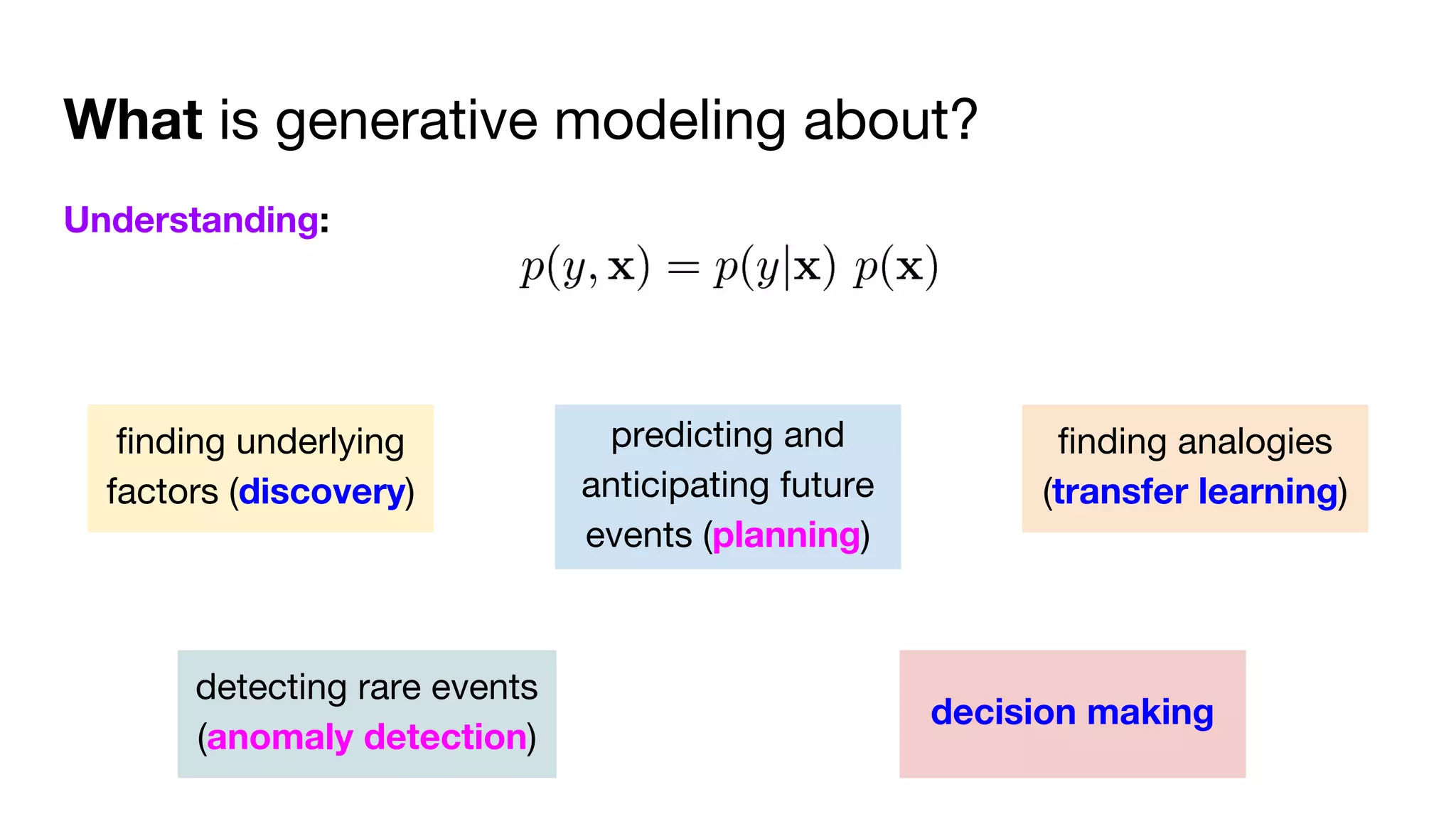
What is generative modeling about?
Understanding:
finding underlying
factors (discovery)
predicting and
anticipating future
events (planning)
finding analogies
(transfer learning)
detecting rare events
(anomaly detection)
decision making
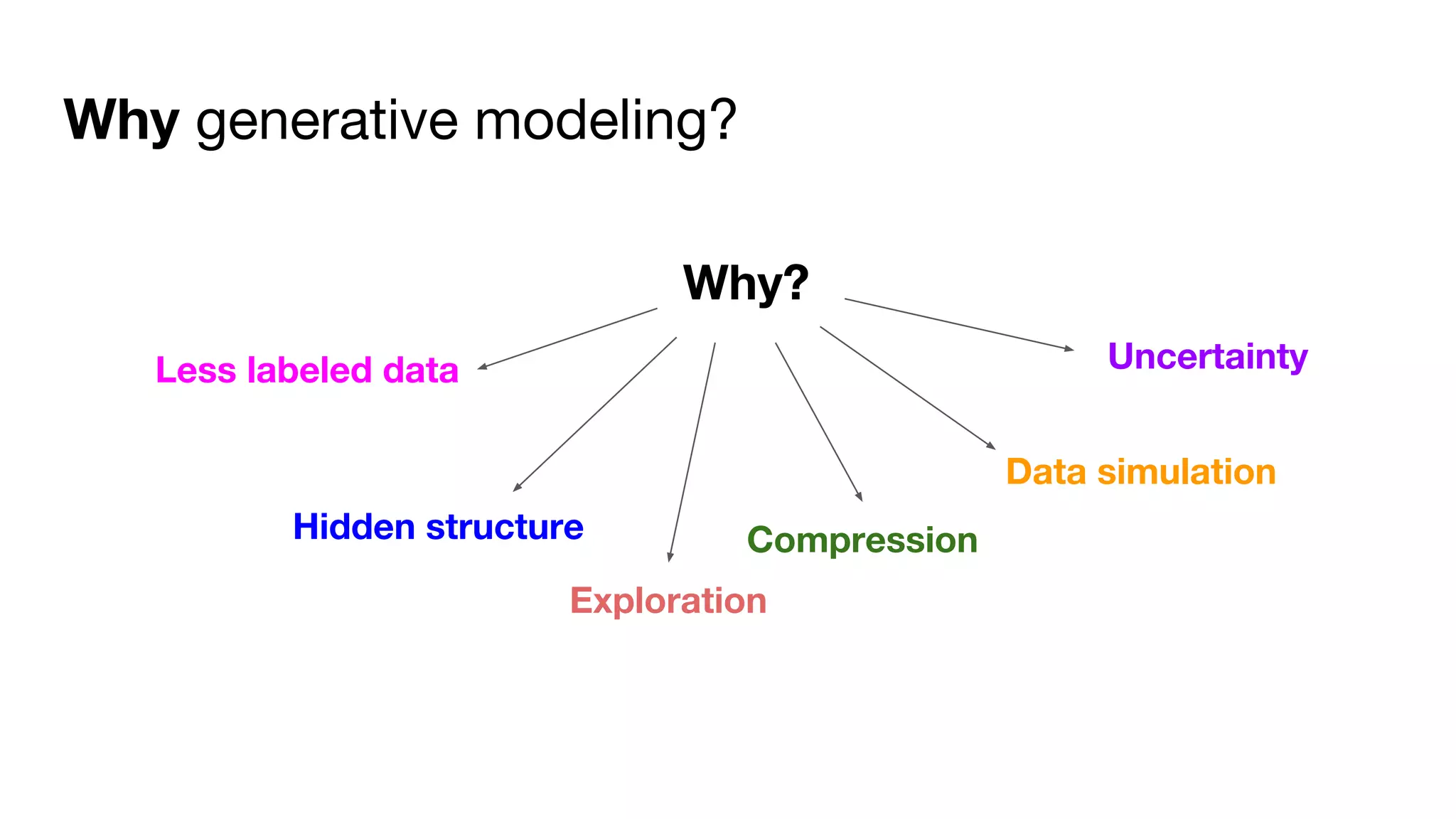
Why generative modeling?
Why?
Less labeled data
Compression
Uncertainty
Hidden structure
Data simulation
Exploration
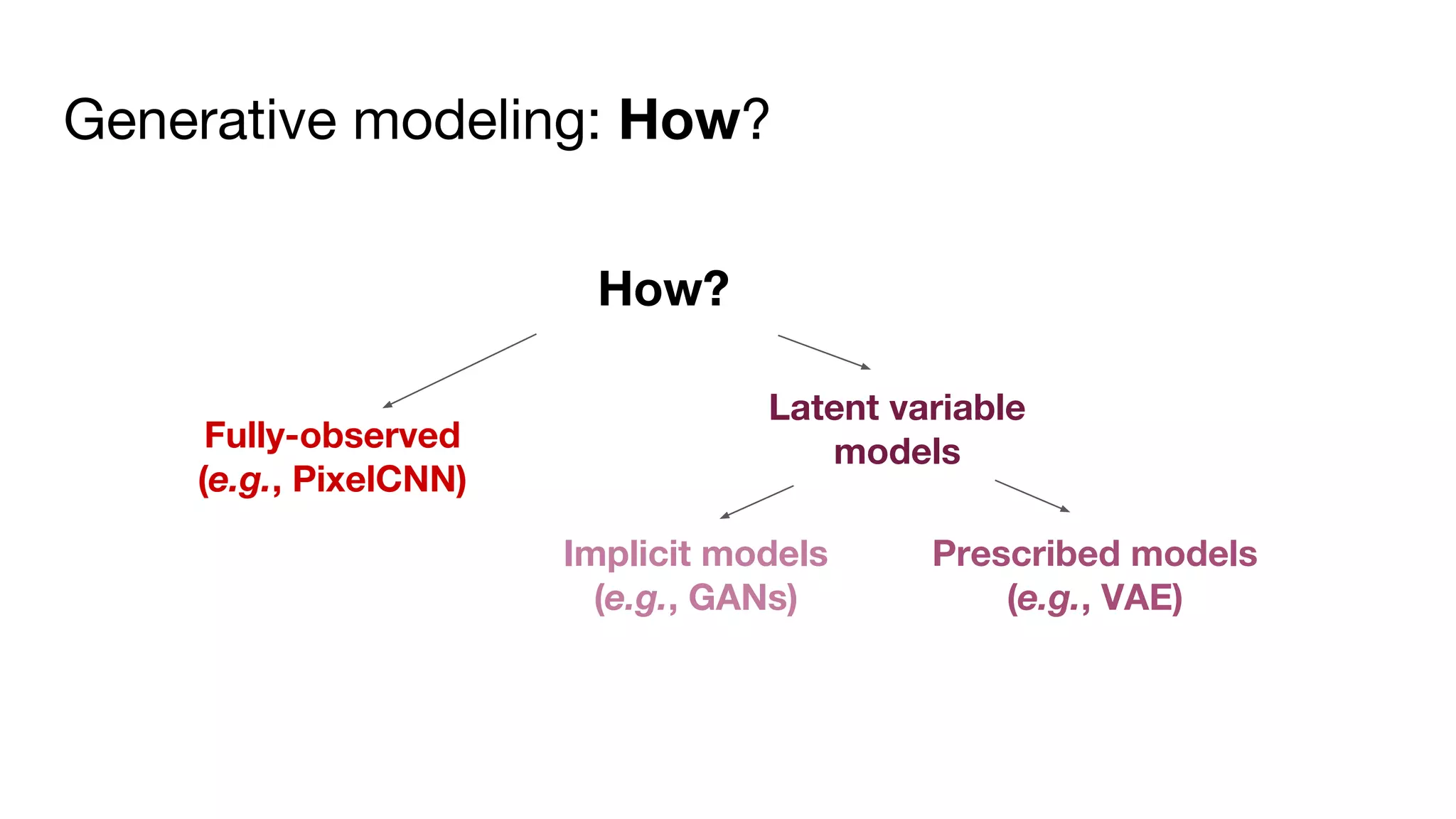
Generative modeling: How?
How?
Fully-observed
(e.g., PixelCNN)
Implicit models
(e.g., GANs)
Prescribed models
(e.g., VAE)
Latent variable
models
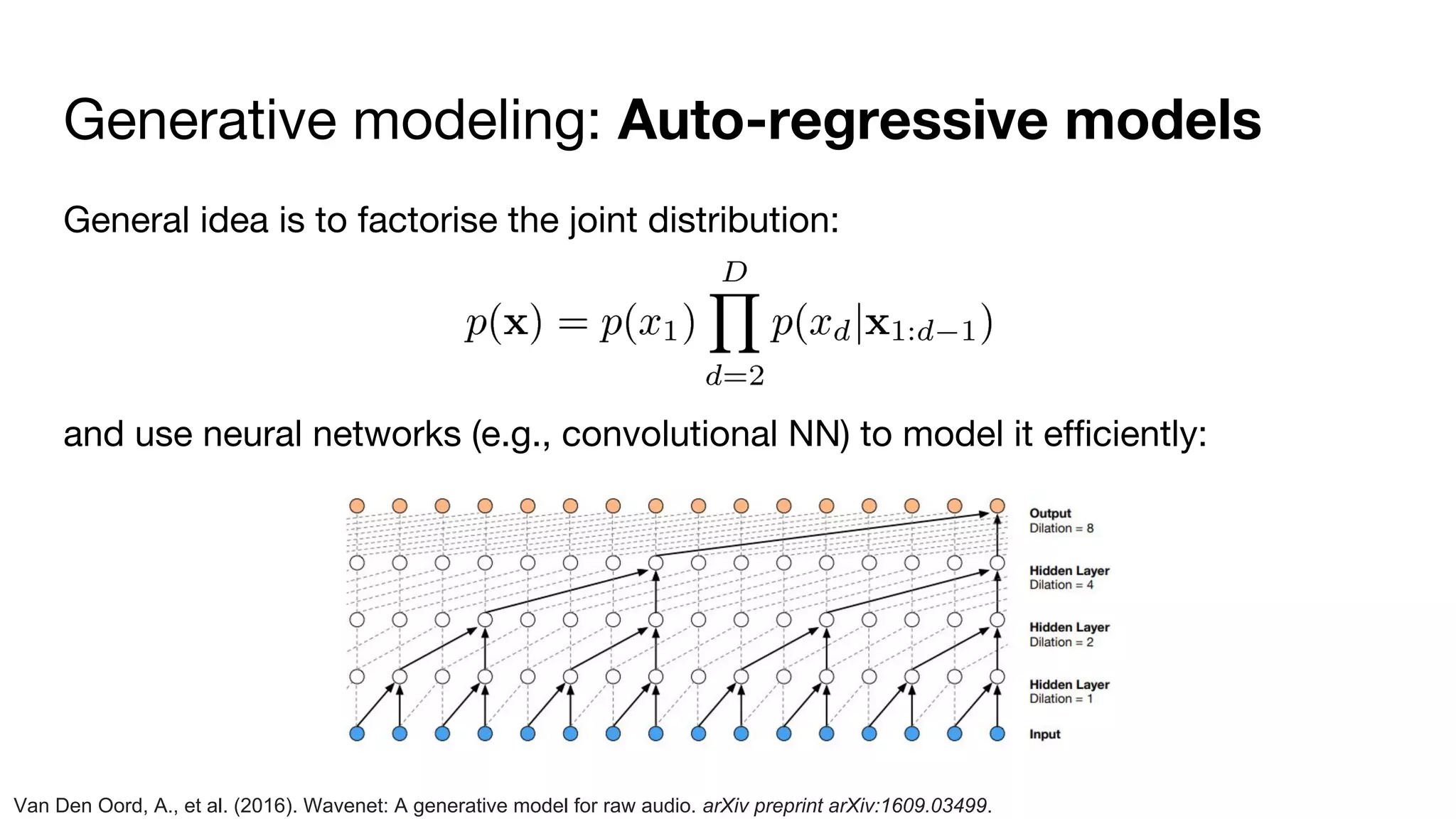
Generative modeling: Auto-regressive models
General idea is to factorise the joint distribution:
and use neural networks (e.g., convolutional NN) to model it efficiently:
Van Den Oord, A., et al. (2016). Wavenet: A generative model for raw audio. arXiv preprint arXiv:1609.03499.
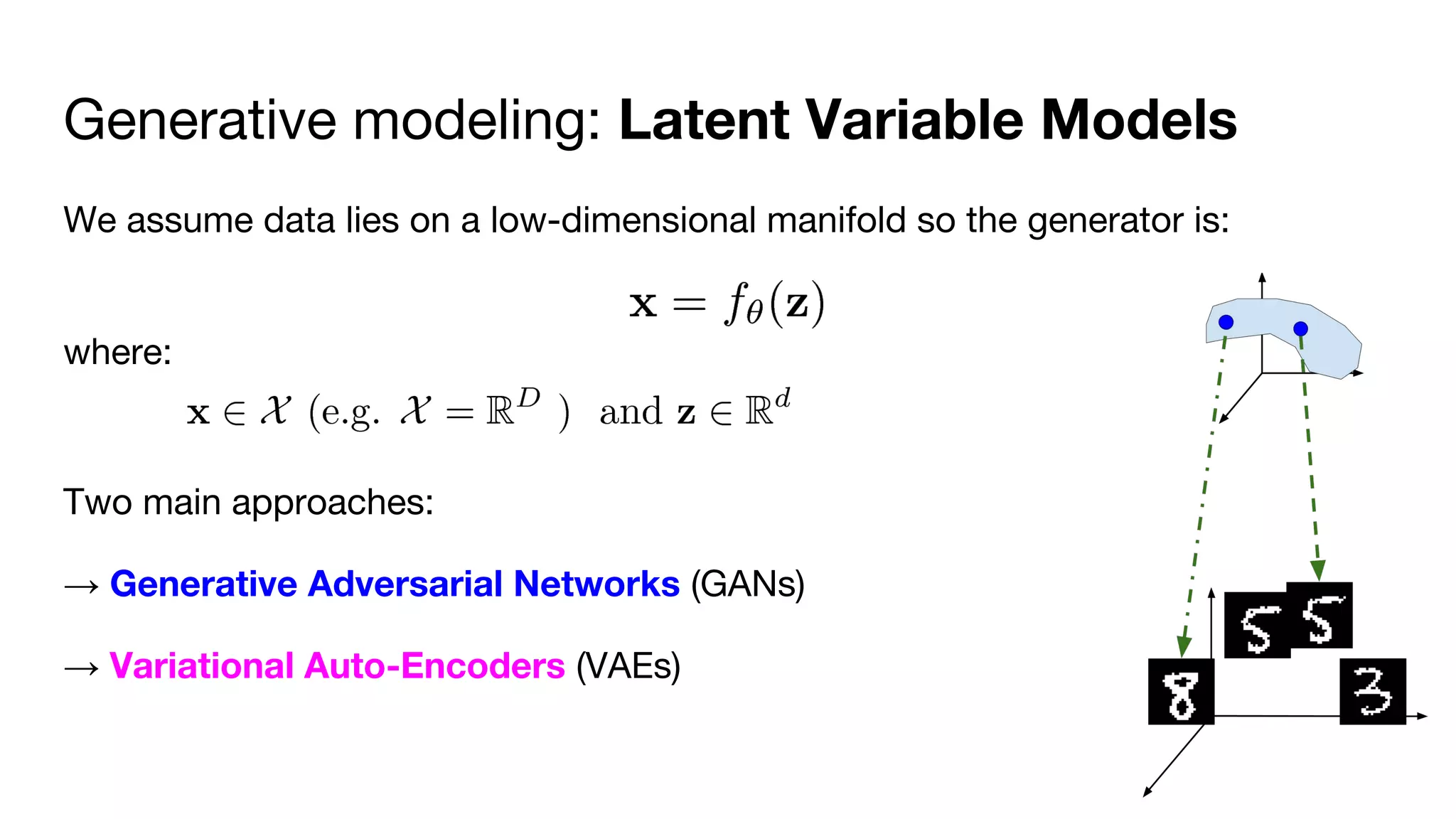
Generative modeling: Latent Variable Models
We assume data lies on a low-dimensional manifold so the generator is:
where:
Two main approaches:
→ Generative Adversarial Networks (GANs)
→ Variational Auto-Encoders (VAEs)
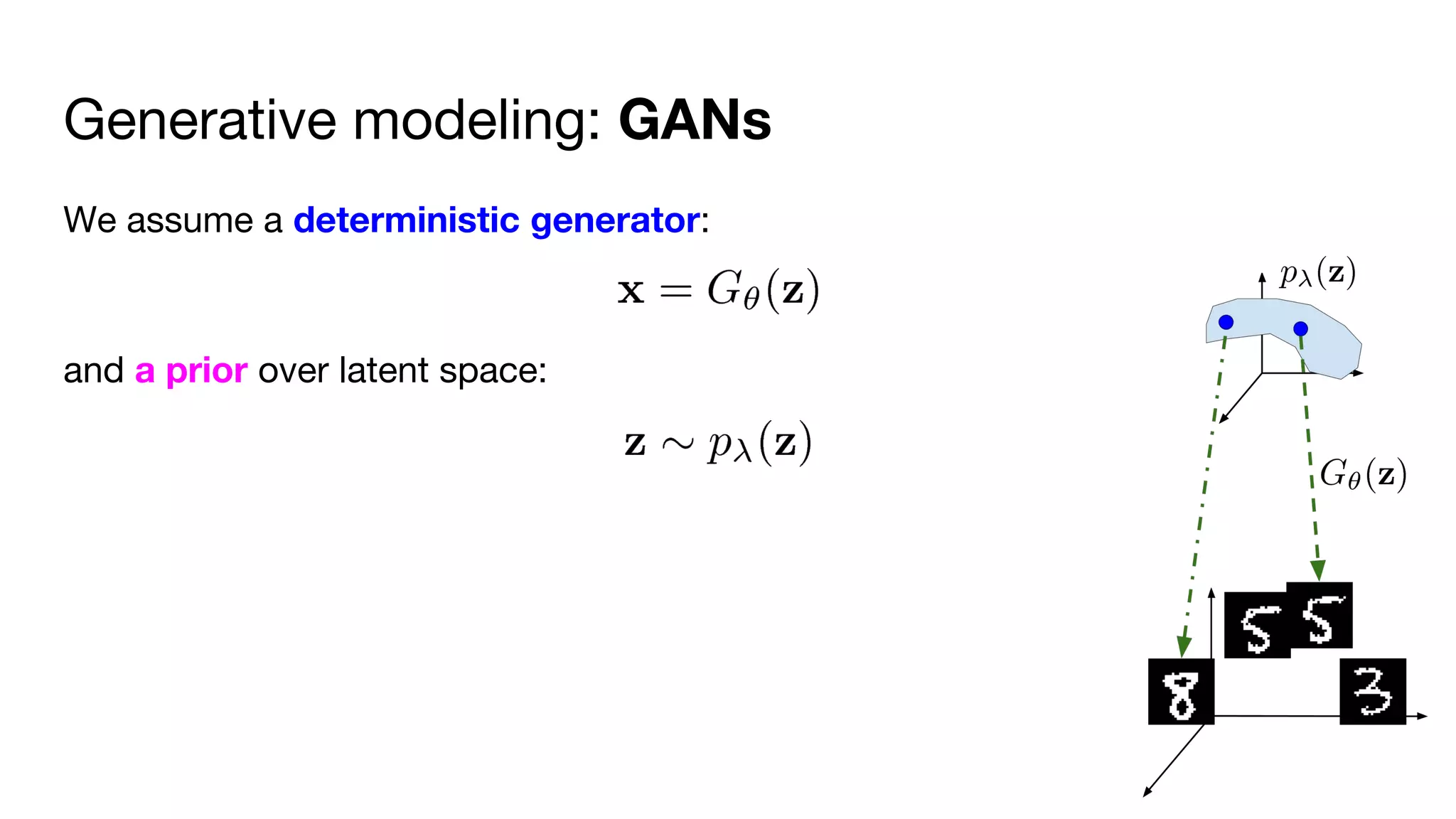
Generative modeling: GANs
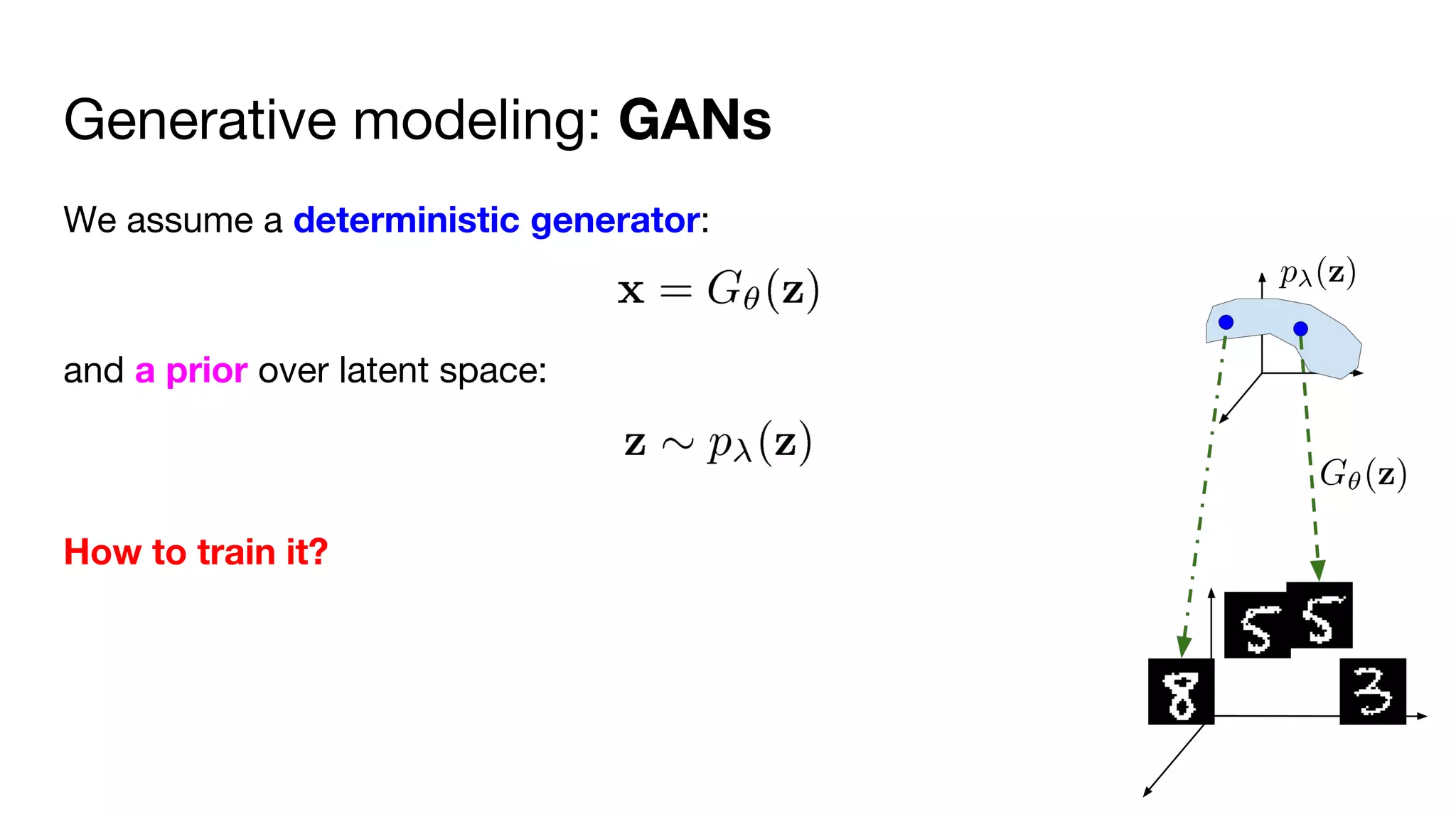
We assume a deterministic generator:
and a prior over latent space:
Generative modeling: GANs
We assume a deterministic generator:
and a prior over latent space:
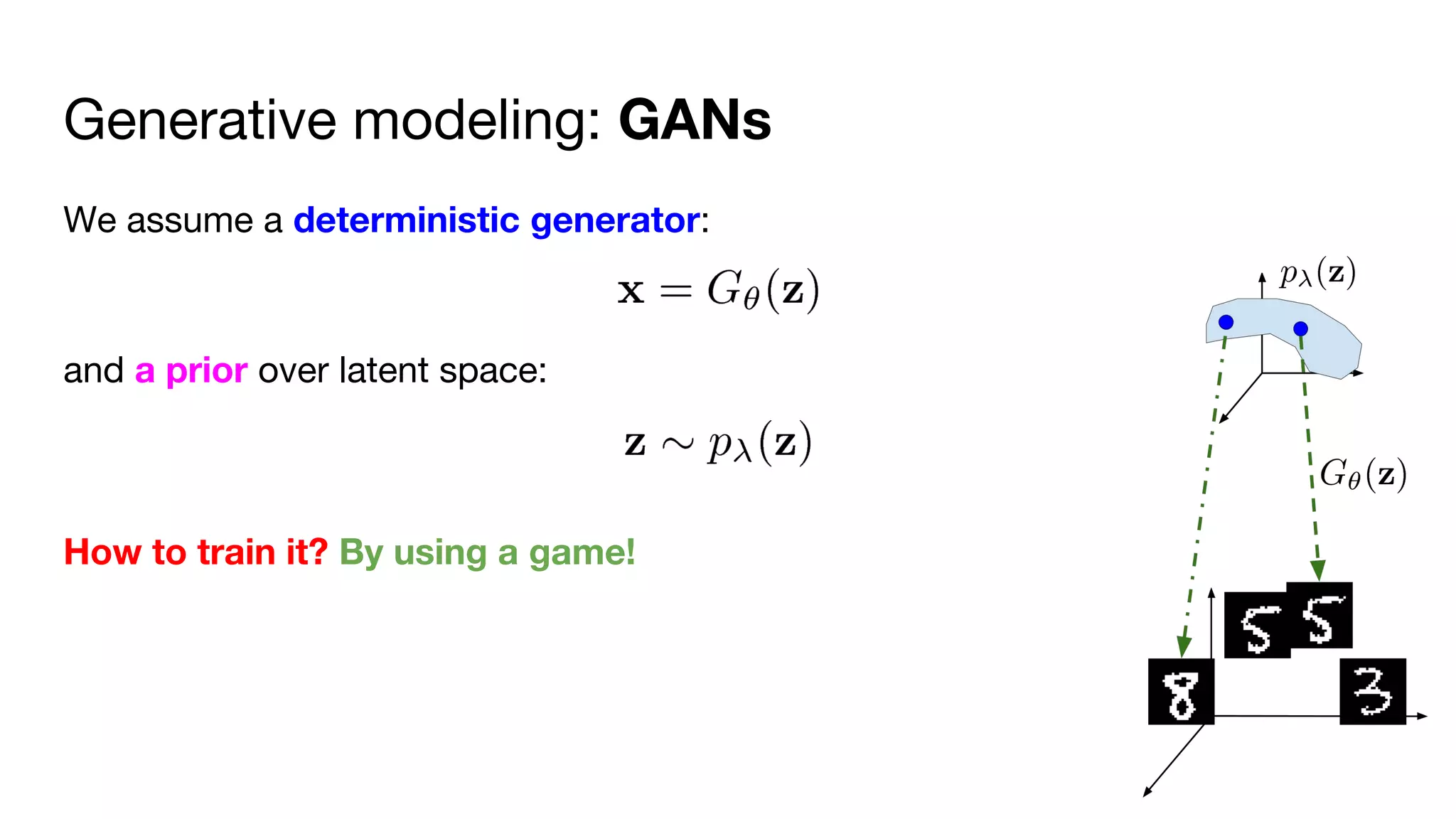
How to train it?
Generative modeling: GANs
We assume a deterministic generator:
and a prior over latent space:
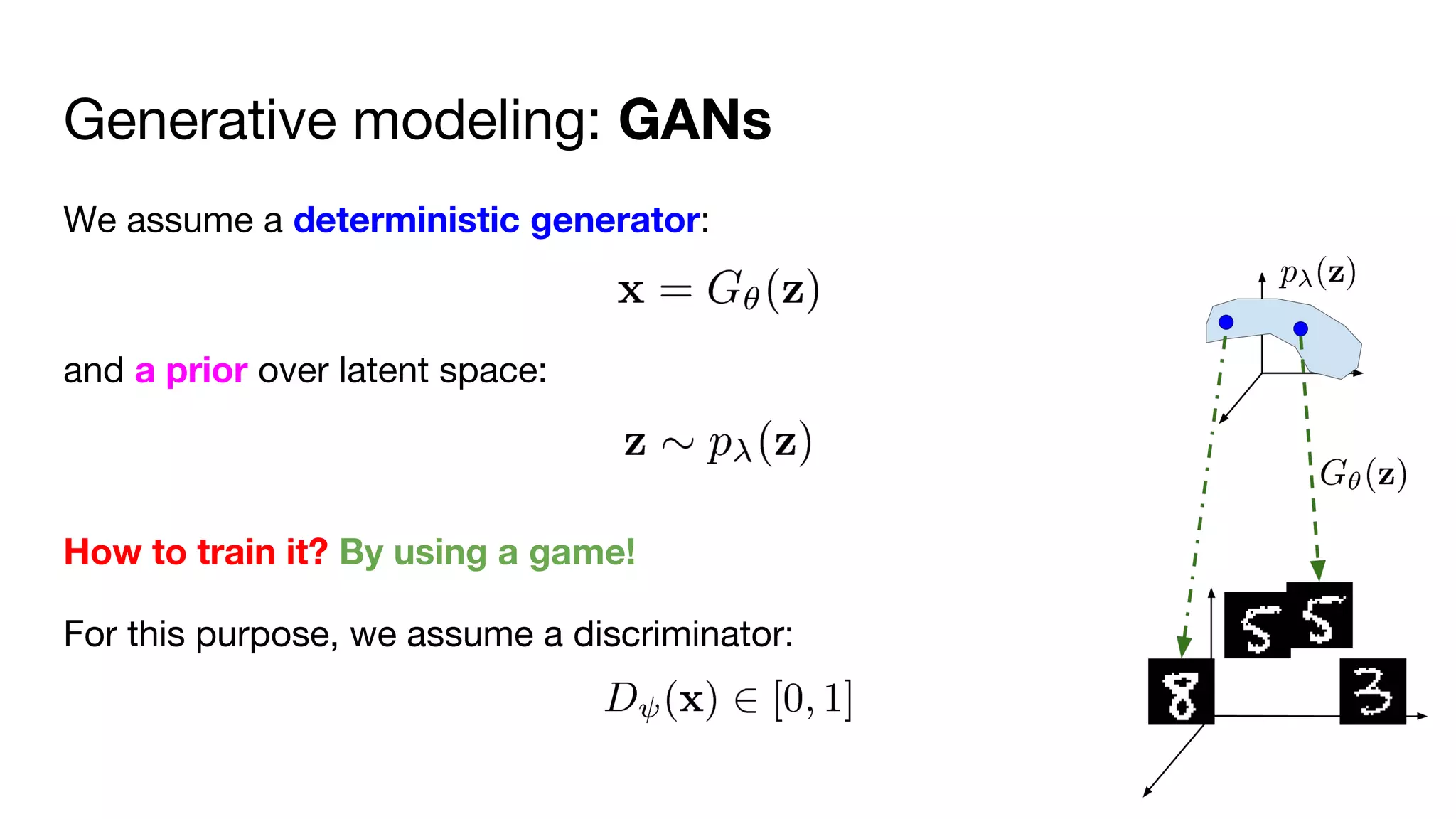
How to train it? By using a game!
Generative modeling: GANs
We assume a deterministic generator:
and a prior over latent space:
How to train it? By using a game!
For this purpose, we assume a discriminator:
Generative modeling: GANs
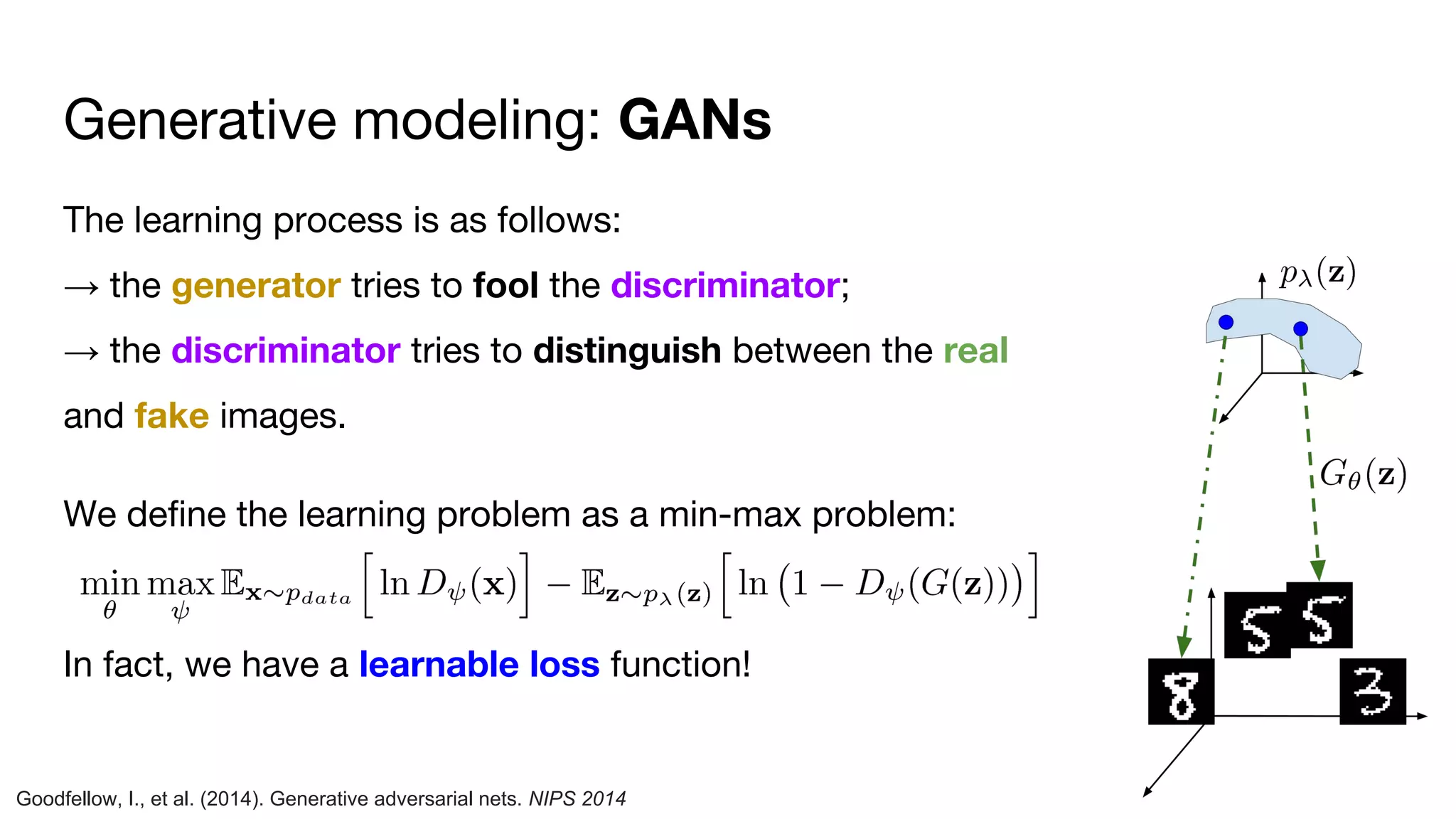
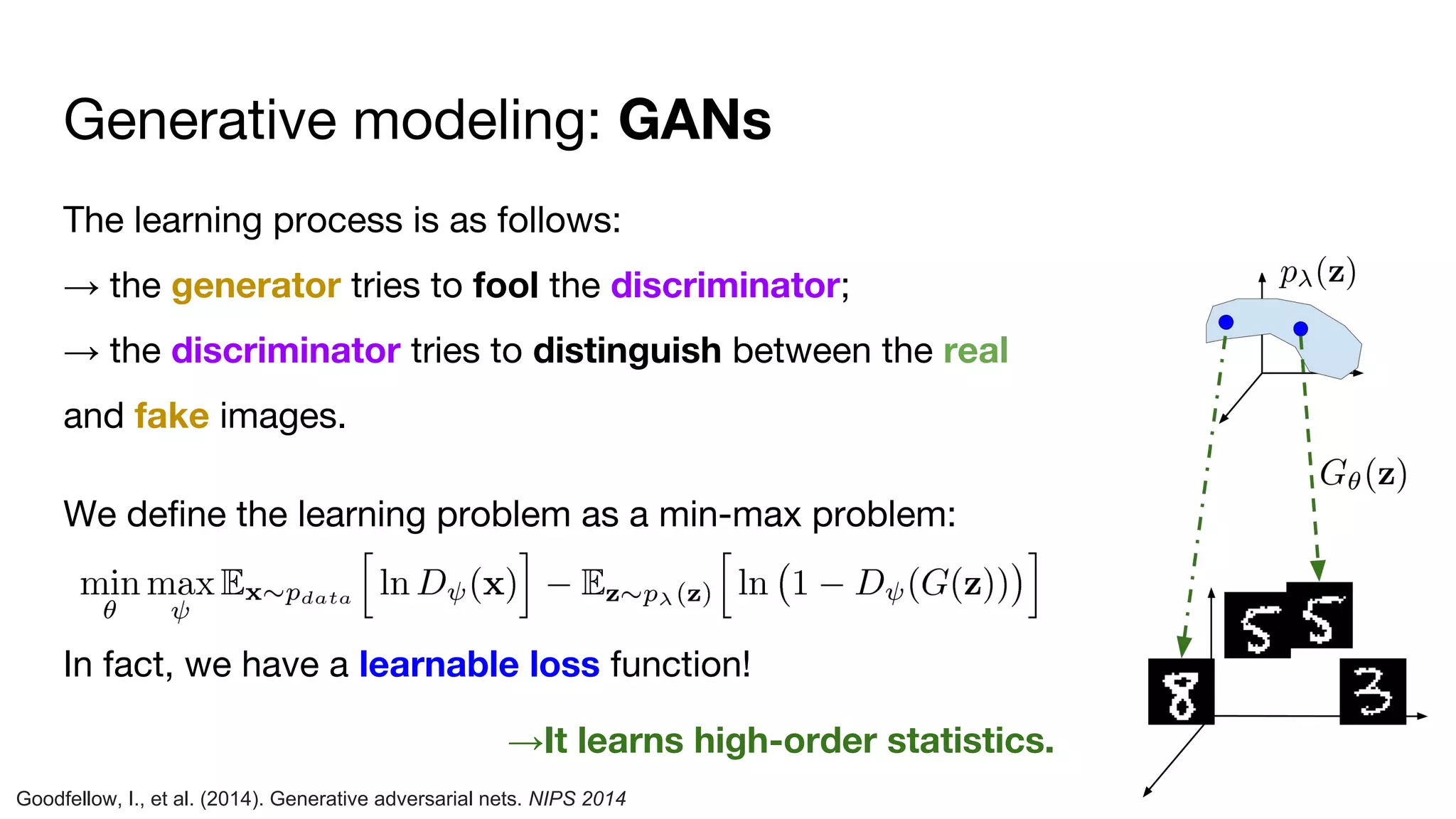
The learning process is as follows:
→ the generator tries to fool the discriminator;
→ the discriminator tries to distinguish between the real
and fake images.
We define the learning problem as a min-max problem:
In fact, we have a learnable loss function!
Goodfellow, I., et al. (2014). Generative adversarial nets. NIPS 2014
Generative modeling: GANs
The learning process is as follows:
→ the generator tries to fool the discriminator;
→ the discriminator tries to distinguish between the real
and fake images.
We define the learning problem as a min-max problem:
In fact, we have a learnable loss function!
Goodfellow, I., et al. (2014). Generative adversarial nets. NIPS 2014
→It learns high-order statistics.
Generative modeling: GANs
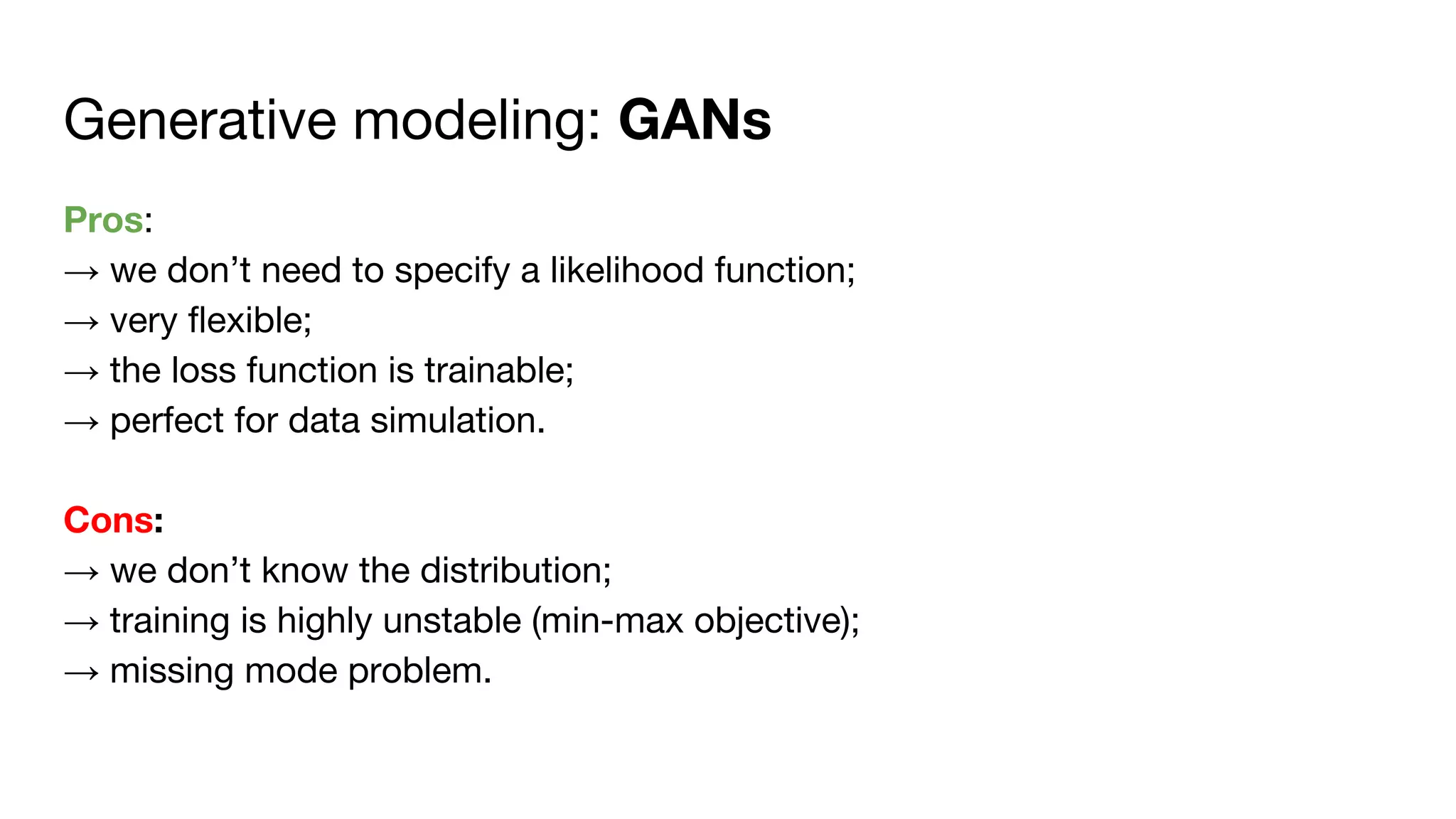
Pros:
→ we don’t need to specify a likelihood function;
→ very flexible;
→ the loss function is trainable;
→ perfect for data simulation.
Cons:
→ we don’t know the distribution;
→ training is highly unstable (min-max objective);
→ missing mode problem.
Generative modeling: VAEs
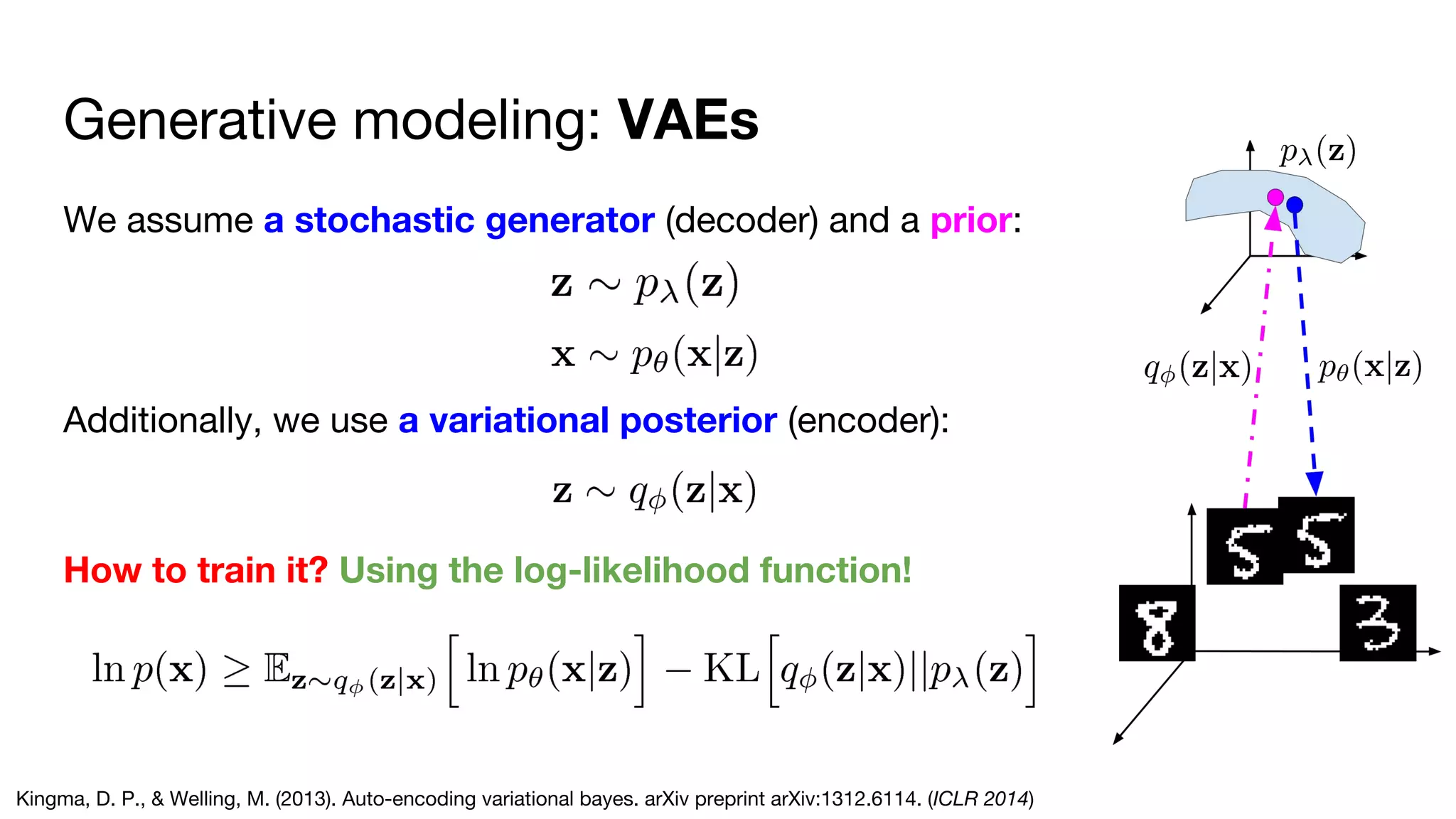
We assume a stochastic generator (decoder) and a prior:
Additionally, we use a variational posterior (encoder):
How to train it? Using the log-likelihood function!
Kingma, D. P., & Welling, M. (2013). Auto-encoding variational bayes. arXiv preprint arXiv:1312.6114. (ICLR 2014)
Variational Auto-Encoder: Extensions
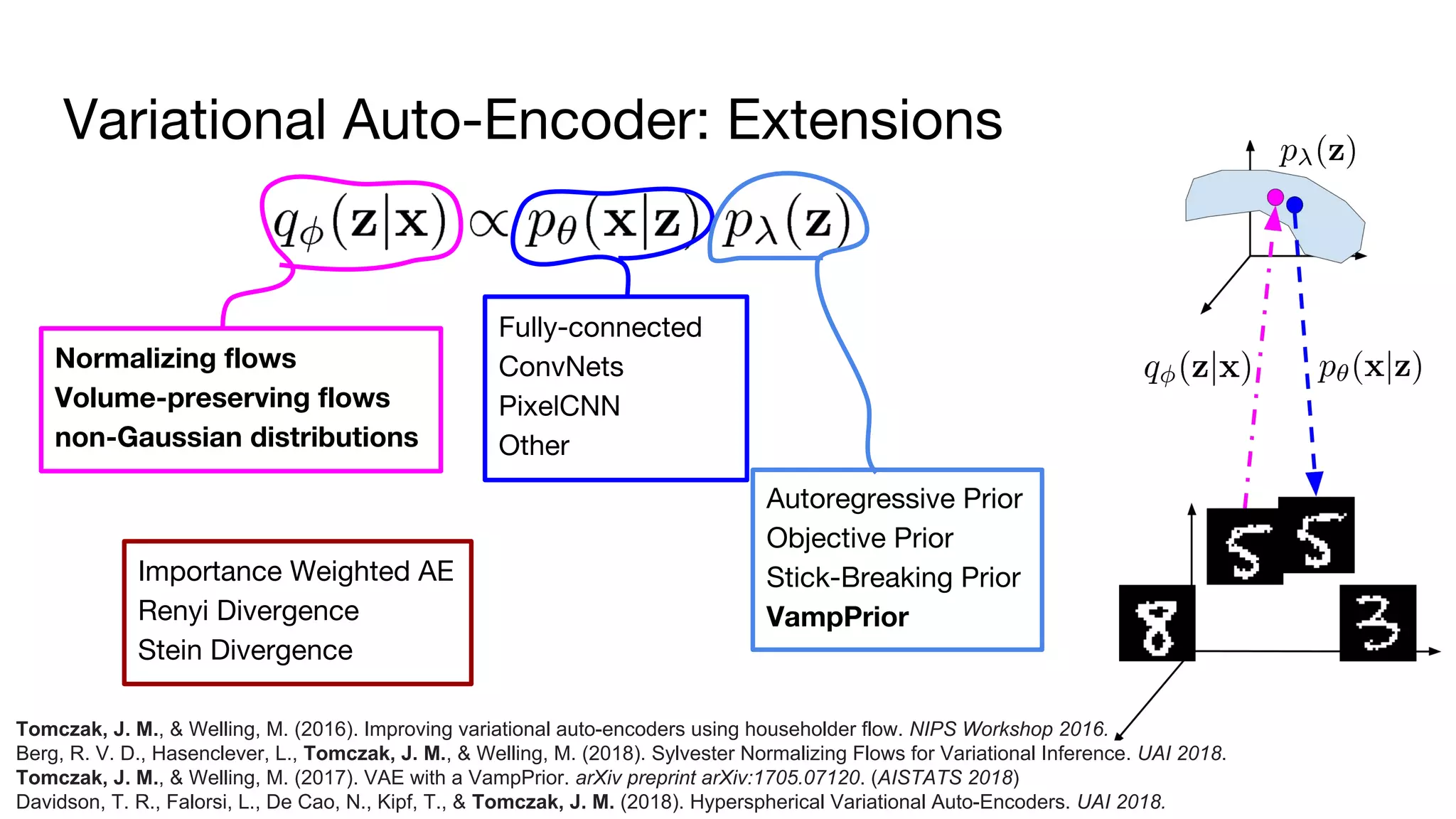
Normalizing flows
Volume-preserving flows
non-Gaussian distributions
Autoregressive Prior
Objective Prior
Stick-Breaking Prior
VampPrior
Importance Weighted AE
Renyi Divergence
Stein Divergence
Fully-connected
ConvNets
PixelCNN
Other
Tomczak, J. M., & Welling, M. (2016). Improving variational auto-encoders using householder flow. NIPS Workshop 2016.
Berg, R. V. D., Hasenclever, L., Tomczak, J. M., & Welling, M. (2018). Sylvester Normalizing Flows for Variational Inference. UAI 2018.
Tomczak, J. M., & Welling, M. (2017). VAE with a VampPrior. arXiv preprint arXiv:1705.07120. (AISTATS 2018)
Davidson, T. R., Falorsi, L., De Cao, N., Kipf, T., & Tomczak, J. M. (2018). Hyperspherical Variational Auto-Encoders. UAI 2018.
Generative modeling: VAEs
Pros:
→ we know the distribution and can calculate the likelihood function;
→ we can encode an object in a low-dim manifold (compression);
→ training is stable;
→ no missing modes.
Cons:
→ we need know the distribution;
→ we need a flexible encoder and prior;
→ blurry images (so far…).
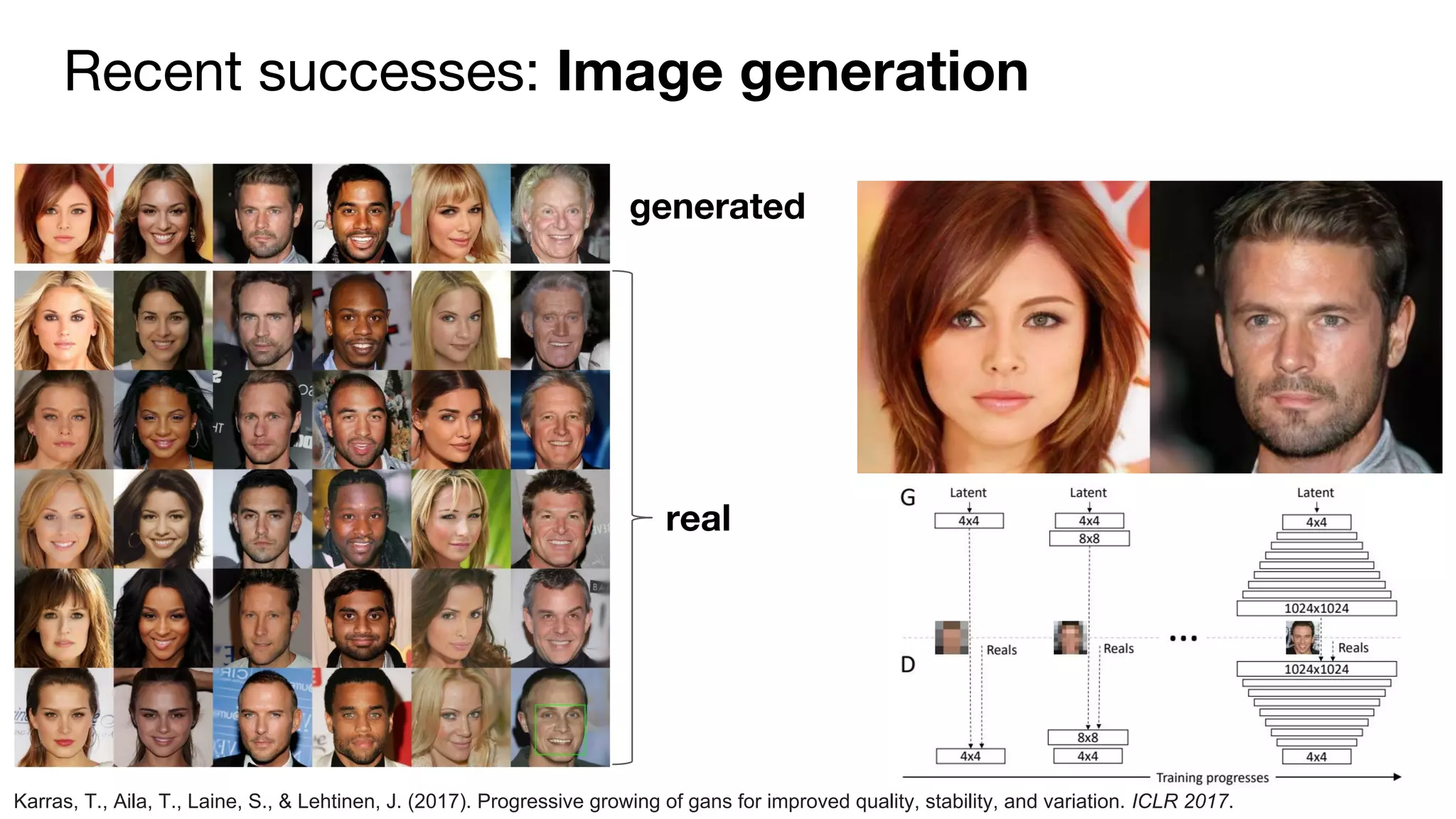
Recent successes: Image generation
generated
real
Karras, T., Aila, T., Laine, S., & Lehtinen, J. (2017). Progressive growing of gans for improved quality, stability, and variation. ICLR 2017.
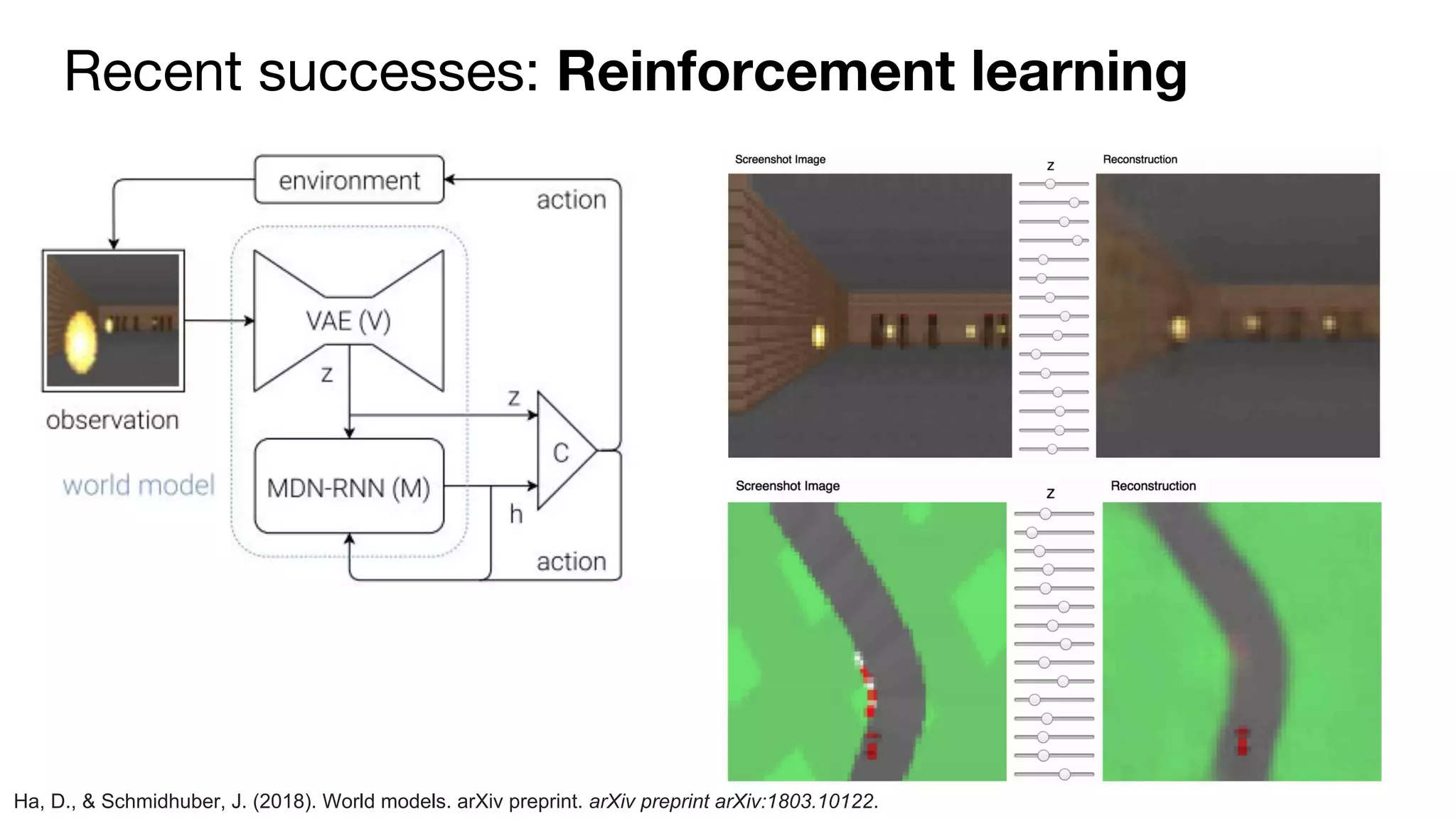
Recent successes: Reinforcement learning
Ha, D., & Schmidhuber, J. (2018). World models. arXiv preprint. arXiv preprint arXiv:1803.10122.
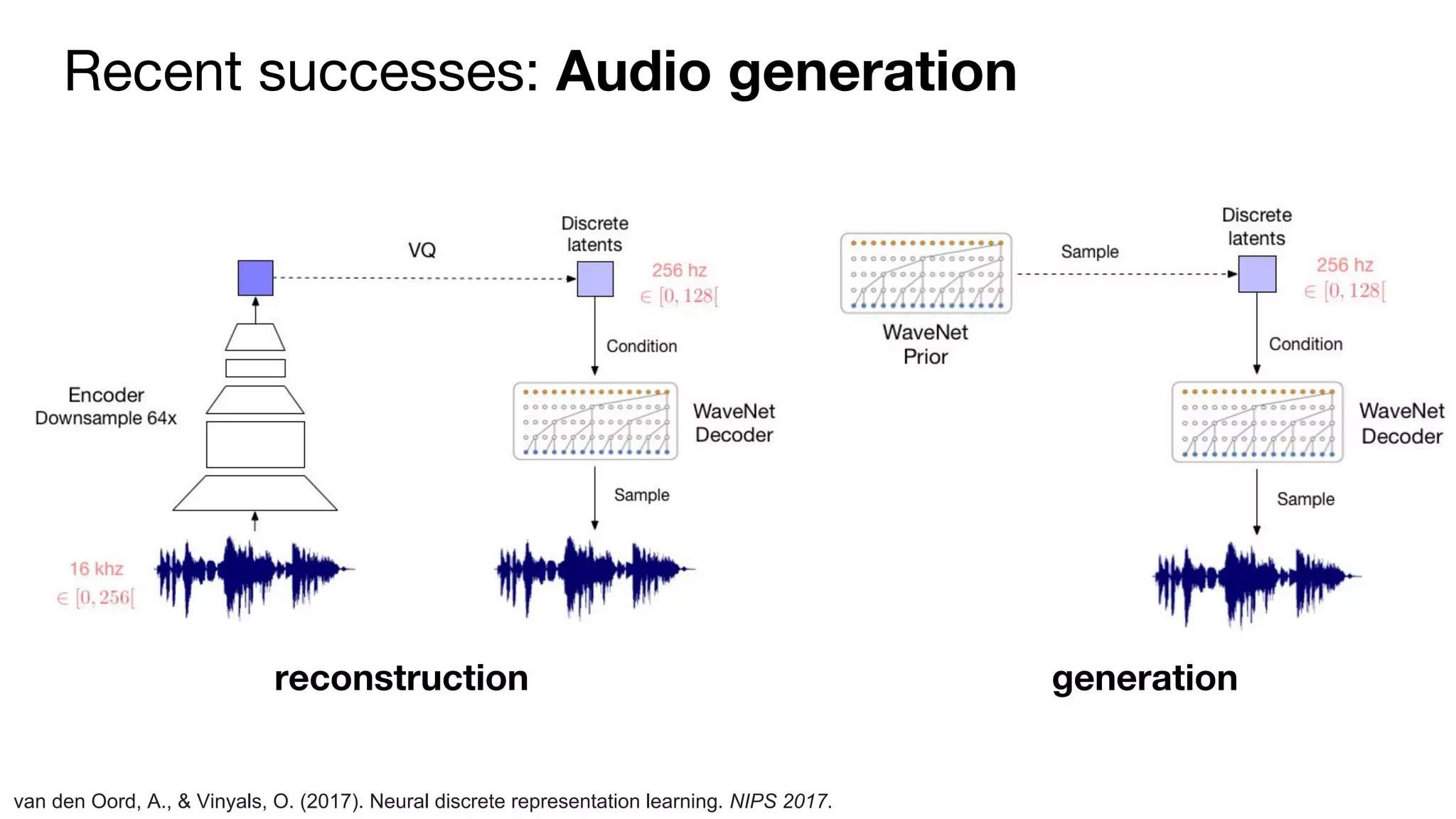
Recent successes: Audio generation
van den Oord, A., & Vinyals, O. (2017). Neural discrete representation learning. NIPS 2017.
reconstruction generation
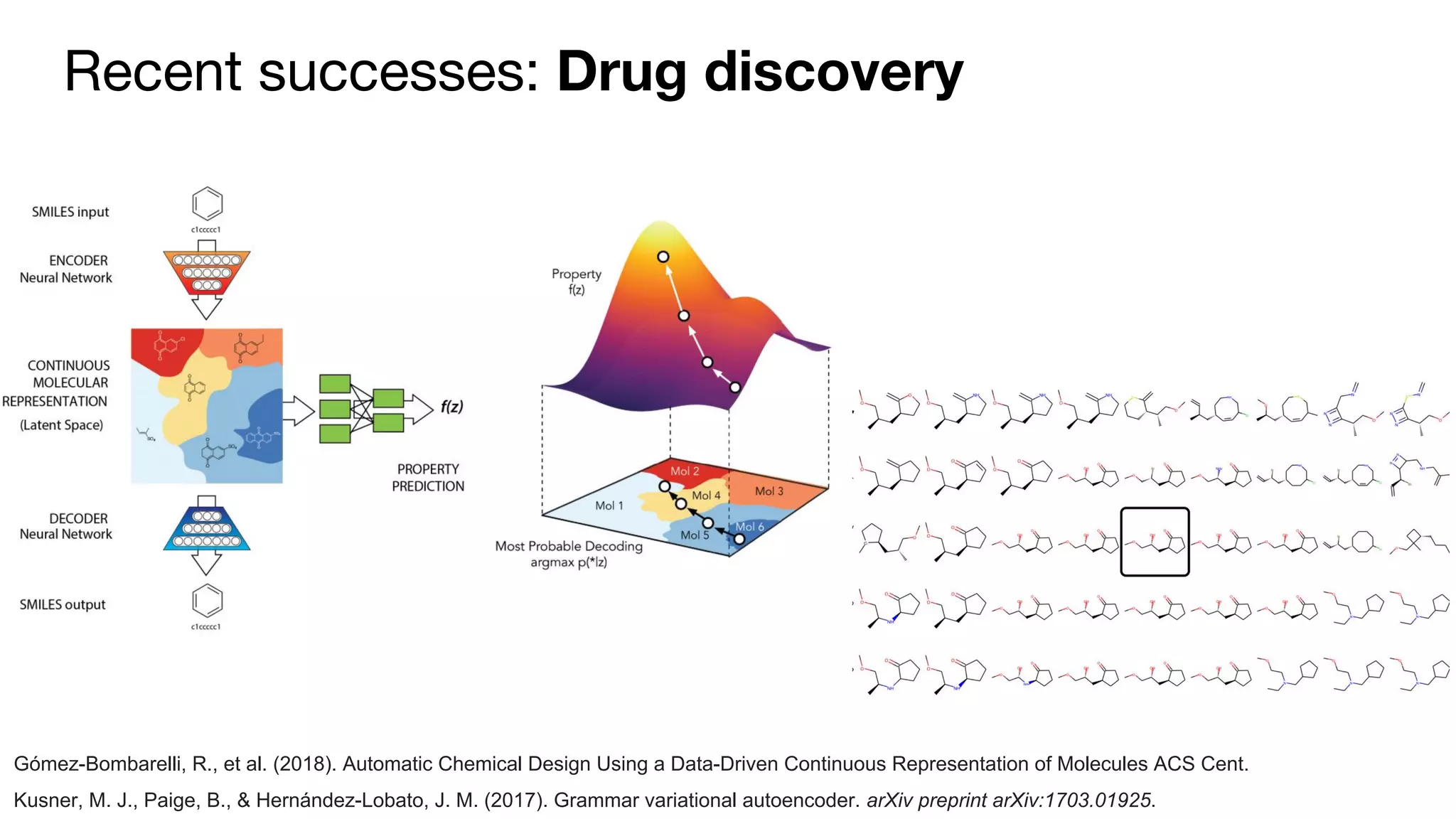
Recent successes: Drug discovery
Gómez-Bombarelli, R., et al. (2018). Automatic Chemical Design Using a Data-Driven Continuous Representation of Molecules ACS Cent.
Kusner, M. J., Paige, B., & Hernández-Lobato, J. M. (2017). Grammar variational autoencoder. arXiv preprint arXiv:1703.01925.
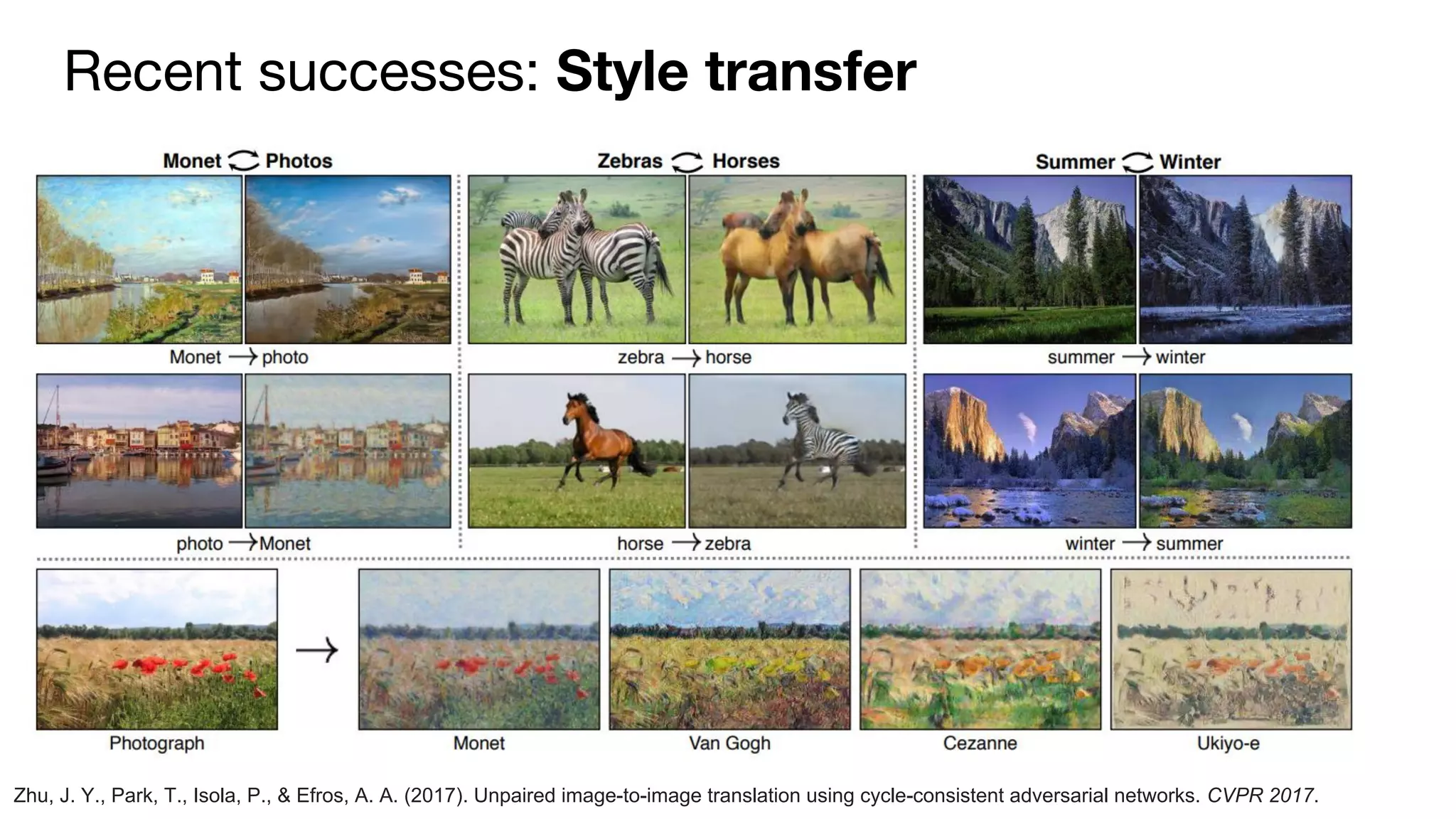
Recent successes: Style transfer
Zhu, J. Y., Park, T., Isola, P., & Efros, A. A. (2017). Unpaired image-to-image translation using cycle-consistent adversarial networks. CVPR 2017.
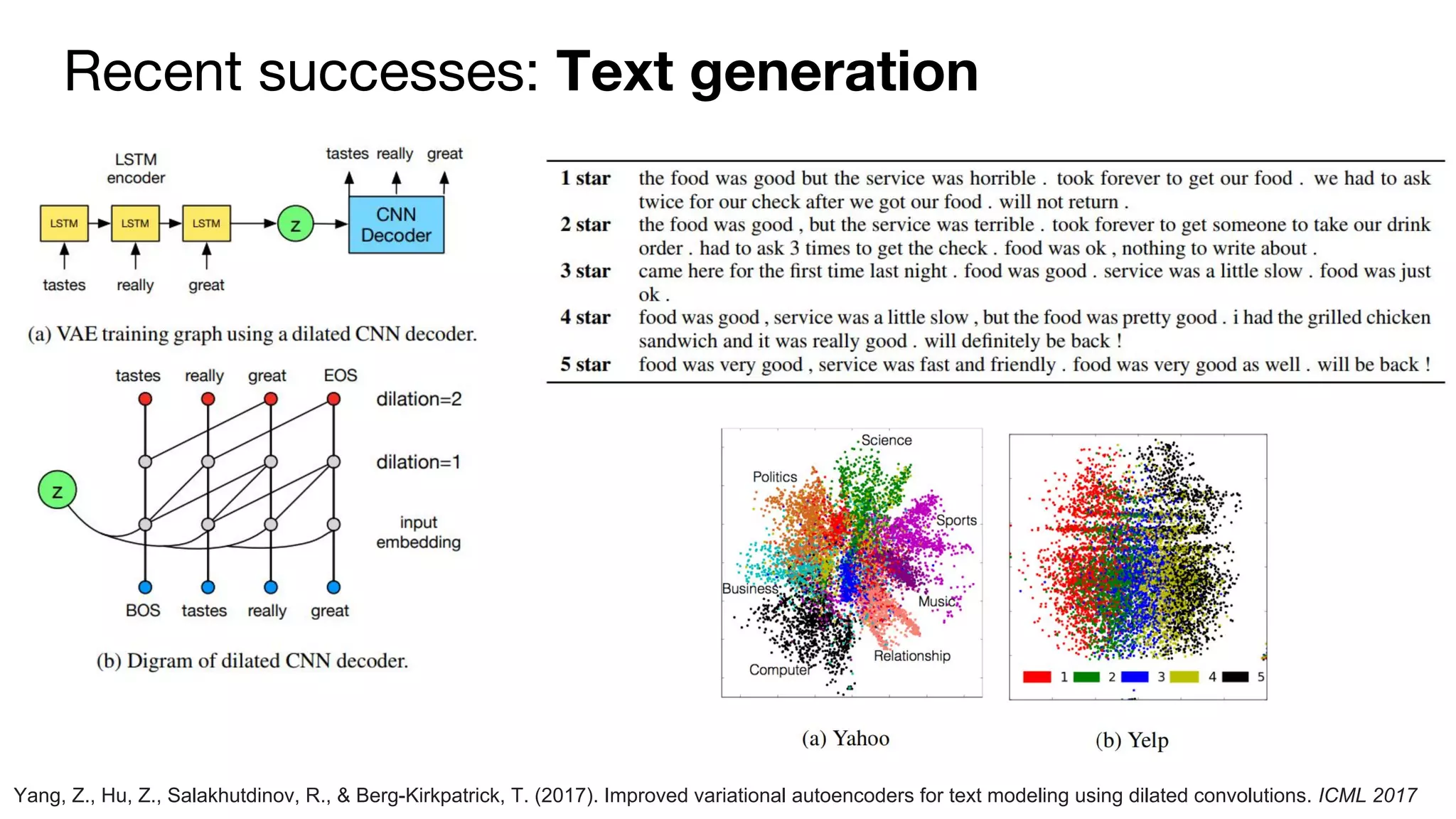
Recent successes: Text generation
Yang, Z., Hu, Z., Salakhutdinov, R., & Berg-Kirkpatrick, T. (2017). Improved variational autoencoders for text modeling using dilated convolutions. ICML 2017
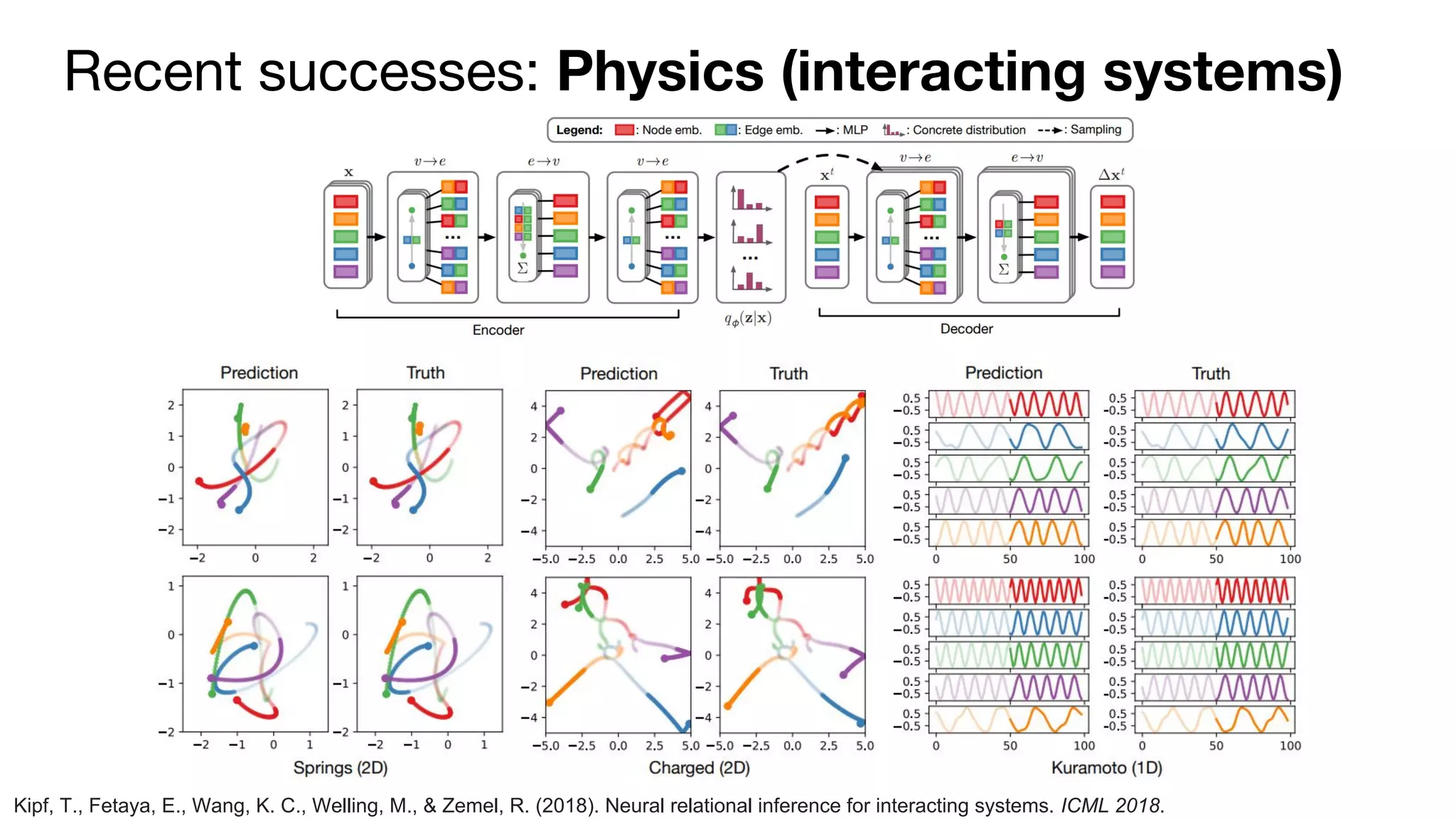
Recent successes: Physics (interacting systems)
Kipf, T., Fetaya, E., Wang, K. C., Welling, M., & Zemel, R. (2018). Neural relational inference for interacting systems. ICML 2018.
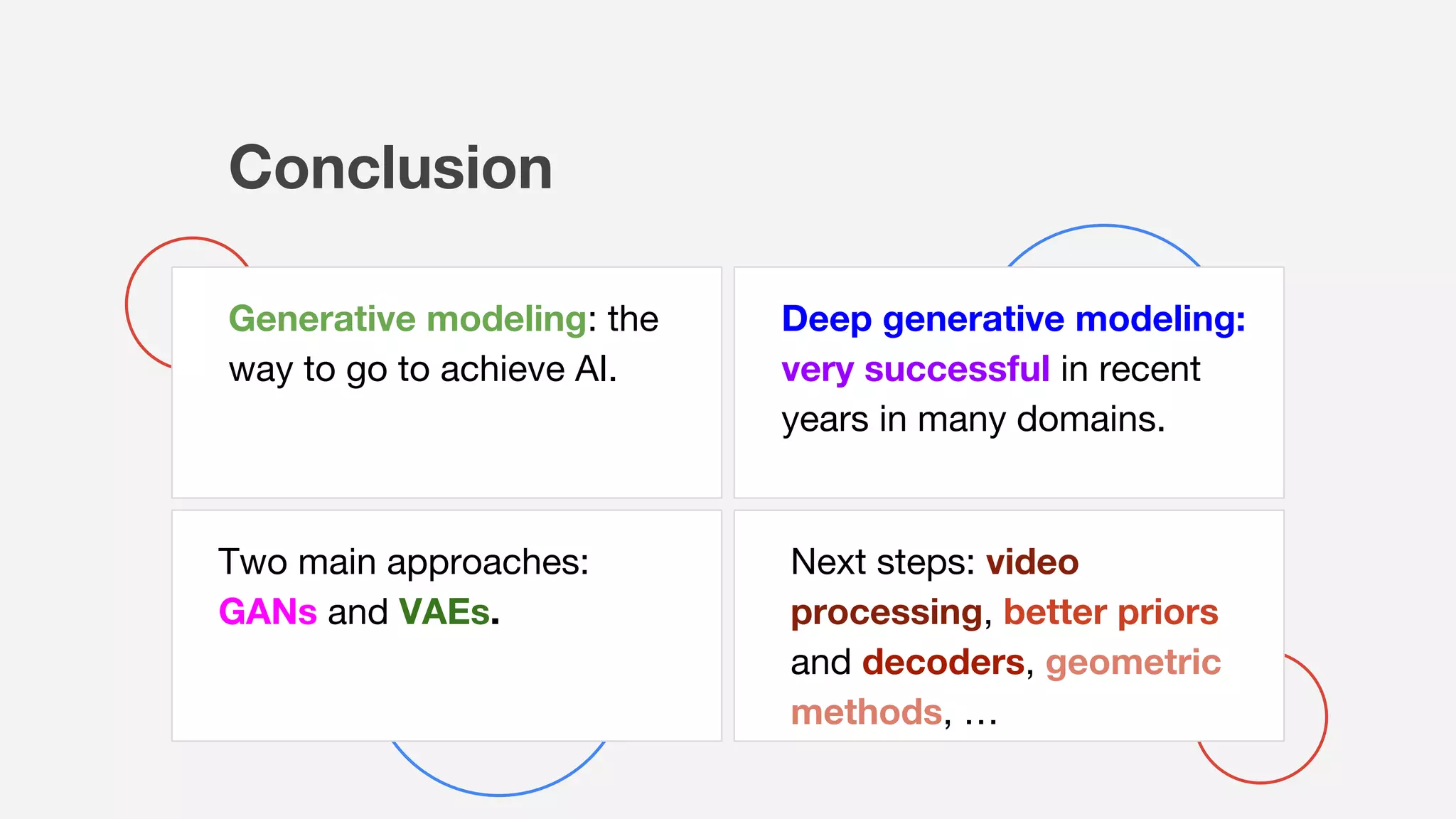
Conclusion
Generative modeling: the
way to go to achieve AI.
Deep generative modeling:
very successful in recent
years in many domains.
Two main approaches:
GANs and VAEs.
Next steps: video
processing, better priors
and decoders, geometric
methods, …
Conclusion
Generative modeling: the
way to go to achieve AI.
Deep generative modeling:
very successful in recent
years in many domains.
Two main approaches:
GANs and VAEs.
Next steps: video
processing, better priors
and decoders, geometric
methods, …
Conclusion
Generative modeling: the
way to go to achieve AI.
Deep generative modeling:
very successful in recent
years in many domains.
Two main approaches:
GANs and VAEs.
Next steps: video
processing, better priors
and decoders, geometric
methods, …
Conclusion
Generative modeling: the
way to go to achieve AI.
Deep generative modeling:
very successful in recent
years in many domains.
Two main approaches:
GANs and VAEs.
Next steps: video
processing, better priors
and decoders, geometric
methods, …
Conclusion
Generative modeling: the
way to go to achieve AI.
Deep generative modeling:
very successful in recent
years in many domains.
Two main approaches:
GANs and VAEs.
Next steps: video
processing, better priors
and decoders, geometric
methods, …
Code on github:
https://github.com/jmtomczak
Webpage:
http://jmtomczak.github.io/
Contact:
jakubmkt@gmail.com The research conducted by Jakub M.
Tomczak was funded by the
European Commission within the
Marie Skłodowska-Curie Individual
Fellowship (Grant No. 702666, ”Deep
learning and Bayesian inference for
medical imaging”).

The Success of Deep Generative Models

  • 1.
    The Success of DeepGenerative Models Jakub Tomczak AMLAB, University of Amsterdam PASC, 2018
  • 2.
    What is AIabout?
  • 3.
    What is AIabout? Decision making:
  • 4.
    What is AIabout? Decision making: High probability of the red label. = Highly probable decision! new data
  • 5.
    What is AIabout? Decision making: Understanding: High probability of the red label. = Highly probable decision! new data
  • 6.
    What is AIabout? Decision making: Understanding: new data High probability of the red label. = Highly probable decision! High probability of the red label. x Low probability of the object = Uncertain decision!
  • 7.
    What is generativemodeling about? Understanding: finding underlying factors (discovery) predicting and anticipating future events (planning) finding analogies (transfer learning) detecting rare events (anomaly detection) decision making
  • 8.
    Why generative modeling? Why? Lesslabeled data Compression Uncertainty Hidden structure Data simulation Exploration
  • 9.
    Generative modeling: How? How? Fully-observed (e.g.,PixelCNN) Implicit models (e.g., GANs) Prescribed models (e.g., VAE) Latent variable models
  • 10.
    Generative modeling: Auto-regressivemodels General idea is to factorise the joint distribution: and use neural networks (e.g., convolutional NN) to model it efficiently: Van Den Oord, A., et al. (2016). Wavenet: A generative model for raw audio. arXiv preprint arXiv:1609.03499.
  • 11.
    Generative modeling: LatentVariable Models We assume data lies on a low-dimensional manifold so the generator is: where: Two main approaches: → Generative Adversarial Networks (GANs) → Variational Auto-Encoders (VAEs)
  • 12.
    Generative modeling: GANs Weassume a deterministic generator: and a prior over latent space:
  • 13.
    Generative modeling: GANs Weassume a deterministic generator: and a prior over latent space: How to train it?
  • 14.
    Generative modeling: GANs Weassume a deterministic generator: and a prior over latent space: How to train it? By using a game!
  • 15.
    Generative modeling: GANs Weassume a deterministic generator: and a prior over latent space: How to train it? By using a game! For this purpose, we assume a discriminator:
  • 16.
    Generative modeling: GANs Thelearning process is as follows: → the generator tries to fool the discriminator; → the discriminator tries to distinguish between the real and fake images. We define the learning problem as a min-max problem: In fact, we have a learnable loss function! Goodfellow, I., et al. (2014). Generative adversarial nets. NIPS 2014
  • 17.
    Generative modeling: GANs Thelearning process is as follows: → the generator tries to fool the discriminator; → the discriminator tries to distinguish between the real and fake images. We define the learning problem as a min-max problem: In fact, we have a learnable loss function! Goodfellow, I., et al. (2014). Generative adversarial nets. NIPS 2014 →It learns high-order statistics.
  • 18.
    Generative modeling: GANs Pros: →we don’t need to specify a likelihood function; → very flexible; → the loss function is trainable; → perfect for data simulation. Cons: → we don’t know the distribution; → training is highly unstable (min-max objective); → missing mode problem.
  • 19.
    Generative modeling: VAEs Weassume a stochastic generator (decoder) and a prior: Additionally, we use a variational posterior (encoder): How to train it? Using the log-likelihood function! Kingma, D. P., & Welling, M. (2013). Auto-encoding variational bayes. arXiv preprint arXiv:1312.6114. (ICLR 2014)
  • 20.
    Variational Auto-Encoder: Extensions Normalizingflows Volume-preserving flows non-Gaussian distributions Autoregressive Prior Objective Prior Stick-Breaking Prior VampPrior Importance Weighted AE Renyi Divergence Stein Divergence Fully-connected ConvNets PixelCNN Other Tomczak, J. M., & Welling, M. (2016). Improving variational auto-encoders using householder flow. NIPS Workshop 2016. Berg, R. V. D., Hasenclever, L., Tomczak, J. M., & Welling, M. (2018). Sylvester Normalizing Flows for Variational Inference. UAI 2018. Tomczak, J. M., & Welling, M. (2017). VAE with a VampPrior. arXiv preprint arXiv:1705.07120. (AISTATS 2018) Davidson, T. R., Falorsi, L., De Cao, N., Kipf, T., & Tomczak, J. M. (2018). Hyperspherical Variational Auto-Encoders. UAI 2018.
  • 21.
    Generative modeling: VAEs Pros: →we know the distribution and can calculate the likelihood function; → we can encode an object in a low-dim manifold (compression); → training is stable; → no missing modes. Cons: → we need know the distribution; → we need a flexible encoder and prior; → blurry images (so far…).
  • 22.
    Recent successes: Imagegeneration generated real Karras, T., Aila, T., Laine, S., & Lehtinen, J. (2017). Progressive growing of gans for improved quality, stability, and variation. ICLR 2017.
  • 23.
    Recent successes: Reinforcementlearning Ha, D., & Schmidhuber, J. (2018). World models. arXiv preprint. arXiv preprint arXiv:1803.10122.
  • 24.
    Recent successes: Audiogeneration van den Oord, A., & Vinyals, O. (2017). Neural discrete representation learning. NIPS 2017. reconstruction generation
  • 25.
    Recent successes: Drugdiscovery Gómez-Bombarelli, R., et al. (2018). Automatic Chemical Design Using a Data-Driven Continuous Representation of Molecules ACS Cent. Kusner, M. J., Paige, B., & Hernández-Lobato, J. M. (2017). Grammar variational autoencoder. arXiv preprint arXiv:1703.01925.
  • 26.
    Recent successes: Styletransfer Zhu, J. Y., Park, T., Isola, P., & Efros, A. A. (2017). Unpaired image-to-image translation using cycle-consistent adversarial networks. CVPR 2017.
  • 27.
    Recent successes: Textgeneration Yang, Z., Hu, Z., Salakhutdinov, R., & Berg-Kirkpatrick, T. (2017). Improved variational autoencoders for text modeling using dilated convolutions. ICML 2017
  • 28.
    Recent successes: Physics(interacting systems) Kipf, T., Fetaya, E., Wang, K. C., Welling, M., & Zemel, R. (2018). Neural relational inference for interacting systems. ICML 2018.
  • 29.
    Conclusion Generative modeling: the wayto go to achieve AI. Deep generative modeling: very successful in recent years in many domains. Two main approaches: GANs and VAEs. Next steps: video processing, better priors and decoders, geometric methods, …
  • 30.
    Conclusion Generative modeling: the wayto go to achieve AI. Deep generative modeling: very successful in recent years in many domains. Two main approaches: GANs and VAEs. Next steps: video processing, better priors and decoders, geometric methods, …
  • 31.
    Conclusion Generative modeling: the wayto go to achieve AI. Deep generative modeling: very successful in recent years in many domains. Two main approaches: GANs and VAEs. Next steps: video processing, better priors and decoders, geometric methods, …
  • 32.
    Conclusion Generative modeling: the wayto go to achieve AI. Deep generative modeling: very successful in recent years in many domains. Two main approaches: GANs and VAEs. Next steps: video processing, better priors and decoders, geometric methods, …
  • 33.
    Conclusion Generative modeling: the wayto go to achieve AI. Deep generative modeling: very successful in recent years in many domains. Two main approaches: GANs and VAEs. Next steps: video processing, better priors and decoders, geometric methods, …
  • 34.
    Code on github: https://github.com/jmtomczak Webpage: http://jmtomczak.github.io/ Contact: jakubmkt@gmail.comThe research conducted by Jakub M. Tomczak was funded by the European Commission within the Marie Skłodowska-Curie Individual Fellowship (Grant No. 702666, ”Deep learning and Bayesian inference for medical imaging”).