DEVELOPMENTAL TASK
-SANTROCK,2002
Created by: Gerard F. Tolero
PRE-NATAL PERIOD
 From conception to birth
 It involves tremendous development-
from single cell to an organism complete
with brain and behavioral capabilities.
INFANCY
 From birth to 18-24 months
 A time of extreme dependence on adults.
 Many physiological activities are just
beginning
Language
Symbolic thought
Sensorimotor coordination
Social learning
EARLY CHILDHOOD
 End of infancy to 5-6 years(grade 1)
 These are the preschool years.
 Young children learn to become more
self-sufficient and to care for
themselves, develop school readiness
skills and spend many hours in play with
peers.
MIDDLE AND LATE CHILDHOOD
 6-11 years of age(elementary school years)
 The fundamental skills of reading, writing and
arithmetic are mastered.
 The child is formally exposed to the larger world
and its culture.
 Achievement becomes a more central theme of
the of the child's world and self-control
increases.
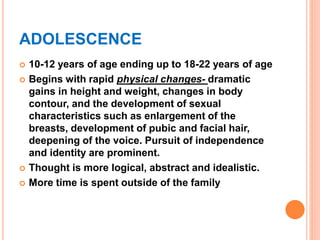
ADOLESCENCE
 10-12 years of age ending up to 18-22 years of age
 Begins with rapid physical changes- dramatic
gains in height and weight, changes in body
contour, and the development of sexual
characteristics such as enlargement of the
breasts, development of pubic and facial hair,
deepening of the voice. Pursuit of independence
and identity are prominent.
 Thought is more logical, abstract and idealistic.
 More time is spent outside of the family
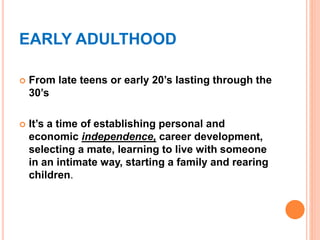
EARLY ADULTHOOD
 From late teens or early 20’s lasting through the
30’s
 It’s a time of establishing personal and
economic independence, career development,
selecting a mate, learning to live with someone
in an intimate way, starting a family and rearing
children.
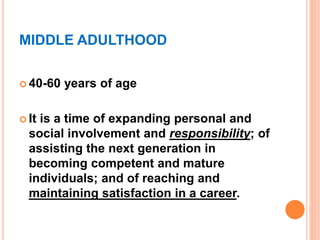
MIDDLE ADULTHOOD
 40-60 years of age
 It is a time of expanding personal and
social involvement and responsibility; of
assisting the next generation in
becoming competent and mature
individuals; and of reaching and
maintaining satisfaction in a career.
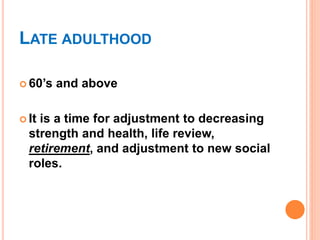
LATE ADULTHOOD
 60’s and above
 It is a time for adjustment to decreasing
strength and health, life review,
retirement, and adjustment to new social
roles.

Developmental task

  • 1.
  • 2.
    PRE-NATAL PERIOD  Fromconception to birth  It involves tremendous development- from single cell to an organism complete with brain and behavioral capabilities.
  • 3.
    INFANCY  From birthto 18-24 months  A time of extreme dependence on adults.  Many physiological activities are just beginning Language Symbolic thought Sensorimotor coordination Social learning
  • 4.
    EARLY CHILDHOOD  Endof infancy to 5-6 years(grade 1)  These are the preschool years.  Young children learn to become more self-sufficient and to care for themselves, develop school readiness skills and spend many hours in play with peers.
  • 5.
    MIDDLE AND LATECHILDHOOD  6-11 years of age(elementary school years)  The fundamental skills of reading, writing and arithmetic are mastered.  The child is formally exposed to the larger world and its culture.  Achievement becomes a more central theme of the of the child's world and self-control increases.
  • 6.
    ADOLESCENCE  10-12 yearsof age ending up to 18-22 years of age  Begins with rapid physical changes- dramatic gains in height and weight, changes in body contour, and the development of sexual characteristics such as enlargement of the breasts, development of pubic and facial hair, deepening of the voice. Pursuit of independence and identity are prominent.  Thought is more logical, abstract and idealistic.  More time is spent outside of the family
  • 7.
    EARLY ADULTHOOD  Fromlate teens or early 20’s lasting through the 30’s  It’s a time of establishing personal and economic independence, career development, selecting a mate, learning to live with someone in an intimate way, starting a family and rearing children.
  • 8.
    MIDDLE ADULTHOOD  40-60years of age  It is a time of expanding personal and social involvement and responsibility; of assisting the next generation in becoming competent and mature individuals; and of reaching and maintaining satisfaction in a career.
  • 9.
    LATE ADULTHOOD  60’sand above  It is a time for adjustment to decreasing strength and health, life review, retirement, and adjustment to new social roles.