The Simple Past Tense   Yesterday, I went for a swim. RVA
Affirmative : S + V- ed  + C   The past tense of regular verbs is formed by adding  – d   or  – ed   to the base form of the verb.   SIMPLE PAST TENSE:  REGULAR VERBS I work ed   hard last weekend.
SIMPLE PAST TENSE:  IRREGULAR VERBS Affirmative : Irregular past verb forms must be learned because they don’t follow any rule: go  went come  came buy  bought drink  drank eat  ate find  found see  saw   I  went  to Paris last July.
PAST SIMPLE TENSE: REGULAR and IRREGULAR VERBS Negative : We use  did not   or  didn’t   + a base form verb  to make the past simple tense negative.  I  didn’t   live  in a flat during my last Summer holidays. I  didn’t   go  to Berlin last July.
Interrogative : We use  did  + subject + a base form verb to make the past simple interrogative.  Did  you  play  sport last Summer? Did   you travel by boat last holidays? Yes, I  did . Did  you see any dolphins? No, I  didn’t . PAST SIMPLE TENSE: REGULAR and IRREGULAR VERBS
No,they didn't. Yes ,  they did. Did  they work? They  didn't  work. They work ed . Did  you  work? You   didn't  work. You  work ed . No,  we  didn't. Yes ,   we  did. Did   we  work? We   didn't  work. We  work ed . No, it didn't. Yes, it did. Did  it work? It  didn't  work. It work ed . No, she didn't. Yes, she did. Did  she   work? She  didn't  work. She work ed . No, he didn't. Yes, he did. Did  he work ? He  didn't  work. He work ed . No, I didn't. Yes, I did. Did  I work? I  didn't  work. I work ed . Short answer Short answer  Questions Regular verbs Negative Past simple tense:  Affirmative
TO BE It is the only verb whose form varies according to person and number: Affirmative :  I  was You  were   He / She / It  was   We / You / They  were I  was  in Madrid yesterday.
TO BE Negative :    I   wasn’t   You  weren’t   He / She / It   wasn’t   We / You / They   weren’t My parents   weren’t   in Madrid yesterday.
TO BE Interrogative :   Was  I …   ?   Were  you … ?   Was   he / she / it … ?   Were   we / you / they … ? Were   you in London last year? Yes, I   was . Was   Peter in London last year? No, he   wasn’t .
1.T o talk about actions that happened at a specific time in the past. You state when it happened using a  time adver b  ( yesterday,  last month ): “ Last year I fail ed  my exams” .   2.  It can be used to describe events that happened over a period of time in the past but not now : "I liv ed  in  Asia  for two years." 3. It  is also used to talk about habitual or repeated actions that took place in the past : " When I  was  a child we always  went  to the  beach  on   holidays." The Simple Past Tense   is used:
Time expressions : yesterday, last month, last year, last time,  …  ago. The Simple Past Tense   My friends travell ed  to Saudi Arabia two years ago.
SPELLING RULES FOR SIMPLE PAST TENSE OF REGULAR VERBS a.) If the verb ends in a consonant, we add – ed . return - return ed , help - help ed , cook - cook ed b.)   If the verb ends in – e , we add  – d . live - live d , create - create d , die - die d c.) In one-syllable verbs, if the verb ends in a consonant + vowel + consonant, we double the last consonant and we add - ed . hop - hopp ed , rub - rubb ed However, do  not  double one-syllable verbs ending in – w , - x , or – y . bow - bow ed , play - play ed , mix - mix ed
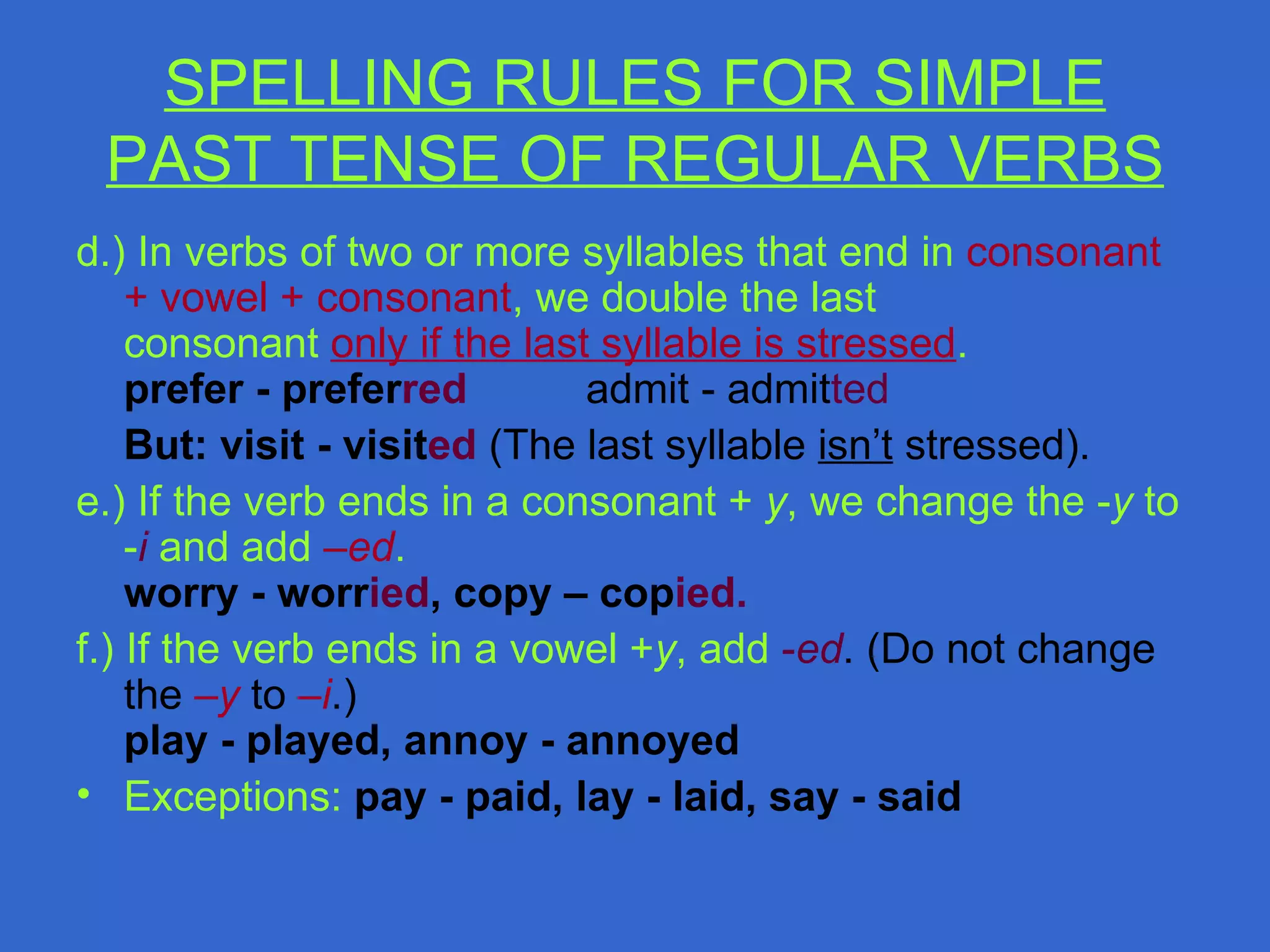
SPELLING RULES FOR SIMPLE PAST TENSE OF REGULAR VERBS d.)   In verbs of two or more syllables that end in  consonant + vowel + consonant , we double the last consonant  only if the last syllable is stressed . prefer - prefer red   admit - admit ted But: visit - visit ed  (The last syllable  isn’t  stressed). e.) If the verb ends in a consonant +  y , we change the - y  to - i   and add  – ed . worry - worr ied , copy – cop ied.  f.) If the verb ends in a vowel + y , add  - ed . (Do not change the  – y  to  – i .) play - played, annoy - annoyed  Exceptions:  pay - paid, lay - laid, say - said
USED TO Used to   is used to describe past habits, usually in contrast with the present.  A time expression is not necessary. I  used to get up  at six, but now I get up at eight. Used to  can also describe past states. I  used to own  a horse. (I owned a horse once.)
USED TO NEGATIVE: I didn’t use to go the beach when I was younger. (No solía ir a la playa cuando era joven) INTERROGATIVE: Did you use to live in Liverpool? (¿Solías vivir en Liverpool?)

The simple-past-tense

  • 1.
    The Simple PastTense Yesterday, I went for a swim. RVA
  • 2.
    Affirmative : S+ V- ed + C The past tense of regular verbs is formed by adding – d or – ed to the base form of the verb. SIMPLE PAST TENSE: REGULAR VERBS I work ed hard last weekend.
  • 3.
    SIMPLE PAST TENSE: IRREGULAR VERBS Affirmative : Irregular past verb forms must be learned because they don’t follow any rule: go went come came buy bought drink drank eat ate find found see saw I went to Paris last July.
  • 4.
    PAST SIMPLE TENSE:REGULAR and IRREGULAR VERBS Negative : We use did not or didn’t + a base form verb to make the past simple tense negative. I didn’t live in a flat during my last Summer holidays. I didn’t go to Berlin last July.
  • 5.
    Interrogative : Weuse did + subject + a base form verb to make the past simple interrogative. Did you play sport last Summer? Did you travel by boat last holidays? Yes, I did . Did you see any dolphins? No, I didn’t . PAST SIMPLE TENSE: REGULAR and IRREGULAR VERBS
  • 6.
    No,they didn't. Yes, they did. Did they work? They didn't work. They work ed . Did you work? You didn't work. You work ed . No, we didn't. Yes , we did. Did we work? We didn't work. We work ed . No, it didn't. Yes, it did. Did it work? It didn't work. It work ed . No, she didn't. Yes, she did. Did she work? She didn't work. She work ed . No, he didn't. Yes, he did. Did he work ? He didn't work. He work ed . No, I didn't. Yes, I did. Did I work? I didn't work. I work ed . Short answer Short answer Questions Regular verbs Negative Past simple tense: Affirmative
  • 7.
    TO BE Itis the only verb whose form varies according to person and number: Affirmative : I was You were He / She / It was We / You / They were I was in Madrid yesterday.
  • 8.
    TO BE Negative: I wasn’t You weren’t He / She / It wasn’t We / You / They weren’t My parents weren’t in Madrid yesterday.
  • 9.
    TO BE Interrogative: Was I … ? Were you … ? Was he / she / it … ? Were we / you / they … ? Were you in London last year? Yes, I was . Was Peter in London last year? No, he wasn’t .
  • 10.
    1.T o talkabout actions that happened at a specific time in the past. You state when it happened using a time adver b ( yesterday, last month ): “ Last year I fail ed my exams” . 2. It can be used to describe events that happened over a period of time in the past but not now : "I liv ed in Asia for two years." 3. It is also used to talk about habitual or repeated actions that took place in the past : " When I was a child we always went to the beach on holidays." The Simple Past Tense is used:
  • 11.
    Time expressions :yesterday, last month, last year, last time, … ago. The Simple Past Tense My friends travell ed to Saudi Arabia two years ago.
  • 12.
    SPELLING RULES FORSIMPLE PAST TENSE OF REGULAR VERBS a.) If the verb ends in a consonant, we add – ed . return - return ed , help - help ed , cook - cook ed b.) If the verb ends in – e , we add – d . live - live d , create - create d , die - die d c.) In one-syllable verbs, if the verb ends in a consonant + vowel + consonant, we double the last consonant and we add - ed . hop - hopp ed , rub - rubb ed However, do not double one-syllable verbs ending in – w , - x , or – y . bow - bow ed , play - play ed , mix - mix ed
  • 13.
    SPELLING RULES FORSIMPLE PAST TENSE OF REGULAR VERBS d.) In verbs of two or more syllables that end in consonant + vowel + consonant , we double the last consonant only if the last syllable is stressed . prefer - prefer red admit - admit ted But: visit - visit ed (The last syllable isn’t stressed). e.) If the verb ends in a consonant + y , we change the - y to - i and add – ed . worry - worr ied , copy – cop ied. f.) If the verb ends in a vowel + y , add - ed . (Do not change the – y to – i .) play - played, annoy - annoyed Exceptions: pay - paid, lay - laid, say - said
  • 14.
    USED TO Usedto is used to describe past habits, usually in contrast with the present. A time expression is not necessary. I used to get up at six, but now I get up at eight. Used to can also describe past states. I used to own a horse. (I owned a horse once.)
  • 15.
    USED TO NEGATIVE:I didn’t use to go the beach when I was younger. (No solía ir a la playa cuando era joven) INTERROGATIVE: Did you use to live in Liverpool? (¿Solías vivir en Liverpool?)