BigData & Wikidata - no lies
SPARQL queries on DBPedia
Camelia Boban
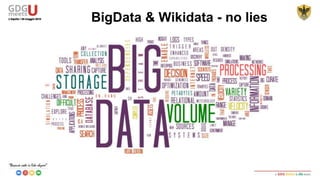
BigData & Wikidata - no lies
Resources for the codelab:
Eclipse Luna for J2EE developers - https://www.eclipse.org/downloads/index-developer.php
Java SE 1.8 - http://www.oracle.com/technetwork/java/javase/downloads/jre8-downloads-2133155.html
Apache Tomcat 8.0.5 - http://tomcat.apache.org/download-80.cgi
Axis2 1.6.2 - http://axis.apache.org/axis2/java/core/download.cgi
Apache Jena 2.11.1 - http://jena.apache.org/download/
Dbpedia Sparql endpoint: - dbpedia.org/sparql
BigData & Wikidata - no lies
JAR needed:
httpclient-4.2.3.jar httpcore-4.2.2.jar Jena-arq-2.11.1.jar
Jena-core-2.11.1.jar Jena-iri-1.0.1.jar jena-sdb-1.4.1.jar jena-tdb-1.0.1.jar
slf4j-api-1.6.4.jar slf4j-log4j12-1.6.4.jar
xercesImpl-2.11.0.jar xml-apis-1.4.01.jar
Attention!!
NO jcl-over-slf4j-1.6.4.jar (slf4j-log4j12-1.6.4 conflict, “Can’t override final class exception”)
NO httpcore-4.0.jar (made by Axis, httpcore-4.2.2.jar conflict, don’t let create the WS)
BigData & Wikidata - no lies
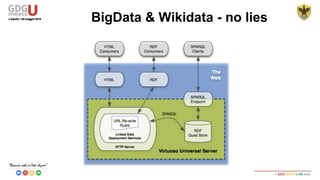
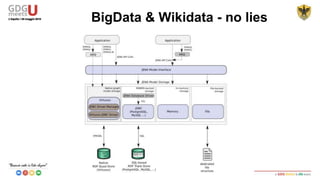
The Semantic Web
The Semantic Web is a project that intends to add computer-processable meaning
(semantics) to the Word Wide Web.
SPARQL
A a protocol and a query language SQL-like for querying RDF graphs via pattern
matching
VIRTUOSO
Both back-end database engine and the HTTP/SPARQL server.
BigData & Wikidata - no lies
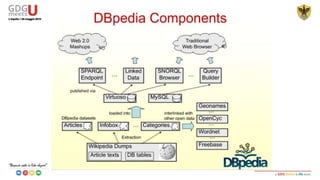
DBpedia.org
Is the Semantic Web mirror of Wikipedia.
RDF
Is a data model of graphs on subject, predicate, object triples.
APACHE JENA
A free and open source Java framework for building Semantic Web and Linked
Data applications.
ARQ - A SPARQL Processor for Jena for querying Remote SPARQL Services
BigData & Wikidata - no lies
DBpedia.org extracts from Wikipedia editions in 119 languages, convert it into RDF
and make this information available on the Web:
★ 24.9 million things (16.8 million from the English Dbpedia);
★ labels and abstracts for 12.6 million unique things;
★ 24.6 million links to images and 27.6 million links to external web pages;
★ 45.0 million external links into other RDF datasets, 67.0 million links to
Wikipedia categories, and 41.2 million YAGO categories.
BigData & Wikidata - no lies
The dataset consists of 2.46 billion RDF triples (470 million were extracted from
the English edition of Wikipedia), 1.98 billion from other language editions, and 45
million are links to external datasets.
DBpedia uses the Resource Description Framework (RDF) as a flexible data
model for representing extracted information and for publishing it on the Web. We
use the SPARQL query language to query this data.
BigData & Wikidata - no lies
What is a Triple?
A Triple is the minimal amount of information expressable in Semantic Web. It is
composed of 3 elements:
1. A subject which is a URI (e.g., a "web address") that represents something.
2. A predicate which is another URI that represents a certain property of the
subject.
3. An object which can be a URI or a literal (a string) that is related to the
subject through the predicate.
BigData & Wikidata - no lies
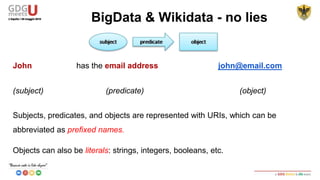
John has the email address john@email.com
(subject) (predicate) (object)
Subjects, predicates, and objects are represented with URIs, which can be
abbreviated as prefixed names.
Objects can also be literals: strings, integers, booleans, etc.
BigData & Wikidata - no lies
Why SPARQL?
SPARQL is a quey language of the Semantic Web that lets us:
1. Extract values from structured and semi-strutured data
2. Explore data by querying unknown relatioships
3. Perform complex join query of various dataset in a unique query
4. Trasform data from a vocabulary in another
BigData & Wikidata - no lies
Structure of a SPARQL query:
● Prefix declarations, for abbreviating URIs ( PREFIX dbpowl:
<http://dbpedia.org/ontology/Mountain> = dbpowl:Mountain)
● Dataset definition, stating what RDF graph(s) are being queried (DBPedia,
Darwin Core Terms, Yago, FOAF - Friend of a Friend)
● A result clause, identifying what information to return from the query The
query pattern, specifying what to query for in the underlying dataset (Select)
● Query modifiers, slicing, ordering, and otherwise rearranging query results -
ORDER BY, GROUP BY
BigData & Wikidata - no lies
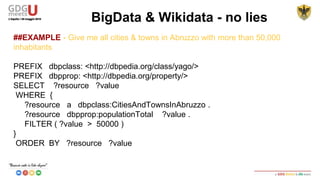
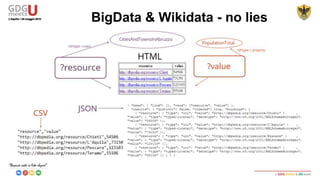
##EXAMPLE - Give me all cities & towns in Abruzzo with more than 50,000
inhabitants
PREFIX dbpclass: <http://dbpedia.org/class/yago/>
PREFIX dbpprop: <http://dbpedia.org/property/>
SELECT ?resource ?value
WHERE {
?resource a dbpclass:CitiesAndTownsInAbruzzo .
?resource dbpprop:populationTotal ?value .
FILTER ( ?value > 50000 )
}
ORDER BY ?resource ?value
BigData & Wikidata - no lies
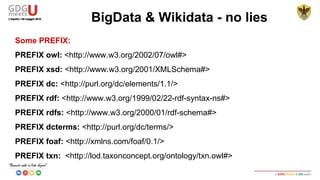
Some PREFIX:
PREFIX owl: <http://www.w3.org/2002/07/owl#>
PREFIX xsd: <http://www.w3.org/2001/XMLSchema#>
PREFIX dc: <http://purl.org/dc/elements/1.1/>
PREFIX rdf: <http://www.w3.org/1999/02/22-rdf-syntax-ns#>
PREFIX rdfs: <http://www.w3.org/2000/01/rdf-schema#>
PREFIX dcterms: <http://purl.org/dc/terms/>
PREFIX foaf: <http://xmlns.com/foaf/0.1/>
PREFIX txn: <http://lod.taxonconcept.org/ontology/txn.owl#>
BigData & Wikidata - no lies
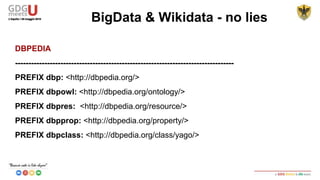
DBPEDIA
----------------------------------------------------------------------------------
PREFIX dbp: <http://dbpedia.org/>
PREFIX dbpowl: <http://dbpedia.org/ontology/>
PREFIX dbpres: <http://dbpedia.org/resource/>
PREFIX dbpprop: <http://dbpedia.org/property/>
PREFIX dbpclass: <http://dbpedia.org/class/yago/>
BigData & Wikidata - no lies
Wikipedia articles consist mostly of free text, but also contain different types of
structured information: infobox templates, categorisation information, images,
geo-coordinates, and links to external Web pages. DBpedia transforms into RDF
triples data that are entered in Wikipedia. So creating a page in Wikipedia creates
RDF in DBpedia.
BigData & Wikidata - no lies
Example:
https://en.wikipedia.org/wiki/Pulp_Fiction describes the movie. DBpedia creates a
URI: http://dbpedia.org/resource/wikipedia_page_name (where
wikipedia_page_name is the name of the regular Wikipedia html page) =
http://dbpedia.org/page/Pulp_Fiction. Underscore characters replace spaces.
DBpedia can be queried via a Web interface at ttp://dbpedia.org/sparql . The
interface uses the Virtuoso SPARQL Query Editor to query the DBpedia endpoint.
BigData & Wikidata - no lies
Public SPARQL Endpoint - use OpenLink Virtuoso
Wikipedia page: http://en.wikipedia.org/wiki/Pulp_Fiction
DBPedia resource: http://dbpedia.org/page/Pulp_Fiction
InfoBox: dbpedia-owl:abstract; dbpedia-owl:starring; dbpedia-owl:budget;
dbpprop:country; dbpprop:caption ecc.
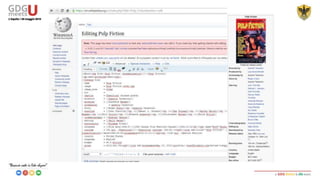
For instance, the figure below shows the source code and the visualisation of an
infobox template containing structured information about Pulp Fiction.
BigData & Wikidata - no lies
Big&Wikidata - no lies
PREFIX prop: <http://dbpedia.org/property/>
PREFIX res:<http://dbpedia.org/resource/>
PREFIX owl:<http://dbpedia.org/ontology/>
SELECT DISTINCT ?name ?abstract ?caption ?image ?budget ?director ?cast ?country ?category
WHERE {
res:Pulp_Fiction prop:name ?name ;
owl:abstract ?abstract ;
prop:caption ?caption;
owl:thumbnail ?image;
owl:budget ?budget ;
owl:director ?director ;
owl:starring ?cast ;
prop:country ?country ;
dcterms:subject ?category .
FILTER langMatches( lang(?abstract), 'en').
}
Big&Wikidata - no lies
...
Linked Data is a method of publishing RDF data on the Web and of interlinking
data between different data sources.
Query builder:
➢ http://dbpedia.org/snorql/
➢ http://querybuilder.dbpedia.org/
➢ http://dbpedia.org/isparql/
➢ http://dbpedia.org/fct/
➢ http://it.dbpedia.org/sparql
Prefix variables start with "?"
BigData & Wikidata - no lies
The current RDF vocabularies are available at the following locations:
➔ W3: http://www.w3.org/TR/vcard-rdf/ vCard Ontology - for describing People
and Organizations
http://www.w3.org/2003/01/geo/ Geo Ontology - for spatially-located things
http://www.w3.org/2004/02/geo/ SKOS Simple Knowledge Organization
System
BigData & Wikidata - no lies
➔ GEO NAMES: http://www.geonames.org/ geospatial semantic information
(postal code)
➔ DUBLIN CORE: http://www.dublincore.org/ defines general metadata
attributes used in a particular application
➔ FOAF: http://www.foaf-project.org/ Friend of a Friend, vocabulary for
describing people
➔ UNIPROT: http://www.uniprot.org/core/, http://beta.sparql.uniprot.org/uniprot
for science articles
BigData & Wikidata - no lies
➔ MUSIC ONTOLOGY: http://musicontology.com/, provides terms for
describing artists, albums and tracks.
➔ REVIEW VOCABULARY: http://purl.org/stuff/rev , vocabulary for
representing reviews.
➔ CREATIVE COMMONS (CC): http://creativecommons.org/ns , vocabulary for
describing license terms.
➔ OPEN UNIVERSITY: http://data.open.ac.uk/
BigData & Wikidata - no lies
➔ Semantically-Interlinked Online Communities (SIOC): www.sioc-
project.org/, vocabulary for representing online communities
➔ Description of a Project (DOAP): http://usefulinc.com/doap/, vocabulary for
describing projects
➔ Simple Knowledge Organization System (SKOS):
http://www.w3.org/2004/02/skos/, vocabulary for representing taxonomies and
loosely structured knowledge
BigData & Wikidata - no lies
SPARQL queries have two parts (FROM is not indispensable):
1. The query (WHERE) part, which produces a list of variable bindings (although
some variables may be unbound).
2. The part which puts together the results. SELECT, ASK, CONSTRUCT, or
DESCRIBE.
Other keywords:
UNION, OPTIONAL (optional display if data exists), FILTER (conditions), ORDER
BY, GROUP BY
BigData & Wikidata - no lies
SELECT - is effectively what the query returns (a ResultSet)
ASK - just looks to see if there are any results
COSTRUCT - uses a template to make RDF from the results. For each result row
it binds the variables and adds the statements to the result model. If a template
triple contains an unbound variable it is skipped. Return a new RDF-Graph
DESCRIBE - unusual, since it takes each result node, finds triples associated with
it, and adds them to a result model. Return a new RDF-Graph
BigData & Wikidata - no lies
What linked data il good for? Don’t search a single thing, but explore a whole
set of related things together!
1) Revolutionize Wikipedia Search
2) Include DBpedia data in our own web page
3) Mobile and Geographic Applications
4) Document Classification, Annotation and Social Bookmarking
5) Multi-Domain Ontology
6) Nucleus for the Web of Data
BigData & Wikidata - no lies
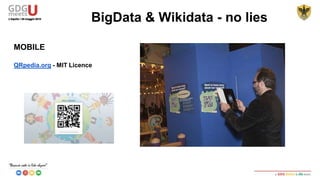
MOBILE
QRpedia.org - MIT Licence
BigData & Wikidata - no lies
WIKIPEDIA DUMPS
● Arabic Wikipedia dumps: http://dumps.wikimedia.org/arwiki/
● Dutch Wikipedia dumps: http://dumps.wikimedia.org/nlwiki/
● English Wikipedia dumps: http://dumps.wikimedia.org/enwiki/
● French Wikipedia dumps: http://dumps.wikimedia.org/frwiki/
● German Wikipedia dumps: http://dumps.wikimedia.org/dewiki/
● Italian Wikipedia dumps: http://dumps.wikimedia.org/itwiki/
● Persian Wikipedia dumps: http://dumps.wikimedia.org/fawiki/
● Polish Wikipedia dumps: http://dumps.wikimedia.org/plwiki/
BigData & Wikidata - no lies
WIKIPEDIA DUMPS
● Portuguese Wikipedia dumps: http://dumps.wikimedia.org/ptwiki/
● Russian Wikipedia dumps: http://dumps.wikimedia.org/ruwiki/
● Serbian Wikipedia dumps: http://dumps.wikimedia.org/srwiki/
● Spanish Wikipedia dumps: http://dumps.wikimedia.org/eswiki/
● Swedish Wikipedia dumps: http://dumps.wikimedia.org/svwiki/
● Ukrainian Wikipedia dumps: http://dumps.wikimedia.org/ukwiki/
● Vietnamese Wikipedia dumps: http://dumps.wikimedia.org/viwiki/
BigData & Wikidata - no lies
LINK
Codelab’s project code: http://github.com/GDG-L-Ab/SparqlOpendataWS
http://dbpedia.org/sparql & http://it.dbpedia.org/sparql
http://wiki.dbpedia.org/Datasets
http://en.wikipedia.org/ & http://it.wikipedia.org/
http://dbpedia.org/snorql, http://data.semanticweb.org/snorql/ SPARQL Explorer
http://downloads.dbpedia.org/3.9/ & http://wiki.dbpedia.org/Downloads39
BigData & Wikidata - no lies
Projects that use linked data:
JAVA: Open Learn Linked data: free access to Open University course materials
PHP: Semantic MediaWiki -Lllets you store and query data within the wiki's pages.
PEARL: WikSAR
PYTHON: Braindump - semantic search in Wikipedia
RUBY: SemperWiki
BigData & Wikidata - no lies
THANK YOU! :-)
I AM
CAMELIA BOBAN
G+ : https://plus.google.com/u/0/+cameliaboban
Twitter : http://twitter.com/GDGRomaLAb
LinkedIn: it.linkedin.com/pub/camelia-boban/22/191/313/
Blog: http://blog.aissatechnologies.com/
Skype: camelia.boban
camelia.boban@gmail.com

GDG Meets U event - Big data & Wikidata - no lies codelab

  • 1.
    BigData & Wikidata- no lies SPARQL queries on DBPedia Camelia Boban
  • 2.
  • 3.
    Resources for thecodelab: Eclipse Luna for J2EE developers - https://www.eclipse.org/downloads/index-developer.php Java SE 1.8 - http://www.oracle.com/technetwork/java/javase/downloads/jre8-downloads-2133155.html Apache Tomcat 8.0.5 - http://tomcat.apache.org/download-80.cgi Axis2 1.6.2 - http://axis.apache.org/axis2/java/core/download.cgi Apache Jena 2.11.1 - http://jena.apache.org/download/ Dbpedia Sparql endpoint: - dbpedia.org/sparql BigData & Wikidata - no lies
  • 4.
    JAR needed: httpclient-4.2.3.jar httpcore-4.2.2.jarJena-arq-2.11.1.jar Jena-core-2.11.1.jar Jena-iri-1.0.1.jar jena-sdb-1.4.1.jar jena-tdb-1.0.1.jar slf4j-api-1.6.4.jar slf4j-log4j12-1.6.4.jar xercesImpl-2.11.0.jar xml-apis-1.4.01.jar Attention!! NO jcl-over-slf4j-1.6.4.jar (slf4j-log4j12-1.6.4 conflict, “Can’t override final class exception”) NO httpcore-4.0.jar (made by Axis, httpcore-4.2.2.jar conflict, don’t let create the WS) BigData & Wikidata - no lies
  • 5.
    The Semantic Web TheSemantic Web is a project that intends to add computer-processable meaning (semantics) to the Word Wide Web. SPARQL A a protocol and a query language SQL-like for querying RDF graphs via pattern matching VIRTUOSO Both back-end database engine and the HTTP/SPARQL server. BigData & Wikidata - no lies
  • 6.
  • 7.
    DBpedia.org Is the SemanticWeb mirror of Wikipedia. RDF Is a data model of graphs on subject, predicate, object triples. APACHE JENA A free and open source Java framework for building Semantic Web and Linked Data applications. ARQ - A SPARQL Processor for Jena for querying Remote SPARQL Services BigData & Wikidata - no lies
  • 8.
  • 9.
    DBpedia.org extracts fromWikipedia editions in 119 languages, convert it into RDF and make this information available on the Web: ★ 24.9 million things (16.8 million from the English Dbpedia); ★ labels and abstracts for 12.6 million unique things; ★ 24.6 million links to images and 27.6 million links to external web pages; ★ 45.0 million external links into other RDF datasets, 67.0 million links to Wikipedia categories, and 41.2 million YAGO categories. BigData & Wikidata - no lies
  • 10.
    The dataset consistsof 2.46 billion RDF triples (470 million were extracted from the English edition of Wikipedia), 1.98 billion from other language editions, and 45 million are links to external datasets. DBpedia uses the Resource Description Framework (RDF) as a flexible data model for representing extracted information and for publishing it on the Web. We use the SPARQL query language to query this data. BigData & Wikidata - no lies
  • 11.
  • 12.
    What is aTriple? A Triple is the minimal amount of information expressable in Semantic Web. It is composed of 3 elements: 1. A subject which is a URI (e.g., a "web address") that represents something. 2. A predicate which is another URI that represents a certain property of the subject. 3. An object which can be a URI or a literal (a string) that is related to the subject through the predicate. BigData & Wikidata - no lies
  • 13.
    John has theemail address john@email.com (subject) (predicate) (object) Subjects, predicates, and objects are represented with URIs, which can be abbreviated as prefixed names. Objects can also be literals: strings, integers, booleans, etc. BigData & Wikidata - no lies
  • 14.
    Why SPARQL? SPARQL isa quey language of the Semantic Web that lets us: 1. Extract values from structured and semi-strutured data 2. Explore data by querying unknown relatioships 3. Perform complex join query of various dataset in a unique query 4. Trasform data from a vocabulary in another BigData & Wikidata - no lies
  • 15.
    Structure of aSPARQL query: ● Prefix declarations, for abbreviating URIs ( PREFIX dbpowl: <http://dbpedia.org/ontology/Mountain> = dbpowl:Mountain) ● Dataset definition, stating what RDF graph(s) are being queried (DBPedia, Darwin Core Terms, Yago, FOAF - Friend of a Friend) ● A result clause, identifying what information to return from the query The query pattern, specifying what to query for in the underlying dataset (Select) ● Query modifiers, slicing, ordering, and otherwise rearranging query results - ORDER BY, GROUP BY BigData & Wikidata - no lies
  • 16.
  • 17.
    ##EXAMPLE - Giveme all cities & towns in Abruzzo with more than 50,000 inhabitants PREFIX dbpclass: <http://dbpedia.org/class/yago/> PREFIX dbpprop: <http://dbpedia.org/property/> SELECT ?resource ?value WHERE { ?resource a dbpclass:CitiesAndTownsInAbruzzo . ?resource dbpprop:populationTotal ?value . FILTER ( ?value > 50000 ) } ORDER BY ?resource ?value BigData & Wikidata - no lies
  • 18.
  • 19.
    Some PREFIX: PREFIX owl:<http://www.w3.org/2002/07/owl#> PREFIX xsd: <http://www.w3.org/2001/XMLSchema#> PREFIX dc: <http://purl.org/dc/elements/1.1/> PREFIX rdf: <http://www.w3.org/1999/02/22-rdf-syntax-ns#> PREFIX rdfs: <http://www.w3.org/2000/01/rdf-schema#> PREFIX dcterms: <http://purl.org/dc/terms/> PREFIX foaf: <http://xmlns.com/foaf/0.1/> PREFIX txn: <http://lod.taxonconcept.org/ontology/txn.owl#> BigData & Wikidata - no lies
  • 20.
    DBPEDIA ---------------------------------------------------------------------------------- PREFIX dbp: <http://dbpedia.org/> PREFIXdbpowl: <http://dbpedia.org/ontology/> PREFIX dbpres: <http://dbpedia.org/resource/> PREFIX dbpprop: <http://dbpedia.org/property/> PREFIX dbpclass: <http://dbpedia.org/class/yago/> BigData & Wikidata - no lies
  • 21.
    Wikipedia articles consistmostly of free text, but also contain different types of structured information: infobox templates, categorisation information, images, geo-coordinates, and links to external Web pages. DBpedia transforms into RDF triples data that are entered in Wikipedia. So creating a page in Wikipedia creates RDF in DBpedia. BigData & Wikidata - no lies
  • 22.
  • 23.
    Example: https://en.wikipedia.org/wiki/Pulp_Fiction describes themovie. DBpedia creates a URI: http://dbpedia.org/resource/wikipedia_page_name (where wikipedia_page_name is the name of the regular Wikipedia html page) = http://dbpedia.org/page/Pulp_Fiction. Underscore characters replace spaces. DBpedia can be queried via a Web interface at ttp://dbpedia.org/sparql . The interface uses the Virtuoso SPARQL Query Editor to query the DBpedia endpoint. BigData & Wikidata - no lies
  • 24.
    Public SPARQL Endpoint- use OpenLink Virtuoso Wikipedia page: http://en.wikipedia.org/wiki/Pulp_Fiction DBPedia resource: http://dbpedia.org/page/Pulp_Fiction InfoBox: dbpedia-owl:abstract; dbpedia-owl:starring; dbpedia-owl:budget; dbpprop:country; dbpprop:caption ecc. For instance, the figure below shows the source code and the visualisation of an infobox template containing structured information about Pulp Fiction. BigData & Wikidata - no lies
  • 25.
  • 26.
    Big&Wikidata - nolies PREFIX prop: <http://dbpedia.org/property/> PREFIX res:<http://dbpedia.org/resource/> PREFIX owl:<http://dbpedia.org/ontology/> SELECT DISTINCT ?name ?abstract ?caption ?image ?budget ?director ?cast ?country ?category WHERE { res:Pulp_Fiction prop:name ?name ; owl:abstract ?abstract ; prop:caption ?caption; owl:thumbnail ?image; owl:budget ?budget ; owl:director ?director ; owl:starring ?cast ; prop:country ?country ; dcterms:subject ?category . FILTER langMatches( lang(?abstract), 'en'). }
  • 27.
  • 28.
    Linked Data isa method of publishing RDF data on the Web and of interlinking data between different data sources. Query builder: ➢ http://dbpedia.org/snorql/ ➢ http://querybuilder.dbpedia.org/ ➢ http://dbpedia.org/isparql/ ➢ http://dbpedia.org/fct/ ➢ http://it.dbpedia.org/sparql Prefix variables start with "?" BigData & Wikidata - no lies
  • 29.
    The current RDFvocabularies are available at the following locations: ➔ W3: http://www.w3.org/TR/vcard-rdf/ vCard Ontology - for describing People and Organizations http://www.w3.org/2003/01/geo/ Geo Ontology - for spatially-located things http://www.w3.org/2004/02/geo/ SKOS Simple Knowledge Organization System BigData & Wikidata - no lies
  • 30.
    ➔ GEO NAMES:http://www.geonames.org/ geospatial semantic information (postal code) ➔ DUBLIN CORE: http://www.dublincore.org/ defines general metadata attributes used in a particular application ➔ FOAF: http://www.foaf-project.org/ Friend of a Friend, vocabulary for describing people ➔ UNIPROT: http://www.uniprot.org/core/, http://beta.sparql.uniprot.org/uniprot for science articles BigData & Wikidata - no lies
  • 31.
    ➔ MUSIC ONTOLOGY:http://musicontology.com/, provides terms for describing artists, albums and tracks. ➔ REVIEW VOCABULARY: http://purl.org/stuff/rev , vocabulary for representing reviews. ➔ CREATIVE COMMONS (CC): http://creativecommons.org/ns , vocabulary for describing license terms. ➔ OPEN UNIVERSITY: http://data.open.ac.uk/ BigData & Wikidata - no lies
  • 32.
    ➔ Semantically-Interlinked OnlineCommunities (SIOC): www.sioc- project.org/, vocabulary for representing online communities ➔ Description of a Project (DOAP): http://usefulinc.com/doap/, vocabulary for describing projects ➔ Simple Knowledge Organization System (SKOS): http://www.w3.org/2004/02/skos/, vocabulary for representing taxonomies and loosely structured knowledge BigData & Wikidata - no lies
  • 33.
  • 34.
    SPARQL queries havetwo parts (FROM is not indispensable): 1. The query (WHERE) part, which produces a list of variable bindings (although some variables may be unbound). 2. The part which puts together the results. SELECT, ASK, CONSTRUCT, or DESCRIBE. Other keywords: UNION, OPTIONAL (optional display if data exists), FILTER (conditions), ORDER BY, GROUP BY BigData & Wikidata - no lies
  • 35.
    SELECT - iseffectively what the query returns (a ResultSet) ASK - just looks to see if there are any results COSTRUCT - uses a template to make RDF from the results. For each result row it binds the variables and adds the statements to the result model. If a template triple contains an unbound variable it is skipped. Return a new RDF-Graph DESCRIBE - unusual, since it takes each result node, finds triples associated with it, and adds them to a result model. Return a new RDF-Graph BigData & Wikidata - no lies
  • 36.
    What linked datail good for? Don’t search a single thing, but explore a whole set of related things together! 1) Revolutionize Wikipedia Search 2) Include DBpedia data in our own web page 3) Mobile and Geographic Applications 4) Document Classification, Annotation and Social Bookmarking 5) Multi-Domain Ontology 6) Nucleus for the Web of Data BigData & Wikidata - no lies
  • 37.
  • 38.
    MOBILE QRpedia.org - MITLicence BigData & Wikidata - no lies
  • 39.
    WIKIPEDIA DUMPS ● ArabicWikipedia dumps: http://dumps.wikimedia.org/arwiki/ ● Dutch Wikipedia dumps: http://dumps.wikimedia.org/nlwiki/ ● English Wikipedia dumps: http://dumps.wikimedia.org/enwiki/ ● French Wikipedia dumps: http://dumps.wikimedia.org/frwiki/ ● German Wikipedia dumps: http://dumps.wikimedia.org/dewiki/ ● Italian Wikipedia dumps: http://dumps.wikimedia.org/itwiki/ ● Persian Wikipedia dumps: http://dumps.wikimedia.org/fawiki/ ● Polish Wikipedia dumps: http://dumps.wikimedia.org/plwiki/ BigData & Wikidata - no lies
  • 40.
    WIKIPEDIA DUMPS ● PortugueseWikipedia dumps: http://dumps.wikimedia.org/ptwiki/ ● Russian Wikipedia dumps: http://dumps.wikimedia.org/ruwiki/ ● Serbian Wikipedia dumps: http://dumps.wikimedia.org/srwiki/ ● Spanish Wikipedia dumps: http://dumps.wikimedia.org/eswiki/ ● Swedish Wikipedia dumps: http://dumps.wikimedia.org/svwiki/ ● Ukrainian Wikipedia dumps: http://dumps.wikimedia.org/ukwiki/ ● Vietnamese Wikipedia dumps: http://dumps.wikimedia.org/viwiki/ BigData & Wikidata - no lies
  • 41.
    LINK Codelab’s project code:http://github.com/GDG-L-Ab/SparqlOpendataWS http://dbpedia.org/sparql & http://it.dbpedia.org/sparql http://wiki.dbpedia.org/Datasets http://en.wikipedia.org/ & http://it.wikipedia.org/ http://dbpedia.org/snorql, http://data.semanticweb.org/snorql/ SPARQL Explorer http://downloads.dbpedia.org/3.9/ & http://wiki.dbpedia.org/Downloads39 BigData & Wikidata - no lies
  • 42.
    Projects that uselinked data: JAVA: Open Learn Linked data: free access to Open University course materials PHP: Semantic MediaWiki -Lllets you store and query data within the wiki's pages. PEARL: WikSAR PYTHON: Braindump - semantic search in Wikipedia RUBY: SemperWiki BigData & Wikidata - no lies
  • 43.
    BigData & Wikidata- no lies THANK YOU! :-) I AM CAMELIA BOBAN G+ : https://plus.google.com/u/0/+cameliaboban Twitter : http://twitter.com/GDGRomaLAb LinkedIn: it.linkedin.com/pub/camelia-boban/22/191/313/ Blog: http://blog.aissatechnologies.com/ Skype: camelia.boban camelia.boban@gmail.com