1
Franck Michel
A Generic Mapping-based Query Translation
from SPARQL to Various Target Database Query
Languages
A Generic Mapping-based Query Translation
from SPARQL to Various Target Database Query
Languages
F. Michel, C. Faron-Zucker, J. Montagnat
I3S laboratory, CNRS, Univ. Nice Sophia
2
Franck Michel
Publication/interlinking of open datasets
• In a common machine-readable format
• Using common vocabularies
Linking data increases its value
• Produce new knowledge
• Mash up with related data
• Opportunity for new (unexpected) usage
Citizenship demand for access to public data (scientific,
government…)
Towards a Web of Data
From a Web of Documents
...to a Web of (Linked) Data
3
Franck Michel
Driven/supported by various initiatives, e.g.:
• General-purpose: Linking Open Data, W3C Data Activity
• Domain-specific: Bio2RDF, BioPortal
• GAFAs: Facebook OG, Google KG, Yahoo!, Microsoft… consume
and produce RDF
Towards a Web of Data
Linked Open Data Cloud
Linked Datasets as of Aug. 30th 2014. (c) R. Cyganiak & and A. Jentzsch
4
Franck Michel
Web-scale data integration
Need to access data from the Deep Web
• Strd./unstrd. data
hardly indexed by search engines,
hardly linked with other data sources
Exponential data growth goes in
• Various types of DBs:
RDB, Native XML, LDAP directory,
OODB, NoSQL, NewSQL, ...
• Heterogeneous data models and
query capabilities
Whatever the type of DB… it can
be of interest for the Web of Data
… “Raw Data Now” (T. Berners Lee)
5
Franck Michel
Populate
the
Web of Data
with
Legacy Data
Populate
the
Web of Data
with
Legacy Data
6
Franck Michel
Focused on data formats
• HTML: RDFa, Microformats
• XML: Using XPath (RML), XQuery (XSPARQL, SPARQL2XQuery),
XSLT (Scissor-Lift, GRDDL), XSD-to-OWL (SPARQL2XQuery)
• CSV/TSV/Spreadsheets: CSV on the web (W3C WG)
• JSON: using JSONPath (RML), JSON-LD
Focused on types of database
• Extensive work on RDBs: D2RQ, Virtuoso, R2RML…
• XML native DBs: SPARQL2XQuery
• NoSQL stores: xR2RML
Integration frameworks: DataLift, RML, Asio Tool Suite…
Previous works
7
Franck Michel
Previous works
Query
rewriting
Legacy DB
Graph
Materialization
(ETL like)
Virtual Graph
Data freshness
Big datasets
DB-to-RDF
Mappings
8
Franck Michel
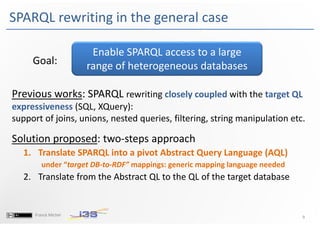
SPARQL rewriting in the general case
Previous works: SPARQL rewriting closely coupled with the target QL
expressiveness (SQL, XQuery):
support of joins, unions, nested queries, filtering, string manipulation etc.
Solution proposed: two-steps approach
1. Translate SPARQL into a pivot Abstract Query Language (AQL)
under “target DB-to-RDF” mappings: generic mapping language needed
2. Translate from the Abstract QL to the QL of the target database
Enable SPARQL access to a large
range of heterogeneous databasesGoal:
9
Franck Michel
SPARQL rewriting in the general case
Previous works: SPARQL rewriting closely coupled with the target QL
expressiveness (SQL, XQuery):
support of joins, unions, nested queries, filtering, string manipulation etc.
Solution proposed: two-steps approach
1. Translate SPARQL into a pivot Abstract Query Language (AQL)
under “target DB-to-RDF” mappings: generic mapping language needed
2. Translate from the Abstract QL to the QL of the target database
Enable SPARQL access to a large
range of heterogeneous databasesGoal:
10
Franck Michel
Agenda
The xR2RML mapping language
The SPARQL translation method
Application
Conclusions & perspectives
11
Franck Michel
Agenda
The xR2RML mapping language
The SPARQL translation method
Application
Conclusions & perspectives
12
Franck Michel
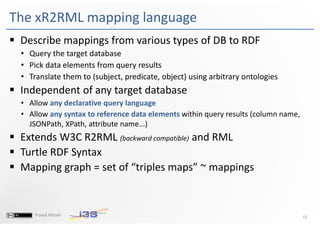
The xR2RML mapping language
Describe mappings from various types of DB to RDF
• Query the target database
• Pick data elements from query results
• Translate them to (subject, predicate, object) using arbitrary ontologies
Independent of any target database
• Allow any declarative query language
• Allow any syntax to reference data elements within query results (column name,
JSONPath, XPath, attribute name...)
Extends W3C R2RML (backward compatible) and RML
Turtle RDF Syntax
Mapping graph = set of “triples maps” ~ mappings
13
Franck Michel
The xR2RML mapping language: example
<http://example.org/member/106> foaf:mbox "john@foo.com".
<http://example.org/member/106> foaf:mbox "john@example.org".
<http://example.org/member/106> foaf:mbox "john@foo.com".
<http://example.org/member/106> foaf:mbox "john@example.org".
<#Mbox> a rr:TriplesMap;
xrr:logicalSource [ xrr:query "db.people.find({'emails':{$ne: null}})" ];
rr:subjectMap [ rr:template "http://example.org/member/{$.id}" ];
rr:predicateObjectMap [
rr:predicate foaf:mbox;
rr:objectMap [ xrr:reference "$.emails.*"; rr:termType rr:Literal ] ].
xR2RMLxR2RML
<#Mbox> a rr:TriplesMap;
xrr:logicalSource [ xrr:query "db.people.find({'emails':{$ne: null}})" ];
rr:subjectMap [ rr:template "http://example.org/member/{$.id}" ];
rr:predicateObjectMap [
rr:predicate foaf:mbox;
rr:objectMap [ xrr:reference "$.emails.*"; rr:termType rr:Literal ] ].
xR2RML
{ "id": 106, "firstname": "John",
"emails": ["john@foo.com", "john@example.org"],
"contacts": ["chris@example.org", "alice@foo.com"] }
14
Franck Michel
The xR2RML mapping language: example
<#Knows> a rr:TriplesMap;
xrr:logicalSource [ xrr:query "db.people.find({'contacts':{$size: {$gte:1}}})" ];
rr:subjectMap [ rr:template "http://example.org/member/{$.id}" ];
rr:predicateObjectMap [
rr:predicate foaf:knows;
rr:objectMap [
rr:parentTriplesMap <#Mbox>;
rr:joinCondition [ rr:child "$.contacts.*"; rr:parent "$.emails.*" ] ] ].
{ "id": 106, "firstname": "John",
"emails": ["john@foo.com", "john@example.org"],
"contacts": ["chris@example.org", "alice@foo.com"] }
<http://example.org/member/106> foaf:knows <http://example.org/member/327>.
<http://example.org/member/327> foaf:knows <http://example.org/member/106>.
<http://example.org/member/106> foaf:knows <http://example.org/member/327>.
<http://example.org/member/327> foaf:knows <http://example.org/member/106>.
xR2RML
{ "id": 327, "firstname": "Alice",
"emails": ["alice@foo.com"],
"contacts": ["john@foo.com"] }
15
Franck Michel
Agenda
The xR2RML mapping language
The SPARQL translation method
Application
Conclusions & perspectives
16
Franck Michel
Graph Pattern
SPARQL-to-AQL rewriting steps
1. Triple Pattern Bindings: figure out minimal set candidate mappings
for each triple pattern
2. Rewrite the SPARQL Graph Pattern into the AQL, under triple
pattern bindings, entail conditions
3. Optimization the resulting Abstract Query
Basic Graph Pattern
SELECT ?y, ?mbox WHERE {
?x foaf:mbox "john@foo.com".
?y foaf:knows ?x.
OPTIONAL { ?y foaf:mbox ?mbox. }
FILTER { ?x != ?y}
}
Triple Pattern
17
Franck Michel
(1) Triples patterns bindings
SELECT ?y, ?mbox WHERE {
?x foaf:mbox "john@foo.com".
?y foaf:knows ?x.
OPTIONAL { ?y foaf:mbox ?mbox. }
FILTER { ?x != ?y}
}
<#Mapping>
<#Mapping>
<#Mapping>
<#Mapping>
<#Mapping>
xR2RML mapping graph
?x
foaf:mbox
"john@foo.com".
<#Mbox> …
rr:subjectMap [ rr:template "…" ]
rr:predicateObjectMap [
rr:predicate foaf:mbox;
rr:objectMap [
xrr:reference "$.emails.*";
rr:termType rr:Literal ] ].
18
Franck Michel
(1) Triples patterns bindings
1. Initial set of mappings for each triple pattern
• Check compatibility: term type, datatype, lang
• Check unsatisfiable SPARQL filter constraints about a terms type, data type,
language: isIRI, isLiteral, isBlank, lang(), datatype()…
e.g. “rr:termType rr:Literal” does not match "isIRI(?var)"
2. Reduce bindings
• Consider join constraints implied by shared variables
SELECT ?x WHERE {
?y foaf:mbox "john@foo.com".//tp2
?x foaf:knows ?y. //tp3
}
Bindings:
(tp2, <#Mbox>)
(tp3, <#Knows>)
Shared variable ?y compatibility between
<#Mbox>’s subject map
and
<#Knows>’s object map
M. Rodríguez-Muro, M. Rezk. Efficient SPARQL-to-SQL with R2RML mappings, Web Semant. Sci. Serv. Agents World Wide Web. 33 (2015) 141–169.
J. Unbehauen, C. Stadler, S. Auer. Accessing relational data on the web with SparqlMap, in: Semantic Technol., Springer, 2013: pp. 65–80.
19
Franck Michel
(2) Rewrite each Triple Pattern
(tp1, <#Mbox>)
(tp2, <#Mbox>)
(tp3, <#Knows>)
Bindings
tp2 <#Mbox>
match
Atomic Abstract Query
{ From, Project, Where }
20
Franck Michel
(2) Rewrite each Triple Pattern
<#Mbox> …
rr:subjectMap [
rr:template "http://example.org/member/{$.id}" ];
rr:predicateObjectMap [
rr:predicate foaf:mbox;
rr:objectMap [ xrr:reference "$.emails.*";
rr:termType rr:Literal ]
]. xR2RMLxR2RML
<#Mbox> …
rr:subjectMap [
rr:template "http://example.org/member/{$.id}" ];
rr:predicateObjectMap [
rr:predicate foaf:mbox;
rr:objectMap [ xrr:reference "$.emails.*";
rr:termType rr:Literal ]
]. xR2RML
?x
foaf:mbox
"john@foo.com".
Condition 1: $.id != null
Condition 2: $.emails.* produces "john@foo.com"
21
Franck Michel
Usual SPARQL-to-SQL example:
FILTER encapsulating SELECT WHERE clause
Relies on the DB engine to optimize the query
In the general case, no assumption on the target DB:
Need to optimize at the earliest stage:
push “down” filter conditions in the translation of triple patterns
(2) Rewrite from SPARQL to the AQL
SELECT ?x WHERE {
?x foaf:age ?age.
…
FILTER (?age > 30)
}
SELECT t2.X FROM
( SELECT t1.ID AS X, t1.AGE AS AGE
FROM PERSON t1
…
) AS t2
WHERE (t2.AGE > 30)
22
Franck Michel
(2) Rewrite from SPARQL to the AQL
transm (P1 AND P2, f) transm (P1, f) INNER JOIN transm (P2, f) ON var(P1) ⋂ var(P2)
transm (P1 OPTIONAL P2, f) transm (P1, f) LEFT JOIN transm (P2, f) ON var(P1) ⋂ var(P2)
transm (P1 UNION P2, f) transm (P1, f) LEFT JOIN transm (P2, f) ON var(P1) ⋂ var(P2)
UNION
transm (P2, f) LEFT JOIN transm (P1, f) ON var(P1) ⋂ var(P2)
transm (tp, f) transTPm (tp, sparqlCond(tp, f))
transm (P FILTER f’, f) transm (P, f && f’) FILTER sparqlCond(P, f && f’)
transm (P) transm (P, true)
Rewrites a well-designed SPARQL graph pattern
into the AQL, under a set of xR2RML mappings m
Function transm (graph pattern, filter)
sparqlCond: Push filter conditions in the translation of relevant triple patterns
23
Franck Michel
(2) Rewrite from SPARQL to the AQL
Function sparqlCond():
Push down filter conditions in the translation of triples patterns
Make inner-queries as selective as possible
Limit the size of intermediary results
SELECT ?x WHERE {
?x foaf:mbox ?mbox. // tp1
?y foaf:mbox "john@foo.com". // tp2
?x foaf:knows ?y. // tp3
FILTER {
contains(str(?mbox),"foo.com") // c1
&& ?x != ?y // c2
}}
transTPm(tp1, c1)
INNER JOIN transTPm(tp2, true) ON {}
INNER JOIN transTPm(tp3, c2) ON {?x,?y}
FILTER c2
24
Franck Michel
Example
SELECT ?x WHERE {
?x foaf:mbox ?mbox. // tp1
?x foaf:mbox "john@foo.com". // tp2
FILTER {
?mbox != "john@foo.com" } // c1
}
{ From: { "db.people.find({'emails':{$ne:null}})" },
Project: { $.id AS ?x, $.emails.* AS ?mbox },
Where: { isNotNull($.id), isNotNull($.emails.*), sparqlFilter(?mbox != "john@foo.com")}}
INNER JOIN
{ From: { "db.people.find({'emails':{$ne: null}})" },
Project: { $.id AS ?x },
Where: { isNotNull($.id), equals($.emails.*, "john@foo.com")} }
ON { ?x } Abstract Query
25
Franck Michel
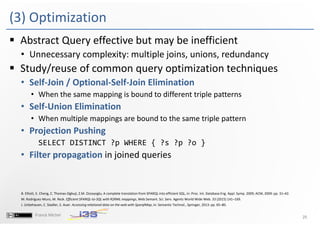
(3) Optimization
Abstract Query effective but may be inefficient
• Unnecessary complexity: multiple joins, unions, redundancy
Study/reuse of common query optimization techniques
• Self-Join / Optional-Self-Join Elimination
• When the same mapping is bound to different triple patterns
• Self-Union Elimination
• When multiple mappings are bound to the same triple pattern
• Projection Pushing
SELECT DISTINCT ?p WHERE { ?s ?p ?o }
• Filter propagation in joined queries
B. Elliott, E. Cheng, C. Thomas-Ogbuji, Z.M. Ozsoyoglu, A complete translation from SPARQL into efficient SQL, in: Proc. Int. Database Eng. Appl. Symp. 2009, ACM, 2009: pp. 31–42.
M. Rodríguez-Muro, M. Rezk. Efficient SPARQL-to-SQL with R2RML mappings, Web Semant. Sci. Serv. Agents World Wide Web. 33 (2015) 141–169.
J. Unbehauen, C. Stadler, S. Auer. Accessing relational data on the web with SparqlMap, in: Semantic Technol., Springer, 2013: pp. 65–80.
26
Franck Michel
Agenda
The xR2RML mapping language
The SPARQL translation method
Application
Conclusions & perspectives
27
Franck Michel
Application: SPARQL-to-MongoDB
Prototype implementation for MongoDB
• SPARQL-to-AQL implemented as a DB-independent component
Extendable to other target DBs
• AQL-to-MongoDB QL
Not straightforward due to MongoDB limitations:
– No join, no nested query, union hardly supported
– Limited comparison filters, JavaScript filters discouraged
Much work falls back on the query processing engine
Two concrete use cases
• SKOS representation of a taxonomical reference
• Biological studies on rice phenotype data
28
Franck Michel
Agenda
The xR2RML mapping language
The SPARQL translation method
Application
Conclusions & perspectives
29
Franck Michel
Conclusions & perspectives
Goal: foster the development of SPARQL interfaces to
heterogeneous databases
Formalized approach:
• Generalize existing works on SQL and XQuery
• Rely on a DB-independent mapping language: xR2RML
• Encompass all DB-independent steps of the rewriting process
• Leave only DB-specific rewriting as a last step
Prototype implementation for MongoDB
• Used in two real world contexts
Perspectives
• Perform benchmarking
• Use it with distributed SPARQL query engine
30
Franck Michel
Conclusions & perspectives
SW vs. NoSQL: two un-reconciliable worlds?
Different paradigms:
• SW manages highly connected graphs,
• NoSQL’s manage isolated documents, joins hardly supported
NoSQL DBs
• pragmatically gave up on consistency and rich query features
• trade-off to high throughput/availability, horizontal elasticity
Filling the gap between the two worlds is not straightforward
The experience of MongoDB shows challenges.
Huge potential source of LOD, can’t be ignored anymore
31
Franck Michel
Contacts:
Franck Michel
Catherine Faron-Zucker
Johan Montagnat
[1] F. Michel, L. Djimenou, C. Faron-Zucker, and J. Montagnat. Translation of Relational and Non-Relational
Databases into RDF with xR2RML. In proc. of WebIST 2015.
[2] C. Callou, F. Michel, C. Faron-Zucker, C. Martin, J. Montagnat. Towards a Shared Reference Thesaurus for
Studies on History of Zoology, Archaeozoology and Conservation Biology. In SW4SH workshop, ESWC’15.
[3] F. Michel, C. Faron-Zucker, and J. Montagnat. Mapping-based SPARQL access to a MongoDB database.
Technical report, CNRS, 2015. https://hal.archives-ouvertes.fr/hal-01245883v4.
https://github.com/frmichel/morph-xr2rml/

A Generic Mapping-based Query Translation from SPARQL to Various Target Database Query Languages

  • 1.
    1 Franck Michel A GenericMapping-based Query Translation from SPARQL to Various Target Database Query Languages A Generic Mapping-based Query Translation from SPARQL to Various Target Database Query Languages F. Michel, C. Faron-Zucker, J. Montagnat I3S laboratory, CNRS, Univ. Nice Sophia
  • 2.
    2 Franck Michel Publication/interlinking ofopen datasets • In a common machine-readable format • Using common vocabularies Linking data increases its value • Produce new knowledge • Mash up with related data • Opportunity for new (unexpected) usage Citizenship demand for access to public data (scientific, government…) Towards a Web of Data From a Web of Documents ...to a Web of (Linked) Data
  • 3.
    3 Franck Michel Driven/supported byvarious initiatives, e.g.: • General-purpose: Linking Open Data, W3C Data Activity • Domain-specific: Bio2RDF, BioPortal • GAFAs: Facebook OG, Google KG, Yahoo!, Microsoft… consume and produce RDF Towards a Web of Data Linked Open Data Cloud Linked Datasets as of Aug. 30th 2014. (c) R. Cyganiak & and A. Jentzsch
  • 4.
    4 Franck Michel Web-scale dataintegration Need to access data from the Deep Web • Strd./unstrd. data hardly indexed by search engines, hardly linked with other data sources Exponential data growth goes in • Various types of DBs: RDB, Native XML, LDAP directory, OODB, NoSQL, NewSQL, ... • Heterogeneous data models and query capabilities Whatever the type of DB… it can be of interest for the Web of Data … “Raw Data Now” (T. Berners Lee)
  • 5.
    5 Franck Michel Populate the Web ofData with Legacy Data Populate the Web of Data with Legacy Data
  • 6.
    6 Franck Michel Focused ondata formats • HTML: RDFa, Microformats • XML: Using XPath (RML), XQuery (XSPARQL, SPARQL2XQuery), XSLT (Scissor-Lift, GRDDL), XSD-to-OWL (SPARQL2XQuery) • CSV/TSV/Spreadsheets: CSV on the web (W3C WG) • JSON: using JSONPath (RML), JSON-LD Focused on types of database • Extensive work on RDBs: D2RQ, Virtuoso, R2RML… • XML native DBs: SPARQL2XQuery • NoSQL stores: xR2RML Integration frameworks: DataLift, RML, Asio Tool Suite… Previous works
  • 7.
    7 Franck Michel Previous works Query rewriting LegacyDB Graph Materialization (ETL like) Virtual Graph Data freshness Big datasets DB-to-RDF Mappings
  • 8.
    8 Franck Michel SPARQL rewritingin the general case Previous works: SPARQL rewriting closely coupled with the target QL expressiveness (SQL, XQuery): support of joins, unions, nested queries, filtering, string manipulation etc. Solution proposed: two-steps approach 1. Translate SPARQL into a pivot Abstract Query Language (AQL) under “target DB-to-RDF” mappings: generic mapping language needed 2. Translate from the Abstract QL to the QL of the target database Enable SPARQL access to a large range of heterogeneous databasesGoal:
  • 9.
    9 Franck Michel SPARQL rewritingin the general case Previous works: SPARQL rewriting closely coupled with the target QL expressiveness (SQL, XQuery): support of joins, unions, nested queries, filtering, string manipulation etc. Solution proposed: two-steps approach 1. Translate SPARQL into a pivot Abstract Query Language (AQL) under “target DB-to-RDF” mappings: generic mapping language needed 2. Translate from the Abstract QL to the QL of the target database Enable SPARQL access to a large range of heterogeneous databasesGoal:
  • 10.
    10 Franck Michel Agenda The xR2RMLmapping language The SPARQL translation method Application Conclusions & perspectives
  • 11.
    11 Franck Michel Agenda The xR2RMLmapping language The SPARQL translation method Application Conclusions & perspectives
  • 12.
    12 Franck Michel The xR2RMLmapping language Describe mappings from various types of DB to RDF • Query the target database • Pick data elements from query results • Translate them to (subject, predicate, object) using arbitrary ontologies Independent of any target database • Allow any declarative query language • Allow any syntax to reference data elements within query results (column name, JSONPath, XPath, attribute name...) Extends W3C R2RML (backward compatible) and RML Turtle RDF Syntax Mapping graph = set of “triples maps” ~ mappings
  • 13.
    13 Franck Michel The xR2RMLmapping language: example <http://example.org/member/106> foaf:mbox "john@foo.com". <http://example.org/member/106> foaf:mbox "john@example.org". <http://example.org/member/106> foaf:mbox "john@foo.com". <http://example.org/member/106> foaf:mbox "john@example.org". <#Mbox> a rr:TriplesMap; xrr:logicalSource [ xrr:query "db.people.find({'emails':{$ne: null}})" ]; rr:subjectMap [ rr:template "http://example.org/member/{$.id}" ]; rr:predicateObjectMap [ rr:predicate foaf:mbox; rr:objectMap [ xrr:reference "$.emails.*"; rr:termType rr:Literal ] ]. xR2RMLxR2RML <#Mbox> a rr:TriplesMap; xrr:logicalSource [ xrr:query "db.people.find({'emails':{$ne: null}})" ]; rr:subjectMap [ rr:template "http://example.org/member/{$.id}" ]; rr:predicateObjectMap [ rr:predicate foaf:mbox; rr:objectMap [ xrr:reference "$.emails.*"; rr:termType rr:Literal ] ]. xR2RML { "id": 106, "firstname": "John", "emails": ["john@foo.com", "john@example.org"], "contacts": ["chris@example.org", "alice@foo.com"] }
  • 14.
    14 Franck Michel The xR2RMLmapping language: example <#Knows> a rr:TriplesMap; xrr:logicalSource [ xrr:query "db.people.find({'contacts':{$size: {$gte:1}}})" ]; rr:subjectMap [ rr:template "http://example.org/member/{$.id}" ]; rr:predicateObjectMap [ rr:predicate foaf:knows; rr:objectMap [ rr:parentTriplesMap <#Mbox>; rr:joinCondition [ rr:child "$.contacts.*"; rr:parent "$.emails.*" ] ] ]. { "id": 106, "firstname": "John", "emails": ["john@foo.com", "john@example.org"], "contacts": ["chris@example.org", "alice@foo.com"] } <http://example.org/member/106> foaf:knows <http://example.org/member/327>. <http://example.org/member/327> foaf:knows <http://example.org/member/106>. <http://example.org/member/106> foaf:knows <http://example.org/member/327>. <http://example.org/member/327> foaf:knows <http://example.org/member/106>. xR2RML { "id": 327, "firstname": "Alice", "emails": ["alice@foo.com"], "contacts": ["john@foo.com"] }
  • 15.
    15 Franck Michel Agenda The xR2RMLmapping language The SPARQL translation method Application Conclusions & perspectives
  • 16.
    16 Franck Michel Graph Pattern SPARQL-to-AQLrewriting steps 1. Triple Pattern Bindings: figure out minimal set candidate mappings for each triple pattern 2. Rewrite the SPARQL Graph Pattern into the AQL, under triple pattern bindings, entail conditions 3. Optimization the resulting Abstract Query Basic Graph Pattern SELECT ?y, ?mbox WHERE { ?x foaf:mbox "john@foo.com". ?y foaf:knows ?x. OPTIONAL { ?y foaf:mbox ?mbox. } FILTER { ?x != ?y} } Triple Pattern
  • 17.
    17 Franck Michel (1) Triplespatterns bindings SELECT ?y, ?mbox WHERE { ?x foaf:mbox "john@foo.com". ?y foaf:knows ?x. OPTIONAL { ?y foaf:mbox ?mbox. } FILTER { ?x != ?y} } <#Mapping> <#Mapping> <#Mapping> <#Mapping> <#Mapping> xR2RML mapping graph ?x foaf:mbox "john@foo.com". <#Mbox> … rr:subjectMap [ rr:template "…" ] rr:predicateObjectMap [ rr:predicate foaf:mbox; rr:objectMap [ xrr:reference "$.emails.*"; rr:termType rr:Literal ] ].
  • 18.
    18 Franck Michel (1) Triplespatterns bindings 1. Initial set of mappings for each triple pattern • Check compatibility: term type, datatype, lang • Check unsatisfiable SPARQL filter constraints about a terms type, data type, language: isIRI, isLiteral, isBlank, lang(), datatype()… e.g. “rr:termType rr:Literal” does not match "isIRI(?var)" 2. Reduce bindings • Consider join constraints implied by shared variables SELECT ?x WHERE { ?y foaf:mbox "john@foo.com".//tp2 ?x foaf:knows ?y. //tp3 } Bindings: (tp2, <#Mbox>) (tp3, <#Knows>) Shared variable ?y compatibility between <#Mbox>’s subject map and <#Knows>’s object map M. Rodríguez-Muro, M. Rezk. Efficient SPARQL-to-SQL with R2RML mappings, Web Semant. Sci. Serv. Agents World Wide Web. 33 (2015) 141–169. J. Unbehauen, C. Stadler, S. Auer. Accessing relational data on the web with SparqlMap, in: Semantic Technol., Springer, 2013: pp. 65–80.
  • 19.
    19 Franck Michel (2) Rewriteeach Triple Pattern (tp1, <#Mbox>) (tp2, <#Mbox>) (tp3, <#Knows>) Bindings tp2 <#Mbox> match Atomic Abstract Query { From, Project, Where }
  • 20.
    20 Franck Michel (2) Rewriteeach Triple Pattern <#Mbox> … rr:subjectMap [ rr:template "http://example.org/member/{$.id}" ]; rr:predicateObjectMap [ rr:predicate foaf:mbox; rr:objectMap [ xrr:reference "$.emails.*"; rr:termType rr:Literal ] ]. xR2RMLxR2RML <#Mbox> … rr:subjectMap [ rr:template "http://example.org/member/{$.id}" ]; rr:predicateObjectMap [ rr:predicate foaf:mbox; rr:objectMap [ xrr:reference "$.emails.*"; rr:termType rr:Literal ] ]. xR2RML ?x foaf:mbox "john@foo.com". Condition 1: $.id != null Condition 2: $.emails.* produces "john@foo.com"
  • 21.
    21 Franck Michel Usual SPARQL-to-SQLexample: FILTER encapsulating SELECT WHERE clause Relies on the DB engine to optimize the query In the general case, no assumption on the target DB: Need to optimize at the earliest stage: push “down” filter conditions in the translation of triple patterns (2) Rewrite from SPARQL to the AQL SELECT ?x WHERE { ?x foaf:age ?age. … FILTER (?age > 30) } SELECT t2.X FROM ( SELECT t1.ID AS X, t1.AGE AS AGE FROM PERSON t1 … ) AS t2 WHERE (t2.AGE > 30)
  • 22.
    22 Franck Michel (2) Rewritefrom SPARQL to the AQL transm (P1 AND P2, f) transm (P1, f) INNER JOIN transm (P2, f) ON var(P1) ⋂ var(P2) transm (P1 OPTIONAL P2, f) transm (P1, f) LEFT JOIN transm (P2, f) ON var(P1) ⋂ var(P2) transm (P1 UNION P2, f) transm (P1, f) LEFT JOIN transm (P2, f) ON var(P1) ⋂ var(P2) UNION transm (P2, f) LEFT JOIN transm (P1, f) ON var(P1) ⋂ var(P2) transm (tp, f) transTPm (tp, sparqlCond(tp, f)) transm (P FILTER f’, f) transm (P, f && f’) FILTER sparqlCond(P, f && f’) transm (P) transm (P, true) Rewrites a well-designed SPARQL graph pattern into the AQL, under a set of xR2RML mappings m Function transm (graph pattern, filter) sparqlCond: Push filter conditions in the translation of relevant triple patterns
  • 23.
    23 Franck Michel (2) Rewritefrom SPARQL to the AQL Function sparqlCond(): Push down filter conditions in the translation of triples patterns Make inner-queries as selective as possible Limit the size of intermediary results SELECT ?x WHERE { ?x foaf:mbox ?mbox. // tp1 ?y foaf:mbox "john@foo.com". // tp2 ?x foaf:knows ?y. // tp3 FILTER { contains(str(?mbox),"foo.com") // c1 && ?x != ?y // c2 }} transTPm(tp1, c1) INNER JOIN transTPm(tp2, true) ON {} INNER JOIN transTPm(tp3, c2) ON {?x,?y} FILTER c2
  • 24.
    24 Franck Michel Example SELECT ?xWHERE { ?x foaf:mbox ?mbox. // tp1 ?x foaf:mbox "john@foo.com". // tp2 FILTER { ?mbox != "john@foo.com" } // c1 } { From: { "db.people.find({'emails':{$ne:null}})" }, Project: { $.id AS ?x, $.emails.* AS ?mbox }, Where: { isNotNull($.id), isNotNull($.emails.*), sparqlFilter(?mbox != "john@foo.com")}} INNER JOIN { From: { "db.people.find({'emails':{$ne: null}})" }, Project: { $.id AS ?x }, Where: { isNotNull($.id), equals($.emails.*, "john@foo.com")} } ON { ?x } Abstract Query
  • 25.
    25 Franck Michel (3) Optimization AbstractQuery effective but may be inefficient • Unnecessary complexity: multiple joins, unions, redundancy Study/reuse of common query optimization techniques • Self-Join / Optional-Self-Join Elimination • When the same mapping is bound to different triple patterns • Self-Union Elimination • When multiple mappings are bound to the same triple pattern • Projection Pushing SELECT DISTINCT ?p WHERE { ?s ?p ?o } • Filter propagation in joined queries B. Elliott, E. Cheng, C. Thomas-Ogbuji, Z.M. Ozsoyoglu, A complete translation from SPARQL into efficient SQL, in: Proc. Int. Database Eng. Appl. Symp. 2009, ACM, 2009: pp. 31–42. M. Rodríguez-Muro, M. Rezk. Efficient SPARQL-to-SQL with R2RML mappings, Web Semant. Sci. Serv. Agents World Wide Web. 33 (2015) 141–169. J. Unbehauen, C. Stadler, S. Auer. Accessing relational data on the web with SparqlMap, in: Semantic Technol., Springer, 2013: pp. 65–80.
  • 26.
    26 Franck Michel Agenda The xR2RMLmapping language The SPARQL translation method Application Conclusions & perspectives
  • 27.
    27 Franck Michel Application: SPARQL-to-MongoDB Prototypeimplementation for MongoDB • SPARQL-to-AQL implemented as a DB-independent component Extendable to other target DBs • AQL-to-MongoDB QL Not straightforward due to MongoDB limitations: – No join, no nested query, union hardly supported – Limited comparison filters, JavaScript filters discouraged Much work falls back on the query processing engine Two concrete use cases • SKOS representation of a taxonomical reference • Biological studies on rice phenotype data
  • 28.
    28 Franck Michel Agenda The xR2RMLmapping language The SPARQL translation method Application Conclusions & perspectives
  • 29.
    29 Franck Michel Conclusions &perspectives Goal: foster the development of SPARQL interfaces to heterogeneous databases Formalized approach: • Generalize existing works on SQL and XQuery • Rely on a DB-independent mapping language: xR2RML • Encompass all DB-independent steps of the rewriting process • Leave only DB-specific rewriting as a last step Prototype implementation for MongoDB • Used in two real world contexts Perspectives • Perform benchmarking • Use it with distributed SPARQL query engine
  • 30.
    30 Franck Michel Conclusions &perspectives SW vs. NoSQL: two un-reconciliable worlds? Different paradigms: • SW manages highly connected graphs, • NoSQL’s manage isolated documents, joins hardly supported NoSQL DBs • pragmatically gave up on consistency and rich query features • trade-off to high throughput/availability, horizontal elasticity Filling the gap between the two worlds is not straightforward The experience of MongoDB shows challenges. Huge potential source of LOD, can’t be ignored anymore
  • 31.
    31 Franck Michel Contacts: Franck Michel CatherineFaron-Zucker Johan Montagnat [1] F. Michel, L. Djimenou, C. Faron-Zucker, and J. Montagnat. Translation of Relational and Non-Relational Databases into RDF with xR2RML. In proc. of WebIST 2015. [2] C. Callou, F. Michel, C. Faron-Zucker, C. Martin, J. Montagnat. Towards a Shared Reference Thesaurus for Studies on History of Zoology, Archaeozoology and Conservation Biology. In SW4SH workshop, ESWC’15. [3] F. Michel, C. Faron-Zucker, and J. Montagnat. Mapping-based SPARQL access to a MongoDB database. Technical report, CNRS, 2015. https://hal.archives-ouvertes.fr/hal-01245883v4. https://github.com/frmichel/morph-xr2rml/