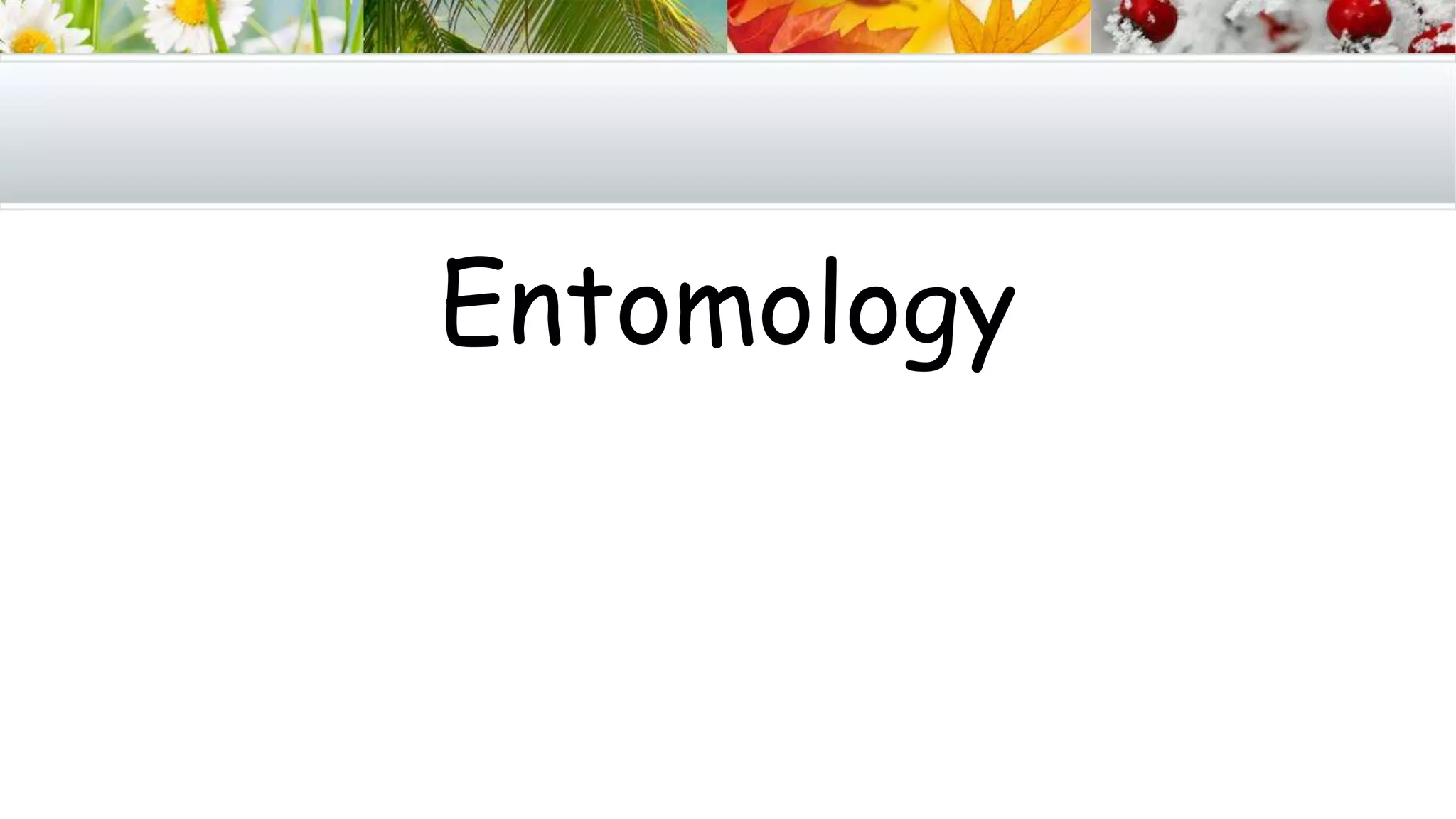
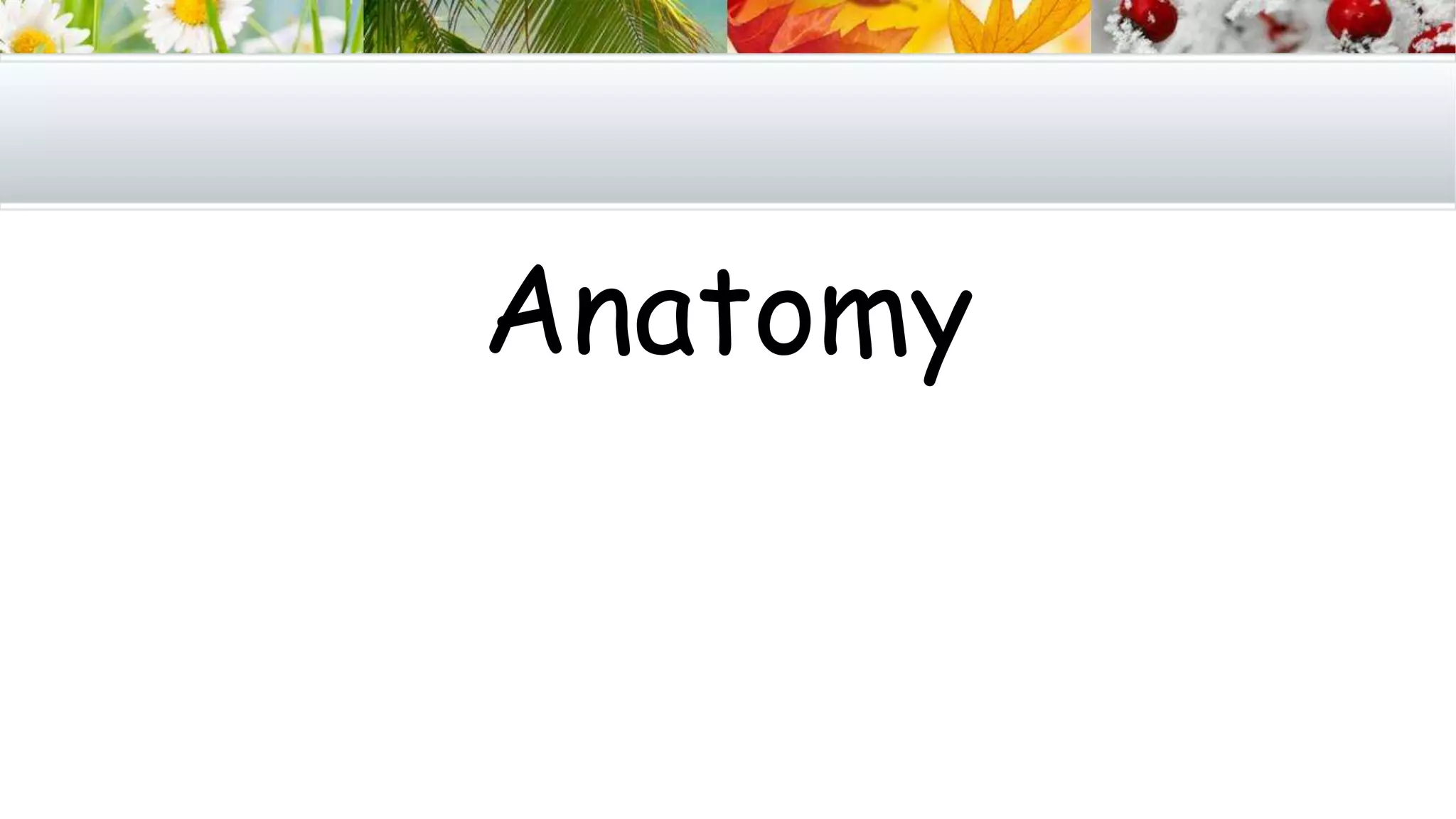
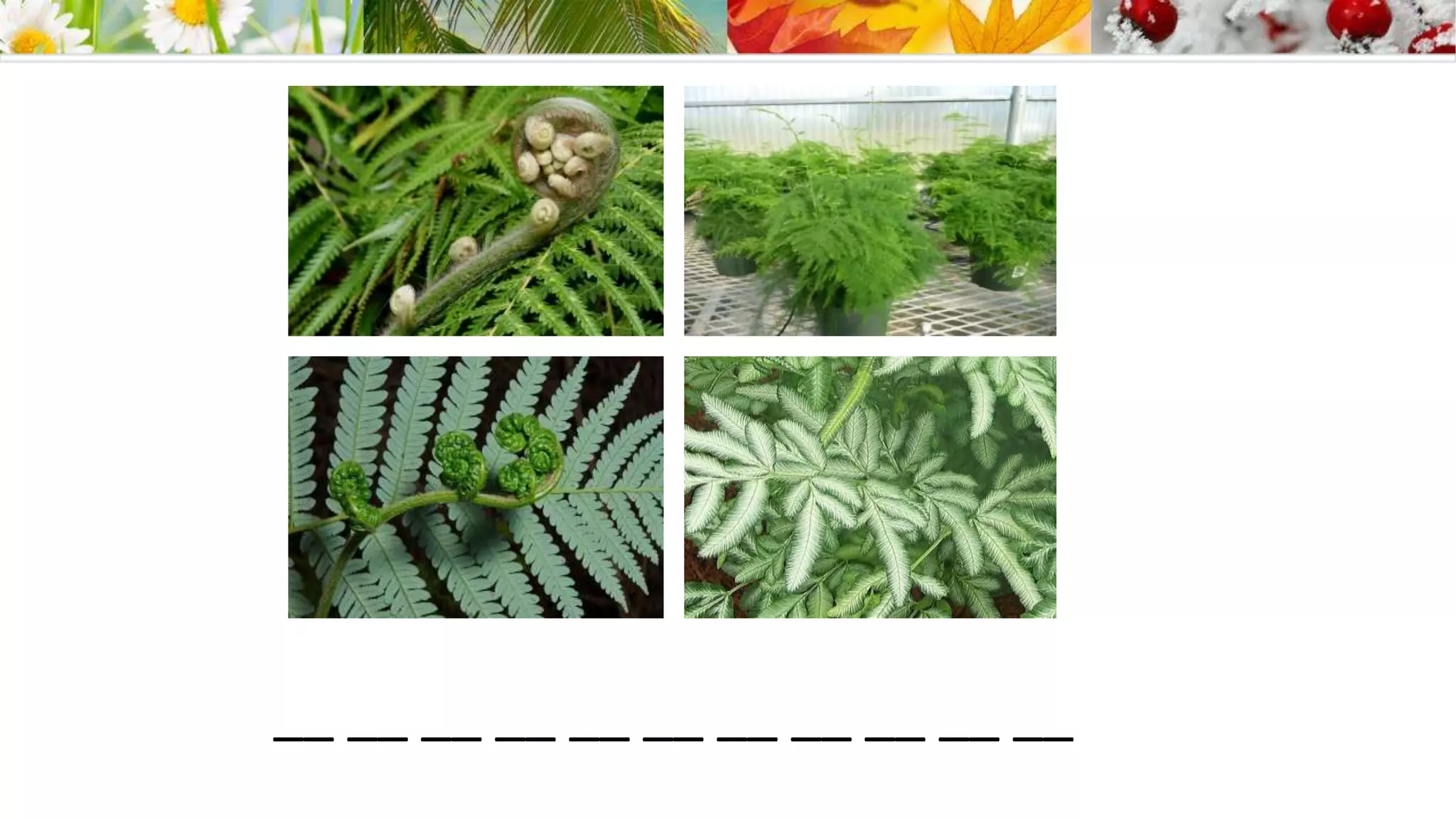
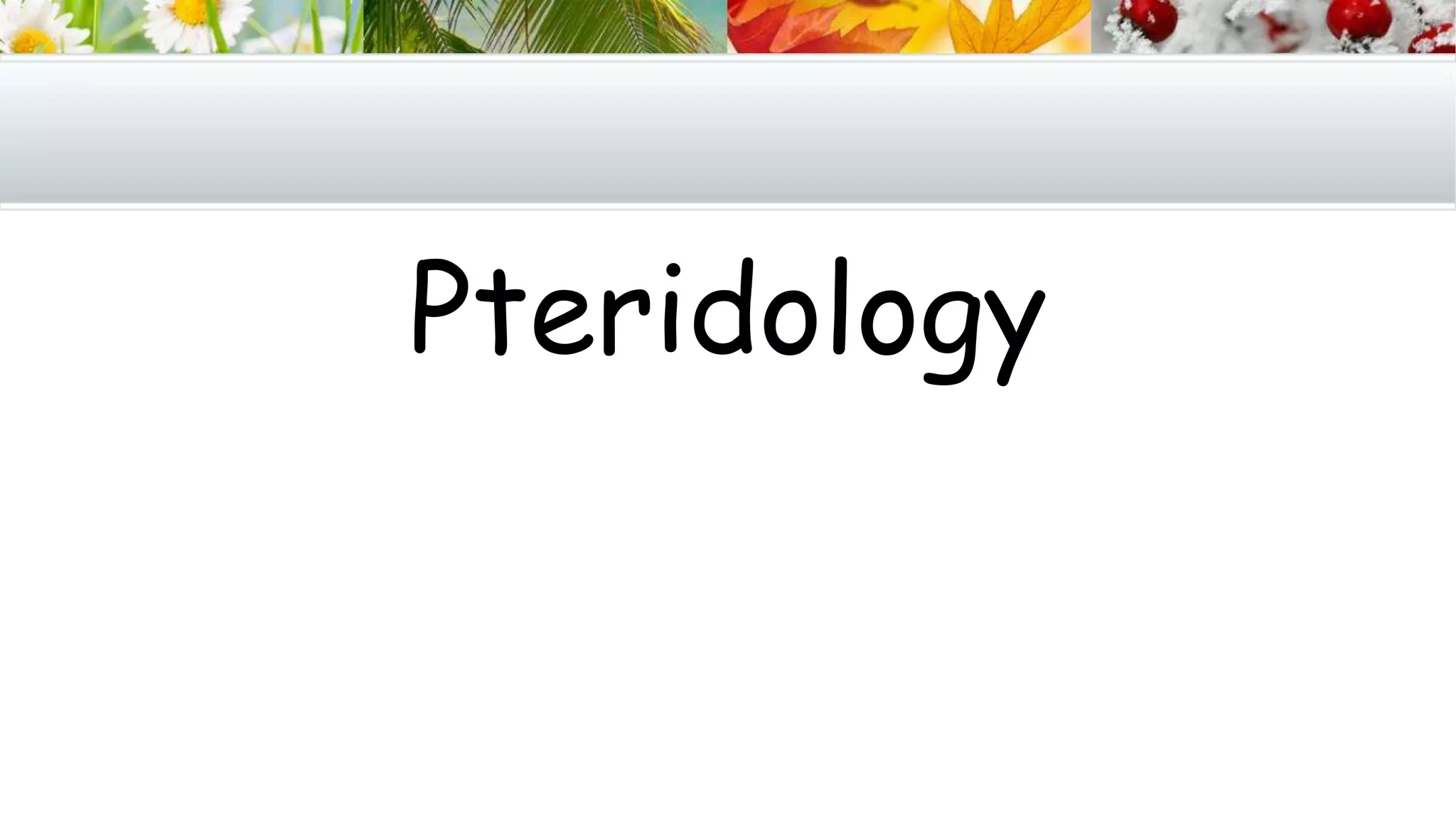
__ __ __ __ __ __ __ __ __ __
Entomology
__ __ __ __ __ __ __
Anatomy
__ __ __ __ __ __ __ __ __ __ __
Pteridology
__ __ __ __ __ __ __ __ __ __ __
Herpetology
__ __ __ __ __ __ __ __
Cytology
THE SCIENCE OF LIFE
Prepared by:
Ma. Lucille W. Abarracoso
MAIS – ASE
BIOLOGY
 A Greek name is coined by a German
naturalist in the early 19th century for this
study of all physical aspects of natural life -
biology, from bios (life) and logos (word or
discourse).
the study of life and living organisms.
WHAT IS LIFE?
What does it mean to be
alive?
LIFE
 the condition that distinguishes animals and
plants from inorganic matter, including the
capacity for growth, reproduction, functional
activity, and continual change preceding death
(Merriam-Webster)
 Must exhibit the characteristics of living
things
CHARACTERISTICS OF LIVING THINGS
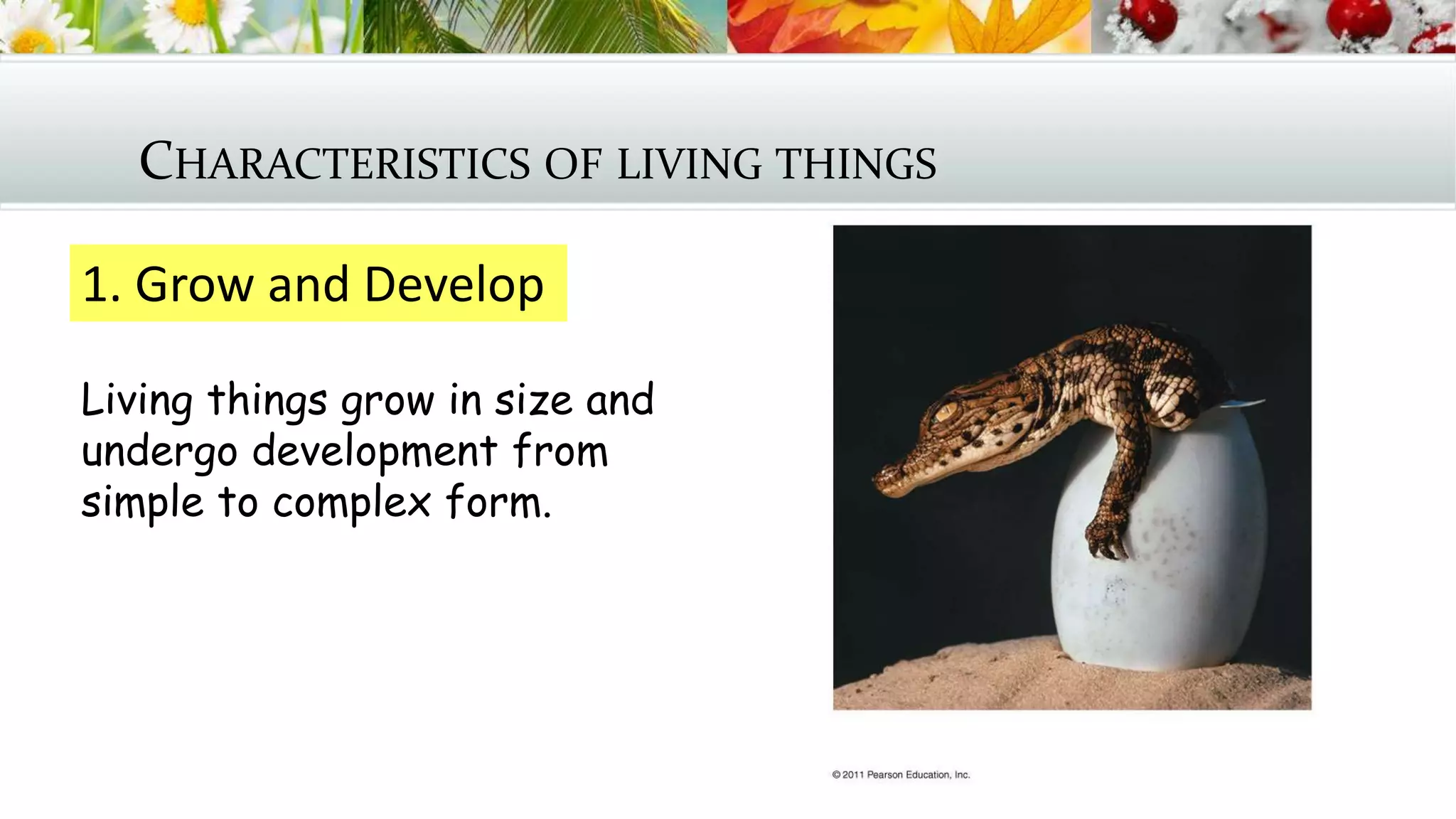
1. Grow and Develop
Living things grow in size and
undergo development from
simple to complex form.
2. Highly Organized
All organisms regardless of size
and complexity are composed of
chemical and cellular components.
On chemical level, it is composed
of organic and inorganic
substances.
LEVELS OF BIOLOGICAL
ORGANIZATION
The biosphere
Ecosystems
Communities
Populations
Organisms
Organs and
organ systems
Tissues
Cells
Organelles
Atoms
Molecules
3. Ability to acquire material
and energy
Living things obtain energy from
food. Some organisms such as
plants, algae and some
microorganisms are autotrophic,
they can produce their own food.
4. Ability to respond to stimuli
Living things are surrounded by
various external factors that my
affect them. They exhibits
irritability, the ability to react to
various stimuli in various ways in
order to survive.
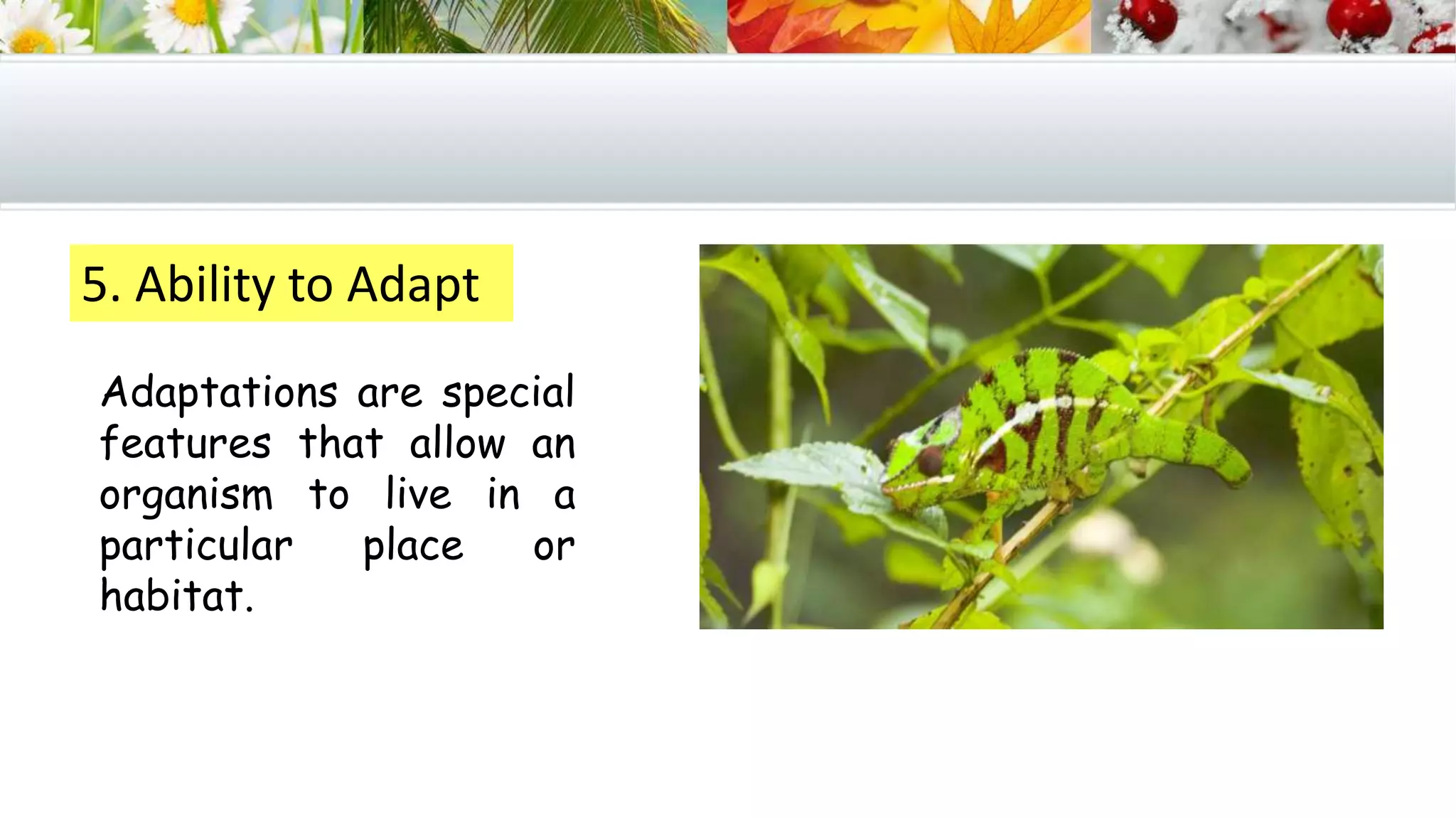
5. Ability to Adapt
Adaptations are special
features that allow an
organism to live in a
particular place or
habitat.
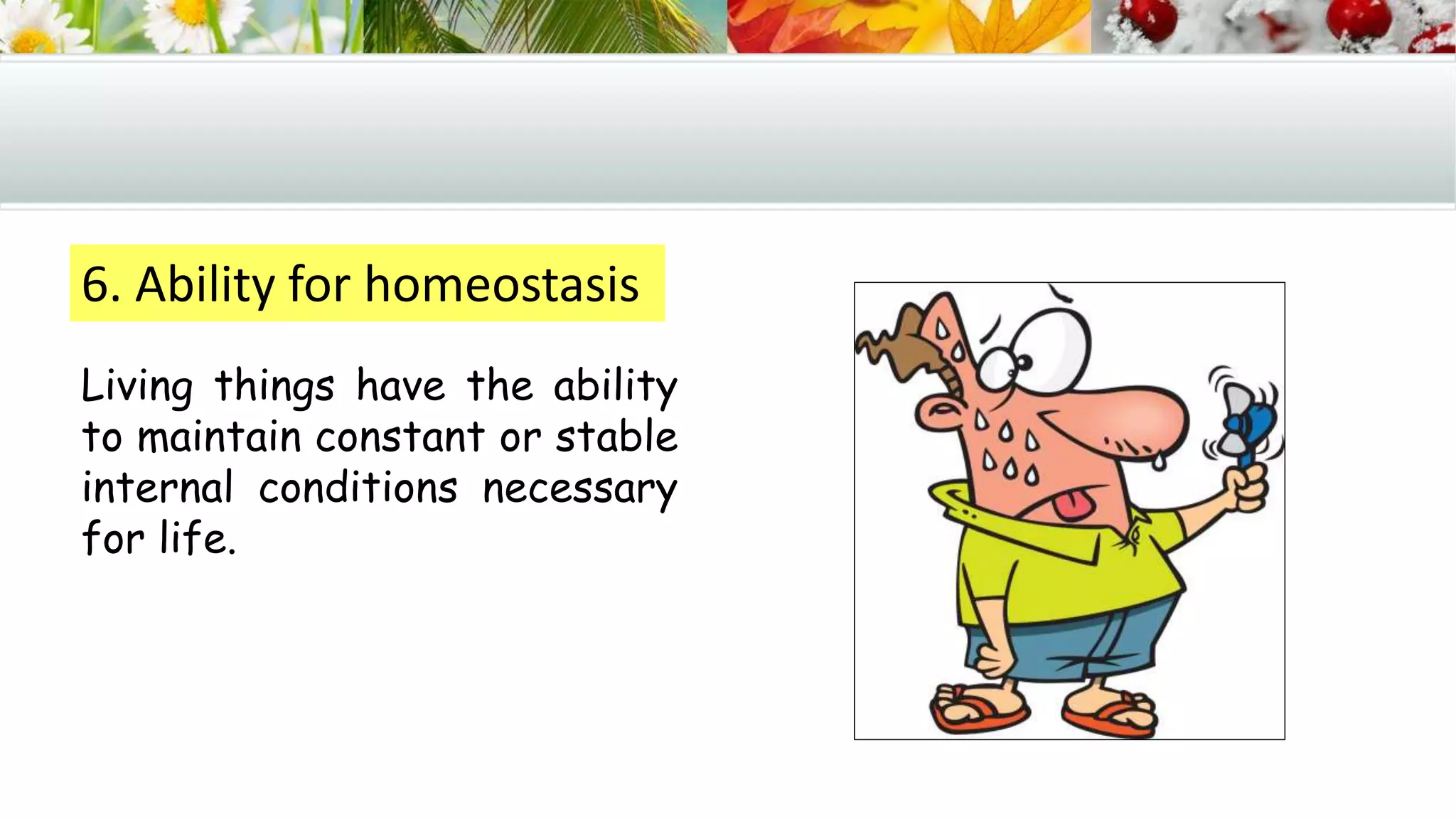
6. Ability for homeostasis
Living things have the ability
to maintain constant or stable
internal conditions necessary
for life.
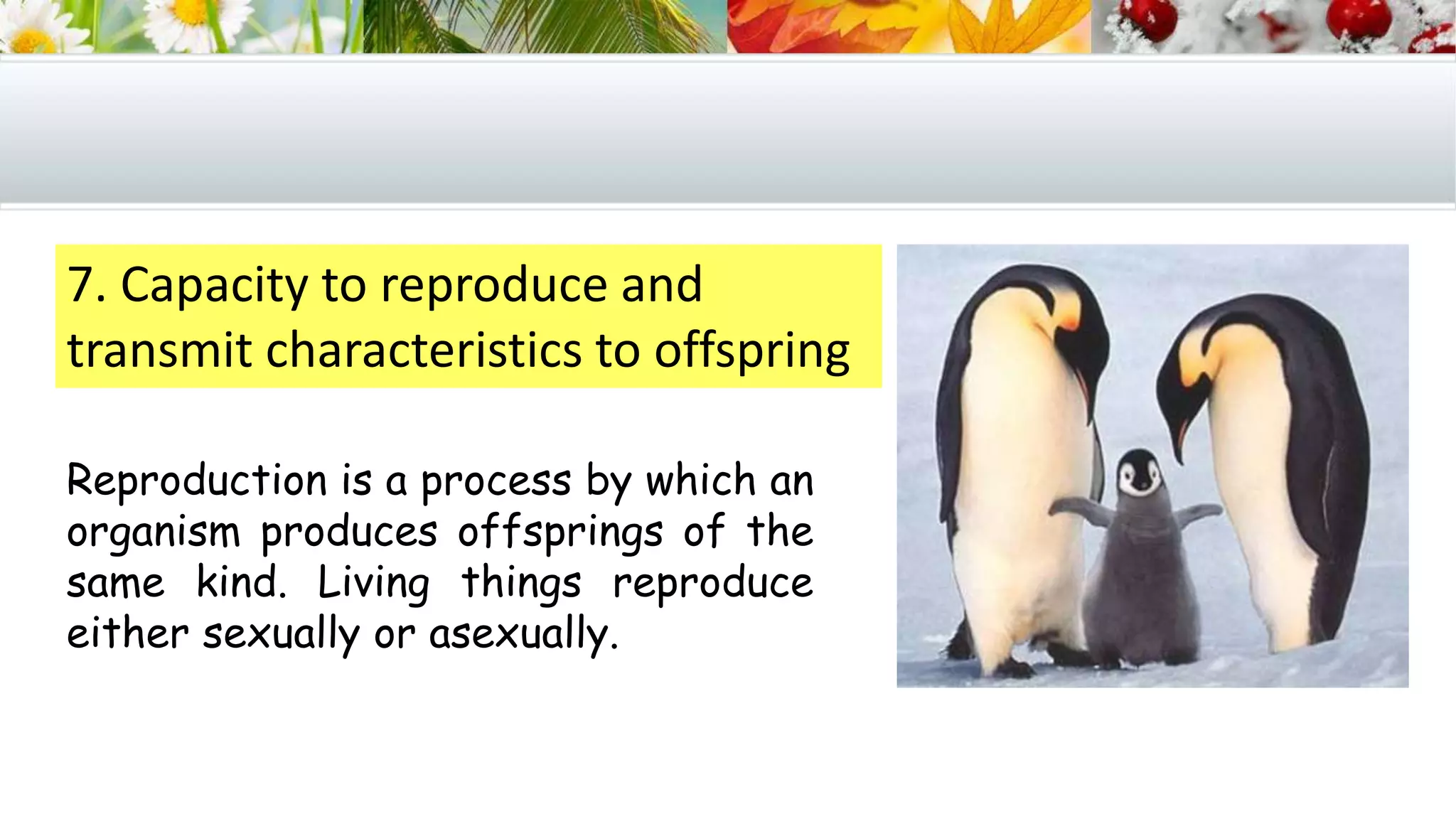
7. Capacity to reproduce and
transmit characteristics to offspring
Reproduction is a process by which an
organism produces offsprings of the
same kind. Living things reproduce
either sexually or asexually.
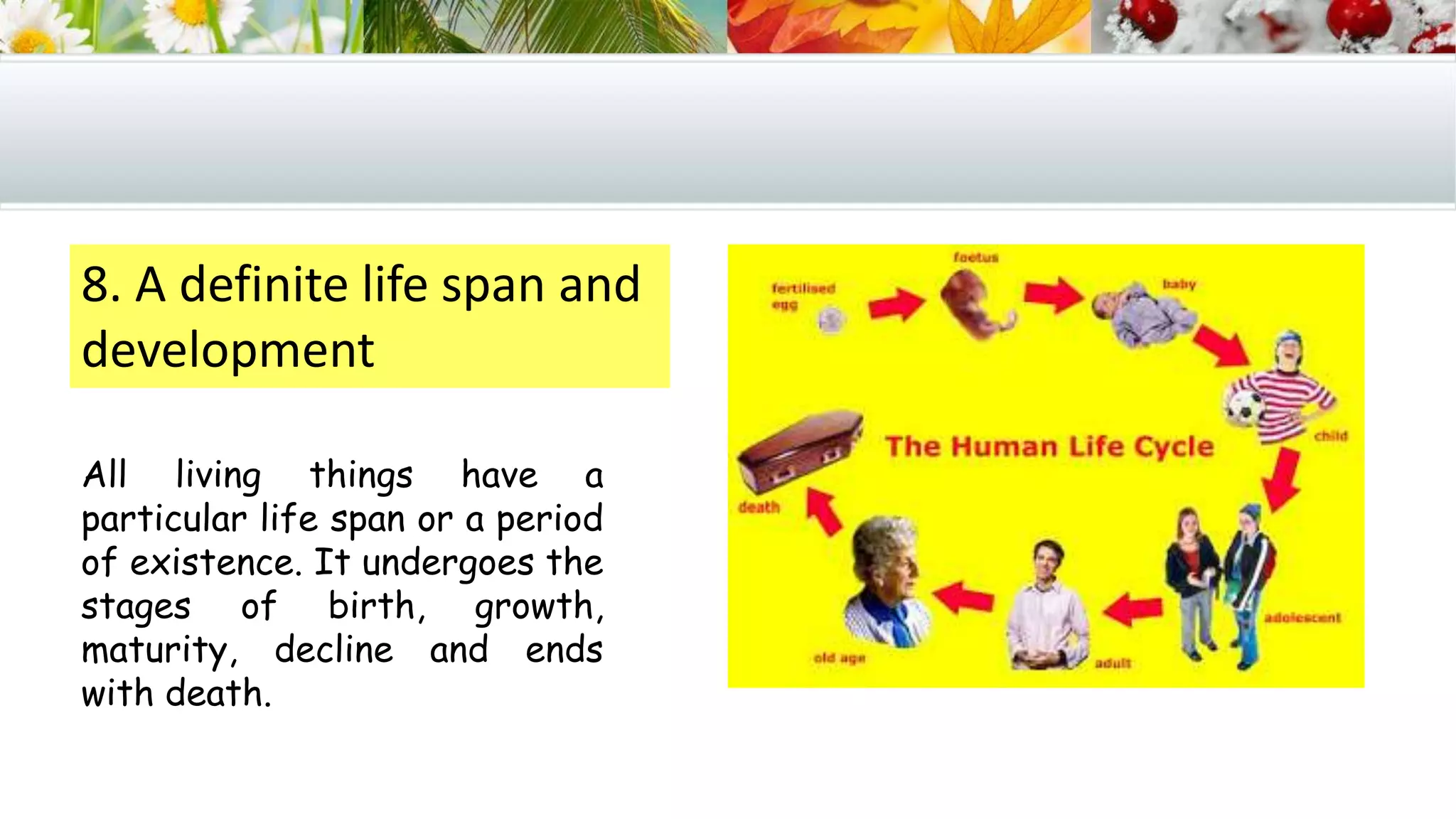
8. A definite life span and
development
All living things have a
particular life span or a period
of existence. It undergoes the
stages of birth, growth,
maturity, decline and ends
with death.
HISTORY OF BIOLOGY
 PRIMITIVE PERIOD
characterized by uncritical accumulation of information, mainly
derived from the practical necessities of obtaining food, materials for
clothing and shelter, substances to cure ailments, and necessary
information about the human body.
 CLASSICAL PERIOD
Marked by the great curiosity about natural phenomena and an ability to organize
biological knowledge and record it.
Alcmaeon
- is the first scientist known to have practised dissection in his researches. His aim is
not anatomical, for his interest lies in trying to find the whereabouts of human
intelligence.
Hippocrates
- Father of medicine
- stated that disease have natural causes and the body has the power to repair itself.
Aristotle
- gives a far more complete and well observed account of biology than
any other Greek philosopher.
HISTORY OF BIOLOGY
Theophrastus
- Aristotle’s favourite pupil
- carried on pioneer studies on the nature of plants, his works are the most
complete biological treatises to reach from the classical period.
Galen
- a Greek physician who began to study human anatomy and carried out the
physiological experiment in animals.
HISTORY OF BIOLOGY
 RENAISSANCE
During which anatomy, physiology, botany were established.
Leonardo de Vinci
- begins a series of anatomical drawings. For accuracy of observation they are far in
advance of anything previously attempted. Over the next twenty-five years he dissects about
thirty human corpses, many of them at a mortuary in Rome - until in 1515 the pope, Leo X,
orders him to stop.
Andreas Vesalius
- publishes in 1543 his great work - De humani corporis fabrica(The Structure of the
Human Body). There are seven volumes including numerous magnificent woodcut
illustrations. The book is an immediate success, though naturally it enrages the
traditionalists who follow Galen. Galen's theories have, after all, the clear merit of
seniority.
William Harvey
- described the blood circulation in man, which contributed to physiology.
HISTORY OF BIOLOGY
MODERN ERA
Robert Hooke, Matthias Schleiden & Theodore Schwann
- established the concept of Cell theory
Carolus Linnaeus
- Father of Taxonomy
- established the system of nomenclature in which all living things are arranged
by genus and species.
Jean Baptiste Lamarck
- proposed the theory of evolution
Charles Darwin
- has the most outstanding contribution to evolution for his work Natural Selection
as an explanation by which evolutionary changes takes place.
HISTORY OF BIOLOGYHISTORY OF BIOLOGY
Louis Pasteur
- Father of Modern Microbiology
- He is best known to the general public for his invention of the technique of
treating milk and wine to stop bacterial contamination, a process now called
Pasteurization.
Gregor Mendel
- made studies on Genetics
HISTORY OF BIOLOGY
DIVISIONS OF BIOLOGY
Agriculture
- Science and practice of producing crops and livestock from the natural resources of
the earth
Anatomy
- study of the parts or structure of organisms.
Anthropology
- Study of man.
Biochemistry
- branch of science that explores the chemical processes within and related to living
organisms
Biotechnology
- applied science that is concerned with biological systems, living organisms to make or
modify products or processes for specific use.
Botany
- scientific study of plants
Cytology
- study of the structures and functions of cells.
Ecology
- study of environment and interrelationship of organisms in it.
DIVISIONS OF BIOLOGY
Embryology
- study of the formation and development of organisms in its earliest stages of development
Entomology
- study of insects.
Evolution
- study of the origin and differentiation of different kinds of organisms.
Genetics
- study of heredity or how an organism’s characteristics are transmitted from parents to
offspring.
DIVISIONS OF BIOLOGY
Herpetology
- study of reptiles and amphibians.
Histology
- study of tissues
Ichthyology
- study of fishes
Marine Biology
- study of ocean plants and animals and their ecological relationships.
DIVISIONS OF BIOLOGY
Ornithology
- study of birds
Paleontology
- study of the fossils of living things and their distribution in time
Taxonomy
- study of the classification and naming of plants and animals
Zoology
- study that deals with animals and animal life
DIVISIONS OF BIOLOGY
IMPORTANCE OF BIOLOGY
1. Explains the Changes of the Human Bodies
By studying biology, everyone will be able to know the reasons behind
the sudden changes happening in their respective bodies.
2. Provides Answers to Large-scale Problems
It will provide answers to large-scale concerns that may affect anyone
from different parts of the world. It can even offer solutions to environmental
issues without compromising or sacrificing anything along the way.
3. Teaches Concepts on Basic Living
Despite being a small-scale concept, the basic way of how human beings
live is also covered by the importance of biology. It teaches people how
to plant for food consumption. Furthermore, it tells what food is appropriate to
consume and what is not.
4. Paves Way for Scientific Investigations
Paving the way for humans to conduct scientific investigations, which
are very useful in discovering new things, through the scientific method is one
of the importance of biology. Basically, biologists do experiments to learn
significant and interesting facts about the world. They also do fieldwork, having
expeditions and explorations into unknown lands to gather more information
about life.
IMPORTANCE OF BIOLOGY
5. Shapes Different Careers
Biology is one of the basic subjects that everyone has to take in school.
With this being said, it helps in shaping the professional careers of every
person. Be it a doctor, chemist, engineer, environmentalist, nurse, psychologist,
scientist, teacher, or other professions that are not inclined to science, studying
the scientific concepts of life and other living organisms is going to be a useful
tool in achieving success in any chosen field of study. You have
different branches of biology to choose from and specialize in.
IMPORTANCE OF BIOLOGY
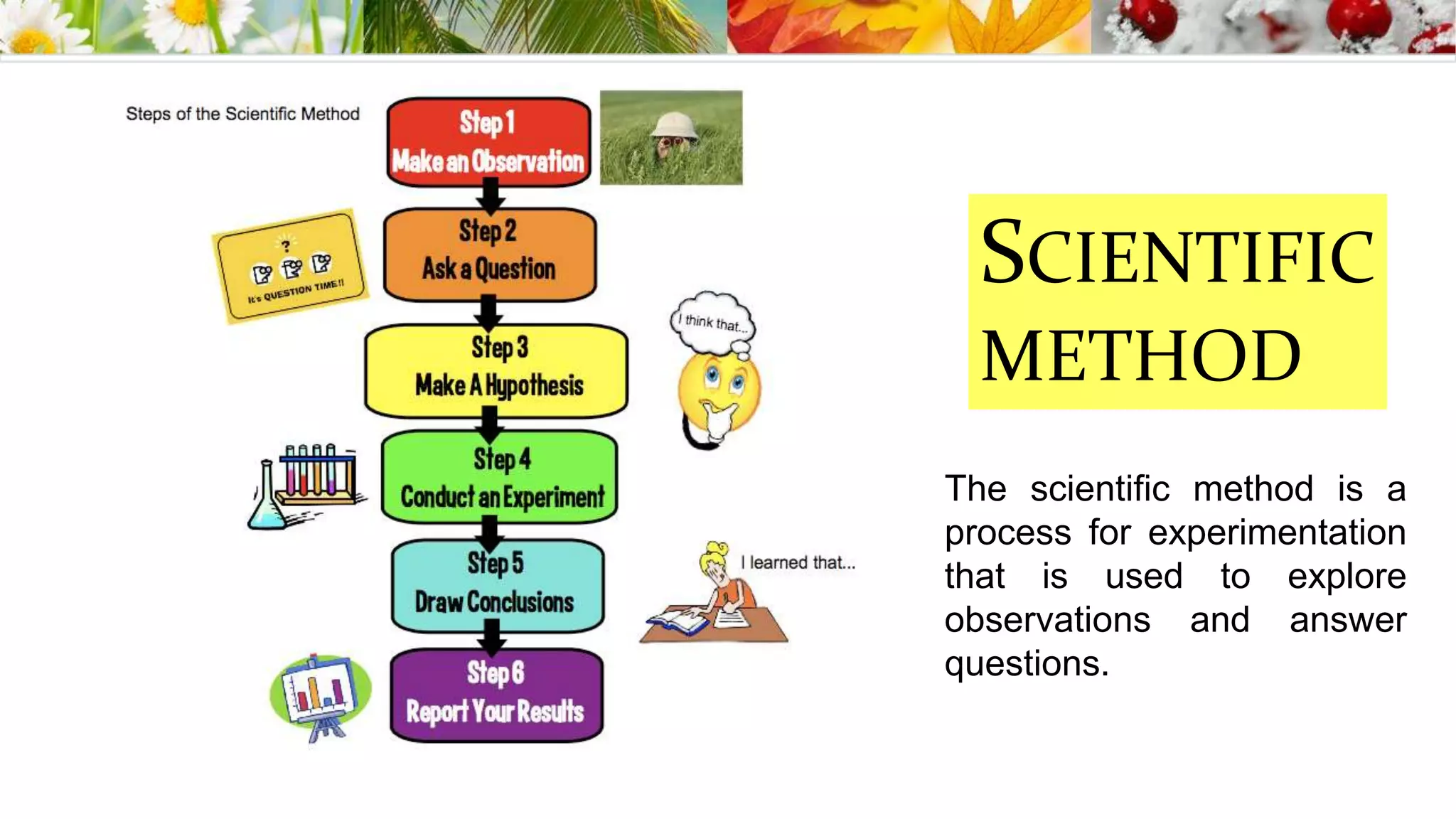
SCIENTIFIC
METHOD
The scientific method is a
process for experimentation
that is used to explore
observations and answer
questions.
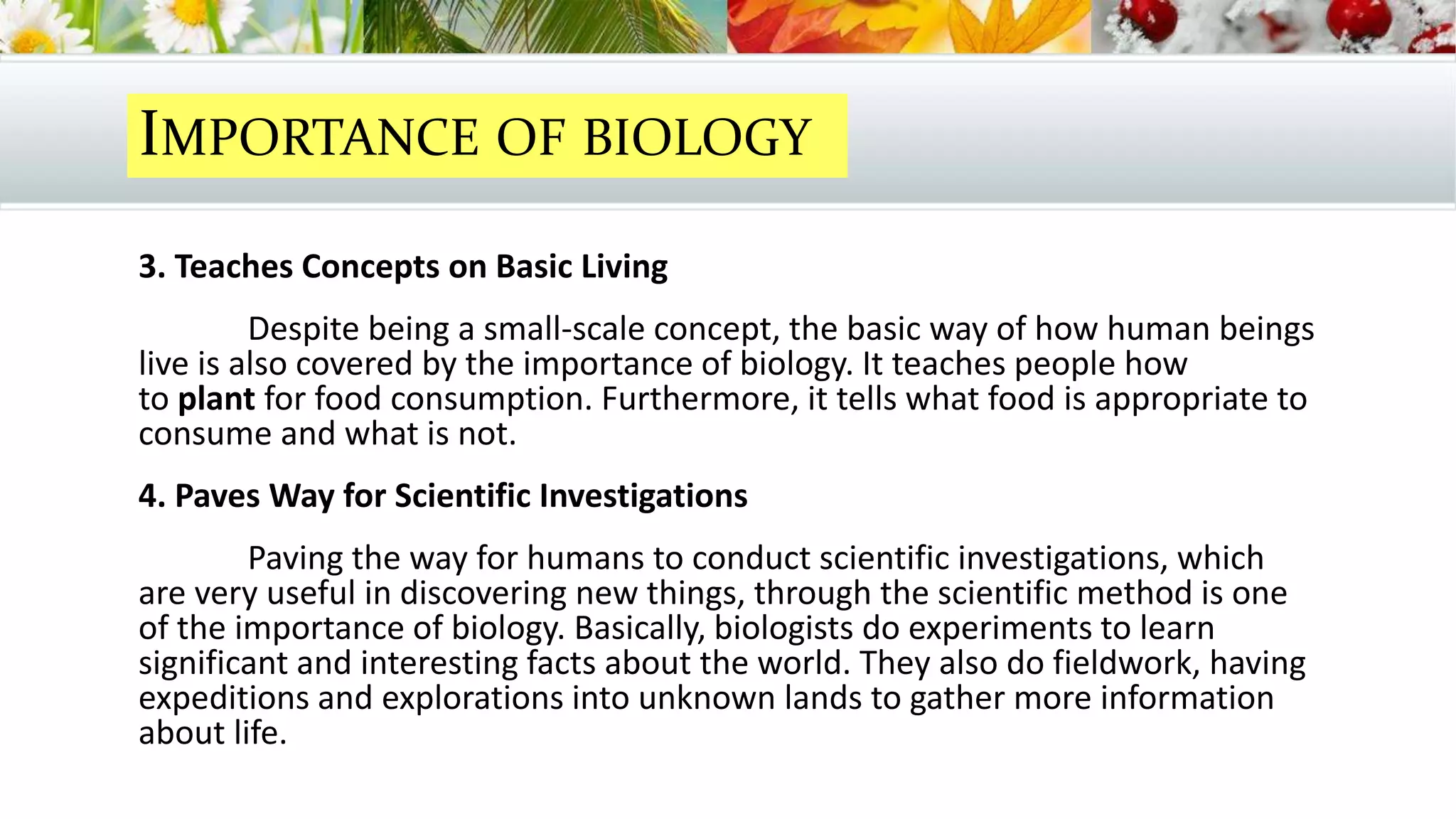
EXAMPLE
1. Observation
The apple turns to brown rapidly.
2. Question
What can you put on an apple to keep it from
turning brown?
3. Hypothesis
If I will place a sliced apple on water or in
any liquid, I will be able to slow down the
decolouration of apple.
4. Experiment
Slice apple into four equal parts. Place one
each on water, milk, lemon juice, and soda.
Watch what happens to each slice.
VARIABLES
5. Conclusion
I have learned that the among the liquids,
lemon juice will less likely turns an apple to
brown.
6. Report of results
Share your result to others.
EXAMPLE
 http://www.historyworld.net/wrldhis/PlainTextHistories.asp?groupid=2473&
HistoryID=ac22&gtrack=pthc#ixzz4lvnu09J0
 https://www.bioexplorer.net/importance-of-biology.html/

The science of life [autosaved]

  • 1.
    __ __ ____ __ __ __ __ __ __
  • 2.
  • 3.
    __ __ ____ __ __ __
  • 4.
  • 5.
    __ __ ____ __ __ __ __ __ __ __
  • 6.
  • 7.
    __ __ ____ __ __ __ __ __ __ __
  • 8.
  • 9.
    __ __ ____ __ __ __ __
  • 10.
  • 11.
    THE SCIENCE OFLIFE Prepared by: Ma. Lucille W. Abarracoso MAIS – ASE
  • 12.
    BIOLOGY  A Greekname is coined by a German naturalist in the early 19th century for this study of all physical aspects of natural life - biology, from bios (life) and logos (word or discourse). the study of life and living organisms.
  • 13.
    WHAT IS LIFE? Whatdoes it mean to be alive?
  • 14.
    LIFE  the conditionthat distinguishes animals and plants from inorganic matter, including the capacity for growth, reproduction, functional activity, and continual change preceding death (Merriam-Webster)  Must exhibit the characteristics of living things
  • 15.
    CHARACTERISTICS OF LIVINGTHINGS 1. Grow and Develop Living things grow in size and undergo development from simple to complex form.
  • 16.
    2. Highly Organized Allorganisms regardless of size and complexity are composed of chemical and cellular components. On chemical level, it is composed of organic and inorganic substances.
  • 17.
    LEVELS OF BIOLOGICAL ORGANIZATION Thebiosphere Ecosystems Communities Populations Organisms Organs and organ systems Tissues Cells Organelles Atoms Molecules
  • 18.
    3. Ability toacquire material and energy Living things obtain energy from food. Some organisms such as plants, algae and some microorganisms are autotrophic, they can produce their own food.
  • 19.
    4. Ability torespond to stimuli Living things are surrounded by various external factors that my affect them. They exhibits irritability, the ability to react to various stimuli in various ways in order to survive.
  • 20.
    5. Ability toAdapt Adaptations are special features that allow an organism to live in a particular place or habitat.
  • 21.
    6. Ability forhomeostasis Living things have the ability to maintain constant or stable internal conditions necessary for life.
  • 22.
    7. Capacity toreproduce and transmit characteristics to offspring Reproduction is a process by which an organism produces offsprings of the same kind. Living things reproduce either sexually or asexually.
  • 23.
    8. A definitelife span and development All living things have a particular life span or a period of existence. It undergoes the stages of birth, growth, maturity, decline and ends with death.
  • 24.
    HISTORY OF BIOLOGY PRIMITIVE PERIOD characterized by uncritical accumulation of information, mainly derived from the practical necessities of obtaining food, materials for clothing and shelter, substances to cure ailments, and necessary information about the human body.
  • 25.
     CLASSICAL PERIOD Markedby the great curiosity about natural phenomena and an ability to organize biological knowledge and record it. Alcmaeon - is the first scientist known to have practised dissection in his researches. His aim is not anatomical, for his interest lies in trying to find the whereabouts of human intelligence. Hippocrates - Father of medicine - stated that disease have natural causes and the body has the power to repair itself. Aristotle - gives a far more complete and well observed account of biology than any other Greek philosopher. HISTORY OF BIOLOGY
  • 26.
    Theophrastus - Aristotle’s favouritepupil - carried on pioneer studies on the nature of plants, his works are the most complete biological treatises to reach from the classical period. Galen - a Greek physician who began to study human anatomy and carried out the physiological experiment in animals. HISTORY OF BIOLOGY
  • 27.
     RENAISSANCE During whichanatomy, physiology, botany were established. Leonardo de Vinci - begins a series of anatomical drawings. For accuracy of observation they are far in advance of anything previously attempted. Over the next twenty-five years he dissects about thirty human corpses, many of them at a mortuary in Rome - until in 1515 the pope, Leo X, orders him to stop. Andreas Vesalius - publishes in 1543 his great work - De humani corporis fabrica(The Structure of the Human Body). There are seven volumes including numerous magnificent woodcut illustrations. The book is an immediate success, though naturally it enrages the traditionalists who follow Galen. Galen's theories have, after all, the clear merit of seniority. William Harvey - described the blood circulation in man, which contributed to physiology. HISTORY OF BIOLOGY
  • 28.
    MODERN ERA Robert Hooke,Matthias Schleiden & Theodore Schwann - established the concept of Cell theory Carolus Linnaeus - Father of Taxonomy - established the system of nomenclature in which all living things are arranged by genus and species. Jean Baptiste Lamarck - proposed the theory of evolution Charles Darwin - has the most outstanding contribution to evolution for his work Natural Selection as an explanation by which evolutionary changes takes place. HISTORY OF BIOLOGYHISTORY OF BIOLOGY
  • 29.
    Louis Pasteur - Fatherof Modern Microbiology - He is best known to the general public for his invention of the technique of treating milk and wine to stop bacterial contamination, a process now called Pasteurization. Gregor Mendel - made studies on Genetics HISTORY OF BIOLOGY
  • 30.
    DIVISIONS OF BIOLOGY Agriculture -Science and practice of producing crops and livestock from the natural resources of the earth Anatomy - study of the parts or structure of organisms. Anthropology - Study of man. Biochemistry - branch of science that explores the chemical processes within and related to living organisms
  • 31.
    Biotechnology - applied sciencethat is concerned with biological systems, living organisms to make or modify products or processes for specific use. Botany - scientific study of plants Cytology - study of the structures and functions of cells. Ecology - study of environment and interrelationship of organisms in it. DIVISIONS OF BIOLOGY
  • 32.
    Embryology - study ofthe formation and development of organisms in its earliest stages of development Entomology - study of insects. Evolution - study of the origin and differentiation of different kinds of organisms. Genetics - study of heredity or how an organism’s characteristics are transmitted from parents to offspring. DIVISIONS OF BIOLOGY
  • 33.
    Herpetology - study ofreptiles and amphibians. Histology - study of tissues Ichthyology - study of fishes Marine Biology - study of ocean plants and animals and their ecological relationships. DIVISIONS OF BIOLOGY
  • 34.
    Ornithology - study ofbirds Paleontology - study of the fossils of living things and their distribution in time Taxonomy - study of the classification and naming of plants and animals Zoology - study that deals with animals and animal life DIVISIONS OF BIOLOGY
  • 35.
    IMPORTANCE OF BIOLOGY 1.Explains the Changes of the Human Bodies By studying biology, everyone will be able to know the reasons behind the sudden changes happening in their respective bodies. 2. Provides Answers to Large-scale Problems It will provide answers to large-scale concerns that may affect anyone from different parts of the world. It can even offer solutions to environmental issues without compromising or sacrificing anything along the way.
  • 36.
    3. Teaches Conceptson Basic Living Despite being a small-scale concept, the basic way of how human beings live is also covered by the importance of biology. It teaches people how to plant for food consumption. Furthermore, it tells what food is appropriate to consume and what is not. 4. Paves Way for Scientific Investigations Paving the way for humans to conduct scientific investigations, which are very useful in discovering new things, through the scientific method is one of the importance of biology. Basically, biologists do experiments to learn significant and interesting facts about the world. They also do fieldwork, having expeditions and explorations into unknown lands to gather more information about life. IMPORTANCE OF BIOLOGY
  • 37.
    5. Shapes DifferentCareers Biology is one of the basic subjects that everyone has to take in school. With this being said, it helps in shaping the professional careers of every person. Be it a doctor, chemist, engineer, environmentalist, nurse, psychologist, scientist, teacher, or other professions that are not inclined to science, studying the scientific concepts of life and other living organisms is going to be a useful tool in achieving success in any chosen field of study. You have different branches of biology to choose from and specialize in. IMPORTANCE OF BIOLOGY
  • 38.
    SCIENTIFIC METHOD The scientific methodis a process for experimentation that is used to explore observations and answer questions.
  • 39.
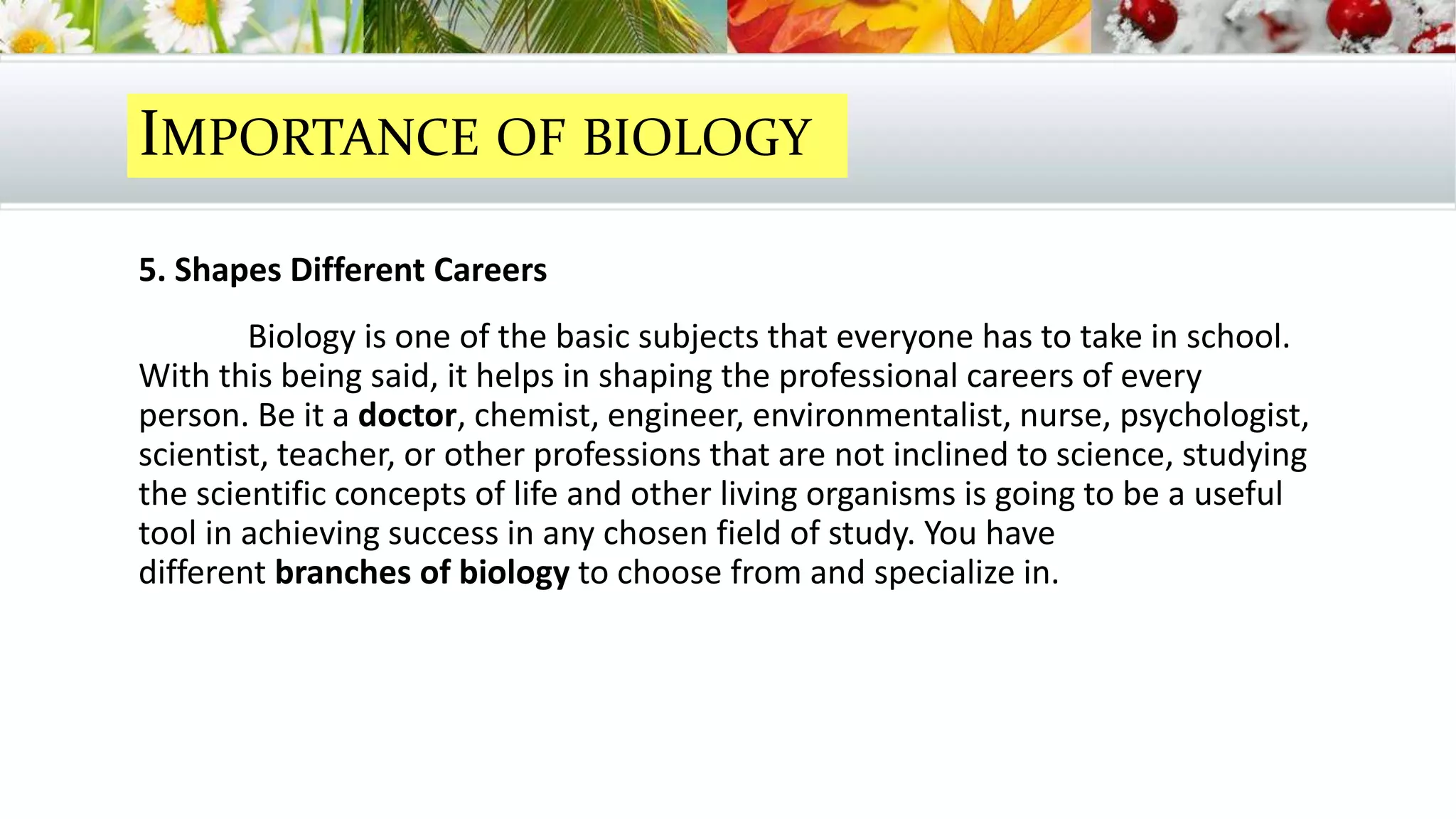
    EXAMPLE 1. Observation The appleturns to brown rapidly. 2. Question What can you put on an apple to keep it from turning brown? 3. Hypothesis If I will place a sliced apple on water or in any liquid, I will be able to slow down the decolouration of apple. 4. Experiment Slice apple into four equal parts. Place one each on water, milk, lemon juice, and soda. Watch what happens to each slice.
  • 40.
  • 41.
    5. Conclusion I havelearned that the among the liquids, lemon juice will less likely turns an apple to brown. 6. Report of results Share your result to others. EXAMPLE
  • 43.

Editor's Notes

  • #36 by studying biology, everyone will be able to know the reasons behind the sudden changes happening in their respective bodies. For instance, when kids unexpectedly grow taller and they experience changes in their physical appearances and sleeping patterns, these mean that their bodies have started releasing hormones in preparation for their puberty stage. For example, when a country is experiencing food shortages, the biological ideologies can be utilized to develop efficient and long-lasting methods for producing more food to sustain life. Another instance, which is the currently one of the most evident problems, is the existence of pollution. This branch of knowledge can supply the solutions to eradicate such environmental issue that has become much worse than before.
  • #42 Basically, when apples are sliced they release an enzyme called polyphenol oxidase.  When this enzyme combines with air it oxidizes and starts the browning process.  The enzyme is “deactivated” when an acid is applied but the acid has to have a pH less than 3.   So all of the acidic juices we chose had a pH greater than 3 except lemon juice.  The article says lime juice and cranberry juice are just as effective as lemon juice!  Cranberry and lime apple slices… sounds yummy to me!