INTRODUCTION TO BIOLOGY
Definition of Biology
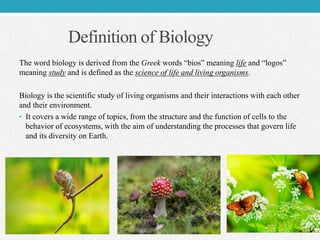
The word biology is derived from the Greek words “bios” meaning life and “logos”
meaning study and is defined as the science of life and living organisms.
Biology is the scientific study of living organisms and their interactions with each other
and their environment.
• It covers a wide range of topics, from the structure and the function of cells to the
behavior of ecosystems, with the aim of understanding the processes that govern life
and its diversity on Earth.
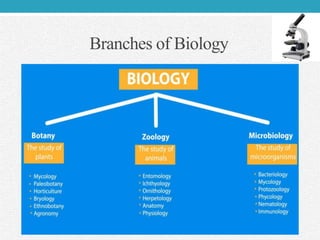
Branches of Biology
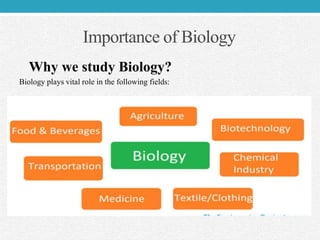
Importance of Biology
Why we study Biology?
Biology plays vital role in the following fields:
History of Biology
• Ancient Beginning:
Biology’s roots can be traced back to ancient civilizations, where observations of the
natural world and basic classifications of living organisms were made. Greek
philosophers like Aristotle made significant early contributions.
• The Renaissance:
During the Renaissance, there was a resurgence of interest in the natural world.
Notable figures like Andreas Vesalius and Carolus Linnaeus made pioneering
contributions to anatomy and taxonomy, respectively.
• The 19th Century:
Charles Darwin theory of evolution by natural selection revolutionized biology by
explaining the diversity of life. Gregor Mendel’s work on inheritance laid the
foundation for genetics.
Continue…
• The 20th Century:
The discovery of the structure of DNA by James Watson and Francis Crick marked a
major breakthrough in genetics. The field of molecular biology emerged, transforming
our understanding of life at the cellular and genetic levels.
• Modern Era:
The 21st century has seen significant advance in biotechnology, genomics, and synthetic
biology. These developments have opened up new frontiers in understanding and
manipulating living organisms.
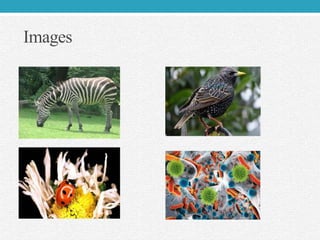
Images
Conclusion
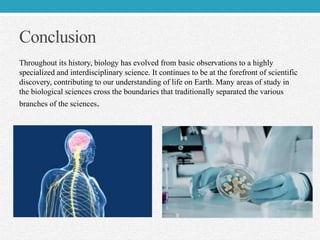
Throughout its history, biology has evolved from basic observations to a highly
specialized and interdisciplinary science. It continues to be at the forefront of scientific
discovery, contributing to our understanding of life on Earth. Many areas of study in
the biological sciences cross the boundaries that traditionally separated the various
branches of the sciences.

INTRODUCTION TO BIOLOGY.pptx

  • 1.
  • 2.
    Definition of Biology Theword biology is derived from the Greek words “bios” meaning life and “logos” meaning study and is defined as the science of life and living organisms. Biology is the scientific study of living organisms and their interactions with each other and their environment. • It covers a wide range of topics, from the structure and the function of cells to the behavior of ecosystems, with the aim of understanding the processes that govern life and its diversity on Earth.
  • 3.
  • 4.
    Importance of Biology Whywe study Biology? Biology plays vital role in the following fields:
  • 5.
    History of Biology •Ancient Beginning: Biology’s roots can be traced back to ancient civilizations, where observations of the natural world and basic classifications of living organisms were made. Greek philosophers like Aristotle made significant early contributions. • The Renaissance: During the Renaissance, there was a resurgence of interest in the natural world. Notable figures like Andreas Vesalius and Carolus Linnaeus made pioneering contributions to anatomy and taxonomy, respectively. • The 19th Century: Charles Darwin theory of evolution by natural selection revolutionized biology by explaining the diversity of life. Gregor Mendel’s work on inheritance laid the foundation for genetics.
  • 6.
    Continue… • The 20thCentury: The discovery of the structure of DNA by James Watson and Francis Crick marked a major breakthrough in genetics. The field of molecular biology emerged, transforming our understanding of life at the cellular and genetic levels. • Modern Era: The 21st century has seen significant advance in biotechnology, genomics, and synthetic biology. These developments have opened up new frontiers in understanding and manipulating living organisms.
  • 7.
  • 8.
    Conclusion Throughout its history,biology has evolved from basic observations to a highly specialized and interdisciplinary science. It continues to be at the forefront of scientific discovery, contributing to our understanding of life on Earth. Many areas of study in the biological sciences cross the boundaries that traditionally separated the various branches of the sciences.