PRESENTED BY: HARSHIT PANDEY
CLASS: XI A
ROLL NO: 1 3
TOPIC: ROMULOUS AUGUSTUS- THE Ist EMPEROR
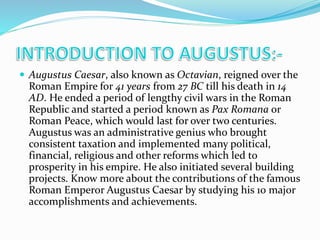
 Augustus Caesar, also known as Octavian, reigned over the
Roman Empire for 41 years from 27 BC till his death in 14
AD. He ended a period of lengthy civil wars in the Roman
Republic and started a period known as Pax Romana or
Roman Peace, which would last for over two centuries.
Augustus was an administrative genius who brought
consistent taxation and implemented many political,
financial, religious and other reforms which led to
prosperity in his empire. He also initiated several building
projects. Know more about the contributions of the famous
Roman Emperor Augustus Caesar by studying his 10 major
accomplishments and achievements.
HIS ACHIEVEMENTS AS EMPEROR:-
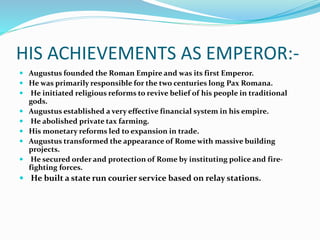
 Augustus founded the Roman Empire and was its first Emperor.
 He was primarily responsible for the two centuries long Pax Romana.
 He initiated religious reforms to revive belief of his people in traditional
gods.
 Augustus established a very effective financial system in his empire.
 He abolished private tax farming.
 His monetary reforms led to expansion in trade.
 Augustus transformed the appearance of Rome with massive building
projects.
 He secured order and protection of Rome by instituting police and fire-
fighting forces.
 He built a state run courier service based on relay stations.
MILITARY REFORMS:-
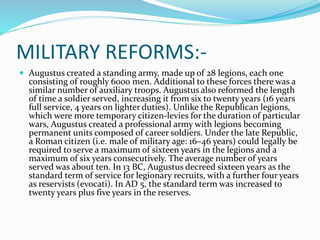
 Augustus created a standing army, made up of 28 legions, each one
consisting of roughly 6000 men. Additional to these forces there was a
similar number of auxiliary troops. Augustus also reformed the length
of time a soldier served, increasing it from six to twenty years (16 years
full service, 4 years on lighter duties). Unlike the Republican legions,
which were more temporary citizen-levies for the duration of particular
wars, Augustus created a professional army with legions becoming
permanent units composed of career soldiers. Under the late Republic,
a Roman citizen (i.e. male of military age: 16–46 years) could legally be
required to serve a maximum of sixteen years in the legions and a
maximum of six years consecutively. The average number of years
served was about ten. In 13 BC, Augustus decreed sixteen years as the
standard term of service for legionary recruits, with a further four years
as reservists (evocati). In AD 5, the standard term was increased to
twenty years plus five years in the reserves.
ADMINISTRATIVE REFORMS:-
 Emperor Augustus (27 BCE – 14 CE) accomplished much during his
time on the Roman throne, far more than many of his successors.
According to historian Mary Beard in her book SPQR, he transformed
the structures of Roman Empire, including its politics and army as well
as the appearance of the city itself. Unlike many of his successors who
would succumb to an early death (by his own hands or someone else’s),
Augustus was able to survive into old age, long enough to write a
personal history of his reign Res Gestae divi Augusti or Acts of the
Divine Augustus. Near the end of his long life, the emperor penned two
simple sentences summarizing his time on the throne, “I found a city
built of sun-dried brick. I leave her clothed in marble.” There are those,
however, who believe that his success was partially due to not only his
long life but also his ability to make essential changes.

CONTRIBUTION TOWARDS ART &
LITERATURE :-
 Augustus in popular culture
 Augustus was ranked #18 on Michael H. Hart's "The 100 list of the most
influential figures in history."
 Television
 Augustus was played by Roland Culver in the BBC miniseries of 1968, The
Caesars.
 Augustus was portrayed in the famous BBC dramatization of Robert Graves'
novel I, Claudius by Brian Blessed. (1975)
 Augustus was portrayed in the movie Imperium: Augustus (part of thw
Imperium movie series) by Peter O'Toole. (2003)
 In the HBO television series, Rome (2005), Gaius Octavian is portrayed by Max
Pirkis. However, in the series, he is wrongly referred to as Octavian, while his
name at that time would have been Octavius.
 Augustus was portrayed by Santiago Cabrera in an ABC miniseries
called Empire (2005), which took place after the assassination of Caesar.
 Literature
 Augustus was a central character in The Sandman #30, "August."
DEATH:-
 Romulus Augustus was a Roman emperor and alleged
usurper who ruled the Western Roman Empire from 31
October AD 475 until 4 September AD 476.
 Died: 527 AD
 Reign: 31 October AD 475 – 4 September AD 476
 Parents: Orestes
 Predecessor: Julius Nepos
 Successor: Office Abolished
 Grandparent: Tatulu
BIBLIOGRAPHY:-
 TO COMPLETE THIS PROJECT I HAVE TAKEN HELP
FROM WIKIPEDIA.COM & EARLYROMANS.COM
THAT’S ALL

ROMULOUS AUGUSTUS- THE FIRST ROMAN EMPEROR

  • 1.
    PRESENTED BY: HARSHITPANDEY CLASS: XI A ROLL NO: 1 3 TOPIC: ROMULOUS AUGUSTUS- THE Ist EMPEROR
  • 2.
     Augustus Caesar,also known as Octavian, reigned over the Roman Empire for 41 years from 27 BC till his death in 14 AD. He ended a period of lengthy civil wars in the Roman Republic and started a period known as Pax Romana or Roman Peace, which would last for over two centuries. Augustus was an administrative genius who brought consistent taxation and implemented many political, financial, religious and other reforms which led to prosperity in his empire. He also initiated several building projects. Know more about the contributions of the famous Roman Emperor Augustus Caesar by studying his 10 major accomplishments and achievements.
  • 3.
    HIS ACHIEVEMENTS ASEMPEROR:-  Augustus founded the Roman Empire and was its first Emperor.  He was primarily responsible for the two centuries long Pax Romana.  He initiated religious reforms to revive belief of his people in traditional gods.  Augustus established a very effective financial system in his empire.  He abolished private tax farming.  His monetary reforms led to expansion in trade.  Augustus transformed the appearance of Rome with massive building projects.  He secured order and protection of Rome by instituting police and fire- fighting forces.  He built a state run courier service based on relay stations.
  • 4.
    MILITARY REFORMS:-  Augustuscreated a standing army, made up of 28 legions, each one consisting of roughly 6000 men. Additional to these forces there was a similar number of auxiliary troops. Augustus also reformed the length of time a soldier served, increasing it from six to twenty years (16 years full service, 4 years on lighter duties). Unlike the Republican legions, which were more temporary citizen-levies for the duration of particular wars, Augustus created a professional army with legions becoming permanent units composed of career soldiers. Under the late Republic, a Roman citizen (i.e. male of military age: 16–46 years) could legally be required to serve a maximum of sixteen years in the legions and a maximum of six years consecutively. The average number of years served was about ten. In 13 BC, Augustus decreed sixteen years as the standard term of service for legionary recruits, with a further four years as reservists (evocati). In AD 5, the standard term was increased to twenty years plus five years in the reserves.
  • 5.
    ADMINISTRATIVE REFORMS:-  EmperorAugustus (27 BCE – 14 CE) accomplished much during his time on the Roman throne, far more than many of his successors. According to historian Mary Beard in her book SPQR, he transformed the structures of Roman Empire, including its politics and army as well as the appearance of the city itself. Unlike many of his successors who would succumb to an early death (by his own hands or someone else’s), Augustus was able to survive into old age, long enough to write a personal history of his reign Res Gestae divi Augusti or Acts of the Divine Augustus. Near the end of his long life, the emperor penned two simple sentences summarizing his time on the throne, “I found a city built of sun-dried brick. I leave her clothed in marble.” There are those, however, who believe that his success was partially due to not only his long life but also his ability to make essential changes. 
  • 6.
    CONTRIBUTION TOWARDS ART& LITERATURE :-  Augustus in popular culture  Augustus was ranked #18 on Michael H. Hart's "The 100 list of the most influential figures in history."  Television  Augustus was played by Roland Culver in the BBC miniseries of 1968, The Caesars.  Augustus was portrayed in the famous BBC dramatization of Robert Graves' novel I, Claudius by Brian Blessed. (1975)  Augustus was portrayed in the movie Imperium: Augustus (part of thw Imperium movie series) by Peter O'Toole. (2003)  In the HBO television series, Rome (2005), Gaius Octavian is portrayed by Max Pirkis. However, in the series, he is wrongly referred to as Octavian, while his name at that time would have been Octavius.  Augustus was portrayed by Santiago Cabrera in an ABC miniseries called Empire (2005), which took place after the assassination of Caesar.  Literature  Augustus was a central character in The Sandman #30, "August."
  • 7.
    DEATH:-  Romulus Augustuswas a Roman emperor and alleged usurper who ruled the Western Roman Empire from 31 October AD 475 until 4 September AD 476.  Died: 527 AD  Reign: 31 October AD 475 – 4 September AD 476  Parents: Orestes  Predecessor: Julius Nepos  Successor: Office Abolished  Grandparent: Tatulu
  • 8.
    BIBLIOGRAPHY:-  TO COMPLETETHIS PROJECT I HAVE TAKEN HELP FROM WIKIPEDIA.COM & EARLYROMANS.COM
  • 9.