Chapter 6
The Phoenicians and the Hebrews
1200 B.C.–510 B.C
Section 1 – The Phoenicians
• “At the eastern end of the Mediterranean Sea lies a
piece of land shared today by Lebanon & Israel. In
ancient times, it was the bridge that connected Egypt
and Mesopotamia, and it was known as Canaan.
Soldiers, shepherds, and merchants who passed
through Canaan carried new ideas and goods between
Egypt and Mesopotamia.
• Two groups—the Phoenicians and the Hebrews—settled
in Canaan and formed small kingdoms. Through these
peaceful activities, they made important contributions to
later civilizations.”
The Phoenicians
• Lived in Northern part of
Canaan
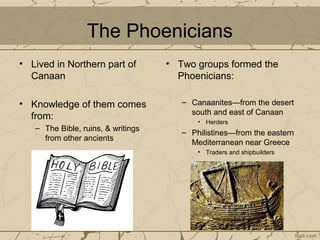
• Knowledge of them comes
from:
– The Bible, ruins, & writings
from other ancients
• Two groups formed the
Phoenicians:
– Canaanites—from the desert
south and east of Canaan
• Herders
– Philistines—from the eastern
Mediterranean near Greece
• Traders and shipbuilders
The Growth of Trade
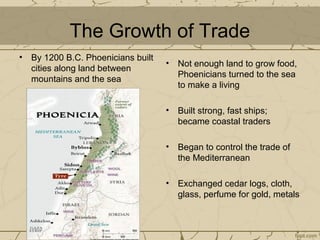
• By 1200 B.C. Phoenicians built
cities along land between
mountains and the sea
• Not enough land to grow food,
Phoenicians turned to the sea
to make a living
• Built strong, fast ships;
became coastal traders
• Began to control the trade of
the Mediterranean
• Exchanged cedar logs, cloth,
glass, perfume for gold, metals
The Growth of Trade
• Sailors traveled by sun & stars
• Learned the value of making
business agreements
• Used business ideas to keep
peace w/ more powerful
neighbors by signing peace
treaties, or agreements
between states or countries
• Promised to supply free
shipments of good for their
independence
• AKA: Created Peace By Trade
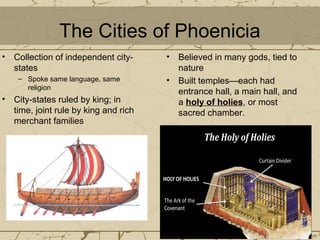
The Cities of Phoenicia
• Collection of independent city-
states
– Spoke same language, same
religion
• City-states ruled by king; in
time, joint rule by king and rich
merchant families
• Believed in many gods, tied to
nature
• Built temples—each had
entrance hall, a main hall, and
a holy of holies, or most
sacred chamber.
Carthage
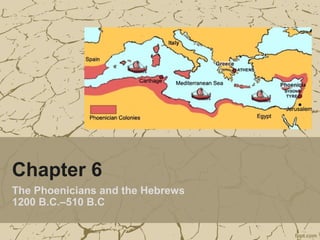
• Built colonies, or permanent
settlements, on North African
coast
• Most famous trading
city/colony: Carthage in 814
B.C.
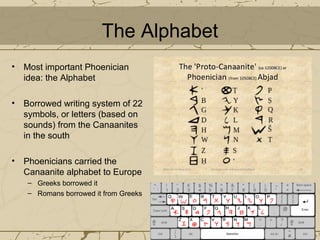
The Alphabet
• Most important Phoenician
idea: the Alphabet
• Borrowed writing system of 22
symbols, or letters (based on
sounds) from the Canaanites
in the south
• Phoenicians carried the
Canaanite alphabet to Europe
– Greeks borrowed it
– Romans borrowed it from Greeks
Chapter 6
Section 2 The Hebrews
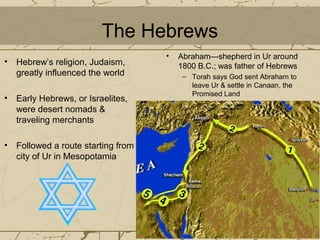
The Hebrews
• Hebrew’s religion, Judaism,
greatly influenced the world
• Early Hebrews, or Israelites,
were desert nomads &
traveling merchants
• Followed a route starting from
city of Ur in Mesopotamia
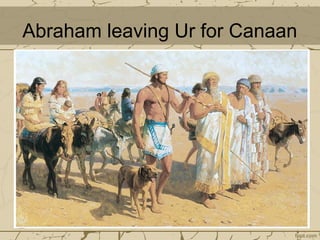
• Abraham—shepherd in Ur around
1800 B.C.; was father of Hebrews
– Torah says God sent Abraham to
leave Ur & settle in Canaan, the
Promised Land
The God of Abraham
• Many people in ancient world
were polytheists, worshiped
many gods
• Hebrews believed God gave
Abraham important teachings
– believed in one all-powerful God
and his moral laws—monotheism
• Hebrew family groups formed
12 tribes
• Stayed in Canaan for 100
years
• Drought forced them to move
to Egypt
Abraham leaving Ur for Canaan
Moses and the Ten
Commandments
• Hebrews enslaved in Egypt –
600 years
• Leader Moses led Hebrews
from Egypt on migration called
Exodus through the desert
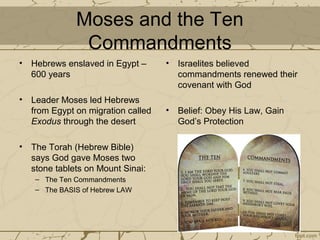
• The Torah (Hebrew Bible)
says God gave Moses two
stone tablets on Mount Sinai:
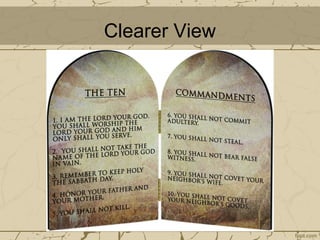
– The Ten Commandments
– The BASIS of Hebrew LAW
• Israelites believed
commandments renewed their
covenant with God
• Belief: Obey His Law, Gain
God’s Protection
Clearer View
Hebrew Beliefs
• Hebrews were not to worship other gods or idols
• Believed god was just; they too should be
• Laws affect the whole community, not just individuals
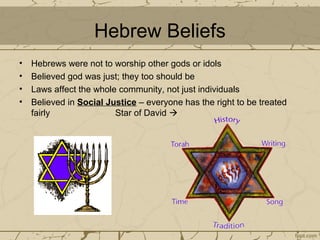
• Believed in Social Justice – everyone has the right to be treated
fairly Star of David 
The Promised Land
• Moses died before Hebrews
reached Canaan
– New leader Joshua brought them
safely to Promised Land
• Saul, warrior-farmer, became
King of 12 Hebrew tribes
• King David reunited Hebrews,
defeated Canaanites
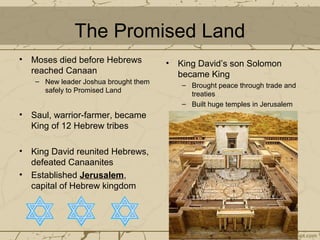
• Established Jerusalem,
capital of Hebrew kingdom
• King David’s son Solomon
became King
– Brought peace through trade and
treaties
– Built huge temples in Jerusalem
The Prophets
• Prophets – persons claiming to
have messages from God
• Criticized Hebrew life –
reminded others of duty to God
and each other
– Warned of God’s punishment
– Mistreatment of poor, corrupt
politicians
• Hebrew Kingdom fell to
powerful neighbors
– After 722 B.C. Israelites of the
North disappeared
– Judeans (in the South in Judah)
survived
– But forced to move to Babylon in
586 B.C.
– Babylonian Jews observed
religious laws, holidays, worship
– Spent 70 years then returned and
rebuilt Jerusalem
– Wrote down laws of Moses in 5
books called The Torah
Major Contributions
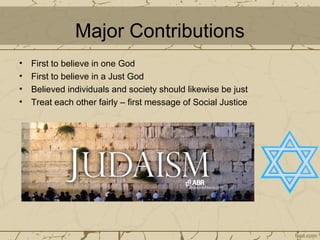
• First to believe in one God
• First to believe in a Just God
• Believed individuals and society should likewise be just
• Treat each other fairly – first message of Social Justice

The Phoenicians & Hebrews

  • 1.
    Chapter 6 The Phoeniciansand the Hebrews 1200 B.C.–510 B.C
  • 2.
    Section 1 –The Phoenicians • “At the eastern end of the Mediterranean Sea lies a piece of land shared today by Lebanon & Israel. In ancient times, it was the bridge that connected Egypt and Mesopotamia, and it was known as Canaan. Soldiers, shepherds, and merchants who passed through Canaan carried new ideas and goods between Egypt and Mesopotamia. • Two groups—the Phoenicians and the Hebrews—settled in Canaan and formed small kingdoms. Through these peaceful activities, they made important contributions to later civilizations.”
  • 3.
    The Phoenicians • Livedin Northern part of Canaan • Knowledge of them comes from: – The Bible, ruins, & writings from other ancients • Two groups formed the Phoenicians: – Canaanites—from the desert south and east of Canaan • Herders – Philistines—from the eastern Mediterranean near Greece • Traders and shipbuilders
  • 4.
    The Growth ofTrade • By 1200 B.C. Phoenicians built cities along land between mountains and the sea • Not enough land to grow food, Phoenicians turned to the sea to make a living • Built strong, fast ships; became coastal traders • Began to control the trade of the Mediterranean • Exchanged cedar logs, cloth, glass, perfume for gold, metals
  • 5.
    The Growth ofTrade • Sailors traveled by sun & stars • Learned the value of making business agreements • Used business ideas to keep peace w/ more powerful neighbors by signing peace treaties, or agreements between states or countries • Promised to supply free shipments of good for their independence • AKA: Created Peace By Trade
  • 6.
    The Cities ofPhoenicia • Collection of independent city- states – Spoke same language, same religion • City-states ruled by king; in time, joint rule by king and rich merchant families • Believed in many gods, tied to nature • Built temples—each had entrance hall, a main hall, and a holy of holies, or most sacred chamber.
  • 7.
    Carthage • Built colonies,or permanent settlements, on North African coast • Most famous trading city/colony: Carthage in 814 B.C.
  • 8.
    The Alphabet • Mostimportant Phoenician idea: the Alphabet • Borrowed writing system of 22 symbols, or letters (based on sounds) from the Canaanites in the south • Phoenicians carried the Canaanite alphabet to Europe – Greeks borrowed it – Romans borrowed it from Greeks
  • 9.
  • 10.
    The Hebrews • Hebrew’sreligion, Judaism, greatly influenced the world • Early Hebrews, or Israelites, were desert nomads & traveling merchants • Followed a route starting from city of Ur in Mesopotamia • Abraham—shepherd in Ur around 1800 B.C.; was father of Hebrews – Torah says God sent Abraham to leave Ur & settle in Canaan, the Promised Land
  • 11.
    The God ofAbraham • Many people in ancient world were polytheists, worshiped many gods • Hebrews believed God gave Abraham important teachings – believed in one all-powerful God and his moral laws—monotheism • Hebrew family groups formed 12 tribes • Stayed in Canaan for 100 years • Drought forced them to move to Egypt
  • 12.
  • 13.
    Moses and theTen Commandments • Hebrews enslaved in Egypt – 600 years • Leader Moses led Hebrews from Egypt on migration called Exodus through the desert • The Torah (Hebrew Bible) says God gave Moses two stone tablets on Mount Sinai: – The Ten Commandments – The BASIS of Hebrew LAW • Israelites believed commandments renewed their covenant with God • Belief: Obey His Law, Gain God’s Protection
  • 14.
  • 15.
    Hebrew Beliefs • Hebrewswere not to worship other gods or idols • Believed god was just; they too should be • Laws affect the whole community, not just individuals • Believed in Social Justice – everyone has the right to be treated fairly Star of David 
  • 16.
    The Promised Land •Moses died before Hebrews reached Canaan – New leader Joshua brought them safely to Promised Land • Saul, warrior-farmer, became King of 12 Hebrew tribes • King David reunited Hebrews, defeated Canaanites • Established Jerusalem, capital of Hebrew kingdom • King David’s son Solomon became King – Brought peace through trade and treaties – Built huge temples in Jerusalem
  • 17.
    The Prophets • Prophets– persons claiming to have messages from God • Criticized Hebrew life – reminded others of duty to God and each other – Warned of God’s punishment – Mistreatment of poor, corrupt politicians • Hebrew Kingdom fell to powerful neighbors – After 722 B.C. Israelites of the North disappeared – Judeans (in the South in Judah) survived – But forced to move to Babylon in 586 B.C. – Babylonian Jews observed religious laws, holidays, worship – Spent 70 years then returned and rebuilt Jerusalem – Wrote down laws of Moses in 5 books called The Torah
  • 18.
    Major Contributions • Firstto believe in one God • First to believe in a Just God • Believed individuals and society should likewise be just • Treat each other fairly – first message of Social Justice

Editor's Notes

  • #12 There in Canaan, they were to worship and obey Yahweh as the one true god. In exchange, Yah-weh promised that they and their descendants, or offspring could always live in Canaan. P. 107
  • #14 Commandments became major part of Western moral, ethical tradition