THE ROLE OF SEMANTICS IN   COMMUNICOLOGY   WITH   REFERENCE TO LANGUAGE TEACHING AND LEARNING   Seyed Hossein Fazeli [email_address]   Department of Linguistics, University of Mysore, Mysore. International Conference on “Quality Improvement in Educational Communication”  29-30 th  March2008-Tiruchirappalli
OUTLINE Introduction 1. The reality and nature of communication   2. Understanding nature of “communication” based on the mathematical models   3. Entity of “Communication” 4. The process of acquiring of “meaning”   5. Where is meaning? (In communication)   6. The elements of messages in communication 7. General view about communication   8.The Concept of “Meaning”   9. General perspective about the process of “Meaning”   10. Characteristics of meaning in communication   11. The use of meaning in communication   12. The Suggested categories OF HUMAN communication  13. Language learning and teaching   14. Language learning and Human Communication   15. Individual differences through language learning   16. Vocabulary in the first and second languages   17. Cultural content as a main role player in language learning and teaching through communication   18. The emphasis of communication and culture in language learning and teaching 19. Communication strategies in Educational Communication   20. Results   21. Conclusion   References
Introduction   “ Semantics” is as a subfield of linguistics, which studies meaning   “ Meaning” as a main subject of semantics  “ Communication” is as a general term  C
1. The reality and nature of  communication   The term “communication” in Webster dictionary (1970) was used as equal to “impact,”, “bestow,” “convey,” and “have interaction” and so on Definitions and Models of Communication Aristotle and Communication Lasswell(1948) and Communication Wright(1957)and Communication Aranguren(1970) and Communication Smith (1988) and Communication
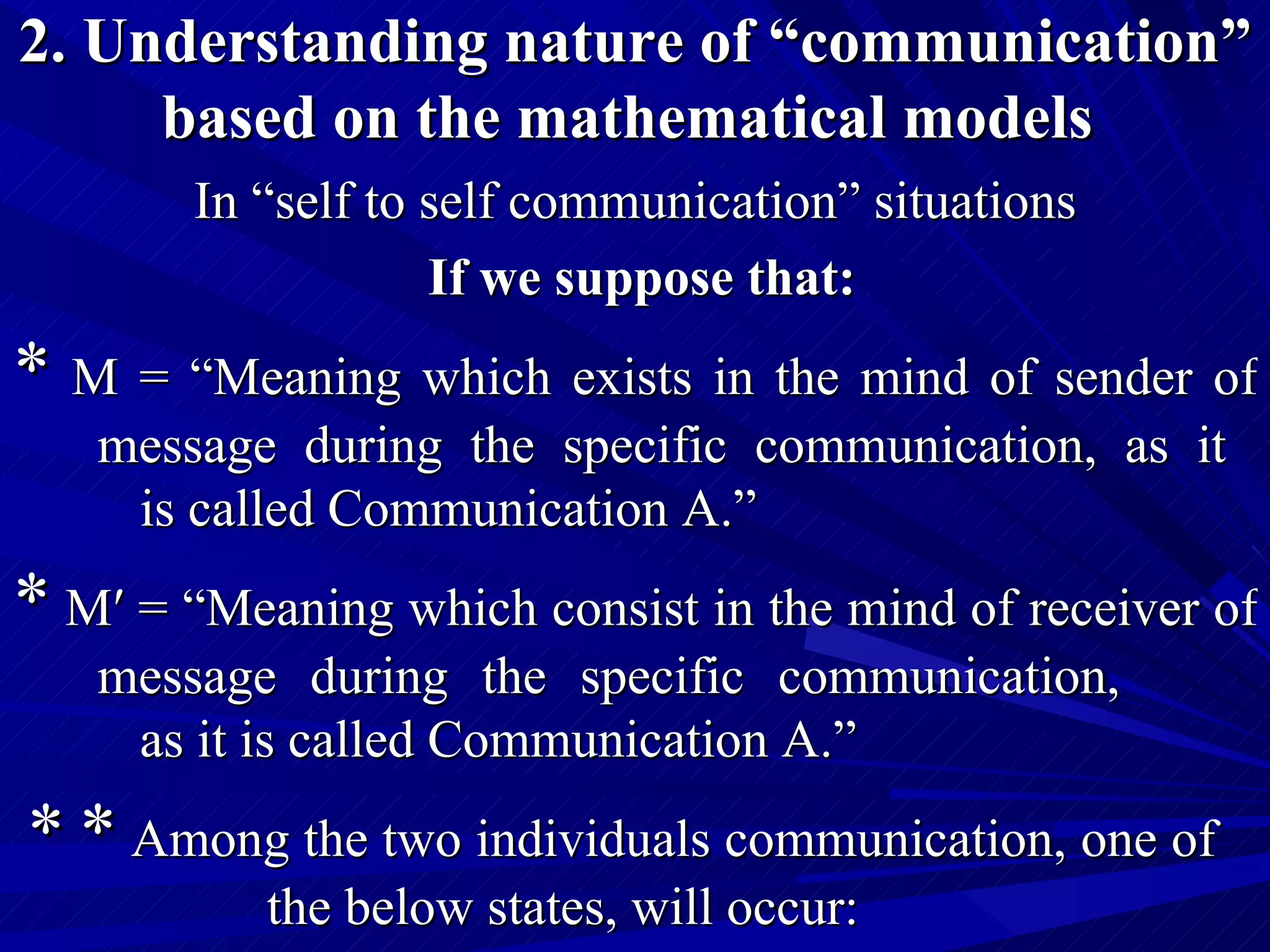
2. Understanding nature of “communication” based on the mathematical models   In “self to self communication” situations If we suppose that: *  M = “Meaning which exists in the mind of sender of message during the specific communication, as it  is called Communication A.” *  M′ = “Meaning which consist in the mind of receiver of message during the specific communication,  as it is called Communication A.”  *   *  Among the two individuals communication, one of  the below states, will occur:
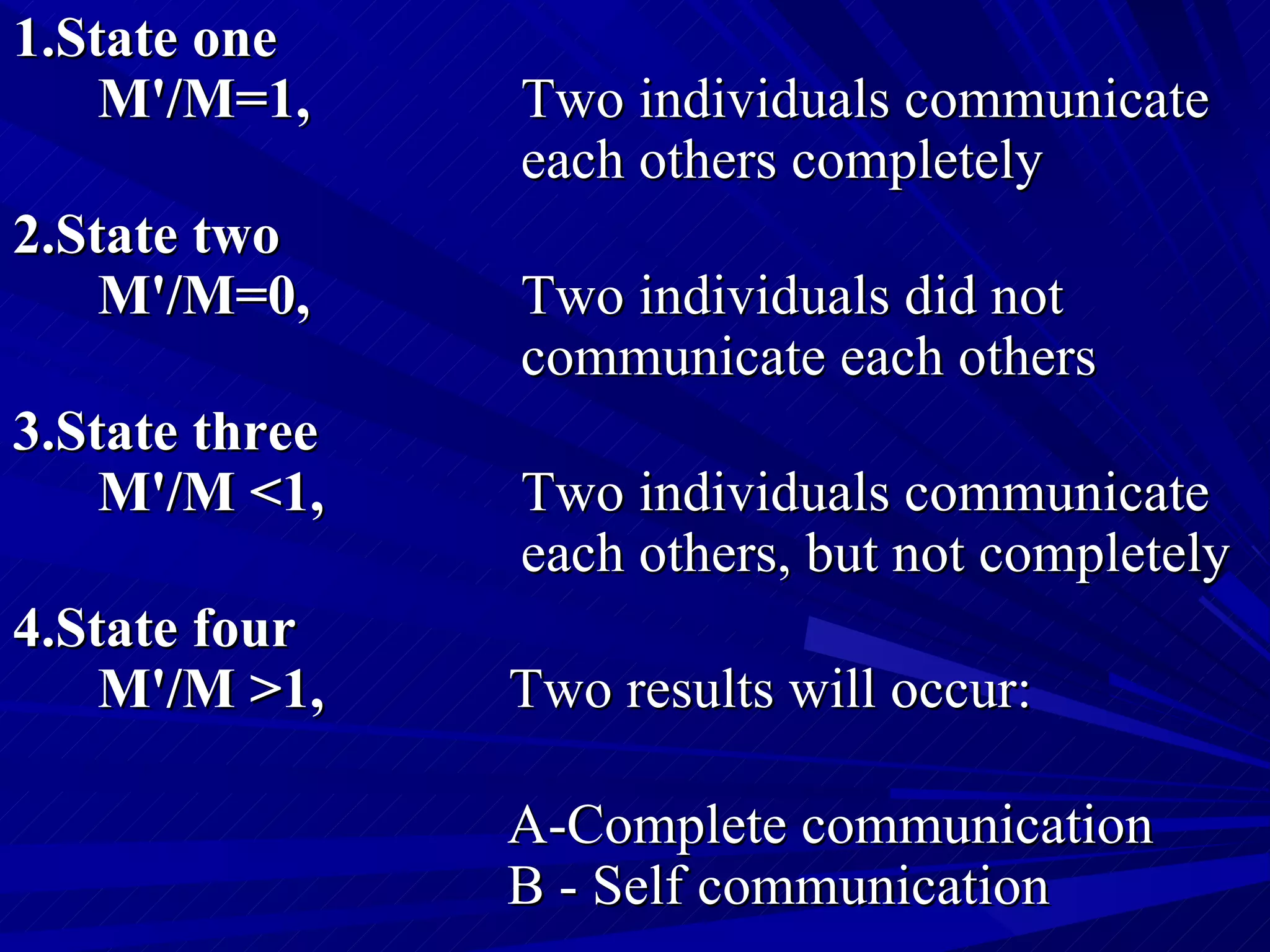
1.State one M'/M=1,   Two individuals communicate  each others completely 2.State two M'/M=0,   Two individuals did not  communicate each others 3.State three M'/M <1,   Two individuals communicate  each others, but not completely 4.State four M'/M >1,   Two results will occur:   A-Complete communication      B - Self communication
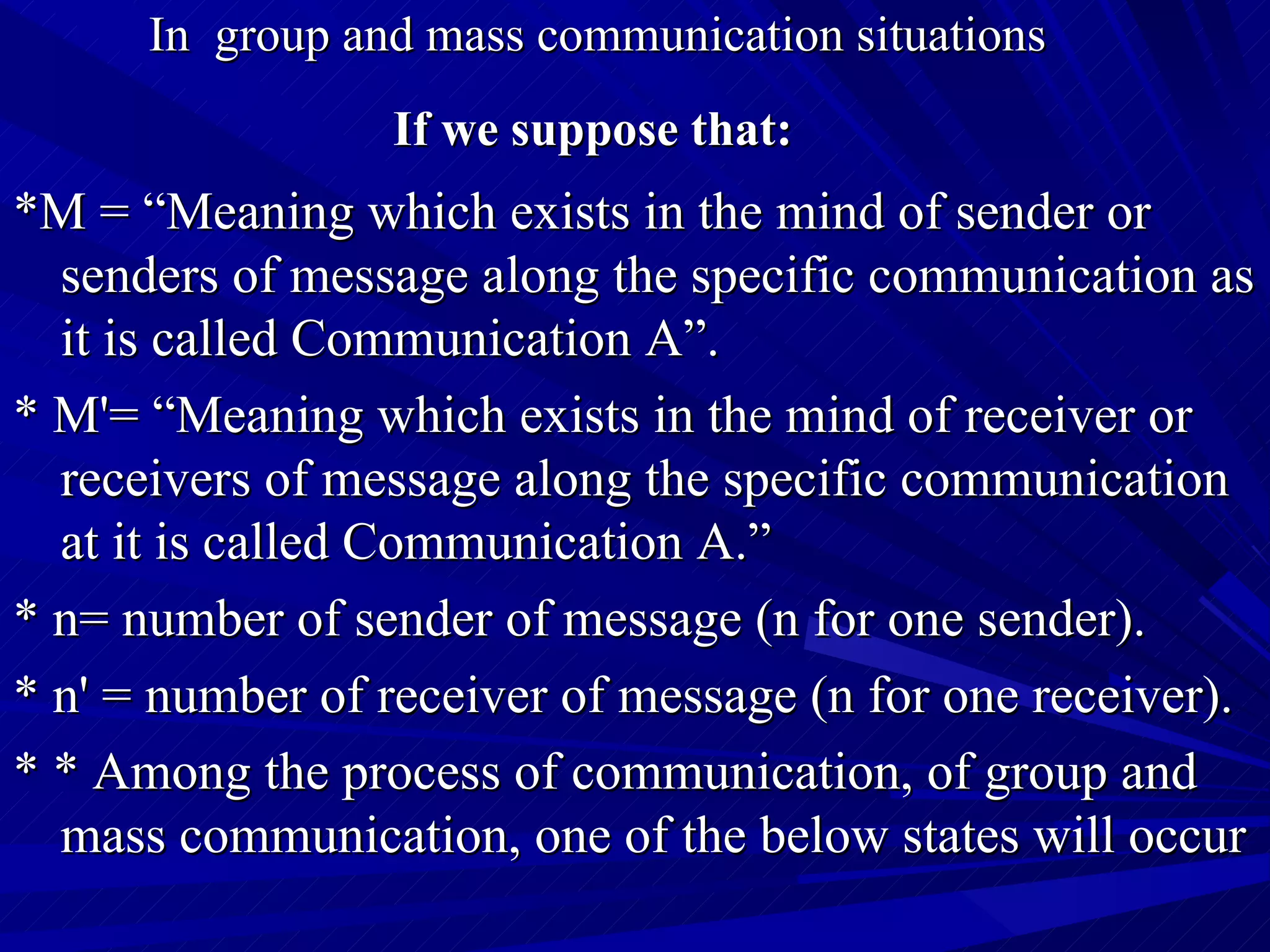
In  group and mass communication situations   If we suppose that:   * M = “Meaning which exists in the mind of sender or senders of message along the specific communication as it is called Communication A”. *  M'= “Meaning which exists in the mind of receiver or receivers of message along the specific communication at it is called Communication A.” *  n= number of sender of message (n for one sender). *  n' = number of receiver of message (n for one receiver). * *  Among the process of communication, of group and mass communication, one of the below states will occur
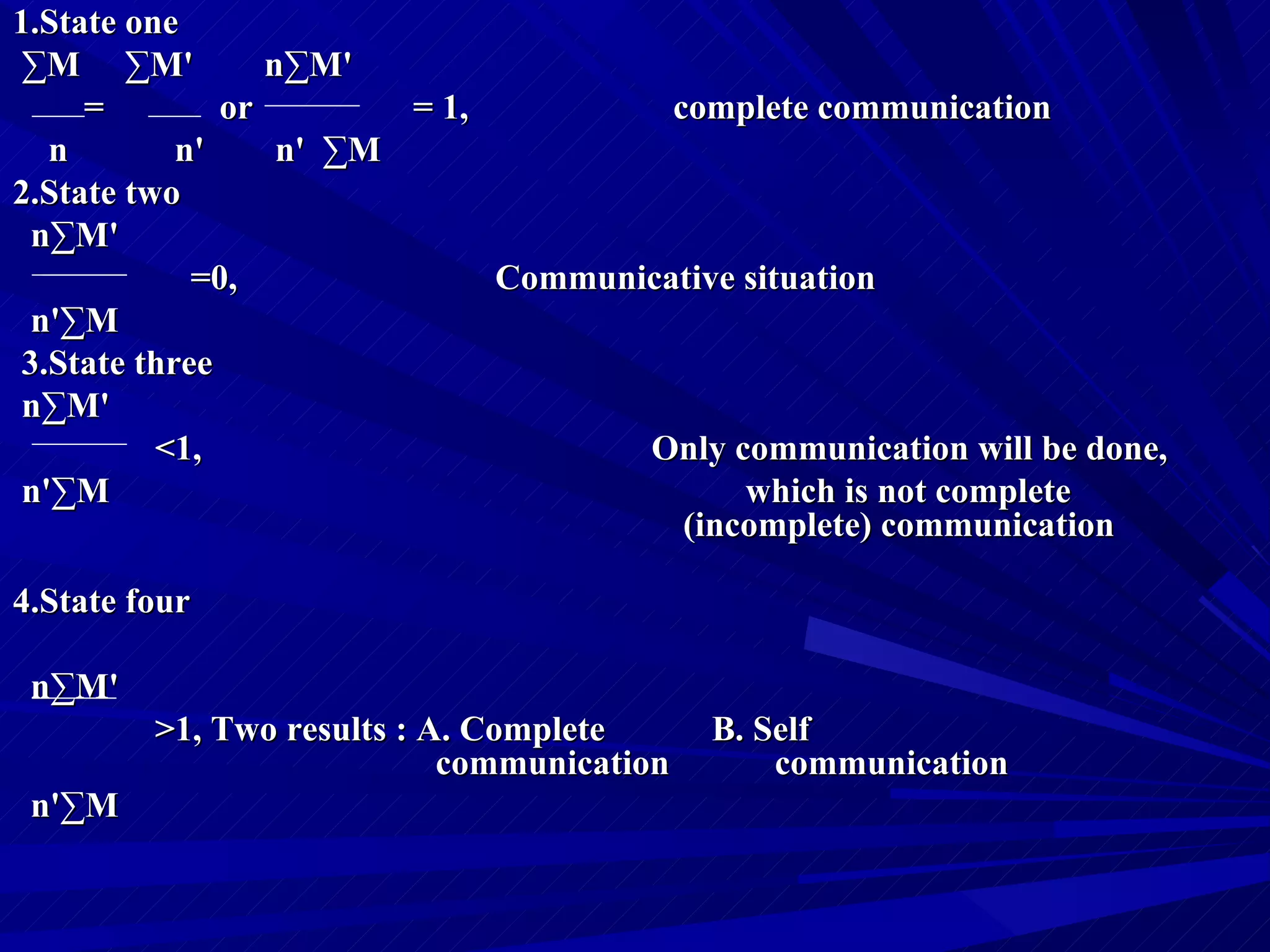
1.State one ∑ M  ∑M '  n∑M ' =  or  = 1,  complete communication n  n '   n '   ∑M 2.State two n∑M ' =0,  Communicative situation n ' ∑M 3.State three n∑M ' < 1,    Only communication will be done,  n ' ∑M    which is not complete    (incomplete) communication  4.State four n∑M ' > 1, Two results : A. Complete  B. Self      communication  communication n ' ∑M
3. Entity of  Communication The process aspect of communication   Communication is not static, but it is dynamic Communication does not have starting or ending point The elements and parts of communication, have mutual interactions to each others
4. The process of acquiring of meaning Human is defined as a communicative animal   Johnson and  acquiring of meaning Berlo and W.Jones and acquiring of meaning Noam chomsky and acquiring of meaning
5. Where is meaning? (In communication)   Berlo and the place of meaning Wallas and the place of meaning L.Norman  and the place of meaning Saches and the place of meaning General view about the place of meaning
6. The elements of messages in communication   Message as prints, sounds, shake landings and any type of sign that can be used to show meaning( W. Schramm 1954)  Message code   Message content   Message treatment   Structure of arranging of code, material and treatment of message
7. General view about communication   Judgments (J) are as result of dominance of subjective (S) on objective (O), G. Hegeal Judgments (J) are as result of dominance of objective (O) on subjective (S), K.Marx Judgments (J) are combination of objective (O) and subjective, M. Weber ELEMENTES IN COMMUNICATION 1.Meaning source of message sender  2.Meaning source of message receiver  3.Communication ability  4.Encoder  5.Code sender  6. Channle  7.Message  8.Code receiver  9.Decoder  10.Evaluation of message 11.Send back  12.Evaluation of send back  13.Noise
8.The  Concept  of Meaning   The main problem in meaning One dynamic bilateral action occurs among the receiver with the message   based on  a particular Social-cultural experience  (J. Watson 1984)  Language,Dictionary and Meaning We use language to express our meaning
9. General perspective about the process of Meaning Extremely, the words do not have any meaning   Meanings are in the humans   Meanings are as cause to reply Meaning are as personal properties   Meanings will learned, added or deleted but will not be found “ Communication” does not include any transformation of meaning  Meaning is not in the message  The elements and components of language, are lack of meaning and they are as symbol and guidance  Some people have codes for some meanings; however, the other people do not have  One type of egocentric  in communication
10. Characteristics of meaning in communication   Meaning is not in the message  Meaning is in the human Meanings are as personal properties  Meaning is learned, added or deleted Language is lack of meaning Meaning is undiscovered Meaning is un transferable
11. The use of meaning in communication To know the people; we should know their conception of language  Implicit meaning of individuals are represented through the words Meanings are represented  in  particular point of time Berlo stated one story that he had asked one person: “why does he call one pig, pig?” that person answered: “because pig is piggish”
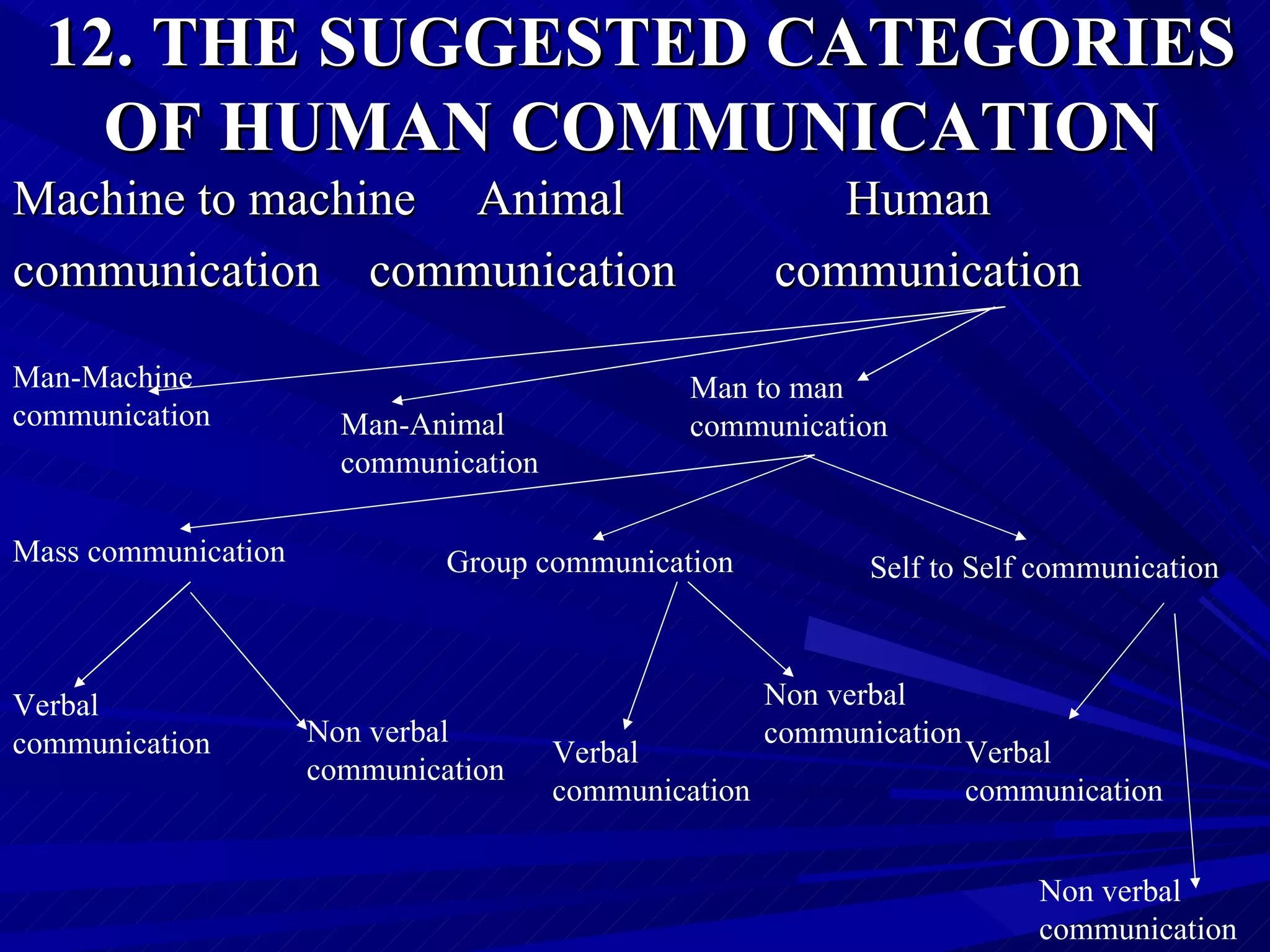
12. THE SUGGESTED CATEGORIES OF HUMAN COMMUNICATION   Machine to machine  Animal  Human  communication  communication  communication Man-Machine  communication Man-Animal communication Man to man communication Mass communication Group communication Self to Self communication Verbal  communication Non verbal communication Verbal  communication Non verbal communication Verbal  communication Non verbal communication
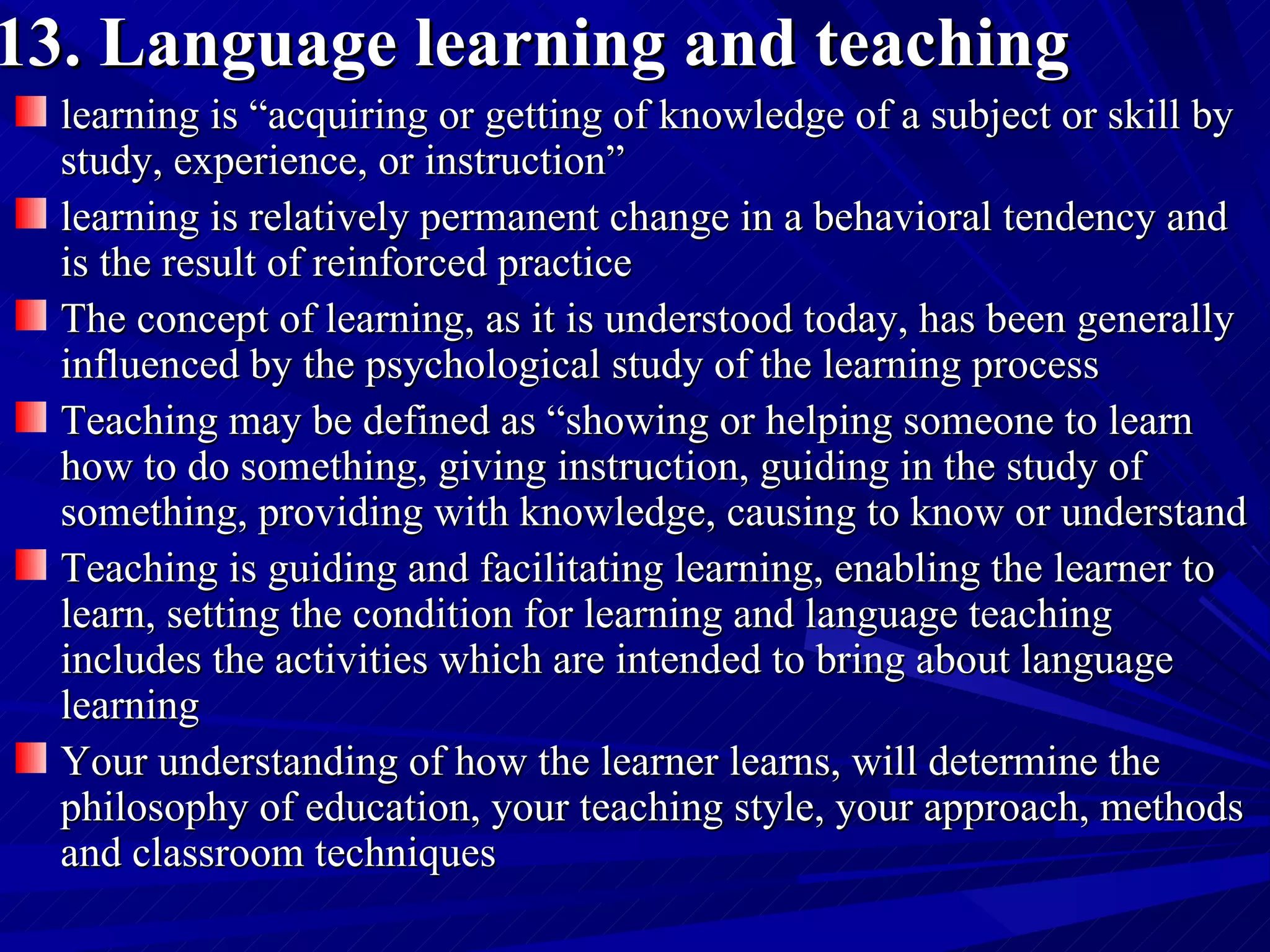
13. Language learning and teaching   learning is “acquiring or getting of knowledge of a subject or skill by study, experience, or instruction”  learning is relatively permanent change in a behavioral tendency and is the result of reinforced practice  The concept of learning, as it is understood today, has been generally influenced by the psychological study of the learning process  Teaching may be defined as “showing or helping someone to learn how to do something, giving instruction, guiding in the study of something, providing with knowledge, causing to know or understand  Teaching is guiding and facilitating learning, enabling the learner to learn, setting the condition for learning and language teaching includes the activities which are intended to bring about language learning  Your understanding of how the learner learns, will determine the philosophy of education, your teaching style, your approach, methods and classroom techniques
14.Language learning and Human Communication Language is acquiring the ability to use its structure within general vocabulary (sign) under essentially the condition of human communication  Acquisition of the language, associated with units and patterns of content that together constitute the language  All language learning occurs through experience
15. Individual differences through language learning Language learning proceeds at different rates for different persons under seemingly the same conditions  The differences are related to different capacities which are the results of genetic potential plus total past experiences Total past experiences, include the total social, cultural, religion and the other effect ons and experiences of individuals
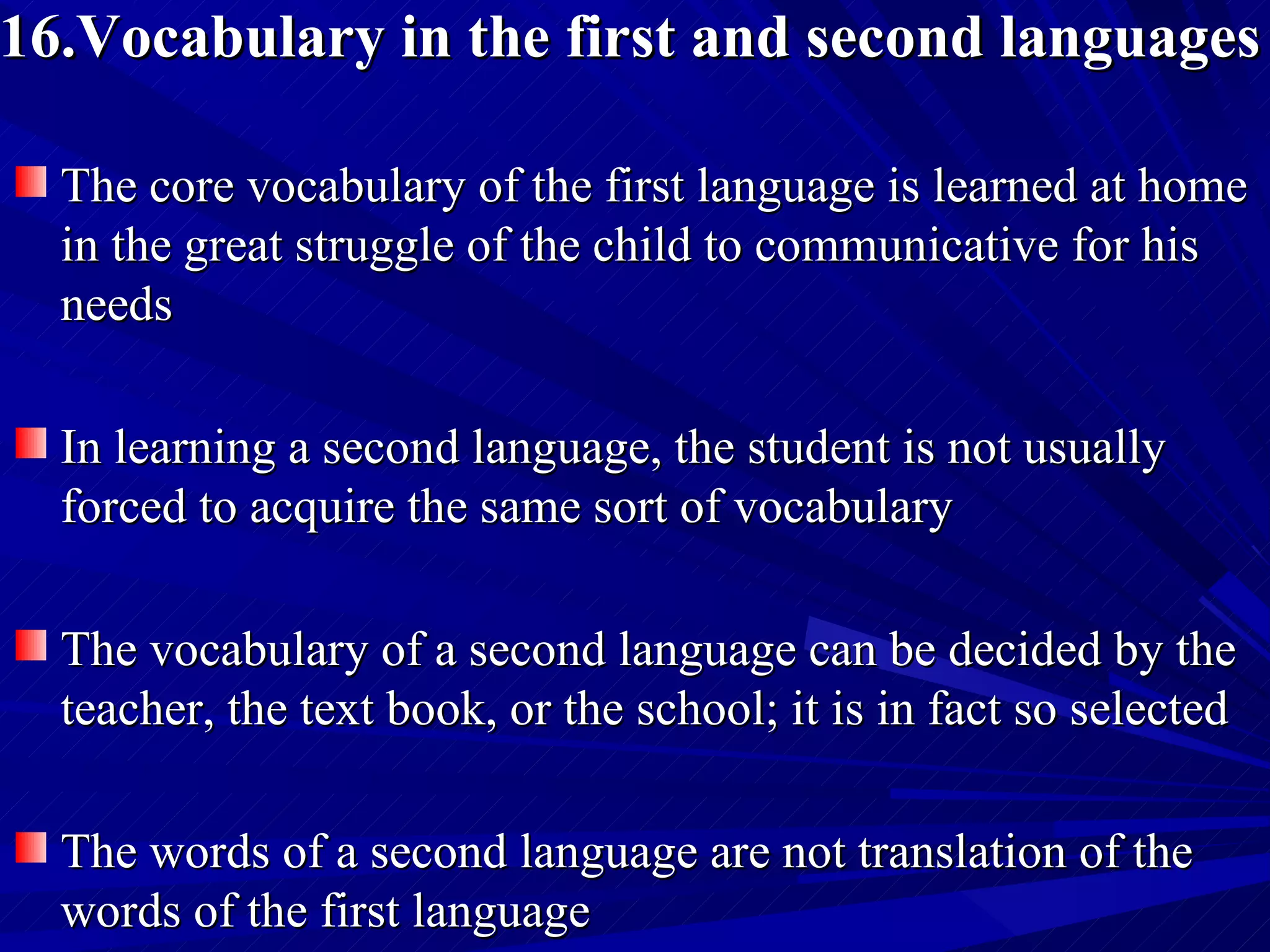
16.Vocabulary in the first and second languages The core vocabulary of the first language is learned at home in the great struggle of the child to communicative for his needs  In learning a second language, the student is not usually forced to acquire the same sort of vocabulary The vocabulary of a second language can be decided by the teacher, the text book, or the school; it is in fact so selected The words of a second language are not translation of the words of the first language
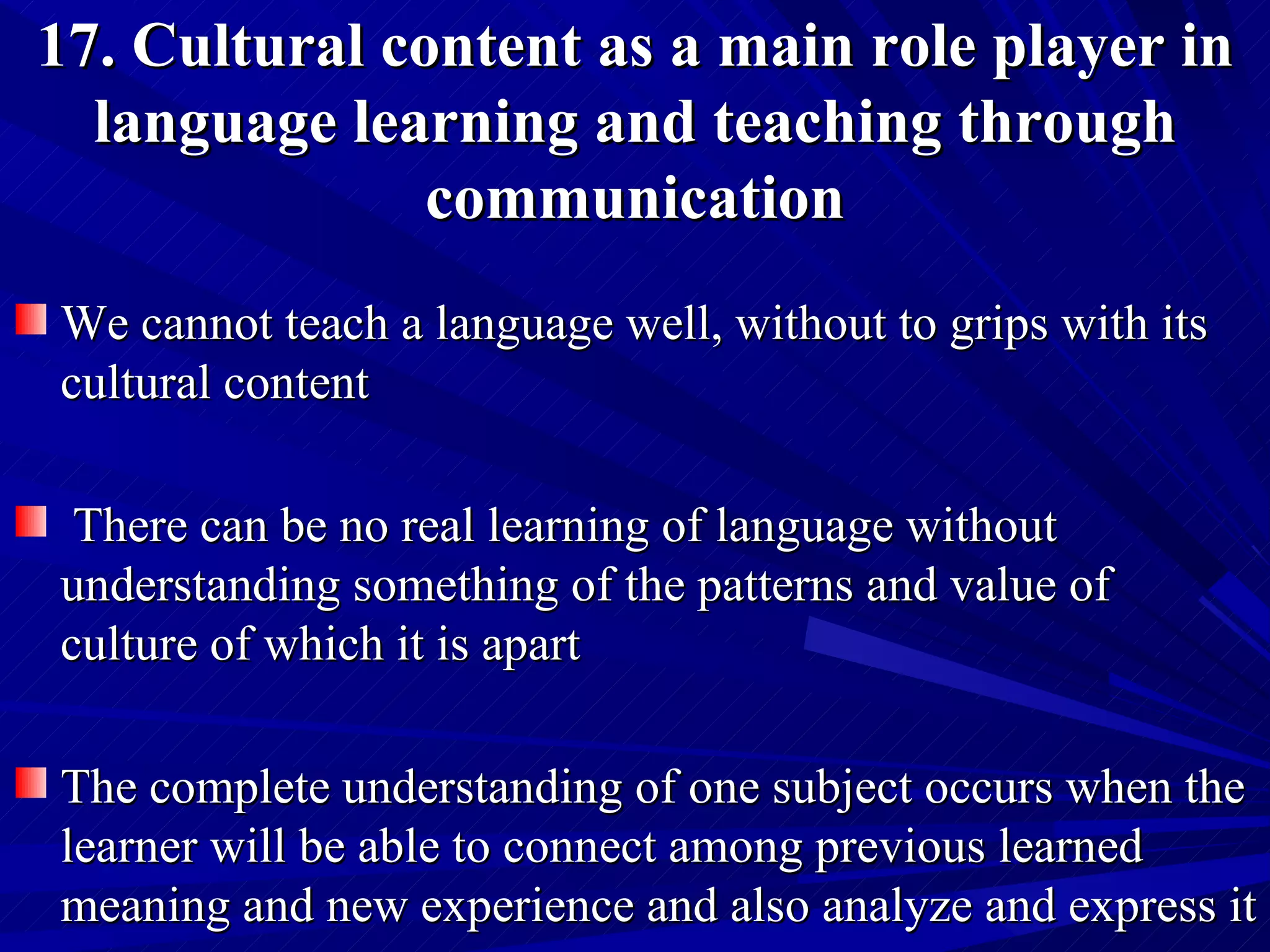
17. Cultural content as a main role player in language learning and teaching through communication We cannot teach a language well, without to grips with its cultural content There can be no real learning of language without understanding something of the patterns and value of culture of which it is apart  The complete understanding of one subject occurs when the learner will be able to connect among previous learned meaning and new experience and also analyze and express it
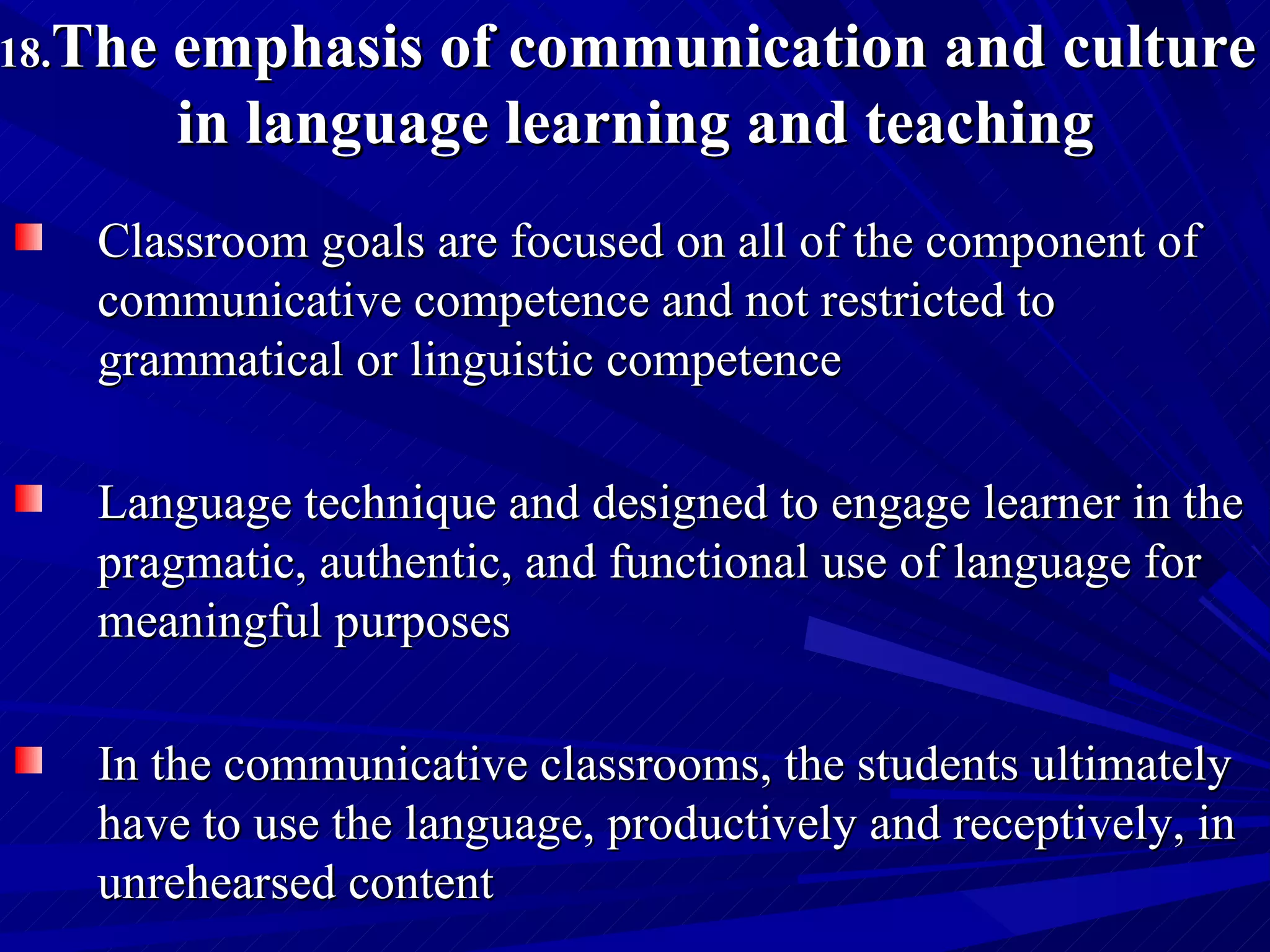
18. The emphasis of communication and culture  in language learning and teaching Classroom goals are focused on all of the component of communicative competence and not restricted to grammatical or linguistic competence Language technique and designed to engage learner in the pragmatic, authentic, and functional use of language for meaningful purposes In the communicative classrooms, the students ultimately have to use the language, productively and receptively, in unrehearsed content
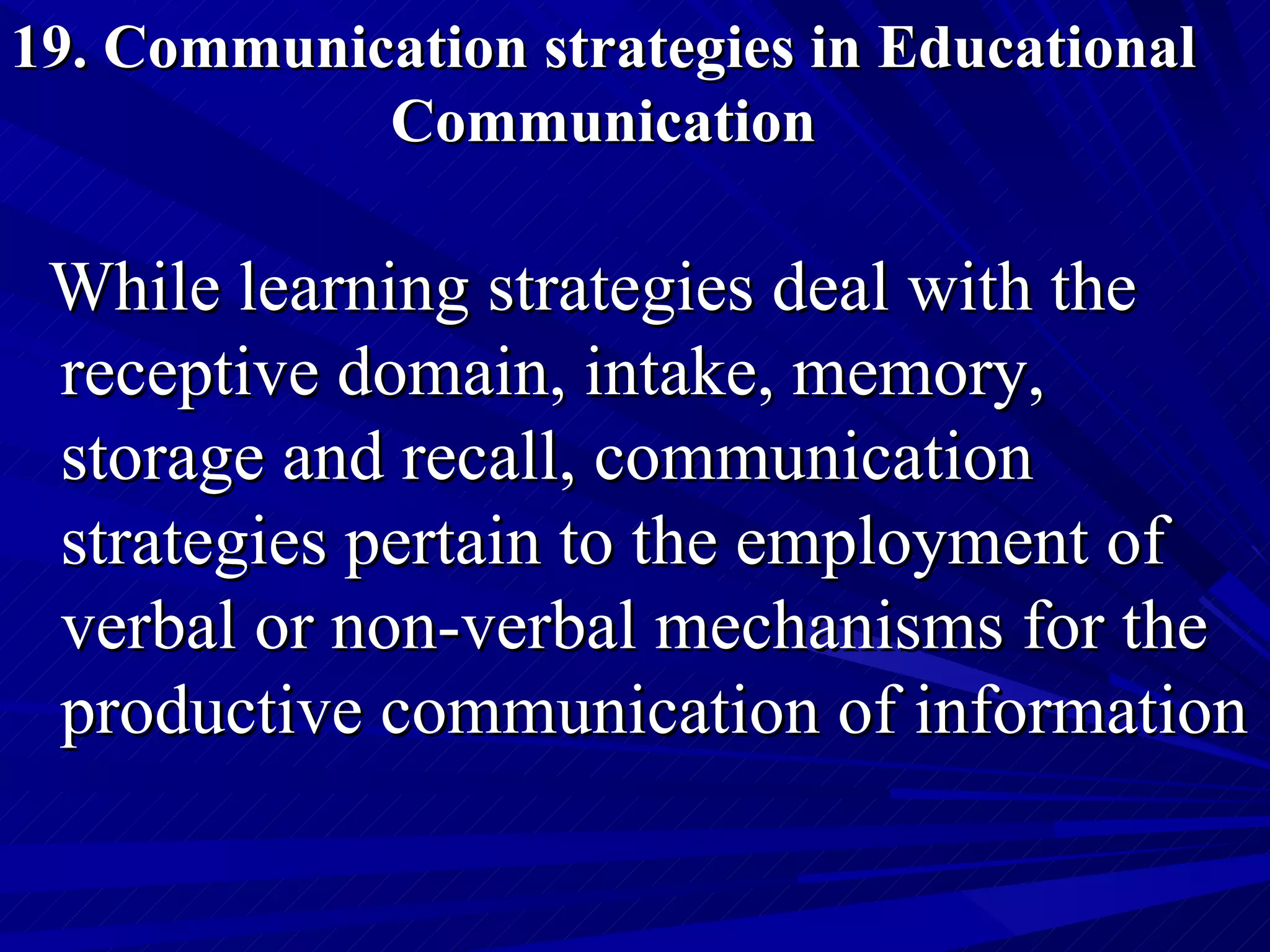
19. Communication strategies in Educational Communication While learning strategies deal with the receptive domain, intake, memory, storage and recall, communication strategies pertain to the employment of verbal or non-verbal mechanisms for the productive communication of information
20. Results The second language text book designers and language teachers should be based on that language includes the symbols only Both of the text book design and teaching should be done based on the communicative view of the learning  Individual potential in the learning are different Meaning of different individual are not same in both same and different languages  Similarities in individuals can be helpful and useful in communication The similarities of meaning are as joint point or aspect makes possible to joint the teacher and learner for different purposes of learning  The meaningful situation can be made based on the cultural, social and the others  The two languages are not translation of each others
21. Conclusion Language teaching and learning is as a type process of communication among the teacher, learner, and text book and so on  If semantics will be so more equipped with the help of the other branches, it can be as main criteria in the study of many universal situations The study of nature of meaning and communication and also the role of meaning in communication can be used for different purposes such as educational communication
References 1. A.kamajian,A. and R.A.Demers.1997.Lingiustics:An introduction to language and communication. M.I.T  press. 2. Crystal, D.1992.An encyclopedic dictionary of language and languages. Black well  publication. 3. Steren, H.H.1991.Fundemental concepts of language teaching. Oxford  university  publication. 4. Brown, H.D.H.1994.Pinciples of language learning and teaching. Prentice Hall Regents. 5. Krashen, S.D.1987.Principles and practice in second language acquisition.(Language methodology series).Prentice-Hall international(UK) LTD. 6. Fisiak, J, 1981.Contrastive Linguistics and the language teacher. Pergamon  press ltd. 7. Keshavarz, M.H.1999.Contrstive analysis and Erorr Analysis. Tehran: Rahnama publication. 8. James, C.1981.Contrastive Analysis. Longman group ltd. 9. Polman, R.1997.Behavioral Genetics. (Translated in Persian by:Nik KHo,M.R.2001.Tehran:Mehtab publication). 10. Dabir-Moghddam.M.2007.Theroretical Linguistics: Emergence and development of generative grammar. Tehran:Samt publication. 11. Mohseniaan Raad, M.2005. Communicology: An innovative definition and model for communication process. Tehran: Soroush press. 12. Avanguren, J.L.1970. Human communication. World University Library. New York: McGraw Hill Book Co. 13. Berlo, D.1960. The process of communication. Michigan State University. New York: Rinehart and Winston. 14. Hilgard, E.R.1975.Introduction to Psychology. New York: Harcourt Brace 15. Lasswell, D.H.1948.The Structure and Function of Communication in Society. New York: Harper. 16. Osgood, C.E.1957.The measurement of meaning, the nature of the semantic differential and its application in several fields. Chicago: University of Illinois. 17. Piaget, J.1971. The child’s conception of the world. New York: Harcourt Brace. 18.  De Saussure, F.1916.Course de Linguistique. Paris: General. 19. Webster Dictionary.1970. New International Dictionary of English Language. Massachusetts: G and C. Merriam Co. 20. Windohl, S.1979.A uses and effects model: Some suggestions. University of Lund.
I acknowledge that I did the main frame of my work through the process of Dr. Mehdi Mohesniaan raad’s works .
THANK YOU

The role of semantics in communicology with reference to language teaching and learning

  • 1.
    THE ROLE OFSEMANTICS IN COMMUNICOLOGY WITH REFERENCE TO LANGUAGE TEACHING AND LEARNING Seyed Hossein Fazeli [email_address] Department of Linguistics, University of Mysore, Mysore. International Conference on “Quality Improvement in Educational Communication” 29-30 th March2008-Tiruchirappalli
  • 2.
    OUTLINE Introduction 1.The reality and nature of communication 2. Understanding nature of “communication” based on the mathematical models 3. Entity of “Communication” 4. The process of acquiring of “meaning” 5. Where is meaning? (In communication) 6. The elements of messages in communication 7. General view about communication 8.The Concept of “Meaning” 9. General perspective about the process of “Meaning” 10. Characteristics of meaning in communication 11. The use of meaning in communication 12. The Suggested categories OF HUMAN communication 13. Language learning and teaching 14. Language learning and Human Communication 15. Individual differences through language learning 16. Vocabulary in the first and second languages 17. Cultural content as a main role player in language learning and teaching through communication 18. The emphasis of communication and culture in language learning and teaching 19. Communication strategies in Educational Communication 20. Results 21. Conclusion References
  • 3.
    Introduction   “Semantics” is as a subfield of linguistics, which studies meaning “ Meaning” as a main subject of semantics “ Communication” is as a general term C
  • 4.
    1. The realityand nature of communication The term “communication” in Webster dictionary (1970) was used as equal to “impact,”, “bestow,” “convey,” and “have interaction” and so on Definitions and Models of Communication Aristotle and Communication Lasswell(1948) and Communication Wright(1957)and Communication Aranguren(1970) and Communication Smith (1988) and Communication
  • 5.
    2. Understanding natureof “communication” based on the mathematical models In “self to self communication” situations If we suppose that: * M = “Meaning which exists in the mind of sender of message during the specific communication, as it is called Communication A.” * M′ = “Meaning which consist in the mind of receiver of message during the specific communication, as it is called Communication A.” * * Among the two individuals communication, one of the below states, will occur:
  • 6.
    1.State one M'/M=1, Two individuals communicate each others completely 2.State two M'/M=0, Two individuals did not communicate each others 3.State three M'/M <1, Two individuals communicate each others, but not completely 4.State four M'/M >1, Two results will occur: A-Complete communication B - Self communication
  • 7.
    In groupand mass communication situations If we suppose that: * M = “Meaning which exists in the mind of sender or senders of message along the specific communication as it is called Communication A”. * M'= “Meaning which exists in the mind of receiver or receivers of message along the specific communication at it is called Communication A.” * n= number of sender of message (n for one sender). * n' = number of receiver of message (n for one receiver). * * Among the process of communication, of group and mass communication, one of the below states will occur
  • 8.
    1.State one ∑M ∑M ' n∑M ' = or = 1, complete communication n n ' n ' ∑M 2.State two n∑M ' =0, Communicative situation n ' ∑M 3.State three n∑M ' < 1, Only communication will be done, n ' ∑M which is not complete (incomplete) communication 4.State four n∑M ' > 1, Two results : A. Complete B. Self communication communication n ' ∑M
  • 9.
    3. Entity of Communication The process aspect of communication Communication is not static, but it is dynamic Communication does not have starting or ending point The elements and parts of communication, have mutual interactions to each others
  • 10.
    4. The processof acquiring of meaning Human is defined as a communicative animal Johnson and acquiring of meaning Berlo and W.Jones and acquiring of meaning Noam chomsky and acquiring of meaning
  • 11.
    5. Where ismeaning? (In communication) Berlo and the place of meaning Wallas and the place of meaning L.Norman and the place of meaning Saches and the place of meaning General view about the place of meaning
  • 12.
    6. The elementsof messages in communication Message as prints, sounds, shake landings and any type of sign that can be used to show meaning( W. Schramm 1954) Message code Message content Message treatment Structure of arranging of code, material and treatment of message
  • 13.
    7. General viewabout communication Judgments (J) are as result of dominance of subjective (S) on objective (O), G. Hegeal Judgments (J) are as result of dominance of objective (O) on subjective (S), K.Marx Judgments (J) are combination of objective (O) and subjective, M. Weber ELEMENTES IN COMMUNICATION 1.Meaning source of message sender 2.Meaning source of message receiver 3.Communication ability 4.Encoder 5.Code sender 6. Channle 7.Message 8.Code receiver 9.Decoder 10.Evaluation of message 11.Send back 12.Evaluation of send back 13.Noise
  • 14.
    8.The Concept of Meaning The main problem in meaning One dynamic bilateral action occurs among the receiver with the message based on a particular Social-cultural experience (J. Watson 1984) Language,Dictionary and Meaning We use language to express our meaning
  • 15.
    9. General perspectiveabout the process of Meaning Extremely, the words do not have any meaning Meanings are in the humans Meanings are as cause to reply Meaning are as personal properties Meanings will learned, added or deleted but will not be found “ Communication” does not include any transformation of meaning Meaning is not in the message The elements and components of language, are lack of meaning and they are as symbol and guidance Some people have codes for some meanings; however, the other people do not have One type of egocentric in communication
  • 16.
    10. Characteristics ofmeaning in communication Meaning is not in the message Meaning is in the human Meanings are as personal properties Meaning is learned, added or deleted Language is lack of meaning Meaning is undiscovered Meaning is un transferable
  • 17.
    11. The useof meaning in communication To know the people; we should know their conception of language Implicit meaning of individuals are represented through the words Meanings are represented in particular point of time Berlo stated one story that he had asked one person: “why does he call one pig, pig?” that person answered: “because pig is piggish”
  • 18.
    12. THE SUGGESTEDCATEGORIES OF HUMAN COMMUNICATION Machine to machine Animal Human communication communication communication Man-Machine communication Man-Animal communication Man to man communication Mass communication Group communication Self to Self communication Verbal communication Non verbal communication Verbal communication Non verbal communication Verbal communication Non verbal communication
  • 19.
    13. Language learningand teaching learning is “acquiring or getting of knowledge of a subject or skill by study, experience, or instruction” learning is relatively permanent change in a behavioral tendency and is the result of reinforced practice The concept of learning, as it is understood today, has been generally influenced by the psychological study of the learning process Teaching may be defined as “showing or helping someone to learn how to do something, giving instruction, guiding in the study of something, providing with knowledge, causing to know or understand Teaching is guiding and facilitating learning, enabling the learner to learn, setting the condition for learning and language teaching includes the activities which are intended to bring about language learning Your understanding of how the learner learns, will determine the philosophy of education, your teaching style, your approach, methods and classroom techniques
  • 20.
    14.Language learning andHuman Communication Language is acquiring the ability to use its structure within general vocabulary (sign) under essentially the condition of human communication Acquisition of the language, associated with units and patterns of content that together constitute the language All language learning occurs through experience
  • 21.
    15. Individual differencesthrough language learning Language learning proceeds at different rates for different persons under seemingly the same conditions The differences are related to different capacities which are the results of genetic potential plus total past experiences Total past experiences, include the total social, cultural, religion and the other effect ons and experiences of individuals
  • 22.
    16.Vocabulary in thefirst and second languages The core vocabulary of the first language is learned at home in the great struggle of the child to communicative for his needs In learning a second language, the student is not usually forced to acquire the same sort of vocabulary The vocabulary of a second language can be decided by the teacher, the text book, or the school; it is in fact so selected The words of a second language are not translation of the words of the first language
  • 23.
    17. Cultural contentas a main role player in language learning and teaching through communication We cannot teach a language well, without to grips with its cultural content There can be no real learning of language without understanding something of the patterns and value of culture of which it is apart The complete understanding of one subject occurs when the learner will be able to connect among previous learned meaning and new experience and also analyze and express it
  • 24.
    18. The emphasisof communication and culture in language learning and teaching Classroom goals are focused on all of the component of communicative competence and not restricted to grammatical or linguistic competence Language technique and designed to engage learner in the pragmatic, authentic, and functional use of language for meaningful purposes In the communicative classrooms, the students ultimately have to use the language, productively and receptively, in unrehearsed content
  • 25.
    19. Communication strategiesin Educational Communication While learning strategies deal with the receptive domain, intake, memory, storage and recall, communication strategies pertain to the employment of verbal or non-verbal mechanisms for the productive communication of information
  • 26.
    20. Results Thesecond language text book designers and language teachers should be based on that language includes the symbols only Both of the text book design and teaching should be done based on the communicative view of the learning Individual potential in the learning are different Meaning of different individual are not same in both same and different languages Similarities in individuals can be helpful and useful in communication The similarities of meaning are as joint point or aspect makes possible to joint the teacher and learner for different purposes of learning The meaningful situation can be made based on the cultural, social and the others The two languages are not translation of each others
  • 27.
    21. Conclusion Languageteaching and learning is as a type process of communication among the teacher, learner, and text book and so on If semantics will be so more equipped with the help of the other branches, it can be as main criteria in the study of many universal situations The study of nature of meaning and communication and also the role of meaning in communication can be used for different purposes such as educational communication
  • 28.
    References 1. A.kamajian,A.and R.A.Demers.1997.Lingiustics:An introduction to language and communication. M.I.T press. 2. Crystal, D.1992.An encyclopedic dictionary of language and languages. Black well publication. 3. Steren, H.H.1991.Fundemental concepts of language teaching. Oxford university publication. 4. Brown, H.D.H.1994.Pinciples of language learning and teaching. Prentice Hall Regents. 5. Krashen, S.D.1987.Principles and practice in second language acquisition.(Language methodology series).Prentice-Hall international(UK) LTD. 6. Fisiak, J, 1981.Contrastive Linguistics and the language teacher. Pergamon press ltd. 7. Keshavarz, M.H.1999.Contrstive analysis and Erorr Analysis. Tehran: Rahnama publication. 8. James, C.1981.Contrastive Analysis. Longman group ltd. 9. Polman, R.1997.Behavioral Genetics. (Translated in Persian by:Nik KHo,M.R.2001.Tehran:Mehtab publication). 10. Dabir-Moghddam.M.2007.Theroretical Linguistics: Emergence and development of generative grammar. Tehran:Samt publication. 11. Mohseniaan Raad, M.2005. Communicology: An innovative definition and model for communication process. Tehran: Soroush press. 12. Avanguren, J.L.1970. Human communication. World University Library. New York: McGraw Hill Book Co. 13. Berlo, D.1960. The process of communication. Michigan State University. New York: Rinehart and Winston. 14. Hilgard, E.R.1975.Introduction to Psychology. New York: Harcourt Brace 15. Lasswell, D.H.1948.The Structure and Function of Communication in Society. New York: Harper. 16. Osgood, C.E.1957.The measurement of meaning, the nature of the semantic differential and its application in several fields. Chicago: University of Illinois. 17. Piaget, J.1971. The child’s conception of the world. New York: Harcourt Brace. 18. De Saussure, F.1916.Course de Linguistique. Paris: General. 19. Webster Dictionary.1970. New International Dictionary of English Language. Massachusetts: G and C. Merriam Co. 20. Windohl, S.1979.A uses and effects model: Some suggestions. University of Lund.
  • 29.
    I acknowledge thatI did the main frame of my work through the process of Dr. Mehdi Mohesniaan raad’s works .
  • 30.