The Role of High Quality
Data in Performance
Management
DATA DRIVEN DECISION MAKING
FS 614929
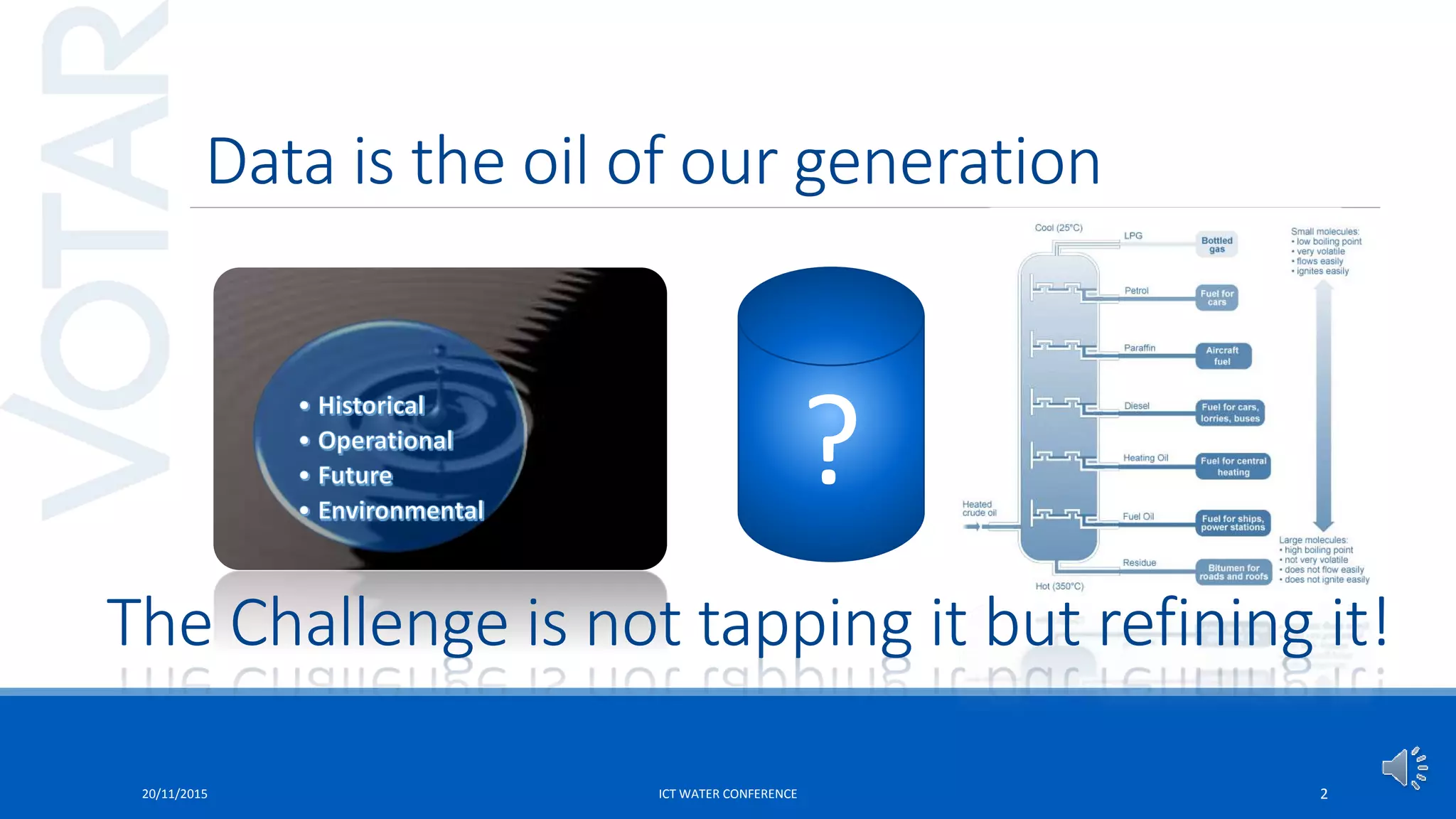
Data is the oil of our generation
20/11/2015 ICT WATER CONFERENCE 2
The Challenge is not tapping it but refining it!
?
Elements of
Performance
Innovation
Customers
Water management
Sewerage management
People
Sustainability
20/11/2015 ICT WATER CONFERENCE 3
The business landscape
20/11/2015 ICT WATER CONFERENCE 4
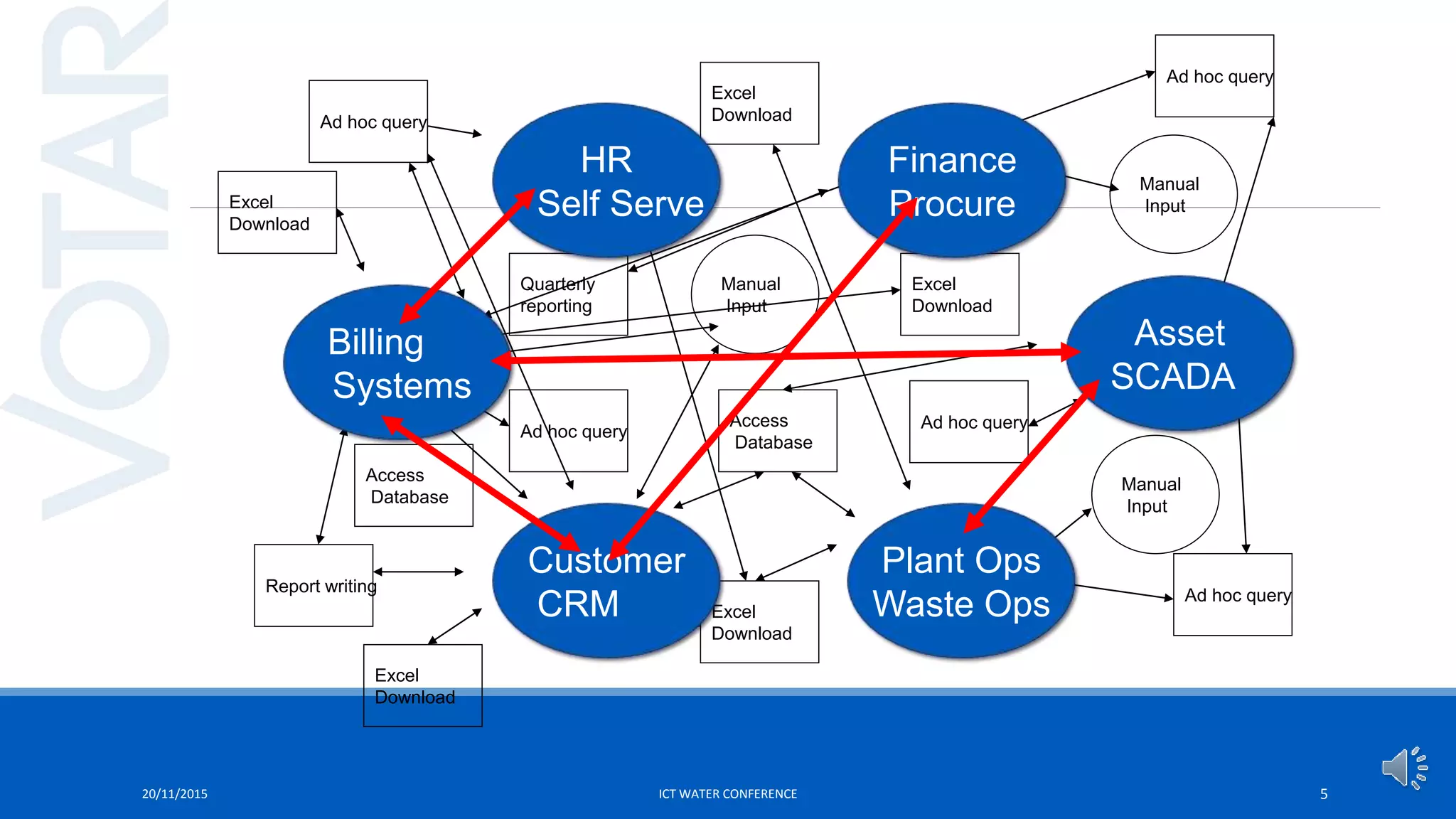
20/11/2015 ICT WATER CONFERENCE 5
Report writing
Ad hoc query
Ad hoc query
Ad hoc query
Ad hoc query
Ad hoc query
Excel
Download
Excel
Download
Excel
Download
Excel
Download
Quarterly
reporting
Access
Database
Access
Database
Manual
Input
Manual
Input
Manual
Input
Excel
Download
Billing
Systems
Customer
CRM
Plant Ops
Waste Ops
Asset
SCADA
Finance
Procure
HR
Self Serve
Focus Areas
20/11/2015 ICT WATER CONFERENCE 6
…to have high quality data and systems that give us an integrated view of customers
and our environment performance…
20/11/2015 ICT WATER CONFERENCE 7
COMPETITIVENESS
CUMULATED INVESTMENT
Process Efficiency
Transactional• Manage transactions
• Enter data
• Make changes to existing data
• Keep track of transactions
• Large volumes
• Read and Write
• Output based
• Historical and future
Decision
Effectiveness
THE TURNING POINT
Decision
Making
Systems
Of
Record
Support
Systems
Leveraging our core systems
20/11/2015 ICT WATER CONFERENCE 8
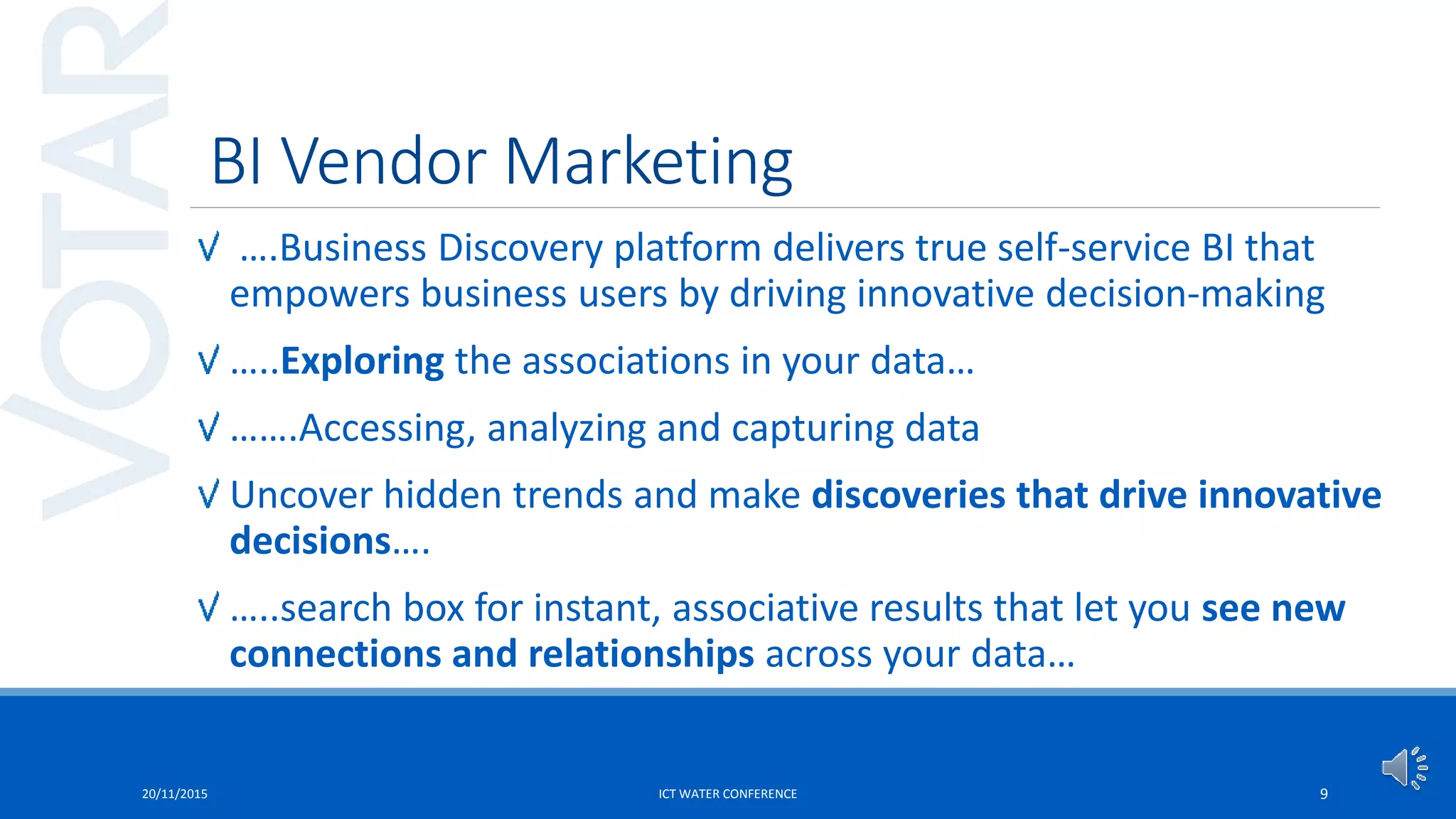
BI Vendor Marketing
….Business Discovery platform delivers true self-service BI that
empowers business users by driving innovative decision-making
…..Exploring the associations in your data…
…….Accessing, analyzing and capturing data
Uncover hidden trends and make discoveries that drive innovative
decisions….
…..search box for instant, associative results that let you see new
connections and relationships across your data…
20/11/2015 ICT WATER CONFERENCE 9
20/11/2015 ICT WATER CONFERENCE 10
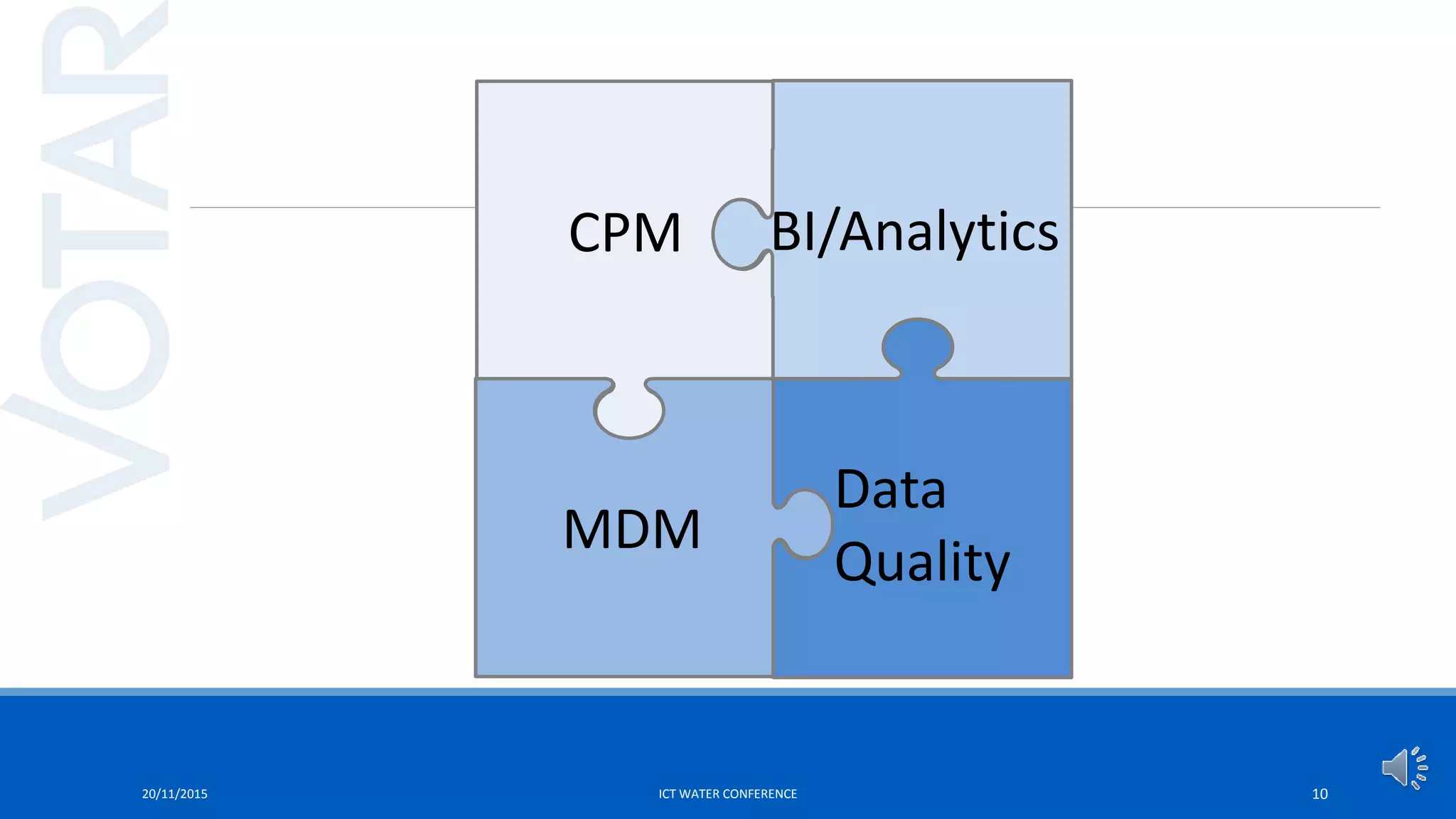
CPM
MDM
BI/Analytics
Data
Quality
20/11/2015 ICT WATER CONFERENCE 11
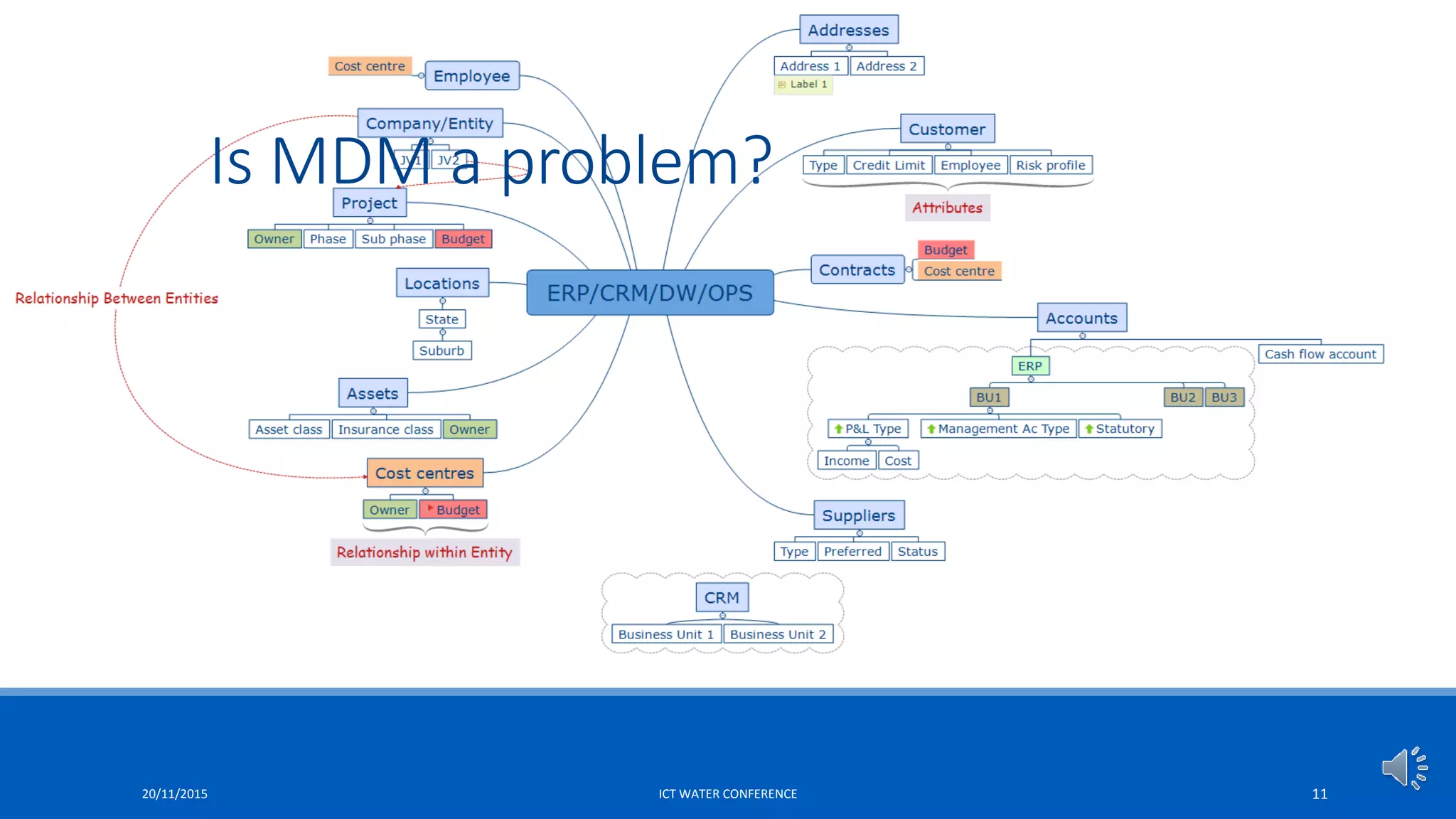
Is MDM a problem?
20/11/2015 ICT WATER CONFERENCE 12
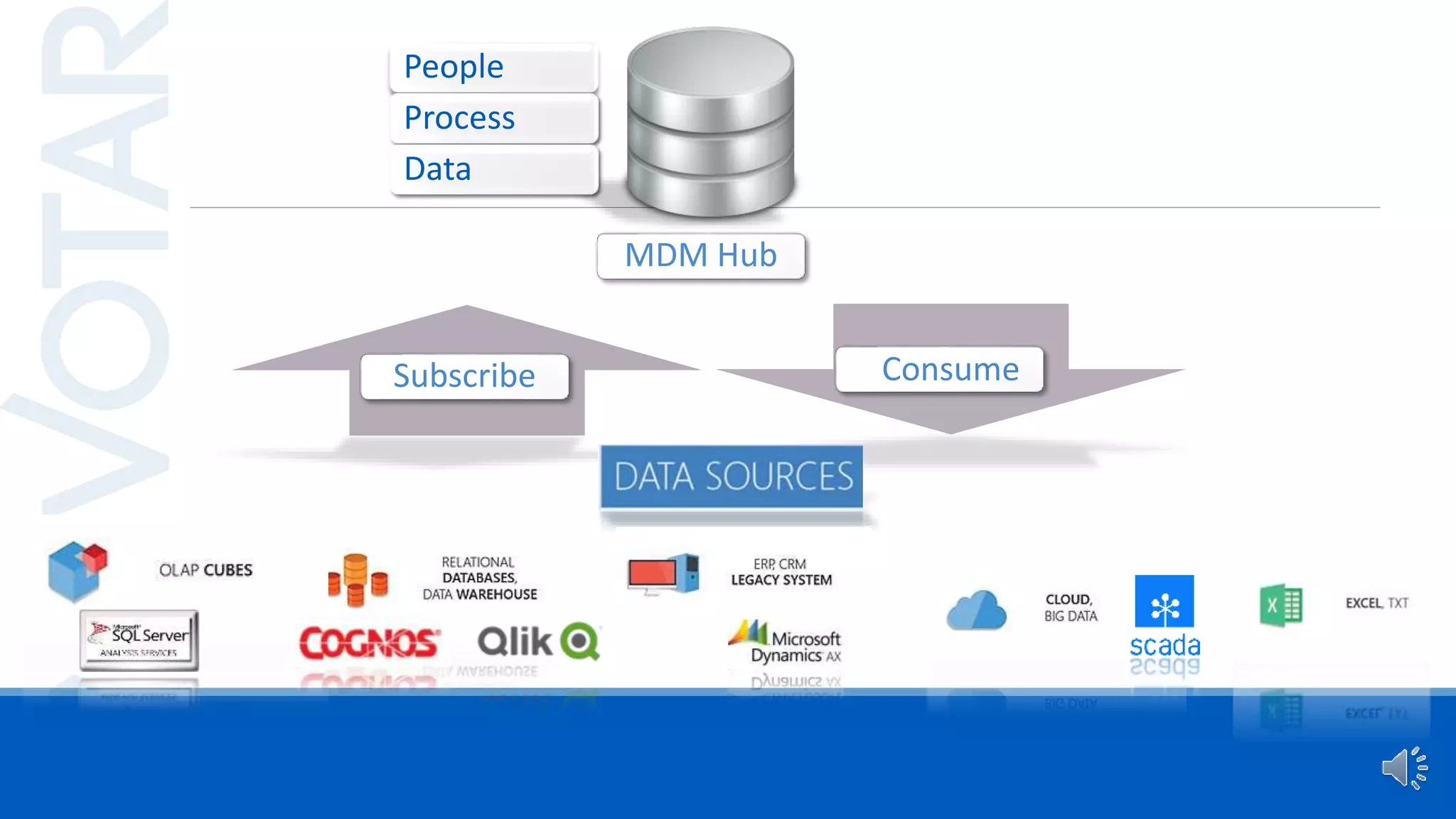
People
Process
Data
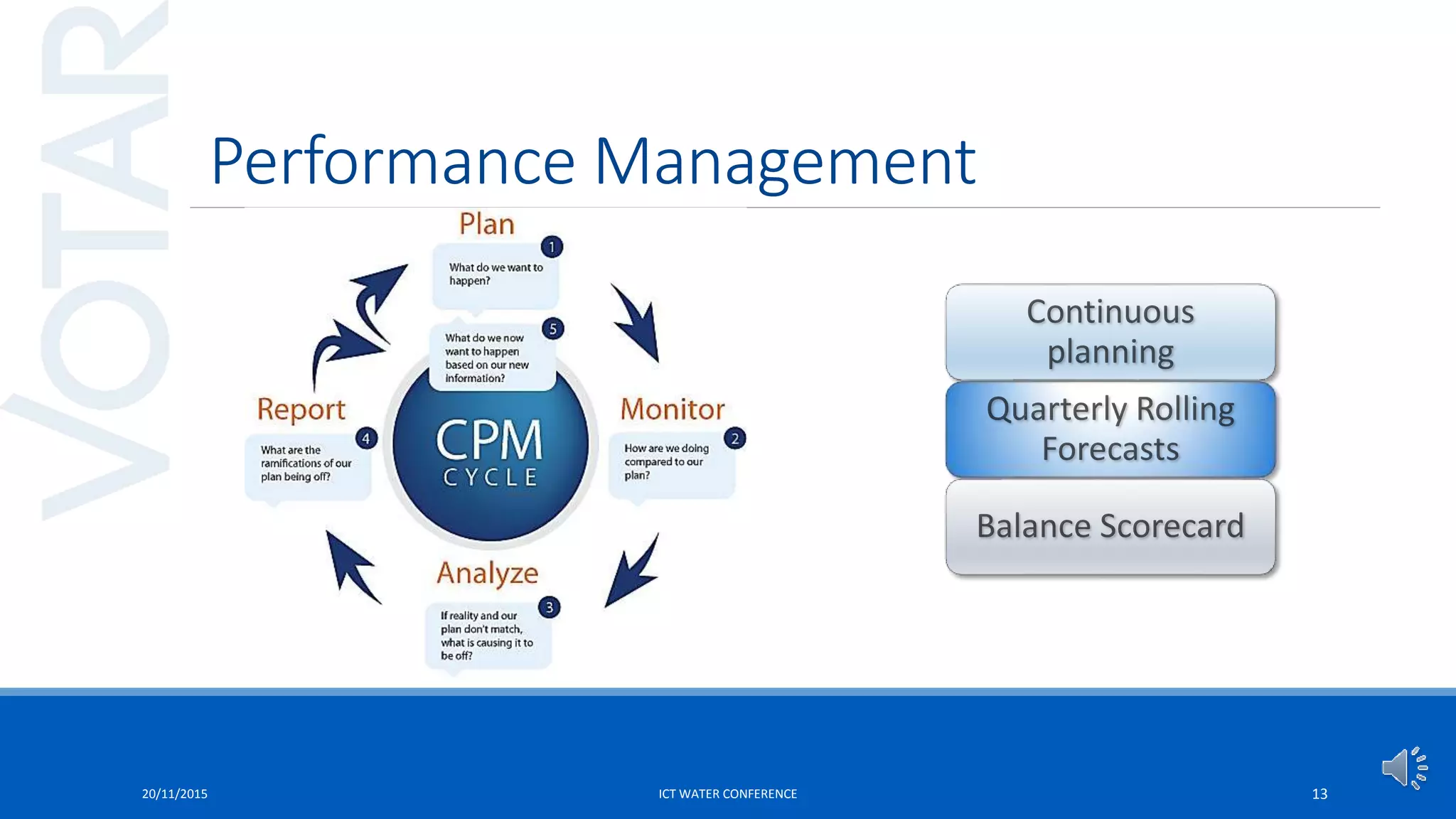
Performance Management
20/11/2015 ICT WATER CONFERENCE 13
20/11/2015 ICT WATER CONFERENCE 14
Creating the
NEWYEAR
1day
2 days
Used to take 2 days
Creating the
‘New Year’
Now takes 15mins
Uploading budgets in management reports
3 days x 3 people
123
Now takes
30 mins
Preparation for budget input into
Management reports
From 19 days
to
90
20/11/2015 ICT WATER CONFERENCE 15
Case Study 1
 Increased visibility of operations across the
organisation
 Sustainability of business – long term planning
 Financial oversight – linking financial, capital and
operational perspectives
 Long term capital asset planning
 Project portfolio analysis
 Technology which enabled the change NOT
managing the change of technology.
20/11/2015 ICT WATER CONFERENCE 16
Looking for:
Where are they now?
 Through centralised business drivers, they are
able to share, update and collaborate on data
across multiple divisions, nationwide
 Less finance focused, more business driven
 Able to plan strategically over multiple year
time horizon
 Able to pick up any anomalies, issues and
respond quickly with business insight
 Planning and forecasting for demand
20/11/2015 ICT WATER CONFERENCE 17
20/11/2015 ICT WATER CONFERENCE 18
Case Study 2
Operational MDM
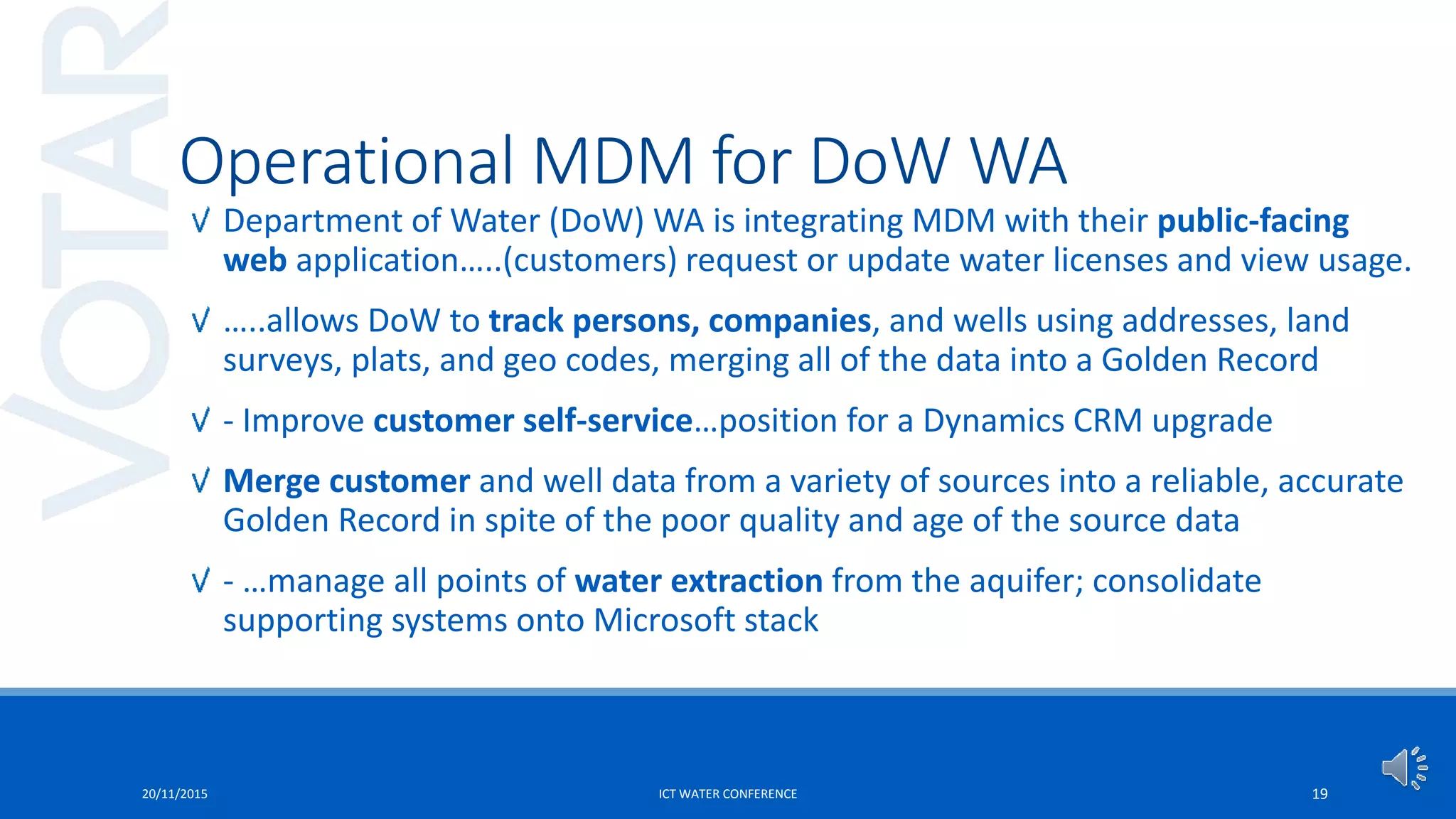
Department of Water (DoW) WA is integrating MDM with their public-facing
web application…..(customers) request or update water licenses and view usage.
…..allows DoW to track persons, companies, and wells using addresses, land
surveys, plats, and geo codes, merging all of the data into a Golden Record
- Improve customer self-service…position for a Dynamics CRM upgrade
Merge customer and well data from a variety of sources into a reliable, accurate
Golden Record in spite of the poor quality and age of the source data
- …manage all points of water extraction from the aquifer; consolidate
supporting systems onto Microsoft stack
20/11/2015 ICT WATER CONFERENCE 19
Operational MDM for DoW WA
Re-usable, relevant data and structures
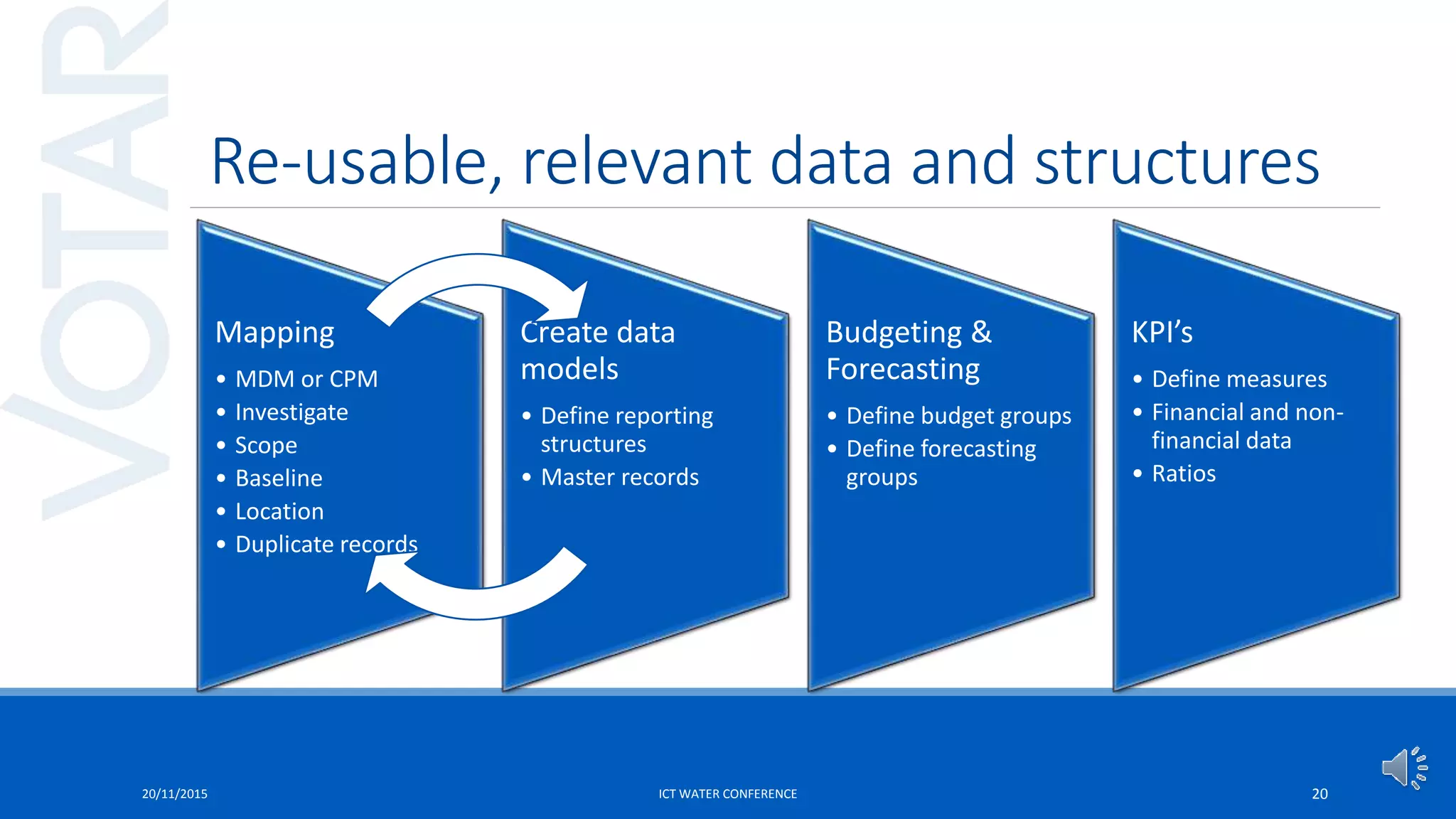
Mapping
• MDM or CPM
• Investigate
• Scope
• Baseline
• Location
• Duplicate records
Create data
models
• Define reporting
structures
• Master records
Budgeting &
Forecasting
• Define budget groups
• Define forecasting
groups
KPI’s
• Define measures
• Financial and non-
financial data
• Ratios
20/11/2015 ICT WATER CONFERENCE 20
20/11/2015 ICT WATER CONFERENCE 21
Start Small
Baseline current capability
20/11/2015 ICT WATER CONFERENCE 22
Observe
20/11/2015 ICT WATER CONFERENCE 23
Scale
20/11/2015 ICT WATER CONFERENCE 24
Summary
20/11/2015 ICT WATER CONFERENCE 25
Refine

The Role of High Quality Data in Performance v5

  • 1.
    The Role ofHigh Quality Data in Performance Management DATA DRIVEN DECISION MAKING FS 614929
  • 2.
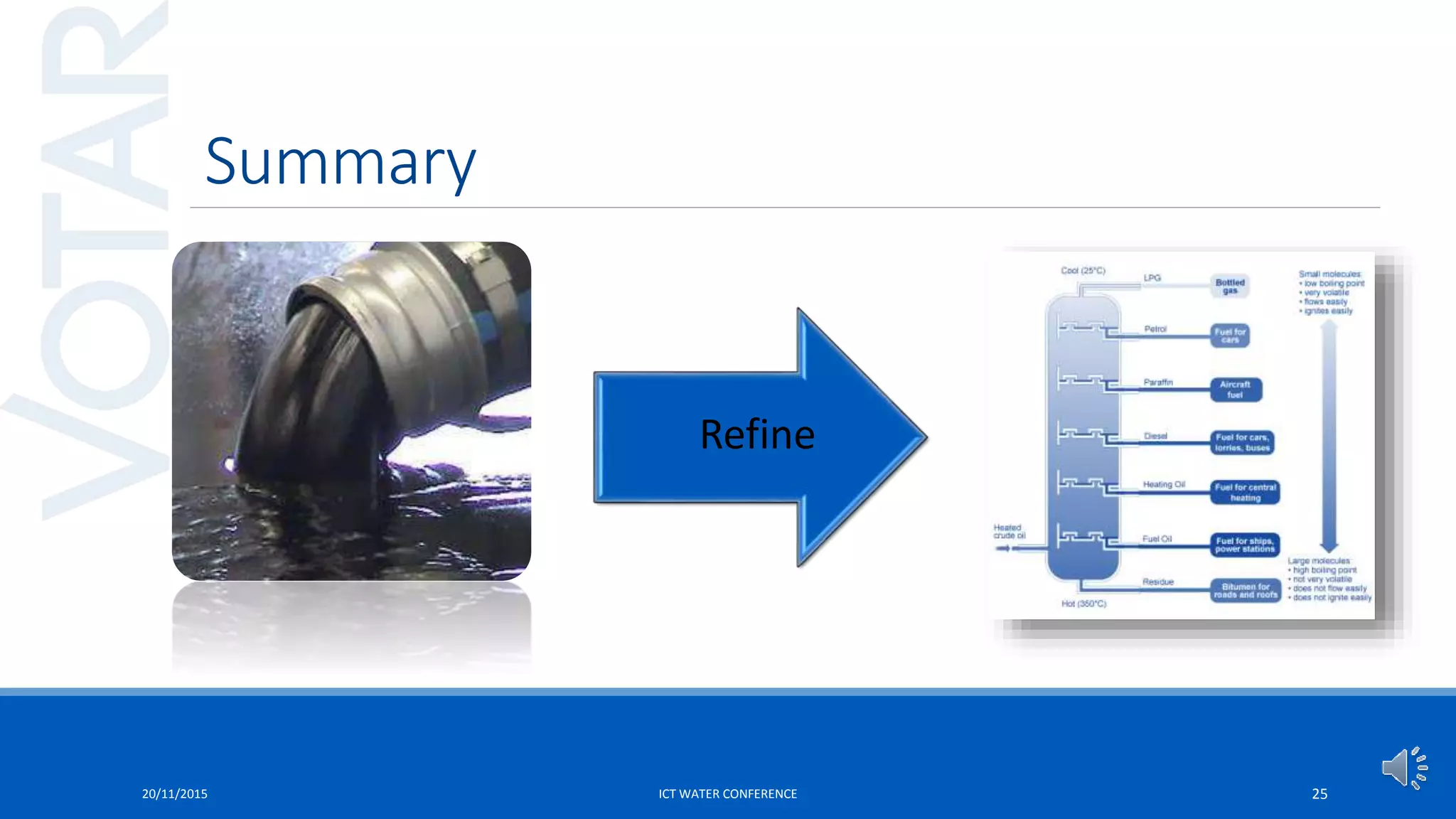
    Data is theoil of our generation 20/11/2015 ICT WATER CONFERENCE 2 The Challenge is not tapping it but refining it! ?
  • 3.
    Elements of Performance Innovation Customers Water management Seweragemanagement People Sustainability 20/11/2015 ICT WATER CONFERENCE 3
  • 4.
    The business landscape 20/11/2015ICT WATER CONFERENCE 4
  • 5.
    20/11/2015 ICT WATERCONFERENCE 5 Report writing Ad hoc query Ad hoc query Ad hoc query Ad hoc query Ad hoc query Excel Download Excel Download Excel Download Excel Download Quarterly reporting Access Database Access Database Manual Input Manual Input Manual Input Excel Download Billing Systems Customer CRM Plant Ops Waste Ops Asset SCADA Finance Procure HR Self Serve
  • 6.
    Focus Areas 20/11/2015 ICTWATER CONFERENCE 6 …to have high quality data and systems that give us an integrated view of customers and our environment performance…
  • 7.
  • 8.
    COMPETITIVENESS CUMULATED INVESTMENT Process Efficiency Transactional•Manage transactions • Enter data • Make changes to existing data • Keep track of transactions • Large volumes • Read and Write • Output based • Historical and future Decision Effectiveness THE TURNING POINT Decision Making Systems Of Record Support Systems Leveraging our core systems 20/11/2015 ICT WATER CONFERENCE 8
  • 9.
    BI Vendor Marketing ….BusinessDiscovery platform delivers true self-service BI that empowers business users by driving innovative decision-making …..Exploring the associations in your data… …….Accessing, analyzing and capturing data Uncover hidden trends and make discoveries that drive innovative decisions…. …..search box for instant, associative results that let you see new connections and relationships across your data… 20/11/2015 ICT WATER CONFERENCE 9
  • 10.
    20/11/2015 ICT WATERCONFERENCE 10 CPM MDM BI/Analytics Data Quality
  • 11.
    20/11/2015 ICT WATERCONFERENCE 11 Is MDM a problem?
  • 12.
    20/11/2015 ICT WATERCONFERENCE 12 People Process Data
  • 13.
  • 14.
    20/11/2015 ICT WATERCONFERENCE 14
  • 15.
    Creating the NEWYEAR 1day 2 days Usedto take 2 days Creating the ‘New Year’ Now takes 15mins Uploading budgets in management reports 3 days x 3 people 123 Now takes 30 mins Preparation for budget input into Management reports From 19 days to 90 20/11/2015 ICT WATER CONFERENCE 15
  • 16.
    Case Study 1 Increased visibility of operations across the organisation  Sustainability of business – long term planning  Financial oversight – linking financial, capital and operational perspectives  Long term capital asset planning  Project portfolio analysis  Technology which enabled the change NOT managing the change of technology. 20/11/2015 ICT WATER CONFERENCE 16 Looking for:
  • 17.
    Where are theynow?  Through centralised business drivers, they are able to share, update and collaborate on data across multiple divisions, nationwide  Less finance focused, more business driven  Able to plan strategically over multiple year time horizon  Able to pick up any anomalies, issues and respond quickly with business insight  Planning and forecasting for demand 20/11/2015 ICT WATER CONFERENCE 17
  • 18.
    20/11/2015 ICT WATERCONFERENCE 18 Case Study 2 Operational MDM
  • 19.
    Department of Water(DoW) WA is integrating MDM with their public-facing web application…..(customers) request or update water licenses and view usage. …..allows DoW to track persons, companies, and wells using addresses, land surveys, plats, and geo codes, merging all of the data into a Golden Record - Improve customer self-service…position for a Dynamics CRM upgrade Merge customer and well data from a variety of sources into a reliable, accurate Golden Record in spite of the poor quality and age of the source data - …manage all points of water extraction from the aquifer; consolidate supporting systems onto Microsoft stack 20/11/2015 ICT WATER CONFERENCE 19 Operational MDM for DoW WA
  • 20.
    Re-usable, relevant dataand structures Mapping • MDM or CPM • Investigate • Scope • Baseline • Location • Duplicate records Create data models • Define reporting structures • Master records Budgeting & Forecasting • Define budget groups • Define forecasting groups KPI’s • Define measures • Financial and non- financial data • Ratios 20/11/2015 ICT WATER CONFERENCE 20
  • 21.
    20/11/2015 ICT WATERCONFERENCE 21
  • 22.
    Start Small Baseline currentcapability 20/11/2015 ICT WATER CONFERENCE 22
  • 23.
  • 24.
  • 25.
    Summary 20/11/2015 ICT WATERCONFERENCE 25 Refine

Editor's Notes

  • #2 1. Introduction   Good morning everybody. I’m delighted to be talking to you about data quality and its role in the management of performance.   We are going to see what things are needed, what new things you can do and what you IT can do to enable data quality in your organisation and why it can be a great opportunity for IT.
  • #3 2. Oil is the data of our generation. The challenge is not tapping it. It is refining it!   How does that resonate with you? This is the challenge I will be addressing.   We are going to look at this part with the question mark – what is needed to get refined data and what actually is refined data?   We are going to talk about data quality in terms of the 3 R’s: relevant, revealing and re-usable and that lead to better understanding and insight of business performance?   This ‘refining’ of data is very much a current day challenge that you can’t ignore   This is not just a business issue – it’s very much an opportunity.   Data gets into our organisation through.   Data that is input into our source systems of record (Historical) Data from our environmental and operational systems including systems such as SCADA Data for the future (budgets and forecasts and targets)
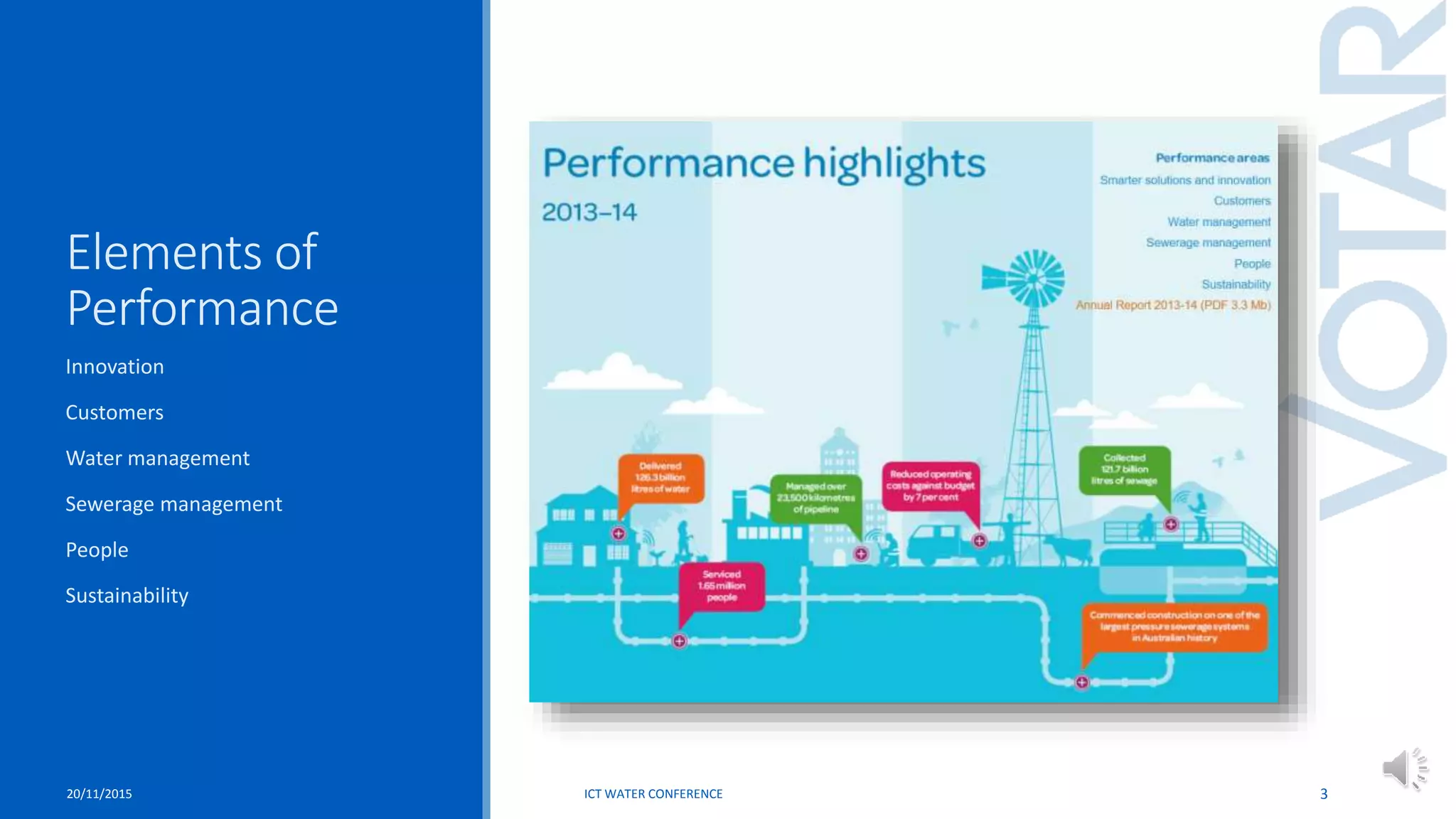
  • #4 3. Q. Is this the sort of landscape that you operate in?   So much of what you do is about how you leverage data to create performance outcomes. This is from your annual reports. It shows how many, how much, how long. We see what we want to do in the future. We see how we are going to measure it.
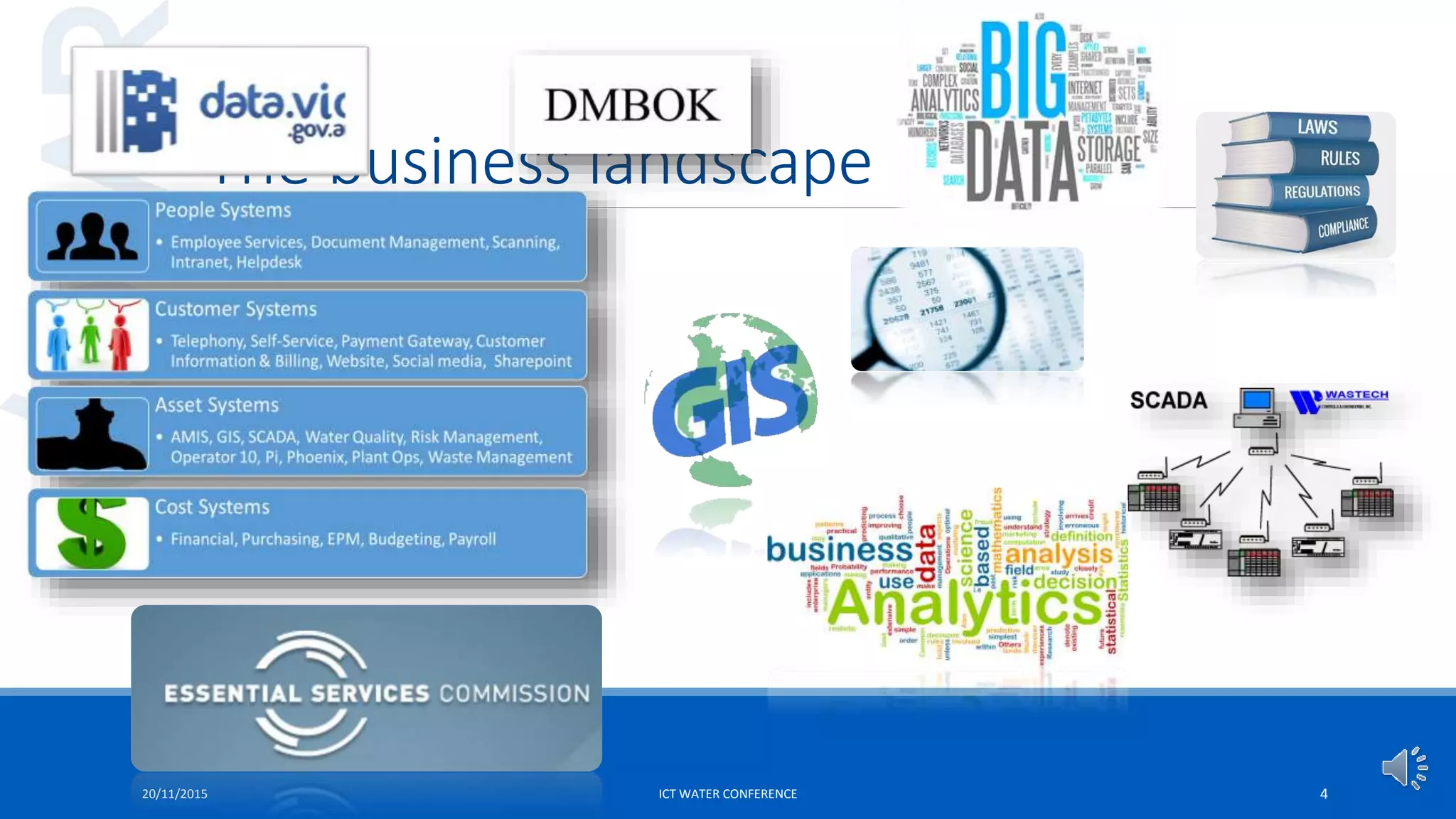
  • #5 4. Let’s acknowledge some of the trends happening in your industry There is going to be pressure on you, ITC, for solutions from your business Q. How will you meet these pressures? Q. What pieces of the Jigsaw will you need to fit together to make it happen?   How will you meet the pressures brought about by regulation, by open data policies, reports coming at you from the essential services commission, by the need for transparency especially of costs and data coming from a variety of oftentimes disparate systems? You may be thinking that this is a finance or business issue but for those of you who want to play in this space there is opportunity in creating platforms that lets business users across the organisation access and adapt the data reliably.
  • #6 5. Q. How many of you are familiar with the type of confusion seen in this white space? (Linger on this question)   I’m sure none of this is new to you…   We see excel being used as independent sources of analytic structures by that I mean information is downloaded from the systems and structured to the individual needs of the user   Q. This is not a great place to be? We see… # Inaccurate picture of costs – whose report is right? # mistaken belief that the report is accurate leading to potentially serious consequences # External regulatory reports being inaccurate….and differences to internal management reports   (# Misalignment of internal mgt vs external regulatory reports often reporting the same data but disclosed in different ways.)
  • #7 6. (This is the sedgeway slide)   Q. If data isn’t backed up or if a security breach occurs, who do people come to? Right – you.   Q. What about the management of data? Who is responsible for that? Some might see that as a business or finance issue.   But with data now the oil our generation, data becomes a more and more valuable resource. The need for competitive advantage and to extract the maximum value from our data will only increase (or refine the oil).   (Sedgeway) To get there, we need to focus on the right things. What are those things?
  • #8 7. The Three R’s What are the three R’s of data Quality? It is data that is Relevant, Re-usable and Revealing. But our raw data needs to go through the Refinery to get this. We wil be looking at what is it that makes something relevant, how is something revealing and once we have discovered – we need to incorporate and re-use these revealing structures.
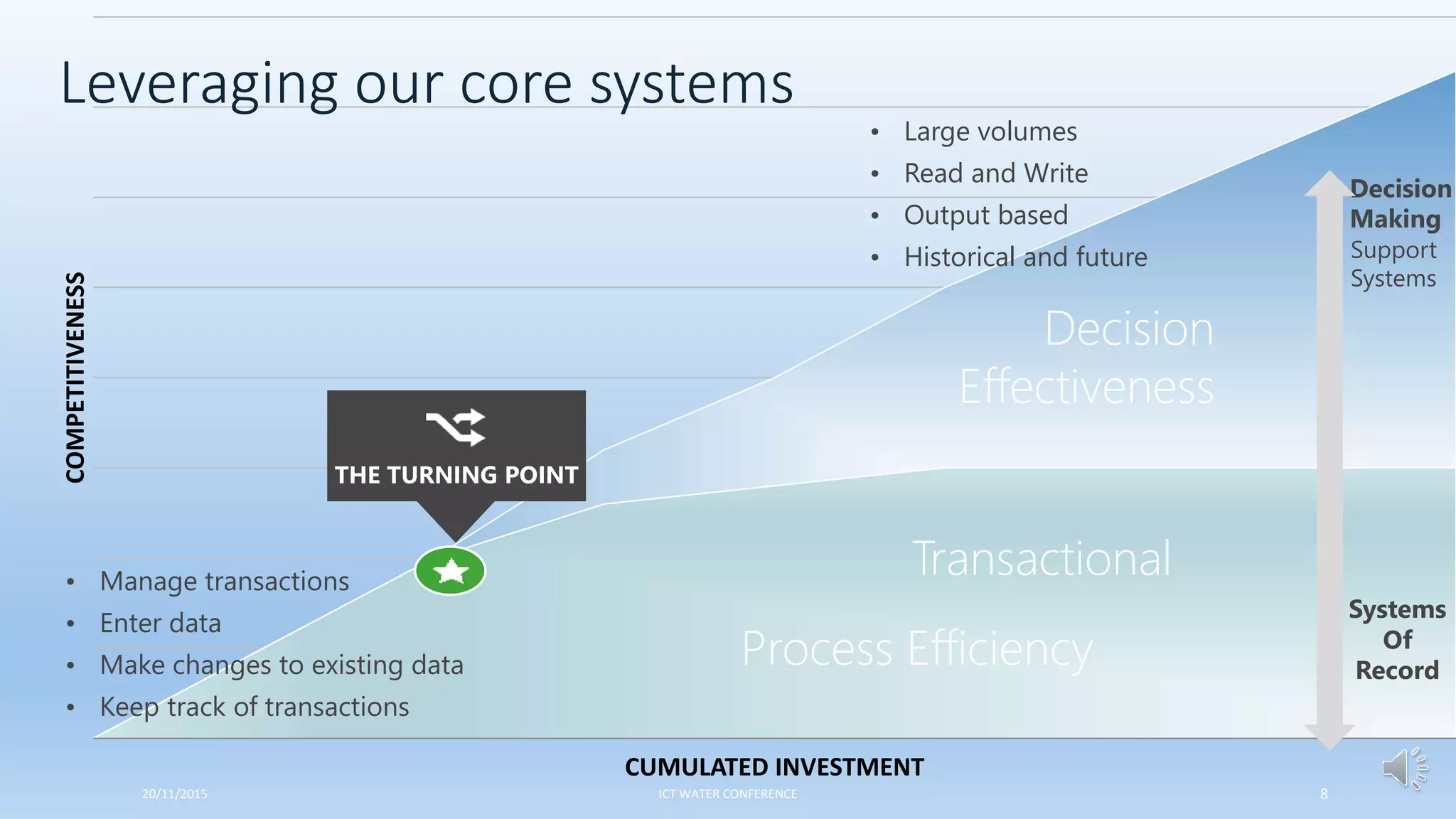
  • #9 8. We really are at a turning point. In fact we’ve gone way past in most cases. There are many still labouring on managing the transaction and a transaction intensive environment when we should be up here… This is the area of increasing insights through data management and putting in processes to improves the quality of our data; data which is the 3 R’s – Relevant, Revealing and Re-usable. I’m not suggesting you should all become data scientists or BI experts but understand the data – yes. Provide platforms for the business to manage the data – yes. Certainly. Having a lot of data is one thing and that continues to grow – leveraging it is the challenge.
  • #10 9. Vendor marketing   You’d think from the BI marketing speak that data refinement is covered. ….uncover hidden trends…innovative decisions….it’s like the Bondi beach version of BI…go on a data discovery mission But the uptake of BI tools is notoriously low – because ‘discovering data’ is a niche area…most people want to be served up already well-structured data….or enable it themselves
  • #11 10. Q. What are the jigsaw pieces that assist us in this   The fundamental dimension is data quality. But what is good quality data?   Data Quality: Q. Is it just about the accuracy and precision of the data? Q. Is it just about having it ‘correct’?     These are important but do they give us the three R’s – relevant, revealing and re-usable? Accountants have been known to forecast a result 12 months in advance as $125,327 and 37 cents. Relevant? No.   And I could print out the balances on your COA’s but would this be revealing? It’s too granular and not matched to making a decision. It needs structuring and enriching.   BI/Analytics The first piece is BI/Analytics BI is more traditionally seen as the realm of IT.   We’ve already seen the marketing material   There are two important things to recognise;   Recognise that BI does not in itself give high quality data – the three R’s The danger here is in not building the foundation layers necessary. It is frequently seen and treated as a technology and a silver bullet   These next two pieces coming up are for those of you that want to accept the challenge to be an enabler to the business in this space   CPM   CPM is often seen as budgeting and forecasting and therefore finance. But this is a massive mistake and has a big role to play in the equation.     Several things to note. CPM is far more supportive than just BI analytics of the data structures that are relevant to measuring performance. It’s relevant because It links to business strategy - are we doing the right things not just measuring for the sake of it It’s revealing because It enables business users to work with business drivers that can be tested out Even if we have a technology, are you running contemporary BPF processes that work because this is a major area of broken PM processes that is occurring in many organisations.   MDM Let’s go up to the final step. It is a more complete approach to data quality   Master data describes fundamental dimensions of the business   MDM takes the responsibility of managing master data away from the source ERP’s and analytic systems. This does many things.   It’s relevant because it brings structure to raw data It is human-centric by allowing every day business users to create their own structures that work for them - Relevant It allows data evolution – data evolution allows structures to emerge as business users grapple with understanding their environment – this points so much to relevance – Many times, structures are built in from day 1 and cannot be easily changed. You can enable that evolution. It gives the opportunity to test alternate views and reporting scenarios – discard/keep/grow - Revealing   So here’s a challenge for you in IT. I’m not expecting you to be an expert in data science but if you want to accept the challenge, you can be an enabler in this space and create the platform for the business to securely access and adapt data structures to their own needs.
  • #12 11. Is MDM a problem?   Q. How many of you have three or four of the following? # 7 – 15 separate transactional and analytical systems # BU’s with own report structures # COA’s in play # Large scale dimensions in place with large number of attributes of the record   If you do, maybe this could be an area of focus for you.   Let’s look at an Account structure Each BU is another copy of the data that needs to be managed. Each one has deep structures that exist in the chart of accounts. Structures which are difficult to maintain and very hard to hold alternate or parallel hierarchies in the ERP or your analytical solution, oftentimes they don’t change in the systems from the day they were first implemented.   Let’s add the complex legal and business structures – maybe amalgamations and mergers, maybe subsidiaries and Joint Ventures. All adding complexity to the structures and rules.   These are issues that the business would love you to fix for them. If we did have an MDM policy, how might it look?
  • #13 12.   Let’s start with the data sources OLAP/CPM able to hold structures – enriched but fairly static ERP – generally poor at MDM so inflexible Cloud/SCADA – you have this data –raw data - little structure, might need to be enriched. Can you gain more insights from it? Excel – independent analytical structures – little governance – can be inaccuracies Let’s separate the management of MDM from the source systems.   Benefits 1. People based MDM Hub – non-destructive of transactions – alternate views – versions – test out 2. Data evolution – allows structures to emerge – captures reporting structures from human intelligence 3. Enriched master data which enables the 3 R’s and leads to decision focused reports   If we look for instance at the impact on Consolidation. Consolidation is holding the structures that make up your reporting structures Consolidation is a revealing process. The structures give meaning and definition from a business perspective from the top to the bottom of the organisation. It allows different and alternate perspectives to be seen. This needs to be part of your structures.
  • #14 13. Let me ask a question here. Q. Who believes current budget processes are valuable and engaging process?   Most surveys reveal great issues with budget process – heavily politicised and negotiated – it should be high value activity.   You might again be thinking this is not an IT issue but is it something you could do with understanding? Yes in my opinion.   The traditional annual budget process is highly flawed. It is extremely slow and labour intensive It goes out of date almost before its finished It’s way too detailed and precise Not based on the drivers of value in the business   And the most important one The variances in management reports are meaningless. If the variances are meaningless and not acted upon, in my opinion we may as well not do it all   Click… These are the sort of contemporary performance processes that are vastly improving the budgeting.   They make the budget process much more relevant and revealing because Continuous therefore always current Look beyond the fixed annual timeframe Lighter and more agile Linking to business drivers and therefore variances are meaningful   Let's look at performance management more closely.
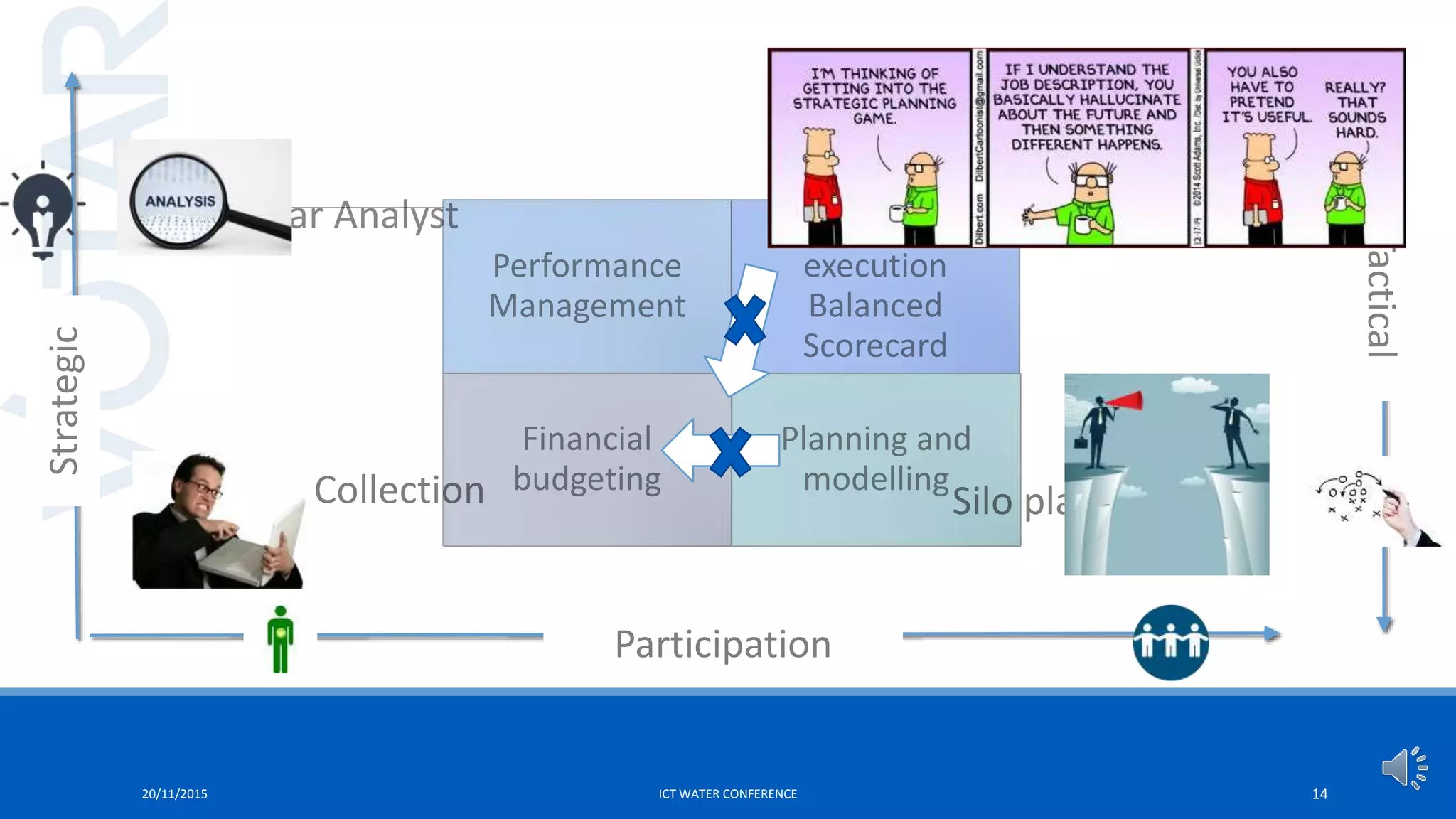
  • #15 14. Within a performance management framework, there are two dimensions – strategic/tactical and participation – enterprise/centralised We can view these as top down and bottom up But too much top down risks no meaningful targets. Have any of you had that top down decree and been asked to just decrease costs by 5% across the board – no relevance, no rationale. Is this a targeted exercise? Or too much bottom up and we risk over detailed and low insights – not revealing - because we are measuring budget at the wrong level.   Click Now, performance management is IMO one of the worse performed processes in business but maybe we can talk about that later. It’s good to recognise the different styles of budgeting in performance management. Financial we get low participation – centralised – we get poor integration to operations Silo – independent planning in spreadsheet models with financial outputs passed to finance at the end Ivory Tower – Top down approach on an arbitrary basis with very relevance e.g reduce by 5% Sedgeway – I’ve been involved in many such projects – the number 1 pain is sheer time and resources taken to do budgeting.
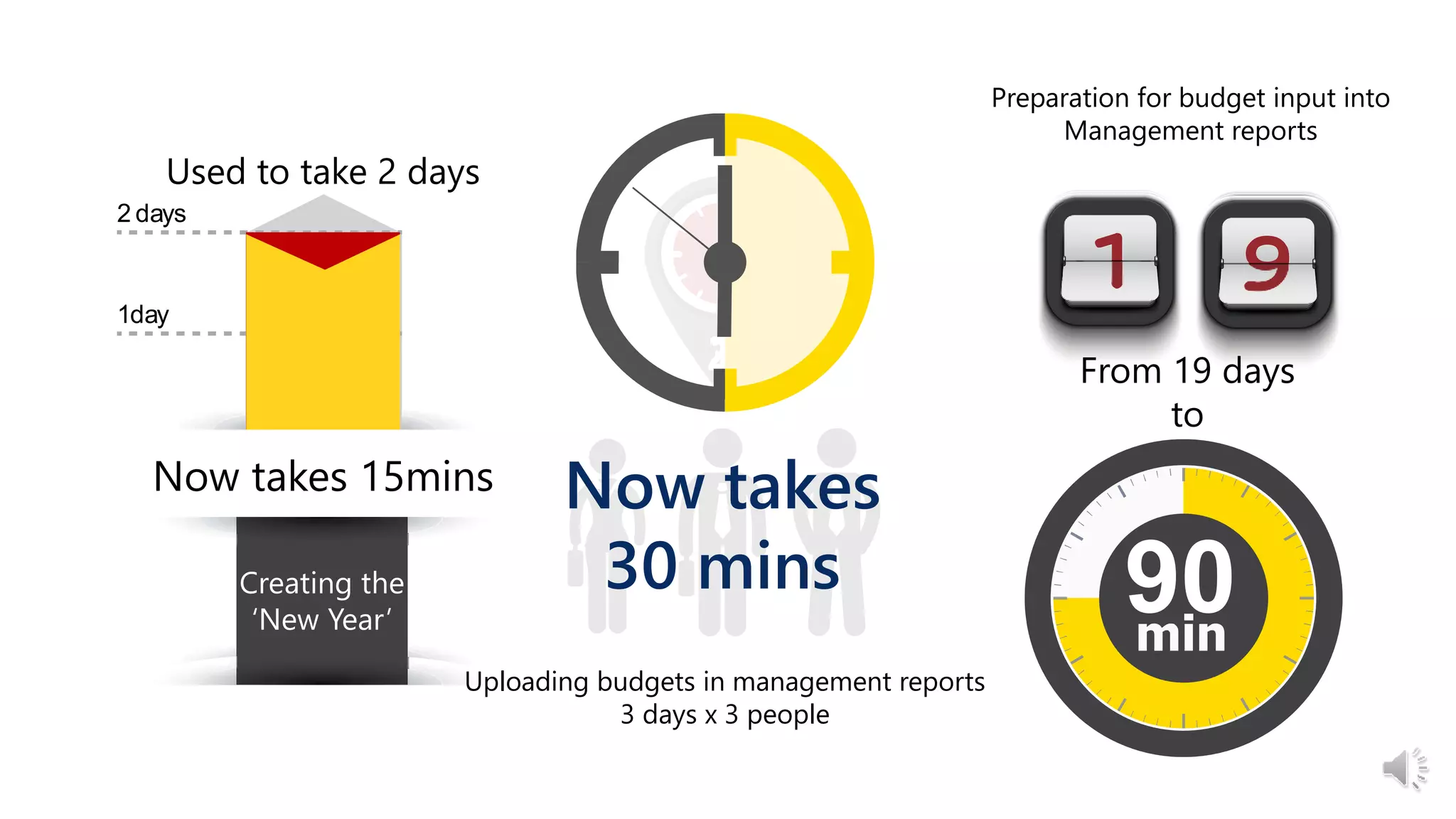
  • #16 15. This is a project for a logistics company that I worked with. As you can see from the existing statistics, the most surprising thing is the poor performance of the process itself – let alone the effectiveness of budgeting.   Linger – days of time to do each major process – changing to new year, updating forecast, generating the management reports – typically these are all done in Excel…this shows you the depth of the problem by not providing data structures for the business.   Efficiency was not the central driver for this project but it paid a huge dividend in terms of time and resource savings.
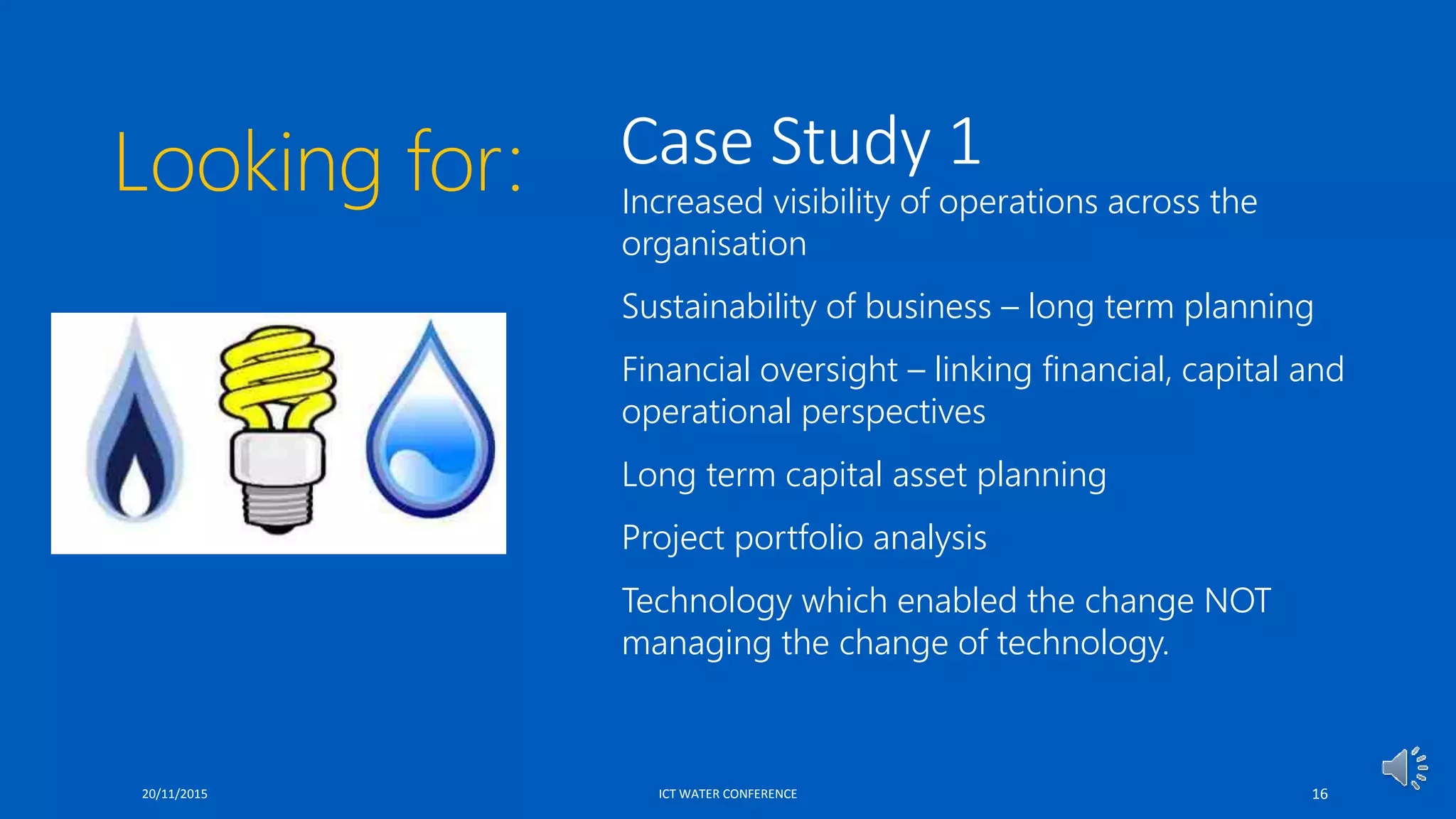
  • #17 16. This shows the sort of business applications that can be created based on working with data that you can get. This technology and approach leverages data in the SOR’s but is separate and free from their constraints. It’s long and short term horizons. It’s delivers on issues of sustainability, cost and operational optimisation and, targeted allocation of resources
  • #18 17. Where are they now? Not about finance’s needs. Able to make decisions more strategically. Plan for demand, plan for long term assets. It’s about tying up the operational and financial outcomes which enables much better planning and understanding of decisions now.  
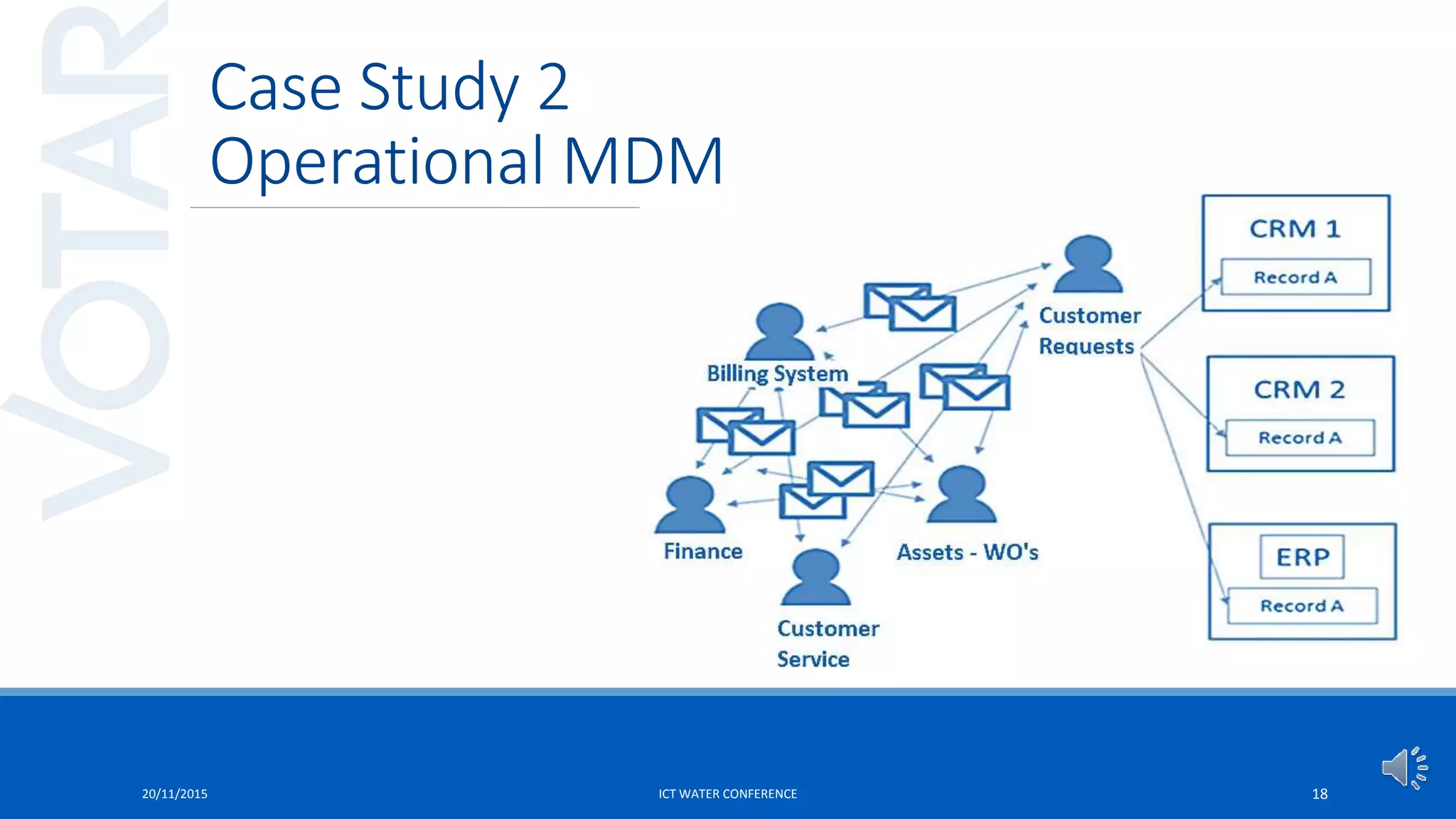
  • #19 18. Case study 2 Let’s look at MDM   This is a common scenario. A customer record is recorded in several different systems. Different components and attributes of the record are stored such as location, account details and agency specific details such as sewerage or water supply details.
  • #20 10. This example shows how combining records across the organisation into a combined, merged single golden record has enabled digital, customer facing strategies. Some of you may for instance be looking at digital first customer engagement. By combining and merging customer data, it enabled greater customer self-service and management of disparate customer management systems – it enabled customer service to be agency and system agnostic.
  • #21 20. How do you making a start?   Are you going to define a stand-alone MDM strategy? Could you make use of existing BI or CPM assets? Could you use of the Master Data Services (MDS) which comes with SQL enterprise? Or do you want to go towards an Enterprise MDM solution?     This process here ensures reporting structures that emerge are closely aligned to the way you budgeting/forecasting and maintains structures which are relevant and aligned to decisions.   If you improve the way you report, you improve the way you budget and forecast …..because, the way you budget and measure performance is the same as the way you report.
  • #22 21. Take away slide Let’s leave you with some takeaways of how you might implement high quality data practises in your organisation
  • #23 22. Start Small Baseline your current capability – decide on an area to pilot Then Prototype the approach But Don’t get too complicated too early – there’s too much data and too many people impacted Review if any existing technology like CPM or MDS can assist
  • #24 23. Observe See where things are not working out – maybe too much maintenance – maybe too confusing and you need to change approach Refine, adapt, reiteration until you have a working model that you can replicate.
  • #25 24. Scale Roll out the model. You can be much more confident having trialled it You will have a much clearer idea if and how technology can help BUT still keep it current with further iterations
  • #26 25. The final point I will leave you with is that information is an important enterprise asset and it needs to be managed and allowed to evolve. Well thank you for listening. I hope this has assisted you and you can go back and put some of these ideas into practice.