Enterprise Information Flow & Data
Management
MDM Stewardship, governance and alignment to Business
Processes
Kaye Homam
Dec 2015
Executive Summary
The quality of any decisions at any levels within an enterprise is directly
related to the quality and availability of the data within the enterprise.
According to recent studies by leading data governance and management
agencies, bad data cost businesses anywhere between 10% to 20% of yearly
revenue. For enterprises to gain competitive advantage in their industry, it is
critical to align their master data management solutions to business process
management solutions to enable agile, timely and effective decision
making.
Enterprise Data and Information Management
Any given business process in an enterprise either creates, changes, uses,
enhances or releases data
Most organizations, however, treat business process management, master data
management and master data governance as separate initiatives
To maximize value creation from data within an organization, it is critical to align
these processes
The synergistic outcome enables consistent and governed single version of the
“truth” for accurate and timely decision making
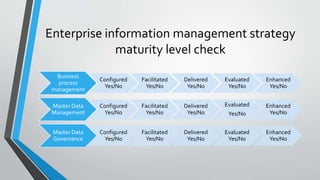
Enterprise information management strategy
maturity level check
Business
process
management
Configured
Yes/No
Facilitated
Yes/No
Delivered
Yes/No
Evaluated
Yes/No
Enhanced
Yes/No
Master Data
Management
Configured
Yes/No
Facilitated
Yes/No
Delivered
Yes/No
Evaluated
Yes/No
Enhanced
Yes/No
Master Data
Governance
Configured
Yes/No
Facilitated
Yes/No
Delivered
Yes/No
Evaluated
Yes/No
Enhanced
Yes/No
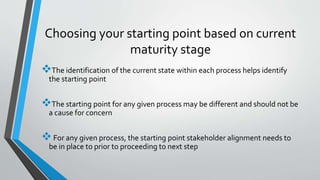
Choosing your starting point based on current
maturity stage
The identification of the current state within each process helps identify
the starting point
The starting point for any given process may be different and should not be
a cause for concern
For any given process, the starting point stakeholder alignment needs to
be in place to prior to proceeding to next step
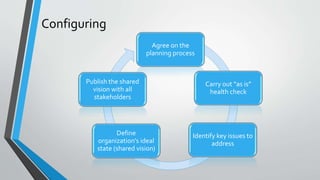
Configuring
Agree on the
planning process
Carry out “as is”
health check
Identify key issues to
address
Define
organization’s ideal
state (shared vision)
Publish the shared
vision with all
stakeholders
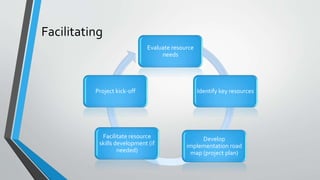
Facilitating
Evaluate resource
needs
Identify key resources
Develop
implementation road
map (project plan)
Facilitate resource
skills development (if
needed)
Project kick-off
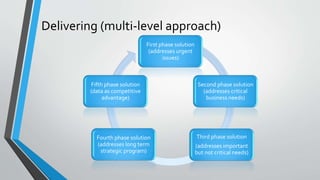
Delivering (multi-level approach)
First phase solution
(addresses urgent
issues)
Second phase solution
(addresses critical
business needs)
Third phase solution
(addresses important
but not critical needs)
Fourth phase solution
(addresses long term
strategic program)
Fifth phase solution
(data as competitive
advantage)
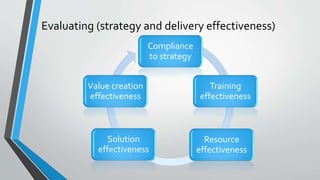
Evaluating (strategy and delivery effectiveness)
Compliance
to strategy
Training
effectiveness
Resource
effectiveness
Solution
effectiveness
Value creation
effectiveness
Changing
The changing stage is applicable if the any part
of the solution is deemed ineffective or no
longer relevant to the business needs. A
formalized change stage allows agility and
open mindedness in any strategic process.
Master Data Management
Key Critical Factors to evaluate
1. Is a technical solution in place
2. Does the technical solution fit well within the current enterprise architecture and
enterprise application management system
3. Is the solution design, process, in-puts and out-puts, upstream and downstream systems
documented
4. Is it inefficient (allows mass creation, and maintenance of MD)
5. Does it meet the current business need
6. Is it easy to adapt if a new business need is identified
7. Is the solution simple to navigate, are the current resources trained and able to navigate
the system with ease
8. Is there a business continuity plan in place (in cases of outages)
Master Data Governance
Key Critical Factors to evaluate
1. Is there organization awareness and business buy for data governance
2. Is there a formal governance charter and strategy in place
3. Has the current situation been investigated or evaluated (health check)
4. Has a value of the data been calculated
5. Are there outages and risks that have been identified that needs to be addressed
urgently
6. Are there established KPIs in place
7. Are there controls in place
8. How effective are the current controls
Business Process Management
Key Critical Factors to evaluate
1. Is a formal business process management in place
2. Does the process allow for lift and adapt across functions
3. Does the process allow agility and adaptability to new business needs
4. Does the process include risk and mitigation plans
5. Does the process limit creation of data and information to authorized personnel
6. Does the process follow a standard approach of data creation, validation and auditing
prior to publication to “source of truth” & peripheral systems
7. Does the process integrate naturally with MDM solution
8. Does the process enable minimum lag time between data creation and usage

Enterprise information flow and data management

  • 1.
    Enterprise Information Flow& Data Management MDM Stewardship, governance and alignment to Business Processes Kaye Homam Dec 2015
  • 2.
    Executive Summary The qualityof any decisions at any levels within an enterprise is directly related to the quality and availability of the data within the enterprise. According to recent studies by leading data governance and management agencies, bad data cost businesses anywhere between 10% to 20% of yearly revenue. For enterprises to gain competitive advantage in their industry, it is critical to align their master data management solutions to business process management solutions to enable agile, timely and effective decision making.
  • 3.
    Enterprise Data andInformation Management Any given business process in an enterprise either creates, changes, uses, enhances or releases data Most organizations, however, treat business process management, master data management and master data governance as separate initiatives To maximize value creation from data within an organization, it is critical to align these processes The synergistic outcome enables consistent and governed single version of the “truth” for accurate and timely decision making
  • 4.
    Enterprise information managementstrategy maturity level check Business process management Configured Yes/No Facilitated Yes/No Delivered Yes/No Evaluated Yes/No Enhanced Yes/No Master Data Management Configured Yes/No Facilitated Yes/No Delivered Yes/No Evaluated Yes/No Enhanced Yes/No Master Data Governance Configured Yes/No Facilitated Yes/No Delivered Yes/No Evaluated Yes/No Enhanced Yes/No
  • 5.
    Choosing your startingpoint based on current maturity stage The identification of the current state within each process helps identify the starting point The starting point for any given process may be different and should not be a cause for concern For any given process, the starting point stakeholder alignment needs to be in place to prior to proceeding to next step
  • 6.
    Configuring Agree on the planningprocess Carry out “as is” health check Identify key issues to address Define organization’s ideal state (shared vision) Publish the shared vision with all stakeholders
  • 7.
    Facilitating Evaluate resource needs Identify keyresources Develop implementation road map (project plan) Facilitate resource skills development (if needed) Project kick-off
  • 8.
    Delivering (multi-level approach) Firstphase solution (addresses urgent issues) Second phase solution (addresses critical business needs) Third phase solution (addresses important but not critical needs) Fourth phase solution (addresses long term strategic program) Fifth phase solution (data as competitive advantage)
  • 9.
    Evaluating (strategy anddelivery effectiveness) Compliance to strategy Training effectiveness Resource effectiveness Solution effectiveness Value creation effectiveness
  • 10.
    Changing The changing stageis applicable if the any part of the solution is deemed ineffective or no longer relevant to the business needs. A formalized change stage allows agility and open mindedness in any strategic process.
  • 11.
    Master Data Management KeyCritical Factors to evaluate 1. Is a technical solution in place 2. Does the technical solution fit well within the current enterprise architecture and enterprise application management system 3. Is the solution design, process, in-puts and out-puts, upstream and downstream systems documented 4. Is it inefficient (allows mass creation, and maintenance of MD) 5. Does it meet the current business need 6. Is it easy to adapt if a new business need is identified 7. Is the solution simple to navigate, are the current resources trained and able to navigate the system with ease 8. Is there a business continuity plan in place (in cases of outages)
  • 12.
    Master Data Governance KeyCritical Factors to evaluate 1. Is there organization awareness and business buy for data governance 2. Is there a formal governance charter and strategy in place 3. Has the current situation been investigated or evaluated (health check) 4. Has a value of the data been calculated 5. Are there outages and risks that have been identified that needs to be addressed urgently 6. Are there established KPIs in place 7. Are there controls in place 8. How effective are the current controls
  • 13.
    Business Process Management KeyCritical Factors to evaluate 1. Is a formal business process management in place 2. Does the process allow for lift and adapt across functions 3. Does the process allow agility and adaptability to new business needs 4. Does the process include risk and mitigation plans 5. Does the process limit creation of data and information to authorized personnel 6. Does the process follow a standard approach of data creation, validation and auditing prior to publication to “source of truth” & peripheral systems 7. Does the process integrate naturally with MDM solution 8. Does the process enable minimum lag time between data creation and usage