Product Management 101
For BI Platform & Application Developers

               Ravi Padaki
About Me
Agenda
• What is this about?
• What is this not about?
• Why this topic?
• Who is this for?
• How does one measure success in BI?
• 10 tips for a successful BI product!
• One last thing...
What is this about?

• Product Management 101 for Business
  Intelligence (and Analytics platforms)
• Ingredients for a successful Business
  Intelligence product
• How to empower business with intelligence?
What is this not about?

•   Go to market strategies
•   Sales enablement
•   Pricing
•   Distribution
•   Partnerships
Why is this topic important?

Heard at Ad Tech Bangalore from panelists
• “Data and analytics is not being very useful to
  the business as they are not actionable”
• “We are getting caught up in the justification
  of (social media) ROI for the sake of
  justification”
• “Technology for the sake of technology does
  not serve the business needs”
The Data Pyramid

                    Analytics
                 (Intelligence)
Value
                   Reporting
                 (Information)


                  Raw Data
General Observations
• Give me all the
  metrics you have       Raw Data
  (because I don’t
  know what I am         Reports
  looking for!)
• So much data and yet   Analytics
  no insights!
• Great Insight, so
  what?
Why is using data so hard?
IT: “What are the key requirements that your BI
   application must address?”
Business: “It must address everything, because I
   don’t know what kinds of reports I’ll have to
   produce and what kinds of analysis I’ll have to
   perform tomorrow,”
 … unfortunately, a typical answer

Source: The Forrester Wave report Q2 2012
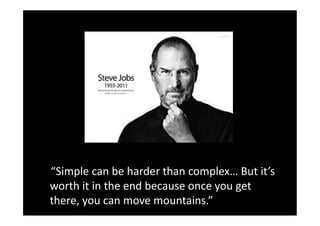
“Simple can be harder than complex… But it’s
worth it in the end because once you get
there, you can move mountains.”
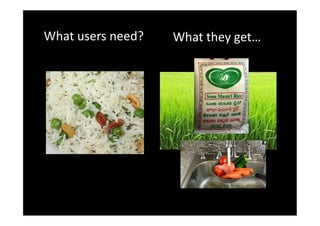
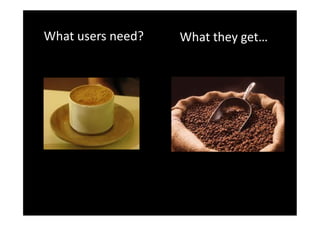
What users need?   What they get…
Who is this for? By Roles
•   Platform developers
•   Application developers
•   Dashboard builders
•   Big data architects and developers
•   UI developers
•   Business Analysts
•   User Experience designers
•   Product Managers
Who is this for? By vendor

• 100% in-house analytics
• 100% vendor solution
• Hybrid
  – Vendor platform, applications
  – In house applications, dashboards
Data stack: Build Vs Buy Vs Lease
                                       Vendor


                  User Interface
                                   A   Vendor

                  Applications     P
Instrumentation                    I

                                       Vendor
                                   A
   Data            Platform        P
  Sources                          I
                                       Vendor

 Data Highway        Cloud
Sample of Self Serve BI products
•   Actuate One from Actuate
•   Cognos Insight from IBM
•   WebFOCUS from Information Builders
•   PowerView, PowerPivot, Excel from Microsoft
•   Microstrategy
•   Oracle Business Intelligence Suite
•   Qlikview from Qliktech
•   SAP Business Objects from SAP
•   SAS Enterprise Business Intelligence
•   Tableau Desktop and Server from Tableau
•   Tibco Spotfire Analytics from Tibco
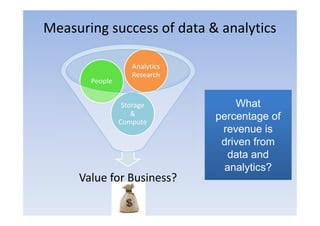
Measuring success of data & analytics

                   Analytics
                   Research
       People


                 Storage           What
                    &          percentage of
                Compute
                                revenue is
                                driven from
                                  data and
                                 analytics?
     Value for Business?
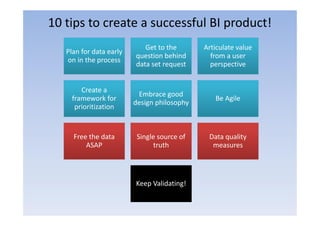
10 tips to create a successful BI product!
                            Get to the       Articulate value
   Plan for data early
                         question behind       from a user
   on in the process
                         data set request      perspective


        Create a
                          Embrace good
     framework for                              Be Agile
                         design philosophy
      prioritization


     Free the data        Single source of    Data quality
         ASAP                  truth           measures


                         Keep Validating!
10 tips by phase!
 Product    Product      Product
Discovery   Planning     Planning

Product      Product      Product
Planning    Definition   Definition

Principle   Principle    Principle

             Basic
            Mantra!
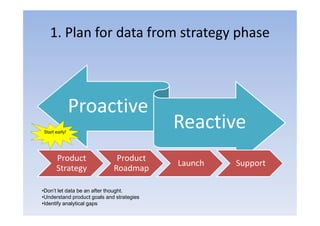
1. Plan for data from strategy phase


               Proactive
Start early!
                                           Reactive
      Product                 Product
                                           Launch   Support
      Strategy               Roadmap

•Don’t let data be an after thought.
•Understand product goals and strategies
•Identify analytical gaps
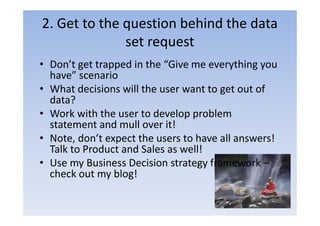
2. Get to the question behind the data
              set request
• Don’t get trapped in the “Give me everything you
  have” scenario
• What decisions will the user want to get out of
  data?
• Work with the user to develop problem
  statement and mull over it!
• Note, don’t expect the users to have all answers!
  Talk to Product and Sales as well!
• Use my Business Decision strategy framework –
  check out my blog!
3. Articulate value from user’s
                 perspective
•   Minimize “Great Insight, so what?”
•   Valuation of analytical features is tough!
•   Indirect revenue impact is a good substitute
•   What is the impact on revenue from decisions
    taken after consuming insights?
4. Create a framework for
                 prioritization
• Prioritize USER STORIES for Minimum Viable Product
• Suggested framework for user story prioritization
   – (Indirect) Revenue impact
   – Strategic impact
   – User base impact
   – User Productivity impact
   – Regional priorities
   – Level of effort
• Optimization (bug fixes, enhancements) should be continuous
• Consider viability of current sources of data, alternate
  solutions
• Consider separating financial & billing reporting from analytics
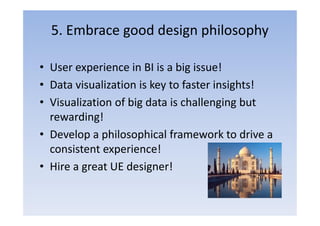
5. Embrace good design philosophy

• User experience in BI is a big issue!
• Data visualization is key to faster insights!
• Visualization of big data is challenging but
  rewarding!
• Develop a philosophical framework to drive a
  consistent experience!
• Hire a great UE designer!
6. Be Agile!

• Agile/scrum methodology is great for BI
• Challenges persist around story points
  estimation
• Benefits
  – User alignment
  – Prioritizing for personas
  – Collaborative
  – Iterative
  – Fail fast
7. Free the data ASAP!

• Data is like a genie! Free the genie first to get
  your wish answered!
• Create value segments of services
   1. Basic: Email excel reports
   2. Standard: Self serve web UI
   3. Premium: Integrated with product
8. Get Peace of Mind with Single
             Source of Truth
• Utter waste of time with multiple sources!
• What time do you have?
9. Data Quality Measures

• If Data is King, Data Quality is King Maker!
• Perception of quality is user’s prerogative!
• Consider data definition read outs early in the
  process
• Make this a non-negotiable feature!
10. Keep Validating!

• Frequently check in with the users at every step of the
  process
   –   Concept
   –   User story
   –   Excel based sample analysis
   –   Wireframes/mocks
   –   Alpha
   –   Beta
• Connect the dots back to the decisions at every stage
• Ensure a fail safe environment for users!
• Create data enthusiasts board of advisors
One Last Thing: Evangelize data or else…


   Numbers confess when tortured!
Thank you!
Contact me:

• Email: ravipadaki@yahoo.com
• Blog: http://datakulfi.wordpress.com
• Linked In: http://linkedin.com/in/ravipadaki

Product Management 101 for Data and Analytics

  • 1.
    Product Management 101 ForBI Platform & Application Developers Ravi Padaki
  • 2.
  • 3.
    Agenda • What isthis about? • What is this not about? • Why this topic? • Who is this for? • How does one measure success in BI? • 10 tips for a successful BI product! • One last thing...
  • 4.
    What is thisabout? • Product Management 101 for Business Intelligence (and Analytics platforms) • Ingredients for a successful Business Intelligence product • How to empower business with intelligence?
  • 5.
    What is thisnot about? • Go to market strategies • Sales enablement • Pricing • Distribution • Partnerships
  • 6.
    Why is thistopic important? Heard at Ad Tech Bangalore from panelists • “Data and analytics is not being very useful to the business as they are not actionable” • “We are getting caught up in the justification of (social media) ROI for the sake of justification” • “Technology for the sake of technology does not serve the business needs”
  • 7.
    The Data Pyramid Analytics (Intelligence) Value Reporting (Information) Raw Data
  • 8.
    General Observations • Giveme all the metrics you have Raw Data (because I don’t know what I am Reports looking for!) • So much data and yet Analytics no insights! • Great Insight, so what?
  • 9.
    Why is usingdata so hard? IT: “What are the key requirements that your BI application must address?” Business: “It must address everything, because I don’t know what kinds of reports I’ll have to produce and what kinds of analysis I’ll have to perform tomorrow,” … unfortunately, a typical answer Source: The Forrester Wave report Q2 2012
  • 10.
    “Simple can beharder than complex… But it’s worth it in the end because once you get there, you can move mountains.”
  • 11.
    What users need? What they get…
  • 12.
    What users need? What they get…
  • 13.
    Who is thisfor? By Roles • Platform developers • Application developers • Dashboard builders • Big data architects and developers • UI developers • Business Analysts • User Experience designers • Product Managers
  • 14.
    Who is thisfor? By vendor • 100% in-house analytics • 100% vendor solution • Hybrid – Vendor platform, applications – In house applications, dashboards
  • 15.
    Data stack: BuildVs Buy Vs Lease Vendor User Interface A Vendor Applications P Instrumentation I Vendor A Data Platform P Sources I Vendor Data Highway Cloud
  • 16.
    Sample of SelfServe BI products • Actuate One from Actuate • Cognos Insight from IBM • WebFOCUS from Information Builders • PowerView, PowerPivot, Excel from Microsoft • Microstrategy • Oracle Business Intelligence Suite • Qlikview from Qliktech • SAP Business Objects from SAP • SAS Enterprise Business Intelligence • Tableau Desktop and Server from Tableau • Tibco Spotfire Analytics from Tibco
  • 17.
    Measuring success ofdata & analytics Analytics Research People Storage What & percentage of Compute revenue is driven from data and analytics? Value for Business?
  • 18.
    10 tips tocreate a successful BI product! Get to the Articulate value Plan for data early question behind from a user on in the process data set request perspective Create a Embrace good framework for Be Agile design philosophy prioritization Free the data Single source of Data quality ASAP truth measures Keep Validating!
  • 19.
    10 tips byphase! Product Product Product Discovery Planning Planning Product Product Product Planning Definition Definition Principle Principle Principle Basic Mantra!
  • 21.
    1. Plan fordata from strategy phase Proactive Start early! Reactive Product Product Launch Support Strategy Roadmap •Don’t let data be an after thought. •Understand product goals and strategies •Identify analytical gaps
  • 22.
    2. Get tothe question behind the data set request • Don’t get trapped in the “Give me everything you have” scenario • What decisions will the user want to get out of data? • Work with the user to develop problem statement and mull over it! • Note, don’t expect the users to have all answers! Talk to Product and Sales as well! • Use my Business Decision strategy framework – check out my blog!
  • 23.
    3. Articulate valuefrom user’s perspective • Minimize “Great Insight, so what?” • Valuation of analytical features is tough! • Indirect revenue impact is a good substitute • What is the impact on revenue from decisions taken after consuming insights?
  • 24.
    4. Create aframework for prioritization • Prioritize USER STORIES for Minimum Viable Product • Suggested framework for user story prioritization – (Indirect) Revenue impact – Strategic impact – User base impact – User Productivity impact – Regional priorities – Level of effort • Optimization (bug fixes, enhancements) should be continuous • Consider viability of current sources of data, alternate solutions • Consider separating financial & billing reporting from analytics
  • 25.
    5. Embrace gooddesign philosophy • User experience in BI is a big issue! • Data visualization is key to faster insights! • Visualization of big data is challenging but rewarding! • Develop a philosophical framework to drive a consistent experience! • Hire a great UE designer!
  • 26.
    6. Be Agile! •Agile/scrum methodology is great for BI • Challenges persist around story points estimation • Benefits – User alignment – Prioritizing for personas – Collaborative – Iterative – Fail fast
  • 27.
    7. Free thedata ASAP! • Data is like a genie! Free the genie first to get your wish answered! • Create value segments of services 1. Basic: Email excel reports 2. Standard: Self serve web UI 3. Premium: Integrated with product
  • 28.
    8. Get Peaceof Mind with Single Source of Truth • Utter waste of time with multiple sources! • What time do you have?
  • 29.
    9. Data QualityMeasures • If Data is King, Data Quality is King Maker! • Perception of quality is user’s prerogative! • Consider data definition read outs early in the process • Make this a non-negotiable feature!
  • 30.
    10. Keep Validating! •Frequently check in with the users at every step of the process – Concept – User story – Excel based sample analysis – Wireframes/mocks – Alpha – Beta • Connect the dots back to the decisions at every stage • Ensure a fail safe environment for users! • Create data enthusiasts board of advisors
  • 31.
    One Last Thing:Evangelize data or else… Numbers confess when tortured!
  • 33.
    Thank you! Contact me: •Email: ravipadaki@yahoo.com • Blog: http://datakulfi.wordpress.com • Linked In: http://linkedin.com/in/ravipadaki