






Priming the
Computer
Science Teacher
Pump:
Integrating CS
Education into Schools
of Ed
What is Computer Science?
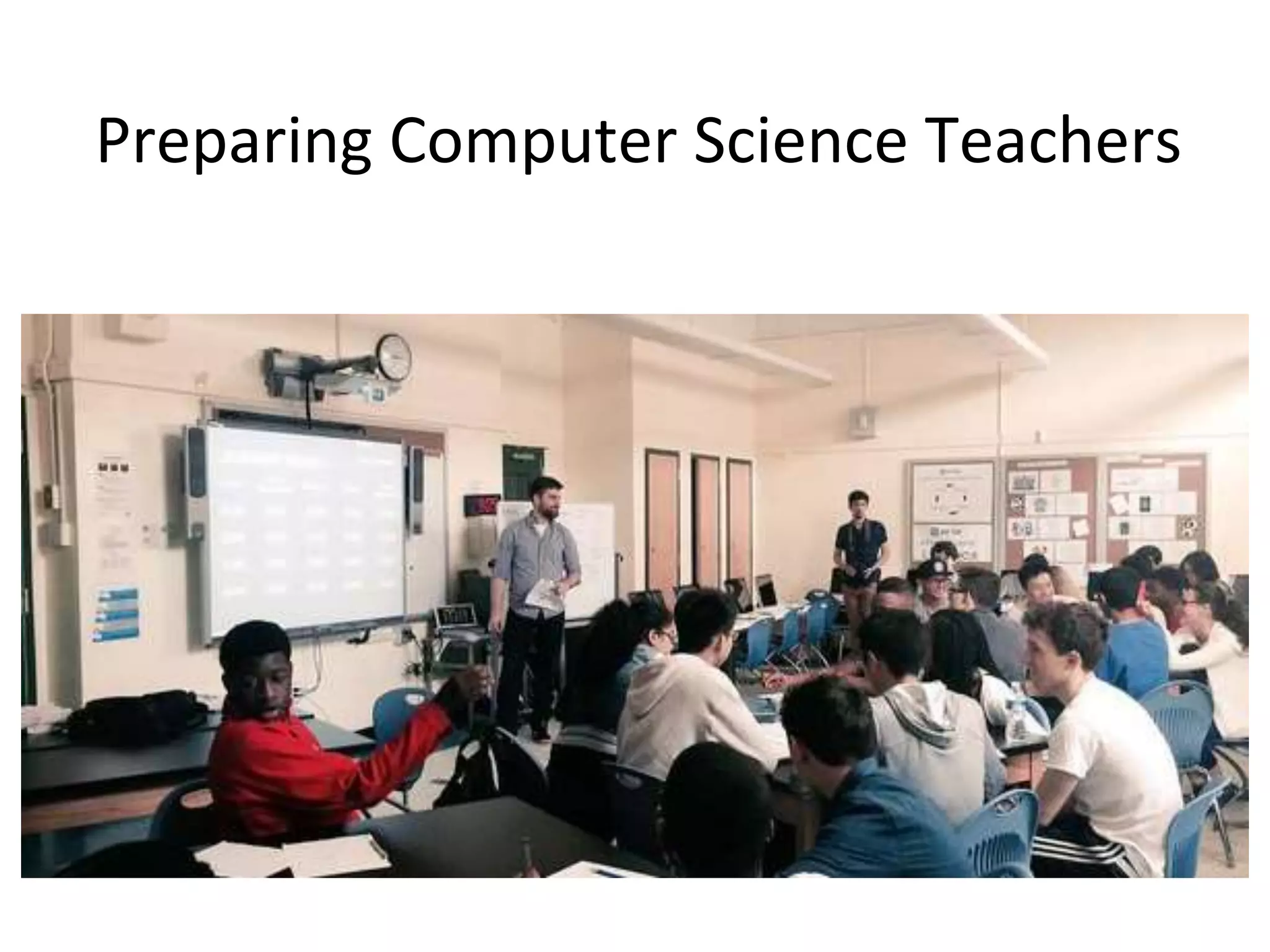
Preparing Computer Science Teachers
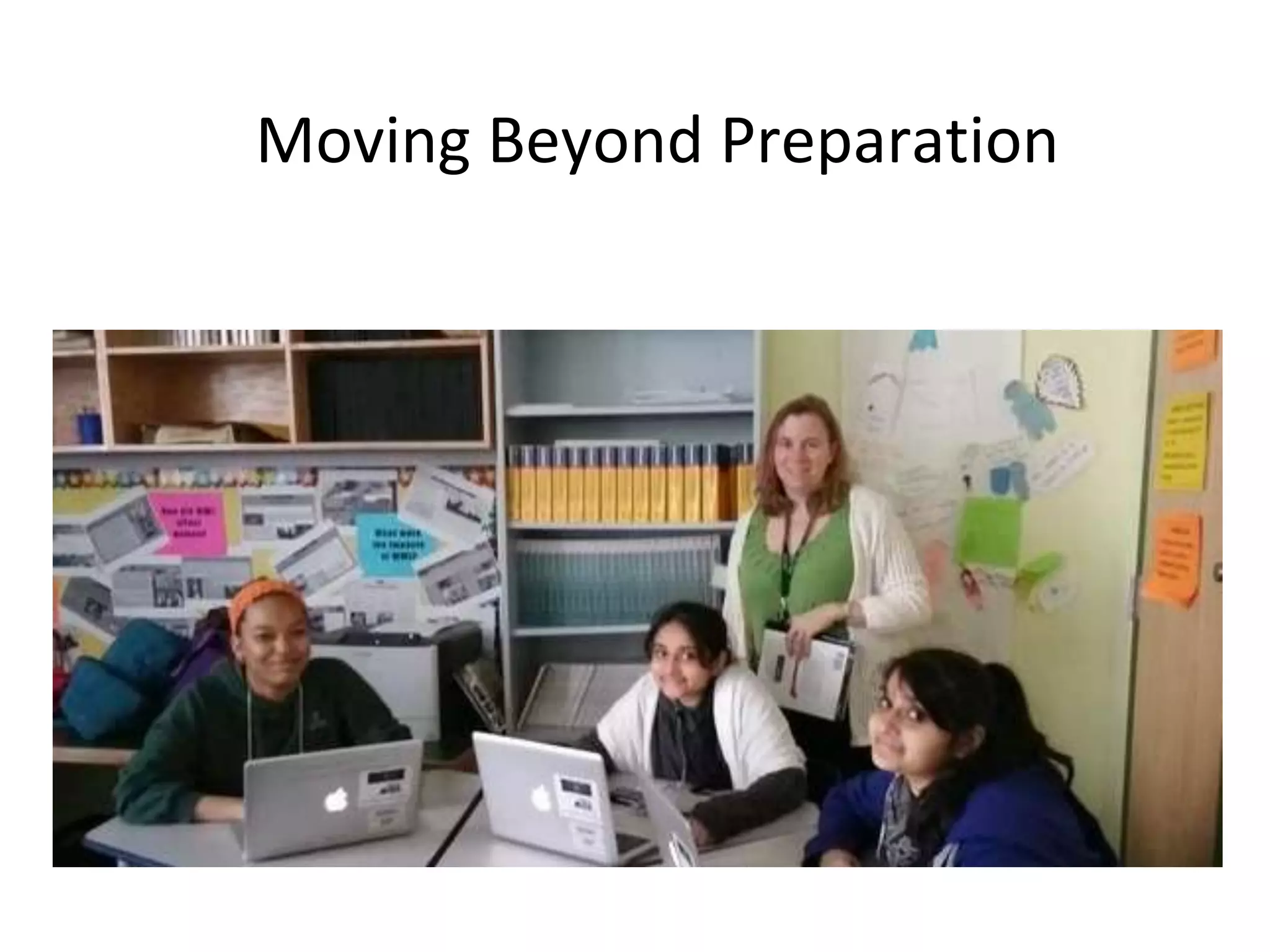
Moving Beyond Preparation
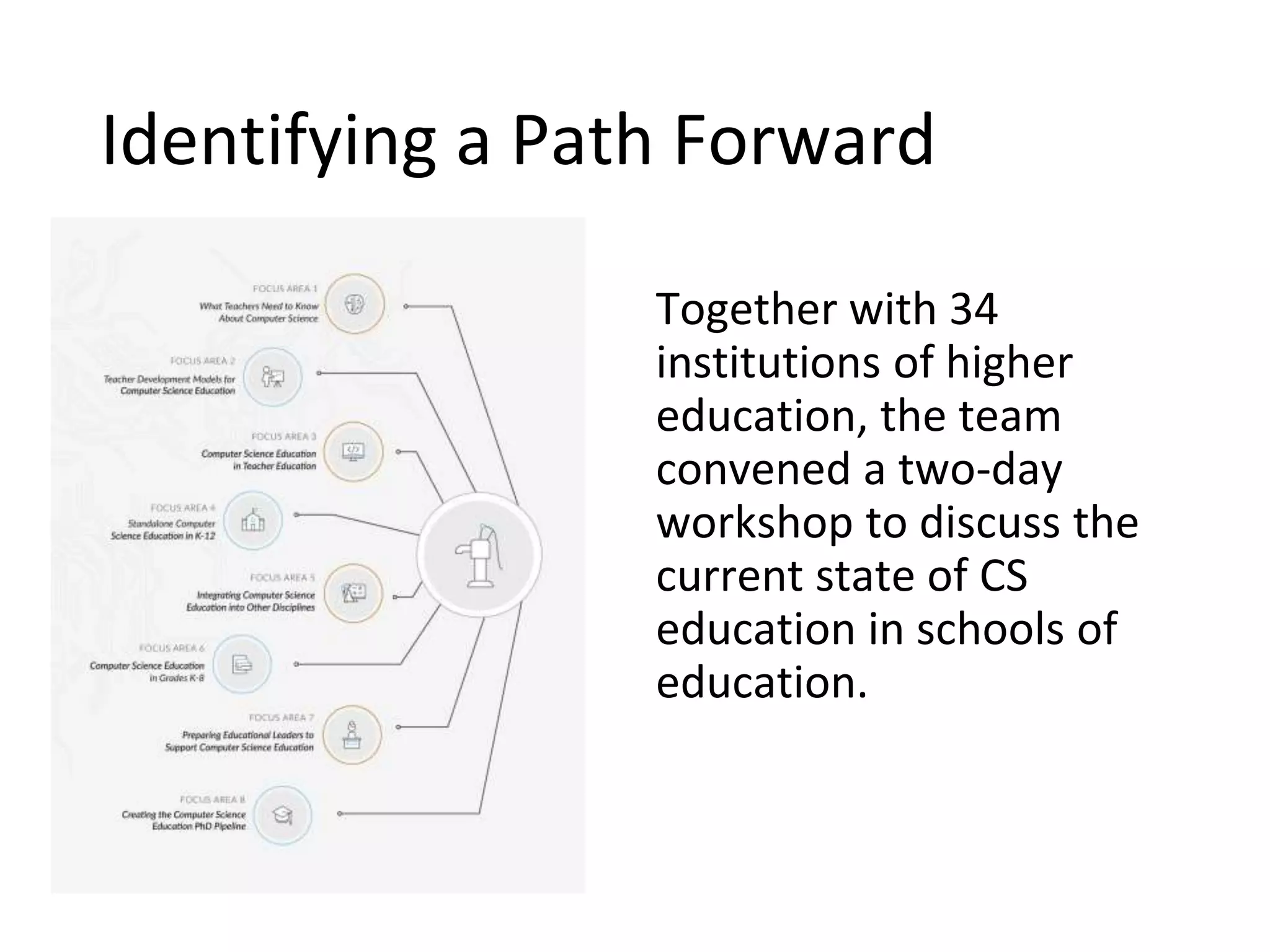
Identifying a Path Forward
Together with 34
institutions of higher
education, the team
convened a two-day
workshop to discuss the
current state of CS
education in schools of
education.
What do
Teachers Need
to Know about
Computer
Science?
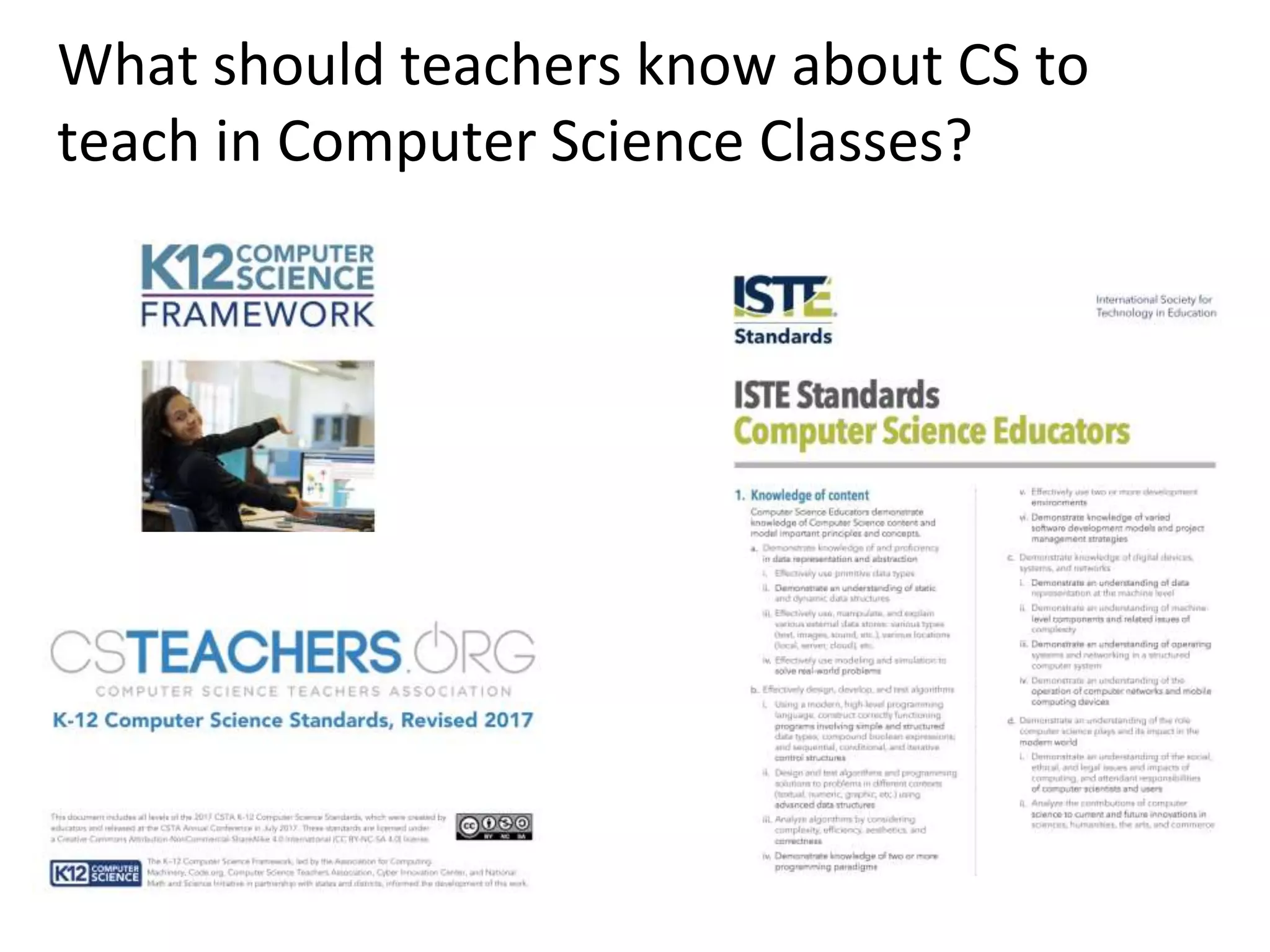
What should teachers know about CS to
teach in Computer Science Classes?
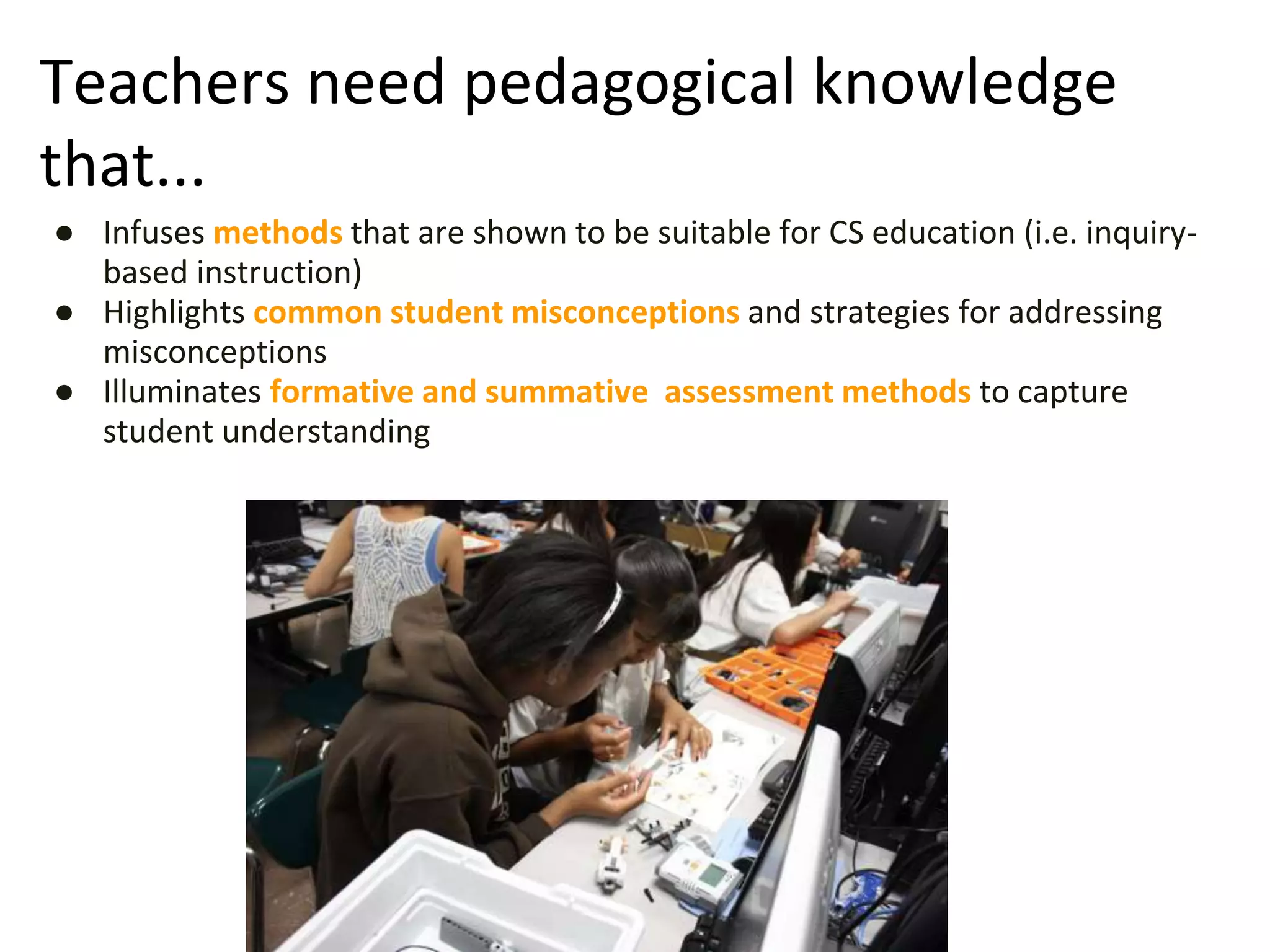
Teachers need pedagogical knowledge
that...
● Infuses methods that are shown to be suitable for CS education (i.e. inquiry-
based instruction)
● Highlights common student misconceptions and strategies for addressing
misconceptions
● Illuminates formative and summative assessment methods to capture
student understanding
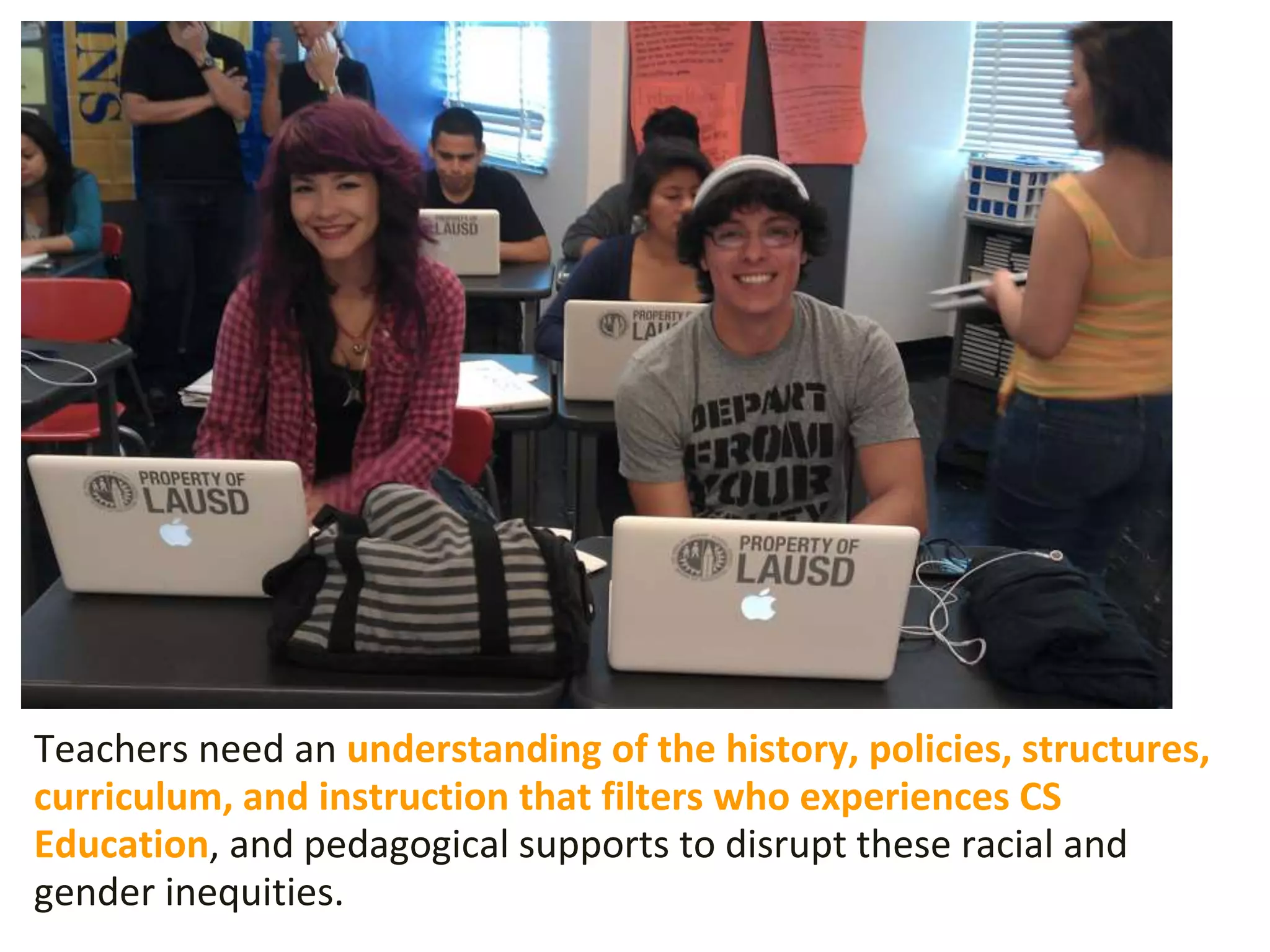
Teachers need an understanding of the history, policies, structures,
curriculum, and instruction that filters who experiences CS
Education, and pedagogical supports to disrupt these racial and
gender inequities.
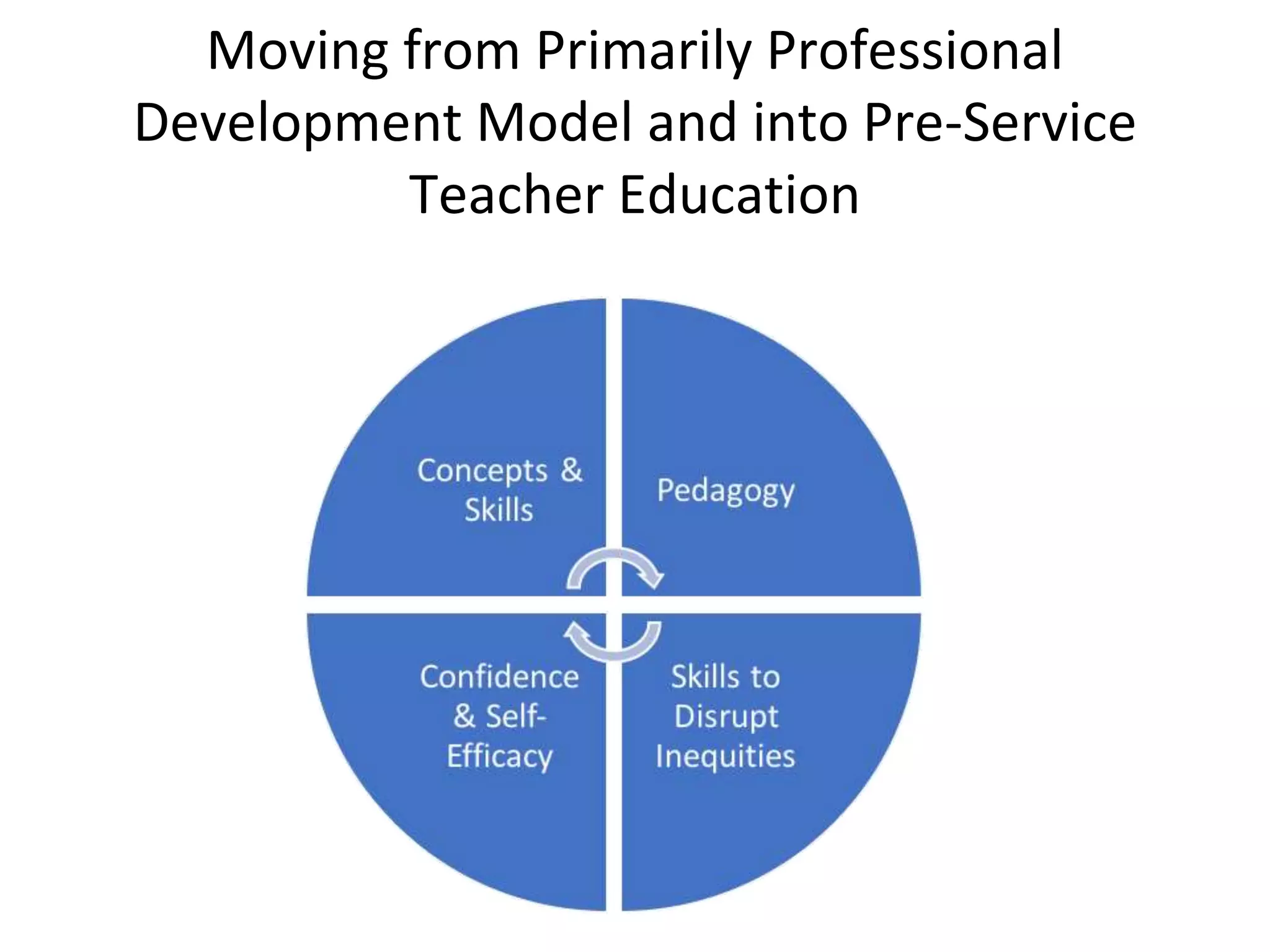
Moving from Primarily Professional
Development Model and into Pre-Service
Teacher Education
RECOMMENDATIONS
1. Schools of education should include content, teaching
methods, and state standards for CS in any preparation
programs for teachers who may have responsibility for those
standards.
1. Faculty designing new courses or programs should partner with
practitioners to make sure coursework aligns with any relevant
offerings in regional schools and to develop possible sites for
student teaching placements
1. Faculty in schools of education should participate in CS teacher
events and read/write for CS education research publications
in order to include current best practices in coursework.
Teacher
Development
Models for
Computer
Science
Education
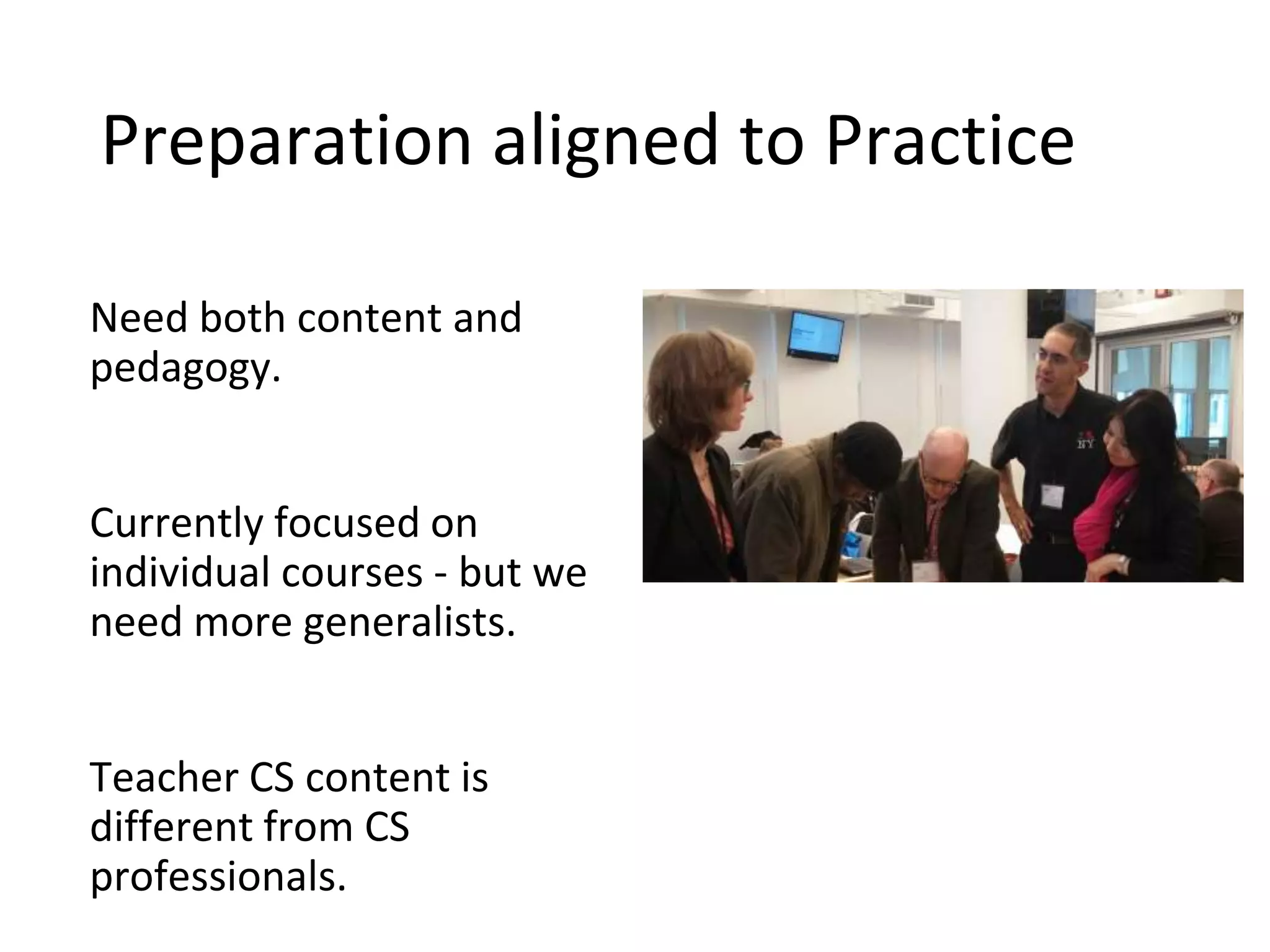
Preparation aligned to Practice
Need both content and
pedagogy.
Currently focused on
individual courses - but we
need more generalists.
Teacher CS content is
different from CS
professionals.
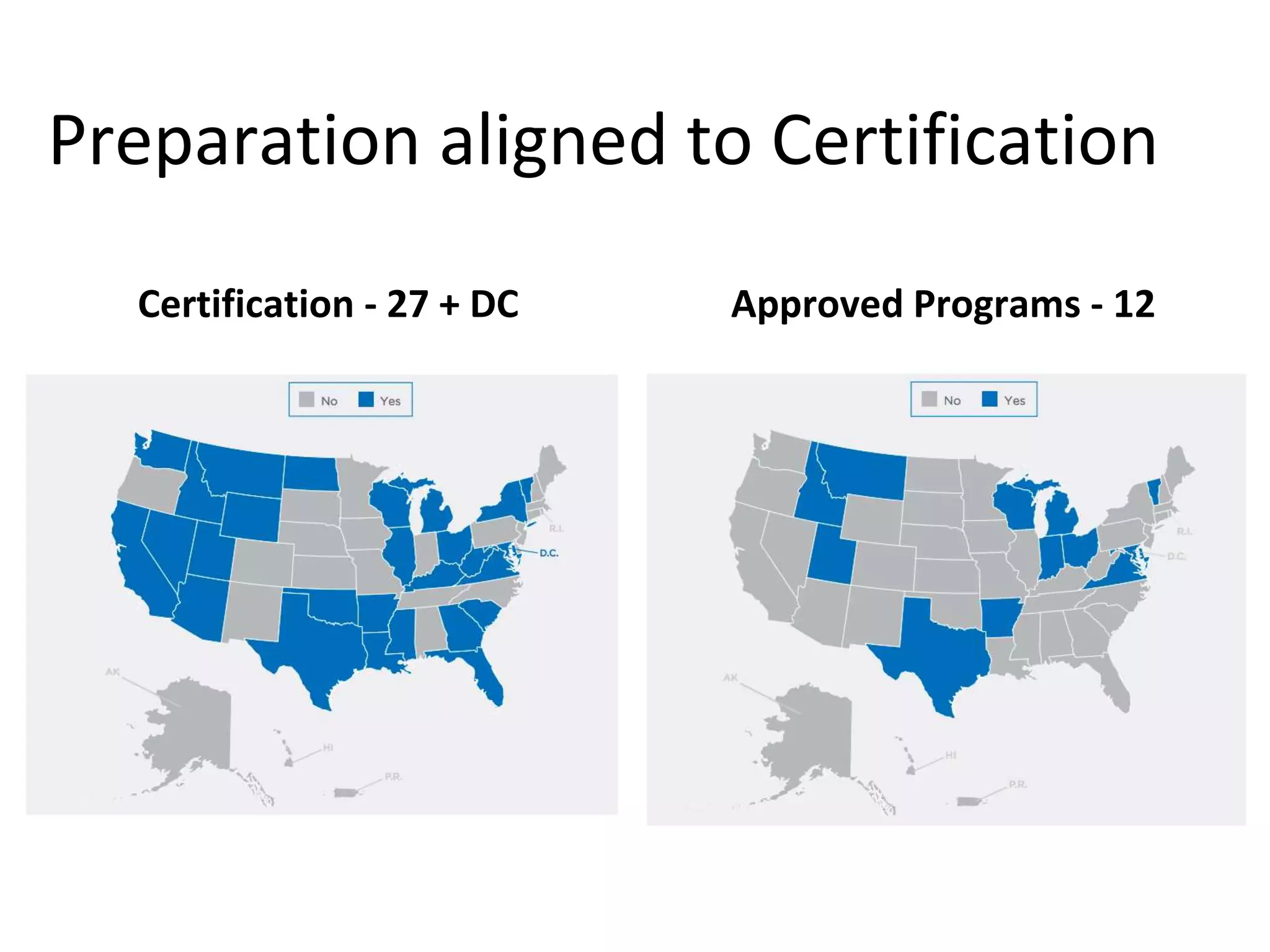
Preparation aligned to Certification
Certification - 27 + DC Approved Programs - 12
RECOMMENDATIONS
● Faculty of education can connect with members of
the department of CS who are running professional
development or inservice teacher preparation to
identify needs and best practices.
● Faculty preparing courses for future teachers should
review example syllabi or program outlines from
other institutions for common practices.
● Schools of education should make sure teacher
candidates have content preparation aligned with
national and relevant state standards for CS
education.
Computer
Science
Education in
Teacher
Education
Training New Teachers
Source: http://blog.firebrandtalent.com/2014/11/the-new-skills-you-need-for-the-digital-age/
❖ Teacher Professional
Development
❖ Bugs in the System
❖ Roadblocks
➢ CS as computer literacy
➢ Declining Enrollments
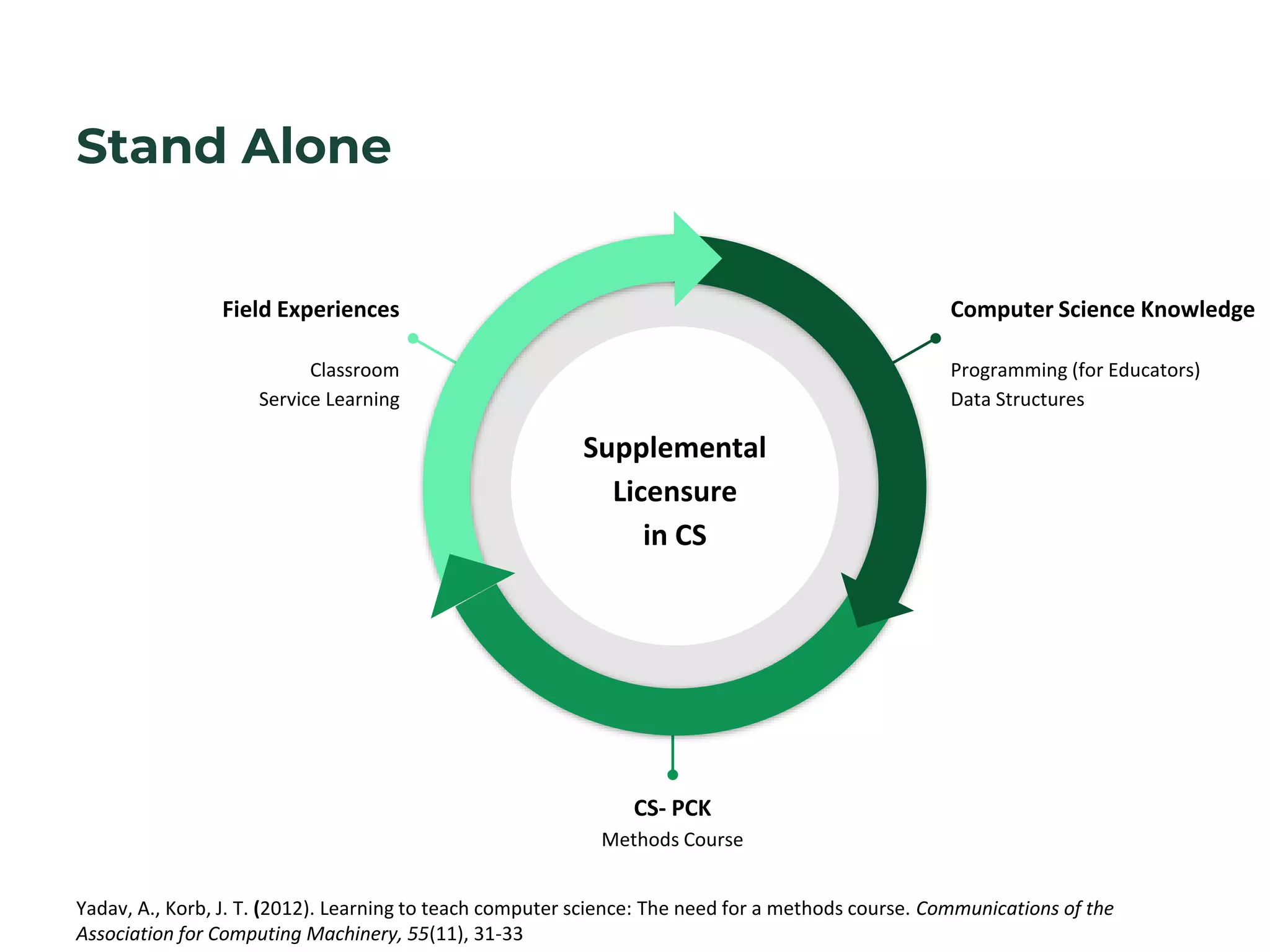
Stand Alone
Field Experiences
Classroom
Service Learning
Computer Science Knowledge
Programming (for Educators)
Data Structures
CS- PCK
Methods Course
Supplemental
Licensure
in CS
Yadav, A., Korb, J. T. (2012). Learning to teach computer science: The need for a methods course. Communications of the
Association for Computing Machinery, 55(11), 31-33
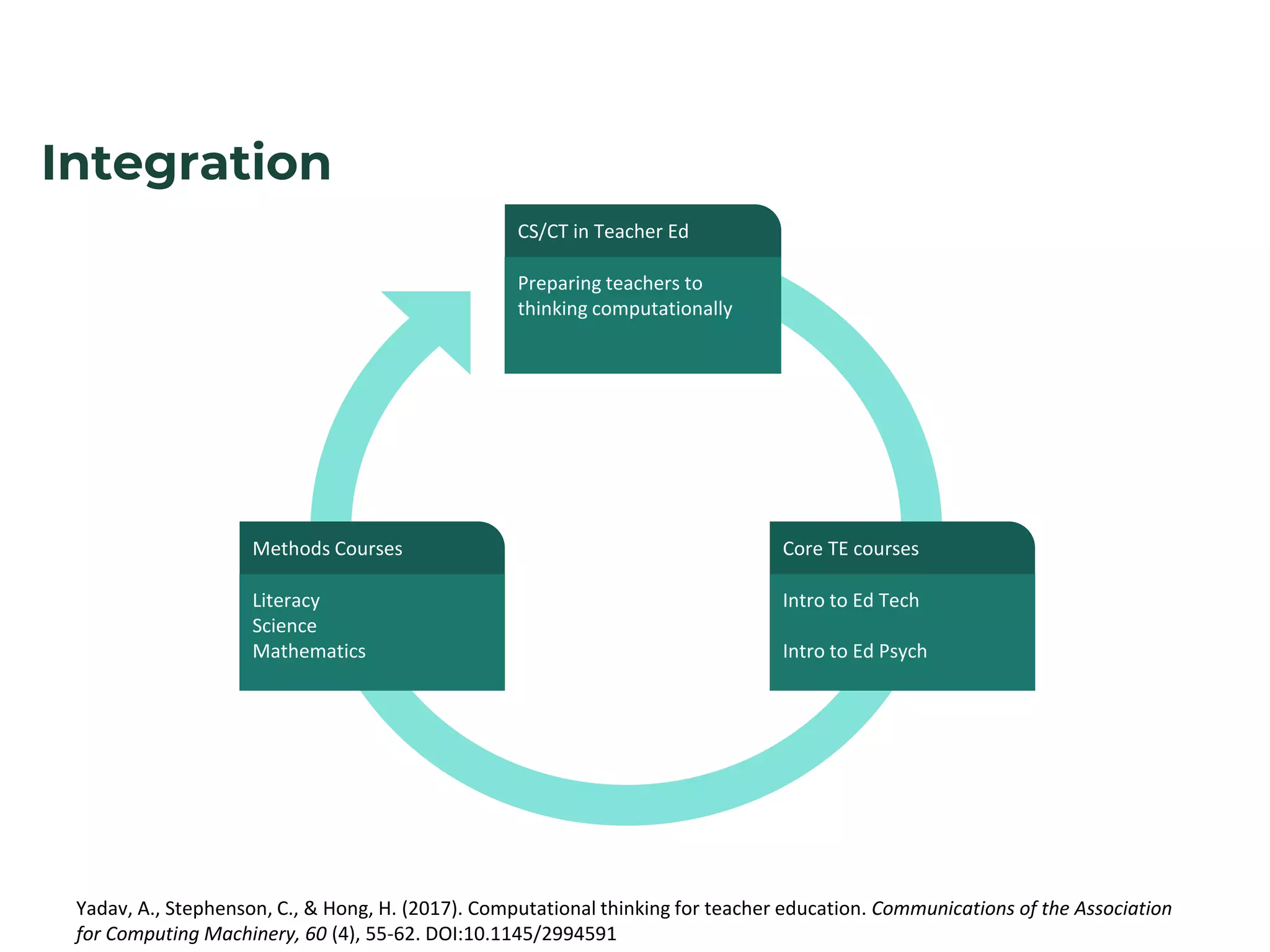
Integration
Intro to Ed Tech
Intro to Ed Psych
Core TE courses
Preparing teachers to
thinking computationally
CS/CT in Teacher Ed
Literacy
Science
Mathematics
Methods Courses
Yadav, A., Stephenson, C., & Hong, H. (2017). Computational thinking for teacher education. Communications of the Association
for Computing Machinery, 60 (4), 55-62. DOI:10.1145/2994591
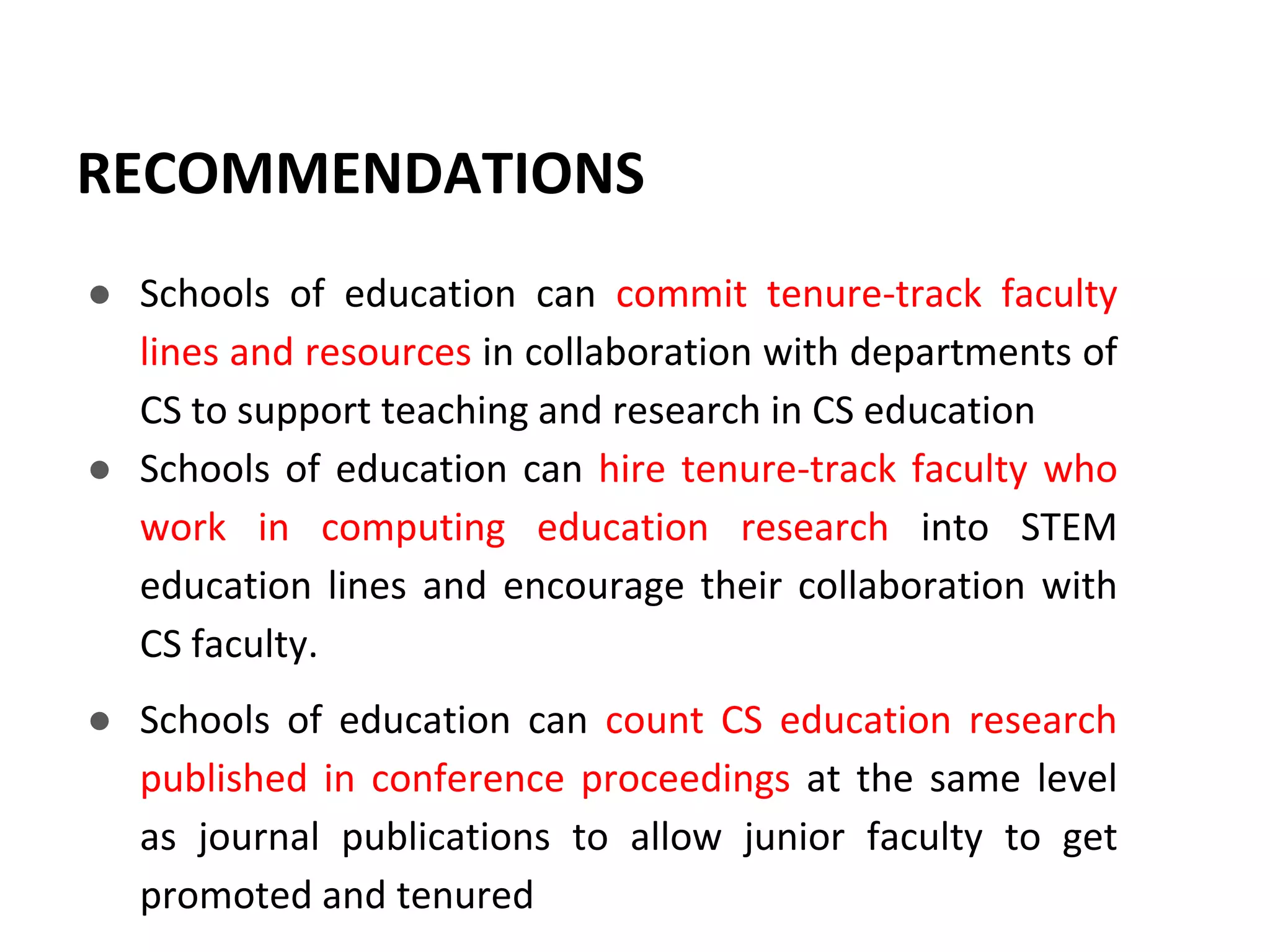
RECOMMENDATIONS
● Schools of education can commit tenure-track faculty
lines and resources in collaboration with departments of
CS to support teaching and research in CS education
● Schools of education can hire tenure-track faculty who
work in computing education research into STEM
education lines and encourage their collaboration with
CS faculty.
● Schools of education can count CS education research
published in conference proceedings at the same level
as journal publications to allow junior faculty to get
promoted and tenured
CS Courses in K-12
Standalone CS
Education in K-12
Integrating CS
Education Into Other
Disciplines
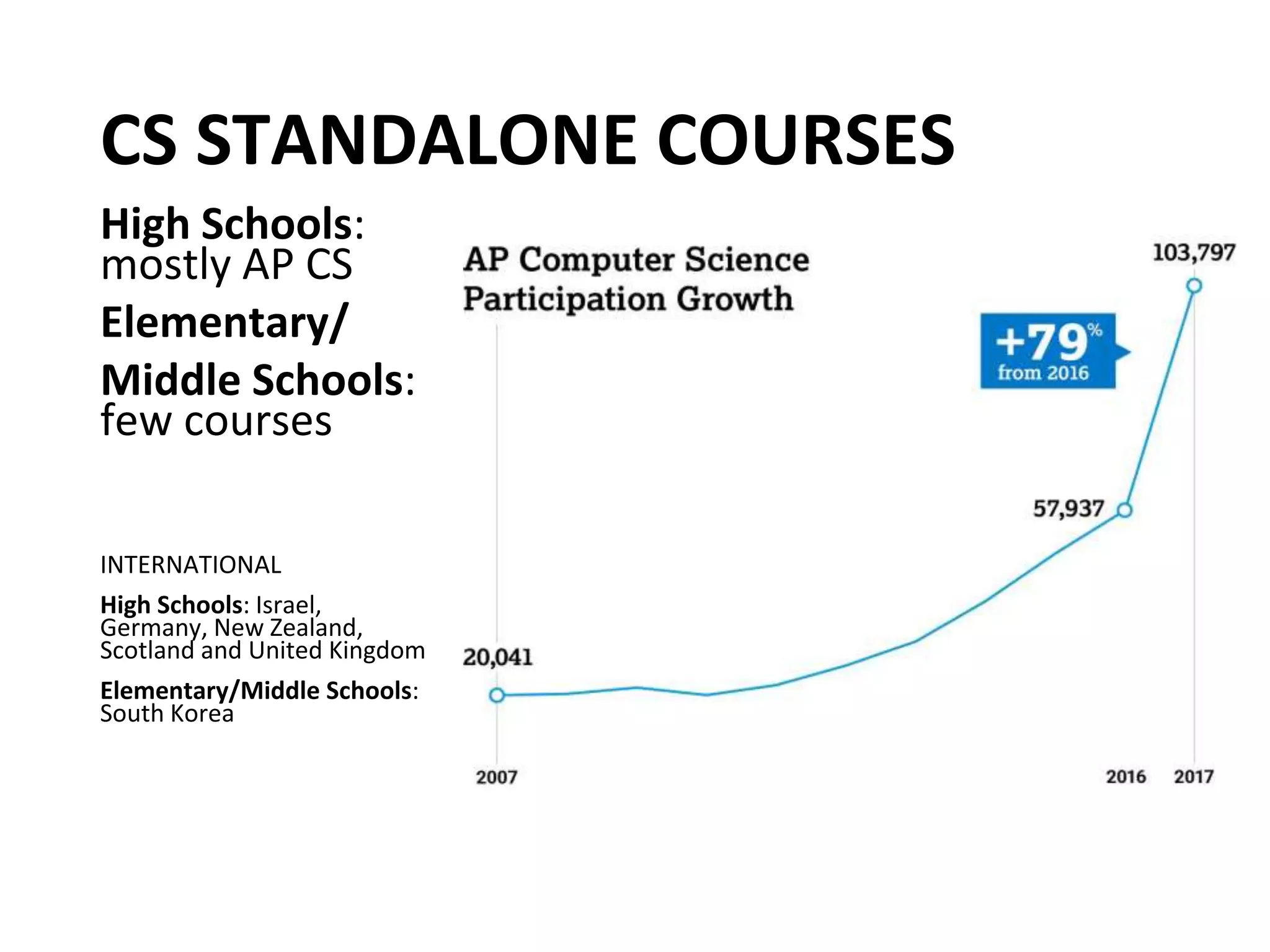
CS STANDALONE COURSES
High Schools:
mostly AP CS
Elementary/
Middle Schools:
few courses
INTERNATIONAL
High Schools: Israel,
Germany, New Zealand,
Scotland and United Kingdom
Elementary/Middle Schools:
South Korea
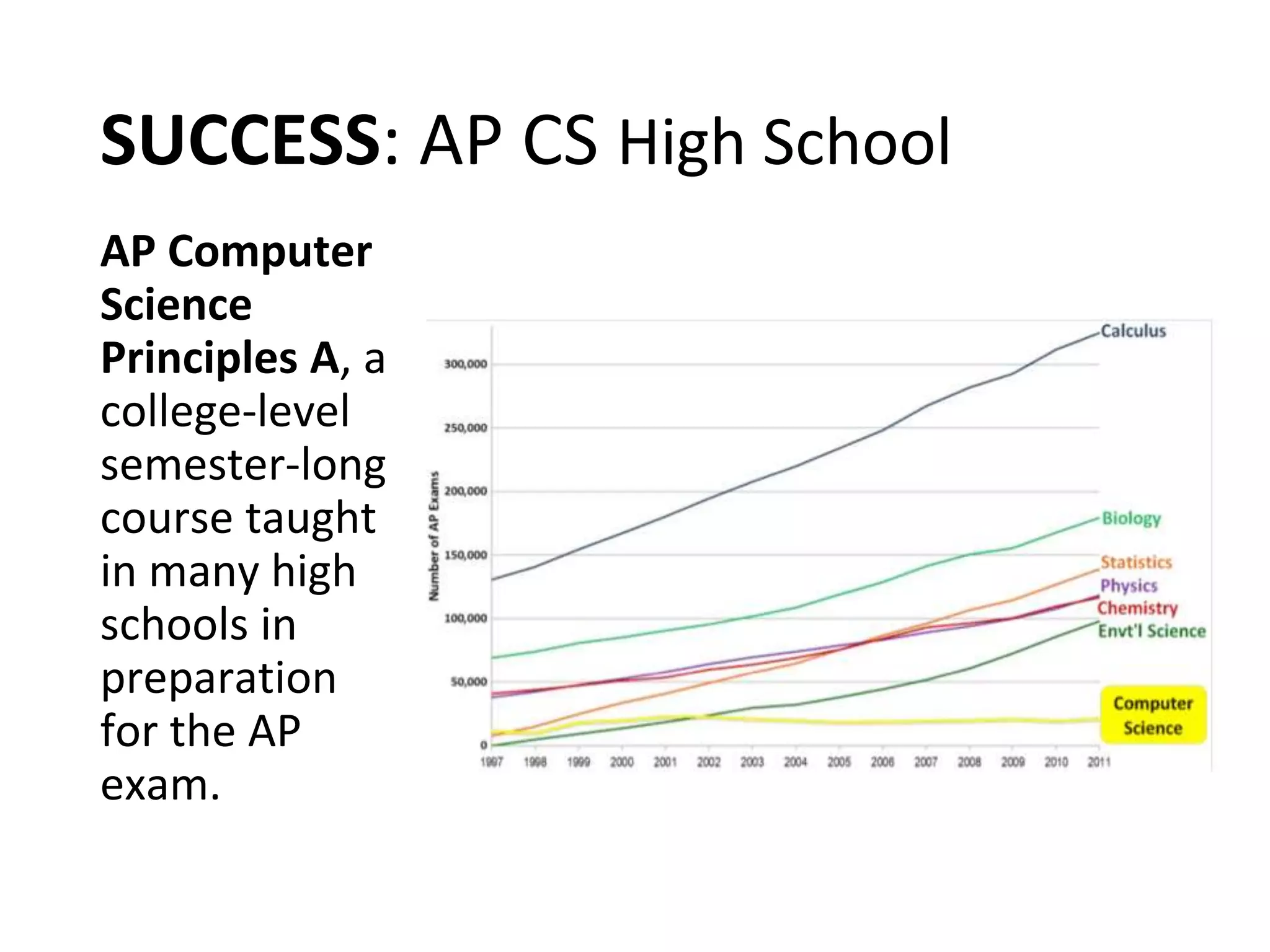
SUCCESS: AP CS High School
AP Computer
Science
Principles A, a
college-level
semester-long
course taught
in many high
schools in
preparation
for the AP
exam.
Beauty and Joy of Computing
Mobile CS Principles
UTeach CS Principles
Code.org CS Principles
Project Lead the Way*
SUCCESS: AP CS High School COURSES
Exploring Computer Science
Computer Science
Discoveries
Programming, Games, and
Apps Society
SUCCESS: Introductory High School Courses
SUCCESS: Elementary/Middle
School
Scalable Game Design
CS Discoveries
CS Fundamentals
Creative fogged Guide
MakeCodePlay
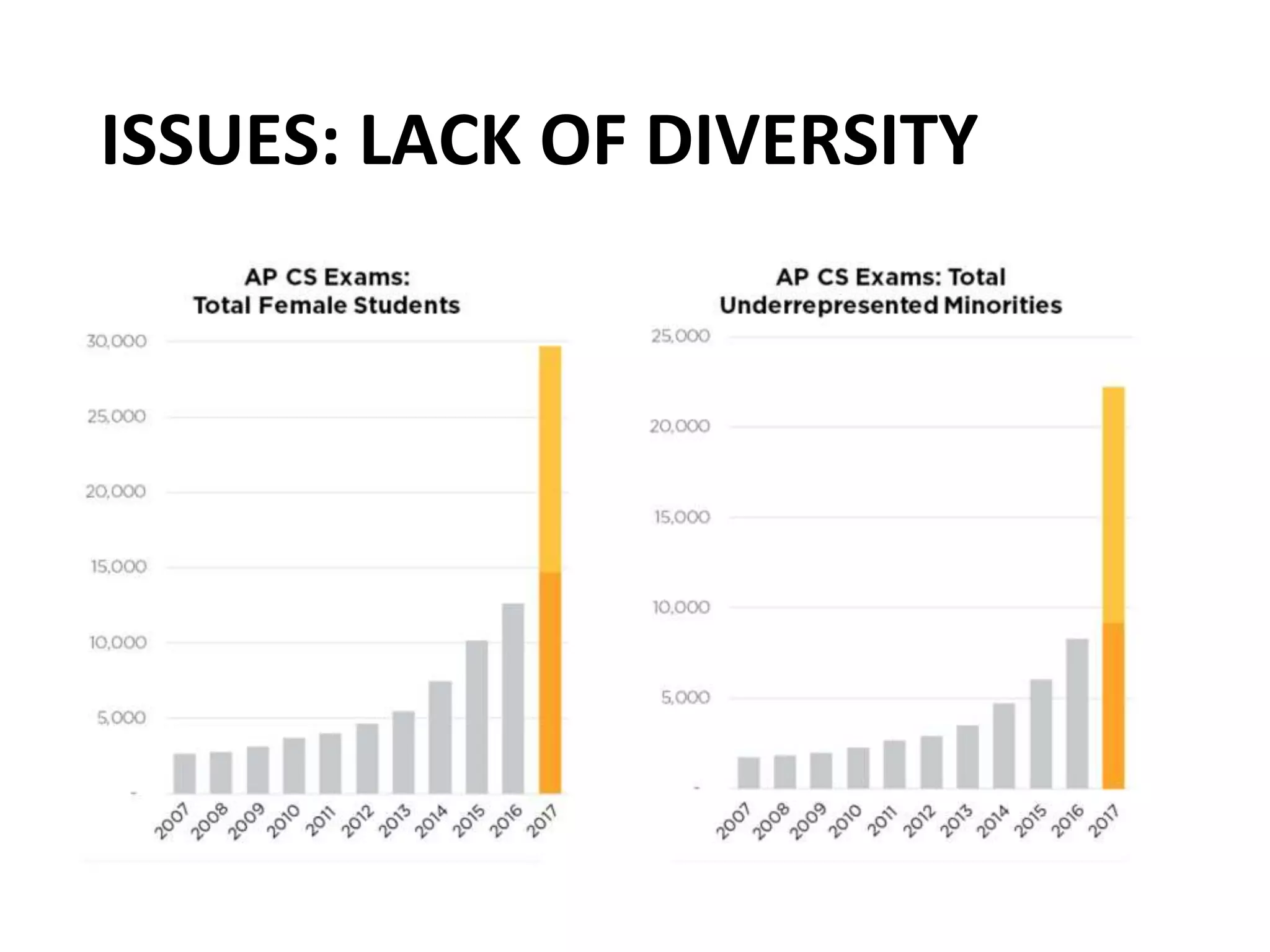
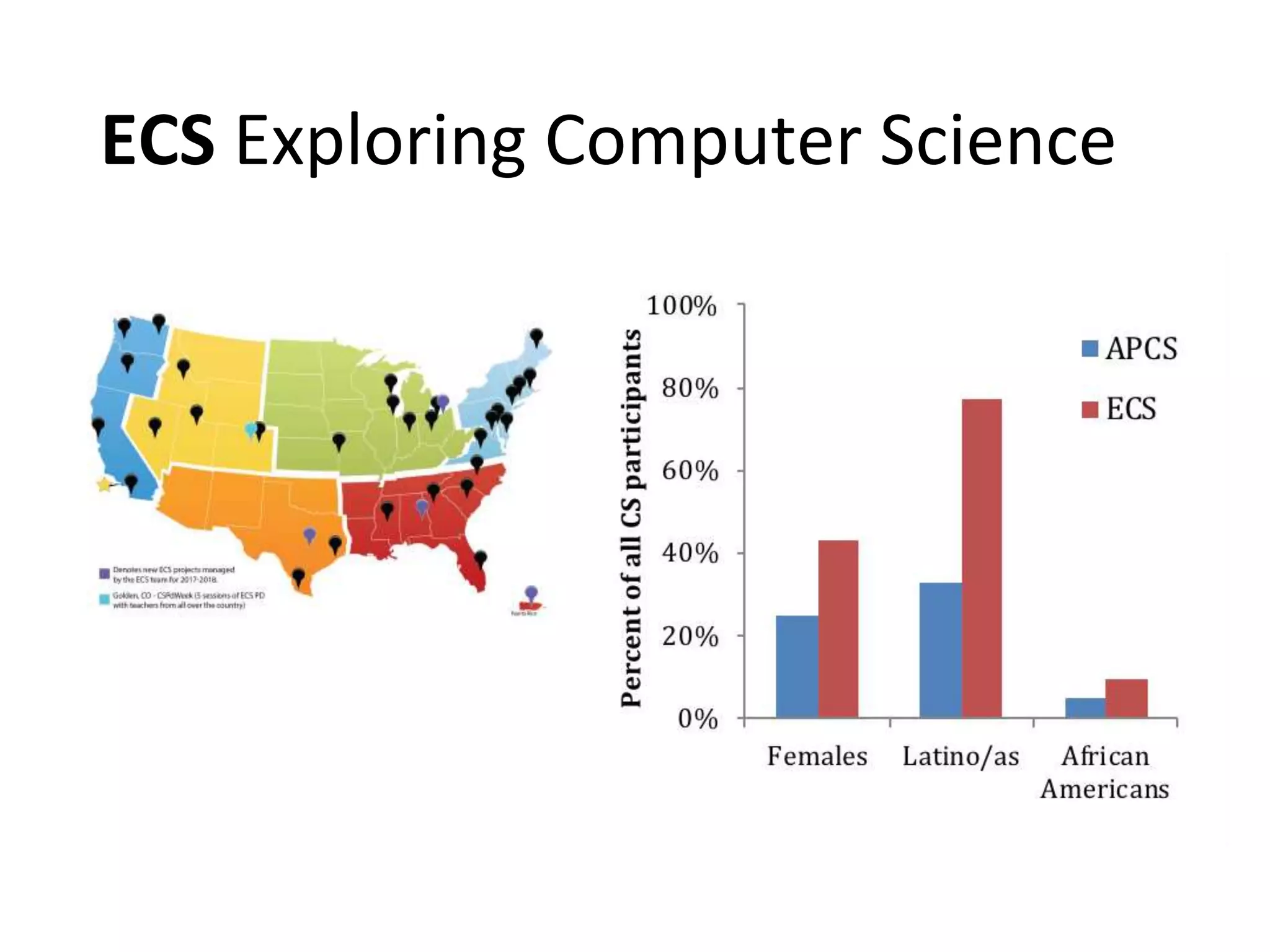
ISSUES: LACK OF DIVERSITY
ECS Exploring Computer Science
RECOMMENDATIONS
• Schools of education should explore offering
graduate coursework, certificate programs,
or even master’s degrees in CS education.
• Secondary teacher education programs need
to develop and provide courses for preparing
teachers
• Teacher education programs should hire CS
education specialists
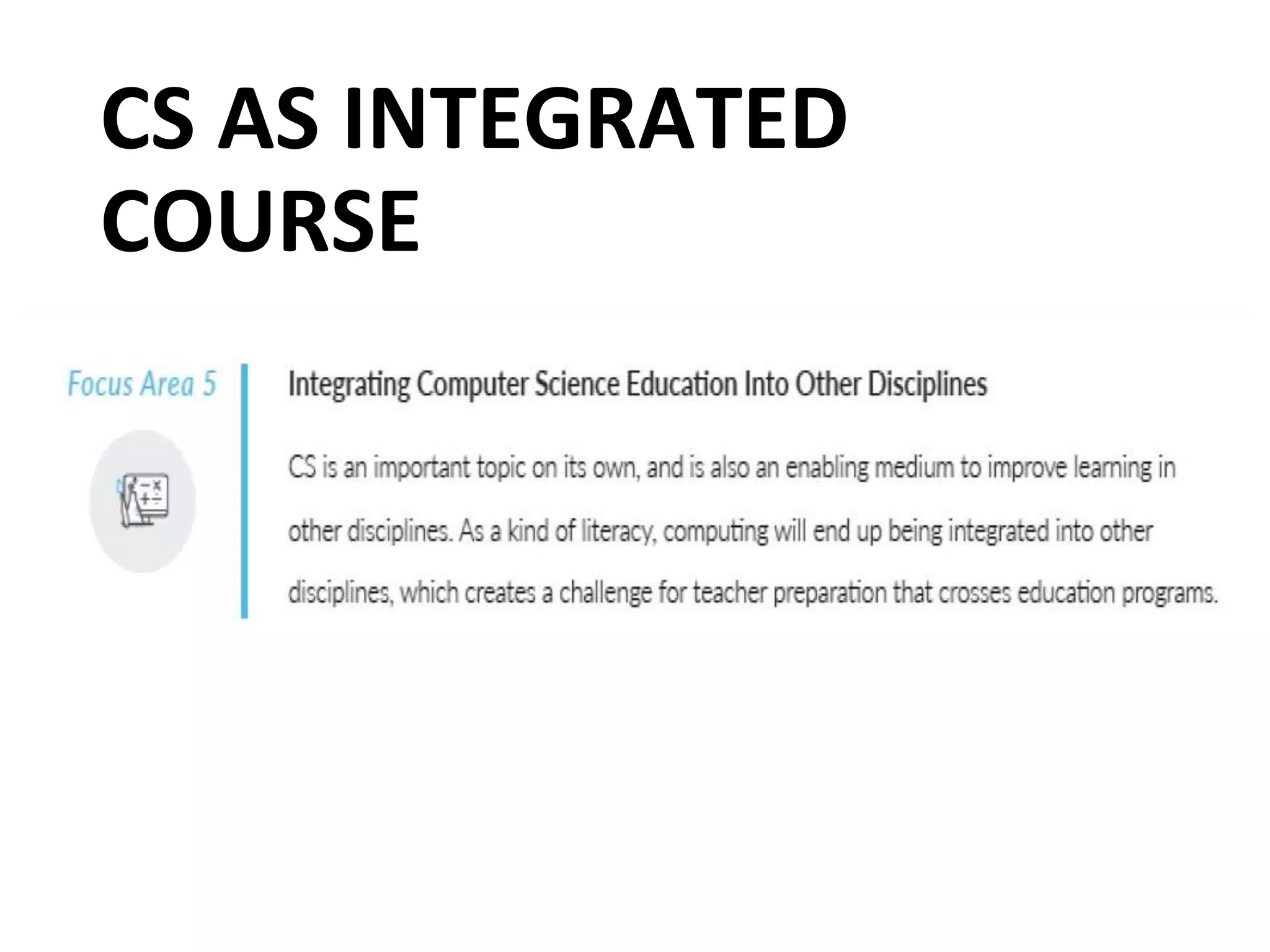
CS AS INTEGRATED
COURSE
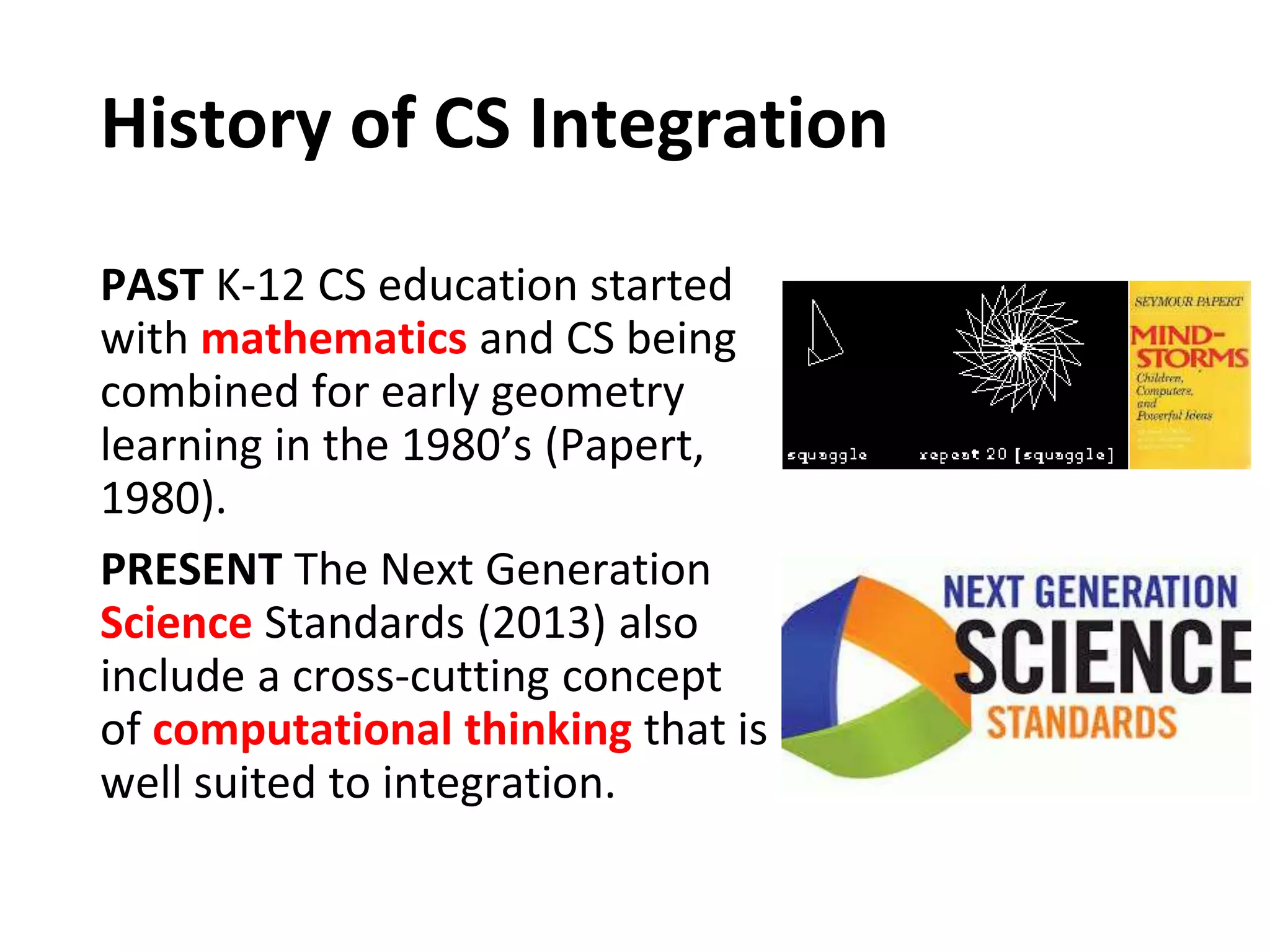
History of CS Integration
PAST K-12 CS education started
with mathematics and CS being
combined for early geometry
learning in the 1980’s (Papert,
1980).
PRESENT The Next Generation
Science Standards (2013) also
include a cross-cutting concept
of computational thinking that is
well suited to integration.
SUCCESS CS Integration in
Schools
Boostrap where students
learn Algebra through
building a video game.
Curriculum bridges the
worlds of programming
and algebra.
The assessment show student improvements in solving
mathematics word problems, even without scaffolding
(Schanzer, Fisler, Krishnamurthi, 2017).
CHALLENGES TO CS
INTEGRATION
STEM (Science, technology, engineering, and mathematics)
disciplines are often the first to come to mind when
considering the integration of CS education into K-12 subjects.
Successfully integrated CS activities have learning goals and
either explicit instruction or explicit reflection for both
domains to promote learning.
CASE: A student may create a simulation depicting viral
growth in a population, however without instruction to
understand the science behind the simulation or a reflection
that enables the student to connect the behavior on the
screen to the desired science instructional goals, very little
domain learning will occur.
GAPS
Teachers have a general contextual understanding
for topics (mathematics, history, etc.) taught in K-12
and how they might integrate with each other.
In contrast, there is no shared understanding of
computer science in even the most basic principles.
➔ We must provide foundational understanding for
all teachers in CS and computational thinking,
RECOMMENDATIONS
• Schools of education should identify examples of
integrated CS education to include in coursework for
education students in other disciplines.
• Schools of education faculty and students should
interact with students and faculty from other
departments on campus.
• Faculty and students from schools of education
should seek out case studies of interventions that did
not produce learning gains in interdisciplinary project
and discuss what may have inhibited the learning.
Discussion
Computer
Science
Education in
Grades K-8
● Schools of education should ensure through
programmatic requirements that K-8 teachers receive
basic literacy instruction in CS as well as foundational CS
education pedagogical instruction.
● Faculty in schools of education should have
opportunities to familiarize themselves with relevant K-
12 CS education standards for integration into core
pedagogical coursework.
● Candidates for ELL or special education licenses or
certificates should include cases or examples with CS
instruction as a part of their training.
RECOMMENDATIONS
Preparing
Educational
Leaders to
Support
Computer
Science
Education
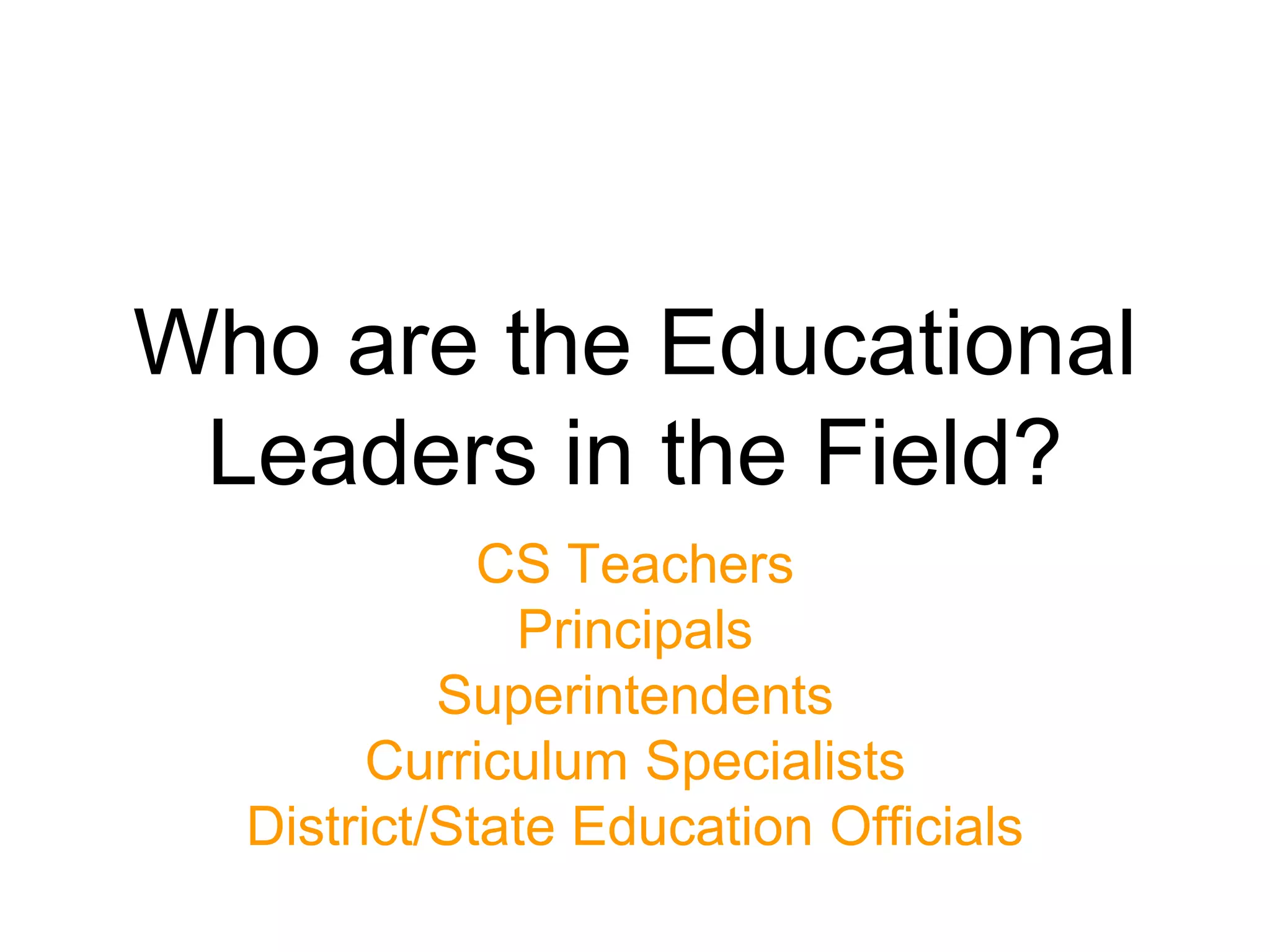
Who are the Educational
Leaders in the Field?
CS Teachers
Principals
Superintendents
Curriculum Specialists
District/State Education Officials
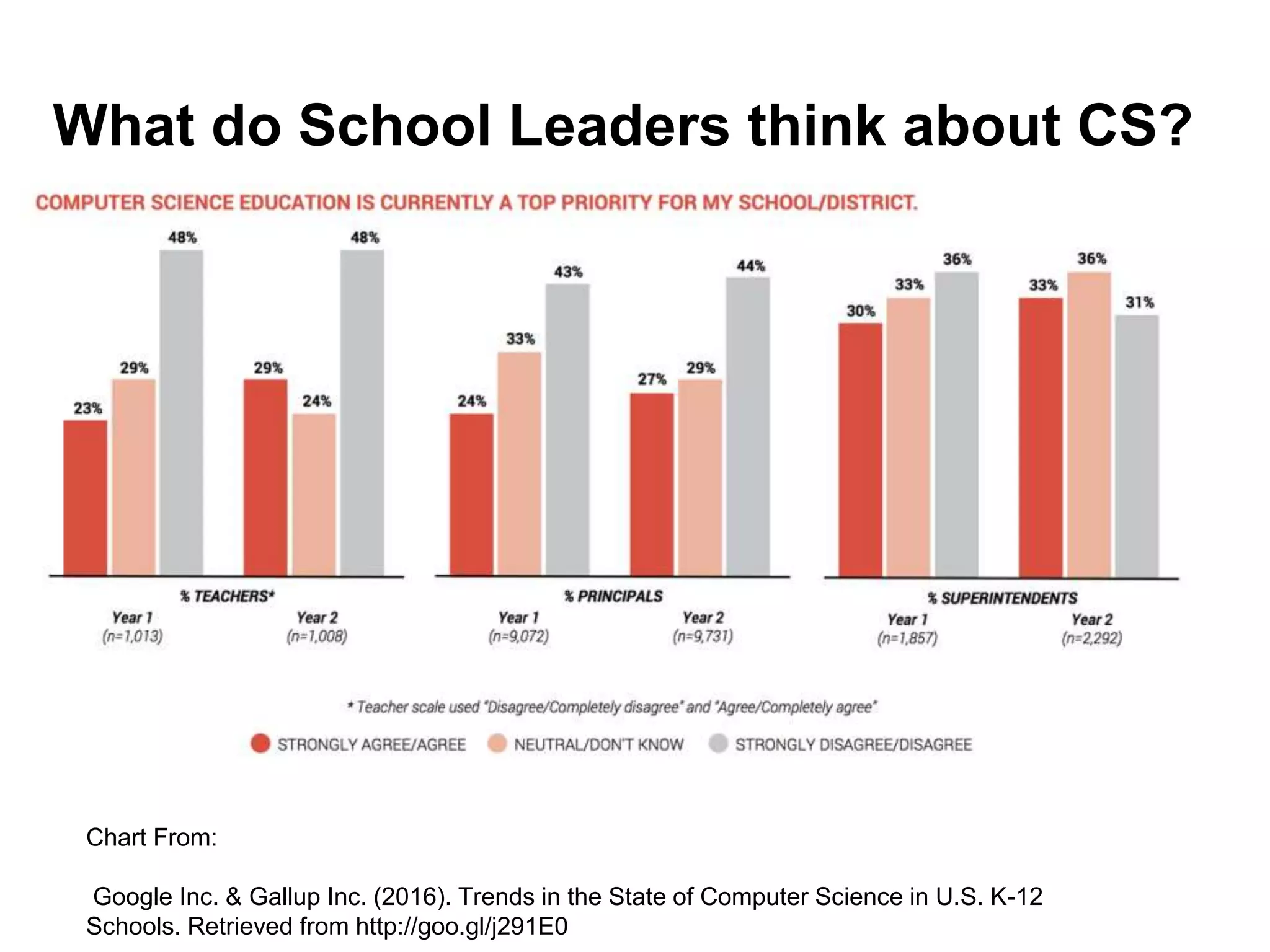
Chart From:
Google Inc. & Gallup Inc. (2016). Trends in the State of Computer Science in U.S. K-12
Schools. Retrieved from http://goo.gl/j291E0
What do School Leaders think about CS?
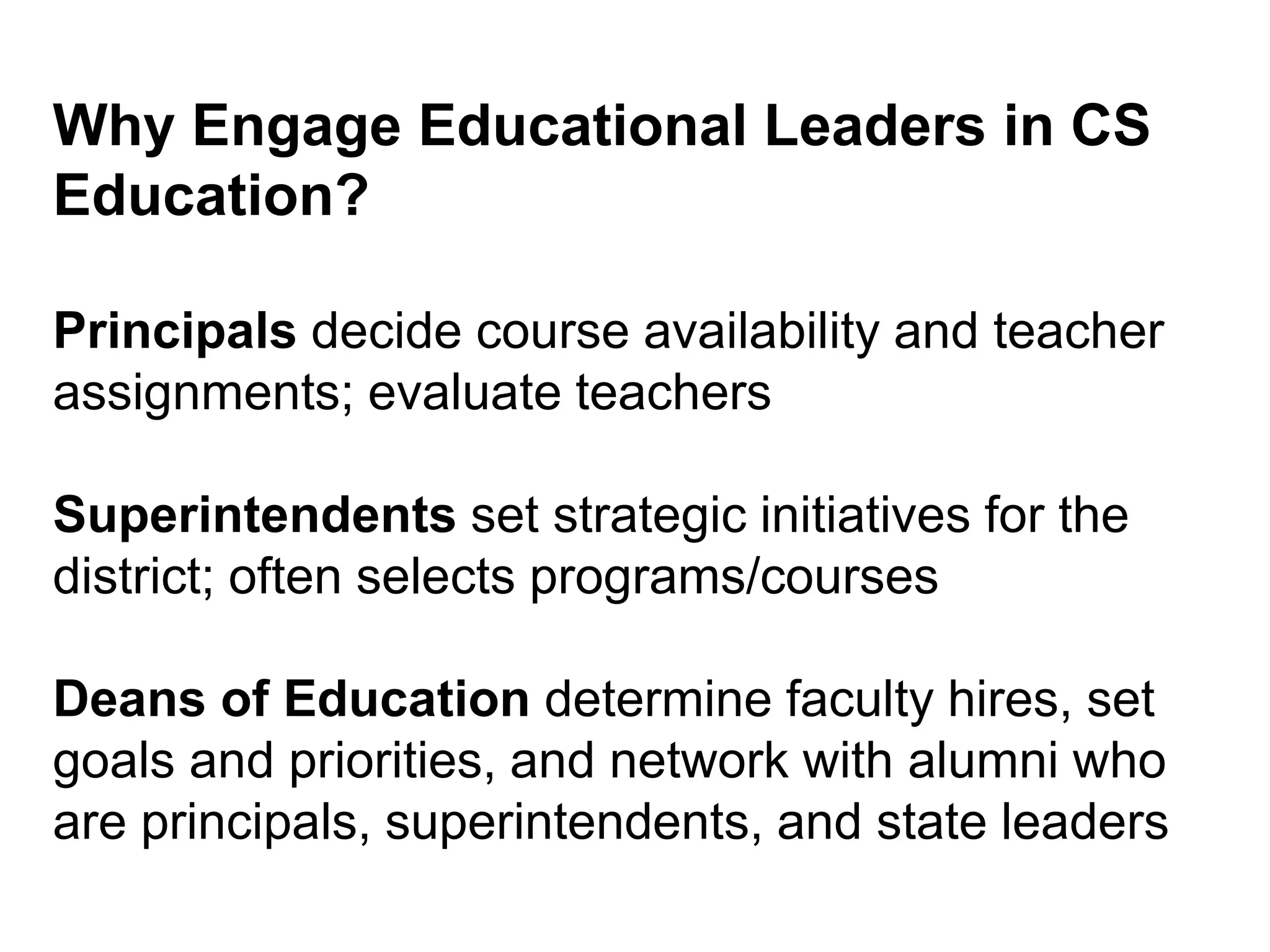
Why Engage Educational Leaders in CS
Education?
Principals decide course availability and teacher
assignments; evaluate teachers
Superintendents set strategic initiatives for the
district; often selects programs/courses
Deans of Education determine faculty hires, set
goals and priorities, and network with alumni who
are principals, superintendents, and state leaders
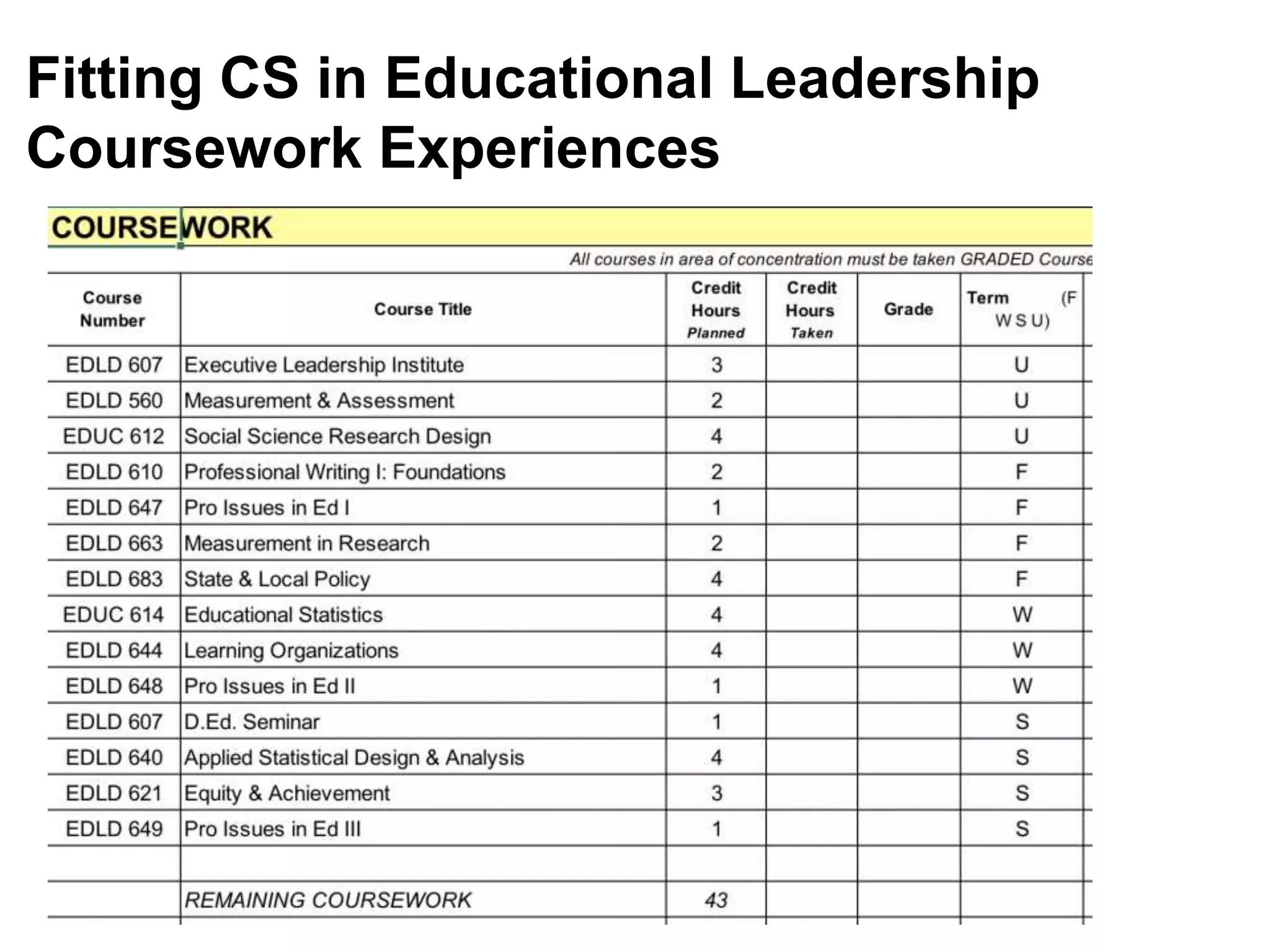
Fitting CS in Educational Leadership
Coursework Experiences
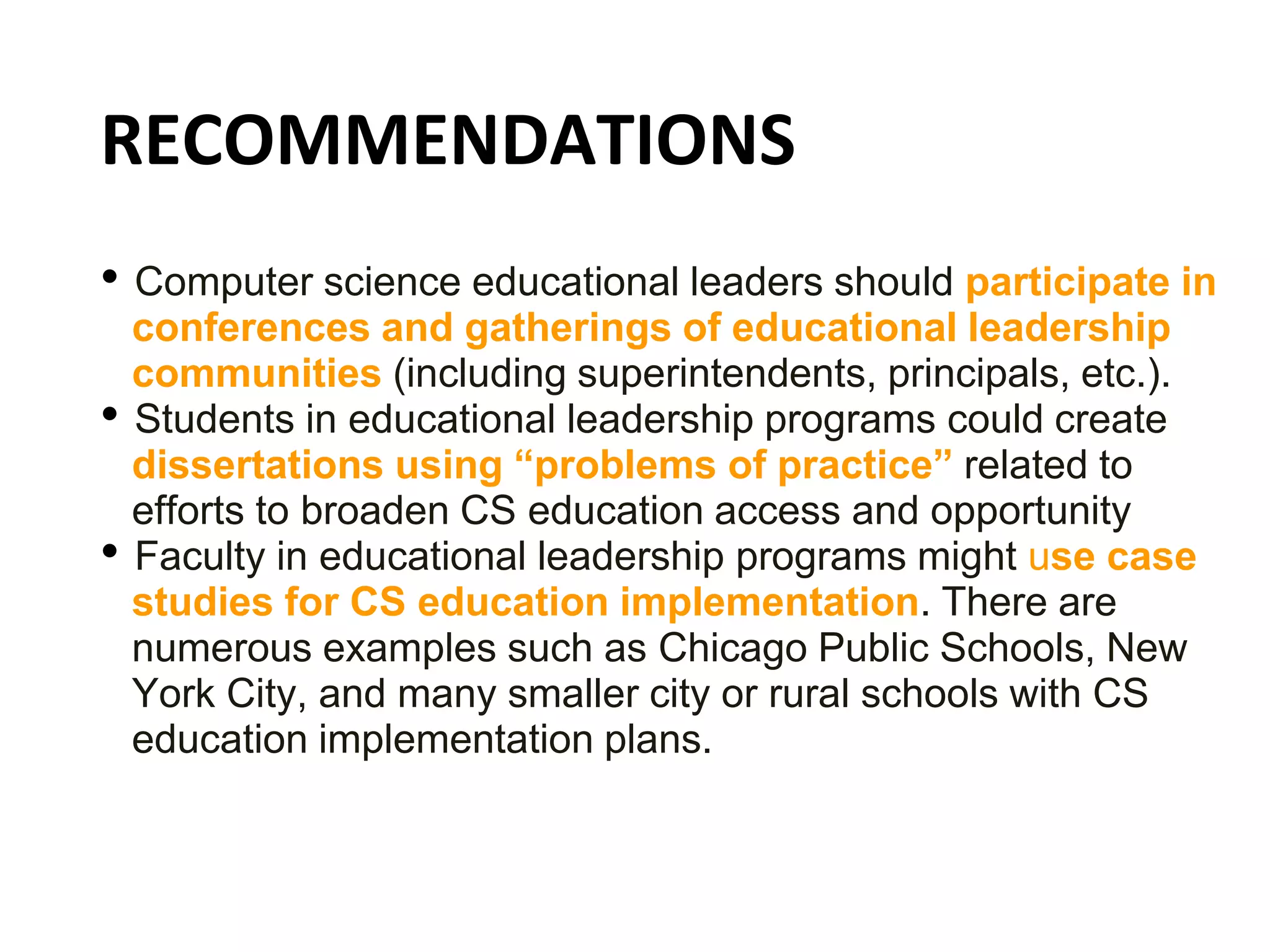
RECOMMENDATIONS
• Computer science educational leaders should participate in
conferences and gatherings of educational leadership
communities (including superintendents, principals, etc.).
• Students in educational leadership programs could create
dissertations using “problems of practice” related to
efforts to broaden CS education access and opportunity
• Faculty in educational leadership programs might use case
studies for CS education implementation. There are
numerous examples such as Chicago Public Schools, New
York City, and many smaller city or rural schools with CS
education implementation plans.
Creating the
Computer
Science
Education PhD
Pipeline
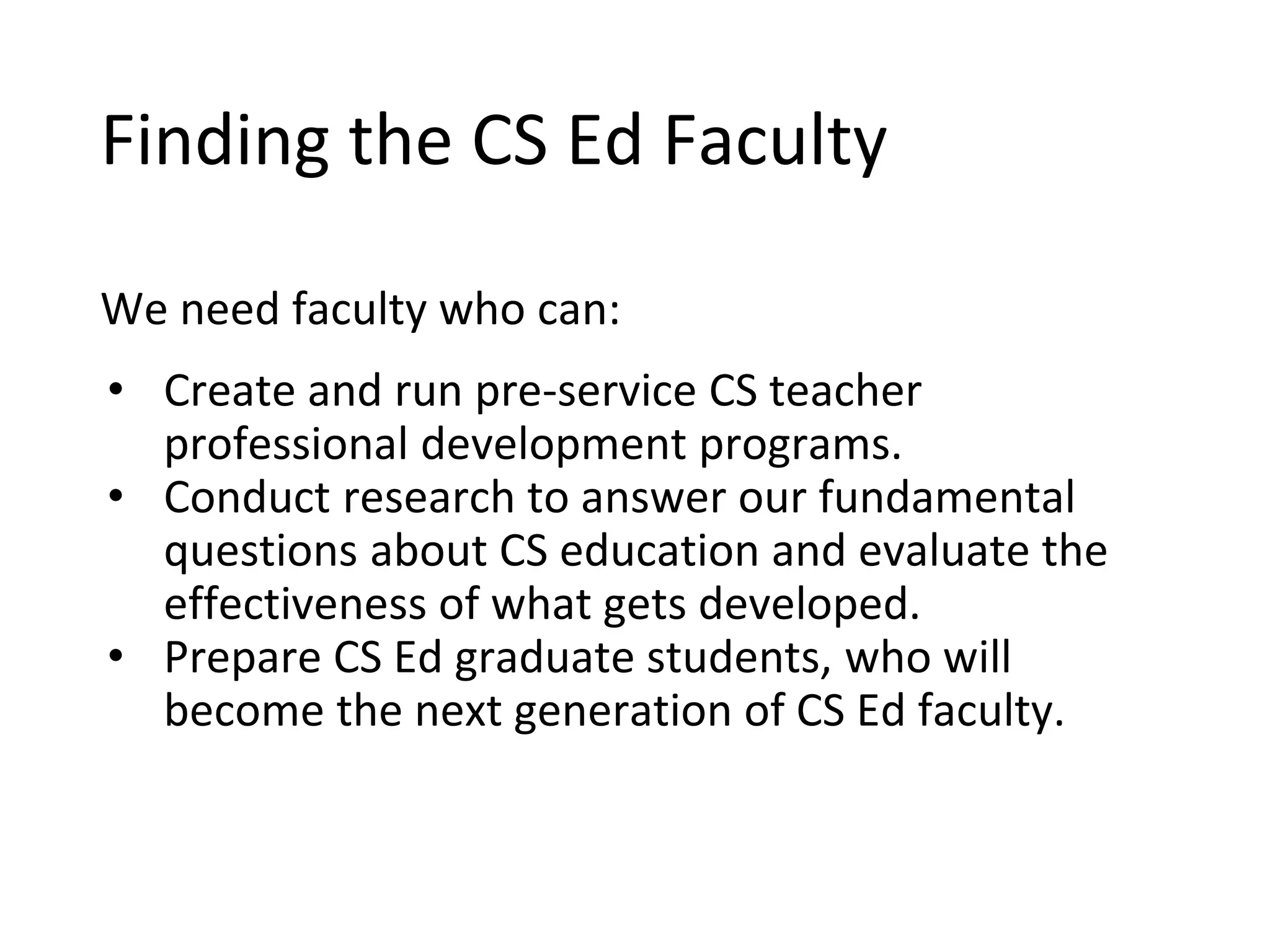
Finding the CS Ed Faculty
We need faculty who can:
• Create and run pre-service CS teacher
professional development programs.
• Conduct research to answer our fundamental
questions about CS education and evaluate the
effectiveness of what gets developed.
• Prepare CS Ed graduate students, who will
become the next generation of CS Ed faculty.
CS Ed today is mostly in CS
Not surprising: Discipline-based Education Research
usually starts in the discipline.
But it can’t stay just there.
• Not informed by schools and classrooms.
• Doesn’t prepare teachers.
• Doesn’t sustain the system.
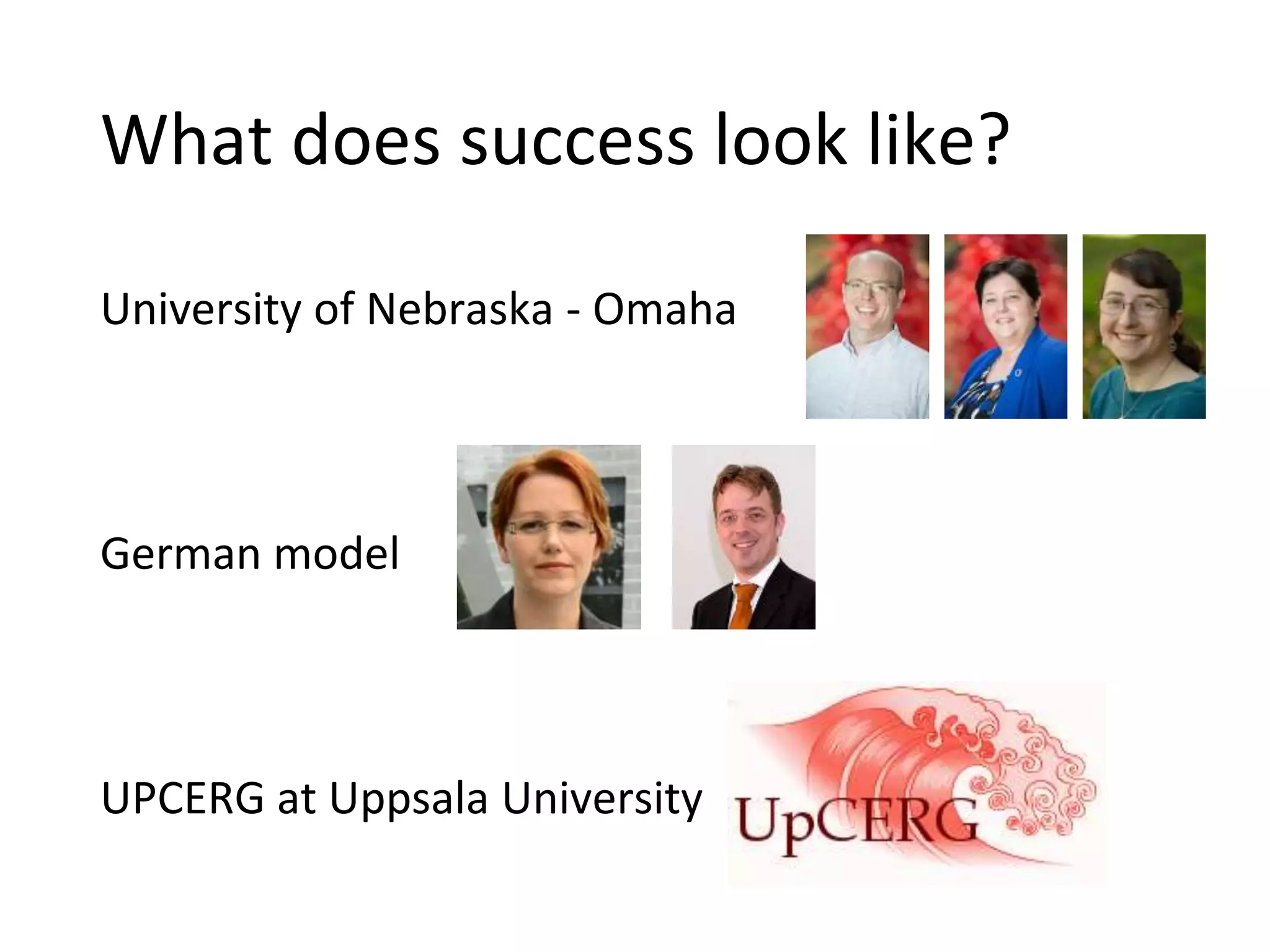
What does success look like?
University of Nebraska - Omaha
German model
UPCERG at Uppsala University
Getting from here to there
Recognizing interdisciplinary publication venues,
even if transitional.
Finding ways to hire CS Ed faculty
• CS Ed slots
• STEM Ed slots
Summary and
Thank Yous
What is Next?
Bring the report back to your department and share!
More copies available at computingteacher.org
Connect with CSforALL to stay informed of upcoming
events/announcements regarding CS education.
Consider writing a grant or making a commitment for
the CSforALL Summit to grow or launch a program.
Thank you!
Areas for Discussion
What are our next steps?
What are your concerns that we have not
addressed?
Lubricated by a Happy Hour,
with thanks from MongoDB

Priming the Computer Science Teacher Pump Report: Finding a Home for Computer Science in Schools of Education

  • 1.
  • 2.
  • 3.
  • 4.
  • 5.
    Identifying a PathForward Together with 34 institutions of higher education, the team convened a two-day workshop to discuss the current state of CS education in schools of education.
  • 6.
    What do Teachers Need toKnow about Computer Science?
  • 7.
    What should teachersknow about CS to teach in Computer Science Classes?
  • 8.
    Teachers need pedagogicalknowledge that... ● Infuses methods that are shown to be suitable for CS education (i.e. inquiry- based instruction) ● Highlights common student misconceptions and strategies for addressing misconceptions ● Illuminates formative and summative assessment methods to capture student understanding
  • 9.
    Teachers need anunderstanding of the history, policies, structures, curriculum, and instruction that filters who experiences CS Education, and pedagogical supports to disrupt these racial and gender inequities.
  • 10.
    Moving from PrimarilyProfessional Development Model and into Pre-Service Teacher Education
  • 11.
    RECOMMENDATIONS 1. Schools ofeducation should include content, teaching methods, and state standards for CS in any preparation programs for teachers who may have responsibility for those standards. 1. Faculty designing new courses or programs should partner with practitioners to make sure coursework aligns with any relevant offerings in regional schools and to develop possible sites for student teaching placements 1. Faculty in schools of education should participate in CS teacher events and read/write for CS education research publications in order to include current best practices in coursework.
  • 12.
  • 13.
    Preparation aligned toPractice Need both content and pedagogy. Currently focused on individual courses - but we need more generalists. Teacher CS content is different from CS professionals.
  • 14.
    Preparation aligned toCertification Certification - 27 + DC Approved Programs - 12
  • 15.
    RECOMMENDATIONS ● Faculty ofeducation can connect with members of the department of CS who are running professional development or inservice teacher preparation to identify needs and best practices. ● Faculty preparing courses for future teachers should review example syllabi or program outlines from other institutions for common practices. ● Schools of education should make sure teacher candidates have content preparation aligned with national and relevant state standards for CS education.
  • 16.
  • 17.
    Training New Teachers Source:http://blog.firebrandtalent.com/2014/11/the-new-skills-you-need-for-the-digital-age/ ❖ Teacher Professional Development ❖ Bugs in the System ❖ Roadblocks ➢ CS as computer literacy ➢ Declining Enrollments
  • 18.
    Stand Alone Field Experiences Classroom ServiceLearning Computer Science Knowledge Programming (for Educators) Data Structures CS- PCK Methods Course Supplemental Licensure in CS Yadav, A., Korb, J. T. (2012). Learning to teach computer science: The need for a methods course. Communications of the Association for Computing Machinery, 55(11), 31-33
  • 19.
    Integration Intro to EdTech Intro to Ed Psych Core TE courses Preparing teachers to thinking computationally CS/CT in Teacher Ed Literacy Science Mathematics Methods Courses Yadav, A., Stephenson, C., & Hong, H. (2017). Computational thinking for teacher education. Communications of the Association for Computing Machinery, 60 (4), 55-62. DOI:10.1145/2994591
  • 20.
    RECOMMENDATIONS ● Schools ofeducation can commit tenure-track faculty lines and resources in collaboration with departments of CS to support teaching and research in CS education ● Schools of education can hire tenure-track faculty who work in computing education research into STEM education lines and encourage their collaboration with CS faculty. ● Schools of education can count CS education research published in conference proceedings at the same level as journal publications to allow junior faculty to get promoted and tenured
  • 21.
    CS Courses inK-12 Standalone CS Education in K-12 Integrating CS Education Into Other Disciplines
  • 23.
    CS STANDALONE COURSES HighSchools: mostly AP CS Elementary/ Middle Schools: few courses INTERNATIONAL High Schools: Israel, Germany, New Zealand, Scotland and United Kingdom Elementary/Middle Schools: South Korea
  • 24.
    SUCCESS: AP CSHigh School AP Computer Science Principles A, a college-level semester-long course taught in many high schools in preparation for the AP exam.
  • 25.
    Beauty and Joyof Computing Mobile CS Principles UTeach CS Principles Code.org CS Principles Project Lead the Way* SUCCESS: AP CS High School COURSES
  • 26.
    Exploring Computer Science ComputerScience Discoveries Programming, Games, and Apps Society SUCCESS: Introductory High School Courses
  • 27.
    SUCCESS: Elementary/Middle School Scalable GameDesign CS Discoveries CS Fundamentals Creative fogged Guide MakeCodePlay
  • 28.
    ISSUES: LACK OFDIVERSITY
  • 29.
  • 30.
    RECOMMENDATIONS • Schools ofeducation should explore offering graduate coursework, certificate programs, or even master’s degrees in CS education. • Secondary teacher education programs need to develop and provide courses for preparing teachers • Teacher education programs should hire CS education specialists
  • 31.
  • 32.
    History of CSIntegration PAST K-12 CS education started with mathematics and CS being combined for early geometry learning in the 1980’s (Papert, 1980). PRESENT The Next Generation Science Standards (2013) also include a cross-cutting concept of computational thinking that is well suited to integration.
  • 33.
    SUCCESS CS Integrationin Schools Boostrap where students learn Algebra through building a video game. Curriculum bridges the worlds of programming and algebra. The assessment show student improvements in solving mathematics word problems, even without scaffolding (Schanzer, Fisler, Krishnamurthi, 2017).
  • 34.
    CHALLENGES TO CS INTEGRATION STEM(Science, technology, engineering, and mathematics) disciplines are often the first to come to mind when considering the integration of CS education into K-12 subjects. Successfully integrated CS activities have learning goals and either explicit instruction or explicit reflection for both domains to promote learning. CASE: A student may create a simulation depicting viral growth in a population, however without instruction to understand the science behind the simulation or a reflection that enables the student to connect the behavior on the screen to the desired science instructional goals, very little domain learning will occur.
  • 35.
    GAPS Teachers have ageneral contextual understanding for topics (mathematics, history, etc.) taught in K-12 and how they might integrate with each other. In contrast, there is no shared understanding of computer science in even the most basic principles. ➔ We must provide foundational understanding for all teachers in CS and computational thinking,
  • 36.
    RECOMMENDATIONS • Schools ofeducation should identify examples of integrated CS education to include in coursework for education students in other disciplines. • Schools of education faculty and students should interact with students and faculty from other departments on campus. • Faculty and students from schools of education should seek out case studies of interventions that did not produce learning gains in interdisciplinary project and discuss what may have inhibited the learning.
  • 37.
  • 38.
  • 39.
    ● Schools ofeducation should ensure through programmatic requirements that K-8 teachers receive basic literacy instruction in CS as well as foundational CS education pedagogical instruction. ● Faculty in schools of education should have opportunities to familiarize themselves with relevant K- 12 CS education standards for integration into core pedagogical coursework. ● Candidates for ELL or special education licenses or certificates should include cases or examples with CS instruction as a part of their training. RECOMMENDATIONS
  • 40.
  • 41.
    Who are theEducational Leaders in the Field? CS Teachers Principals Superintendents Curriculum Specialists District/State Education Officials
  • 42.
    Chart From: Google Inc.& Gallup Inc. (2016). Trends in the State of Computer Science in U.S. K-12 Schools. Retrieved from http://goo.gl/j291E0 What do School Leaders think about CS?
  • 43.
    Why Engage EducationalLeaders in CS Education? Principals decide course availability and teacher assignments; evaluate teachers Superintendents set strategic initiatives for the district; often selects programs/courses Deans of Education determine faculty hires, set goals and priorities, and network with alumni who are principals, superintendents, and state leaders
  • 44.
    Fitting CS inEducational Leadership Coursework Experiences
  • 45.
    RECOMMENDATIONS • Computer scienceeducational leaders should participate in conferences and gatherings of educational leadership communities (including superintendents, principals, etc.). • Students in educational leadership programs could create dissertations using “problems of practice” related to efforts to broaden CS education access and opportunity • Faculty in educational leadership programs might use case studies for CS education implementation. There are numerous examples such as Chicago Public Schools, New York City, and many smaller city or rural schools with CS education implementation plans.
  • 46.
  • 47.
    Finding the CSEd Faculty We need faculty who can: • Create and run pre-service CS teacher professional development programs. • Conduct research to answer our fundamental questions about CS education and evaluate the effectiveness of what gets developed. • Prepare CS Ed graduate students, who will become the next generation of CS Ed faculty.
  • 48.
    CS Ed todayis mostly in CS Not surprising: Discipline-based Education Research usually starts in the discipline. But it can’t stay just there. • Not informed by schools and classrooms. • Doesn’t prepare teachers. • Doesn’t sustain the system.
  • 49.
    What does successlook like? University of Nebraska - Omaha German model UPCERG at Uppsala University
  • 50.
    Getting from hereto there Recognizing interdisciplinary publication venues, even if transitional. Finding ways to hire CS Ed faculty • CS Ed slots • STEM Ed slots
  • 51.
  • 52.
    What is Next? Bringthe report back to your department and share! More copies available at computingteacher.org Connect with CSforALL to stay informed of upcoming events/announcements regarding CS education. Consider writing a grant or making a commitment for the CSforALL Summit to grow or launch a program.
  • 53.
  • 54.
    Areas for Discussion Whatare our next steps? What are your concerns that we have not addressed? Lubricated by a Happy Hour, with thanks from MongoDB