Using Learning Sciences to Inform Cyber
Security Education
Mark Guzdial
School of Interactive Computing
Story
• Cyber Security Education requires thinking about “how
computing works.”
• For programmers, why some practices create holes/opportunities.
• For end-users, why some activities compromise security.
• We need everyone to learn about cyber security.
• What can learning sciences tell us about encouraging that
kind of learning?
• Lesson #1: Context matters.
• The Story of Computing for All at Georgia Tech.
• Lesson #2: Identity matters.
• “Teaching” Graphics Designers who reject CS about CS.
• Lesson #3: Structure matters.
• Subgoal Labels can Dramatically Improve Learning
.
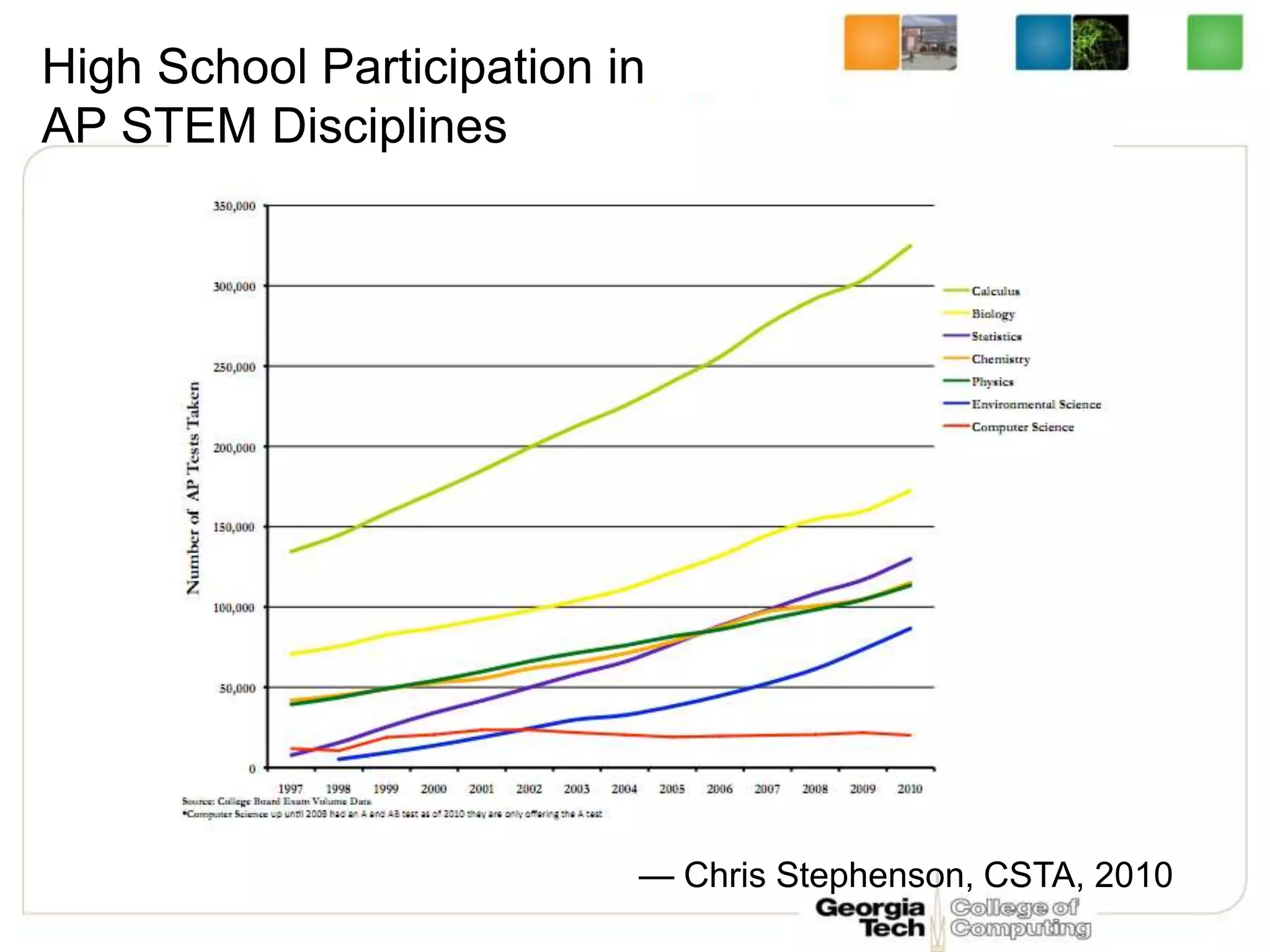
High School Participation in
AP STEM Disciplines
— Chris Stephenson, CSTA, 2010
Thanks
to Brian
Danielak
Most developers never take CS
• Computing is at the core of the modern society and
modern economy.
• Computing is key to innovation in many disciplines.
• Most people who use programming are not
professional programmers
• Estimates:
~13 million non-professional programmer/end-user
programmers in US by 2012,
vs.
~3 million professional software developers (Scaffidi,
Shaw, & Myers, 2005)
5
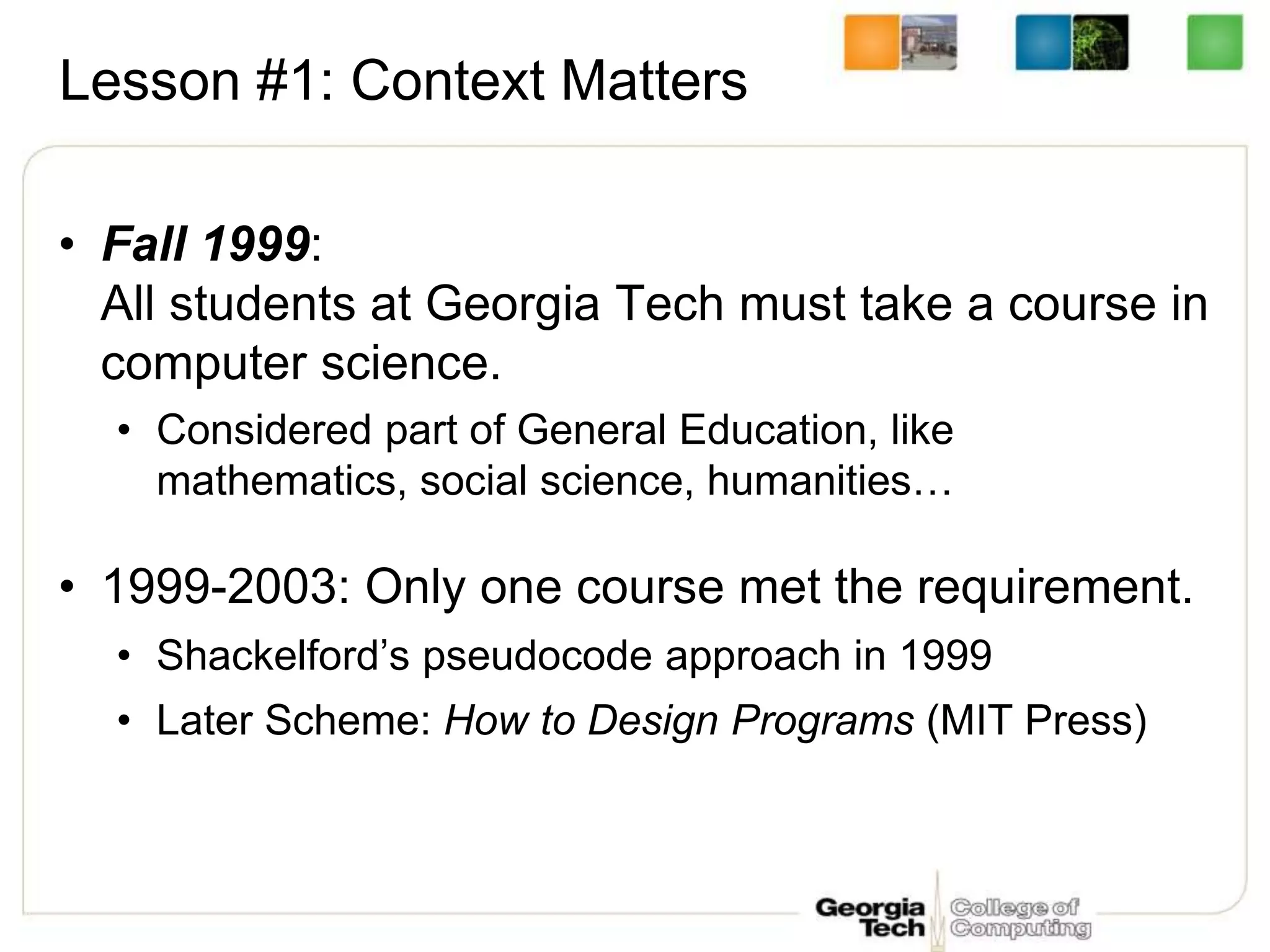
Lesson #1: Context Matters
• Fall 1999:
All students at Georgia Tech must take a course in
computer science.
• Considered part of General Education, like
mathematics, social science, humanities…
• 1999-2003: Only one course met the requirement.
• Shackelford’s pseudocode approach in 1999
• Later Scheme: How to Design Programs (MIT Press)
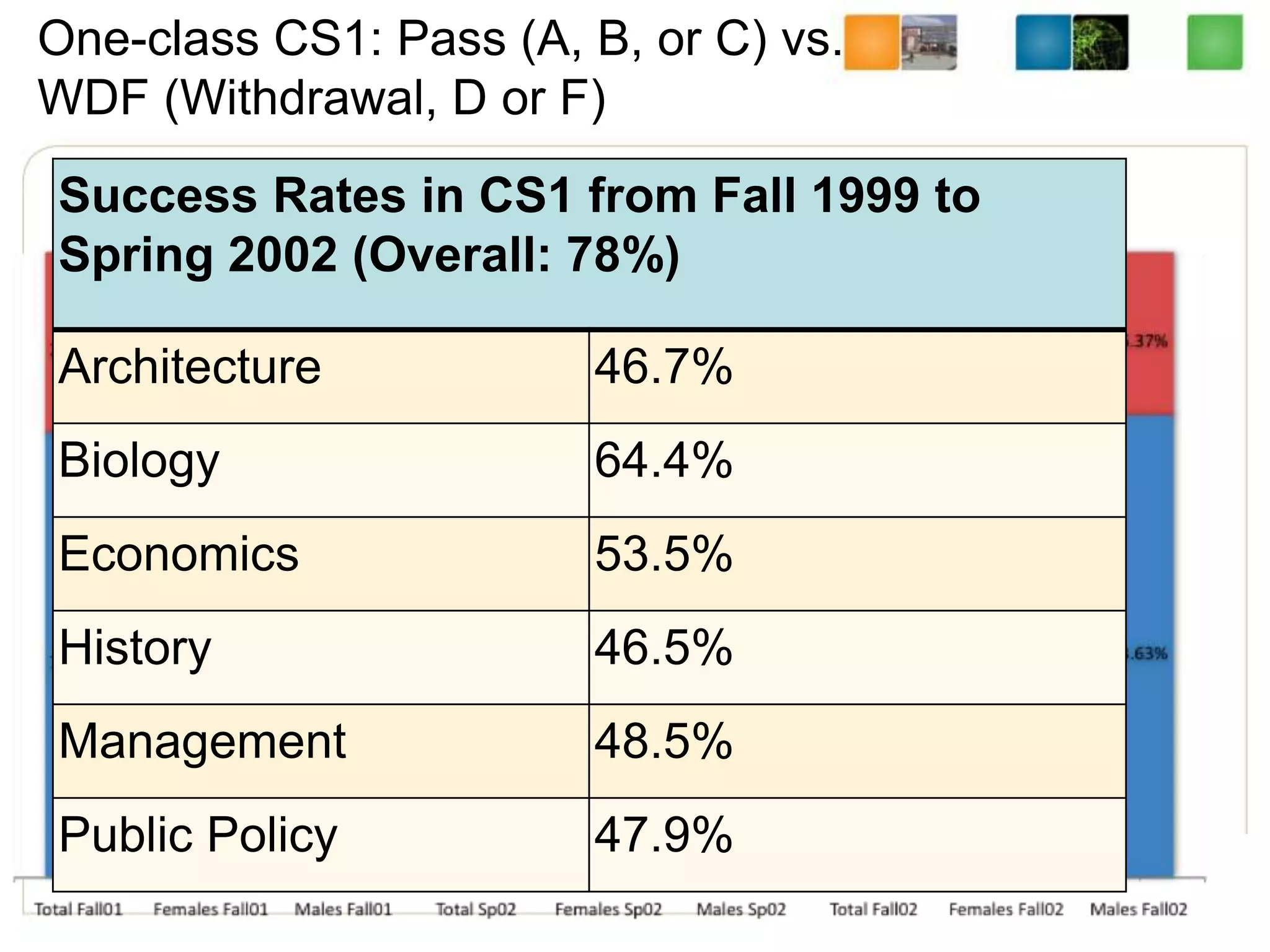
One-class CS1: Pass (A, B, or C) vs.
WDF (Withdrawal, D or F)
Success Rates in CS1 from Fall 1999 to
Spring 2002 (Overall: 78%)
Architecture 46.7%
Biology 64.4%
Economics 53.5%
History 46.5%
Management 48.5%
Public Policy 47.9%
Contextualized Computing Education
• What’s going on?
• Research results: Computing is
“tedious, boring, irrelevant”
• Since Spring 2003, Georgia Tech
teaches three introductory CS
courses.
• Based on Margolis and Fisher’s
“alternative paths”
• Each course introduces computing
using a context (examples,
homework assignments, lecture
discussion) relevant to majors.
• Make computing relevant by teaching it
in terms of what computers are good for
(from the students’ perspective)
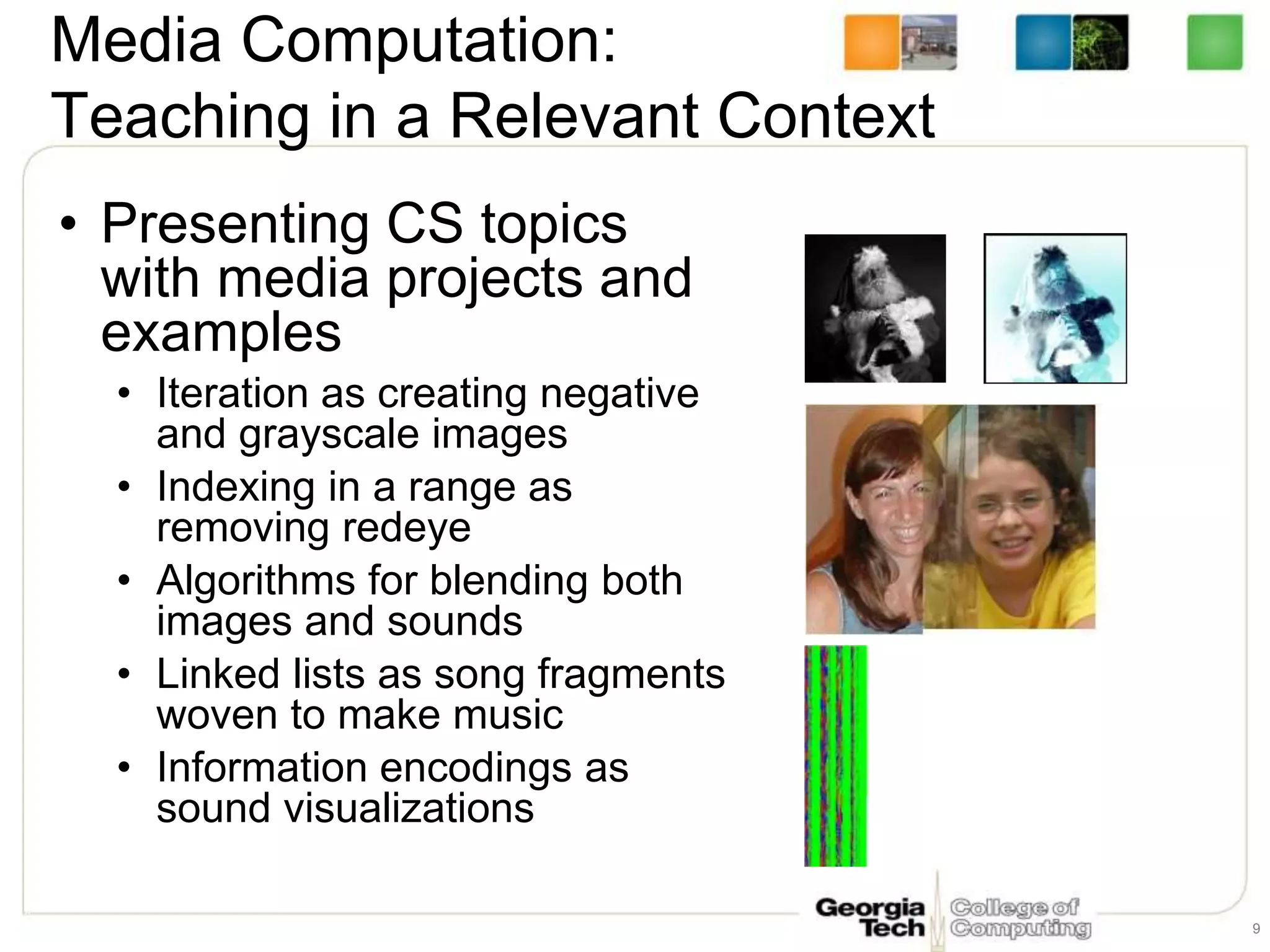
Media Computation:
Teaching in a Relevant Context
• Presenting CS topics
with media projects and
examples
• Iteration as creating negative
and grayscale images
• Indexing in a range as
removing redeye
• Algorithms for blending both
images and sounds
• Linked lists as song fragments
woven to make music
• Information encodings as
sound visualizations
9
Results:CS1“Media Computation”
86.470% 88.360% 84.710% 89.870% 91.940% 87.500%
80.330% 82.900% 77.460%
12.540% 10.270% 14.650% 9.370% 7.580% 11.410%
19.650% 17.100% 22.540%
Total
Fall03
Females
Fall03
Males
Fall03
Total
Sp04
Females
Sp04
Males
Sp04
Total
Fall04
Females
Fall04
Males
Fall04
WDF
Pass
Change in Success rates in CS1 “Media
Computation” from Spring 2003 to Fall 2005
(Overall 85%)
Architecture 46.7% 85.7%
Biology 64.4% 90.4%
Economics 54.5% 92.0%
History 46.5% 67.6%
Management 48.5% 87.8%
Public Policy 47.9% 85.4%
Voices from Media
Computation Students
• Intl Affairs student (female): “I just wish I had more time to
play around with that and make neat effects. But JES [IDE
for class] will be on my computer forever, so… that’s the
nice thing about this class is that you could go as deep into
the homework as you wanted. So, I’d turn it in and then me
and my roommate would do more after to see what we
could do with it.”
• “I dreaded CS, but ALL of the topics thus far have been
applicable to my future career (& personal) plans—there
isn't anything I don't like about this class!!!"
• "Media Computation is a CS class but with less severity.
The media part of the class is extremely visually
interesting. I would only take another CS class if it were
Media Computation."
12
Survey One Year Later
• 19% of respondents had programmed since class
ended
"Did the class change how you interact with
computers?”
• “Definitely makes me think of what is going on behind
the scenes of such programs like Photoshop and
Illustrator.”
• 'I understand technological concepts more easily now;
I am more willing and able to experience new things
with computers now’
• 'I have learned more about the big picture behind
computer science and programming. This has helped
me to figure out how to use programs that I've never
used before.’
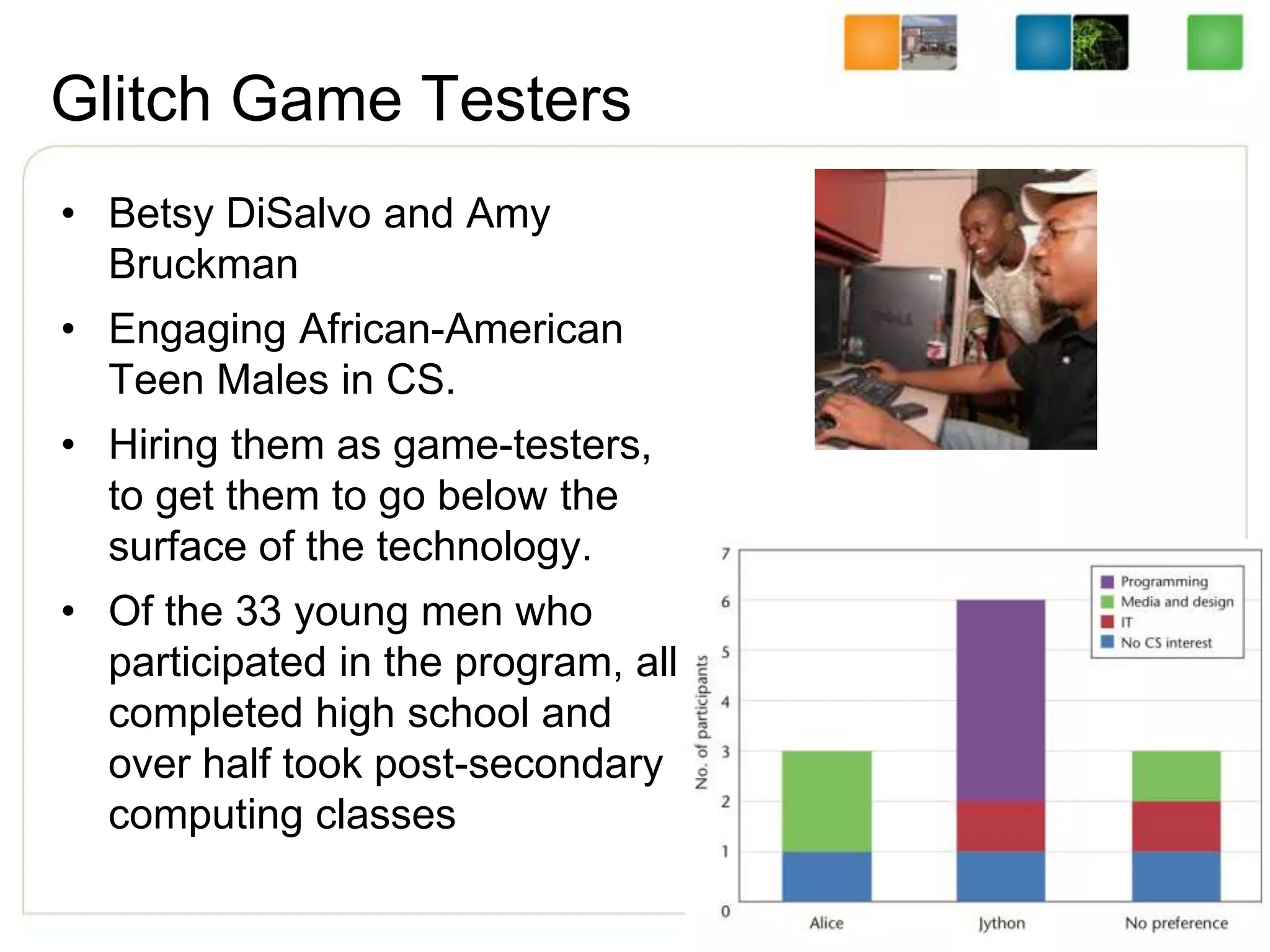
Glitch Game Testers
• Betsy DiSalvo and Amy
Bruckman
• Engaging African-American
Teen Males in CS.
• Hiring them as game-testers,
to get them to go below the
surface of the technology.
• Of the 33 young men who
participated in the program, all
completed high school and
over half took post-secondary
computing classes
Lesson for Cyber Security Education
• Context matters.
• Students will learn more if they know why
they’re learning it.
• Value of the context is judged by the
student.
• It’s not valuable because you say it is.
Lesson #2: Graphic designers
who program
• Brian Dorn studied
graphics designers who
program.
• Conducted a series of
interviews and assessment
activities.
• Found that these subjects
want more computer
science, but don’t find
courses (and most other
resources) adequate (Dorn
& Guzdial, ICER 2010)
• P10: So, that was a
really long way of
saying yes, I think
that an academic
study would make
me a better
programmer, but not
by a whole lot.
Where are they getting their
CS knowledge?
• Mostly on-line:
• FAQs and other
documentation
• Books (when
applicable)
• Lots of examples and
networking.
• Not so much classes
16
Dorn & Guzdial, CHI
2010
What do software engineers do?
Answer: The Boring Stuff.
• P2: I was able to take different samples from different
places and instead of just being let's say an MIS major, or
computer science major, you know it's—you're not going
to be front-end anything with computer science.
You're going to be back-end everything.
• P4: I think as a front-end developer, you focus more on
the design and the usability, and you're focusing more on
the audience. And then on the back-end I think you're
focused on more, these are like the software developers.
And they're programming something, and they don't
really see what it's gonna look like; they're just making
it work.
Who is in CS?
• P2: I went to a meeting for some kind of programmers,
something or other. And they were OLD, and they were
nerdy, and they were boring! And I'm like, this is not my
personality. Like I can't work with people like that. And
they worked at like IBM, or places like that. They've been
doing, they were working with Pascal. And I didn’t…I
couldn't see myself in that lifestyle for that long.
• P5: I don't know a whole ton of programmers, but the ones
I know, they enjoy seeing them type up all these
numbers and stuff and what it makes things do. Um,
whereas I just do it, to get it done and to get paid. To be
honest. The design aspect is what really interests me a lot
more.
18
They’re Lost without Initial Knowledge
• Learning less than they might because of a lack of
deep knowledge.
• For example: Exploring code by searching Google for
function and variable names.
• Learning about Java when programming in JavaScript
• Brian’s experiment: Given a case library with
conceptual information vs. a code repository
alone, what gets learned, used, and liked? (ICER
2011)
20
Bottomline: Cases work
• Both groups like the code/cases.
• Both groups coded the problems the same.
• Case-users learn the concepts, while
repository users do not.
21
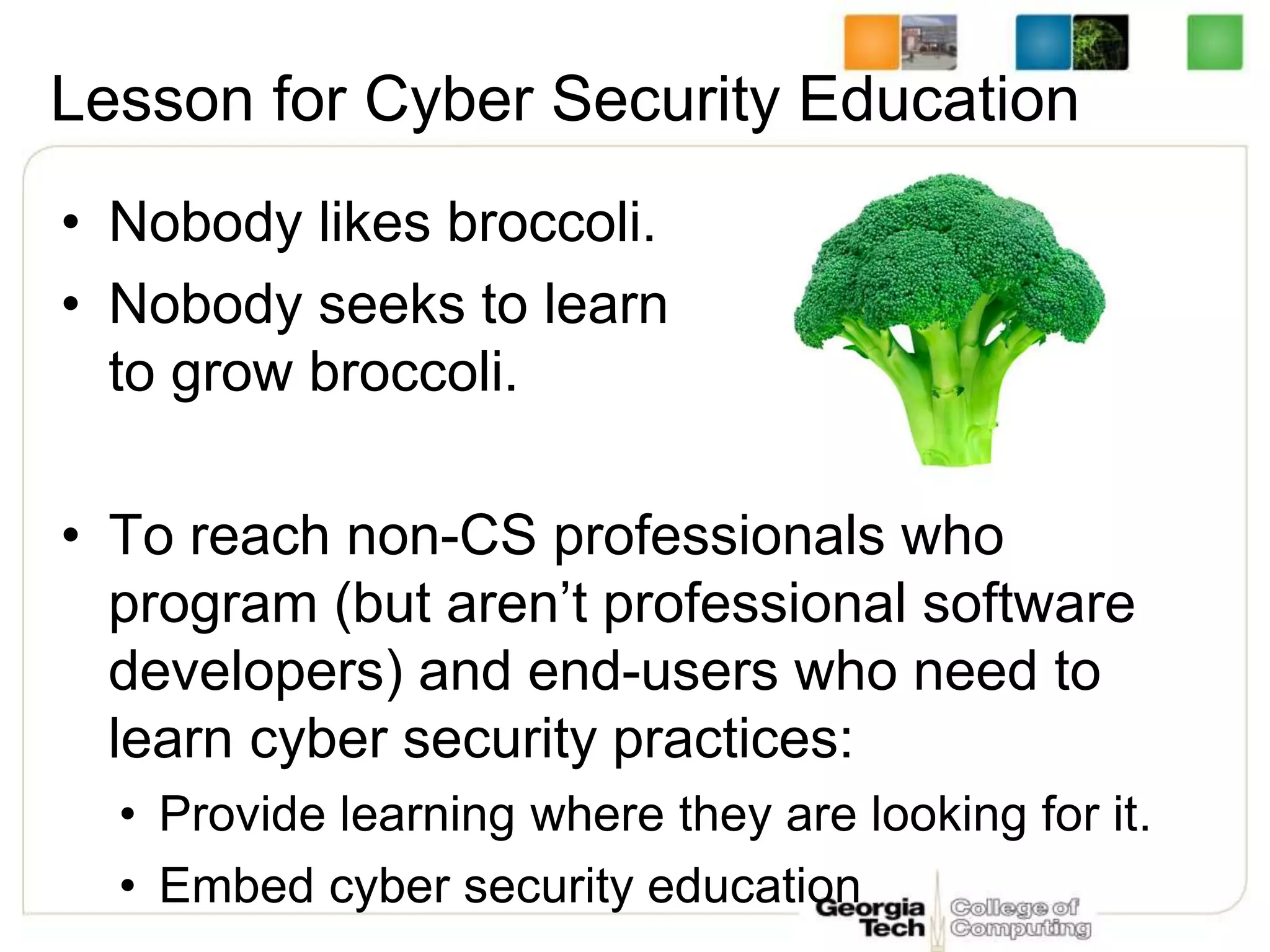
Lesson for Cyber Security Education
• Nobody likes broccoli.
• Nobody seeks to learn
to grow broccoli.
• To reach non-CS professionals who
program (but aren’t professional software
developers) and end-users who need to
learn cyber security practices:
• Provide learning where they are looking for it.
• Embed cyber security education
Lesson #3: Restructuring Instruction
• Educational psychologists really know
something about learning & teaching.
• When everyone is demanding your classes,
you don’t have to sweat it.
• But to teach the content that students are
not demanding, we do have to sweat it.
Helping students figure
out “process”
• Provide worked examples (Anderson et al., 1984)
• Label subgoals in worked examples (Catrambone,
1994; 1998)
• Successful in other domains (e.g., statistics)
• Hypothesis: Students remember the subgoals, and transfer
those.
• Subgoal labels groups steps of a worked example
into a meaningful unit
• Helps students differentiate between structural and
incidental information
• Provide framework for general mental model of process
Employing Subgoal Labels in CS Ed
• Used these techniques to teach Android
App Inventor to programming novices
• 2 groups (N=40, No App Inventor
experience):
• Original/Conventional (created by Barbara
Ericson)
• Subgoal-labeled
• Materials were identical except for the
subgoal labels
Experiment Procedure
• 2 hour-long sessions
• Session 1
• 5 min – demographic questionnaire
• 40 min – instructional period for first app
• 15 min – assessment 1
• Session 2: A Week Later
• 10 min – assessment 2
• 25 min – instructional period for second app
• 25 min – assessment 3
• 15 minutes to answer questions
• 10 minutes to make a new (third) app to specification
Example of Written Materials
Subgoal
Define Variables from Built-in
• Click on "Built-In" and "Definition" and
pull out a def variable.
• Click on the "variable" and replace it
with "fortuneList". This creates a
variable called "fortuneList".
• Click on "Lists" and drag out a call
make a list
• Click on "Text" and drag out a text
text block and drop it next to "item".
Click on the rightmost "text" and
replace it with your first fortune.
Handle Events from My Blocks
• Click on "My Blocks" and "Button1".
• Drag out a when Button1.Click.
Non-subgoal
• Click on "Built-In" and "Definition" and
pull out a def variable.
• Click on the "variable" and replace it
with "fortuneList". This creates a
variable called "fortuneList".
• Click on "Lists" and drag out a call
make a list
• Click on "Text" and drag out a text
text block and drop it next to "item".
• Click on the rightmost "text" and
replace it with your first fortune.
• Click on "My Blocks" and "Button1".
• Drag out a when Button1.Click.
Original/Conventional Video
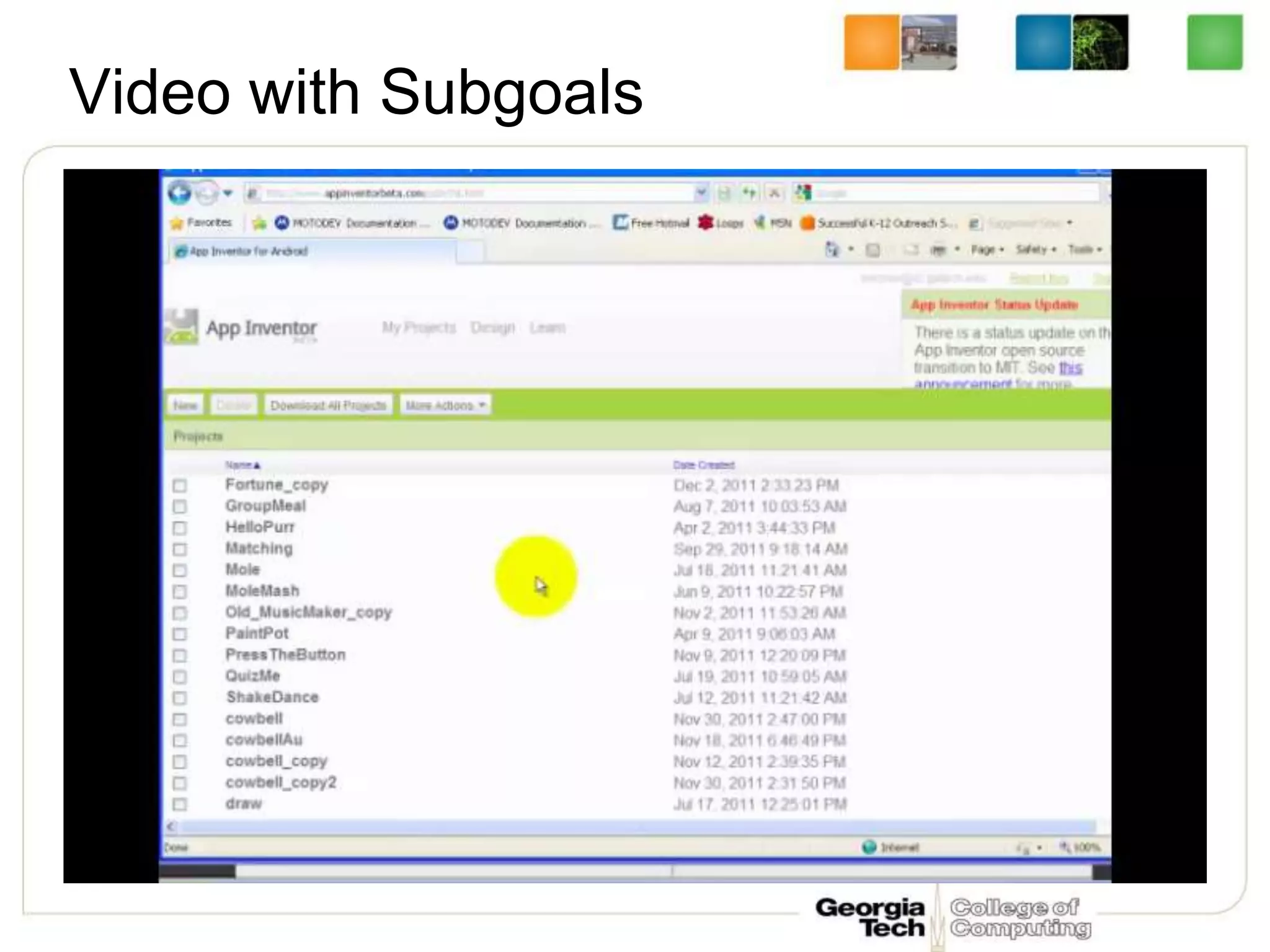
Video with Subgoals
Results: Overall
0
5
10
15
20
25
30
35
40
45
Attempted Correct
Subgoal
Conventional
p = .002, f = .53
p = .02, f = .38
Results: Time
• r between time and
correct = .06
0
5
10
15
20
25
30
35
40
45
Time
Subgoal
Conventional
p = .03, f = .37
What this means: Subgoal group
was faster, but faster didn’t mean
that they did worse.
Results: Retention Assessment
0
2
4
6
8
10
Attempted Correct
Subgoal
Conventional
p > .05, f = .25
p = .01, f = .42
Results: Define Variable Step in Transfer Task
0
0.2
0.4
0.6
0.8
1
Define Variable
Subgoal
Conventional
p < .001, f = .61
Results: Less thrashing
• Side observation:
Less thrashing.
• Participants in the
subgoal group were
less likely to drag out
blocks while working
through assessment
tasks (p < 0.02)
• r between
correctness and
#blocks = -.349
0
10
20
30
40
50
60
Blocks
p = .02, f = .91
Lesson for Cyber Security Education
• Figure out what students are having trouble
with.
• Robert Bjork’s Desirable Difficulties.
• Teach that.
Conclusions
• Computing education isn’t getting everywhere and
everyone.
We need everyone to get cyber security education.
• Lesson #1: Context matters. People learn if they
appreciate why it’s interesting and valuable.
• Lesson #2: Identity matters. Many people reject CS. We
have to teach them where they’re looking for information.
• Lessons #3: Structure matters. Figure out what students
are having trouble learning, and teach that.
With thanks to our supporters
• US National Science Foundation
• Statewide BPC Alliance: Project “Georgia Computes!”
http://www.gacomputes.org
• Expanding Computing Education Pathways Alliance,
http://expandingcomputing.org
• CCLI and CPATH Grants, and now CE21 to produce new media
• GVU Center, and Institute for People and
Technology (iPaT) at Georgia Tech
Thank you!
• http://www.cc.gatech.edu/~mark.guzdial
http://home.cc.gatech.edu/csl
http://www.georgiacomputes.org
For more on Media
Computation approach:
• http://www.mediacomputation.org
Spare Slides
Asking women:
What is CS to you?
• MediaComp• Tradition
al
Rich, Perry, Guzdial, SIGCSE
Scoring
• Answers scored on 2 dimensions
• Subgoals ATTEMPTED
• Subgoals CORRECT
• 46 subgoals across the 3 assessments
• Interrater reliability
• ICC(A) = .97, Cronbach’s alpha = .98, r = .96
Why don’t they take CS classes?
• P7: I started out in computer science, but didn't like it
at all. The fact that I wasn't learning anything new. I took
an intro to programming course, and then I talked to some
other people in the program and it was all repetition and I
guess there wasn't any really new. So you weren't really
learning any concepts. You were learning the
languages, and I didn't like that at all. So that's why I
left…
42
43
Our Three CS1’s Today
• CS1301/1321 Introduction to Computing
Traditional CS1 for our CS majors and
Science majors (math, physics,
psychology, etc.). Now, uses robots.
• CS1371 Computing for Engineers
CS1 for Engineers. Same topics as
CS1301, but using MATLAB with
Engineering problems.
• CS1315 Introduction to Media
Computation for Architecture,
Management, and Liberal Arts students.
The typical CS student:
Future Software Engineer
• To produce reliable,
robust, secure software.
• To work in
interdisciplinary teams.
• To use appropriate
design notations, such
as UML.
• To work in multiple
programming
languages.
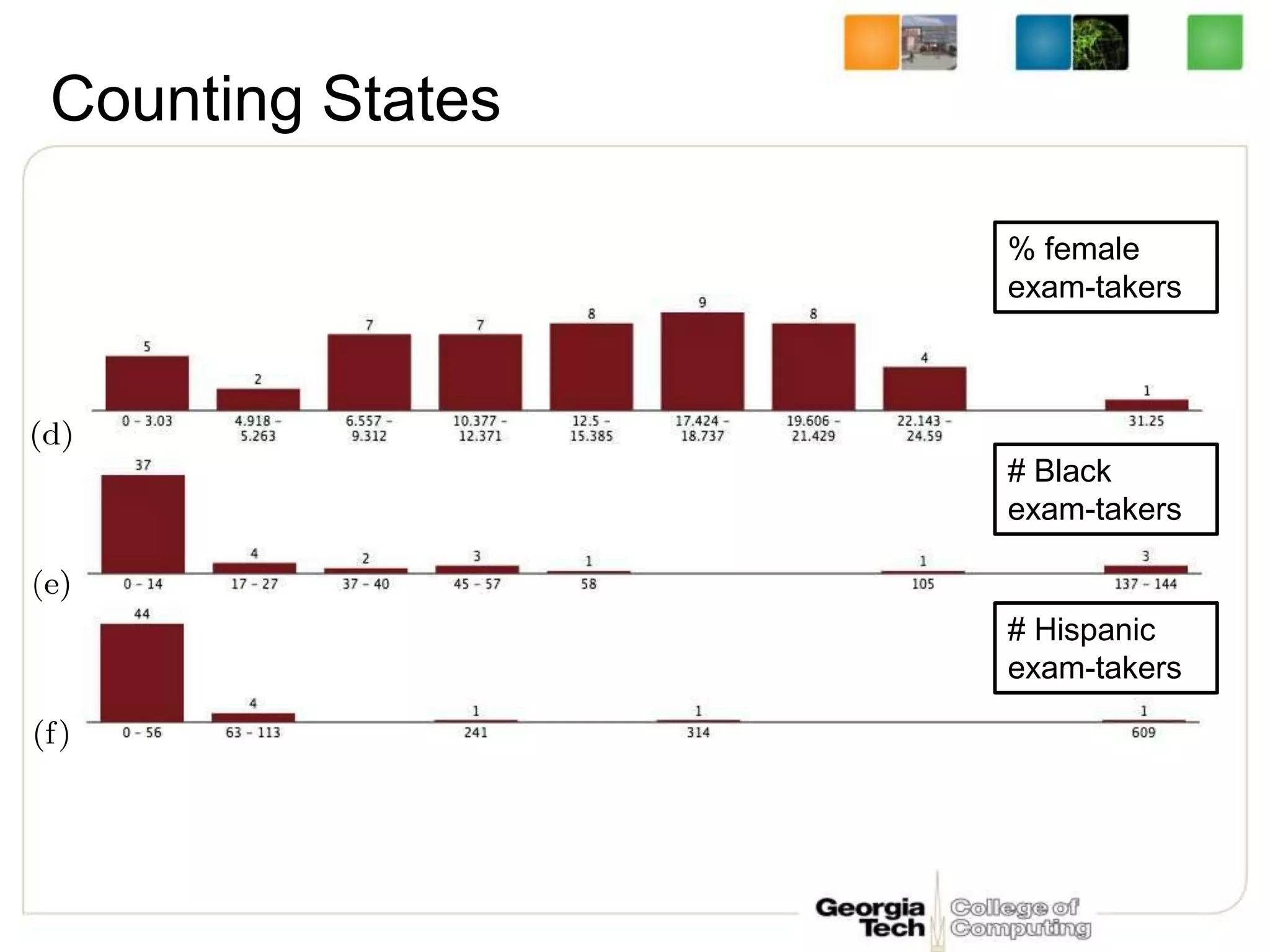
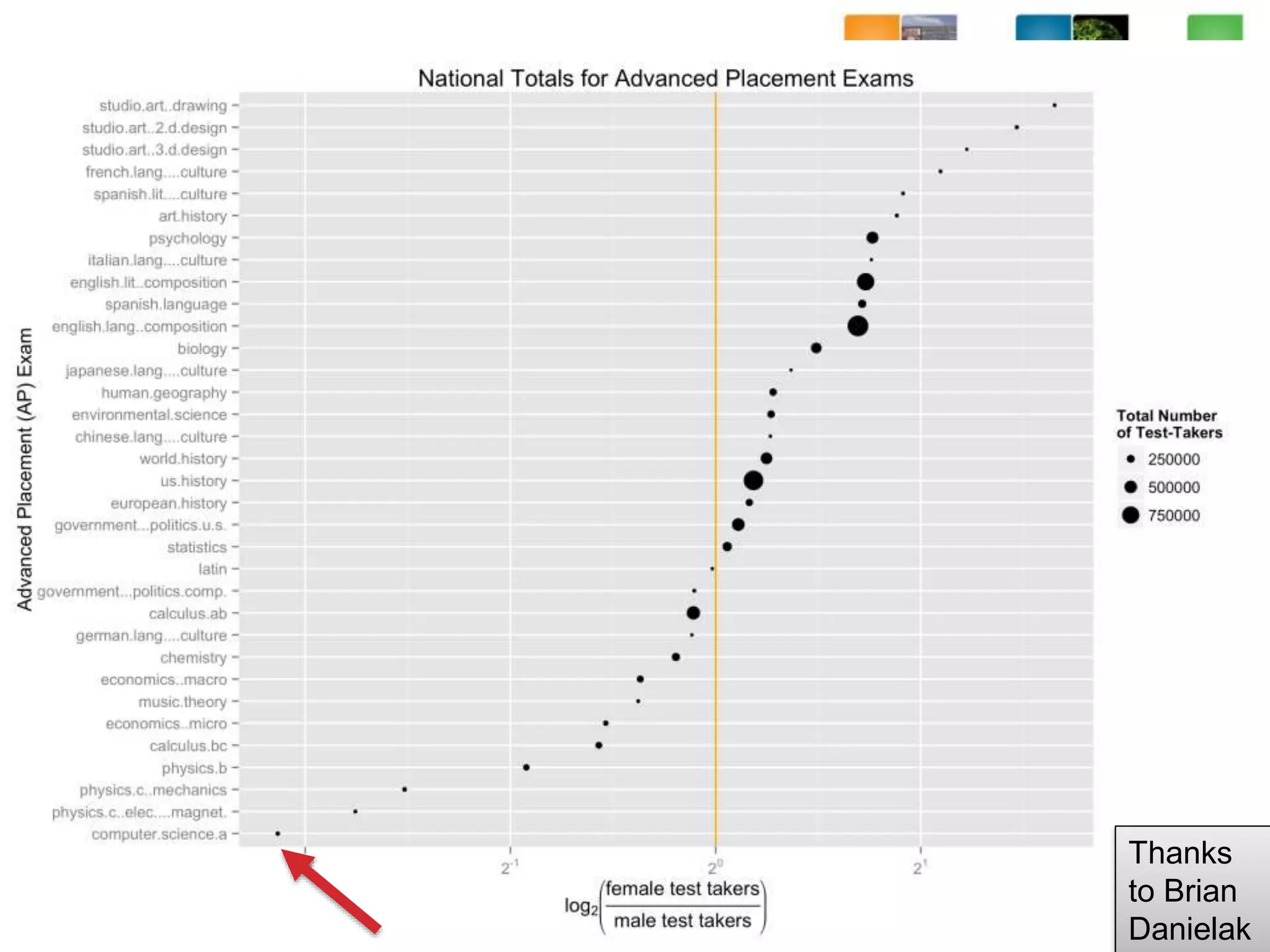
Counting States
% female
exam-takers
# Black
exam-takers
# Hispanic
exam-takers
Who is in CS?
• Like Yardi and Bruckman (ICER 2007), participants held negative
stereotypes of those in CS:
• P2: I went to a meeting for some kind of programmers, something or
other. And they were OLD, and they were nerdy, and they were
boring! And I'm like, this is not my personality. Like I can't work with
people like that. And they worked at like IBM, or places like that.
They've been doing, they were working with Pascal. And I didn’t…I
couldn't see myself in that lifestyle for that long.
• P5: I don't know a whole ton of programmers, but the ones I know,
they enjoy seeing them type up all these numbers and stuff and
what it makes things do. Um, whereas I just do it, to get it done and
to get paid. To be honest. The design aspect is what really interests
me a lot more.
46
Why don’t they take CS classes?
• P7: I started out in computer science, but didn't like it
at all. The fact that I wasn't learning anything new. I took
an intro to programming course, and then I talked to some
other people in the program and it was all repetition and I
guess there wasn't any really new. So you weren't really
learning any concepts. You were learning the
languages, and I didn't like that at all. So that's why I
left…
• Do we just teach languages?
Why don’t they see the concepts?
47
Who are graphics designers
who program?
• Mostly arts/media
trained.
• Don’t consider
themselves
programmers.
• But do some
significant automation
of their process.
48
Dorn & Guzdial, ICER
2006
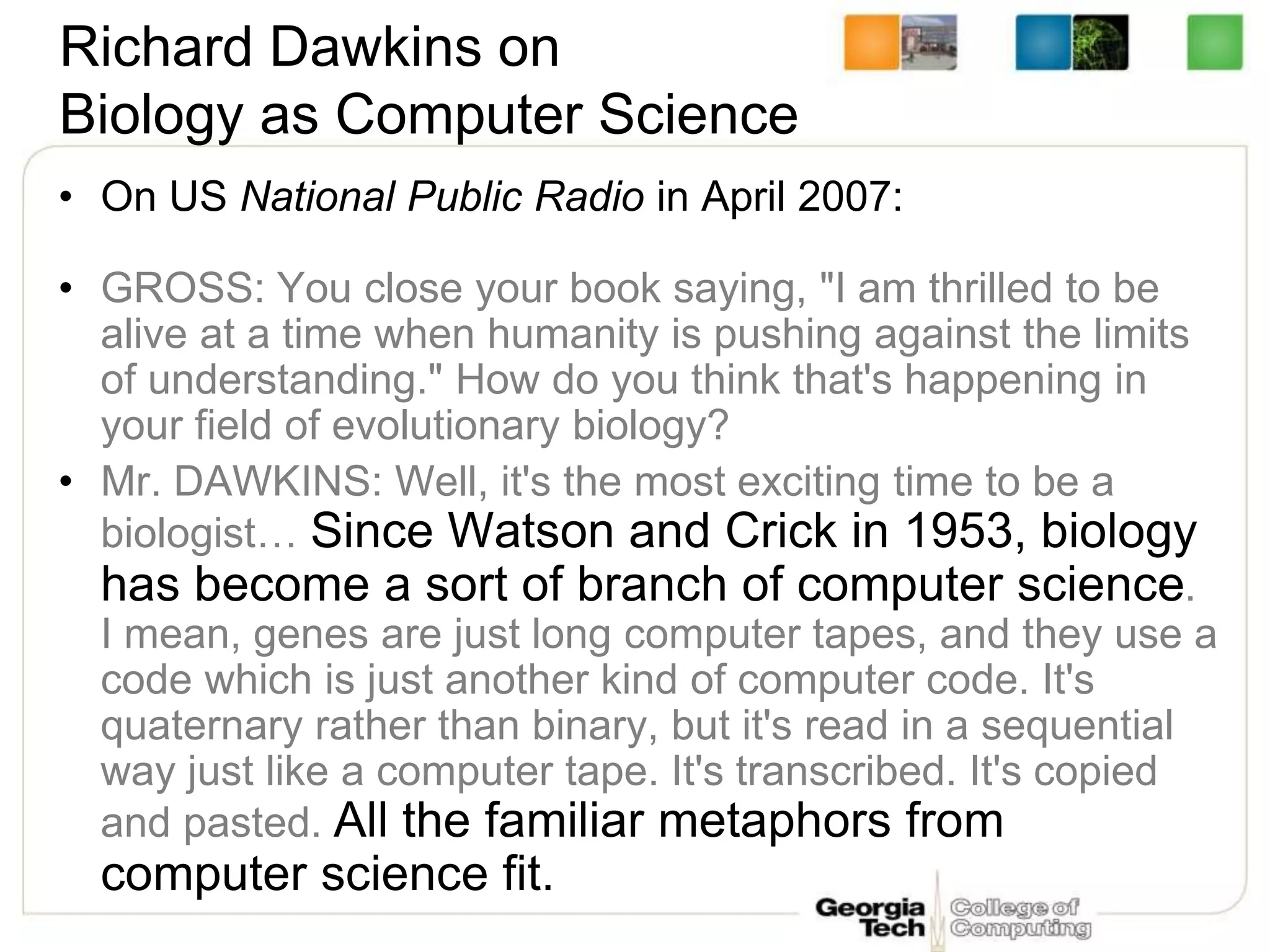
Richard Dawkins on
Biology as Computer Science
• On US National Public Radio in April 2007:
• GROSS: You close your book saying, "I am thrilled to be
alive at a time when humanity is pushing against the limits
of understanding." How do you think that's happening in
your field of evolutionary biology?
• Mr. DAWKINS: Well, it's the most exciting time to be a
biologist… Since Watson and Crick in 1953, biology
has become a sort of branch of computer science.
I mean, genes are just long computer tapes, and they use a
code which is just another kind of computer code. It's
quaternary rather than binary, but it's read in a sequential
way just like a computer tape. It's transcribed. It's copied
and pasted. All the familiar metaphors from
computer science fit.
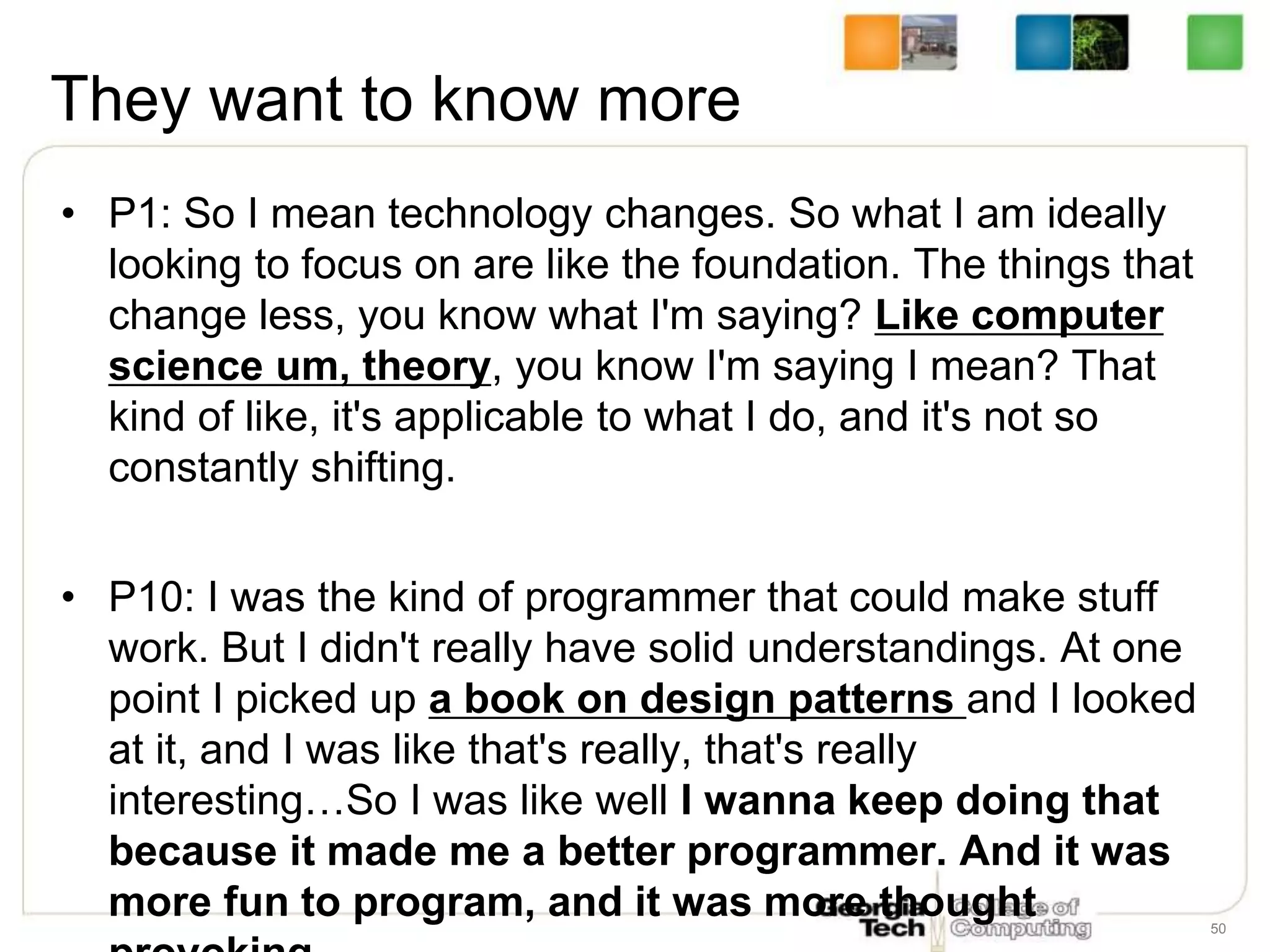
They want to know more
• P1: So I mean technology changes. So what I am ideally
looking to focus on are like the foundation. The things that
change less, you know what I'm saying? Like computer
science um, theory, you know I'm saying I mean? That
kind of like, it's applicable to what I do, and it's not so
constantly shifting.
• P10: I was the kind of programmer that could make stuff
work. But I didn't really have solid understandings. At one
point I picked up a book on design patterns and I looked
at it, and I was like that's really, that's really
interesting…So I was like well I wanna keep doing that
because it made me a better programmer. And it was
more fun to program, and it was more thought 50
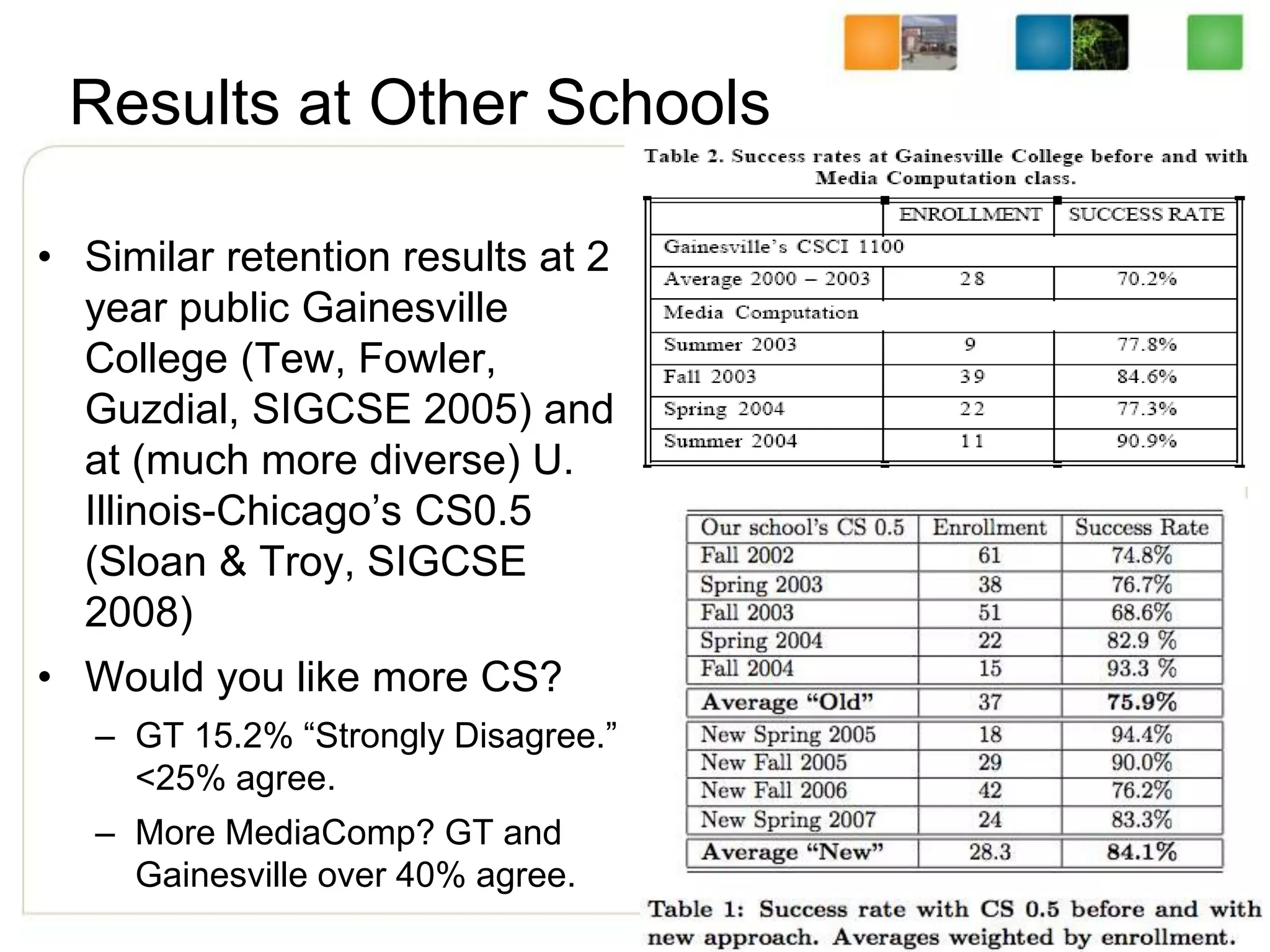
Results at Other Schools
• Similar retention results at 2
year public Gainesville
College (Tew, Fowler,
Guzdial, SIGCSE 2005) and
at (much more diverse) U.
Illinois-Chicago’s CS0.5
(Sloan & Troy, SIGCSE
2008)
• Would you like more CS?
– GT 15.2% “Strongly Disagree.”
<25% agree.
– More MediaComp? GT and
Gainesville over 40% agree.
(Tew, Fowler,
Guzdial,
SIGCSE
2005)
Can we teach more of CS
more efficiently?
• Matt Jadud [2006] (and others) has shown us how
small Java errors can lead to an enormous waste
of time.
• Can we teach about variables, behavior, how loops work, how
conditionals behave – without a half hour of “where goes the semi-
colon”?
• Can we reduce the wasted time?
• Analogy: Does coursework in a foreign language make
it easier to be immersed in the new language, or is
immersion the only way to learn?
• New NSF CE21 Project: CSLearning4U
http://home.cc.gatech.edu/csl/CSLearning4u
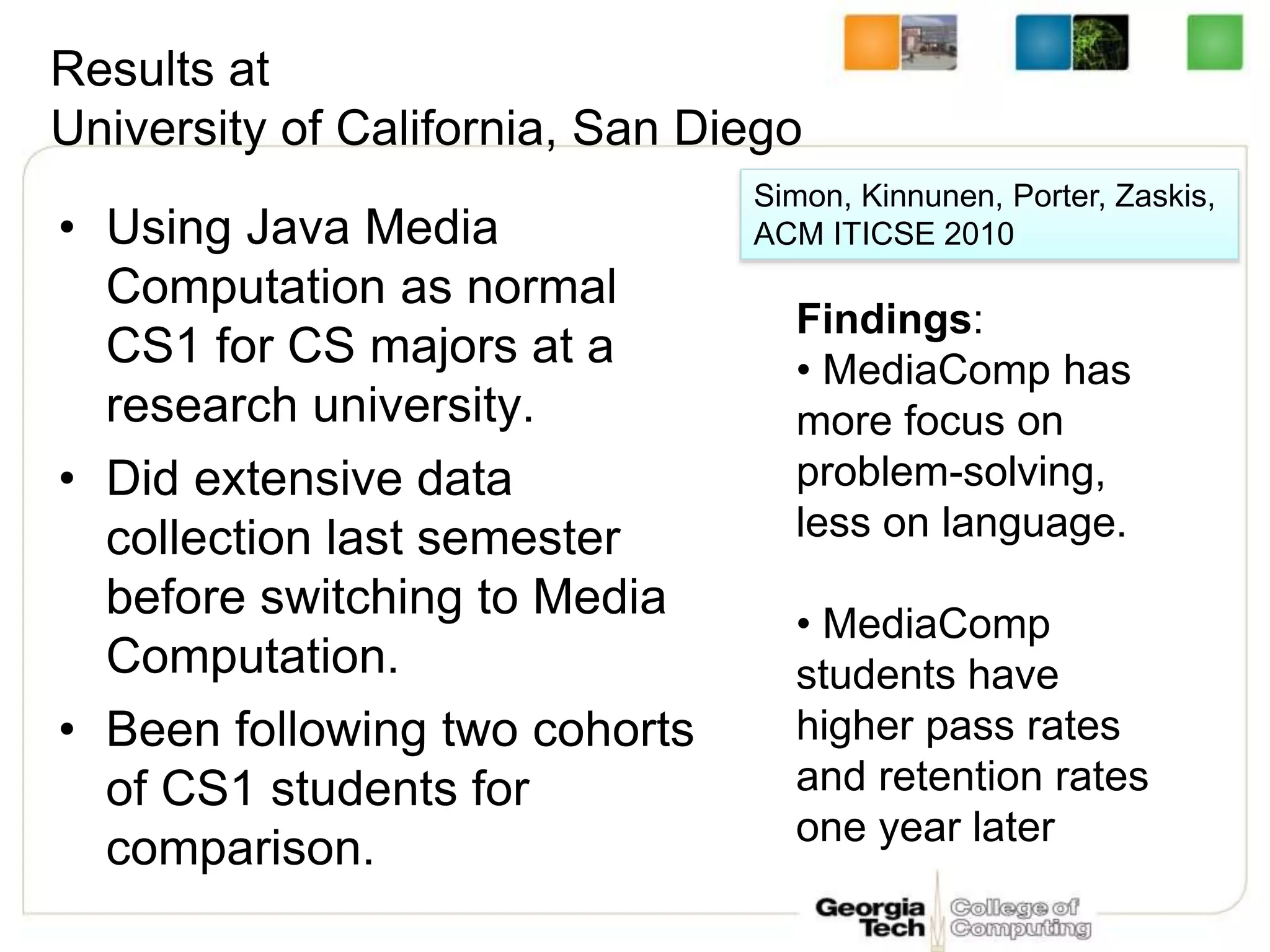
Results at
University of California, San Diego
• Using Java Media
Computation as normal
CS1 for CS majors at a
research university.
• Did extensive data
collection last semester
before switching to Media
Computation.
• Been following two cohorts
of CS1 students for
comparison.
Simon, Kinnunen, Porter, Zaskis,
ACM ITICSE 2010
Findings:
• MediaComp has
more focus on
problem-solving,
less on language.
• MediaComp
students have
higher pass rates
and retention rates
one year later
The Two Cultures
Does it have to be programming?
• Elias: If the computers, together with sufficiently
ingenious languages and programming systems, are
capable of doing everything that Professor Perlis
describes—and I believe they are (and more)—then
they should be ingenious enough to do it without
the human symbiote being obliged to perform the
mechanical chores which are a huge part of current
programming effort, and which are a large part of
what must now be taught in the introductory course
that he proposes.
55
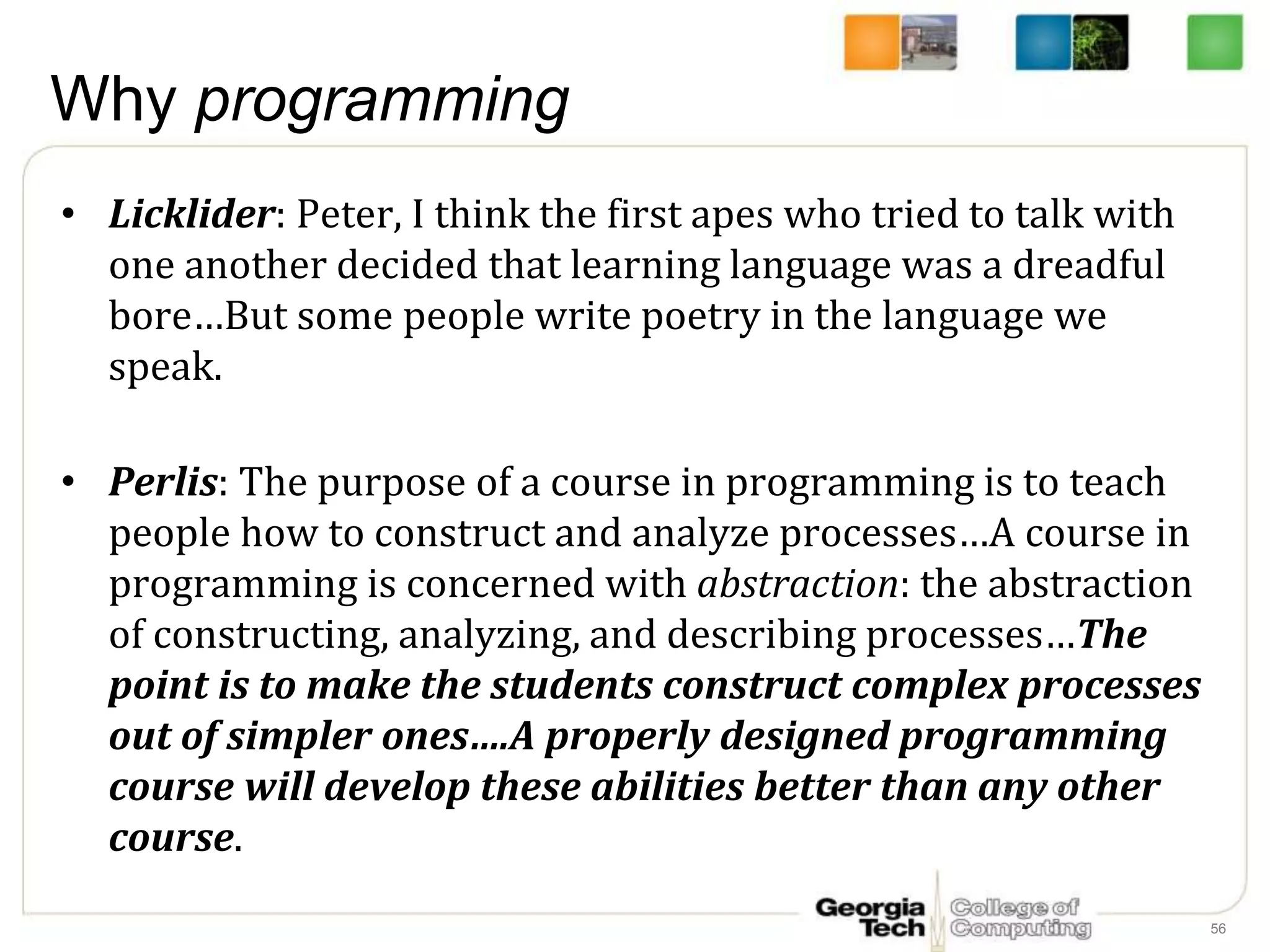
Why programming
• Licklider: Peter, I think the first apes who tried to talk with
one another decided that learning language was a dreadful
bore…But some people write poetry in the language we
speak.
• Perlis: The purpose of a course in programming is to teach
people how to construct and analyze processes…A course in
programming is concerned with abstraction: the abstraction
of constructing, analyzing, and describing processes…The
point is to make the students construct complex processes
out of simpler ones….A properly designed programming
course will develop these abilities better than any other
course.
56

Cyber securityeducation may2015

  • 1.
    Using Learning Sciencesto Inform Cyber Security Education Mark Guzdial School of Interactive Computing
  • 2.
    Story • Cyber SecurityEducation requires thinking about “how computing works.” • For programmers, why some practices create holes/opportunities. • For end-users, why some activities compromise security. • We need everyone to learn about cyber security. • What can learning sciences tell us about encouraging that kind of learning? • Lesson #1: Context matters. • The Story of Computing for All at Georgia Tech. • Lesson #2: Identity matters. • “Teaching” Graphics Designers who reject CS about CS. • Lesson #3: Structure matters. • Subgoal Labels can Dramatically Improve Learning .
  • 3.
    High School Participationin AP STEM Disciplines — Chris Stephenson, CSTA, 2010
  • 4.
  • 5.
    Most developers nevertake CS • Computing is at the core of the modern society and modern economy. • Computing is key to innovation in many disciplines. • Most people who use programming are not professional programmers • Estimates: ~13 million non-professional programmer/end-user programmers in US by 2012, vs. ~3 million professional software developers (Scaffidi, Shaw, & Myers, 2005) 5
  • 6.
    Lesson #1: ContextMatters • Fall 1999: All students at Georgia Tech must take a course in computer science. • Considered part of General Education, like mathematics, social science, humanities… • 1999-2003: Only one course met the requirement. • Shackelford’s pseudocode approach in 1999 • Later Scheme: How to Design Programs (MIT Press)
  • 7.
    One-class CS1: Pass(A, B, or C) vs. WDF (Withdrawal, D or F) Success Rates in CS1 from Fall 1999 to Spring 2002 (Overall: 78%) Architecture 46.7% Biology 64.4% Economics 53.5% History 46.5% Management 48.5% Public Policy 47.9%
  • 8.
    Contextualized Computing Education •What’s going on? • Research results: Computing is “tedious, boring, irrelevant” • Since Spring 2003, Georgia Tech teaches three introductory CS courses. • Based on Margolis and Fisher’s “alternative paths” • Each course introduces computing using a context (examples, homework assignments, lecture discussion) relevant to majors. • Make computing relevant by teaching it in terms of what computers are good for (from the students’ perspective)
  • 9.
    Media Computation: Teaching ina Relevant Context • Presenting CS topics with media projects and examples • Iteration as creating negative and grayscale images • Indexing in a range as removing redeye • Algorithms for blending both images and sounds • Linked lists as song fragments woven to make music • Information encodings as sound visualizations 9
  • 10.
    Results:CS1“Media Computation” 86.470% 88.360%84.710% 89.870% 91.940% 87.500% 80.330% 82.900% 77.460% 12.540% 10.270% 14.650% 9.370% 7.580% 11.410% 19.650% 17.100% 22.540% Total Fall03 Females Fall03 Males Fall03 Total Sp04 Females Sp04 Males Sp04 Total Fall04 Females Fall04 Males Fall04 WDF Pass Change in Success rates in CS1 “Media Computation” from Spring 2003 to Fall 2005 (Overall 85%) Architecture 46.7% 85.7% Biology 64.4% 90.4% Economics 54.5% 92.0% History 46.5% 67.6% Management 48.5% 87.8% Public Policy 47.9% 85.4%
  • 11.
    Voices from Media ComputationStudents • Intl Affairs student (female): “I just wish I had more time to play around with that and make neat effects. But JES [IDE for class] will be on my computer forever, so… that’s the nice thing about this class is that you could go as deep into the homework as you wanted. So, I’d turn it in and then me and my roommate would do more after to see what we could do with it.” • “I dreaded CS, but ALL of the topics thus far have been applicable to my future career (& personal) plans—there isn't anything I don't like about this class!!!" • "Media Computation is a CS class but with less severity. The media part of the class is extremely visually interesting. I would only take another CS class if it were Media Computation."
  • 12.
    12 Survey One YearLater • 19% of respondents had programmed since class ended "Did the class change how you interact with computers?” • “Definitely makes me think of what is going on behind the scenes of such programs like Photoshop and Illustrator.” • 'I understand technological concepts more easily now; I am more willing and able to experience new things with computers now’ • 'I have learned more about the big picture behind computer science and programming. This has helped me to figure out how to use programs that I've never used before.’
  • 13.
    Glitch Game Testers •Betsy DiSalvo and Amy Bruckman • Engaging African-American Teen Males in CS. • Hiring them as game-testers, to get them to go below the surface of the technology. • Of the 33 young men who participated in the program, all completed high school and over half took post-secondary computing classes
  • 14.
    Lesson for CyberSecurity Education • Context matters. • Students will learn more if they know why they’re learning it. • Value of the context is judged by the student. • It’s not valuable because you say it is.
  • 15.
    Lesson #2: Graphicdesigners who program • Brian Dorn studied graphics designers who program. • Conducted a series of interviews and assessment activities. • Found that these subjects want more computer science, but don’t find courses (and most other resources) adequate (Dorn & Guzdial, ICER 2010) • P10: So, that was a really long way of saying yes, I think that an academic study would make me a better programmer, but not by a whole lot.
  • 16.
    Where are theygetting their CS knowledge? • Mostly on-line: • FAQs and other documentation • Books (when applicable) • Lots of examples and networking. • Not so much classes 16 Dorn & Guzdial, CHI 2010
  • 17.
    What do softwareengineers do? Answer: The Boring Stuff. • P2: I was able to take different samples from different places and instead of just being let's say an MIS major, or computer science major, you know it's—you're not going to be front-end anything with computer science. You're going to be back-end everything. • P4: I think as a front-end developer, you focus more on the design and the usability, and you're focusing more on the audience. And then on the back-end I think you're focused on more, these are like the software developers. And they're programming something, and they don't really see what it's gonna look like; they're just making it work.
  • 18.
    Who is inCS? • P2: I went to a meeting for some kind of programmers, something or other. And they were OLD, and they were nerdy, and they were boring! And I'm like, this is not my personality. Like I can't work with people like that. And they worked at like IBM, or places like that. They've been doing, they were working with Pascal. And I didn’t…I couldn't see myself in that lifestyle for that long. • P5: I don't know a whole ton of programmers, but the ones I know, they enjoy seeing them type up all these numbers and stuff and what it makes things do. Um, whereas I just do it, to get it done and to get paid. To be honest. The design aspect is what really interests me a lot more. 18
  • 19.
    They’re Lost withoutInitial Knowledge • Learning less than they might because of a lack of deep knowledge. • For example: Exploring code by searching Google for function and variable names. • Learning about Java when programming in JavaScript • Brian’s experiment: Given a case library with conceptual information vs. a code repository alone, what gets learned, used, and liked? (ICER 2011)
  • 20.
  • 21.
    Bottomline: Cases work •Both groups like the code/cases. • Both groups coded the problems the same. • Case-users learn the concepts, while repository users do not. 21
  • 22.
    Lesson for CyberSecurity Education • Nobody likes broccoli. • Nobody seeks to learn to grow broccoli. • To reach non-CS professionals who program (but aren’t professional software developers) and end-users who need to learn cyber security practices: • Provide learning where they are looking for it. • Embed cyber security education
  • 23.
    Lesson #3: RestructuringInstruction • Educational psychologists really know something about learning & teaching. • When everyone is demanding your classes, you don’t have to sweat it. • But to teach the content that students are not demanding, we do have to sweat it.
  • 24.
    Helping students figure out“process” • Provide worked examples (Anderson et al., 1984) • Label subgoals in worked examples (Catrambone, 1994; 1998) • Successful in other domains (e.g., statistics) • Hypothesis: Students remember the subgoals, and transfer those. • Subgoal labels groups steps of a worked example into a meaningful unit • Helps students differentiate between structural and incidental information • Provide framework for general mental model of process
  • 25.
    Employing Subgoal Labelsin CS Ed • Used these techniques to teach Android App Inventor to programming novices • 2 groups (N=40, No App Inventor experience): • Original/Conventional (created by Barbara Ericson) • Subgoal-labeled • Materials were identical except for the subgoal labels
  • 26.
    Experiment Procedure • 2hour-long sessions • Session 1 • 5 min – demographic questionnaire • 40 min – instructional period for first app • 15 min – assessment 1 • Session 2: A Week Later • 10 min – assessment 2 • 25 min – instructional period for second app • 25 min – assessment 3 • 15 minutes to answer questions • 10 minutes to make a new (third) app to specification
  • 27.
    Example of WrittenMaterials Subgoal Define Variables from Built-in • Click on "Built-In" and "Definition" and pull out a def variable. • Click on the "variable" and replace it with "fortuneList". This creates a variable called "fortuneList". • Click on "Lists" and drag out a call make a list • Click on "Text" and drag out a text text block and drop it next to "item". Click on the rightmost "text" and replace it with your first fortune. Handle Events from My Blocks • Click on "My Blocks" and "Button1". • Drag out a when Button1.Click. Non-subgoal • Click on "Built-In" and "Definition" and pull out a def variable. • Click on the "variable" and replace it with "fortuneList". This creates a variable called "fortuneList". • Click on "Lists" and drag out a call make a list • Click on "Text" and drag out a text text block and drop it next to "item". • Click on the rightmost "text" and replace it with your first fortune. • Click on "My Blocks" and "Button1". • Drag out a when Button1.Click.
  • 28.
  • 29.
  • 30.
  • 31.
    Results: Time • rbetween time and correct = .06 0 5 10 15 20 25 30 35 40 45 Time Subgoal Conventional p = .03, f = .37 What this means: Subgoal group was faster, but faster didn’t mean that they did worse.
  • 32.
    Results: Retention Assessment 0 2 4 6 8 10 AttemptedCorrect Subgoal Conventional p > .05, f = .25 p = .01, f = .42
  • 33.
    Results: Define VariableStep in Transfer Task 0 0.2 0.4 0.6 0.8 1 Define Variable Subgoal Conventional p < .001, f = .61
  • 34.
    Results: Less thrashing •Side observation: Less thrashing. • Participants in the subgoal group were less likely to drag out blocks while working through assessment tasks (p < 0.02) • r between correctness and #blocks = -.349 0 10 20 30 40 50 60 Blocks p = .02, f = .91
  • 35.
    Lesson for CyberSecurity Education • Figure out what students are having trouble with. • Robert Bjork’s Desirable Difficulties. • Teach that.
  • 36.
    Conclusions • Computing educationisn’t getting everywhere and everyone. We need everyone to get cyber security education. • Lesson #1: Context matters. People learn if they appreciate why it’s interesting and valuable. • Lesson #2: Identity matters. Many people reject CS. We have to teach them where they’re looking for information. • Lessons #3: Structure matters. Figure out what students are having trouble learning, and teach that.
  • 37.
    With thanks toour supporters • US National Science Foundation • Statewide BPC Alliance: Project “Georgia Computes!” http://www.gacomputes.org • Expanding Computing Education Pathways Alliance, http://expandingcomputing.org • CCLI and CPATH Grants, and now CE21 to produce new media • GVU Center, and Institute for People and Technology (iPaT) at Georgia Tech
  • 38.
  • 39.
  • 40.
    Asking women: What isCS to you? • MediaComp• Tradition al Rich, Perry, Guzdial, SIGCSE
  • 41.
    Scoring • Answers scoredon 2 dimensions • Subgoals ATTEMPTED • Subgoals CORRECT • 46 subgoals across the 3 assessments • Interrater reliability • ICC(A) = .97, Cronbach’s alpha = .98, r = .96
  • 42.
    Why don’t theytake CS classes? • P7: I started out in computer science, but didn't like it at all. The fact that I wasn't learning anything new. I took an intro to programming course, and then I talked to some other people in the program and it was all repetition and I guess there wasn't any really new. So you weren't really learning any concepts. You were learning the languages, and I didn't like that at all. So that's why I left… 42
  • 43.
    43 Our Three CS1’sToday • CS1301/1321 Introduction to Computing Traditional CS1 for our CS majors and Science majors (math, physics, psychology, etc.). Now, uses robots. • CS1371 Computing for Engineers CS1 for Engineers. Same topics as CS1301, but using MATLAB with Engineering problems. • CS1315 Introduction to Media Computation for Architecture, Management, and Liberal Arts students.
  • 44.
    The typical CSstudent: Future Software Engineer • To produce reliable, robust, secure software. • To work in interdisciplinary teams. • To use appropriate design notations, such as UML. • To work in multiple programming languages.
  • 45.
    Counting States % female exam-takers #Black exam-takers # Hispanic exam-takers
  • 46.
    Who is inCS? • Like Yardi and Bruckman (ICER 2007), participants held negative stereotypes of those in CS: • P2: I went to a meeting for some kind of programmers, something or other. And they were OLD, and they were nerdy, and they were boring! And I'm like, this is not my personality. Like I can't work with people like that. And they worked at like IBM, or places like that. They've been doing, they were working with Pascal. And I didn’t…I couldn't see myself in that lifestyle for that long. • P5: I don't know a whole ton of programmers, but the ones I know, they enjoy seeing them type up all these numbers and stuff and what it makes things do. Um, whereas I just do it, to get it done and to get paid. To be honest. The design aspect is what really interests me a lot more. 46
  • 47.
    Why don’t theytake CS classes? • P7: I started out in computer science, but didn't like it at all. The fact that I wasn't learning anything new. I took an intro to programming course, and then I talked to some other people in the program and it was all repetition and I guess there wasn't any really new. So you weren't really learning any concepts. You were learning the languages, and I didn't like that at all. So that's why I left… • Do we just teach languages? Why don’t they see the concepts? 47
  • 48.
    Who are graphicsdesigners who program? • Mostly arts/media trained. • Don’t consider themselves programmers. • But do some significant automation of their process. 48 Dorn & Guzdial, ICER 2006
  • 49.
    Richard Dawkins on Biologyas Computer Science • On US National Public Radio in April 2007: • GROSS: You close your book saying, "I am thrilled to be alive at a time when humanity is pushing against the limits of understanding." How do you think that's happening in your field of evolutionary biology? • Mr. DAWKINS: Well, it's the most exciting time to be a biologist… Since Watson and Crick in 1953, biology has become a sort of branch of computer science. I mean, genes are just long computer tapes, and they use a code which is just another kind of computer code. It's quaternary rather than binary, but it's read in a sequential way just like a computer tape. It's transcribed. It's copied and pasted. All the familiar metaphors from computer science fit.
  • 50.
    They want toknow more • P1: So I mean technology changes. So what I am ideally looking to focus on are like the foundation. The things that change less, you know what I'm saying? Like computer science um, theory, you know I'm saying I mean? That kind of like, it's applicable to what I do, and it's not so constantly shifting. • P10: I was the kind of programmer that could make stuff work. But I didn't really have solid understandings. At one point I picked up a book on design patterns and I looked at it, and I was like that's really, that's really interesting…So I was like well I wanna keep doing that because it made me a better programmer. And it was more fun to program, and it was more thought 50
  • 51.
    Results at OtherSchools • Similar retention results at 2 year public Gainesville College (Tew, Fowler, Guzdial, SIGCSE 2005) and at (much more diverse) U. Illinois-Chicago’s CS0.5 (Sloan & Troy, SIGCSE 2008) • Would you like more CS? – GT 15.2% “Strongly Disagree.” <25% agree. – More MediaComp? GT and Gainesville over 40% agree. (Tew, Fowler, Guzdial, SIGCSE 2005)
  • 52.
    Can we teachmore of CS more efficiently? • Matt Jadud [2006] (and others) has shown us how small Java errors can lead to an enormous waste of time. • Can we teach about variables, behavior, how loops work, how conditionals behave – without a half hour of “where goes the semi- colon”? • Can we reduce the wasted time? • Analogy: Does coursework in a foreign language make it easier to be immersed in the new language, or is immersion the only way to learn? • New NSF CE21 Project: CSLearning4U http://home.cc.gatech.edu/csl/CSLearning4u
  • 53.
    Results at University ofCalifornia, San Diego • Using Java Media Computation as normal CS1 for CS majors at a research university. • Did extensive data collection last semester before switching to Media Computation. • Been following two cohorts of CS1 students for comparison. Simon, Kinnunen, Porter, Zaskis, ACM ITICSE 2010 Findings: • MediaComp has more focus on problem-solving, less on language. • MediaComp students have higher pass rates and retention rates one year later
  • 54.
  • 55.
    Does it haveto be programming? • Elias: If the computers, together with sufficiently ingenious languages and programming systems, are capable of doing everything that Professor Perlis describes—and I believe they are (and more)—then they should be ingenious enough to do it without the human symbiote being obliged to perform the mechanical chores which are a huge part of current programming effort, and which are a large part of what must now be taught in the introductory course that he proposes. 55
  • 56.
    Why programming • Licklider:Peter, I think the first apes who tried to talk with one another decided that learning language was a dreadful bore…But some people write poetry in the language we speak. • Perlis: The purpose of a course in programming is to teach people how to construct and analyze processes…A course in programming is concerned with abstraction: the abstraction of constructing, analyzing, and describing processes…The point is to make the students construct complex processes out of simpler ones….A properly designed programming course will develop these abilities better than any other course. 56