By Nyla Beth Gawel, Principal, Strategic Innovation Group
IS YOUR WORKPLACE WORKING FOR MOMS?
FOUR QUESTIONS YOU SHOULD BE ASKING
Innovating the Working Mom
EXAMINING
FLEXIBILITY
Workplace flexibility is becoming more and more the norm at
many traditional employers—even the federal government has
gotten wise to the benefits of offering telework. This transition
away from sitting at an office desk from 9 to 5 has largely been
prompted by the prospering on-demand economy. Traditional
workplaces have had to start offering more flexibility to compete
with this work-from-anywhere model.
1
I HAVE LEARNED A LOT OF LESSONS
as a working mom. For me to have the
opportunity to share those key lessons
with other working moms speaks to
Booz Allen’s dedication to fostering this
on-going conversation. Booz Allen is
committed to figuring out ways to
recruit, retain, and empower working
moms—and I believe one of those ways
is through workplace flexibility.
As a professional woman currently
holding two full-time jobs—a mom and
a strategy consultant—the increased
flexibility that Booz Allen has provided
has been a godsend for me.
Traditional, 9-to-5, in-office employment
models have made strides in offering
more flexibility and acknowledging that
working parents require greater elasticity
in their work days. Companies like
Google, Salesforce, and Johnson &
Johnson are recognized for their flexible
workplace arrangements, which include
everything from telecommuting to
flexible scheduling. But for today’s
working mom, the concept can fall short
when it comes to physical office spaces,
the technologies used, and merging it
with your personal life.
Here are four questions you should be
asking to ensure you are truly able to
benefit from workplace flexibility.
1. Does your organization support
workplace flexibility?
Let’s start by acknowledging that
working remotely is very much a
privileged opportunity. It gives greater
agency to those who likely already have
a great deal of it. So, it behooves us to
think about workplace flexibility as not
just “remote delivery,” but in terms of
flexibility within the on-site working
environment. This lens is especially
important for those in jobs that demand
your physical presence, like teachers,
doctors, nurses, laborers, and more.
2. How does your organization support
new mothers?
For on-site moms, the state of lactation
rooms should be, at a minimum, clean,
private and readily available. Medical-
grade pumps would help moms spend
It behooves us to think about workplace
flexibility as not just “remote delivery,”
but in terms of flexibility within the
on-site working environment.
WORKPL ACE FLEXIBILIT Y
EMPOWERS WORKING MOMS
2
less time away from their desks, and
accessible refrigeration ensures that the
time spent pumping wasn’t wasted. And
if an office building has mother’s room
amenities, are the cleaning and security
staff allowed to use them after hours,
too?
In an ideal world, workplaces should be
close to day care facilities or coordinate
transportation with a day care facility
partner. Highly desirable employers may
consider providing access to, if not
subsidizing, back-up, emergency day
care near the office for the days when
you just can’t be out. And, if a uniform
is a required part of the job, flexibility in
attire is critical while a mother is
expecting.
Every parent has those days where a
child has a 100-degree temperature,
and you have to drop what you’re doing
be there for them. But I am lucky in that
even on those days, I can still head
home with my laptop, take conference
calls, respond to emails, and be just as
engaged as I would be at the office.
Other times, because of my role,
working remotely simply isn’t possible.
Sometimes my role demands my
presence in the office—if there’s a
deadline on a proposal going out under
my name, everyone on my team is
looking to me for leadership in real time.
That’s part of why my employer pays
me—to be there in those moments—
but it’s also the part of my work that I
find the most fulfilling. However, for
many, working away from client site is
virtually impossible because they lack
the technology to do so. Which brings
me to…
3. Does your organization use tech-
nology to empower you to work
remotely?
Having the option to work remotely
doesn’t do you much good if your
employer-provided technology tethers
you to a physical office space. This
applies to all forms of workplace
technologies. If you’re able to work from
home, a dedicated work phone line for
conferencing, texting, or calling
coworkers can be a real benefit. The
same goes for home Internet access.
The ability to use different software
programs like Skype for Business and
instant messaging applications allows
me to have those real-time, prob-
lem-solving conversations that lead to
higher productivity. Being able to
participate in a meeting via video
conference creates a visual presence in
the room and gives you the optics and
relevance that calling may not provide.
That relevance is especially crucial if
your role demands visibility.
4. Does your organization acknowl-
edge your personal journey?
Very often I find that the leaders of
organizations have succeeded in part
because of the support and opportuni-
ties they’ve received throughout their
careers. But what if that was a micro-
cosm for employees at all levels of an
organization? Employers who are willing
to support you in a new role for which
you might not be a 100% fit, but one
that acknowledges and aligns with your
personal life’s demands is a great
means to find professional fulfillment
and life integration. It can be a real
shame if a company does not take into
account life’s biggest personal moments
when deciding what role staff can take.
Retention and empowerment can occur
when companies are able to help
employees rotate into and out of roles in
pace with their desired career
momentum and parallel to their
personal lives.
There’s a lot to be said for workplace
flexibility as a mom, but therein lies the
crux—we are not solely mothers, and
we are not solely professionals. A
workplace that understands the multi-di-
mensional nature of the modern
working mom will benefit greatly from
the richness of her ideas if they mean-
ingfully appreciate, and accommodate,
her daily working life.
Continue the
conversation by
contacting our author
using her email below.
Or, follow @LifeatBooz
on Twitter.
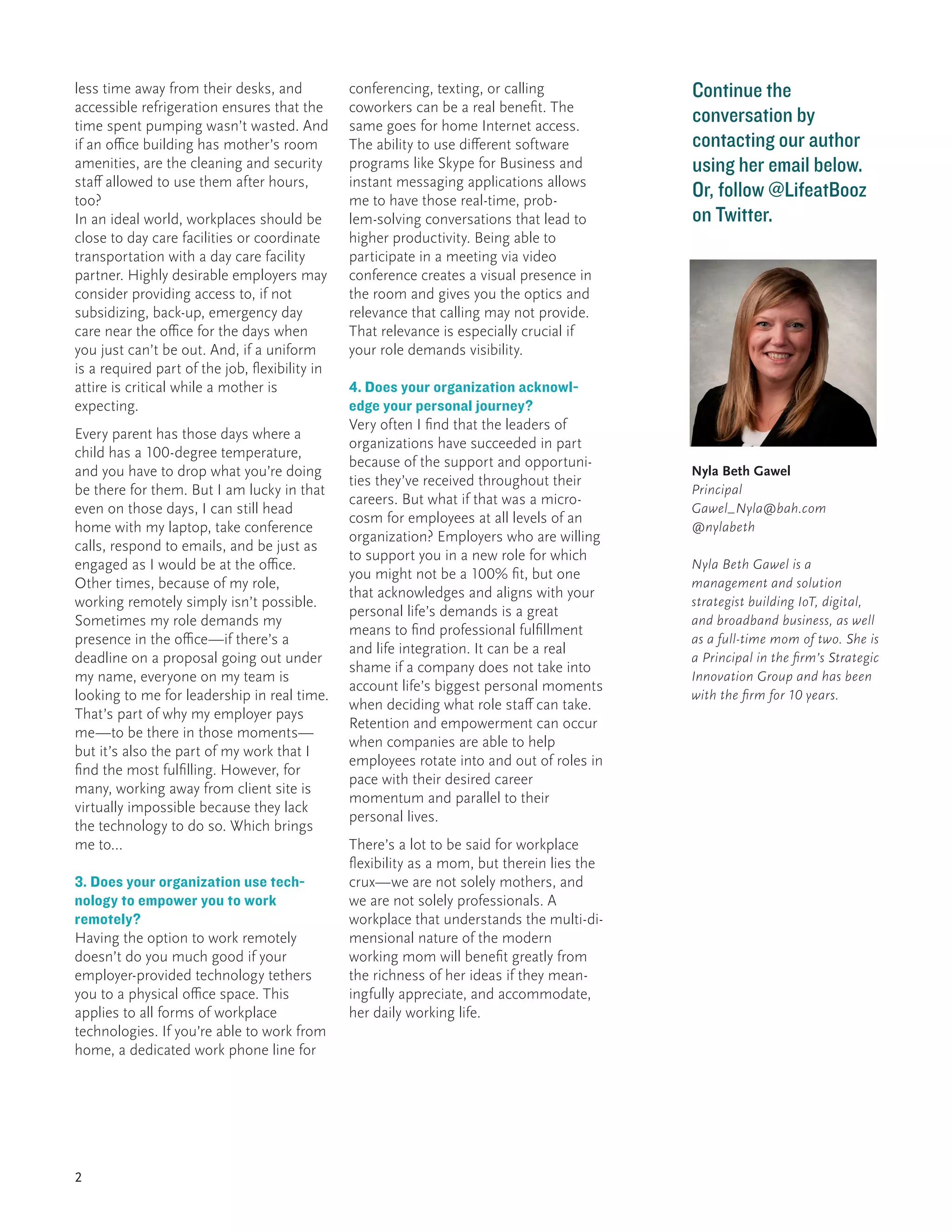
Nyla Beth Gawel
Principal
Gawel_Nyla@bah.com
@nylabeth
Nyla Beth Gawel is a
management and solution
strategist building IoT, digital,
and broadband business, as well
as a full-time mom of two. She is
a Principal in the firm’s Strategic
Innovation Group and has been
with the firm for 10 years.
3
VERY OFTEN I FIND THAT THE LEADERS OF
ORGANIZATIONS HAVE SUCCEEDED IN PART BECAUSE
OF THE SUPPORT AND OPPORTUNITIES THEY’VE
RECEIVED THROUGHOUT THEIR CAREERS. BUT WHAT
IF THAT WAS A MICROCOSM FOR EMPLOYEES AT ALL
LEVELS OF AN ORGANIZATION?
BOOZALLEN.COM© 2017 Booz Allen Hamilton, Inc.
About Booz Allen
Booz Allen Hamilton is committed to
exploring new and innovative ways to enhance
the work experience for working moms and all
of its employees. As one of Working Mother’s
100 Best Companies for 18 years running, the
firm is dedicated to providing the family
support, flexibility, and advancement that the
modern workplace demands.
Booz Allen Hamilton has been at the forefront
of strategy and technology for more than 100
years. Today, the firm provides management
and technology consulting and engineering
services to leading Fortune 500 corporations,
governments, and not-for-profits across the
globe. Booz Allen partners with public and
private sector clients to solve their most
difficult challenges through a combination of
consulting, analytics, mission operations,
technology, systems delivery, cybersecurity,
engineering, and innovation expertise.
With international headquarters in McLean,
Virginia, the firm employs more than 22,600
people globally and had revenue of $5.41
billion for the 12 months ended March 31,
2016. To learn more, visit BoozAllen.com.
(NYSE: BAH)

Examining Flexibility in the Workplace for Working Moms

  • 1.
    By Nyla BethGawel, Principal, Strategic Innovation Group IS YOUR WORKPLACE WORKING FOR MOMS? FOUR QUESTIONS YOU SHOULD BE ASKING Innovating the Working Mom EXAMINING FLEXIBILITY
  • 2.
    Workplace flexibility isbecoming more and more the norm at many traditional employers—even the federal government has gotten wise to the benefits of offering telework. This transition away from sitting at an office desk from 9 to 5 has largely been prompted by the prospering on-demand economy. Traditional workplaces have had to start offering more flexibility to compete with this work-from-anywhere model.
  • 3.
    1 I HAVE LEARNEDA LOT OF LESSONS as a working mom. For me to have the opportunity to share those key lessons with other working moms speaks to Booz Allen’s dedication to fostering this on-going conversation. Booz Allen is committed to figuring out ways to recruit, retain, and empower working moms—and I believe one of those ways is through workplace flexibility. As a professional woman currently holding two full-time jobs—a mom and a strategy consultant—the increased flexibility that Booz Allen has provided has been a godsend for me. Traditional, 9-to-5, in-office employment models have made strides in offering more flexibility and acknowledging that working parents require greater elasticity in their work days. Companies like Google, Salesforce, and Johnson & Johnson are recognized for their flexible workplace arrangements, which include everything from telecommuting to flexible scheduling. But for today’s working mom, the concept can fall short when it comes to physical office spaces, the technologies used, and merging it with your personal life. Here are four questions you should be asking to ensure you are truly able to benefit from workplace flexibility. 1. Does your organization support workplace flexibility? Let’s start by acknowledging that working remotely is very much a privileged opportunity. It gives greater agency to those who likely already have a great deal of it. So, it behooves us to think about workplace flexibility as not just “remote delivery,” but in terms of flexibility within the on-site working environment. This lens is especially important for those in jobs that demand your physical presence, like teachers, doctors, nurses, laborers, and more. 2. How does your organization support new mothers? For on-site moms, the state of lactation rooms should be, at a minimum, clean, private and readily available. Medical- grade pumps would help moms spend It behooves us to think about workplace flexibility as not just “remote delivery,” but in terms of flexibility within the on-site working environment. WORKPL ACE FLEXIBILIT Y EMPOWERS WORKING MOMS
  • 4.
    2 less time awayfrom their desks, and accessible refrigeration ensures that the time spent pumping wasn’t wasted. And if an office building has mother’s room amenities, are the cleaning and security staff allowed to use them after hours, too? In an ideal world, workplaces should be close to day care facilities or coordinate transportation with a day care facility partner. Highly desirable employers may consider providing access to, if not subsidizing, back-up, emergency day care near the office for the days when you just can’t be out. And, if a uniform is a required part of the job, flexibility in attire is critical while a mother is expecting. Every parent has those days where a child has a 100-degree temperature, and you have to drop what you’re doing be there for them. But I am lucky in that even on those days, I can still head home with my laptop, take conference calls, respond to emails, and be just as engaged as I would be at the office. Other times, because of my role, working remotely simply isn’t possible. Sometimes my role demands my presence in the office—if there’s a deadline on a proposal going out under my name, everyone on my team is looking to me for leadership in real time. That’s part of why my employer pays me—to be there in those moments— but it’s also the part of my work that I find the most fulfilling. However, for many, working away from client site is virtually impossible because they lack the technology to do so. Which brings me to… 3. Does your organization use tech- nology to empower you to work remotely? Having the option to work remotely doesn’t do you much good if your employer-provided technology tethers you to a physical office space. This applies to all forms of workplace technologies. If you’re able to work from home, a dedicated work phone line for conferencing, texting, or calling coworkers can be a real benefit. The same goes for home Internet access. The ability to use different software programs like Skype for Business and instant messaging applications allows me to have those real-time, prob- lem-solving conversations that lead to higher productivity. Being able to participate in a meeting via video conference creates a visual presence in the room and gives you the optics and relevance that calling may not provide. That relevance is especially crucial if your role demands visibility. 4. Does your organization acknowl- edge your personal journey? Very often I find that the leaders of organizations have succeeded in part because of the support and opportuni- ties they’ve received throughout their careers. But what if that was a micro- cosm for employees at all levels of an organization? Employers who are willing to support you in a new role for which you might not be a 100% fit, but one that acknowledges and aligns with your personal life’s demands is a great means to find professional fulfillment and life integration. It can be a real shame if a company does not take into account life’s biggest personal moments when deciding what role staff can take. Retention and empowerment can occur when companies are able to help employees rotate into and out of roles in pace with their desired career momentum and parallel to their personal lives. There’s a lot to be said for workplace flexibility as a mom, but therein lies the crux—we are not solely mothers, and we are not solely professionals. A workplace that understands the multi-di- mensional nature of the modern working mom will benefit greatly from the richness of her ideas if they mean- ingfully appreciate, and accommodate, her daily working life. Continue the conversation by contacting our author using her email below. Or, follow @LifeatBooz on Twitter. Nyla Beth Gawel Principal Gawel_Nyla@bah.com @nylabeth Nyla Beth Gawel is a management and solution strategist building IoT, digital, and broadband business, as well as a full-time mom of two. She is a Principal in the firm’s Strategic Innovation Group and has been with the firm for 10 years.
  • 5.
    3 VERY OFTEN IFIND THAT THE LEADERS OF ORGANIZATIONS HAVE SUCCEEDED IN PART BECAUSE OF THE SUPPORT AND OPPORTUNITIES THEY’VE RECEIVED THROUGHOUT THEIR CAREERS. BUT WHAT IF THAT WAS A MICROCOSM FOR EMPLOYEES AT ALL LEVELS OF AN ORGANIZATION?
  • 6.
    BOOZALLEN.COM© 2017 BoozAllen Hamilton, Inc. About Booz Allen Booz Allen Hamilton is committed to exploring new and innovative ways to enhance the work experience for working moms and all of its employees. As one of Working Mother’s 100 Best Companies for 18 years running, the firm is dedicated to providing the family support, flexibility, and advancement that the modern workplace demands. Booz Allen Hamilton has been at the forefront of strategy and technology for more than 100 years. Today, the firm provides management and technology consulting and engineering services to leading Fortune 500 corporations, governments, and not-for-profits across the globe. Booz Allen partners with public and private sector clients to solve their most difficult challenges through a combination of consulting, analytics, mission operations, technology, systems delivery, cybersecurity, engineering, and innovation expertise. With international headquarters in McLean, Virginia, the firm employs more than 22,600 people globally and had revenue of $5.41 billion for the 12 months ended March 31, 2016. To learn more, visit BoozAllen.com. (NYSE: BAH)