By
Abdalla Ibrahim
Healthcare Surveyor
Accreditation Specialist
May, 2013
5/27/2013 :
abdallaibrahim@hotmail.com 2
5/27/2013 3
Required Organizational Practices
(ROPs)
Essential practice that organization must
have in place to:
 enhance patient/client safety
 minimize risk.
5/27/2013 4
5/27/2013 5
The Required Organizational Practices
The ROP
 Statement defines the practice that is expected.
Guidelines
 Context and motivation on why ROP is important to patient
safety and risk management.
Tests for Compliance (major and minor)
 Expectations of surveyors during on-site assessment to
determine compliances with ROP.
 Categorized as major or minor.
Reference Material
 Sources of evidence, tools and resources to assist
organizations in meeting tests for compliance.
5/27/2013 6
Pathway of Development
 Developed in 2004 by Patient Safety Advisory Committee
 Developing:
 National and international literature reviews
 Analysis of survey results and compliance rates
 Research with regard to other accrediting bodies
 ROPs Extensive testing and national consultation
 Feedback from expert advisory committees, client organizations,
surveyors and stakeholders
 ROPs reviewed and updated
 New ROPs are developed as recommended by advisory
committees and field-specific consultation.
5/27/2013 7
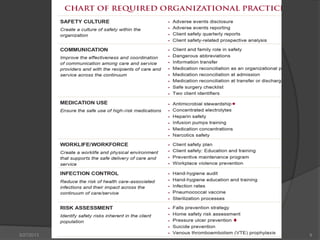
ROPs categories
ROPs are categorized into six patient safety
areas:
1. Safety culture
2. Communication
3. Medication use
4. Worklife/workforce
5. Infection control
6. Risk assessment
5/27/2013 8
5/27/2013 9
SAFETY AREAS, GOAL AND ROPs
SAFETY CULTURE:
Create a culture of
safety within the
organization
• Adverse events
disclosure
• Adverse events reporting
• Client safety quarterly
reports
• Client safety-related
prospective analysis
e.g.
Failure Modes and Effects
Analysis (FMEA)
5/27/2013 10
SAFETY AREAS, GOAL AND ROPs
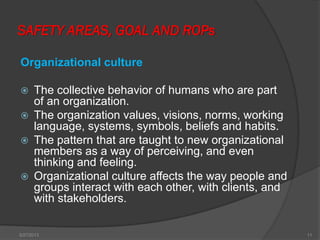
Organizational culture
 The collective behavior of humans who are part
of an organization.
 The organization values, visions, norms, working
language, systems, symbols, beliefs and habits.
 The pattern that are taught to new organizational
members as a way of perceiving, and even
thinking and feeling.
 Organizational culture affects the way people and
groups interact with each other, with clients, and
with stakeholders.
5/27/2013 11
SAFETY AREAS, GOAL AND ROPs
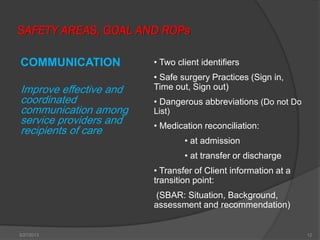
COMMUNICATION
Improve effective and
coordinated
communication among
service providers and
recipients of care
• Two client identifiers
• Safe surgery Practices (Sign in,
Time out, Sign out)
• Dangerous abbreviations (Do not Do
List)
• Medication reconciliation:
• at admission
• at transfer or discharge
• Transfer of Client information at a
transition point:
(SBAR: Situation, Background,
assessment and recommendation)
5/27/2013 12
5/27/2013 13
5/27/2013 14
5/27/2013 15
SAFETY AREAS, GOAL AND ROPs
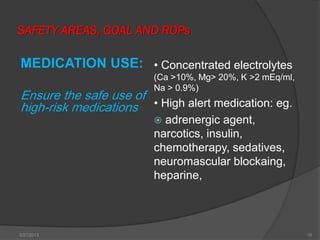
MEDICATION USE:
Ensure the safe use of
high-risk medications
• Concentrated electrolytes
(Ca >10%, Mg> 20%, K >2 mEq/ml,
Na > 0.9%)
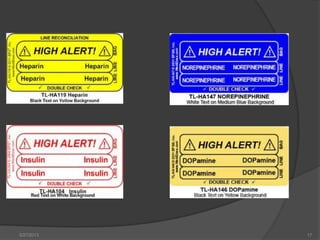
• High alert medication: eg.
 adrenergic agent,
narcotics, insulin,
chemotherapy, sedatives,
neuromascular blockaing,
heparine,
5/27/2013 16
5/27/2013 17
SAFETY AREAS, GOAL AND ROPs
WORKLIFE/
WORKFORCE:
Create a worklife and
physical environment
that supports safe
delivery of care and
service
• Workplace violence
prevention
• Client safety plan
• Client safety: Education
and training
• Preventive maintenance
program
5/27/2013 18
5/27/2013 19
SAFETY AREAS, GOAL AND ROPs
INFECTION
CONTROL:
Reduce risk of health
care-associated
infections and their
impact across the
continuum of
care/service
• Hand-hygiene education
and training
• Hand-hygiene audit
• Infection rates
• Pneumococcal vaccine
• Sterilization processes
5/27/2013 20
5/27/2013 21
SAFETY AREAS, GOAL AND ROPs
RISK
ASSESSMENT:
Identify safety risks
inherent in the client
population
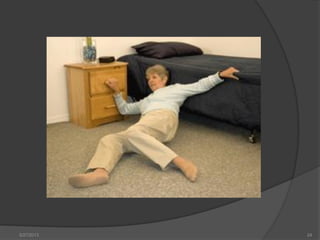
• Falls prevention
strategy
• Home safety risk
assessment
• Pressure ulcer
prevention
• Suicide prevention
• Venous
thromboembolism
(VTE) prophylaxis
5/27/2013 22
5/27/2013 23
5/27/2013 24
5/27/2013 25
5/27/2013 26
5/27/2013 27
5/27/2013 28

The required organizational practices (ROPs)

  • 2.
    By Abdalla Ibrahim Healthcare Surveyor AccreditationSpecialist May, 2013 5/27/2013 : abdallaibrahim@hotmail.com 2
  • 3.
  • 4.
    Required Organizational Practices (ROPs) Essentialpractice that organization must have in place to:  enhance patient/client safety  minimize risk. 5/27/2013 4
  • 5.
  • 6.
    The Required OrganizationalPractices The ROP  Statement defines the practice that is expected. Guidelines  Context and motivation on why ROP is important to patient safety and risk management. Tests for Compliance (major and minor)  Expectations of surveyors during on-site assessment to determine compliances with ROP.  Categorized as major or minor. Reference Material  Sources of evidence, tools and resources to assist organizations in meeting tests for compliance. 5/27/2013 6
  • 7.
    Pathway of Development Developed in 2004 by Patient Safety Advisory Committee  Developing:  National and international literature reviews  Analysis of survey results and compliance rates  Research with regard to other accrediting bodies  ROPs Extensive testing and national consultation  Feedback from expert advisory committees, client organizations, surveyors and stakeholders  ROPs reviewed and updated  New ROPs are developed as recommended by advisory committees and field-specific consultation. 5/27/2013 7
  • 8.
    ROPs categories ROPs arecategorized into six patient safety areas: 1. Safety culture 2. Communication 3. Medication use 4. Worklife/workforce 5. Infection control 6. Risk assessment 5/27/2013 8
  • 9.
  • 10.
    SAFETY AREAS, GOALAND ROPs SAFETY CULTURE: Create a culture of safety within the organization • Adverse events disclosure • Adverse events reporting • Client safety quarterly reports • Client safety-related prospective analysis e.g. Failure Modes and Effects Analysis (FMEA) 5/27/2013 10
  • 11.
    SAFETY AREAS, GOALAND ROPs Organizational culture  The collective behavior of humans who are part of an organization.  The organization values, visions, norms, working language, systems, symbols, beliefs and habits.  The pattern that are taught to new organizational members as a way of perceiving, and even thinking and feeling.  Organizational culture affects the way people and groups interact with each other, with clients, and with stakeholders. 5/27/2013 11
  • 12.
    SAFETY AREAS, GOALAND ROPs COMMUNICATION Improve effective and coordinated communication among service providers and recipients of care • Two client identifiers • Safe surgery Practices (Sign in, Time out, Sign out) • Dangerous abbreviations (Do not Do List) • Medication reconciliation: • at admission • at transfer or discharge • Transfer of Client information at a transition point: (SBAR: Situation, Background, assessment and recommendation) 5/27/2013 12
  • 13.
  • 14.
  • 15.
  • 16.
    SAFETY AREAS, GOALAND ROPs MEDICATION USE: Ensure the safe use of high-risk medications • Concentrated electrolytes (Ca >10%, Mg> 20%, K >2 mEq/ml, Na > 0.9%) • High alert medication: eg.  adrenergic agent, narcotics, insulin, chemotherapy, sedatives, neuromascular blockaing, heparine, 5/27/2013 16
  • 17.
  • 18.
    SAFETY AREAS, GOALAND ROPs WORKLIFE/ WORKFORCE: Create a worklife and physical environment that supports safe delivery of care and service • Workplace violence prevention • Client safety plan • Client safety: Education and training • Preventive maintenance program 5/27/2013 18
  • 19.
  • 20.
    SAFETY AREAS, GOALAND ROPs INFECTION CONTROL: Reduce risk of health care-associated infections and their impact across the continuum of care/service • Hand-hygiene education and training • Hand-hygiene audit • Infection rates • Pneumococcal vaccine • Sterilization processes 5/27/2013 20
  • 21.
  • 22.
    SAFETY AREAS, GOALAND ROPs RISK ASSESSMENT: Identify safety risks inherent in the client population • Falls prevention strategy • Home safety risk assessment • Pressure ulcer prevention • Suicide prevention • Venous thromboembolism (VTE) prophylaxis 5/27/2013 22
  • 23.
  • 24.
  • 25.
  • 26.
  • 27.
  • 28.