Qmentum Accreditation 
All what you need to know 
By: Abdalla Ibrahim
By 
Abdalla Ibrahim 
Accreditation Specialist, Healthcare Surveyor 
Email: abdallaibrahim@hotmail.com 
Qmentum Accreditation All what you need to know
* 
Qmentum (Quality + Momentum) literally referred to Quality Process in energetic and continuous motion.
* 
* It is a Comprehensive Accreditation Program to help health organizations improve quality of care and patient safety.
* 
*The program brings accreditation standards into every day service operations.
* 
*It focuses on what matters most to Organizations and Patients.
* 
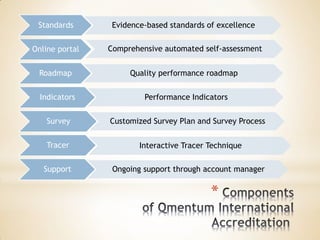
Standards 
Evidence-based standards of excellence 
Online portal 
Comprehensive automated self-assessment 
Roadmap 
Quality performance roadmap 
Indicators 
Performance Indicators 
Survey 
Customized Survey Plan and Survey Process 
Tracer 
Interactive Tracer Technique 
Support 
Ongoing support through account manager
* 
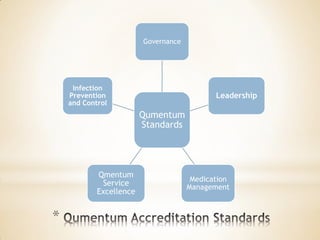
Qumentum Standards 
Governance 
Leadership 
Medication Management 
Qmentum Service Excellence 
Infection Prevention and Control
* 
*The Standards are goal statements, written in bold and numbered 1.0, 2.0, 3.0, etc. 
*Each standard is followed by a number of Criteria that are the activities required to achieve the standard. 
*By complying with the criteria, an organization can achieve the standard.
*
* 
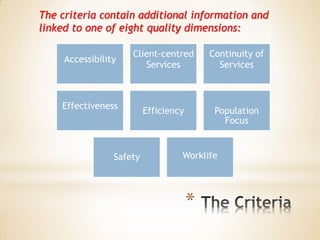
The criteria contain additional information and linked to one of eight quality dimensions: 
Accessibility 
Client-centred Services 
Continuity of Services 
Effectiveness 
Efficiency 
Population Focus 
Safety 
Worklife
* 
* Some of the criteria are identified as a Required Organizational Practice (ROP). 
*An ROP is as an essential practice that organizations should have in place to enhance patient/client safety and minimize risk. 
*To reflect the step-by-step approach of the program, each ROP is assigned a level of Gold, Platinum, or Diamond.
* 
All criteria are assigned a level of Gold, Platinum, or Diamond to reflect the tailored nature of the accreditation program (see above). 
*Gold criteria would apply to organizations in the Gold cycle of accreditation. 
*Gold and Platinum criteria would apply to organizations in the Platinum cycle of accreditation. 
*All criteria would apply to organizations in the Diamond cycle of accreditation.
* 
*The Qmentum International Accreditation Program has three levels of accreditation: 
Diamond 
Platinum 
Gold
* 
*The Qmentum International Accreditation Program has three levels of accreditation: 
Gold addresses basic structures and processes linked to the foundational elements of safety and quality improvement. 
Platinum 
•emphasizes on client-centred care. 
•creating consistency in delivery of services through standardized processes. 
•involving clients and staff in decision- making. 
Diamond 
•focuses on monitoring outcomes 
•using evidence and best practice 
•benchmarking with peer organizations to drive system-level improvements.
*Cycle of Accreditation Services
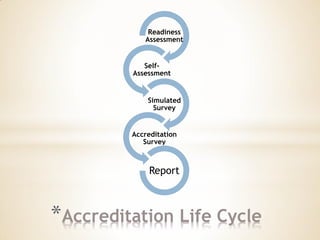
*Accreditation Life Cycle 
Readiness Assessment 
Self- Assessment 
Simulated Survey 
Accreditation Survey 
Report
*
*New organizations to accreditation starts the process with a clear understanding of where they stand in comparison to accreditation standards. 
*It is conducted by surveyors using Tracer Methodology. 
*
* 
Initial Assessment 
Action Plan 
Risk Profile 
Indicator 
Culture of Quality 
Education
* 
*Initial Assessment of existing processes and systems against standards and a baseline for future work. 
*Action Plan for getting started 
*Risk Profile: Organization’s compliance with Required Organization Practices (ROPs), 
*Indicators: Readiness to collect performance measures 
*Capacity to transition to a Culture of quality improvement 
*Education about the accreditation process, quality improvement, and safety.
*Surveyors uses: 
Focus Group 
Discussion Group 
One-to-On 
Group Interview 
Tours to trace priority processes 
Observation
By observing and interacting directly with frontline staff in their working environment, surveyors able to assess the health care organization’s: 
*Readiness for accreditation 
*Compliance with Qmentum International™ standards and levels. 
*
* 
The outcome of the RA is 
a Comprehensive REPORT providing: 
Analysis 
•Analysis of organization’s capacity to achieve accreditation 
Recommendation 
•To assist the in achieving accreditation goals and objective. 
Action Plan 
•To ensure that organization continues to provide the highest quality of service and care.
* 
Orientation sessions allow surveyors to: 
* Introduce the Qmentum International™ accreditation program to leaders and staff of the organization 
*Provide a refresher, especially with those experiencing higher staff turnover.
* 
These sessions are meant to: 
*Reduce the anxiety associated with accreditation 
*Frame the process according to philosophy of continuous quality improvement.
* Introduction to Qmentum International: 
for all levels of staff, introduces the key elements of the Qmentum International accreditation process Qmentum International™ for Leaders: 
overview of the new accreditation program including tools, team formation, and team work required by the organization’s team leaders and senior leadership to manage the process Qmentum International™ for Self-Assessment Teams: introducing the Qmentum International accreditation program to the organization’s leadership and senior management team.
* 
Introduction to Qmentum International: for all levels of staff, introduces key elements of Qmentum International accreditation process 
Qmentum International for Leaders: (Team leaders, senior leadership to management) overview of new accreditation program including tools, team formation, and team work 
Qmentum International™ for Self- Assessment Teams: (leadership and senior management team). Introducing Qmentum International accreditation program
*
* 
*A web-based tool that allow all staff to evaluate the level of compliance against Qmentum International™ standards 
*And aggregate this data by Functional Teams and reported within a Management Dashboard. 
*The self-assessment tool includes a Client Portal and the Quality Performance Roadmap™.
* 
*In this secure portal, the health care organization completes its self-assessment at its convenience. 
*Once the self-assessment is complete, the health care organization can obtain its Results automatically, and also generate reports. 
*Report includes findings related to performance measures and indicators.
* 
*Comprehensive picture of organization’s status performance against standards and measures. 
*Identifies quality and safety areas for follow-up and improvement. 
*Consolidate and present information in a secure database. 
*Enable policy-makers and leaders to identify system-wide quality and safety issues and strengths.
* 
*Creates, coordinates and ensures execution of a critical path of key events leading up to accreditation 
*Guides, mentors and coaches the organization in its accreditation-related activities, for example standards interpretation and knowledge transfer regarding quality improvement plans 
*Ascertains the organization’s educational needs and may also be part of delivering client education and capacity building programs
* 
*Assists the organization in developing and implementing quality improvement action plans 
*Provides access to resources, examples of policies and procedures, best practices and contacts available within its network of over a thousand accredited organizations 
*Provides access to all national and international health care accreditation and distinction standards available 
*Reviews and provides advice on the implementation of accreditation recommendations
*
* 
* The surveyors conduct both clinical and administrative tracers for a sample of priority processes which are critical areas and systems known to have a significant impact on the quality and safety of care and services. 
*Normally occurs 4 - 6 months prior to the final survey 
The Simulated Survey provides the staff with: 
*Opportunity to experience the Tracer Methodology 
*Understand the questions surveyors may ask during this activity.
*
* 
*A comprehensive onsite review that evaluates the organization’s level of performance against Qmentum International™ standards. 
*The onsite visit is conducted by a team of external peer surveyors using tracer methodology.
* 
*Tracer Methodology is used to assess levels of care, treatment, and services by following an actual client or patient experience through the care continuum. 
Tracers are used to evaluate both: 
* clinical process(direct client care). 
* administrative processes (governance, leadership, management).
* 
*The tracer is an interactive process whereby surveyors use direct observation and interaction with a wide variety of staff and patients/clients to gather evidence about the quality and safety of care and services in a particular service area.
* 
Professionals with: 
* credentials 
* healthcare and leadership experience 
* analytical and communication skills.
* 
*The PHC Centers will be chosen based on a high volume & high risk basis.
* 
*Timing: 10-20 days after the survey 
*It provides specific information on key findings, strengths, and areas for improvement, and highlights areas that will minimize risk and improve overall performance.
* 
*Accreditation: the organization may be accredited at a Gold, Platinum or Diamond level depending on their performance at the time of the survey. 
*Accreditation with Condition: the organization achieves compliance with standards at a certain level, but conditions must be met to maintain accreditation. 
*Non-Accreditation: Unsuccessful in achieving accreditation.
* 
*The Accreditation Decision is provided with the Accreditation Report. 
*Upon achieving successful accreditation, the organization will receive an award letter, a certificate of accreditation for each location. 
*In the event that the decision specifies conditions, the organization will have five months to one year to meet the required conditions by providing evidence of improvement initiatives and outcomes.
*
* 
*Following the receipt of the Accreditation report, the organization must address any conditions, and continue to work on the areas identified for improvement. 
*Accreditation Canada International will review whether the conditions are met based on the information received including evidence of action taken.
Qmentum accreditation

Qmentum accreditation

  • 1.
    Qmentum Accreditation Allwhat you need to know By: Abdalla Ibrahim
  • 2.
    By Abdalla Ibrahim Accreditation Specialist, Healthcare Surveyor Email: abdallaibrahim@hotmail.com Qmentum Accreditation All what you need to know
  • 3.
    * Qmentum (Quality+ Momentum) literally referred to Quality Process in energetic and continuous motion.
  • 4.
    * * Itis a Comprehensive Accreditation Program to help health organizations improve quality of care and patient safety.
  • 5.
    * *The programbrings accreditation standards into every day service operations.
  • 6.
    * *It focuseson what matters most to Organizations and Patients.
  • 7.
    * Standards Evidence-basedstandards of excellence Online portal Comprehensive automated self-assessment Roadmap Quality performance roadmap Indicators Performance Indicators Survey Customized Survey Plan and Survey Process Tracer Interactive Tracer Technique Support Ongoing support through account manager
  • 8.
    * Qumentum Standards Governance Leadership Medication Management Qmentum Service Excellence Infection Prevention and Control
  • 9.
    * *The Standardsare goal statements, written in bold and numbered 1.0, 2.0, 3.0, etc. *Each standard is followed by a number of Criteria that are the activities required to achieve the standard. *By complying with the criteria, an organization can achieve the standard.
  • 10.
  • 11.
    * The criteriacontain additional information and linked to one of eight quality dimensions: Accessibility Client-centred Services Continuity of Services Effectiveness Efficiency Population Focus Safety Worklife
  • 13.
    * * Someof the criteria are identified as a Required Organizational Practice (ROP). *An ROP is as an essential practice that organizations should have in place to enhance patient/client safety and minimize risk. *To reflect the step-by-step approach of the program, each ROP is assigned a level of Gold, Platinum, or Diamond.
  • 17.
    * All criteriaare assigned a level of Gold, Platinum, or Diamond to reflect the tailored nature of the accreditation program (see above). *Gold criteria would apply to organizations in the Gold cycle of accreditation. *Gold and Platinum criteria would apply to organizations in the Platinum cycle of accreditation. *All criteria would apply to organizations in the Diamond cycle of accreditation.
  • 18.
    * *The QmentumInternational Accreditation Program has three levels of accreditation: Diamond Platinum Gold
  • 19.
    * *The QmentumInternational Accreditation Program has three levels of accreditation: Gold addresses basic structures and processes linked to the foundational elements of safety and quality improvement. Platinum •emphasizes on client-centred care. •creating consistency in delivery of services through standardized processes. •involving clients and staff in decision- making. Diamond •focuses on monitoring outcomes •using evidence and best practice •benchmarking with peer organizations to drive system-level improvements.
  • 20.
  • 22.
    *Accreditation Life Cycle Readiness Assessment Self- Assessment Simulated Survey Accreditation Survey Report
  • 23.
  • 24.
    *New organizations toaccreditation starts the process with a clear understanding of where they stand in comparison to accreditation standards. *It is conducted by surveyors using Tracer Methodology. *
  • 25.
    * Initial Assessment Action Plan Risk Profile Indicator Culture of Quality Education
  • 26.
    * *Initial Assessmentof existing processes and systems against standards and a baseline for future work. *Action Plan for getting started *Risk Profile: Organization’s compliance with Required Organization Practices (ROPs), *Indicators: Readiness to collect performance measures *Capacity to transition to a Culture of quality improvement *Education about the accreditation process, quality improvement, and safety.
  • 27.
    *Surveyors uses: FocusGroup Discussion Group One-to-On Group Interview Tours to trace priority processes Observation
  • 28.
    By observing andinteracting directly with frontline staff in their working environment, surveyors able to assess the health care organization’s: *Readiness for accreditation *Compliance with Qmentum International™ standards and levels. *
  • 29.
    * The outcomeof the RA is a Comprehensive REPORT providing: Analysis •Analysis of organization’s capacity to achieve accreditation Recommendation •To assist the in achieving accreditation goals and objective. Action Plan •To ensure that organization continues to provide the highest quality of service and care.
  • 30.
    * Orientation sessionsallow surveyors to: * Introduce the Qmentum International™ accreditation program to leaders and staff of the organization *Provide a refresher, especially with those experiencing higher staff turnover.
  • 31.
    * These sessionsare meant to: *Reduce the anxiety associated with accreditation *Frame the process according to philosophy of continuous quality improvement.
  • 32.
    * Introduction toQmentum International: for all levels of staff, introduces the key elements of the Qmentum International accreditation process Qmentum International™ for Leaders: overview of the new accreditation program including tools, team formation, and team work required by the organization’s team leaders and senior leadership to manage the process Qmentum International™ for Self-Assessment Teams: introducing the Qmentum International accreditation program to the organization’s leadership and senior management team.
  • 33.
    * Introduction toQmentum International: for all levels of staff, introduces key elements of Qmentum International accreditation process Qmentum International for Leaders: (Team leaders, senior leadership to management) overview of new accreditation program including tools, team formation, and team work Qmentum International™ for Self- Assessment Teams: (leadership and senior management team). Introducing Qmentum International accreditation program
  • 34.
  • 35.
    * *A web-basedtool that allow all staff to evaluate the level of compliance against Qmentum International™ standards *And aggregate this data by Functional Teams and reported within a Management Dashboard. *The self-assessment tool includes a Client Portal and the Quality Performance Roadmap™.
  • 36.
    * *In thissecure portal, the health care organization completes its self-assessment at its convenience. *Once the self-assessment is complete, the health care organization can obtain its Results automatically, and also generate reports. *Report includes findings related to performance measures and indicators.
  • 37.
    * *Comprehensive pictureof organization’s status performance against standards and measures. *Identifies quality and safety areas for follow-up and improvement. *Consolidate and present information in a secure database. *Enable policy-makers and leaders to identify system-wide quality and safety issues and strengths.
  • 38.
    * *Creates, coordinatesand ensures execution of a critical path of key events leading up to accreditation *Guides, mentors and coaches the organization in its accreditation-related activities, for example standards interpretation and knowledge transfer regarding quality improvement plans *Ascertains the organization’s educational needs and may also be part of delivering client education and capacity building programs
  • 39.
    * *Assists theorganization in developing and implementing quality improvement action plans *Provides access to resources, examples of policies and procedures, best practices and contacts available within its network of over a thousand accredited organizations *Provides access to all national and international health care accreditation and distinction standards available *Reviews and provides advice on the implementation of accreditation recommendations
  • 40.
  • 41.
    * * Thesurveyors conduct both clinical and administrative tracers for a sample of priority processes which are critical areas and systems known to have a significant impact on the quality and safety of care and services. *Normally occurs 4 - 6 months prior to the final survey The Simulated Survey provides the staff with: *Opportunity to experience the Tracer Methodology *Understand the questions surveyors may ask during this activity.
  • 42.
  • 43.
    * *A comprehensiveonsite review that evaluates the organization’s level of performance against Qmentum International™ standards. *The onsite visit is conducted by a team of external peer surveyors using tracer methodology.
  • 44.
    * *Tracer Methodologyis used to assess levels of care, treatment, and services by following an actual client or patient experience through the care continuum. Tracers are used to evaluate both: * clinical process(direct client care). * administrative processes (governance, leadership, management).
  • 45.
    * *The traceris an interactive process whereby surveyors use direct observation and interaction with a wide variety of staff and patients/clients to gather evidence about the quality and safety of care and services in a particular service area.
  • 46.
    * Professionals with: * credentials * healthcare and leadership experience * analytical and communication skills.
  • 47.
    * *The PHCCenters will be chosen based on a high volume & high risk basis.
  • 48.
    * *Timing: 10-20days after the survey *It provides specific information on key findings, strengths, and areas for improvement, and highlights areas that will minimize risk and improve overall performance.
  • 49.
    * *Accreditation: theorganization may be accredited at a Gold, Platinum or Diamond level depending on their performance at the time of the survey. *Accreditation with Condition: the organization achieves compliance with standards at a certain level, but conditions must be met to maintain accreditation. *Non-Accreditation: Unsuccessful in achieving accreditation.
  • 50.
    * *The AccreditationDecision is provided with the Accreditation Report. *Upon achieving successful accreditation, the organization will receive an award letter, a certificate of accreditation for each location. *In the event that the decision specifies conditions, the organization will have five months to one year to meet the required conditions by providing evidence of improvement initiatives and outcomes.
  • 51.
  • 52.
    * *Following thereceipt of the Accreditation report, the organization must address any conditions, and continue to work on the areas identified for improvement. *Accreditation Canada International will review whether the conditions are met based on the information received including evidence of action taken.