Gp Capt (Dr) RK Pathni
AM I
Learning in other medical specialties is tangible
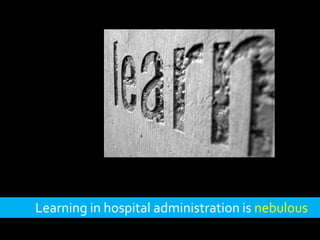
Learning in hospital administration is nebulous
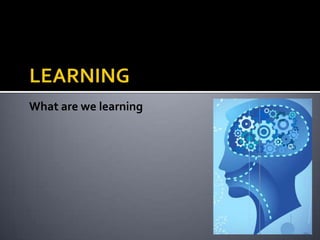
What are we learning
Out in the real world
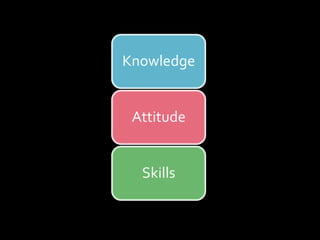
Knowledge
Attitude
Skills
 knowl·edge/ˈnälij/
 Information acquired through experience or
education
 The theoretical or practical understanding of
a subject.
Skills (Noun)
 The ability to do something well;
 Expertise.
at·ti·tude/ˈatiˈt(y)o͞od/
A settled way of thinking or
feeling, typically reflected in a person's
behaviour.
 A predisposition or a tendency to respond in a
particular way towards an idea, object, person or
situation.
 Attitude influences an individual’s choice of
action and response to challenges
Your Attitude,
not your Aptitude
determines your Altitude
It does not matter
WHAT you know
But
WHO you know.
How do we acquire it
Is teaching the purpose of
education or is learning the purpose
of education?
 Simple storing of information or rote learning
is the most basic learning activity.
Machines
cannot be called
intelligent until
they are able to
learn to do new
things and adapt
to new
situations, rather
than simply do as
they are told to
do.
• Lecture 10% retention rate
• Reading 20%
• Audiovisual 30%
• Discussion 50%
• Practice by Doing 80%
• Immediate use of Learning 90%
learn·ing/ˈlərniNG/
 The acquisition of knowledge or skills
through experience, practice, or study or by
being taught.
 Acquiring new or modifying
existing, knowledge, behaviour, skills, values
or preferences
 It is a relatively lasting change in behavior
TEACHING
 Lazy
 Delivery of instructions
 Degree
LEARNING
 Active
 Experiential
 Demonstrated knowledge
& skills
PEDAGOGY
 Focus is upon change
 Change must be long-lasting
 The focus of learning can be
cognitive, psychomotor or behavioral
 Results from the individual’s interaction with the
learning environment
 Creativity – application of knowledge
Learning, at its best, is a self-motivated
journey of discovery and change
 Thesis & Dissertations
 Each thesis / dissertation gives you an
opportunity to master that specific field
 Thesis & Dissertations
 Tasks, Conferences
 Meetings
 Mentoring
 Observation
 Induction
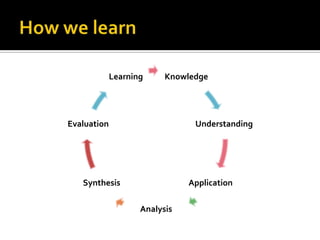
Knowledge
Understanding
Application
Analysis
Synthesis
Evaluation
Learning
What’s unique here
LEARN TO LEAD
LEAD TO LEARN
 A real-world working environment
 Self-confidence and self-esteem
 Leadership
 Participatory skills
 Interpersonal communication skills
 Decision-making skills
 Team Dynamics
 Conflict resolution
Learning in hospital administration is different. It is
very subtle but transformational.
Q & D

Learning hospital administration

Editor's Notes

  • #3 As a resident of the prestigious MHA programme at AIIMS, I was confused. Was I learning anything? It went on for 6 months. Till the next batch of residents came in.
  • #4 Learning in other medical specialties is tangible
  • #5 Hence, difficult to realize that we are actually learning something.
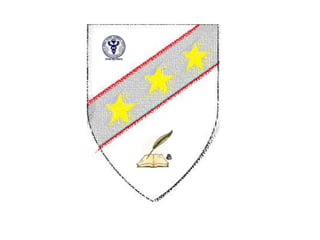
  • #8 Nothing in life is black or white – it is mostly GREY (represented by the grey band). The three stars represent – Knowledge, Attitudes & Skills.
  • #12 But administration is not about knowledge alone.
  • #13 Attitude is the most nebulous part of learning
  • #20 A brain by itself is not intelligent! It is just a storage for information. Just like a computer. It is the actions by using this information that define the leader.
  • #26 Lear by observing…faithfully.
  • #31 Your teachers are facilitators. They will not be there to carry you when you are out in the real world.
  • #32 Administrative learning is a two way process. It is also continuous – you should never start learning, even when you are in a leadership position.