The Problem and
Purpose Statement
NSU/FCE SUMMER INSTITUTE 2016
DR. DAVID WEINTRAUB, DISSERTATION SERVICES ASSOCIATE
What is a Problem Statement?
A good problem is an issue or difficulty of
some significance, urgency and priority
whose investigation will make a useful
contribution to knowledge. If you already
know the answer, if the answer can be
found by a simple search of existing studies,
or is totally predictable, there is no need to
do the study.
Problem Statement
 WHAT IS THE PROBLEM? Not "question", "topic.", or “lack”
of something. Just state what is wrong or needs to be
addressed, not WHY it’s a problem, nor how you plan on
addressing it.
 WHY IS IT A PROBLEM? Reason for and significance of
problem. These could be the “LACK” of something
 PROOF? Show the reader evidence that the problem
actually exists
 Who has done what about research on this problem?
Using a Matrix to Help you Frame
out the Problem and Purpose
 It gives you a visual representation of the process
 Problem Statement Goal
 Evidences Outcomes
 Possible Causes Proven Solutions
 Shows alignment between Problem and Purpose
Statements
 Helps you to plan for the lit review
 Helps you align the problem and purpose with your
research questions
Let’s look at the Matrix
One Step at a Time
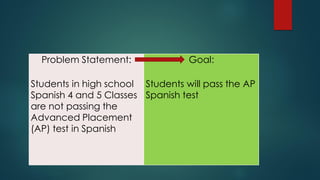
Problem Statement:
Students in high school
Spanish 4 and 5 Classes
are not passing the
Advanced Placement
(AP) test in Spanish
Goal:
Students will pass the AP
Spanish test
Creation of the Purpose Statement
 Based on goals to alleviate or reduce the
problem, you can create your Purpose
Statement
“The purpose of this study is to discover what
tools are needed to better prepare high school
students for the AP Spanish exam and to
measure the level of efficacy of those tools.”
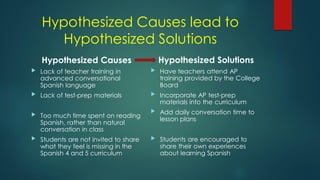
Hypothesized Causes lead to
Hypothesized Solutions
Hypothesized Causes
 Lack of teacher training in
advanced conversational
Spanish language
 Lack of test-prep materials
 Too much time spent on reading
Spanish, rather than natural
conversation in class
 Students are not invited to share
what they feel is missing in the
Spanish 4 and 5 curriculum
Hypothesized Solutions
 Have teachers attend AP
training provided by the College
Board
 Incorporate AP test-prep
materials into the curriculum
 Add daily conversation time to
lesson plans
 Students are encouraged to
share their own experiences
about learning Spanish
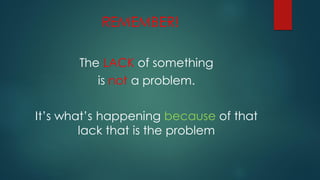
REMEMBER!
The LACK of something
is not a problem.
It’s what’s happening because of that
lack that is the problem
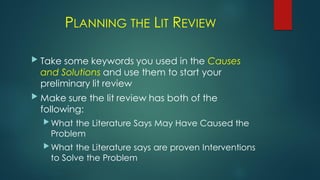
PLANNING THE LIT REVIEW
 Take some keywords you used in the Causes
and Solutions and use them to start your
preliminary lit review
 Make sure the lit review has both of the
following:
 What the Literature Says May Have Caused the
Problem
 What the Literature says are proven Interventions
to Solve the Problem
Your next step:
Create a matrix of your own using the
following blank template
Problem
Statement:
Goal:
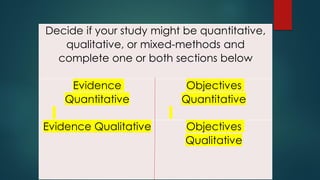
Decide if your study might be quantitative,
qualitative, or mixed-methods and
complete one or both sections below
Evidence
Quantitative
Objectives
Quantitative
Evidence Qualitative Objectives
Qualitative
Create Your
Purpose Statement
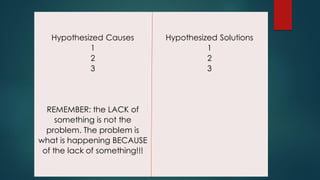
Hypothesized Causes
1
2
3
REMEMBER: the LACK of
something is not the
problem. The problem is
what is happening BECAUSE
of the lack of something!!!
Hypothesized Solutions
1
2
3
List at Least 5 Keywords you Could
Use to Start your Literature Search
from the Cause/Solution Chart.
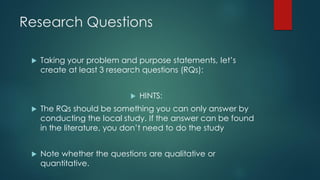
Research Questions
 Taking your problem and purpose statements, let’s
create at least 3 research questions (RQs):
 HINTS:
 The RQs should be something you can only answer by
conducting the local study. If the answer can be found
in the literature, you don’t need to do the study
 Note whether the questions are qualitative or
quantitative.
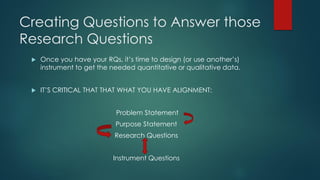
Creating Questions to Answer those
Research Questions
 Once you have your RQs, it’s time to design (or use another’s)
instrument to get the needed quantitative or qualitative data.
 IT’S CRITICAL THAT THAT WHAT YOU HAVE ALIGNMENT:
Problem Statement
Purpose Statement
Research Questions
Instrument Questions
For more info
Contact Dr. David Weintraub
daweint@nova.edu

The problem and purpose statement

  • 1.
    The Problem and PurposeStatement NSU/FCE SUMMER INSTITUTE 2016 DR. DAVID WEINTRAUB, DISSERTATION SERVICES ASSOCIATE
  • 2.
    What is aProblem Statement? A good problem is an issue or difficulty of some significance, urgency and priority whose investigation will make a useful contribution to knowledge. If you already know the answer, if the answer can be found by a simple search of existing studies, or is totally predictable, there is no need to do the study.
  • 3.
    Problem Statement  WHATIS THE PROBLEM? Not "question", "topic.", or “lack” of something. Just state what is wrong or needs to be addressed, not WHY it’s a problem, nor how you plan on addressing it.  WHY IS IT A PROBLEM? Reason for and significance of problem. These could be the “LACK” of something  PROOF? Show the reader evidence that the problem actually exists  Who has done what about research on this problem?
  • 4.
    Using a Matrixto Help you Frame out the Problem and Purpose  It gives you a visual representation of the process  Problem Statement Goal  Evidences Outcomes  Possible Causes Proven Solutions  Shows alignment between Problem and Purpose Statements  Helps you to plan for the lit review  Helps you align the problem and purpose with your research questions
  • 5.
    Let’s look atthe Matrix One Step at a Time
  • 6.
    Problem Statement: Students inhigh school Spanish 4 and 5 Classes are not passing the Advanced Placement (AP) test in Spanish Goal: Students will pass the AP Spanish test
  • 7.
    Creation of thePurpose Statement  Based on goals to alleviate or reduce the problem, you can create your Purpose Statement “The purpose of this study is to discover what tools are needed to better prepare high school students for the AP Spanish exam and to measure the level of efficacy of those tools.”
  • 8.
    Hypothesized Causes leadto Hypothesized Solutions Hypothesized Causes  Lack of teacher training in advanced conversational Spanish language  Lack of test-prep materials  Too much time spent on reading Spanish, rather than natural conversation in class  Students are not invited to share what they feel is missing in the Spanish 4 and 5 curriculum Hypothesized Solutions  Have teachers attend AP training provided by the College Board  Incorporate AP test-prep materials into the curriculum  Add daily conversation time to lesson plans  Students are encouraged to share their own experiences about learning Spanish
  • 9.
    REMEMBER! The LACK ofsomething is not a problem. It’s what’s happening because of that lack that is the problem
  • 10.
    PLANNING THE LITREVIEW  Take some keywords you used in the Causes and Solutions and use them to start your preliminary lit review  Make sure the lit review has both of the following:  What the Literature Says May Have Caused the Problem  What the Literature says are proven Interventions to Solve the Problem
  • 11.
    Your next step: Createa matrix of your own using the following blank template
  • 12.
  • 13.
    Decide if yourstudy might be quantitative, qualitative, or mixed-methods and complete one or both sections below Evidence Quantitative Objectives Quantitative Evidence Qualitative Objectives Qualitative
  • 14.
  • 15.
    Hypothesized Causes 1 2 3 REMEMBER: theLACK of something is not the problem. The problem is what is happening BECAUSE of the lack of something!!! Hypothesized Solutions 1 2 3
  • 16.
    List at Least5 Keywords you Could Use to Start your Literature Search from the Cause/Solution Chart.
  • 17.
    Research Questions  Takingyour problem and purpose statements, let’s create at least 3 research questions (RQs):  HINTS:  The RQs should be something you can only answer by conducting the local study. If the answer can be found in the literature, you don’t need to do the study  Note whether the questions are qualitative or quantitative.
  • 18.
    Creating Questions toAnswer those Research Questions  Once you have your RQs, it’s time to design (or use another’s) instrument to get the needed quantitative or qualitative data.  IT’S CRITICAL THAT THAT WHAT YOU HAVE ALIGNMENT: Problem Statement Purpose Statement Research Questions Instrument Questions
  • 19.
    For more info ContactDr. David Weintraub daweint@nova.edu