The Probit Model
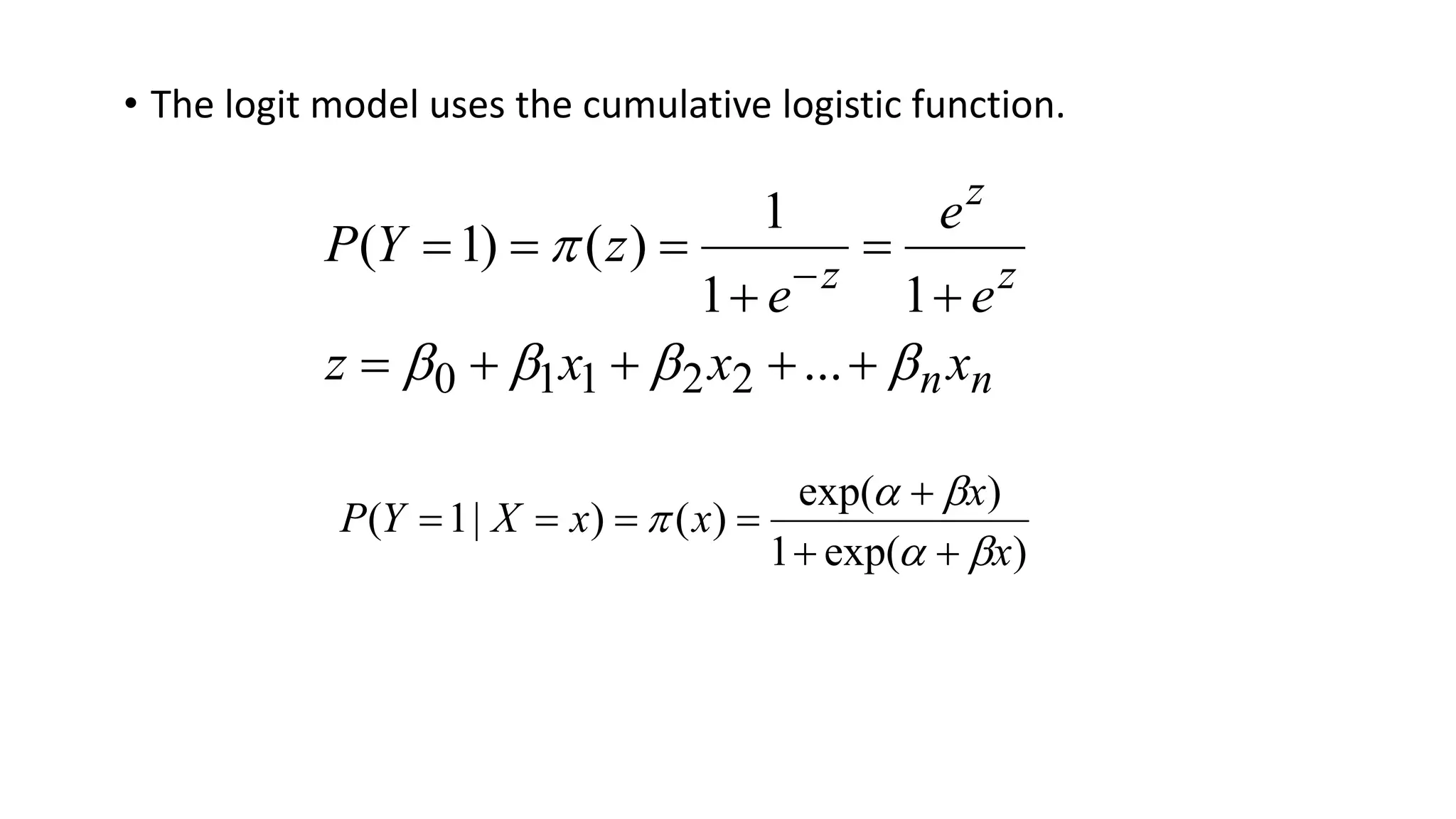
• The logit model uses the cumulative logistic function.
n
n
z
z
z
x
x
x
z
e
e
e
z
Y
P

















...
1
1
1
)
(
)
1
(
2
2
1
1
0
)
exp(
1
)
exp(
)
(
)
|
1
(
x
x
x
x
X
Y
P












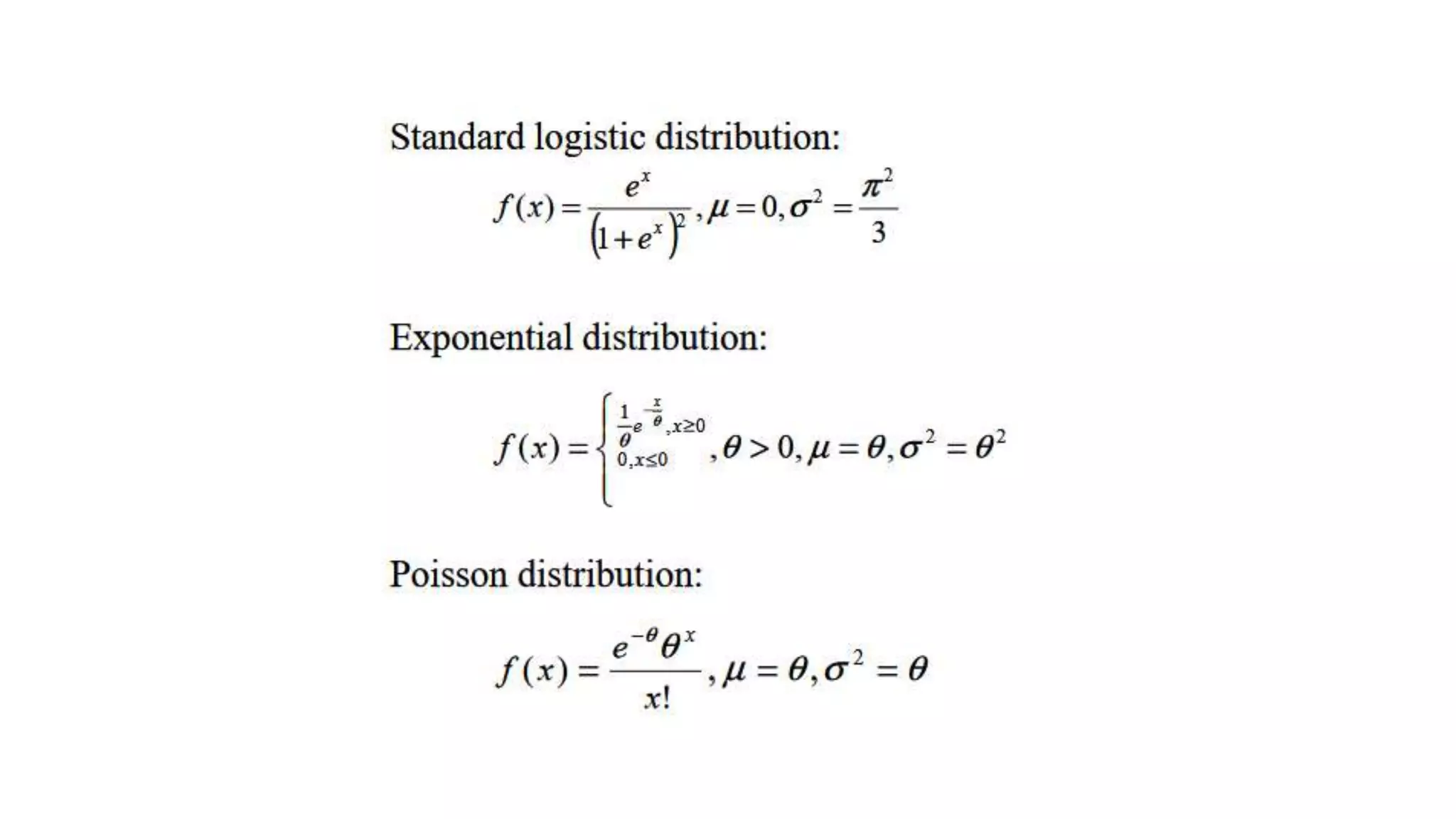
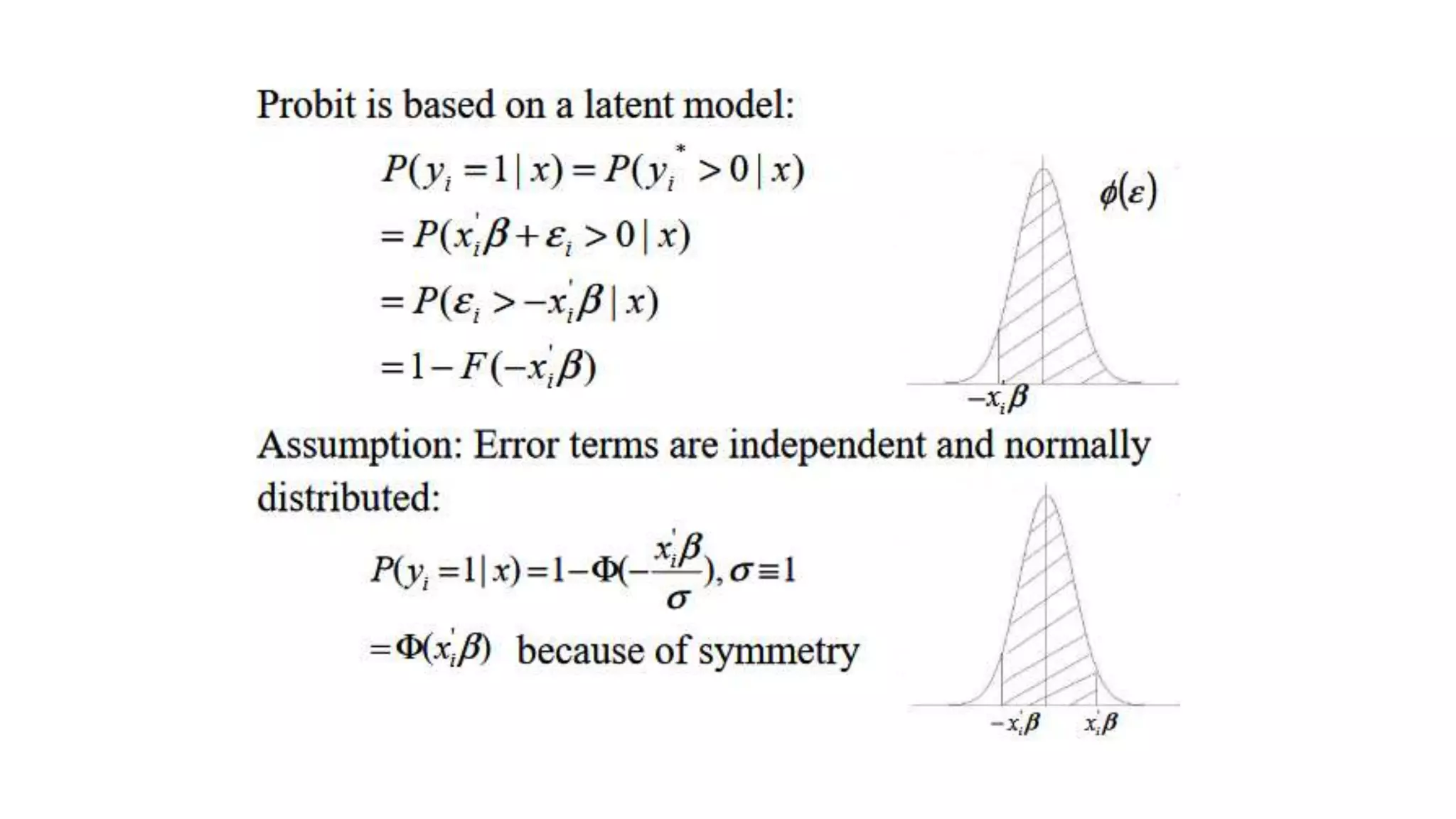
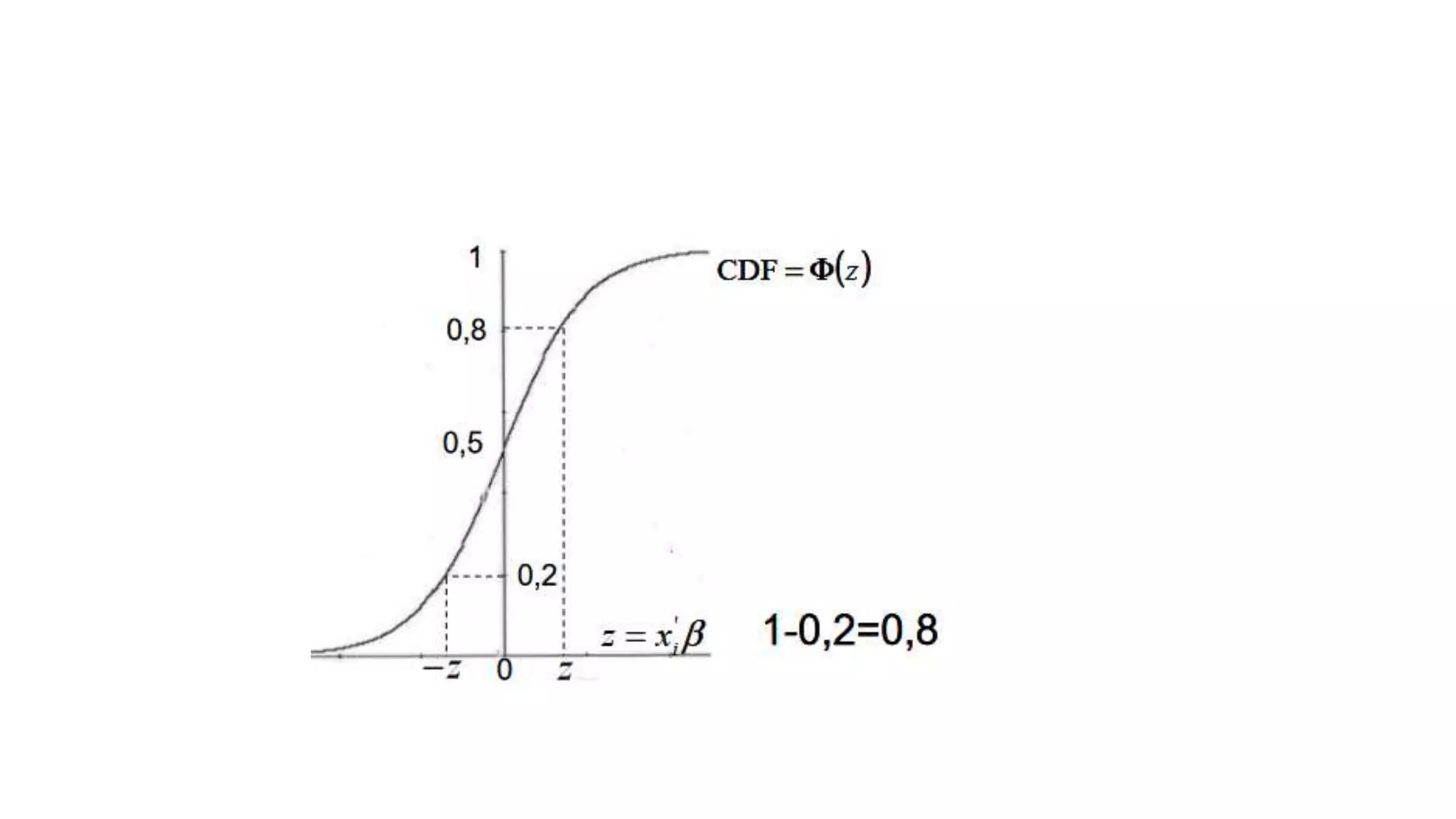
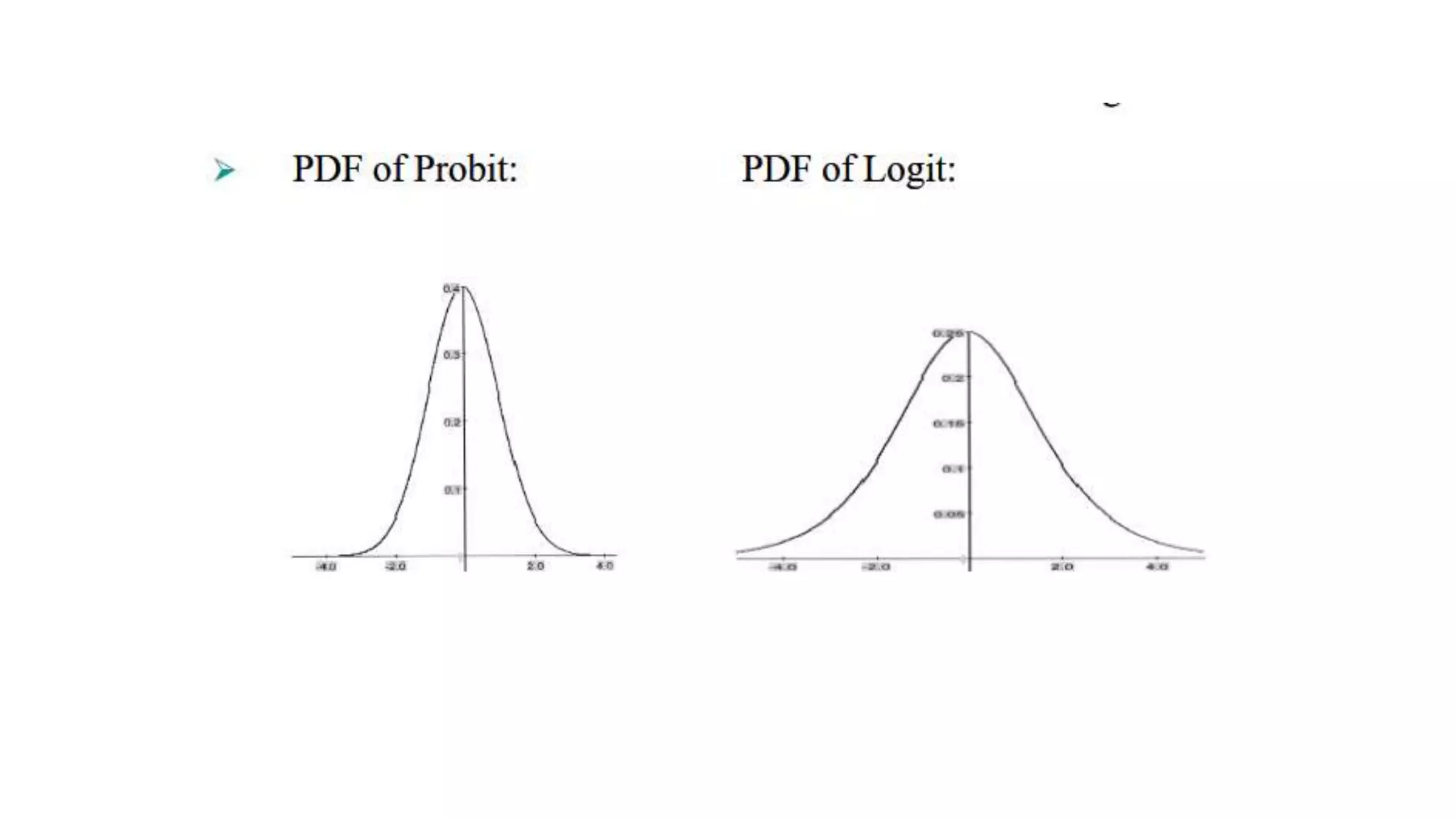
• In some applications, the Normal CDF has been found useful.
• The estimating model that emerges from the Normal CDF is popularly
known as the probit model. Although sometimes it is also known as
the Normit model.
• In principle one could substitute the Normal CDF in place of logistic
CDF
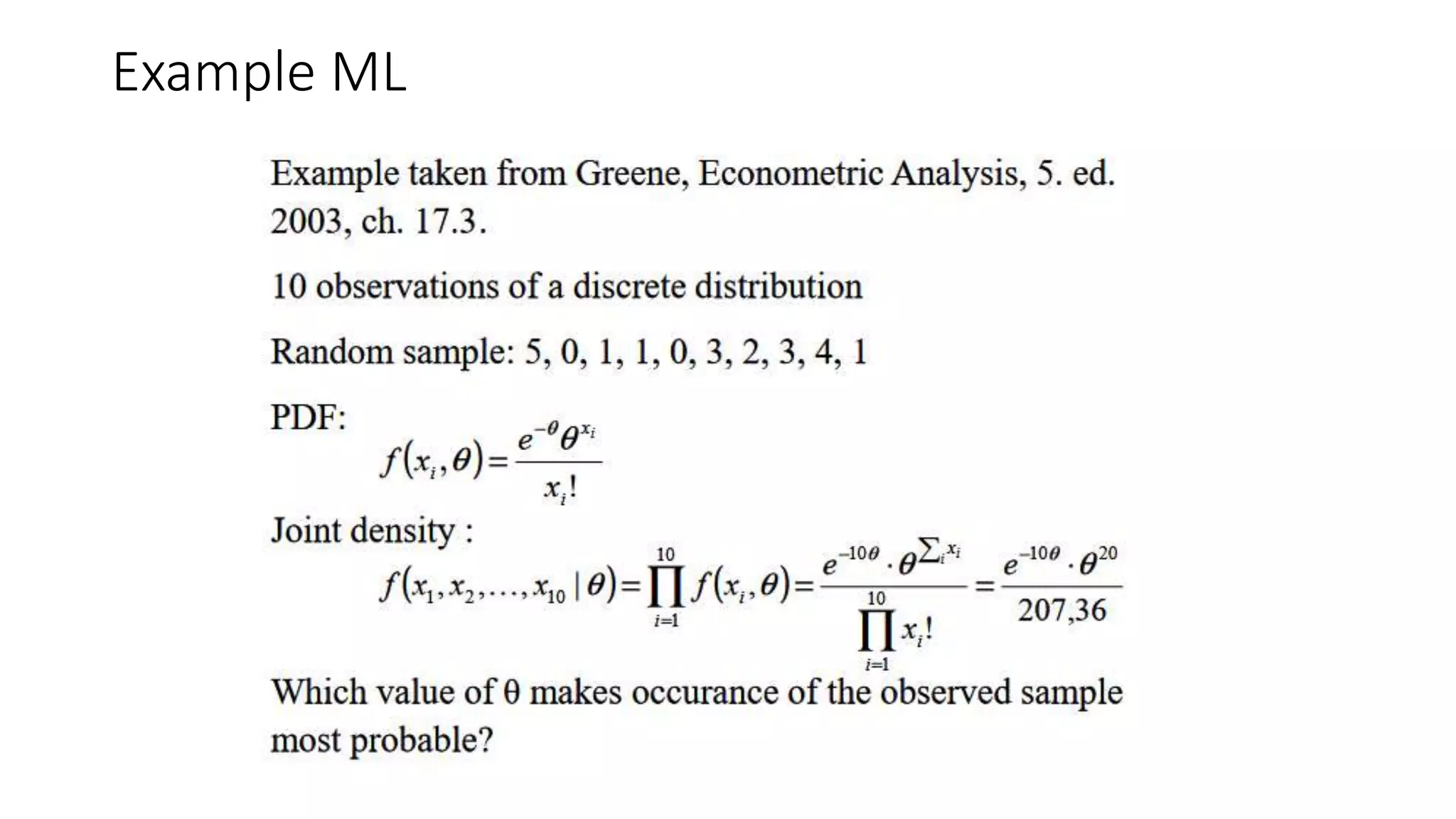
The ML principle
The ML principle
Example ML
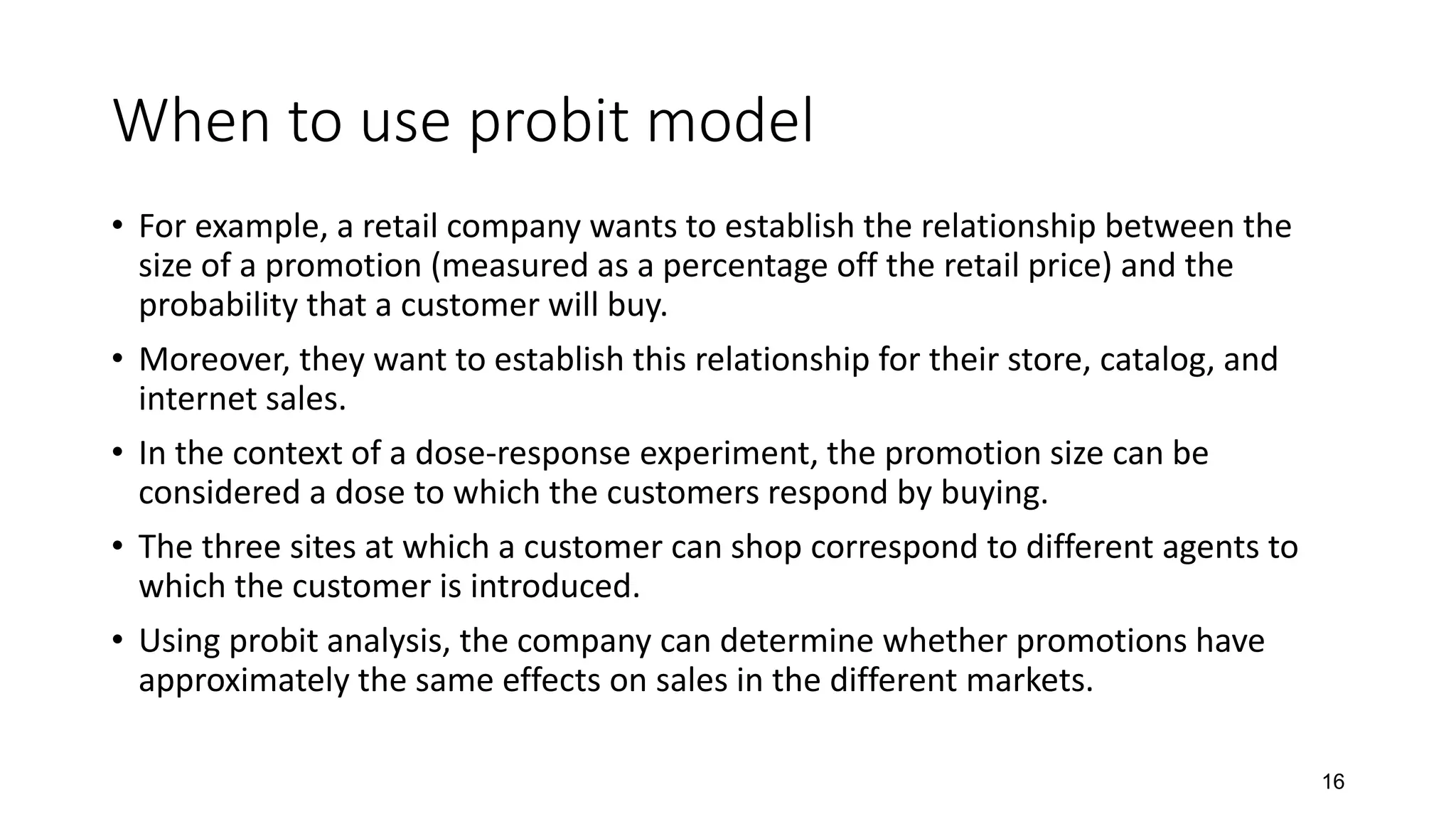
When to use probit model
• For example, a retail company wants to establish the relationship between the
size of a promotion (measured as a percentage off the retail price) and the
probability that a customer will buy.
• Moreover, they want to establish this relationship for their store, catalog, and
internet sales.
• In the context of a dose-response experiment, the promotion size can be
considered a dose to which the customers respond by buying.
• The three sites at which a customer can shop correspond to different agents to
which the customer is introduced.
• Using probit analysis, the company can determine whether promotions have
approximately the same effects on sales in the different markets.
16
17
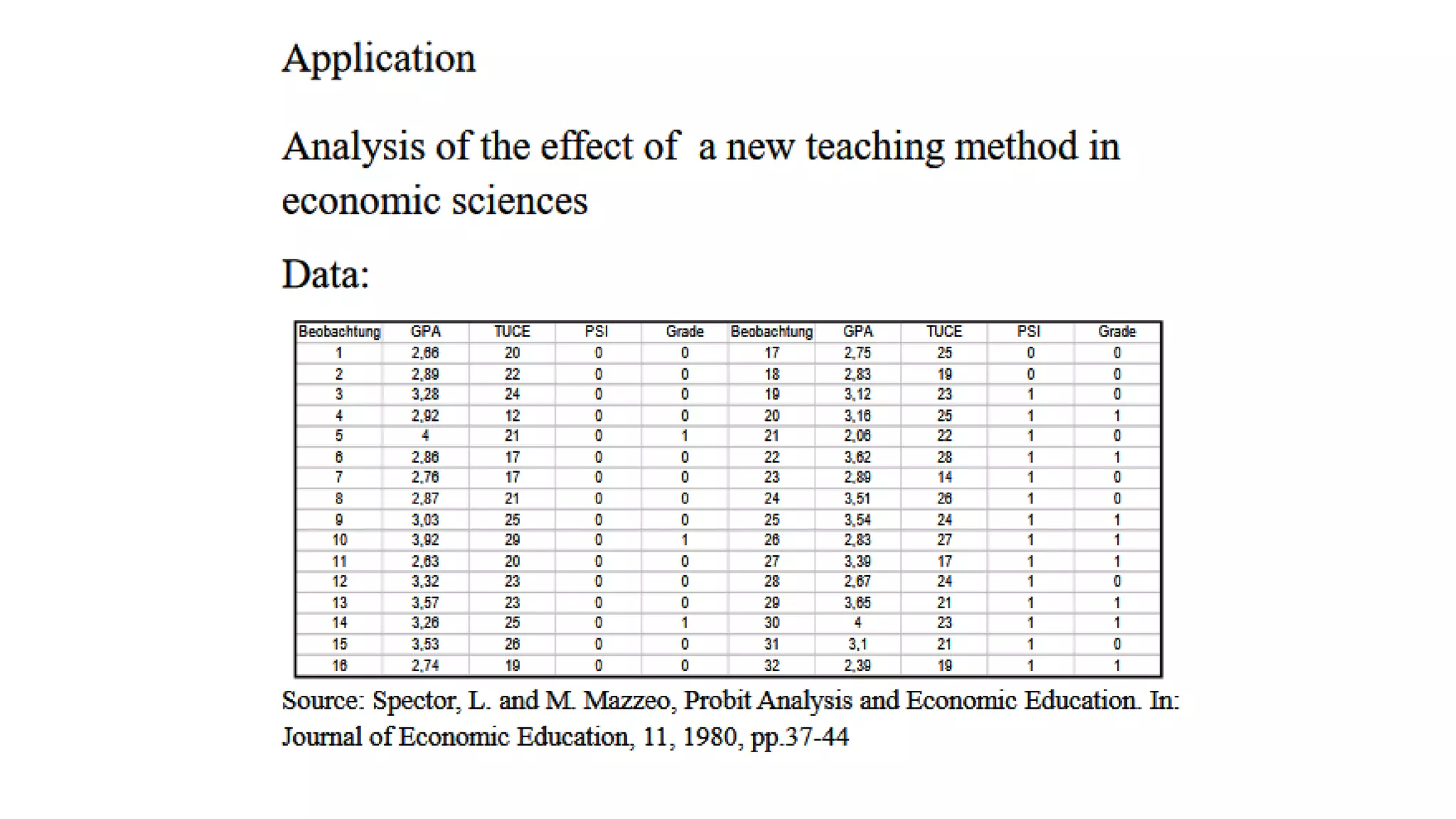
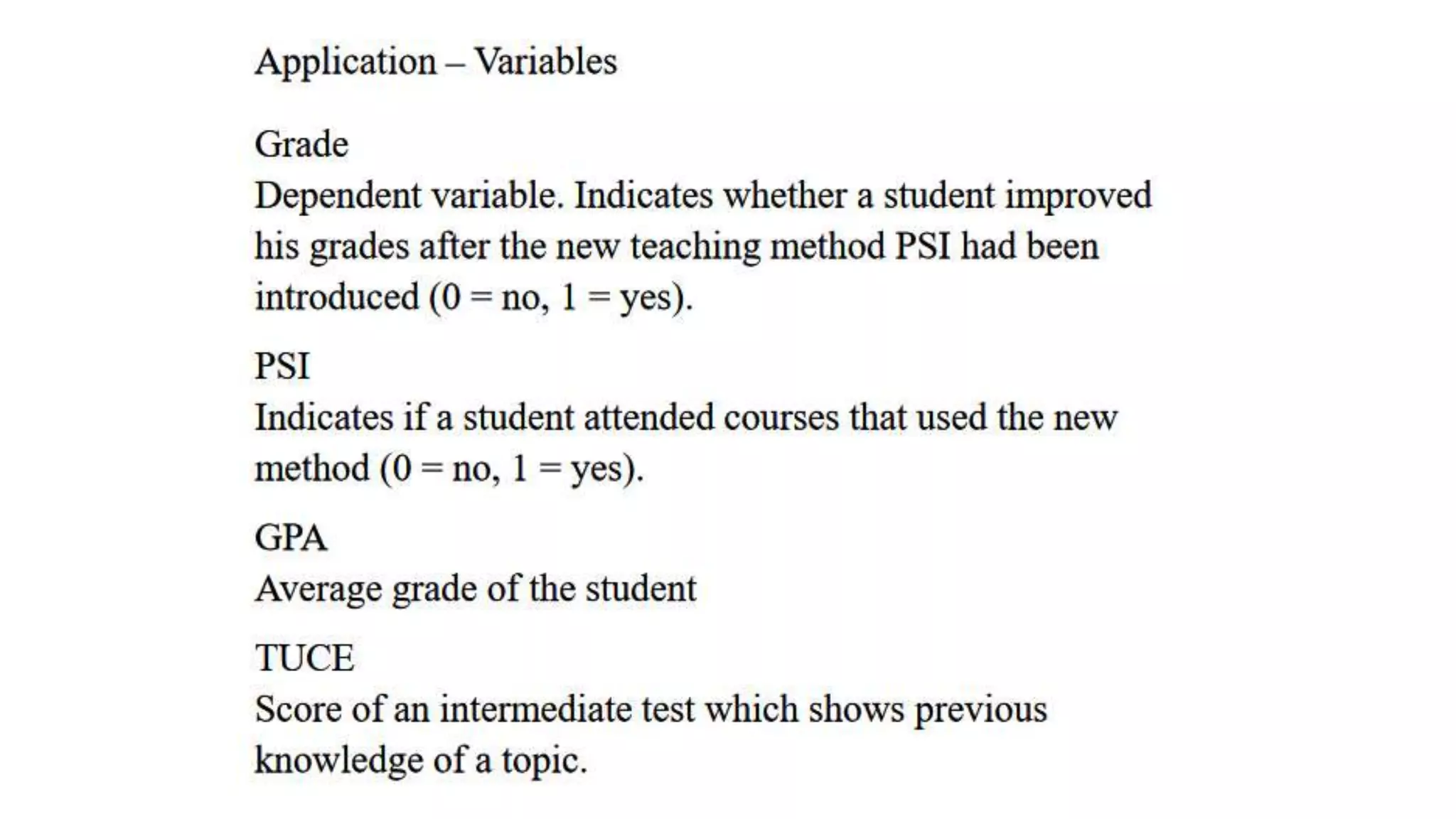
Grade = 1, if the final grade is A;
= 0, if the final grade is B or C
Explanatory variables are
• Grade Point Average (GPA),
• TUCE (Score on an examination given at the beginning of the term to test
entering knowledge of macroeconomics)
• Personalized System of Instruction (PSI);
PSI = 1, if new teaching method is used
= 0, otherwise
Application on Probit model
• Probit analysis is most appropriate when we would like to
estimate the effects of one or more independent variables on a
binomial dependent variable, particularly in the setting of a
dose-response experiment.
18
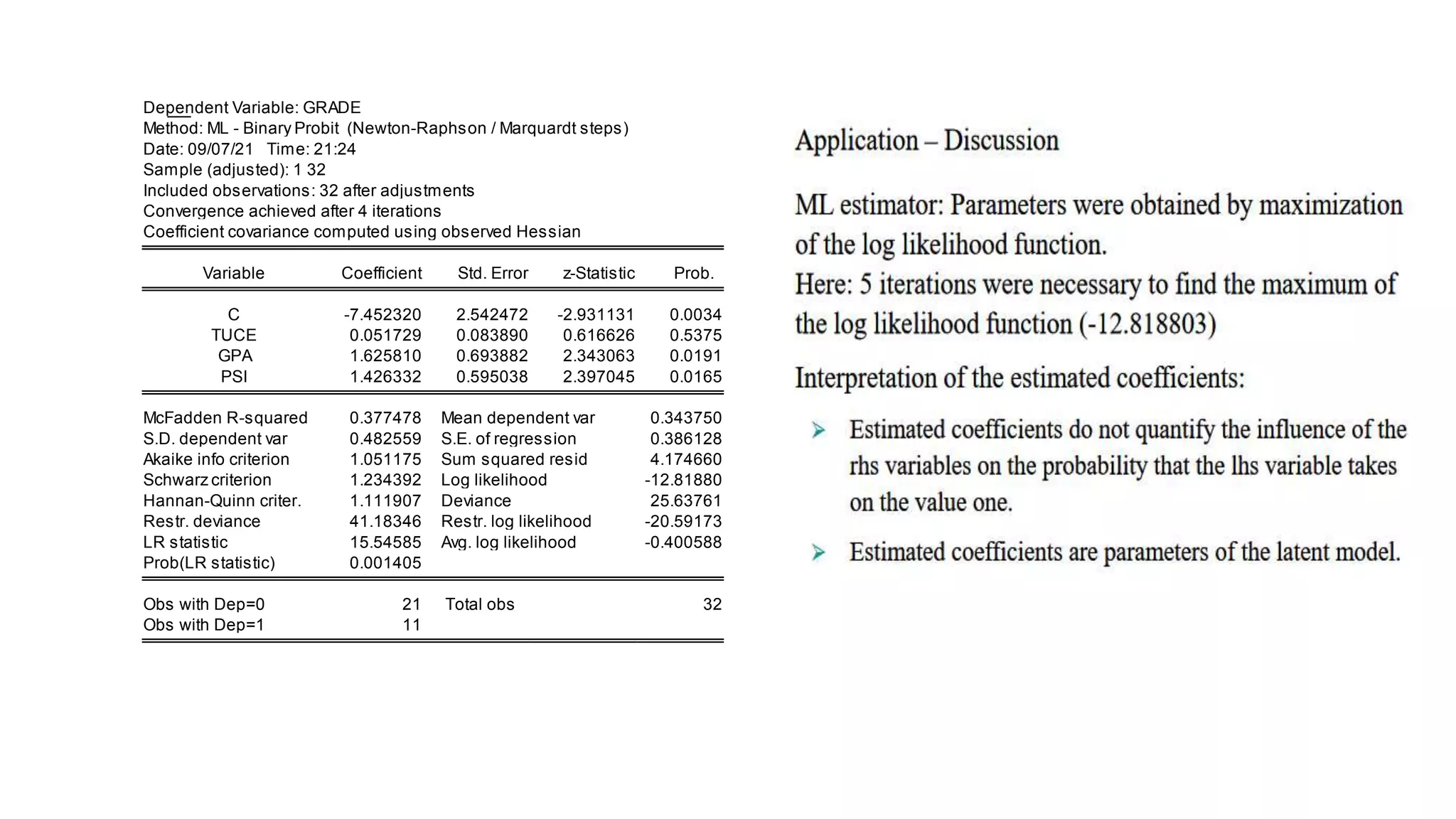
Dependent Variable: GRADE
Method: ML - Binary Probit (Newton-Raphson / Marquardt steps)
Date: 09/07/21 Time: 21:24
Sample (adjusted): 1 32
Included observations: 32 after adjustments
Convergence achieved after 4 iterations
Coefficient covariance computed using observed Hessian
Variable Coefficient Std. Error z-Statistic Prob.
C -7.452320 2.542472 -2.931131 0.0034
TUCE 0.051729 0.083890 0.616626 0.5375
GPA 1.625810 0.693882 2.343063 0.0191
PSI 1.426332 0.595038 2.397045 0.0165
McFadden R-squared 0.377478 Mean dependent var 0.343750
S.D. dependent var 0.482559 S.E. of regression 0.386128
Akaike info criterion 1.051175 Sum squared resid 4.174660
Schwarz criterion 1.234392 Log likelihood -12.81880
Hannan-Quinn criter. 1.111907 Deviance 25.63761
Restr. deviance 41.18346 Restr. log likelihood -20.59173
LR statistic 15.54585 Avg. log likelihood -0.400588
Prob(LR statistic) 0.001405
Obs with Dep=0 21 Total obs 32
Obs with Dep=1 11
The probit model
The probit model
The probit model
The probit model

The probit model

  • 1.
  • 2.
    • The logitmodel uses the cumulative logistic function. n n z z z x x x z e e e z Y P                  ... 1 1 1 ) ( ) 1 ( 2 2 1 1 0 ) exp( 1 ) exp( ) ( ) | 1 ( x x x x X Y P            
  • 3.
    • In someapplications, the Normal CDF has been found useful. • The estimating model that emerges from the Normal CDF is popularly known as the probit model. Although sometimes it is also known as the Normit model. • In principle one could substitute the Normal CDF in place of logistic CDF
  • 9.
  • 10.
  • 11.
  • 16.
    When to useprobit model • For example, a retail company wants to establish the relationship between the size of a promotion (measured as a percentage off the retail price) and the probability that a customer will buy. • Moreover, they want to establish this relationship for their store, catalog, and internet sales. • In the context of a dose-response experiment, the promotion size can be considered a dose to which the customers respond by buying. • The three sites at which a customer can shop correspond to different agents to which the customer is introduced. • Using probit analysis, the company can determine whether promotions have approximately the same effects on sales in the different markets. 16
  • 17.
    17 Grade = 1,if the final grade is A; = 0, if the final grade is B or C Explanatory variables are • Grade Point Average (GPA), • TUCE (Score on an examination given at the beginning of the term to test entering knowledge of macroeconomics) • Personalized System of Instruction (PSI); PSI = 1, if new teaching method is used = 0, otherwise Application on Probit model
  • 18.
    • Probit analysisis most appropriate when we would like to estimate the effects of one or more independent variables on a binomial dependent variable, particularly in the setting of a dose-response experiment. 18
  • 21.
    Dependent Variable: GRADE Method:ML - Binary Probit (Newton-Raphson / Marquardt steps) Date: 09/07/21 Time: 21:24 Sample (adjusted): 1 32 Included observations: 32 after adjustments Convergence achieved after 4 iterations Coefficient covariance computed using observed Hessian Variable Coefficient Std. Error z-Statistic Prob. C -7.452320 2.542472 -2.931131 0.0034 TUCE 0.051729 0.083890 0.616626 0.5375 GPA 1.625810 0.693882 2.343063 0.0191 PSI 1.426332 0.595038 2.397045 0.0165 McFadden R-squared 0.377478 Mean dependent var 0.343750 S.D. dependent var 0.482559 S.E. of regression 0.386128 Akaike info criterion 1.051175 Sum squared resid 4.174660 Schwarz criterion 1.234392 Log likelihood -12.81880 Hannan-Quinn criter. 1.111907 Deviance 25.63761 Restr. deviance 41.18346 Restr. log likelihood -20.59173 LR statistic 15.54585 Avg. log likelihood -0.400588 Prob(LR statistic) 0.001405 Obs with Dep=0 21 Total obs 32 Obs with Dep=1 11