
The power of Cognitive
Computing for the
Internet of Things
Eleni Pratsini
23 October 2016
12/1/2016World of Watson 20162
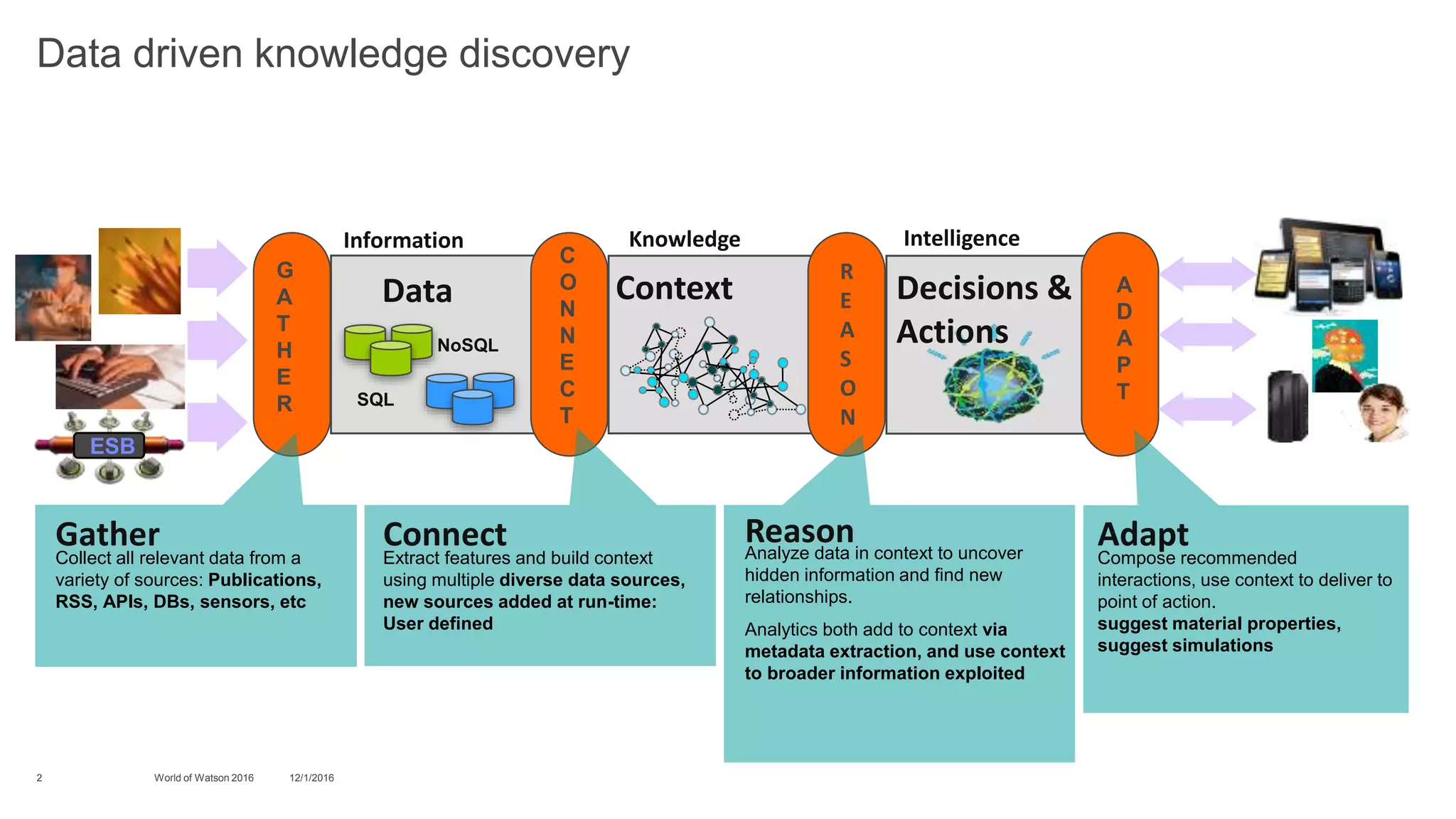
Data driven knowledge discovery
SQL
NoSQL
Information Knowledge Intelligence
ESB
R
E
A
S
O
N
C
O
N
N
E
C
T
A
D
A
P
T
G
A
T
H
E
R
Data Context Decisions &
Actions
Collect all relevant data from a
variety of sources: Publications,
RSS, APIs, DBs, sensors, etc
Extract features and build context
using multiple diverse data sources,
new sources added at run-time:
User defined
Analyze data in context to uncover
hidden information and find new
relationships.
Analytics both add to context via
metadata extraction, and use context
to broader information exploited
Compose recommended
interactions, use context to deliver to
point of action.
suggest material properties,
suggest simulations
Gather Connect Reason Adapt
12/1/2016World of Watson 20163
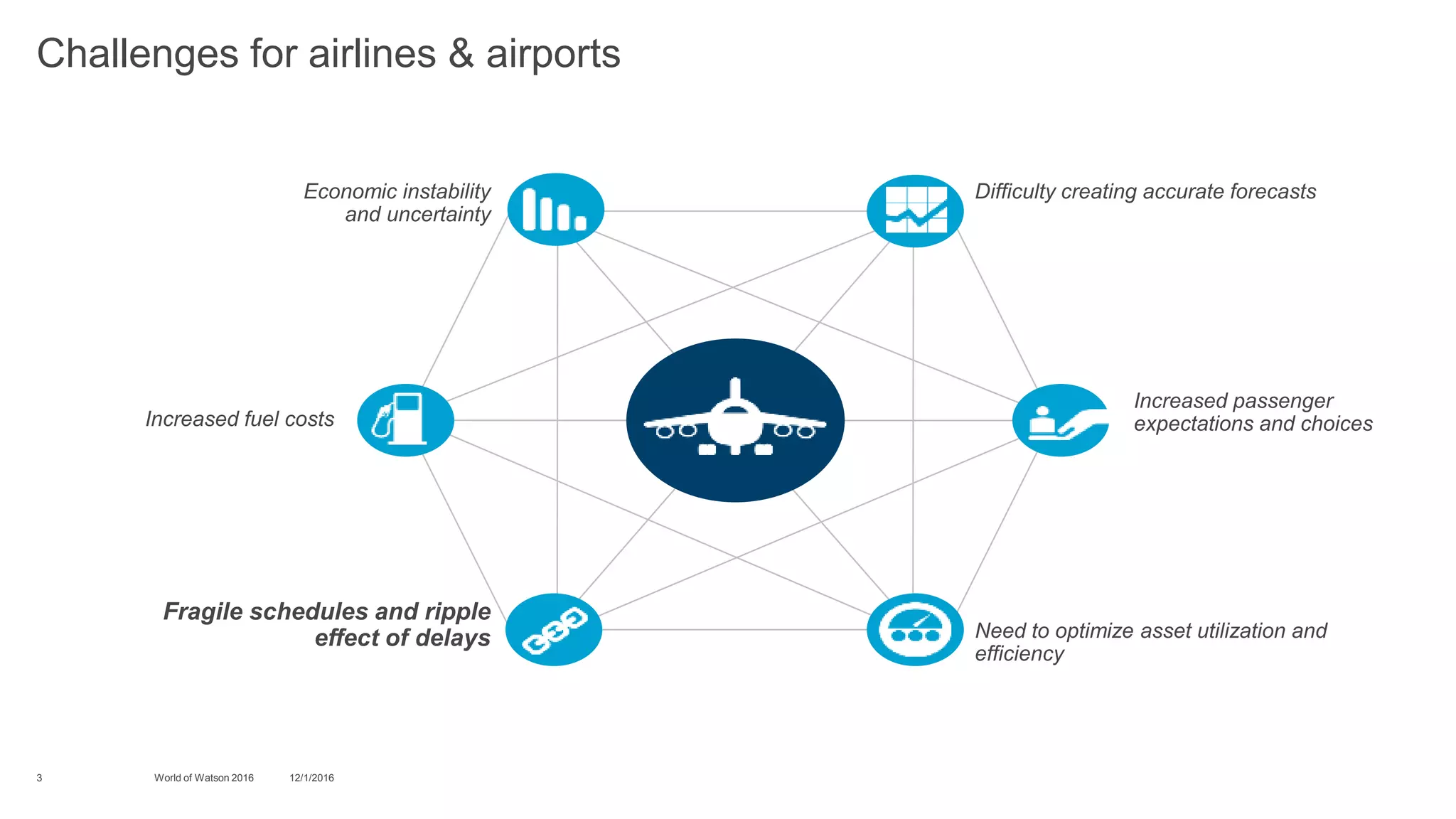
Challenges for airlines & airports
Fragile schedules and ripple
effect of delays
Increased passenger
expectations and choices
Economic instability
and uncertainty
Need to optimize asset utilization and
efficiency
Increased fuel costs
Difficulty creating accurate forecasts
12/1/2016World of Watson 20164
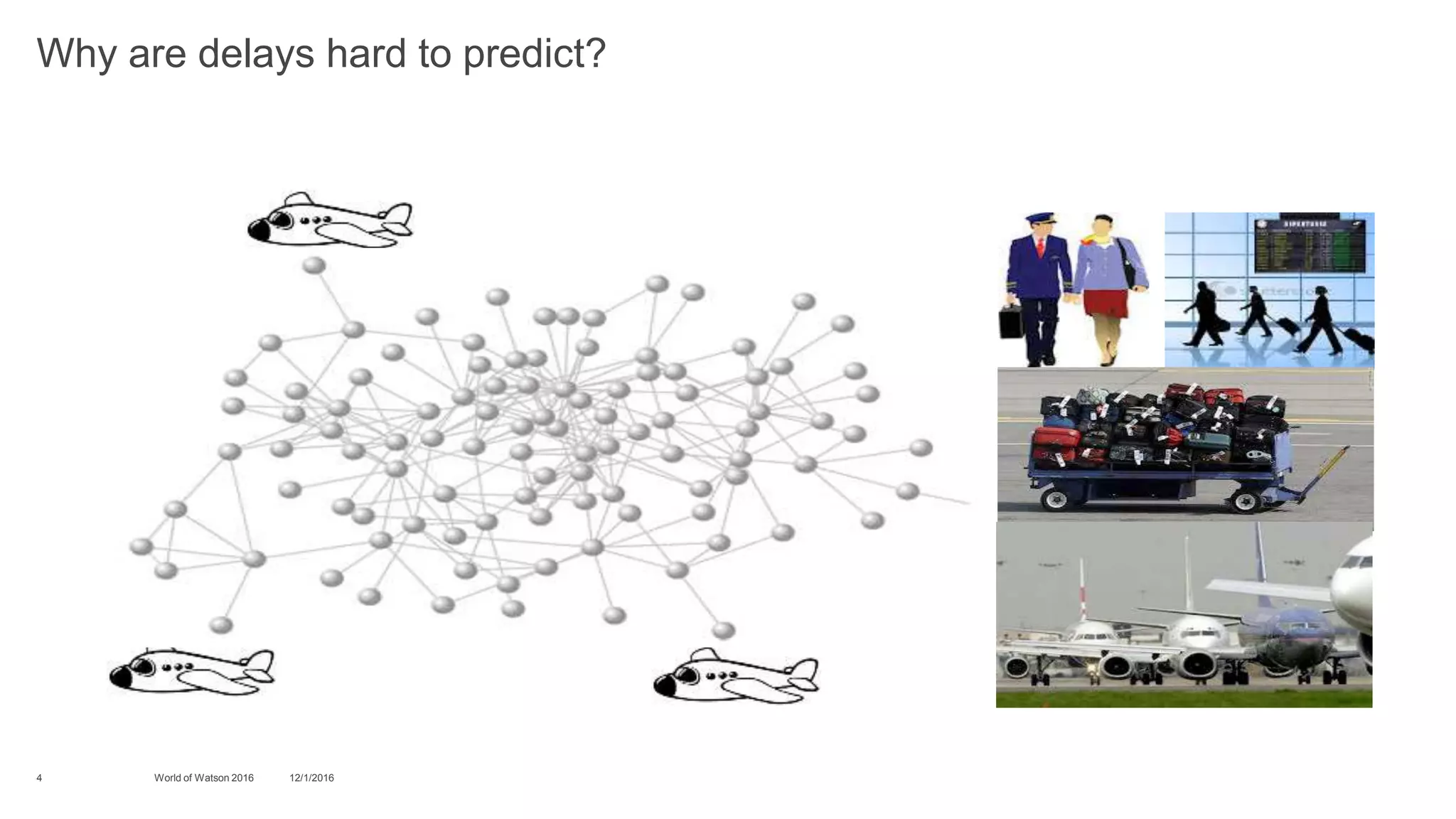
Why are delays hard to predict?
Fragile schedules and ripple
effect of delays
Increased passenger
expectations and choices
Economic instability
and uncertainty
Need to optimize asset utilization and
efficiency
Increased fuel costs
Difficulty creating accurate forecasts
Challenges for
airlines & airports
• Forecast delays
via Markov models
• Reasoning and
explanation
• Suggest action
and associated
cost estimation
12/1/2016World of Watson 2016Page 6
Decision Support
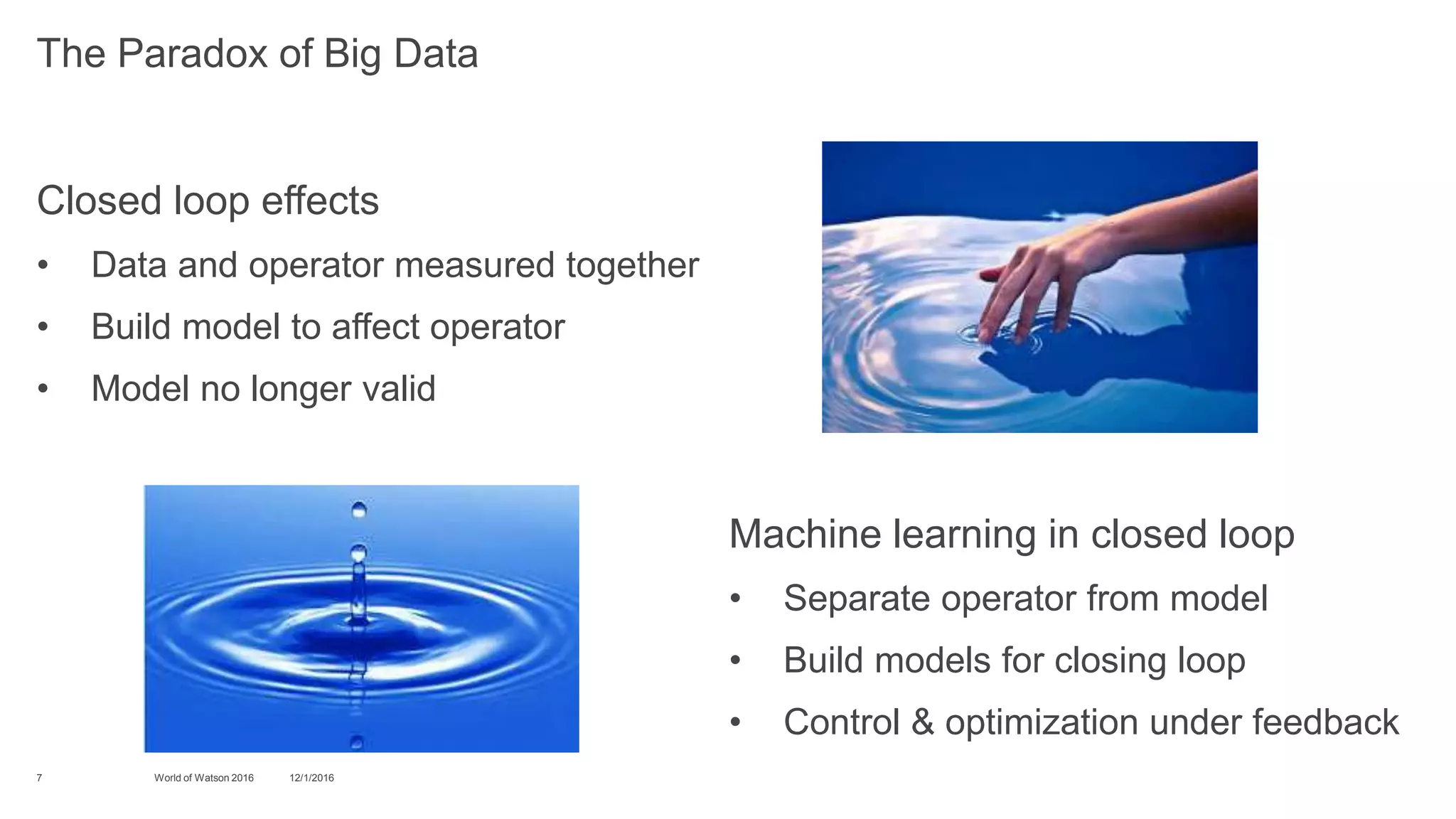
Closed loop effects
• Data and operator measured together
• Build model to affect operator
• Model no longer valid
12/1/2016World of Watson 20167
The Paradox of Big Data
Machine learning in closed loop
• Separate operator from model
• Build models for closing loop
• Control & optimization under feedback
12/1/2016World of Watson 20168
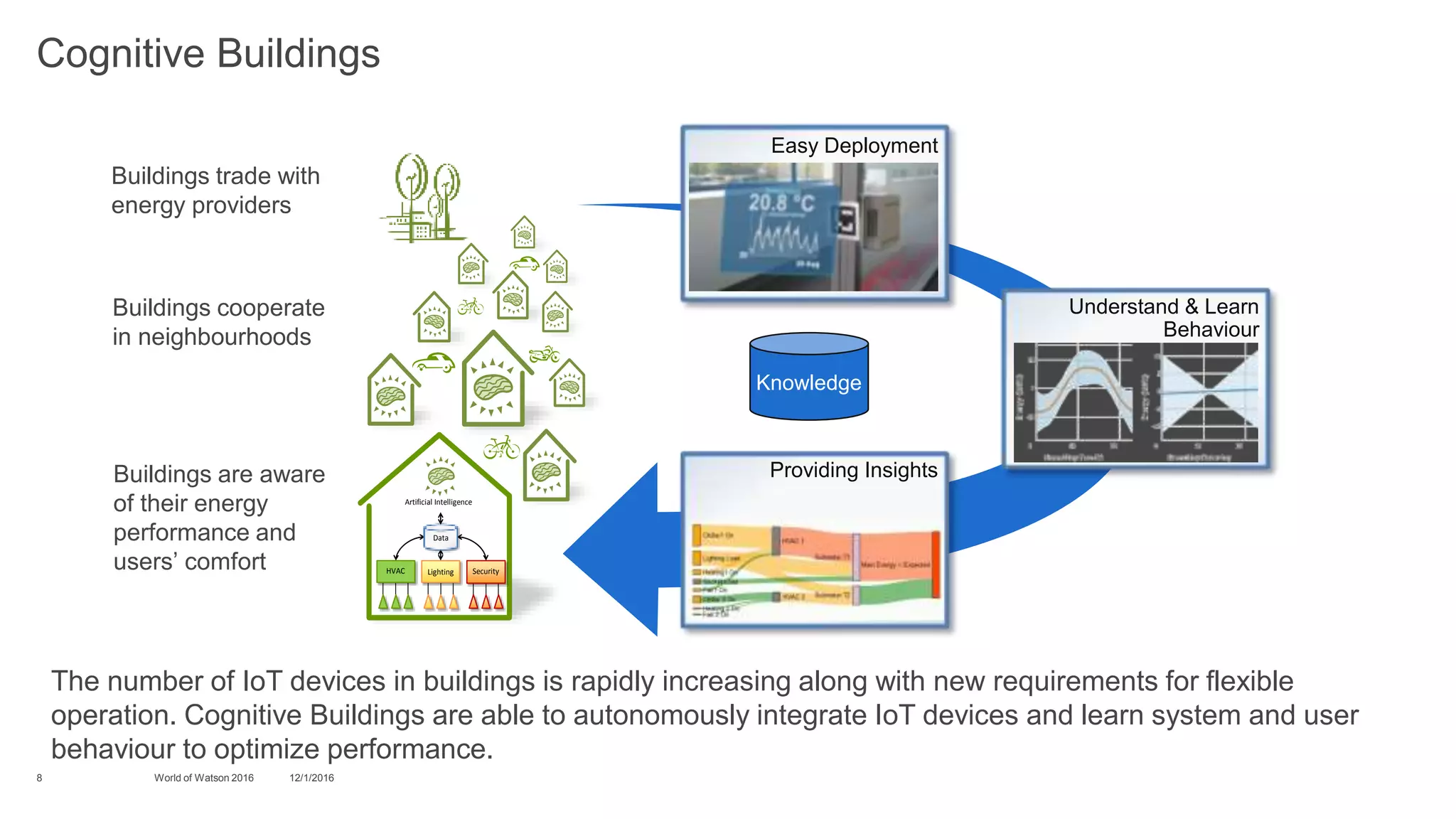
Cognitive Buildings
The number of IoT devices in buildings is rapidly increasing along with new requirements for flexible
operation. Cognitive Buildings are able to autonomously integrate IoT devices and learn system and user
behaviour to optimize performance.
Knowledge
SecurityHVAC Lighting
Data
Artificial Intelligence
Buildings cooperate
in neighbourhoods
Buildings are aware
of their energy
performance and
users’ comfort
Buildings trade with
energy providers
Providing Insights
Understand & Learn
Behaviour
Easy Deployment
12/1/2016World of Watson 20169
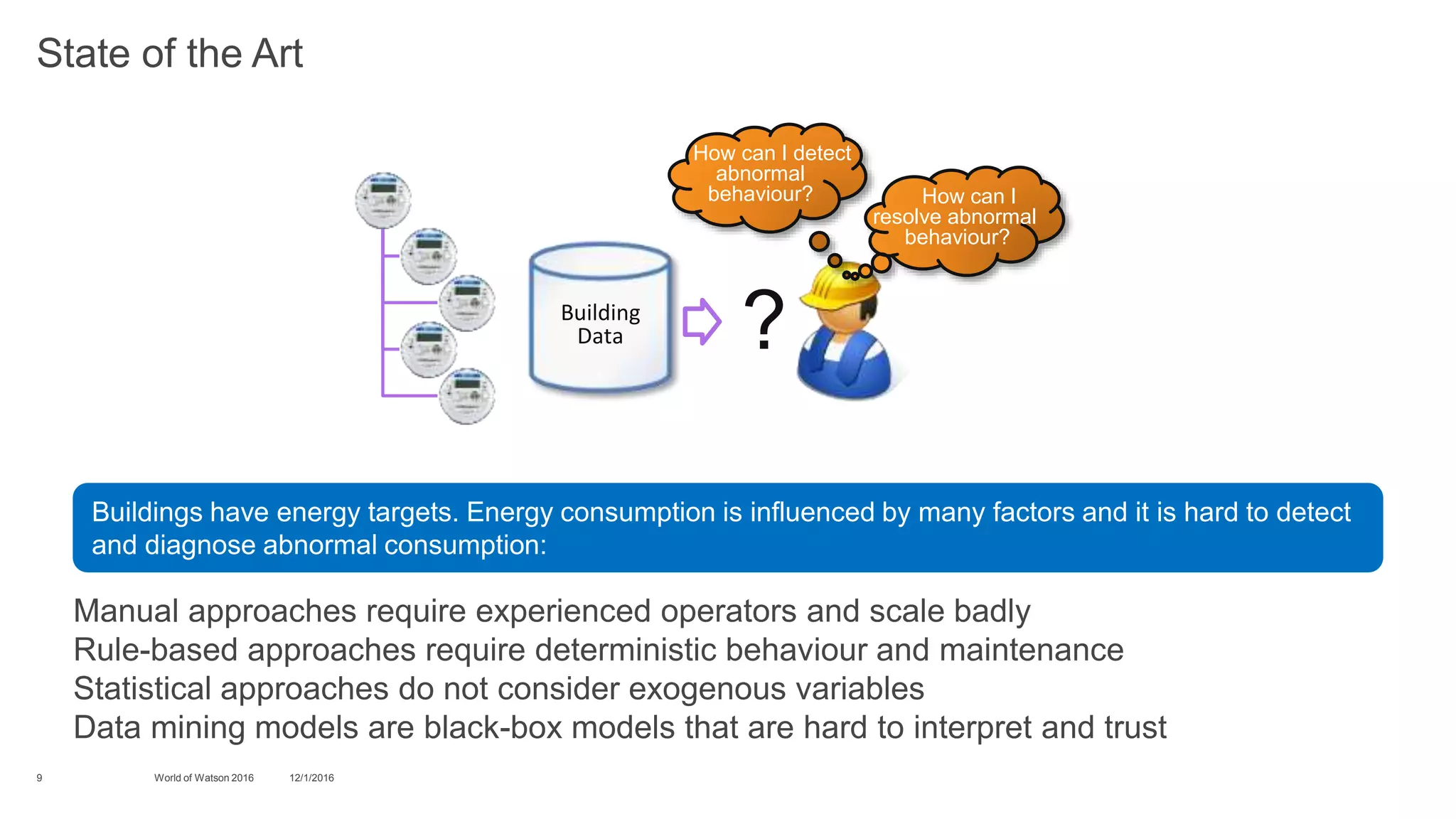
State of the Art
Buildings have energy targets. Energy consumption is influenced by many factors and it is hard to detect
and diagnose abnormal consumption:
?Building
Data
How can I
resolve abnormal
behaviour?
How can I detect
abnormal
behaviour?
Manual approaches require experienced operators and scale badly
Rule-based approaches require deterministic behaviour and maintenance
Statistical approaches do not consider exogenous variables
Data mining models are black-box models that are hard to interpret and trust
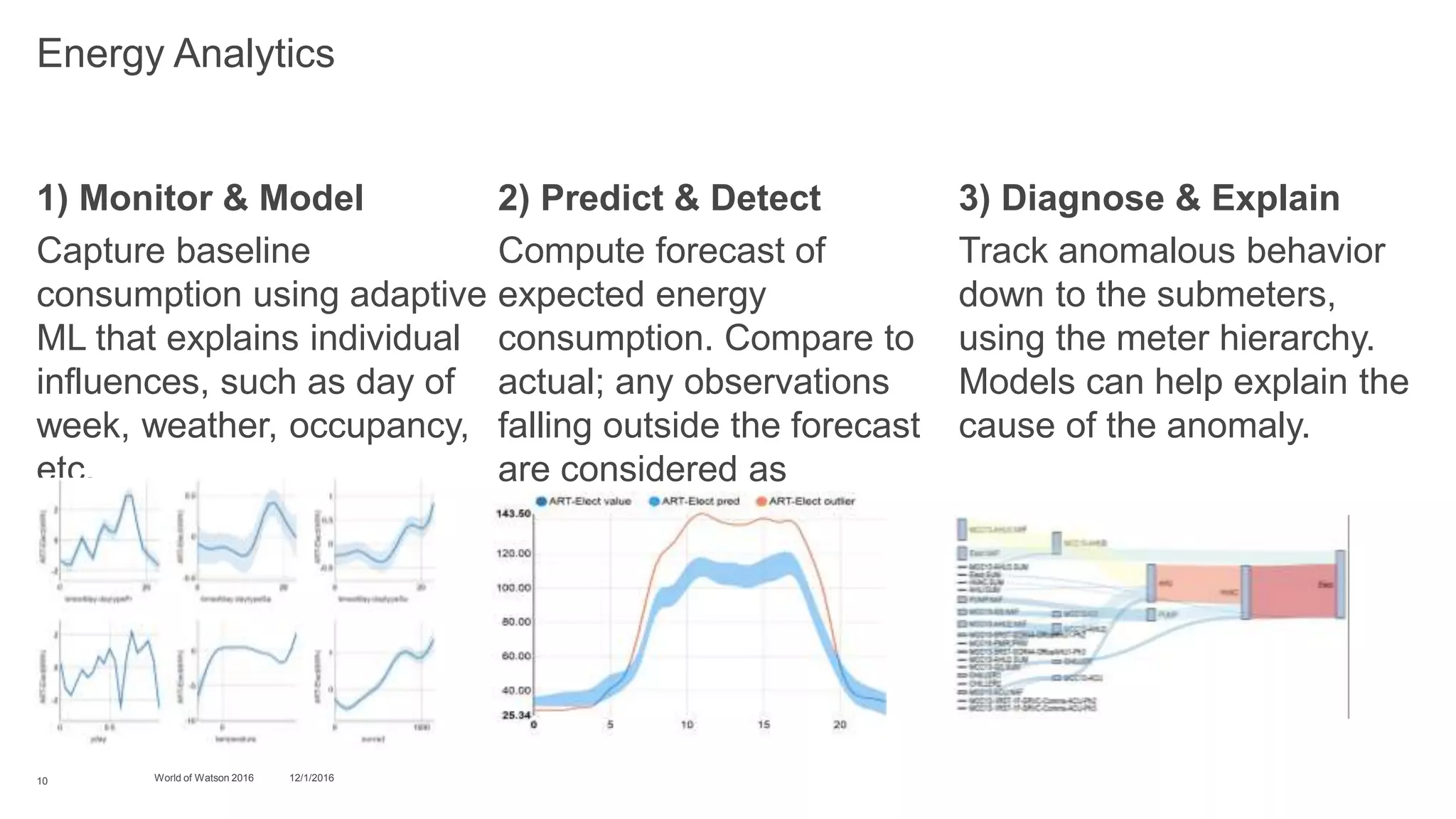
1) Monitor & Model
Capture baseline
consumption using adaptive
ML that explains individual
influences, such as day of
week, weather, occupancy,
etc.
12/1/2016World of Watson 201610
Energy Analytics
3) Diagnose & Explain
Track anomalous behavior
down to the submeters,
using the meter hierarchy.
Models can help explain the
cause of the anomaly.
2) Predict & Detect
Compute forecast of
expected energy
consumption. Compare to
actual; any observations
falling outside the forecast
are considered as
anomalies.
Notices and
disclaimers
Copyright © 2016 by International Business Machines Corporation (IBM). No part of this document may be reproduced or
transmitted in any form without written permission from IBM.
U.S. Government Users Restricted Rights - Use, duplication or disclosure restricted by GSA ADP Schedule Contract with
IBM.
Information in these presentations (including information relating to products that have not yet been announced by IBM) has been
reviewed for accuracy as of the date of initial publication and could include unintentional technical or typographical errors. IBM shall
have no responsibility to update this information. THIS DOCUMENT IS DISTRIBUTED "AS IS" WITHOUT ANY WARRANTY,
EITHER EXPRESS OR IMPLIED. IN NO EVENT SHALL IBM BE LIABLE FOR ANY DAMAGE ARISING FROM THE USE OF THIS
INFORMATION, INCLUDING BUT NOT LIMITED TO, LOSS OF DATA, BUSINESS INTERRUPTION, LOSS OF PROFIT OR LOSS
OF OPPORTUNITY. IBM products and services are warranted according to the terms and conditions of the agreements under
which they are provided.
IBM products are manufactured from new parts or new and used parts. In some cases, a product may not be new and may have
been previously installed. Regardless, our warranty terms apply.”
Any statements regarding IBM's future direction, intent or product plans are subject to change or withdrawal without
notice.
Performance data contained herein was generally obtained in a controlled, isolated environments. Customer examples are
presented as illustrations of how those customers have used IBM products and the results they may have achieved. Actual
performance, cost, savings or other results in other operating environments may vary.
References in this document to IBM products, programs, or services does not imply that IBM intends to make such products,
programs or services available in all countries in which IBM operates or does business.
Workshops, sessions and associated materials may have been prepared by independent session speakers, and do not necessarily
reflect the views of IBM. All materials and discussions are provided for informational purposes only, and are neither intended to, nor
shall constitute legal or other guidance or advice to any individual participant or their specific situation.
It is the customer’s responsibility to insure its own compliance with legal requirements and to obtain advice of competent legal
counsel as to the identification and interpretation of any relevant laws and regulatory requirements that may affect the customer’s
business and any actions the customer may need to take to comply with such laws. IBM does not provide legal advice or represent
or warrant that its services or products will ensure that the customer is in compliance with any law.
11 12/1/2016World of Watson 2016
Notices and
disclaimers
continued
Information concerning non-IBM products was obtained from the suppliers of those products, their published announcements or other
publicly available sources. IBM has not tested those products in connection with this publication and cannot confirm the accuracy of
performance, compatibility or any other claims related to non-IBM products. Questions on the capabilities of non-IBM products should be
addressed to the suppliers of those products. IBM does not warrant the quality of any third-party products, or the ability of any such third-
party products to interoperate with IBM’s products. IBM EXPRESSLY DISCLAIMS ALL WARRANTIES, EXPRESSED OR IMPLIED,
INCLUDING BUT NOT LIMITED TO, THE IMPLIED WARRANTIES OF MERCHANTABILITY AND FITNESS FOR A PARTICULAR
PURPOSE.
The provision of the information contained herein is not intended to, and does not, grant any right or license under any IBM patents,
copyrights, trademarks or other intellectual property right.
IBM, the IBM logo, ibm.com, Aspera®, Bluemix, Blueworks Live, CICS, Clearcase, Cognos®, DOORS®, Emptoris®, Enterprise Document
Management System™, FASP®, FileNet®, Global Business Services ®, Global Technology Services ®, IBM ExperienceOne™, IBM
SmartCloud®, IBM Social Business®, Information on Demand, ILOG, Maximo®, MQIntegrator®, MQSeries®, Netcool®, OMEGAMON,
OpenPower, PureAnalytics™, PureApplication®, pureCluster™, PureCoverage®, PureData®, PureExperience®, PureFlex®, pureQuery®,
pureScale®, PureSystems®, QRadar®, Rational®, Rhapsody®, Smarter Commerce®, SoDA, SPSS, Sterling Commerce®, StoredIQ,
Tealeaf®, Tivoli®, Trusteer®, Unica®, urban{code}®, Watson, WebSphere®, Worklight®, X-Force® and System z® Z/OS, are trademarks of
International Business Machines Corporation, registered in many jurisdictions worldwide. Other product and service names might be
trademarks of IBM or other companies. A current list of IBM trademarks is available on the Web at "Copyright and trademark information" at:
www.ibm.com/legal/copytrade.shtml.
12 12/1/2016World of Watson 2016
Thank You

The Power of Cognitive Computing for the Internet of Things

  • 1.
    The power ofCognitive Computing for the Internet of Things Eleni Pratsini 23 October 2016
  • 2.
    12/1/2016World of Watson20162 Data driven knowledge discovery SQL NoSQL Information Knowledge Intelligence ESB R E A S O N C O N N E C T A D A P T G A T H E R Data Context Decisions & Actions Collect all relevant data from a variety of sources: Publications, RSS, APIs, DBs, sensors, etc Extract features and build context using multiple diverse data sources, new sources added at run-time: User defined Analyze data in context to uncover hidden information and find new relationships. Analytics both add to context via metadata extraction, and use context to broader information exploited Compose recommended interactions, use context to deliver to point of action. suggest material properties, suggest simulations Gather Connect Reason Adapt
  • 3.
    12/1/2016World of Watson20163 Challenges for airlines & airports Fragile schedules and ripple effect of delays Increased passenger expectations and choices Economic instability and uncertainty Need to optimize asset utilization and efficiency Increased fuel costs Difficulty creating accurate forecasts
  • 4.
    12/1/2016World of Watson20164 Why are delays hard to predict?
  • 5.
    Fragile schedules andripple effect of delays Increased passenger expectations and choices Economic instability and uncertainty Need to optimize asset utilization and efficiency Increased fuel costs Difficulty creating accurate forecasts Challenges for airlines & airports
  • 6.
    • Forecast delays viaMarkov models • Reasoning and explanation • Suggest action and associated cost estimation 12/1/2016World of Watson 2016Page 6 Decision Support
  • 7.
    Closed loop effects •Data and operator measured together • Build model to affect operator • Model no longer valid 12/1/2016World of Watson 20167 The Paradox of Big Data Machine learning in closed loop • Separate operator from model • Build models for closing loop • Control & optimization under feedback
  • 8.
    12/1/2016World of Watson20168 Cognitive Buildings The number of IoT devices in buildings is rapidly increasing along with new requirements for flexible operation. Cognitive Buildings are able to autonomously integrate IoT devices and learn system and user behaviour to optimize performance. Knowledge SecurityHVAC Lighting Data Artificial Intelligence Buildings cooperate in neighbourhoods Buildings are aware of their energy performance and users’ comfort Buildings trade with energy providers Providing Insights Understand & Learn Behaviour Easy Deployment
  • 9.
    12/1/2016World of Watson20169 State of the Art Buildings have energy targets. Energy consumption is influenced by many factors and it is hard to detect and diagnose abnormal consumption: ?Building Data How can I resolve abnormal behaviour? How can I detect abnormal behaviour? Manual approaches require experienced operators and scale badly Rule-based approaches require deterministic behaviour and maintenance Statistical approaches do not consider exogenous variables Data mining models are black-box models that are hard to interpret and trust
  • 10.
    1) Monitor &Model Capture baseline consumption using adaptive ML that explains individual influences, such as day of week, weather, occupancy, etc. 12/1/2016World of Watson 201610 Energy Analytics 3) Diagnose & Explain Track anomalous behavior down to the submeters, using the meter hierarchy. Models can help explain the cause of the anomaly. 2) Predict & Detect Compute forecast of expected energy consumption. Compare to actual; any observations falling outside the forecast are considered as anomalies.
  • 11.
    Notices and disclaimers Copyright ©2016 by International Business Machines Corporation (IBM). No part of this document may be reproduced or transmitted in any form without written permission from IBM. U.S. Government Users Restricted Rights - Use, duplication or disclosure restricted by GSA ADP Schedule Contract with IBM. Information in these presentations (including information relating to products that have not yet been announced by IBM) has been reviewed for accuracy as of the date of initial publication and could include unintentional technical or typographical errors. IBM shall have no responsibility to update this information. THIS DOCUMENT IS DISTRIBUTED "AS IS" WITHOUT ANY WARRANTY, EITHER EXPRESS OR IMPLIED. IN NO EVENT SHALL IBM BE LIABLE FOR ANY DAMAGE ARISING FROM THE USE OF THIS INFORMATION, INCLUDING BUT NOT LIMITED TO, LOSS OF DATA, BUSINESS INTERRUPTION, LOSS OF PROFIT OR LOSS OF OPPORTUNITY. IBM products and services are warranted according to the terms and conditions of the agreements under which they are provided. IBM products are manufactured from new parts or new and used parts. In some cases, a product may not be new and may have been previously installed. Regardless, our warranty terms apply.” Any statements regarding IBM's future direction, intent or product plans are subject to change or withdrawal without notice. Performance data contained herein was generally obtained in a controlled, isolated environments. Customer examples are presented as illustrations of how those customers have used IBM products and the results they may have achieved. Actual performance, cost, savings or other results in other operating environments may vary. References in this document to IBM products, programs, or services does not imply that IBM intends to make such products, programs or services available in all countries in which IBM operates or does business. Workshops, sessions and associated materials may have been prepared by independent session speakers, and do not necessarily reflect the views of IBM. All materials and discussions are provided for informational purposes only, and are neither intended to, nor shall constitute legal or other guidance or advice to any individual participant or their specific situation. It is the customer’s responsibility to insure its own compliance with legal requirements and to obtain advice of competent legal counsel as to the identification and interpretation of any relevant laws and regulatory requirements that may affect the customer’s business and any actions the customer may need to take to comply with such laws. IBM does not provide legal advice or represent or warrant that its services or products will ensure that the customer is in compliance with any law. 11 12/1/2016World of Watson 2016
  • 12.
    Notices and disclaimers continued Information concerningnon-IBM products was obtained from the suppliers of those products, their published announcements or other publicly available sources. IBM has not tested those products in connection with this publication and cannot confirm the accuracy of performance, compatibility or any other claims related to non-IBM products. Questions on the capabilities of non-IBM products should be addressed to the suppliers of those products. IBM does not warrant the quality of any third-party products, or the ability of any such third- party products to interoperate with IBM’s products. IBM EXPRESSLY DISCLAIMS ALL WARRANTIES, EXPRESSED OR IMPLIED, INCLUDING BUT NOT LIMITED TO, THE IMPLIED WARRANTIES OF MERCHANTABILITY AND FITNESS FOR A PARTICULAR PURPOSE. The provision of the information contained herein is not intended to, and does not, grant any right or license under any IBM patents, copyrights, trademarks or other intellectual property right. IBM, the IBM logo, ibm.com, Aspera®, Bluemix, Blueworks Live, CICS, Clearcase, Cognos®, DOORS®, Emptoris®, Enterprise Document Management System™, FASP®, FileNet®, Global Business Services ®, Global Technology Services ®, IBM ExperienceOne™, IBM SmartCloud®, IBM Social Business®, Information on Demand, ILOG, Maximo®, MQIntegrator®, MQSeries®, Netcool®, OMEGAMON, OpenPower, PureAnalytics™, PureApplication®, pureCluster™, PureCoverage®, PureData®, PureExperience®, PureFlex®, pureQuery®, pureScale®, PureSystems®, QRadar®, Rational®, Rhapsody®, Smarter Commerce®, SoDA, SPSS, Sterling Commerce®, StoredIQ, Tealeaf®, Tivoli®, Trusteer®, Unica®, urban{code}®, Watson, WebSphere®, Worklight®, X-Force® and System z® Z/OS, are trademarks of International Business Machines Corporation, registered in many jurisdictions worldwide. Other product and service names might be trademarks of IBM or other companies. A current list of IBM trademarks is available on the Web at "Copyright and trademark information" at: www.ibm.com/legal/copytrade.shtml. 12 12/1/2016World of Watson 2016
  • 13.