Business and Higher Education Collaborating to
Create Actionable Intelligence in Data Science
and Analytics
Brian Fitzgerald
October 23, 2016
Las Vegas, Nevada
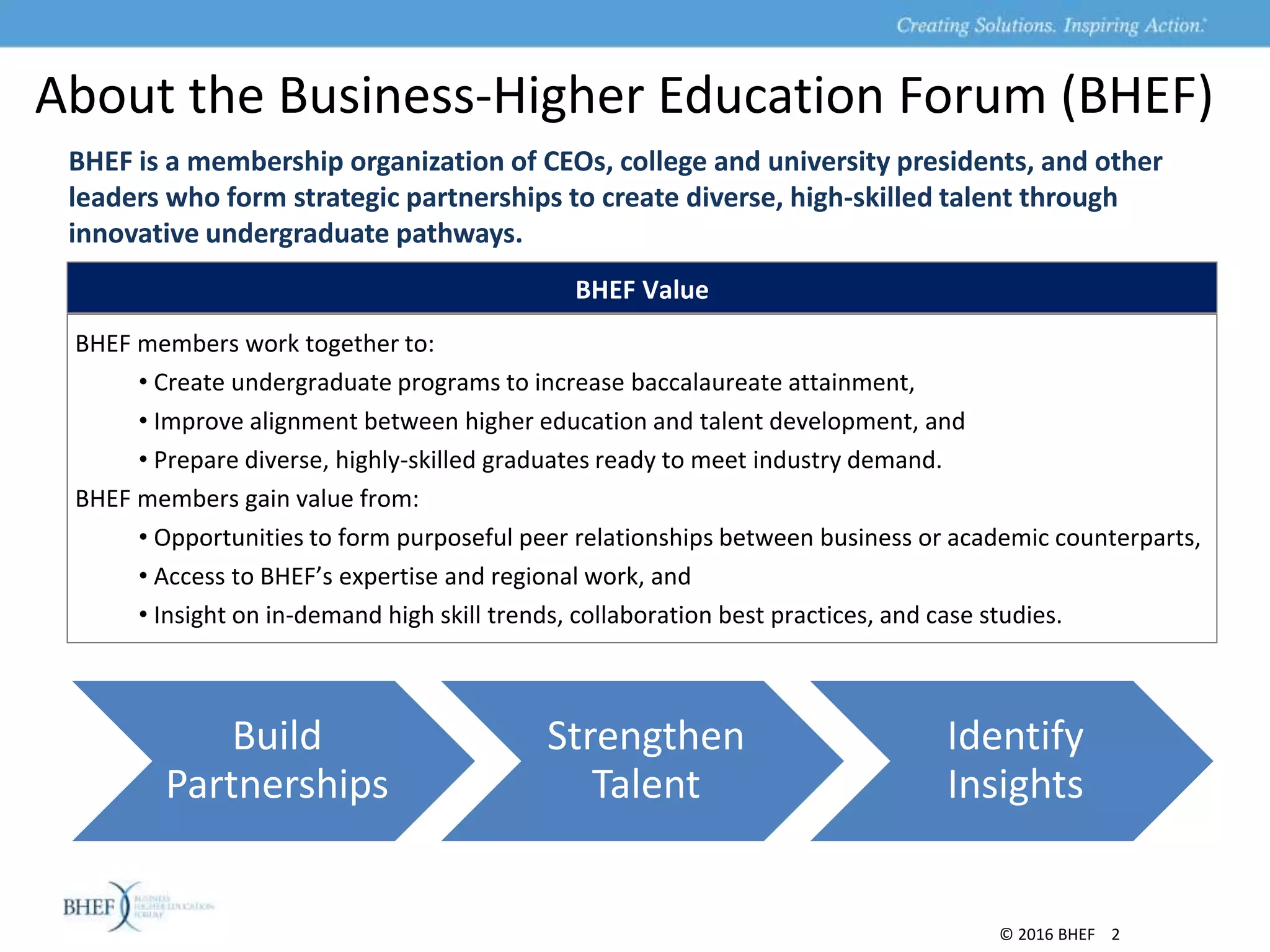
BHEF is a membership organization of CEOs, college and university presidents, and other
leaders who form strategic partnerships to create diverse, high-skilled talent through
innovative undergraduate pathways.
BHEF Value
BHEF members work together to:
• Create undergraduate programs to increase baccalaureate attainment,
• Improve alignment between higher education and talent development, and
• Prepare diverse, highly-skilled graduates ready to meet industry demand.
BHEF members gain value from:
• Opportunities to form purposeful peer relationships between business or academic counterparts,
• Access to BHEF’s expertise and regional work, and
• Insight on in-demand high skill trends, collaboration best practices, and case studies.
About the Business-Higher Education Forum (BHEF)
© 2016 BHEF 2
Build
Partnerships
Strengthen
Talent
Identify
Insights
How We Do It
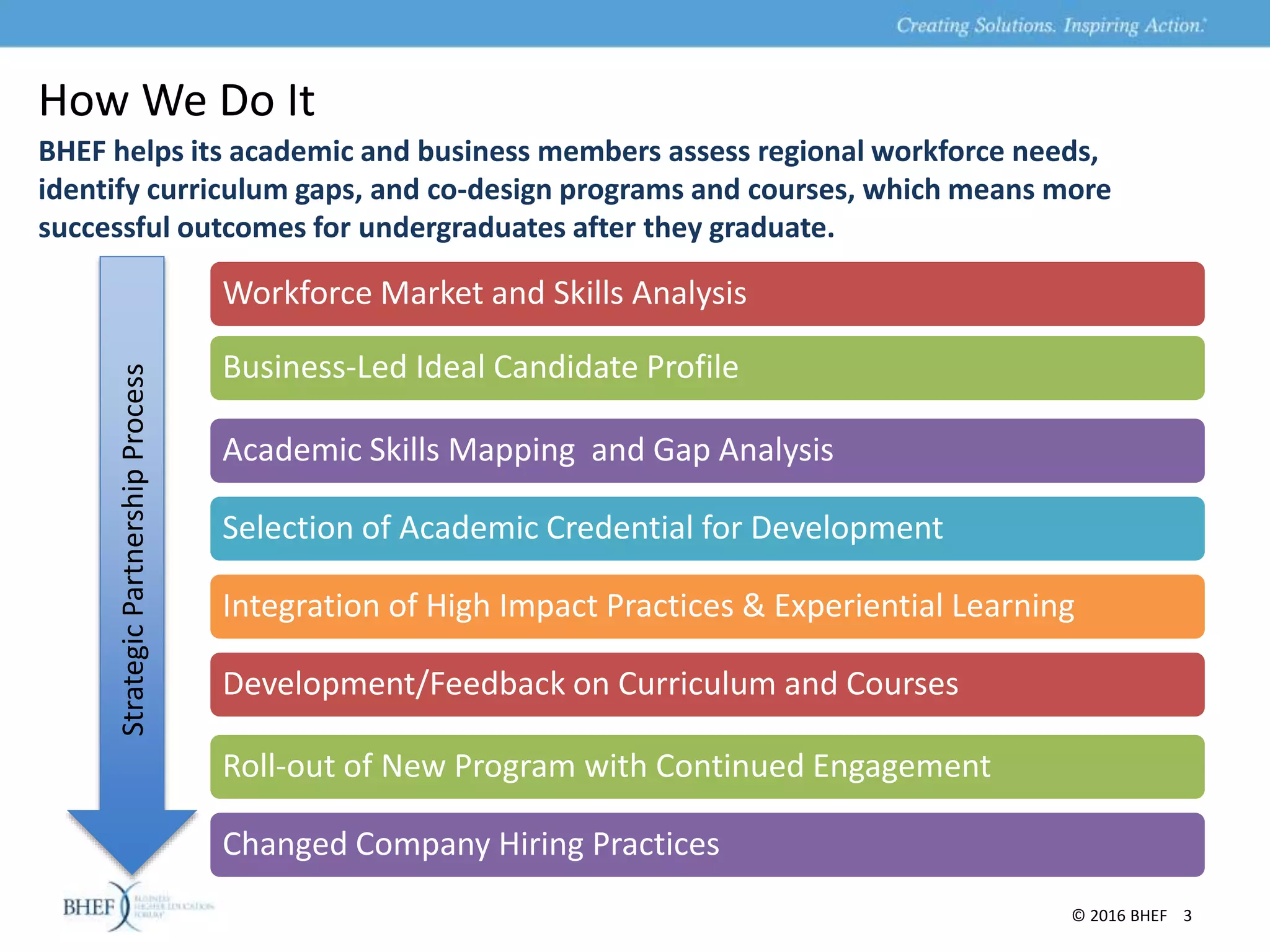
BHEF helps its academic and business members assess regional workforce needs,
identify curriculum gaps, and co-design programs and courses, which means more
successful outcomes for undergraduates after they graduate.
Workforce Market and Skills Analysis
Business-Led Ideal Candidate Profile
Academic Skills Mapping and Gap Analysis
Selection of Academic Credential for Development
Integration of High Impact Practices & Experiential Learning
Development/Feedback on Curriculum and Courses
Roll-out of New Program with Continued Engagement
Changed Company Hiring Practices
StrategicPartnershipProcess
© 2016 BHEF 3
HEWI Highlights
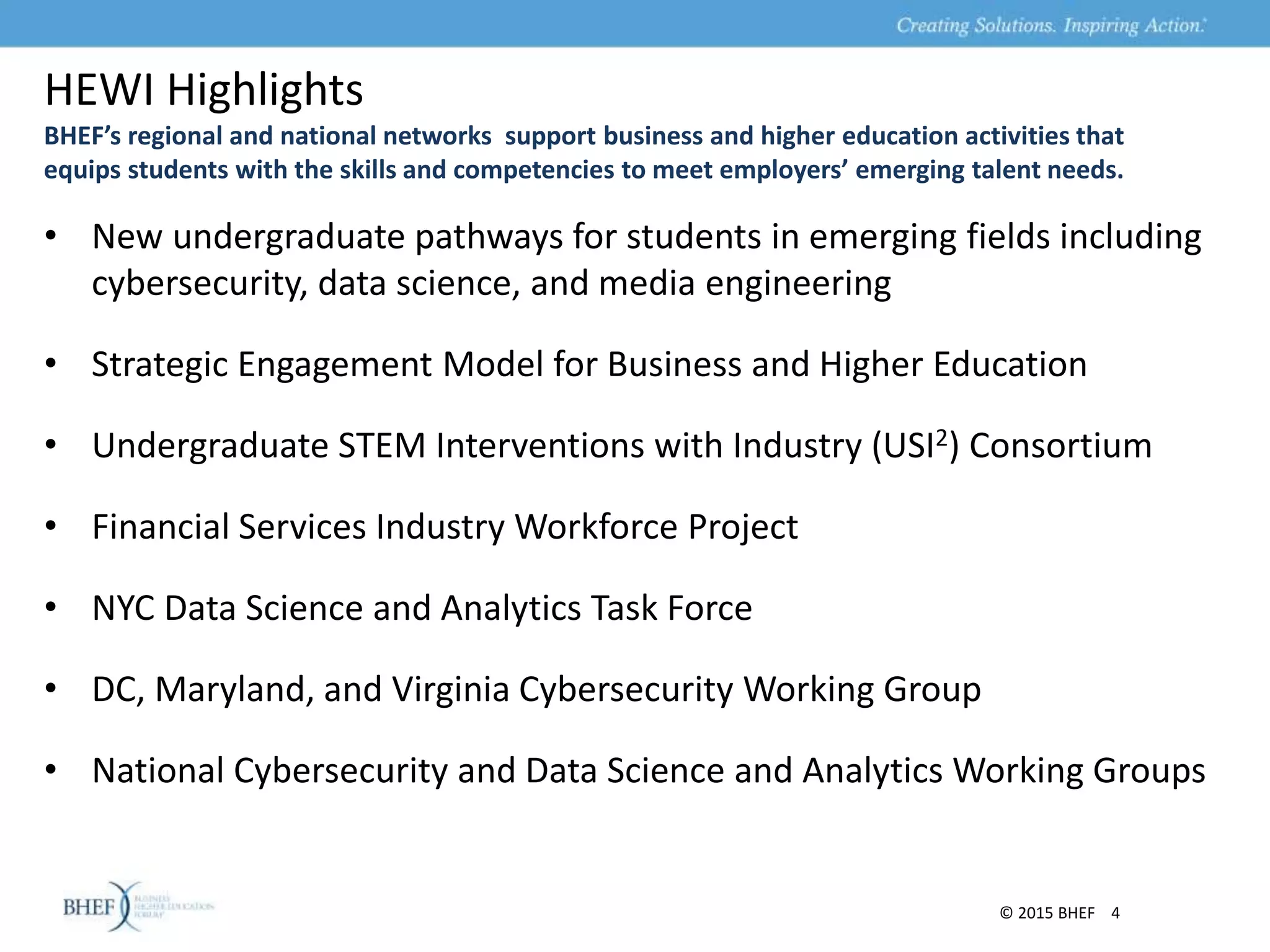
• New undergraduate pathways for students in emerging fields including
cybersecurity, data science, and media engineering
• Strategic Engagement Model for Business and Higher Education
• Undergraduate STEM Interventions with Industry (USI2) Consortium
• Financial Services Industry Workforce Project
• NYC Data Science and Analytics Task Force
• DC, Maryland, and Virginia Cybersecurity Working Group
• National Cybersecurity and Data Science and Analytics Working Groups
© 2015 BHEF 4
BHEF’s regional and national networks support business and higher education activities that
equips students with the skills and competencies to meet employers’ emerging talent needs.
BHEF Serving as Thought Leaders for DSA Education
BHEF is uniquely positioned to serve as the nation’s thought leaders for data science and analytics
(DSA) education and workforce development, and build a vibrant community of engaged leaders to
shape the education offerings linked with this emerging field.
• DSA serves as a key example for aligning workforce with higher education
• BHEF serves as the hub for business-higher education collaborations
– Develop national competency maps
– Create repository of capacity building resources
– Establish gold standard experiences
• Publish cutting edge research on workforce and higher education trends
• Facilitate development of industry recognized credentials and pathways
• Regional hubs
– NYC Data Science Task Force
– Work with partners in Virginia, North Carolina, Ohio, Florida, California
• Explore DSA as it relates to the enabled graduate
– Create a deeper understanding of DSA as it relates to the liberal arts
– Explore hybrid degrees and credentials
© 2015 BHEF 5
NYC Data Science Task Force
BHEF launched a city-wide task force in data science with the region’s colleges and universities,
companies, government agencies, and cultural institutions with the support of the Alfred P.
Sloan Foundation.
© 2015 BHEF 6
• Identify and map the competencies, skills, and knowledge for the broader data
science workforce, e.g., data science-enabled professionals in selected sectors
• Support the working group to develop a repository of undergraduate data
science resources (e.g., data sets, exercises, and student work experiences)
• Seed new undergraduate data science pathways (e.g., courses, concentrations,
or minors) at three or more task force academic institutions that are inclusive of
women and minorities
• Establish a menu of high-quality learning experiences in data science to define
the essential elements for successful real-world undergraduate experiences
• Develop and apply assessment metrics to the work
• Disseminate the learnings nationally through convenings, reports, webinars, and
other platforms
© 2016 BHEF 6
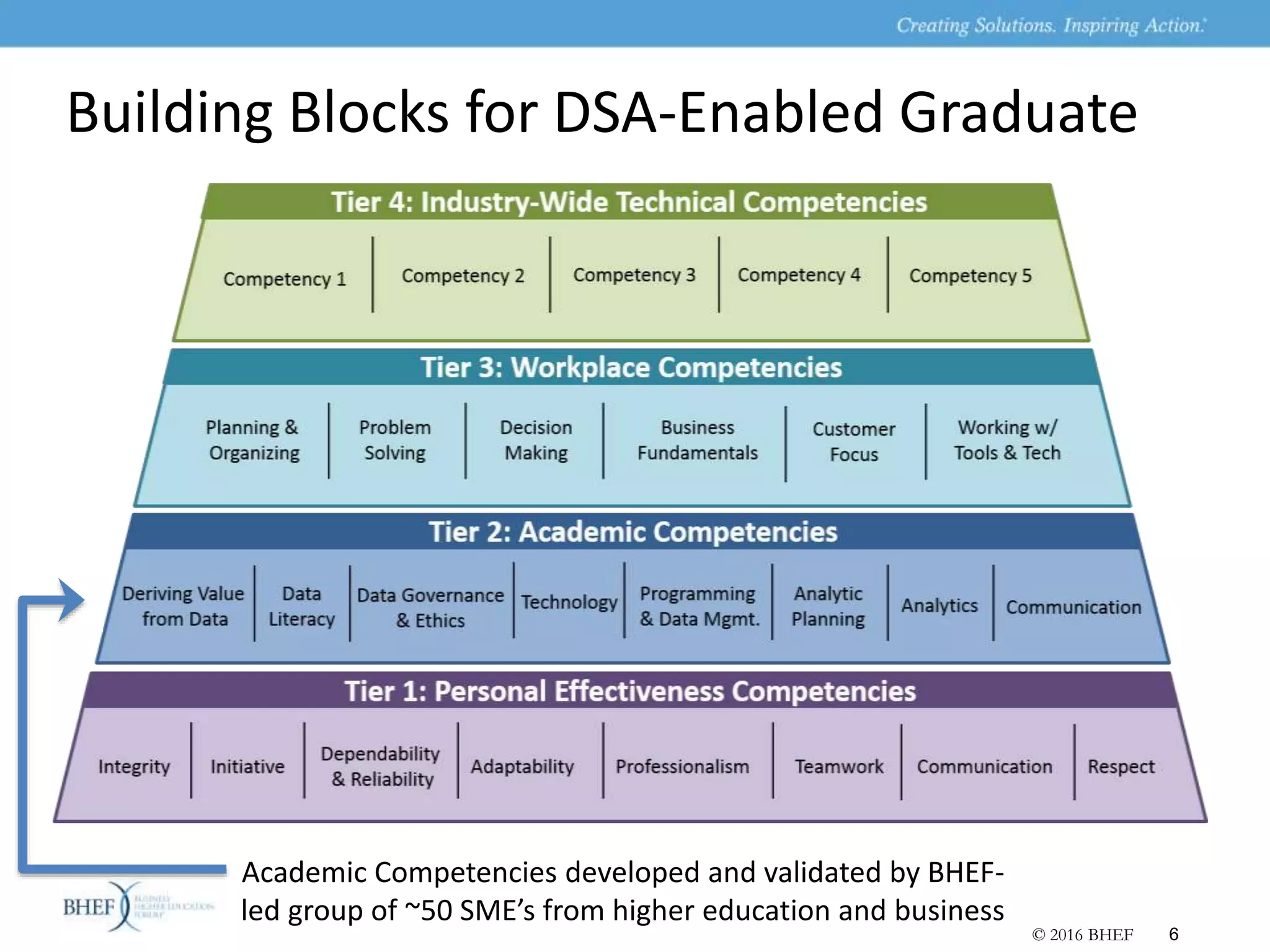
Building Blocks for DSA-Enabled Graduate
Academic Competencies developed and validated by BHEF-
led group of ~50 SME’s from higher education and business
l
Deploying the Competency Map
The vision for adoption of the DSA Competency Map is to provide business and higher education
with an actionable common framework to build new education pathways into the workforce
• Higher Education
– Map existing curricula or current competencies to understand alignment and
identify gaps
– Develop new educational courses or programs to fill identified gaps
– Explore application of competency map across multiple departments
– Offer feedback to BHEF on adoption of competency map
• Business
– Prioritize competencies for a project/employee by linking them to
business/research objectives
– Identify job families and titles where DSA competencies should be included
– Compare job descriptions to competency map and modify to include missing
competencies
– Create mechanism for identifying potential employees where these
competencies are a priority
© 2016 BHEF
Market Intelligence Driving Actionable Insights
BHEF conducts research, develops insights, produces publications, and hosts convenings that
inform BHEF members’ talent development strategies and drives comprehensive national and
international action and response
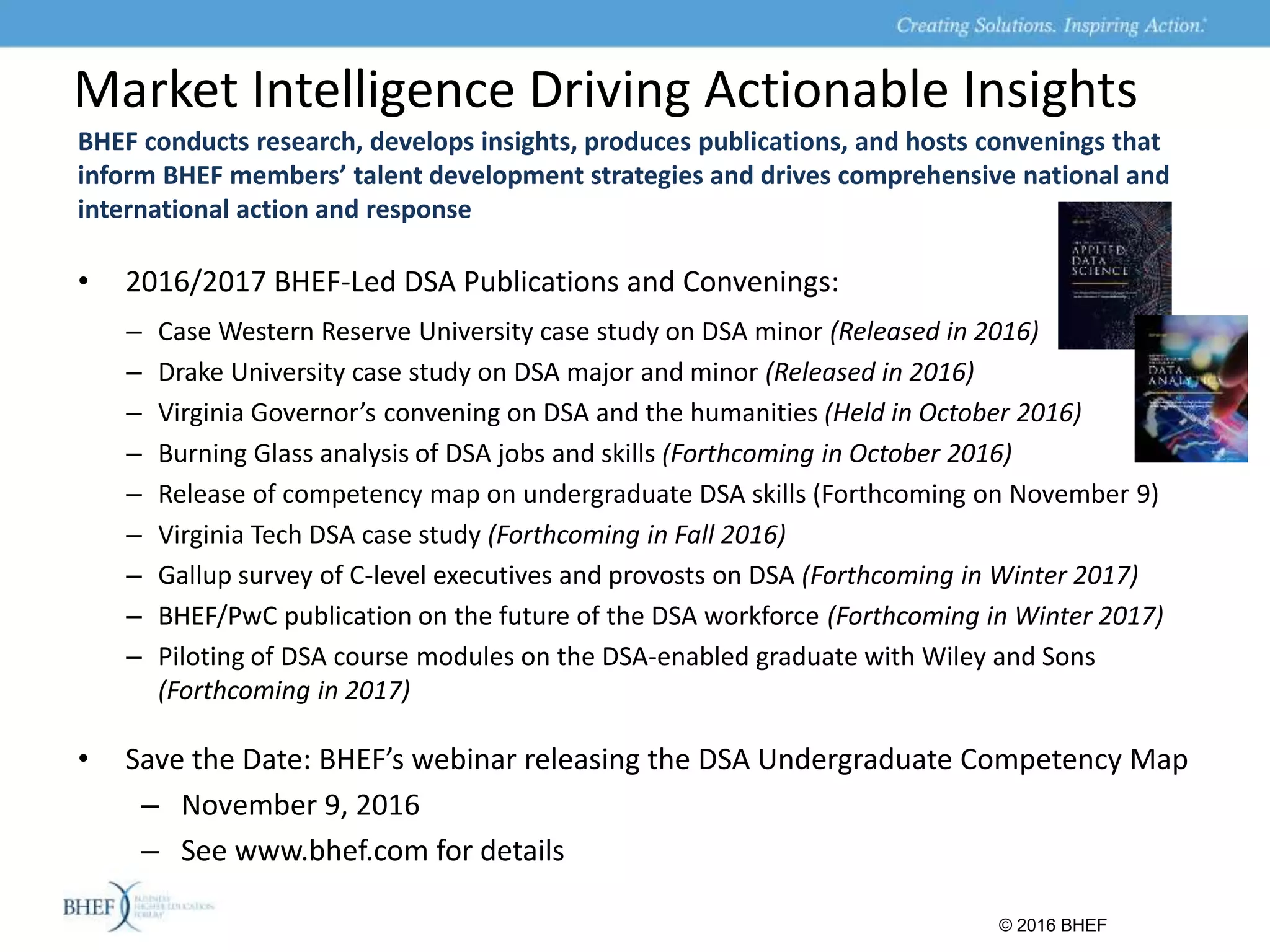
• 2016/2017 BHEF-Led DSA Publications and Convenings:
– Case Western Reserve University case study on DSA minor (Released in 2016)
– Drake University case study on DSA major and minor (Released in 2016)
– Virginia Governor’s convening on DSA and the humanities (Held in October 2016)
– Burning Glass analysis of DSA jobs and skills (Forthcoming in October 2016)
– Release of competency map on undergraduate DSA skills (Forthcoming on November 9)
– Virginia Tech DSA case study (Forthcoming in Fall 2016)
– Gallup survey of C-level executives and provosts on DSA (Forthcoming in Winter 2017)
– BHEF/PwC publication on the future of the DSA workforce (Forthcoming in Winter 2017)
– Piloting of DSA course modules on the DSA-enabled graduate with Wiley and Sons
(Forthcoming in 2017)
• Save the Date: BHEF’s webinar releasing the DSA Undergraduate Competency Map
– November 9, 2016
– See www.bhef.com for details
© 2016 BHEF
BHEF and IBM will co-host a roundtable on The Data-Enabled, Hybrid Graduate: Data,
Trends, and Solutions for Shaping the Next Generation Graduate at the IBM World of
Watson 2016.
IBM World of Watson Roundtable
© 2016 BHEF
• Roundtable will be held on October 24 from 8:30 a.m. – 1:00 p.m. in the
Tribeca Room at the New York New York Hotel
• The session goals are to:
— Explore the need for graduates who are data science-enabled versus
data science experts
— Understand workforce trends and the implications for participants
— Learn how to apply BHEF’s data science and analytics-enabled
competency map
— Discover the global nature of the data science workforce landscape
For additional information visit
www.bhef.com
Contact Information
Isabel.Cardenas-Navia@bhef.com
Brian.Fitzgerald@bhef.com
Debbie.Hughes@bhef.com
© 2016 BHEF 11

Business and Higher Education Collaborating to Create Actionable Intelligence in Data Science and Analytics

  • 1.
    Business and HigherEducation Collaborating to Create Actionable Intelligence in Data Science and Analytics Brian Fitzgerald October 23, 2016 Las Vegas, Nevada
  • 2.
    BHEF is amembership organization of CEOs, college and university presidents, and other leaders who form strategic partnerships to create diverse, high-skilled talent through innovative undergraduate pathways. BHEF Value BHEF members work together to: • Create undergraduate programs to increase baccalaureate attainment, • Improve alignment between higher education and talent development, and • Prepare diverse, highly-skilled graduates ready to meet industry demand. BHEF members gain value from: • Opportunities to form purposeful peer relationships between business or academic counterparts, • Access to BHEF’s expertise and regional work, and • Insight on in-demand high skill trends, collaboration best practices, and case studies. About the Business-Higher Education Forum (BHEF) © 2016 BHEF 2 Build Partnerships Strengthen Talent Identify Insights
  • 3.
    How We DoIt BHEF helps its academic and business members assess regional workforce needs, identify curriculum gaps, and co-design programs and courses, which means more successful outcomes for undergraduates after they graduate. Workforce Market and Skills Analysis Business-Led Ideal Candidate Profile Academic Skills Mapping and Gap Analysis Selection of Academic Credential for Development Integration of High Impact Practices & Experiential Learning Development/Feedback on Curriculum and Courses Roll-out of New Program with Continued Engagement Changed Company Hiring Practices StrategicPartnershipProcess © 2016 BHEF 3
  • 4.
    HEWI Highlights • Newundergraduate pathways for students in emerging fields including cybersecurity, data science, and media engineering • Strategic Engagement Model for Business and Higher Education • Undergraduate STEM Interventions with Industry (USI2) Consortium • Financial Services Industry Workforce Project • NYC Data Science and Analytics Task Force • DC, Maryland, and Virginia Cybersecurity Working Group • National Cybersecurity and Data Science and Analytics Working Groups © 2015 BHEF 4 BHEF’s regional and national networks support business and higher education activities that equips students with the skills and competencies to meet employers’ emerging talent needs.
  • 5.
    BHEF Serving asThought Leaders for DSA Education BHEF is uniquely positioned to serve as the nation’s thought leaders for data science and analytics (DSA) education and workforce development, and build a vibrant community of engaged leaders to shape the education offerings linked with this emerging field. • DSA serves as a key example for aligning workforce with higher education • BHEF serves as the hub for business-higher education collaborations – Develop national competency maps – Create repository of capacity building resources – Establish gold standard experiences • Publish cutting edge research on workforce and higher education trends • Facilitate development of industry recognized credentials and pathways • Regional hubs – NYC Data Science Task Force – Work with partners in Virginia, North Carolina, Ohio, Florida, California • Explore DSA as it relates to the enabled graduate – Create a deeper understanding of DSA as it relates to the liberal arts – Explore hybrid degrees and credentials © 2015 BHEF 5
  • 6.
    NYC Data ScienceTask Force BHEF launched a city-wide task force in data science with the region’s colleges and universities, companies, government agencies, and cultural institutions with the support of the Alfred P. Sloan Foundation. © 2015 BHEF 6 • Identify and map the competencies, skills, and knowledge for the broader data science workforce, e.g., data science-enabled professionals in selected sectors • Support the working group to develop a repository of undergraduate data science resources (e.g., data sets, exercises, and student work experiences) • Seed new undergraduate data science pathways (e.g., courses, concentrations, or minors) at three or more task force academic institutions that are inclusive of women and minorities • Establish a menu of high-quality learning experiences in data science to define the essential elements for successful real-world undergraduate experiences • Develop and apply assessment metrics to the work • Disseminate the learnings nationally through convenings, reports, webinars, and other platforms
  • 7.
    © 2016 BHEF6 Building Blocks for DSA-Enabled Graduate Academic Competencies developed and validated by BHEF- led group of ~50 SME’s from higher education and business l
  • 8.
    Deploying the CompetencyMap The vision for adoption of the DSA Competency Map is to provide business and higher education with an actionable common framework to build new education pathways into the workforce • Higher Education – Map existing curricula or current competencies to understand alignment and identify gaps – Develop new educational courses or programs to fill identified gaps – Explore application of competency map across multiple departments – Offer feedback to BHEF on adoption of competency map • Business – Prioritize competencies for a project/employee by linking them to business/research objectives – Identify job families and titles where DSA competencies should be included – Compare job descriptions to competency map and modify to include missing competencies – Create mechanism for identifying potential employees where these competencies are a priority © 2016 BHEF
  • 9.
    Market Intelligence DrivingActionable Insights BHEF conducts research, develops insights, produces publications, and hosts convenings that inform BHEF members’ talent development strategies and drives comprehensive national and international action and response • 2016/2017 BHEF-Led DSA Publications and Convenings: – Case Western Reserve University case study on DSA minor (Released in 2016) – Drake University case study on DSA major and minor (Released in 2016) – Virginia Governor’s convening on DSA and the humanities (Held in October 2016) – Burning Glass analysis of DSA jobs and skills (Forthcoming in October 2016) – Release of competency map on undergraduate DSA skills (Forthcoming on November 9) – Virginia Tech DSA case study (Forthcoming in Fall 2016) – Gallup survey of C-level executives and provosts on DSA (Forthcoming in Winter 2017) – BHEF/PwC publication on the future of the DSA workforce (Forthcoming in Winter 2017) – Piloting of DSA course modules on the DSA-enabled graduate with Wiley and Sons (Forthcoming in 2017) • Save the Date: BHEF’s webinar releasing the DSA Undergraduate Competency Map – November 9, 2016 – See www.bhef.com for details © 2016 BHEF
  • 10.
    BHEF and IBMwill co-host a roundtable on The Data-Enabled, Hybrid Graduate: Data, Trends, and Solutions for Shaping the Next Generation Graduate at the IBM World of Watson 2016. IBM World of Watson Roundtable © 2016 BHEF • Roundtable will be held on October 24 from 8:30 a.m. – 1:00 p.m. in the Tribeca Room at the New York New York Hotel • The session goals are to: — Explore the need for graduates who are data science-enabled versus data science experts — Understand workforce trends and the implications for participants — Learn how to apply BHEF’s data science and analytics-enabled competency map — Discover the global nature of the data science workforce landscape
  • 11.
    For additional informationvisit www.bhef.com Contact Information Isabel.Cardenas-Navia@bhef.com Brian.Fitzgerald@bhef.com Debbie.Hughes@bhef.com © 2016 BHEF 11