Cognitive Computing
Prof. Dr. Gordon Pipa,
University Osnabrück
23 Oct. 2016
Prof. Dr. Gordon Pipa, University Osnabrück
Prof. Dr. Kai-Uwe Kühnberger, University Osnabrück
Prof. Dr. Dr. Bertram Scheller, University Hospital Frankfurt
Institute of
Cognitive Science
At the core of
Cognitive Computing
since 15 years
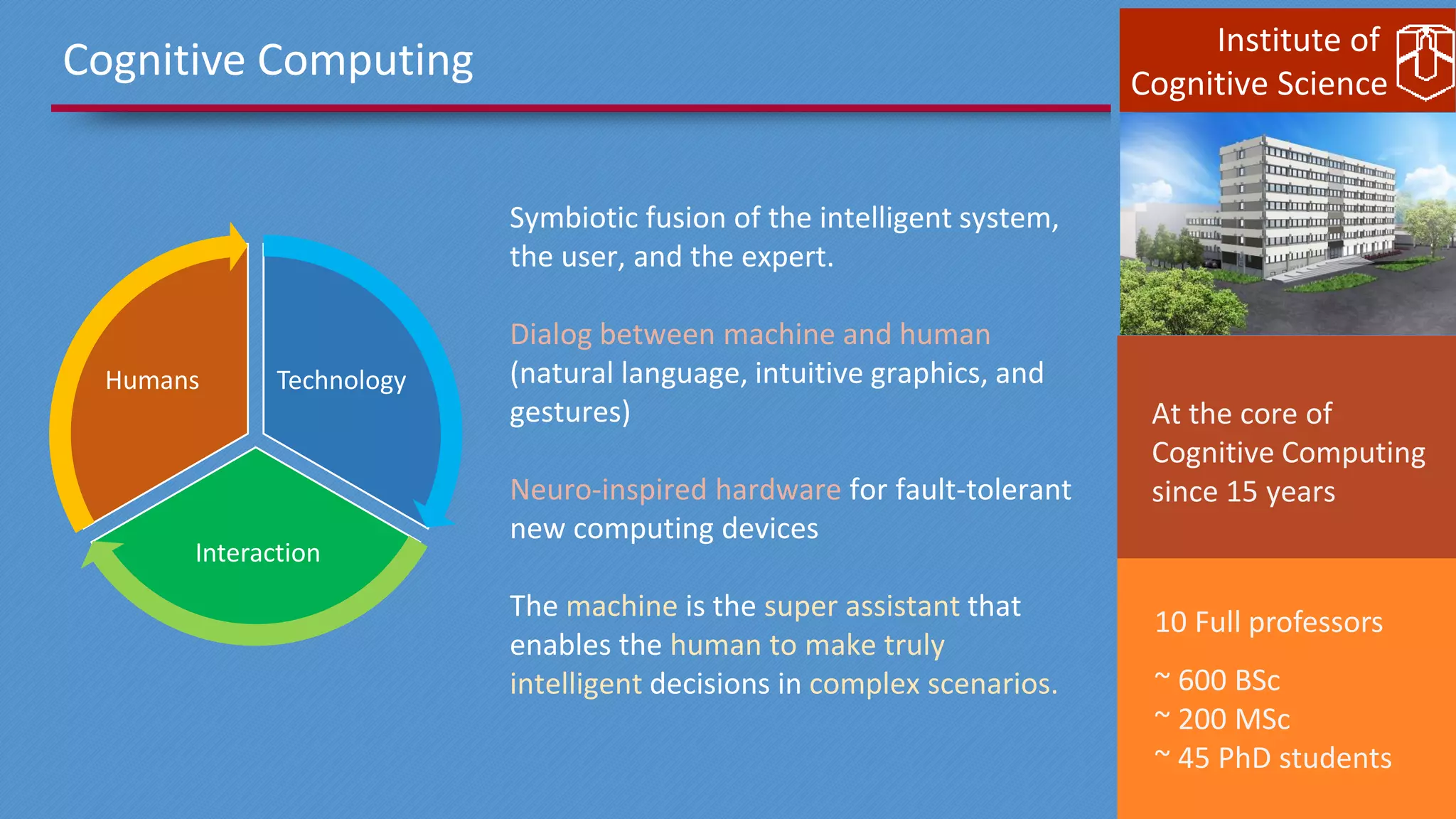
Cognitive Computing
Technology
Interaction
Humans
10 Full professors
~ 600 BSc
~ 200 MSc
~ 45 PhD students
Symbiotic fusion of the intelligent system,
the user, and the expert.
Dialog between machine and human
(natural language, intuitive graphics, and
gestures)
Neuro-inspired hardware for fault-tolerant
new computing devices
The machine is the super assistant that
enables the human to make truly
intelligent decisions in complex scenarios.
Institute of
Cognitive Science
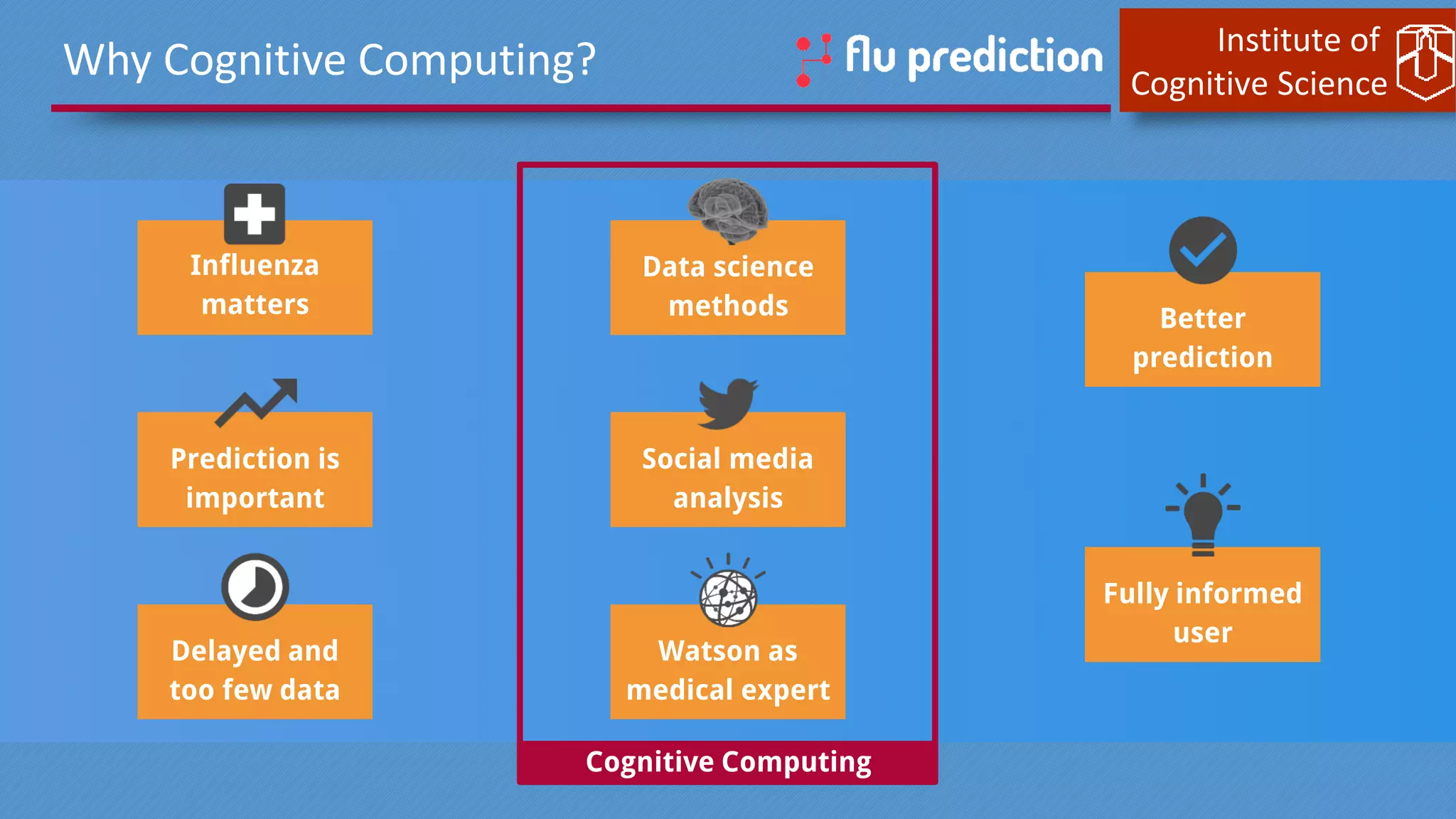
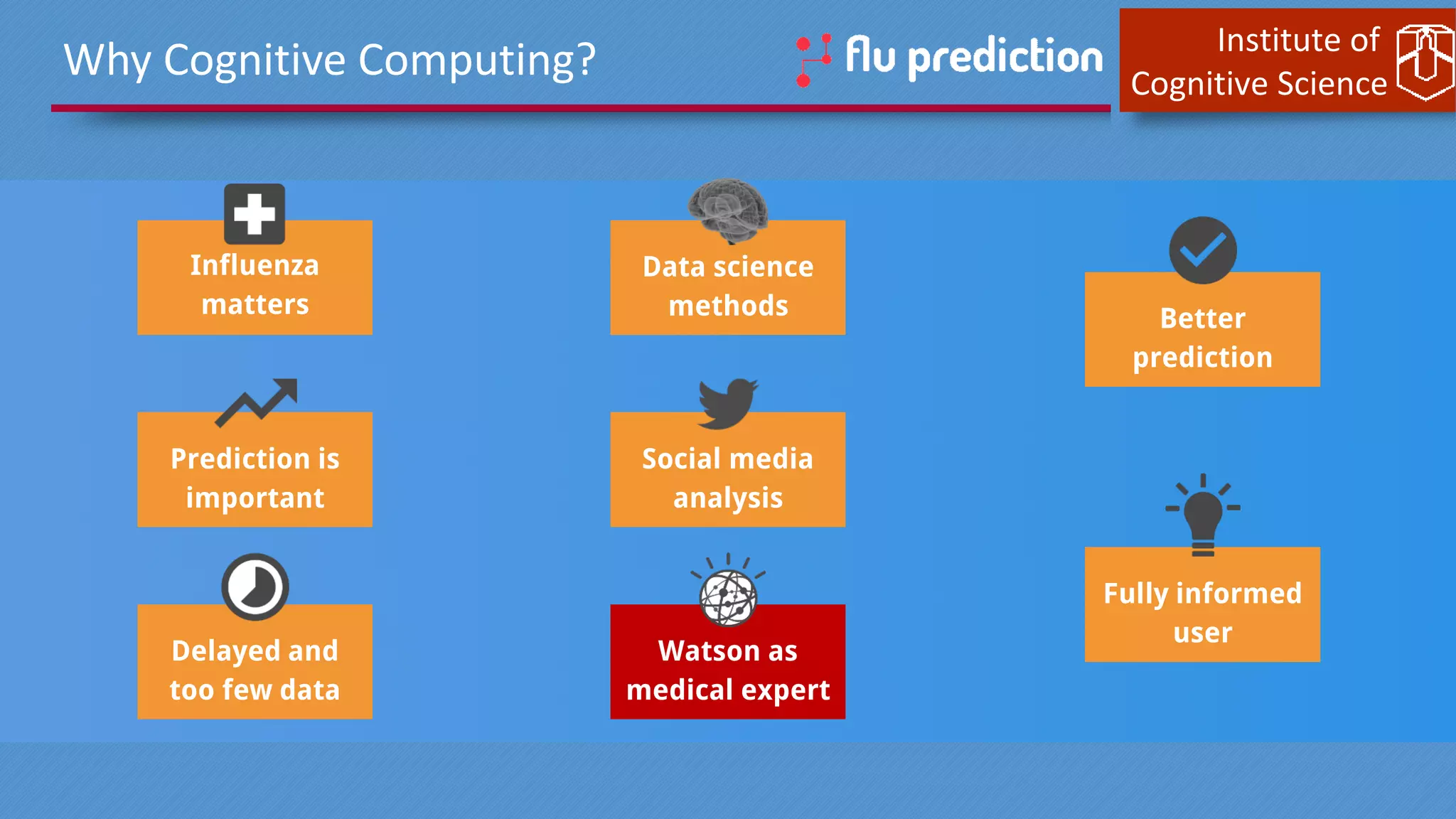
Influenza
matters
Prediction is
important
Delayed and
too few data
Why Cognitive Computing?
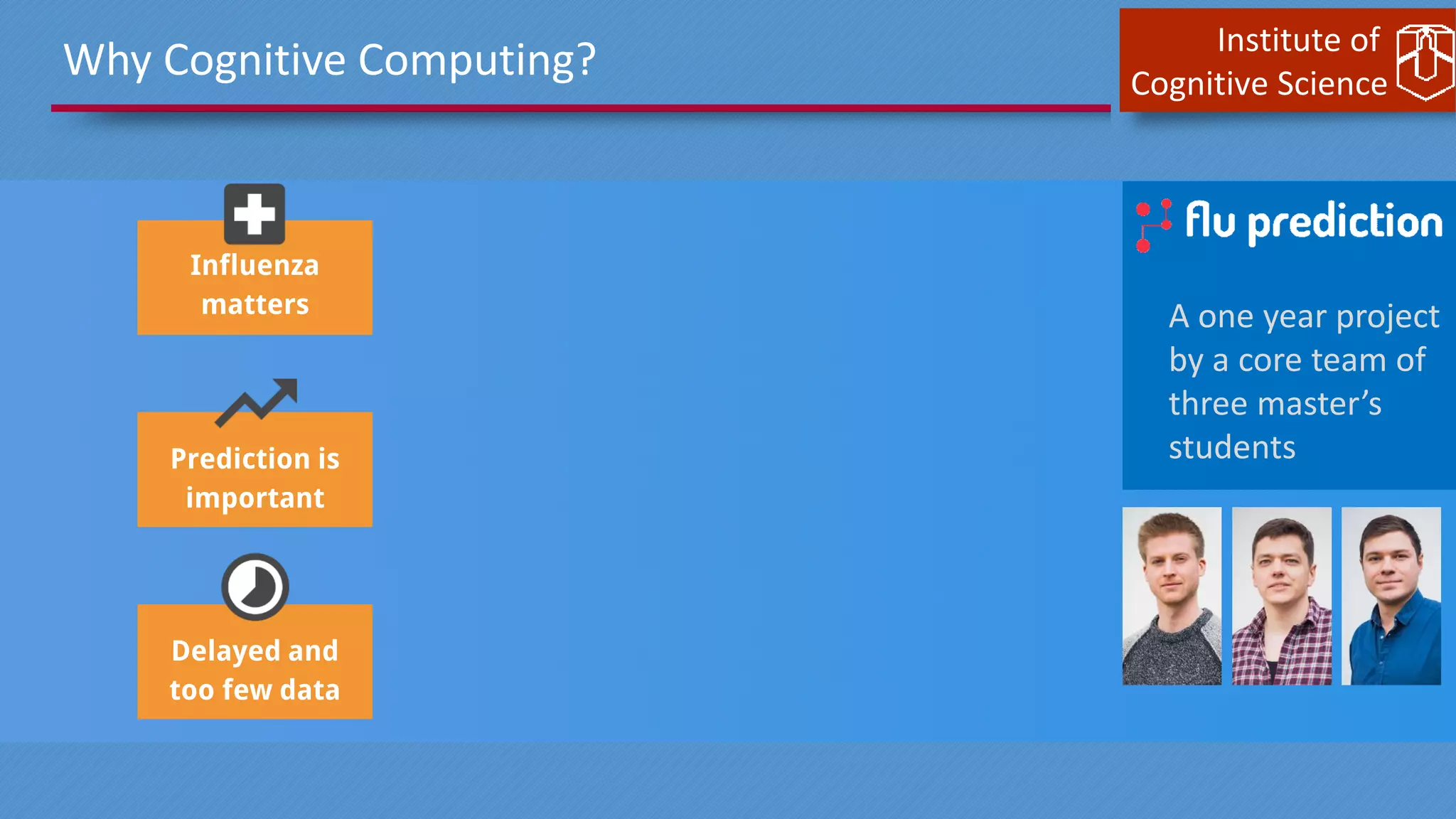
A one year project
by a core team of
three master’s
students
Institute of
Cognitive Science
Influenza
matters
Prediction is
important
Delayed and
too few data
Why Cognitive Computing?
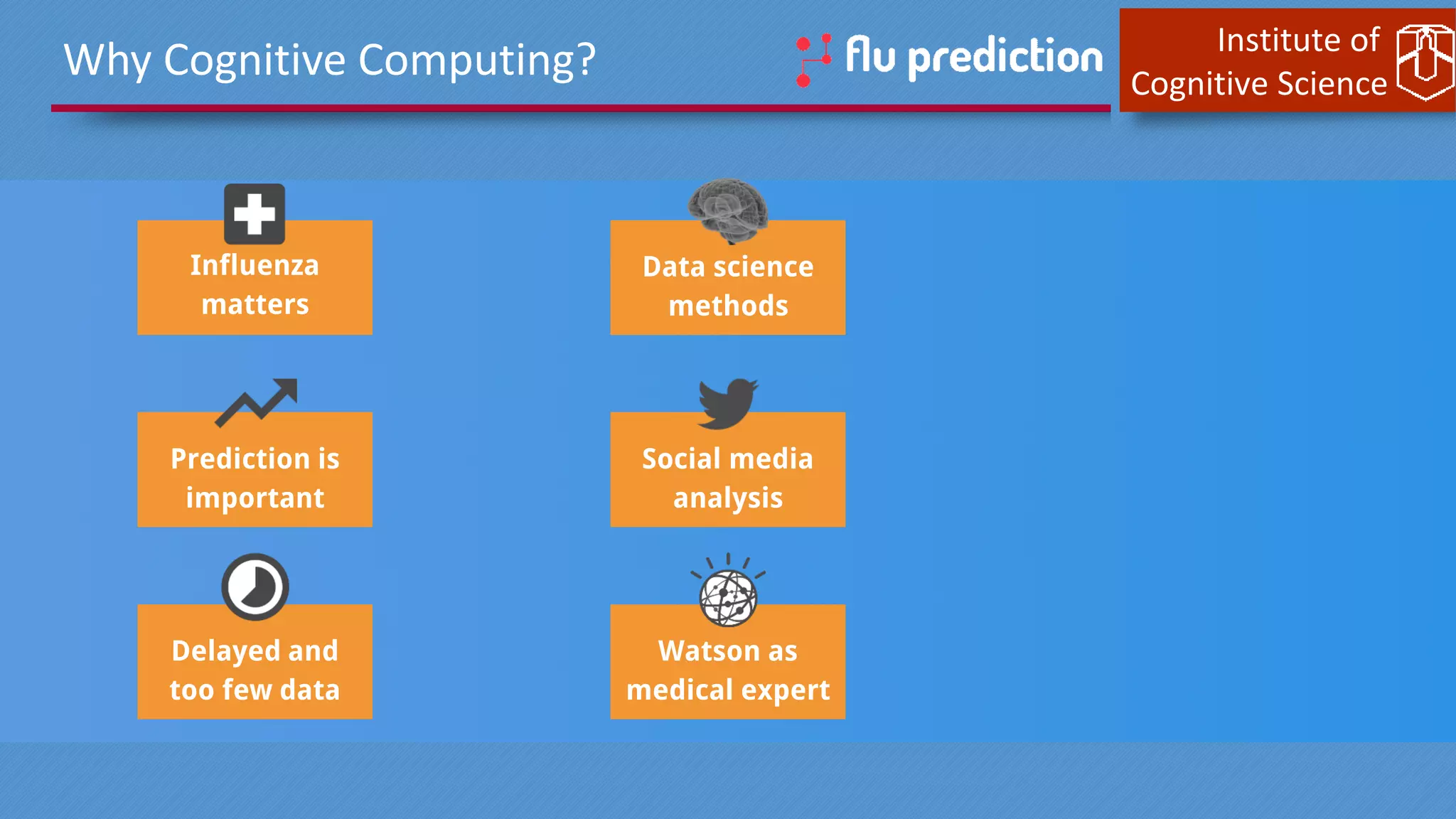
Social media
analysis
Data science
methods
Watson as
medical expert
Institute of
Cognitive Science
Influenza
matters
Prediction is
important
Delayed and
too few data
Why Cognitive Computing?
Social media
analysis
Data science
methods
Watson as
medical expert
Fully informed
user
Better
prediction
Cognitive Computing
Institute of
Cognitive Science
Influenza
matters
Prediction is
important
Delayed and
too few data
Why Cognitive Computing?
Social media
analysis
Data science
methods
Watson as
medical expert
Fully informed
user
Better
prediction
Institute of
Cognitive Science
Structured Causal Models
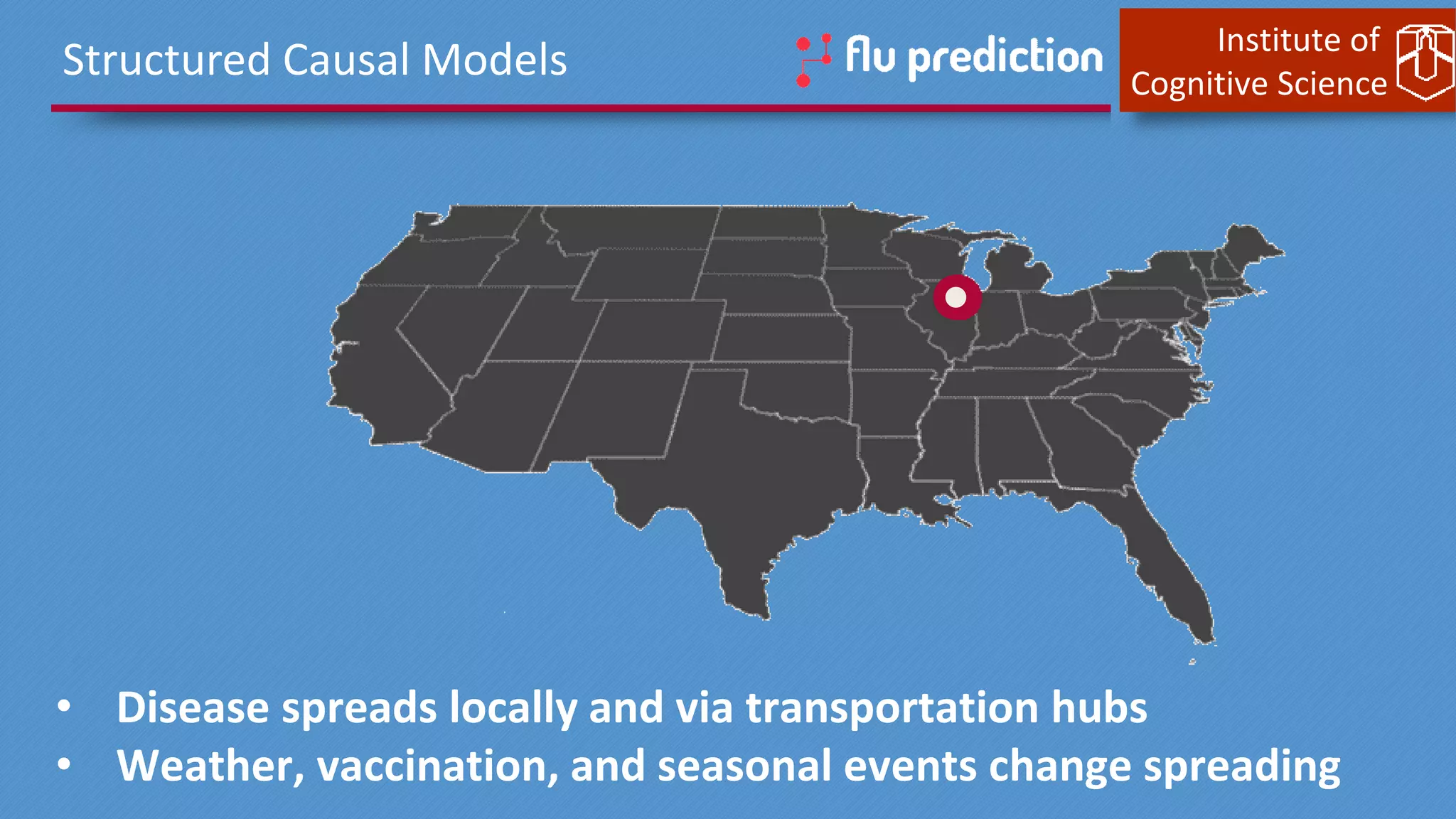
• Disease spreads locally and via transportation hubs
• Weather, vaccination, and seasonal events change spreading
Institute of
Cognitive Science
Structured Causal Models
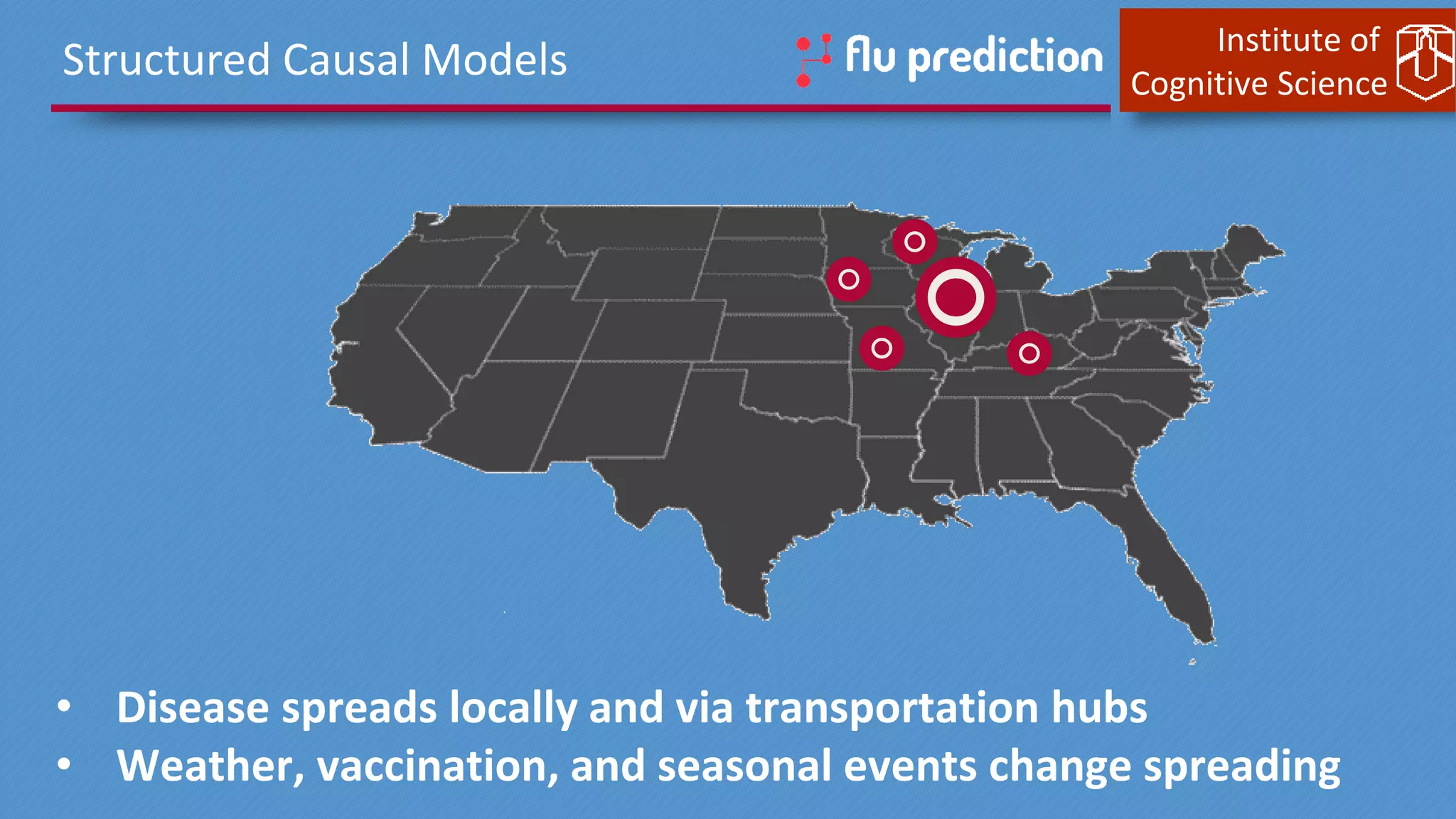
• Disease spreads locally and via transportation hubs
• Weather, vaccination, and seasonal events change spreading
Institute of
Cognitive Science
Structured Causal Models
• Disease spreads locally and via transportation hubs
• Weather, vaccination, and seasonal events change spreading
Institute of
Cognitive Science
Structured Causal Models
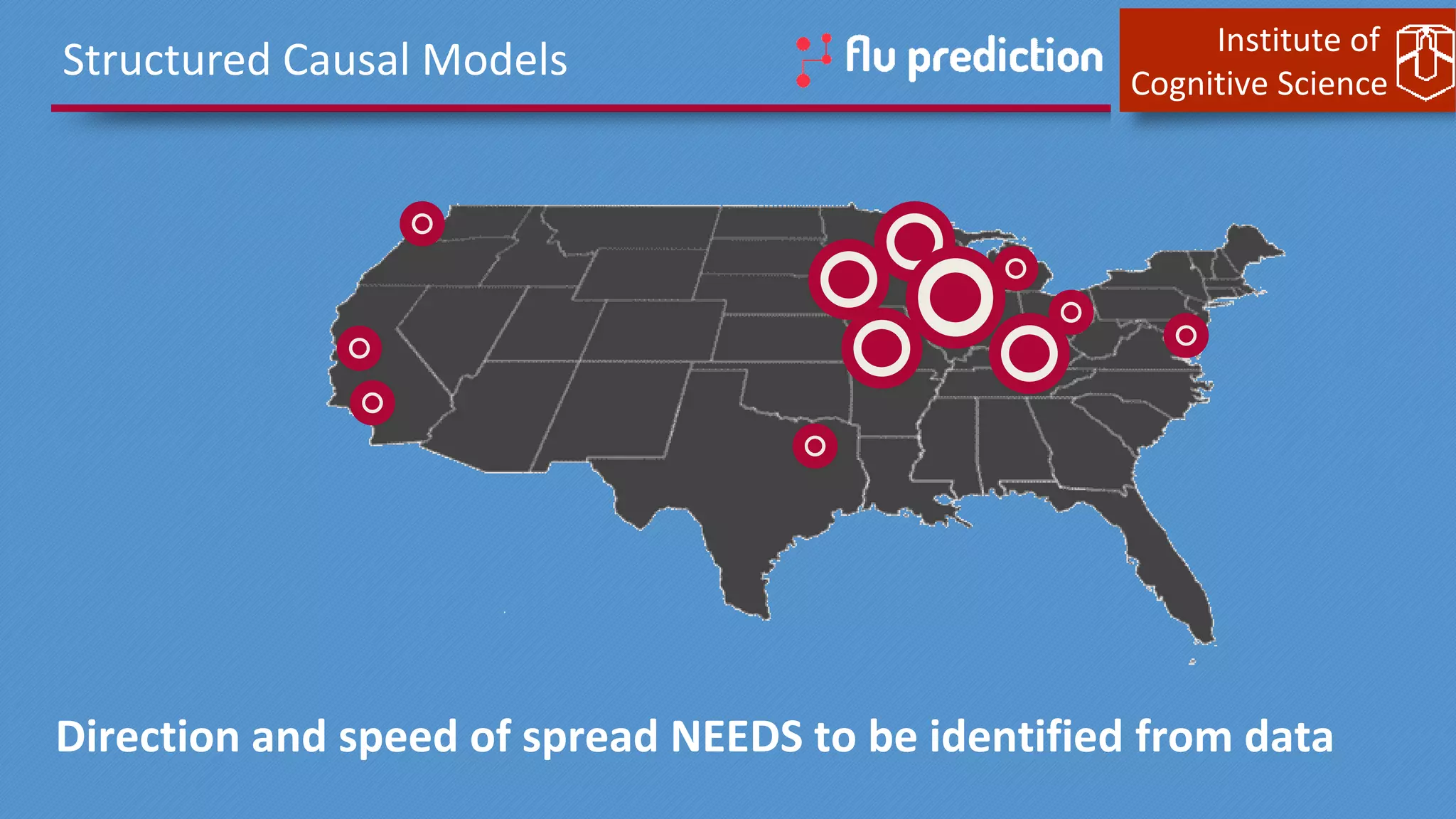
Direction and speed of spread NEEDS to be identified from data
Institute of
Cognitive Science
Identify Causal Interactions
A driver influences and
thereby leaves a trace that can be reconstructed
B
• Schumacher et al. (2015) - A Statistical Framework to Infer Delay and Direction of Information …
• Sugihara et al. (2012) - Detecting Causality in Complex Ecosystems
A
C
Institute of
Cognitive Science
Identify Causal Interactions
The model can be analyzed:
When is New York going to be hit?
• Schumacher et al. (2015) - A Statistical Framework to Infer Delay and Direction of Information …
• Sugihara et al. (2012) - Detecting Causality in Complex Ecosystems
B
A
C
Institute of
Cognitive Science
Identify Causal Interactions
The model can be analyzed:
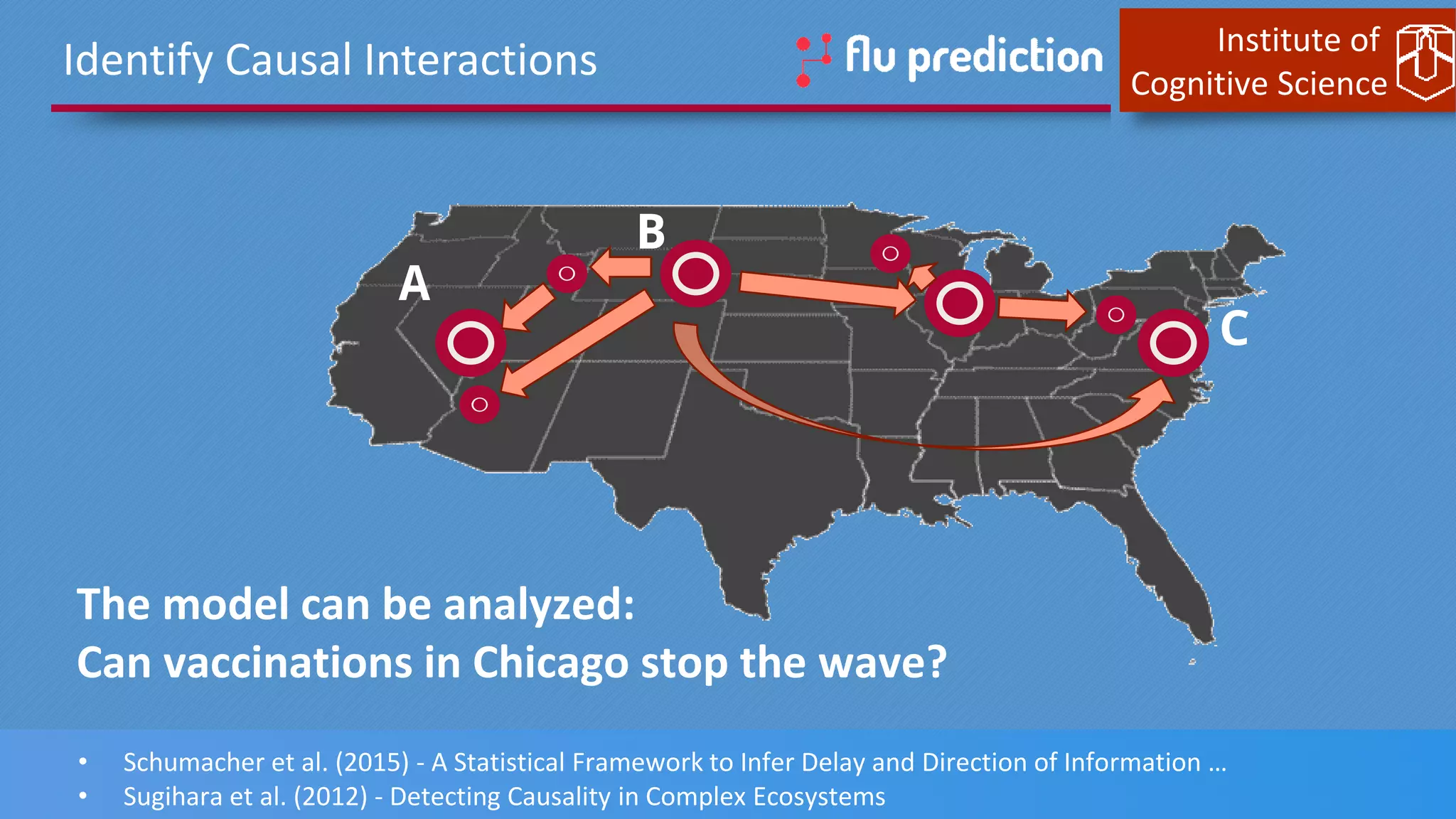
Can vaccinations in Chicago stop the wave?
• Schumacher et al. (2015) - A Statistical Framework to Infer Delay and Direction of Information …
• Sugihara et al. (2012) - Detecting Causality in Complex Ecosystems
B
A
C
Institute of
Cognitive Science
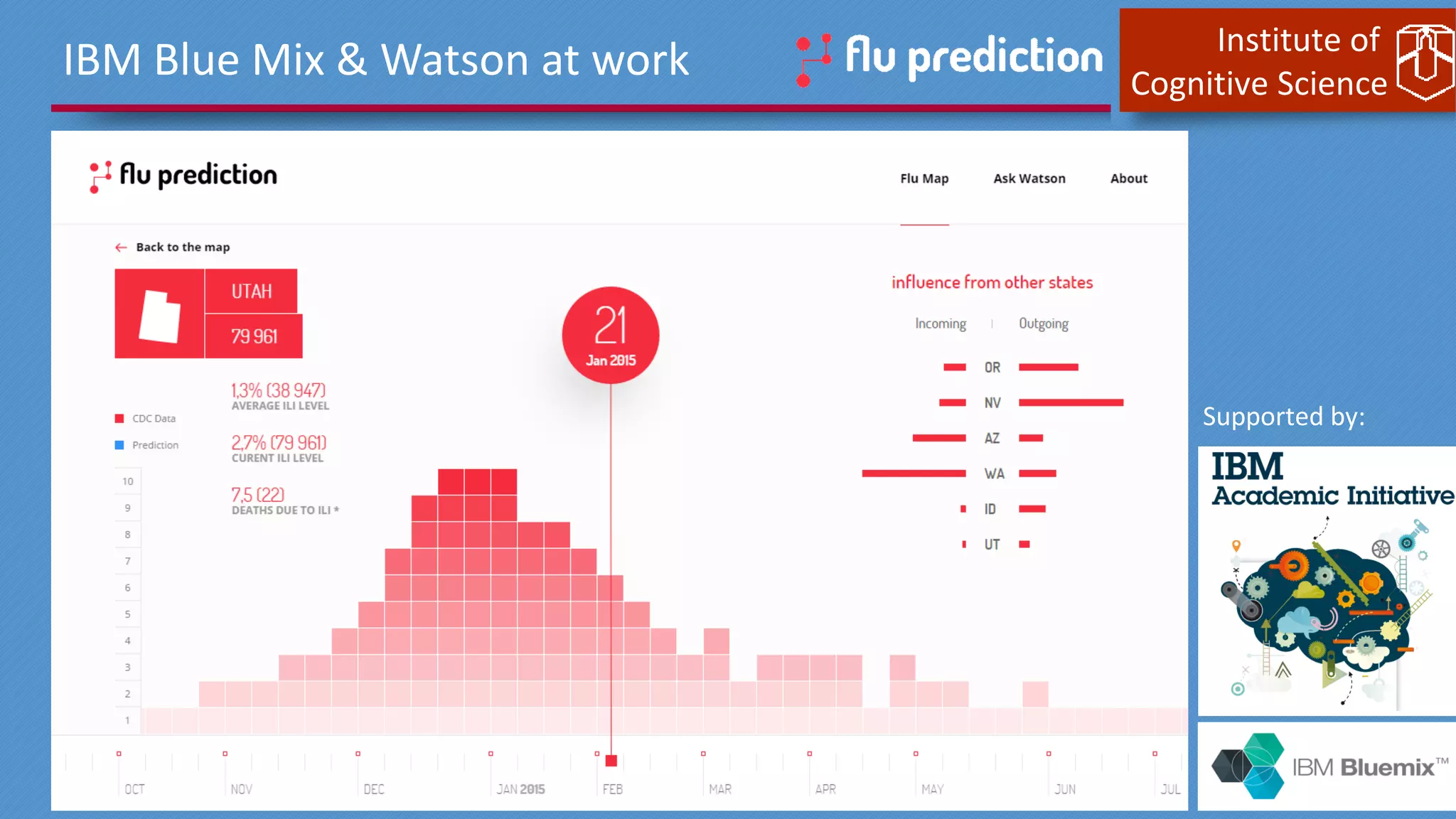
IBM Blue Mix & Watson at work
Supported by:
Institute of
Cognitive Science
IBM Blue Mix & Watson at work
Supported by:
Institute of
Cognitive Science
Influenza
matters
Prediction is
important
Delayed and
too few data
Why Cognitive Computing?
Social media
analysis
Data science
methods
Watson as
medical expert
Fully informed
user
Better
prediction
Institute of
Cognitive Science
Social Media
Twitter gives realtime and anytime available data
IBM Insights contains tweets since 2014
Twitter activity
(geo tag + tweet)
Institute of
Cognitive Science
Sample Tweets from 29/09/16
himself
worried
herself
sick
familiy is
sick
friends are
sick
Institute of
Cognitive Science
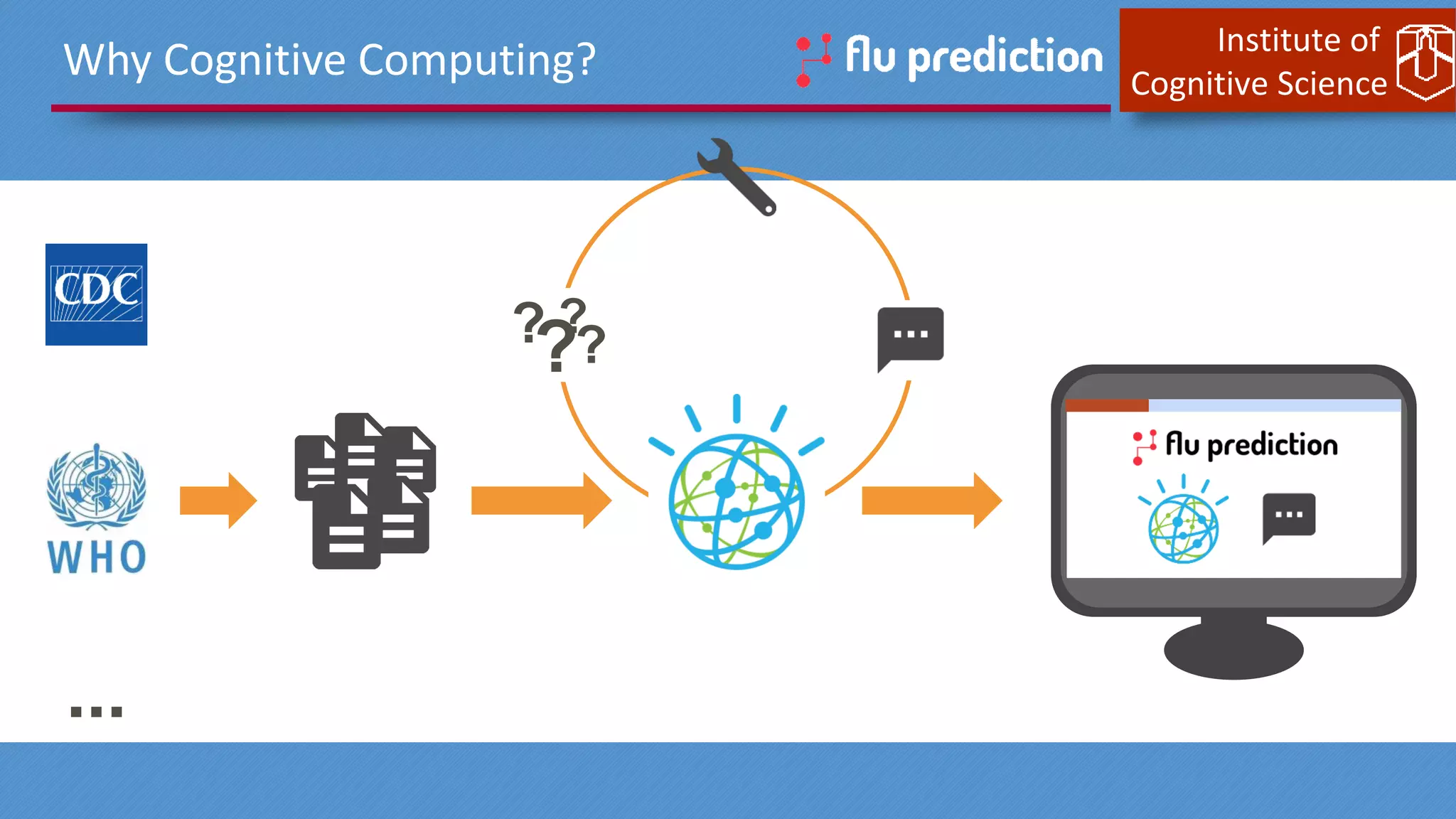
Close the Gap by Fusing Data
Realtime fuzzy
social media
+
Slow but reliable
CDC data
Twitter activity
(geo tag + tweet)
CDC – delayed
influenza data
Use the best from both worlds to improve prediction
Institute of
Cognitive Science
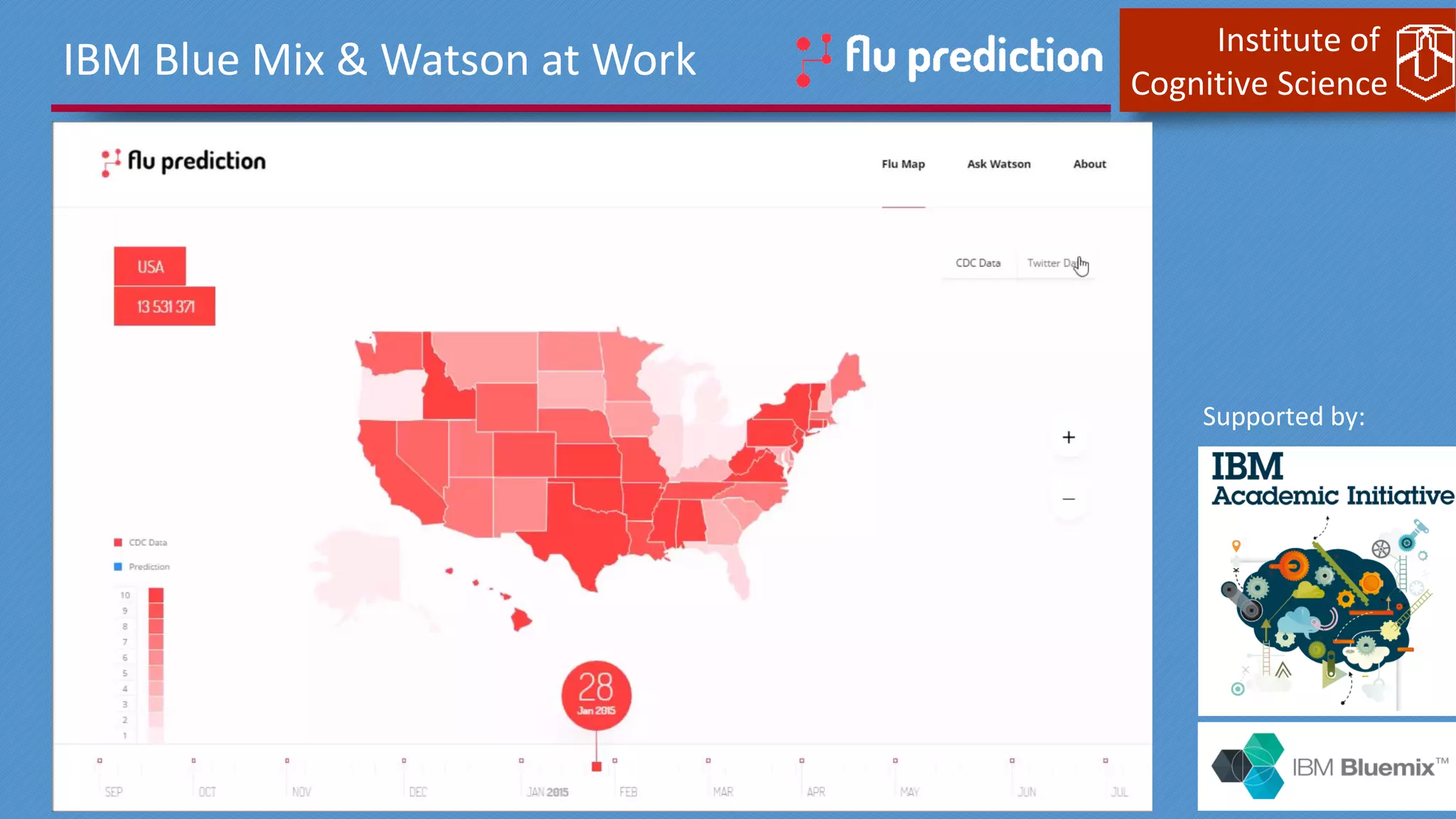
IBM Blue Mix & Watson at Work
Supported by:
Institute of
Cognitive Science
IBM Blue Mix & Watson at Work
Supported by:
Institute of
Cognitive Science
Influenza
matters
Prediction is
important
Delayed and
too few data
Why Cognitive Computing?
Social media
analysis
Data science
methods
Watson as
medical expert
Fully informed
user
Better
prediction
Institute of
Cognitive Science
Why Cognitive Computing?
...
?
?
?
?
Institute of
Cognitive Science
Watson at Work
Supported by:
Institute of
Cognitive Science
Watson at Work
Supported by:
Institute of
Cognitive Science
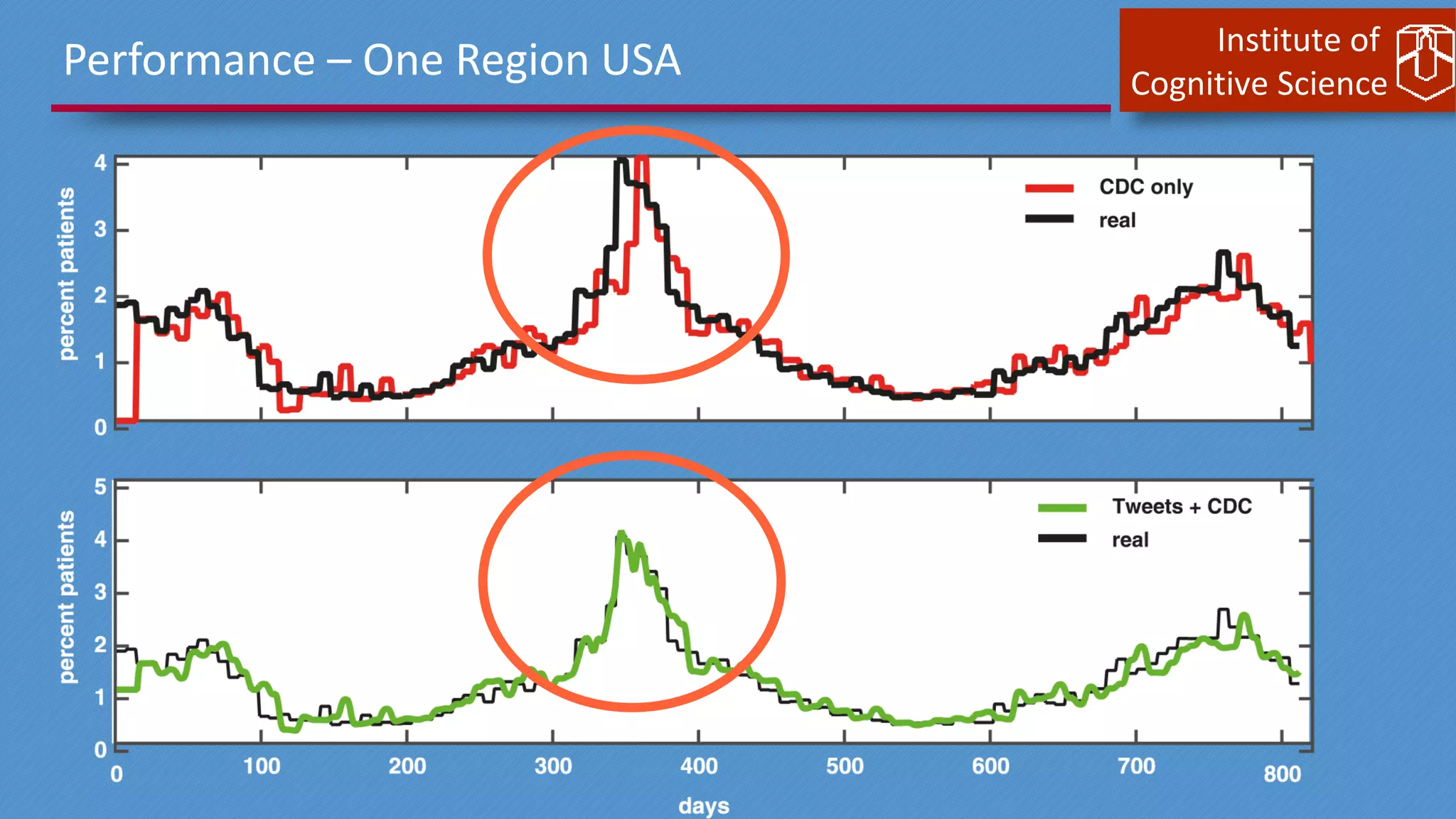
Performance – One Region USA
Institute of
Cognitive Science
Performance: Twitter + CDC for 6 Regions of US
target
CDC
CDC+Tw.
Institute of
Cognitive Science
Performance – One Region USA
Institute of
Cognitive Science
Summary
Social media
analysis
Data science
methods
Watson as expert
● Data science allows identification of very complex causal relations
● Efficient use of BlueMix and Watson services
● Combine social media with other conventional data to get the best of both
worlds  realtime and reliable
● Use large corpora to identify structure and relationships in your problem
● Use natural language interface for easy to use HCI
Institute of
Cognitive ScienceLEARNING TO FLY – LIKE A BIRD
• Bioinspired motor control
• Use of real-time recurrent
networks
• Reservoir computing system
learns complex flight
dynamics
Institute of
Cognitive Science
Neuromorphic Devices – A new Era of Computing
• Millions of spiking
neurons at ultra low
power (<mW)
• Super fast, super parallel
brain-like computation
Nieters, Leugering, Pipa, „Neuromorphic computation in multi-delay coupled models“, IBM Journal of Research (accepted)
Institute of
Cognitive Science
Computing with Random Recurrent Networks
• Fading memory
• Causal changes
• A model
Institute of
Cognitive ScienceReservoir Computing
•Herbert. Jaeger, Harald Haas. "Harnessing nonlinearity: Predicting chaotic systems and saving
energy in wireless communication." Science 304.5667 (2004): 78-80.
•Jaeger, H., Lukoševičius, M., Popovici, D., & Siewert, U. (2007). Optimization and applications of
echo state networks with leaky-integrator neurons. Neural Networks, 20(3), 335-352.
•Yildiz, Izzet B., H. Jaeger, and S. J. Kiebel. "Re-visiting the echo state property." Neural Networks
(2012).
•Waegeman, Schrauwen, Jaeger. "Technical report on hierarchical reservoir computing
architectures." (2012).
•W. Maass, T. Natschläger, H. Markram. "Real-time computing without stable states: A new
framework for neural computation based on perturbations." Neural computation 14.11 (2002):
2531-2560.
•Buesing, Lars, et al. "Neural dynamics as sampling: A model for stochastic computation in recurrent
networks of spiking neurons." PLoS computational biology 7.11 (2011): e1002211.
•Buonomano, D. V., & Maass, W. (2009). State-dependent computations: spatiotemporal processing
in cortical networks. Nature Reviews Neuroscience, 10(2), 113-125.
Prof. Herbert Jäger
Prof. Wolfgang Maass
Institute of
Cognitive ScienceReservoir Computing
y(t)
Perturbation u(t)
W. Maass, T. Natschläger, H. Markram. "Real-time computing without stable states: A new framework for neural computation based on
perturbations." Neural computation 14.11 (2002): 2531-2560.
Task-specific mapping
In mathematical terms, this liquid state is simply the
current output of some operator or filter LM that maps
input functions u(.) onto a liquid state xM(t) :
( ) ( )( )M M
x t L u t
The second component is a memory-less
readout map fM that transforms, at every time t ,
the current liquid state xM(t) into the output
( ) ( ( ))M M
y t f x t
Institute of
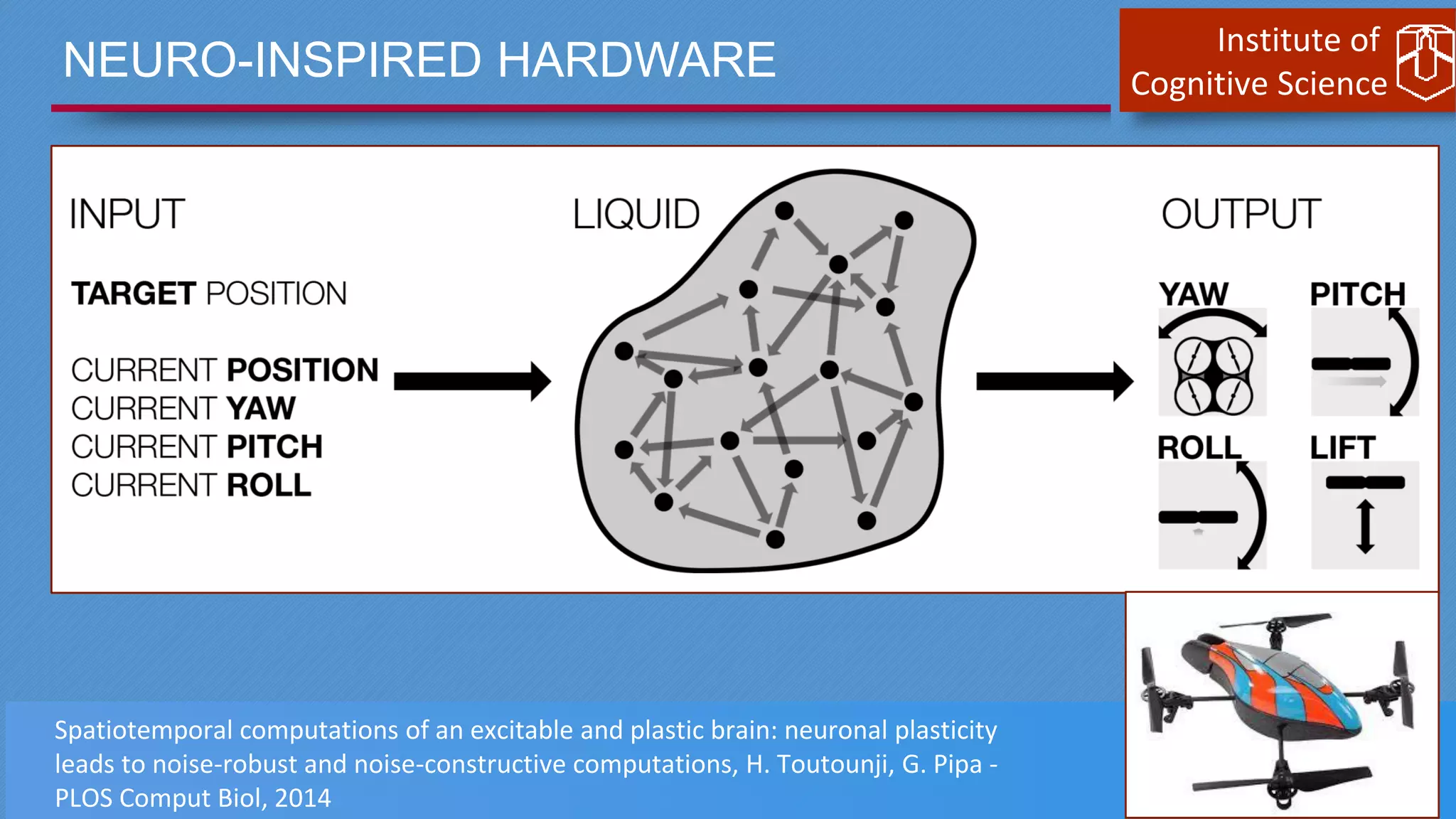
Cognitive ScienceNEURO-INSPIRED HARDWARE
Spatiotemporal computations of an excitable and plastic brain: neuronal plasticity
leads to noise-robust and noise-constructive computations, H. Toutounji, G. Pipa -
PLOS Comput Biol, 2014
Institute of
Cognitive Science
Neuro-Inspired Self-Learning Systems
Institute of
Cognitive Science
Mobile Crowd EEG
• Less than $99
• 8 channel, LED stimulation, gyroscope
• Mobile system with Bluetooth LE, encrypted data transmission
• Allows for nothing less than a new ERA of crowd EEG experiments
Institute of
Cognitive Science
IoT: The Future of ALP Crowd Bio-Signals
You design
your analysis
that we perform
for you.
Pay for the
service and the
data you get.
We store
and process
the data.
We rent
devices.
Institute of
Cognitive Science
At the core of
Cognitive Computing
since 15 years
The Cognitive Era
Technology
Interaction
Humans
10 Full professors
~ 600 BSc
~ 200 MSc
~ 45 PhD students
Symbiotic fusion of the intelligent
system, the user, and the expert.
Dialog between machine and human
(natural language, intuitive graphics,
and gestures)
Neuro-inspired hardware for fault
tolerant new computing devices
The machine is the super assistant
that enables the human to make
truly intelligent decisions in complex
scenarios.
Institute of
Cognitive Science
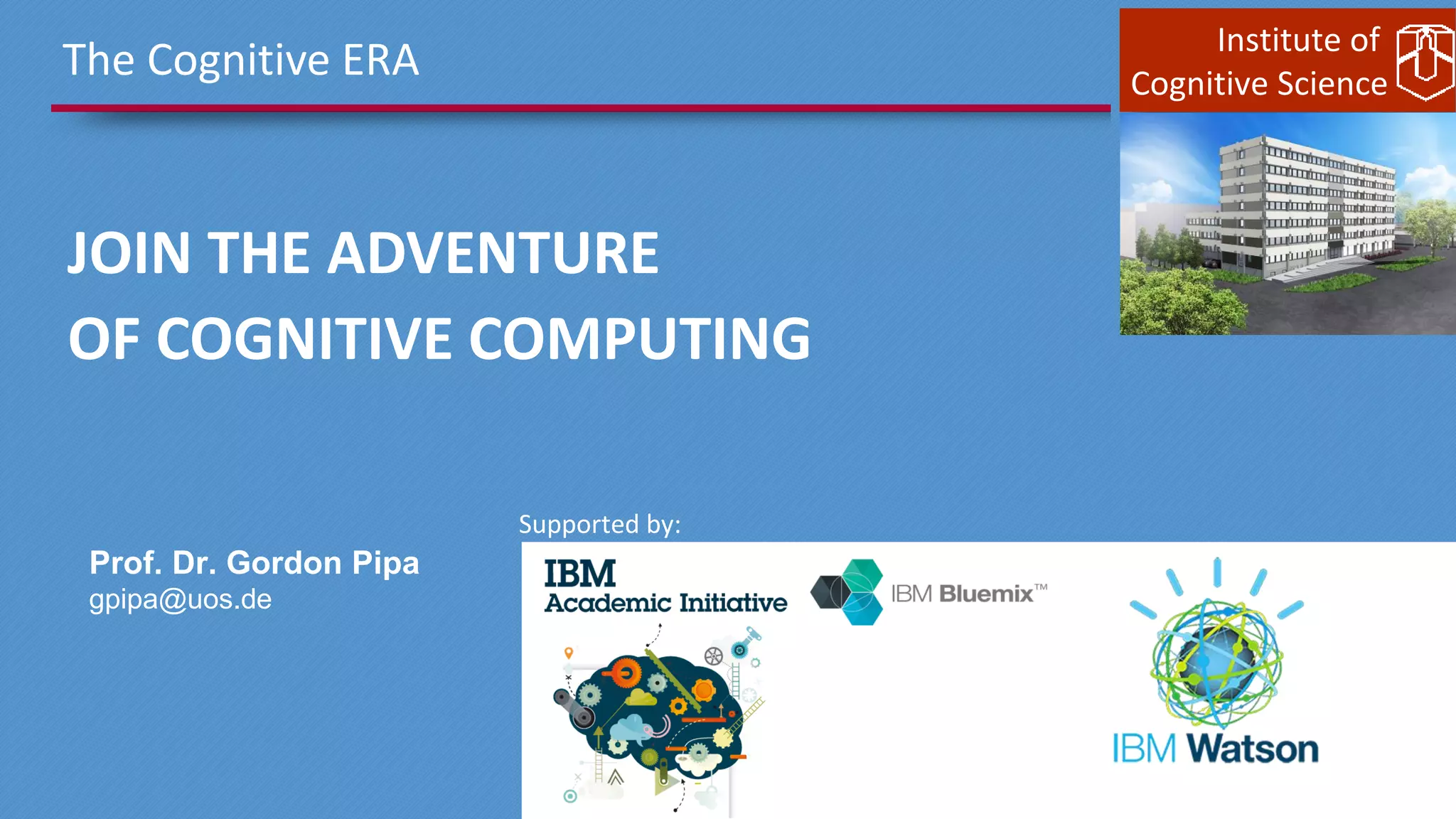
The Cognitive ERA
JOIN THE ADVENTURE
OF COGNITIVE COMPUTING
Supported by:
Prof. Dr. Gordon Pipa
gpipa@uos.de

Cognitive Computing at University Osnabrück

  • 1.
    Cognitive Computing Prof. Dr.Gordon Pipa, University Osnabrück 23 Oct. 2016 Prof. Dr. Gordon Pipa, University Osnabrück Prof. Dr. Kai-Uwe Kühnberger, University Osnabrück Prof. Dr. Dr. Bertram Scheller, University Hospital Frankfurt
  • 2.
    Institute of Cognitive Science Atthe core of Cognitive Computing since 15 years Cognitive Computing Technology Interaction Humans 10 Full professors ~ 600 BSc ~ 200 MSc ~ 45 PhD students Symbiotic fusion of the intelligent system, the user, and the expert. Dialog between machine and human (natural language, intuitive graphics, and gestures) Neuro-inspired hardware for fault-tolerant new computing devices The machine is the super assistant that enables the human to make truly intelligent decisions in complex scenarios.
  • 3.
    Institute of Cognitive Science Influenza matters Predictionis important Delayed and too few data Why Cognitive Computing? A one year project by a core team of three master’s students
  • 4.
    Institute of Cognitive Science Influenza matters Predictionis important Delayed and too few data Why Cognitive Computing? Social media analysis Data science methods Watson as medical expert
  • 5.
    Institute of Cognitive Science Influenza matters Predictionis important Delayed and too few data Why Cognitive Computing? Social media analysis Data science methods Watson as medical expert Fully informed user Better prediction Cognitive Computing
  • 6.
    Institute of Cognitive Science Influenza matters Predictionis important Delayed and too few data Why Cognitive Computing? Social media analysis Data science methods Watson as medical expert Fully informed user Better prediction
  • 7.
    Institute of Cognitive Science StructuredCausal Models • Disease spreads locally and via transportation hubs • Weather, vaccination, and seasonal events change spreading
  • 8.
    Institute of Cognitive Science StructuredCausal Models • Disease spreads locally and via transportation hubs • Weather, vaccination, and seasonal events change spreading
  • 9.
    Institute of Cognitive Science StructuredCausal Models • Disease spreads locally and via transportation hubs • Weather, vaccination, and seasonal events change spreading
  • 10.
    Institute of Cognitive Science StructuredCausal Models Direction and speed of spread NEEDS to be identified from data
  • 11.
    Institute of Cognitive Science IdentifyCausal Interactions A driver influences and thereby leaves a trace that can be reconstructed B • Schumacher et al. (2015) - A Statistical Framework to Infer Delay and Direction of Information … • Sugihara et al. (2012) - Detecting Causality in Complex Ecosystems A C
  • 12.
    Institute of Cognitive Science IdentifyCausal Interactions The model can be analyzed: When is New York going to be hit? • Schumacher et al. (2015) - A Statistical Framework to Infer Delay and Direction of Information … • Sugihara et al. (2012) - Detecting Causality in Complex Ecosystems B A C
  • 13.
    Institute of Cognitive Science IdentifyCausal Interactions The model can be analyzed: Can vaccinations in Chicago stop the wave? • Schumacher et al. (2015) - A Statistical Framework to Infer Delay and Direction of Information … • Sugihara et al. (2012) - Detecting Causality in Complex Ecosystems B A C
  • 14.
    Institute of Cognitive Science IBMBlue Mix & Watson at work Supported by:
  • 15.
    Institute of Cognitive Science IBMBlue Mix & Watson at work Supported by:
  • 16.
    Institute of Cognitive Science Influenza matters Predictionis important Delayed and too few data Why Cognitive Computing? Social media analysis Data science methods Watson as medical expert Fully informed user Better prediction
  • 17.
    Institute of Cognitive Science SocialMedia Twitter gives realtime and anytime available data IBM Insights contains tweets since 2014 Twitter activity (geo tag + tweet)
  • 18.
    Institute of Cognitive Science SampleTweets from 29/09/16 himself worried herself sick familiy is sick friends are sick
  • 19.
    Institute of Cognitive Science Closethe Gap by Fusing Data Realtime fuzzy social media + Slow but reliable CDC data Twitter activity (geo tag + tweet) CDC – delayed influenza data Use the best from both worlds to improve prediction
  • 20.
    Institute of Cognitive Science IBMBlue Mix & Watson at Work Supported by:
  • 21.
    Institute of Cognitive Science IBMBlue Mix & Watson at Work Supported by:
  • 22.
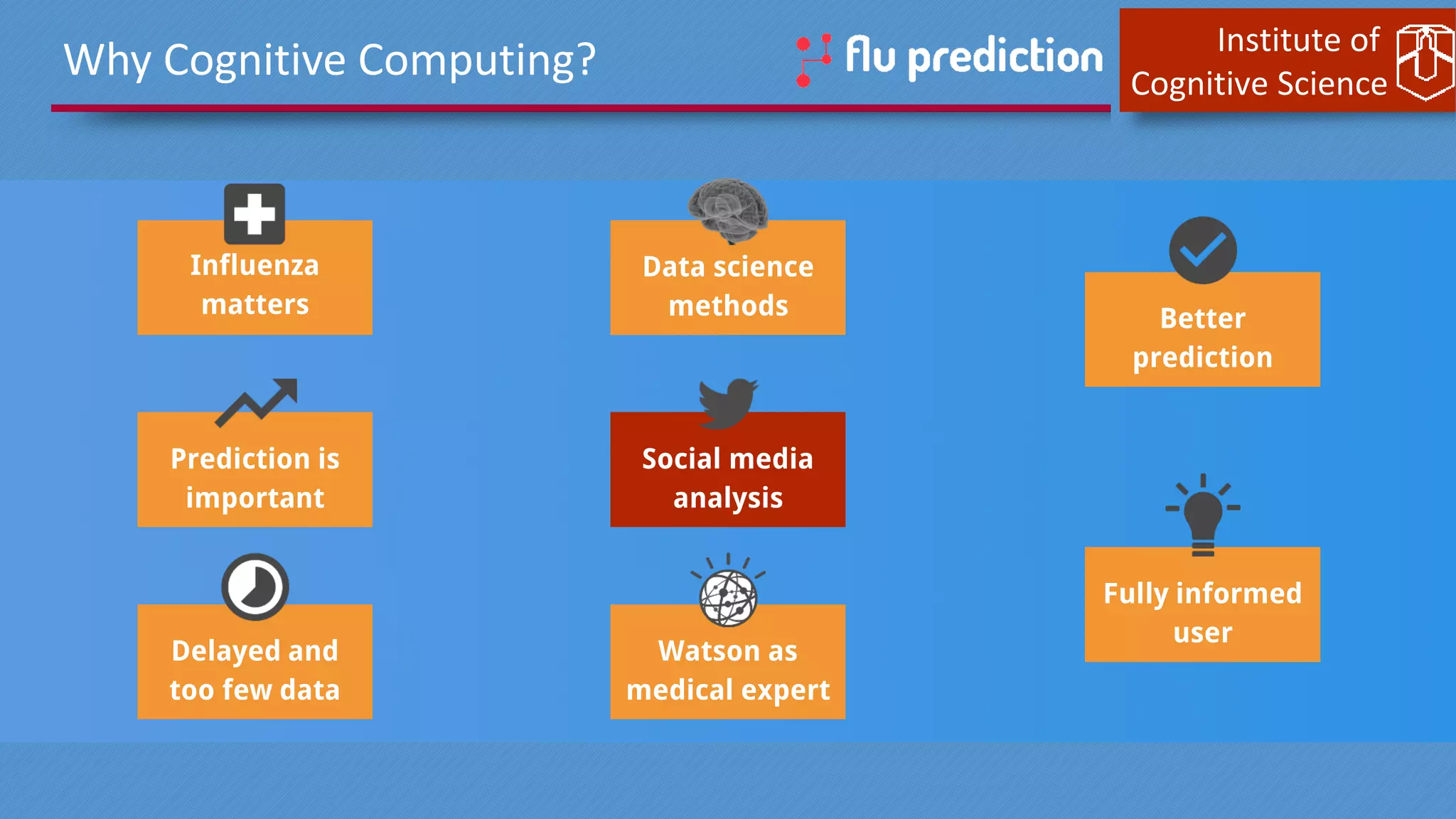
    Institute of Cognitive Science Influenza matters Predictionis important Delayed and too few data Why Cognitive Computing? Social media analysis Data science methods Watson as medical expert Fully informed user Better prediction
  • 23.
    Institute of Cognitive Science WhyCognitive Computing? ... ? ? ? ?
  • 24.
  • 25.
  • 26.
  • 27.
    Institute of Cognitive Science Performance:Twitter + CDC for 6 Regions of US target CDC CDC+Tw.
  • 28.
  • 29.
    Institute of Cognitive Science Summary Socialmedia analysis Data science methods Watson as expert ● Data science allows identification of very complex causal relations ● Efficient use of BlueMix and Watson services ● Combine social media with other conventional data to get the best of both worlds  realtime and reliable ● Use large corpora to identify structure and relationships in your problem ● Use natural language interface for easy to use HCI
  • 30.
    Institute of Cognitive ScienceLEARNINGTO FLY – LIKE A BIRD • Bioinspired motor control • Use of real-time recurrent networks • Reservoir computing system learns complex flight dynamics
  • 31.
    Institute of Cognitive Science NeuromorphicDevices – A new Era of Computing • Millions of spiking neurons at ultra low power (<mW) • Super fast, super parallel brain-like computation Nieters, Leugering, Pipa, „Neuromorphic computation in multi-delay coupled models“, IBM Journal of Research (accepted)
  • 32.
    Institute of Cognitive Science Computingwith Random Recurrent Networks • Fading memory • Causal changes • A model
  • 33.
    Institute of Cognitive ScienceReservoirComputing •Herbert. Jaeger, Harald Haas. "Harnessing nonlinearity: Predicting chaotic systems and saving energy in wireless communication." Science 304.5667 (2004): 78-80. •Jaeger, H., Lukoševičius, M., Popovici, D., & Siewert, U. (2007). Optimization and applications of echo state networks with leaky-integrator neurons. Neural Networks, 20(3), 335-352. •Yildiz, Izzet B., H. Jaeger, and S. J. Kiebel. "Re-visiting the echo state property." Neural Networks (2012). •Waegeman, Schrauwen, Jaeger. "Technical report on hierarchical reservoir computing architectures." (2012). •W. Maass, T. Natschläger, H. Markram. "Real-time computing without stable states: A new framework for neural computation based on perturbations." Neural computation 14.11 (2002): 2531-2560. •Buesing, Lars, et al. "Neural dynamics as sampling: A model for stochastic computation in recurrent networks of spiking neurons." PLoS computational biology 7.11 (2011): e1002211. •Buonomano, D. V., & Maass, W. (2009). State-dependent computations: spatiotemporal processing in cortical networks. Nature Reviews Neuroscience, 10(2), 113-125. Prof. Herbert Jäger Prof. Wolfgang Maass
  • 34.
    Institute of Cognitive ScienceReservoirComputing y(t) Perturbation u(t) W. Maass, T. Natschläger, H. Markram. "Real-time computing without stable states: A new framework for neural computation based on perturbations." Neural computation 14.11 (2002): 2531-2560. Task-specific mapping In mathematical terms, this liquid state is simply the current output of some operator or filter LM that maps input functions u(.) onto a liquid state xM(t) : ( ) ( )( )M M x t L u t The second component is a memory-less readout map fM that transforms, at every time t , the current liquid state xM(t) into the output ( ) ( ( ))M M y t f x t
  • 35.
    Institute of Cognitive ScienceNEURO-INSPIREDHARDWARE Spatiotemporal computations of an excitable and plastic brain: neuronal plasticity leads to noise-robust and noise-constructive computations, H. Toutounji, G. Pipa - PLOS Comput Biol, 2014
  • 36.
  • 37.
    Institute of Cognitive Science MobileCrowd EEG • Less than $99 • 8 channel, LED stimulation, gyroscope • Mobile system with Bluetooth LE, encrypted data transmission • Allows for nothing less than a new ERA of crowd EEG experiments
  • 38.
    Institute of Cognitive Science IoT:The Future of ALP Crowd Bio-Signals You design your analysis that we perform for you. Pay for the service and the data you get. We store and process the data. We rent devices.
  • 39.
    Institute of Cognitive Science Atthe core of Cognitive Computing since 15 years The Cognitive Era Technology Interaction Humans 10 Full professors ~ 600 BSc ~ 200 MSc ~ 45 PhD students Symbiotic fusion of the intelligent system, the user, and the expert. Dialog between machine and human (natural language, intuitive graphics, and gestures) Neuro-inspired hardware for fault tolerant new computing devices The machine is the super assistant that enables the human to make truly intelligent decisions in complex scenarios.
  • 40.
    Institute of Cognitive Science TheCognitive ERA JOIN THE ADVENTURE OF COGNITIVE COMPUTING Supported by: Prof. Dr. Gordon Pipa gpipa@uos.de