1) The pediatric ECG shows age-specific changes from infancy to adulthood due to maturation of the heart and circulatory system. In early infancy, the right ventricle dominates but later the left ventricle increases in size.
2) Common reasons for obtaining pediatric ECGs in the emergency department include chest pain, arrhythmias, seizures, syncope, and abnormal physical exam findings. About 20% of pediatric ECGs show clinically significant abnormalities.
3) Interpretation of a pediatric ECG requires consideration of normal age-related variability in heart rate, QRS axis, intervals, and wave amplitudes compared to adult values. Attention to these details can help identify true abnormalities.
![The Pediatric ECG
Ghazala Q. Sharieff, MDa,b,*, Sri O. Rao, MDc
a
Children’s Hospital and Health Center/University of California–San Diego,
3020 Children’s Way, San Diego, CA 92123
b
Pediatric Emergency Medicine, Palomar-Pomerado Hospitals/California
Emergency Physicians, 555 East Valley Parkway, Escondido, CA 92025, USA
c
Division of Pediatric Cardiology, Children’s Hospital and Health Center,
3020 Children’s Way, San Diego, CA 92123, USA
There are many nuances to the pediatric ECG that relate to age-specific
changes. These findings relate directly to changes in the myocardium and
circulatory system as the individual matures from infancy to adulthood.
For example, fetal circulation relies primarily on the right side of the heart
and at birth the right ventricle is larger and thicker than the left ventricle.
During infancy, increased physiologic stress and work of the left ventricle
leads to its enlargement, such that by 6 months it is twice the thickness of
the right. By adolescence, the left ventricle is at least 2.5 times as thick as
the right [1]. These changes over time lead to the variability of normal
ECGs in children, which can sometimes delay interpretation in the emergency
department (ED).
A recent review of pediatric ED use reveals that the most common reasons
for obtaining ECGs in children are chest pain, suspected dysrhythmia, sei-
zure, syncope, drug exposure, electrical burns, electrolyte abnormalities,
and abnormal physical examination findings. Of 71 pediatric ECGs reviewed
over a 15-month period, 14 (20%) had clinical significance, such as prolonged
QT syndrome, ventricular hypertrophy, or premature ventricular beats [2].
Although a complete review of ECG interpretation is beyond the scope of
this article, the authors suggest the use of a systematic approach to ECG in-
terpretation with special attention to rate, rhythm, axis, intervals, ventricular
and atrial hypertrophy, and the presence of any ischemia or repolarization
abnormalities. This article aids the reader in discerning what is truly essential
on the pediatric ECG and also discusses findings in patients with congenital
heart disease, hypertrophic cardiomyopathy, and myocarditis.
* Corresponding author.
E-mail address: ghazalaqs@hotmail.com (G.Q. Sharieff).
0733-8627/06/$ - see front matter Ó 2005 Elsevier Inc. All rights reserved.
doi:10.1016/j.emc.2005.08.014 emed.theclinics.com
Emerg Med Clin N Am 24 (2006) 195–208](https://image.slidesharecdn.com/thepediatricecg-130920232037-phpapp02/85/The-pediatric-ecg-1-320.jpg)
![The normal pediatric ECG
There are many systematic techniques for interpreting ECGs and no one
method is particularly better than another. A caveat to the electronic inter-
pretation that many ECG machines conduct is that they are manufactured
and calibrated with adult values in the software package; hence, the machine
interpretation is frequently inaccurate with children. On the other hand,
they are reasonably accurate in calculating intervals that are averaged
over the entire recording period. The settings of the ECG, however, must
be full standard, defined as 10 mm/mV with a standard paper speed of 25
mm/sec. These settings can be changed on the machine to elucidate certain
features, but a standard ECG is the only one that should be referenced to
normal values. Frequently, additional right ventricular and posterior left
ventricular precordial leads (V3R, V4R, and V7) are included with pediatric
ECGs to provide additional information on patients who have complex con-
genital abnormalities. In most pediatric patients, these leads can be ignored.
Table 1 lists the normal pediatric ECG values seen in the newborn,
infant, child, and adolescent [3–5]. This table lists normal ranges for heart
rate, QRS axis, PR and QRS complex intervals, and R- and S-wave ampli-
tudes, all of which significantly change with age. Rapid changes occur over
the first year of life as a result of the dramatic changes in circulation and
cardiac physiology. After infancy, subsequent changes are more gradual
until late adolescence and adulthood.
Heart rate
In children, cardiac output is determined primarily by heart rate as
opposed to stroke volume. With age, the heart rate decreases as the ven-
tricles mature and stroke volume plays a larger role in cardiac output.
Age and activity-appropriate heart rates thus must be recognized. Average
Table 1
Pediatric ECG: normal values by age
Age
HR
(bpm)
QRS axis
(degrees)
PR interval
(sec)
QRS interval
(sec)
R in V1
(mm)
S in V1
(mm)
R in V6
(mm)
S in V6
(mm)
1st wk 90–160 60–180 0.08–0.15 0.03–0.08 5–26 0–23 0–12 0–10
1–3 wk 100–180 45–160 0.08–0.15 0.03–0.08 3–21 0–16 2–16 0–10
1–2 mo 120–180 30–135 0.08–0.15 0.03–0.08 3–18 0–15 5–21 0–10
3–5 mo 105–185 0–135 0.08–0.15 0.03–0.08 3–20 0–15 6–22 0–10
6–11 mo 110–170 0–135 0.07–0.16 0.03–0.08 2–20 0.5–20 6–23 0–7
1–2 yr 90–165 0–110 0.08–0.16 0.03–0.08 2–18 0.5–21 6–23 0–7
3–4 yr 70–140 0–110 0.09–0.17 0.04–0.08 1–18 0.5–21 4–24 0–5
5–7 yr 65–140 0–110 0.09–0.17 0.04–0.08 0.5–14 0.5–24 4–26 0–4
8–11 yr 60–130 ÿ15–110 0.09–0.17 0.04–0.09 0–14 0.5–25 4–25 0–4
12–15 yr 65–130 ÿ15–110 0.09–0.18 0.04–0.09 0–14 0.5–21 4–25 0–4
O16 yr 50–120 ÿ15–110 0.12–0.20 0.05–0.10 0–14 0.5–23 4–21 0–4
Courtesy of Ra’id Abdullah, MD, University of Chicago, Illinois.
196 SHARIEFF & RAO](https://image.slidesharecdn.com/thepediatricecg-130920232037-phpapp02/85/The-pediatric-ecg-2-320.jpg)
![resting heart rate varies with age; newborns can range from 90–160 beats per
minute (bpm) and adolescents from 50–120 bpm. The average heart rate
peaks about the second month of life and thereafter gradually decreases un-
til adolescence (Fig. 1). Heart rates grossly outside the normal range for age
should be scrutinized closely for dysrhythmias.
QRS axis
In utero, blood is shunted away from the lungs by the patent ductus
arteriosus, and the right ventricle provides most of the systemic blood
flow. As a result, the right ventricle is the dominant chamber in the newborn
infant. In the neonate and young infant (up to 2 months), the ECG shows
right ventricular dominance and right QRS axis deviation (Fig. 1). Most
of the QRS complex is reflective of right ventricular mass. Across the pre-
cordium, the QRS complex demonstrates a large amplitude R wave (in-
creased R-/S-wave ratio) in leads V1 and V2, and small amplitude R wave
(decreased R-/S-wave ratio) in leads V5 and V6. As the cardiac and circula-
tory physiology matures, the left ventricle becomes increasingly dominant.
Over time, the QRS axis shifts from rightward to a more normal position,
and the R-wave amplitude decreases in leads V1 and V2 and increases in
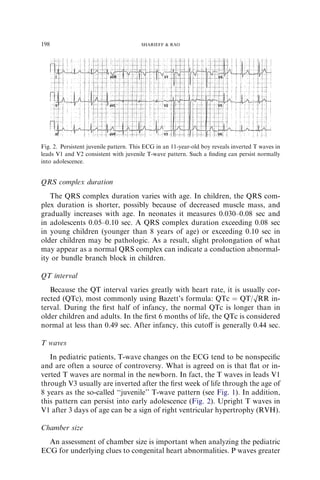
leads V5 and V6 (Fig. 2; and see Fig. 1).
PR interval
Similarly, the PR interval also varies with age, gradually increasing with
cardiac maturity and increased muscle mass. In neonates, it ranges from
0.08–0.15 sec and in adolescents from 0.120–0.20 sec [3]. The normal shorter
PR interval in children must be taken into account when considering the
diagnosis of conduction and atrioventricular (AV) block.
Fig. 1. Normal ECG of 4-week-old infant. The ECG demonstrates right axis deviation and
large R-wave amplitude and inverted T waves in the right precordial leads (V1 and V2) indicat-
ing right ventricular dominance normally seen in early infancy. Also note the fast heart rate,
which is also normal for this age group.
197THE PEDIATRIC ECG](https://image.slidesharecdn.com/thepediatricecg-130920232037-phpapp02/85/The-pediatric-ecg-3-320.jpg)

![ventricular in origin. Although AV node re-entrant tachycardias are more
common in adults, the vast majority of tachycardias in children are supra-
ventricular in origin. It is important to record continuous ECG or rhythm
strips with the child in tachycardia, while medication is being pushed, and
when converted to sinus rhythm. On recognition of a tachycardia, stepwise
questioning can help clarify the ECG tracing. Is it regular or irregular? Is
the QRS complex narrow or wide? Does every P wave result in a single
QRS complex?
Sinus tachycardia can be differentiated from other tachycardias by a nar-
row QRS complex and a P wave that precedes every QRS complex. Sinus
tachycardia is a normal rhythm with activity and exercise and can be a nor-
mal physiologic response to stresses, such as fever, dehydration, volume
loss, anxiety, or pain. Sinus tachycardia that occurs at rest may be a sign
of sinus node dysfunction. It is important to keep in mind, however, that
the normal range for heart rate is higher in children (see Table 1).
Supraventricular tachycardia (SVT) is the most common symptomatic
dysrhythmia in infants and children, with a frequency of 1 in 250–1000 pa-
tients [6]. The peak incidence of SVT is during the first 2 months of life.
Infants with SVT typically present with nonspecific complaints, such as fuss-
iness, poor feeding, pallor, or lethargy. Older children may complain of chest
pain, pounding in their chest, dizziness, shortness of breath, or may demon-
strate an altered level of consciousness. The diagnosis often begins in triage
with the nurse reporting that ‘‘The heart rate is too fast to count.’’
In newborns and infants with SVT, the heart rate is greater than 220 bpm
and can be as fast as 280 bpm, whereas in older children, SVT is defined as
a heart rate of more than 180 bpm [7]. On the ECG, supraventricular tachy-
cardia is evidenced by a narrow QRS complex tachycardia without discern-
ible P waves or beat-to-beat variability (Fig. 3). The initial ECG may be
normal, however, and a 24-hour rhythm recording (eg, Holter monitor) or
an event monitor may be necessary to document the dysrhythmia in cases
of intermittent episodes. In children younger than 12 years of age, the
most common cause of supraventricular tachycardia is an accessory atrio-
ventricular pathway, whereas in adolescents, AV node re-entry tachycardia
becomes more evident [5].
SVT can be associated with Wolff Parkinson White (WPW) syndrome.
SVT in WPW syndrome generally is initiated by a premature atrial depolar-
ization that travels to the ventricles by way of the normal atrioventricular
pathway, travels retrograde through the accessory pathway, and re-enters
the AV node to start a re-entrant type of tachycardia [7,8]. Antegrade con-
duction through the AV node followed by retrograde conduction through
the accessory pathway produces a narrow complex tachycardia (orthodromic
tachycardia) and is the most common form of SVT found in WPW syndrome
[7,8]. Less commonly re-entry occurs with antegrade conduction through the
accessory pathway and retrograde conduction through the AV node (anti-
dromic tachycardia) to produce a wide complex tachycardia [9]. Typical
200 SHARIEFF & RAO](https://image.slidesharecdn.com/thepediatricecg-130920232037-phpapp02/85/The-pediatric-ecg-6-320.jpg)
![ECG findings of WPW are a short PR interval, wide QRS complex, and
a positive slurring in the upstroke of the QRS complex, known as a delta
wave (Fig. 4). The ECG in most WPW SVT does not show the delta wave,
because tachycardia is not conducted down through the accessory pathway.
Episodes of SVT in children who have WPW usually occur early in the first
year of life [9]. Episodes of SVT often resolve during infancy but may recur
later in life, usually from 6–8 years of age [9].
Atrial ectopic tachycardia may be differentiated from SVT by the pres-
ence of different P-wave morphologies. Each P wave is conducted to the
Fig. 3. Supraventricular tachycardia. This ECG demonstrates a supraventricular tachycardia in
a neonate. Note the remarkably fast heart rate (260 bpm) and narrow QRS complexes without
discernible P waves. It often can be difficult to interpret the ECG in this setting, because the
normal QRS complex width is shorter in infants and young children.
Fig. 4. Wolff Parkinson White syndrome. This ECG is of a 9-year-old boy who presented to the
ED with palpitations and minor neck trauma and was found to be in a supraventricular tachy-
cardia. This ECG was done shortly after adenosine was administered and the rhythm converted
to sinus. Note the abnormally short PR interval for age and the presence of a delta wave
(arrows) at the beginning of the QRS complex. The delta wave is not uniformly apparent in
all leads.
201THE PEDIATRIC ECG](https://image.slidesharecdn.com/thepediatricecg-130920232037-phpapp02/85/The-pediatric-ecg-7-320.jpg)
![ventricle, and because the ectopic atrial focus is faster than the SA node, the
ectopic determines the ventricular rate (Fig. 5).
Although supraventricular tachycardias are more common than those of
ventricular origin, it is important to remember that the normal QRS com-
plex is shorter in duration in children than adults. As a result, a QRS com-
plex width of 0.09 sec may seem normal on the ECG but actually represents
an abnormal wide QRS complex tachycardia in an infant. The differential
diagnosis of wide complex tachycardia includes sinus/supraventricular
tachycardia with bundle branch block or aberrancy, antidromic AV re-entry
tachycardia, ventricular tachycardia (VT), or coarse ventricular fibrillation
[10]. ECG findings that support the presence of VT include AV dissociation
with the ventricular rate exceeding the atrial rate, significantly prolonged
QRS complex intervals, and the presence of fusion or capture beats. If there
is a right bundle branch block, the presence of VT is supported by a qR
complex in V1 and a deep S wave in V6. If there is a left bundle branch block
present, then the presence of VT is supported by a notched S wave and an
R-wave duration of O0.03 sec in V1 and V2 and a Q wave in V6 [10].
Conduction abnormalities
All degrees of AV block may occur in pediatric patients. It is important
to remember that the normal PR interval in infants is shorter and lengthens
as cardiac tissue matures with age. A normal appearing PR interval of 0.20
sec may thus in fact represent a pathologic first-degree AV block in an infant
or young child.
Fig. 5. Atrial ectopic tachycardia. This ECG is of an 18-month-old infant who presented with
a several week history of poor feeding and vomiting. The ECG shows atrial ectopic tachycardia.
Notice the different P-wave morphologies (arrows). Each P wave is conducted to the ventricle,
and because the ectopic atrial focus is faster than the sinoatrial node, it determines the ventric-
ular rate.
202 SHARIEFF & RAO](https://image.slidesharecdn.com/thepediatricecg-130920232037-phpapp02/85/The-pediatric-ecg-8-320.jpg)
![Complete heart block is a common cause of significant bradycardia in
pediatric patients and may be acquired or congenital (Fig. 6). Causes of con-
genital heart block include structural lesions like L-transposition of the
great arteries, or maternal connective tissue disorders. Acquired heart block
may result from disorders such as Lyme disease, systemic lupus erythemato-
sus, muscular dystrophies, Kawasaki disease, or rheumatic fever [11].
Bundle branch blocks (BBB) may be present when there is QRS complex
prolongation abnormal for a given age. Right BBB occurs with abnormal
rightward and anterior terminal forces, frequently manifesting on ECG as
an rSR# pattern in leads V1 and V2. Right BBB is more common than left
BBB and can be seen after surgical repair of congenital heart defects, partic-
ularly ventricular septal defect repairs. Similarly, left BBB is seen with abnor-
mal leftward and posterior forces, best appreciated in leads V5 and V6. Left
BBB is rare in children, however, and the possibility of WPW should be con-
sidered, because this syndrome can mimic a left BBB pattern.
Congenital heart
With an incidence of 8/1000 live births, many of the structural congenital
heart diseases present in the neonatal period [12]. The signs and symptoms
of congenital heart disease may be nonspecific, however. Infants may pres-
ent with tachypnea, sudden onset of cyanosis or pallor that may worsen with
crying, sweating with feeds, lethargy, or failure to thrive [13].
Congenital heart disease lesions that present in the first 2–3 weeks of life
are typically the ductal-dependent cardiac lesions. During this period the
ductus arteriosus had been sustaining blood flow for these infants. When
the ductus closes anatomically at 2–3 weeks of life, these infants suddenly
Fig. 6. Complete heart block. The QRS complexes are independent of the P waves (dots). This
ECG is from a 6-month-old infant who had undergone recent repair of a membranous VSD
that temporarily stunned the AV node.
203THE PEDIATRIC ECG](https://image.slidesharecdn.com/thepediatricecg-130920232037-phpapp02/85/The-pediatric-ecg-9-320.jpg)
![become ill. Depending on the underlying structural abnormality, these neo-
nates present with sudden cyanosis or signs of cardiovascular collapse.
These newborns have depended on the ductus arteriosus to supply blood
to the lungsdas with tetralogy of Fallot (ToF) or tricuspid atresia (TA)d
or to the systemic circulationdas in the case of coarctation of the aorta
(CoA) or hypoplastic left heart syndrome (HLHS). The main causes of
cyanotic congenital heart disease are ToF, TA, transposition of the great
arteries (TGA), truncus arteriosus, total anomalous pulmonary venous
return (TAPVR), and pulmonary atresia or stenosis. Time of onset and
the common associated ECG findings are listed in Table 3 [14–16].
The other class of congenital cardiac lesions that present in the first
month of life are the left-to-right intracardiac shunts, such as ventricular
septal or atrioventricular canal defects. As the normal pulmonary vascular
resistance falls over the first month of life, any pre-existing left-to-right
shunt sees a gradual increase in flow across the shunt, resulting in congestive
heart failure. The differential diagnosis of congenital heart diseases that
cause congestive heart failure include not only the left-to-right intracardiac
Table 3
Congenital heart abnormalities: time of onset and typical ECG findings
CHD Onset RVH LVH RAE LAE RAD LAD RBBB
PDA 2nd
–3rd
wk þ (older
child)
ASD Variable þ þ þ þ
VSD 2nd
–12th
wk þ þ þ þ
CoA 1st
wk þ
(newborn)
þ
(older)
þ
(newborn)
ToF 1st
–12th
wk þ þ þ
(after
repair)
TGA 1st
wk þ þ þ
Truncus
arteriosis
Variable,
infancy
þ þ
Tricuspid
atresia
1st
–4th
wk þ þ þ
PA Variable þ
HLHS 1st
wk þ
AS Variable þ
PS 1st
–4th
wk þ þ þ
AVC 2nd
–3rd
wk þ þ þ þ þ þ
HCM Variable,
adulthood
þ þ
AS, aortic stenosis; ASD, atrial septal defect; AVC, atrioventricular canal defects; CoA, co-
arctation of aorta; HCM, hypertrophic cardiomyopathy; HLHS, hypoplastic left heart syn-
drome; LAD, left axis deviation; LAE, left atrial enlargement; LVH, left ventricular
hypertrophy; PA, pulmonary atresia; PDA, patent ductus arteriosus; PS, pulmonic stenosis;
RAD, right axis deviation; RAE, right atrial enlargement; RBBB, right bundle branch block;
RVH, right ventricular hypertrophy; TGA, transposition of great vessels; ToF, tetralogy of Fal-
lot; VSD, ventricular septal defect.
204 SHARIEFF & RAO](https://image.slidesharecdn.com/thepediatricecg-130920232037-phpapp02/85/The-pediatric-ecg-10-320.jpg)
![shunts, but also HLHS, CoA, TA, endocardial cushion defect, patent ductus
arteriosus (PDA), aortic stenosis, interrupted aortic arch, aortic atresia, and
mitral valve atresia [17,18].
An ECG should be obtained in all infants suspected of having congenital
heart disease. Although the ECG does not make the diagnosis, it can show
evidence of conduction abnormalities or chamber enlargement as a result of
the congenital defect. In addition, the ECG provides a means of assessing
the degree of cardiac flow obstruction, chamber hypertrophy, and the devel-
opment of dysrhythmias as a result of the congenital heart disease.
Several ECG findings can be associated with specific congenital heart dis-
eases (Table 3). The ECG can seem normal or age-appropriate for some
congenital heart diseases. These include cases of PDA, mild-moderate pul-
monary stenosis, TGA, ASD, VSD, and CoA, though the presence of ab-
normalities on the ECG is generally the rule.
RVH is the most common abnormality seen with congenital heart disease
and can be seen with pulmonary stenosis, ToF, TGA, and VSD with pulmo-
nary stenosis or pulmonary hypertension, CoA (newborn), pulmonary valve
atresia, HLHS, and ASD. RVH may be difficult to distinguish during the
early neonatal period because of the normal right ventricular predominance
on the ECG at this age. The abnormality becomes clear, however, with later
infancy and early childhood.
LVH is seen in lesions with small right ventricles, such as tricuspid atre-
sia, pulmonary atresia with intact ventricular septum, and lesions with left
ventricular outflow track obstruction (AS, CoA, hypertrophic cardiomyop-
athy [HCM]). LVH also can be seen in older children with PDA and larger
VSD or AV canal defects (Fig. 7).
In conjunction with ventricular changes, atrial abnormalities can be de-
tected on the ECG with congenital heart disease. RAE occurs with large
Fig. 7. Atrioventricular canal defect. This ECG is of an 8-week-old boy who had an AVC. The
ECG reveals biventricular hypertrophy and left axis deviation not typical for this age group.
205THE PEDIATRIC ECG](https://image.slidesharecdn.com/thepediatricecg-130920232037-phpapp02/85/The-pediatric-ecg-11-320.jpg)
![left-to-right shunts, causing RA volume overload, and can be seen with ASD,
atrioventricular canal defects, tricuspid atresia, Ebstein anomaly, and severe
pulmonary stenosis. LAE can be seen with mitral stenosis or insufficiency, left
heart obstruction, and complete AV canal defects.
Abnormal QRS axis deviations are seen commonly with congenital heart
defects. Right axis deviation can occur with ASD, ToF, CoA, TGA, and
pulmonary stenosis. Left axis deviation can be seen with large VSD, tricus-
pid atresia, TGA, and complete AV canal defects (Fig. 7). Right BBB can be
seen with ASD, complete AV defects, small VSD, and after repair of ToF. It
is important to keep in mind, however, that incomplete right BBB can be
a normal part of the involution of right ventricular forces during infancy
and early childhood (Fig. 8).
Hypertrophic cardiomyopathy
Although most cases of HCM are diagnosed at 30–40 years of age, 2% of
cases occur in children younger than 5 years of age and 7% occur in children
younger than 10 years of age [19]. Clinical presentation varies, with patients
experiencing chest pain, palpitations, shortness of breath, syncopal or near
syncopal episodes, or sudden death. The hallmark anatomic finding in pa-
tients who have HCM is an asymmetric, hypertrophied, nondilated left ven-
tricle with greater involvement of the septum than the ventricular free wall.
ECG findings include LAE and LVH, ST-segment abnormalities, T-wave
inversions, Q waves, and diminished or absent R waves in the lateral leads.
Premature atrial and ventricular contractions, supraventricular tachycardia,
multifocal ventricular dysrhythmias, or new onset atrial fibrillation also may
be present.
Fig. 8. Incomplete right bundle branch block. This ECG is from a 4-year-old boy. Lead V1
demonstrates an rSR# pattern, but a relatively narrow QRS complex. The amplitude of the
R# wave approaches criteria for RVH, but this ECG also may be a normal variant.
206 SHARIEFF & RAO](https://image.slidesharecdn.com/thepediatricecg-130920232037-phpapp02/85/The-pediatric-ecg-12-320.jpg)
![Myocarditis
An inflammatory condition of the myocardium, this disease has numerous
causes; the most common etiology in North America is viral (Coxsackie A
and B, ECHO viruses, and influenza viruses) [20,21]. The clinical presentation
varies depending on multiple factors, including etiology and patient age. Neo-
nates and infants may present with symptoms such as lethargy, poor feeding,
irritability, pallor, fever, and failure to thrive. Symptoms suggestive of heart
failure like diaphoresis with feeding, rapid breathing, tachycardia, or respira-
tory distress also may be present. Older children may complain of weakness
and fatigue, particularly on exertion. Signs of poor cardiac function, includ-
ing signs of congestive heart failure, may be present on examination.
Multiple ECG findings may be present. Sinus tachycardia is the most
common dysrhythmia. A tachycardia faster than expected for the degree
of fever (10 bpm for each degree of temperature elevation) may indicate
myocarditis. Many other dysrhythmias may be associated with myocarditis,
including junctional tachycardias, ventricular ectopy, ventricular tachycar-
dias, and even second- and third-degree AV blocks. Morphologically there
may be T-wave flattening or inversion and low QRS complex voltage, less
than 5 mm in all limb leads.
Summary
Knowledge of the basics of pediatric ECG interpretation is helpful in dif-
ferentiating normal from abnormal findings. These basics include familiarity
with the age-related normal findings in heart rate, intervals, axis and wave-
form morphologies; an understanding of cardiac physiologic changes asso-
ciated with age and maturation, particularly the adaptation from right to
left ventricular predominance; and a rudimentary understanding of common
pediatric dysrhythmias and findings associated with congenital heart
diseases.
References
[1] Allen HD, Gutgesell HP, Clark EB, et al, editors. Moss and Adams’ heart disease in infants,
children, and adolescents. 6th edition. Philadelphia: Lippincott, Williams and Wilkins; 2001.
[2] Horton L, Mosee S, Brenner J. Use of the electrocardiogram in a pediatric emergency depart-
ment. Arch Pediatr Adolesc Med 1994;148:184–8.
[3] Park MK, Guntheroth WG. How to read pediatric ECGs. 3rd edition. St. Louis: Mosby
Year Book; 1992.
[4] Park MK, George R. Pediatric cardiology for practitioners. 4th edition. St. Louis: Mosby;
2002. p. 34–51.
[5] Robinson B, Anisman P, Eshagh E. A primer on pediatric ECGs. Contemp Pediatr 1994;11:
69.
[6] Ziegler VL, Gillette PC, editors. Practical management of pediatric cardiac arrhythmias. Ar-
monk NY: Futura Publishing Co., Inc.; 2001.
207THE PEDIATRIC ECG](https://image.slidesharecdn.com/thepediatricecg-130920232037-phpapp02/85/The-pediatric-ecg-13-320.jpg)
![[7] Perry JC. Supraventricular tachycardia. In: Garson A Jr, Bricker JT, Fisher DJ, et al, editors.
The science and practice of pediatric cardiology. 2nd edition. Baltimore: Williams & Wilkins;
1998.
[8] O’Laughlin MP. Congestive heart failure in children. Pediatr Clin North Am 1999;46(2):
263–73.
[9] Gewitz MH, Vetter VL. Cardiac emergencies. In: Fleisher GR, Ludwig S, editors. Textbook
of pediatric emergency medicine. 4th edition. Philadelphia: Lippincott Williams & Williams;
2000.
[10] Silka M. Emergency management of arrhythmias. In: Deal B, Wolff G, Gelband H, editors.
Current concepts in diagnosis and management of arrhythmias in infants and children. Ar-
monk NY: Futura Publishing Co.; 1998. p. 319–22.
[11] Fitzmaurice L, Gerardi MJ. Cardiovascular system. In: Gausche-Hill M, Fuchs S, Yama-
moto L, editors. The pediatric emergency medicine resource. 4th edition. Sudbury, MA:
Jones and Bartlett Publishers; 2004.
[12] McCollough M, Sharieff G. Common complaints in the first month of life. Pediatr Emerg
Med Clin N Am 2002;20:27–48.
[13] Savitsky E, Alejos J, Votey S. Emergency department presentations of pediatric congenital
heart disease. J Emerg Med 2003;24:239–45.
[14] Woolridge D, Love J. Congenital heart disease in the pediatric emergency department. Path-
ophysiology and clinical characteristics. Pediatr Emerg Med Reports 2002;7:69–80.
[15] Sharieff G, Wylie T. Pediatric cardiac disorders. J Emerg Med 2004;26:65–79.
[16] Flynn P, Engle M, Ehlers K, et al. Cardiac issues in the pediatric emergency. Pediatr Clin N
Am 1992;39:955–83.
[17] DiMaio A, Singh J, et al. The infant with cyanosis in the emergency department. Pediatr Clin
N Am 1992;39:987–1006.
[18] al Wigle E. Hypertrophic cardiomyopathy: clinical spectrum and treatment. Circulation
1995;92:1680.
[19] Jouriles N. Pericardial and myocardial disease. In: Marx J, Hockberger R, Walls R, editors.
Rosen’s emergency medicine concepts and clinical practice. 5th edition. St Louis: Mosby;
2002. p. 1143–4.
[20] Li MM, Klassen TP, Watters LK. Cardiovascular disorders. In: Barkin R, editor. Pediatric
emergency medicine, concepts and clinical practice. 2nd edition. St. Louis: Mosby, Inc.;
1997.
[21] Kopeck SL, Gersh BJ. Dilated cardiomyopathy and myocarditis: natural history, etiology,
clinical manifestations, and management. Curr Prob Cardiol 1987;12:569–647.
208 SHARIEFF & RAO](https://image.slidesharecdn.com/thepediatricecg-130920232037-phpapp02/85/The-pediatric-ecg-14-320.jpg)


