Credible Sources of Info in Web2.0- A Reflection by Pray
Problem with Search Engine like Google and Yahoo Do not distinguish between academic and personal source Search only key words or phrases and returns result.  Since anyone can post/edit anything in Wiki, it is not a reliable source; so is the most blogs and forums in the net. Using a database, like EbscoHost or ProQuest, is the best way to find a credible source because these databases weed out articles that are not very reliable.
The way forward….. Instead of Google, one should use Google Scholar. Still better is using research databases such as SciVerse Scopus, PubMed, ProQuest, EBSCOhost  These databases weed out articles that are not very reliable; hence above databases list reliable sources.
Google Scholar Technical reports, conference presentations, and journal articles are included, as are links to Google Books.  However, Google Scholar, like regular Google, is created by Google’s “robots” which scan different webpages for scholarly material, with less care going into the journals that publish these articles.
Google Scholar Incapable to list all of the articles as scholarly databases  do. Broken links and repetitive results are common. A better approach is to use it, though, in combination with other subject-specific databases discussed  hereafter.
SciVerse Scopus Provides authentic  database containing abstracts and citations for scholarly journal articles. SciVerse Scopus, as narrated by  itself is,  integrating ScienceDirect, Scopus, SciTopics and targeted Web content, with community developed applications SciVerse is a groundbreaking platform  that  gives you  our data, your way . Not free resource; one has to pay for search.
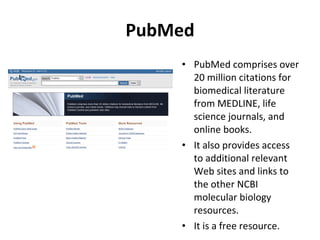
PubMed PubMed comprises over 20 million citations for biomedical literature from MEDLINE, life science journals, and online books. It also provides access to additional relevant Web sites and links to the other NCBI molecular biology resources. It is a free resource.
ProQuest Results vetted, reliable information. One has three option to search: By Library Type:  By Product Line: By Subject For more information one may  visit  www.proquest.com Not free resource; one has to pay for search.
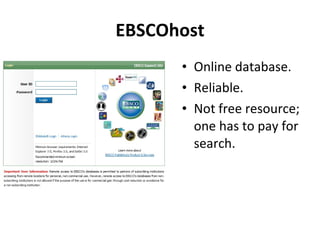
EBSCOhost Online database. Reliable. Not free resource; one has to pay for search.
Who is creator? Check for name  of author(s) and their affiliation. Does search engine immediately spot them in the first page? Check for “About us” page.
Scan the document & look for….. The reference list —good article usually cite references.  Also look for whether references are mostly from a single/common author(s).
Be cautious if….. The author(s) provide a one-sided view. Discard if you identify any prejudiced content in the article. Check for outdated references only.
Acknowledgements Sites of Google Scholar, SciVerse Scopus, PubMed, ProQuest, EBSCOhost.
 

Reflection on web2.0

  • 1.
    Credible Sources ofInfo in Web2.0- A Reflection by Pray
  • 2.
    Problem with SearchEngine like Google and Yahoo Do not distinguish between academic and personal source Search only key words or phrases and returns result. Since anyone can post/edit anything in Wiki, it is not a reliable source; so is the most blogs and forums in the net. Using a database, like EbscoHost or ProQuest, is the best way to find a credible source because these databases weed out articles that are not very reliable.
  • 3.
    The way forward…..Instead of Google, one should use Google Scholar. Still better is using research databases such as SciVerse Scopus, PubMed, ProQuest, EBSCOhost These databases weed out articles that are not very reliable; hence above databases list reliable sources.
  • 4.
    Google Scholar Technicalreports, conference presentations, and journal articles are included, as are links to Google Books. However, Google Scholar, like regular Google, is created by Google’s “robots” which scan different webpages for scholarly material, with less care going into the journals that publish these articles.
  • 5.
    Google Scholar Incapableto list all of the articles as scholarly databases do. Broken links and repetitive results are common. A better approach is to use it, though, in combination with other subject-specific databases discussed hereafter.
  • 6.
    SciVerse Scopus Providesauthentic database containing abstracts and citations for scholarly journal articles. SciVerse Scopus, as narrated by itself is, integrating ScienceDirect, Scopus, SciTopics and targeted Web content, with community developed applications SciVerse is a groundbreaking platform that gives you our data, your way . Not free resource; one has to pay for search.
  • 7.
    PubMed PubMed comprisesover 20 million citations for biomedical literature from MEDLINE, life science journals, and online books. It also provides access to additional relevant Web sites and links to the other NCBI molecular biology resources. It is a free resource.
  • 8.
    ProQuest Results vetted,reliable information. One has three option to search: By Library Type: By Product Line: By Subject For more information one may visit www.proquest.com Not free resource; one has to pay for search.
  • 9.
    EBSCOhost Online database.Reliable. Not free resource; one has to pay for search.
  • 10.
    Who is creator?Check for name of author(s) and their affiliation. Does search engine immediately spot them in the first page? Check for “About us” page.
  • 11.
    Scan the document& look for….. The reference list —good article usually cite references. Also look for whether references are mostly from a single/common author(s).
  • 12.
    Be cautious if…..The author(s) provide a one-sided view. Discard if you identify any prejudiced content in the article. Check for outdated references only.
  • 13.
    Acknowledgements Sites ofGoogle Scholar, SciVerse Scopus, PubMed, ProQuest, EBSCOhost.
  • 14.