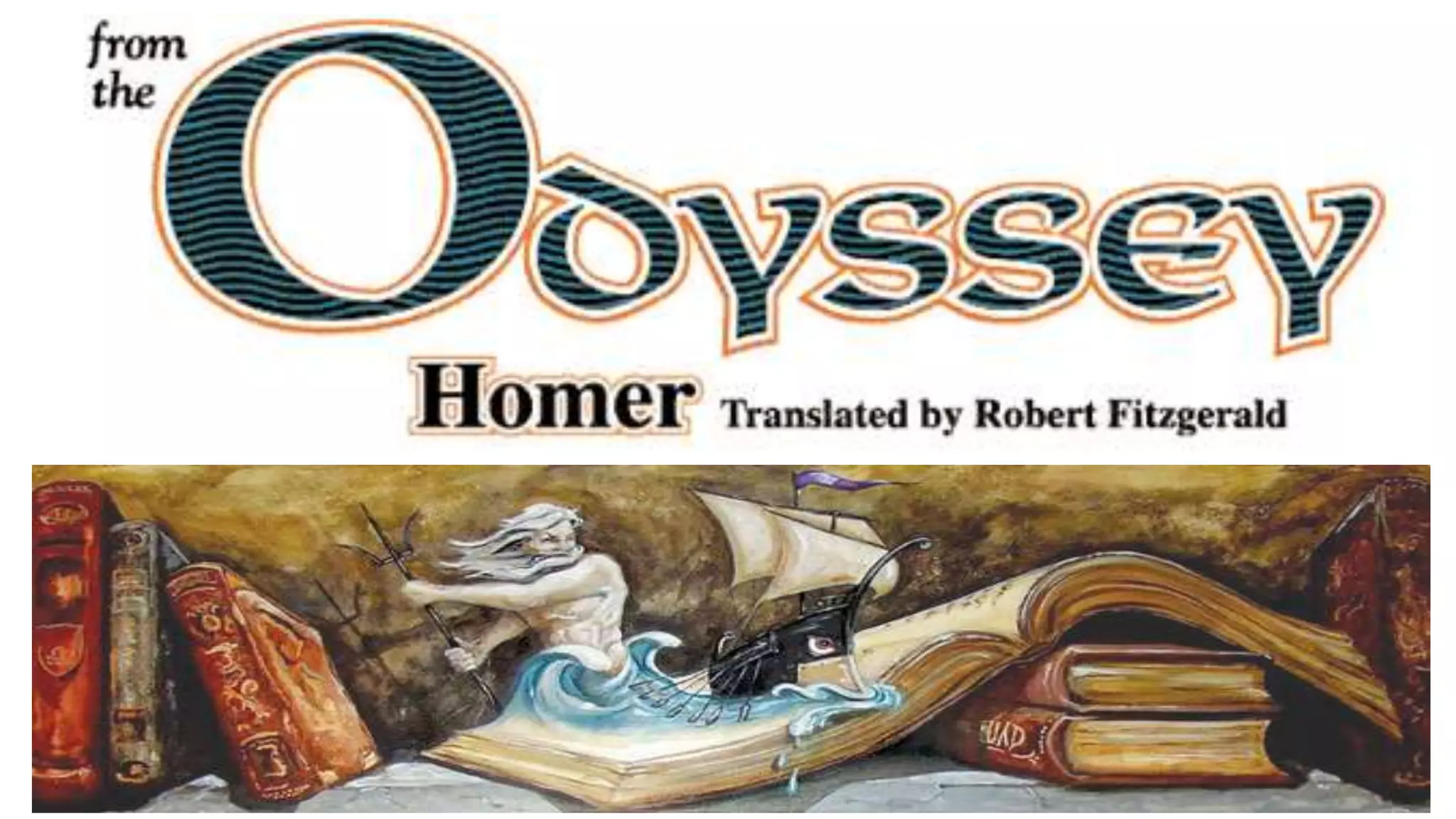
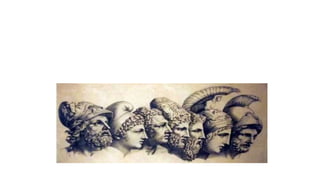
Homer
(800 B.C.)
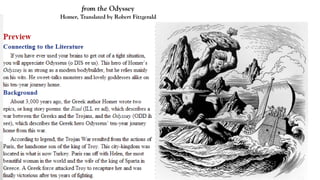
A legendary poet and historian, Homer is credited with
two of the most famous and enduring epics of all time:
the Iliad and the Odyssey. Their impressive length and
scope have resulted in the coining of an adjective from
the author’s name: homeric, meaning “large-scale,
massive, or enormous.”
Facts about Homer’s life have been lost over time.
Scholars even disagree about whether the Iliad and the
Odyssey were written by the same person—and whether
Homer existed at all! According to tradition, however,
Homer was born in western Asia Minor, and he was
blind.
In later centuries, the Iliad and the Odyssey were the
basis of Greek and Roman education.
Character Study
Odysseus is an epic hero who
was admired by the ancient
Greeks, but he may not be a
good role model for people
living today. In a character
study, evaluate Odysseus’
status as a hero by analyzing
his actions and motives.
Support your analysis with
examples and quotations from
the epic.
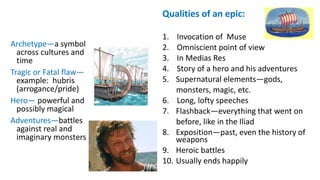
Archetype—a symbol
across cultures and
time
Tragic or Fatal flaw—
example: hubris
(arrogance/pride)
Hero— powerful and
possibly magical
Adventures—battles
against real and
imaginary monsters
Qualities of an epic:
1. Invocation of Muse
2. Omniscient point of view
3. In Medias Res
4. Story of a hero and his adventures
5. Supernatural elements—gods,
monsters, magic, etc.
6. Long, lofty speeches
7. Flashback—everything that went on
before, like in the Iliad
8. Exposition—past, even the history of
weapons
9. Heroic battles
10. Usually ends happily
http://www.amazon.com/The-Trojan-Horse-
Graphic-
Legends/dp/082256484X/ref=pd_sim_b_84?ie=UT
F8&refRID=1YYGQW5FVYSJTKN8JJPC
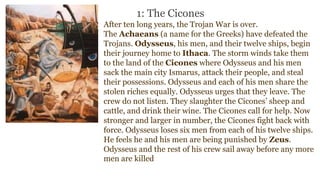
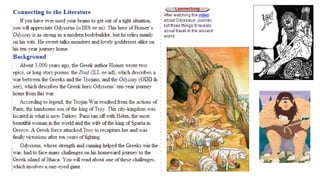
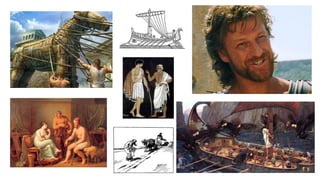
After ten long years, the Trojan War is over.
The Achaeans (a name for the Greeks) have defeated the
Trojans. Odysseus, his men, and their twelve ships, begin
their journey home to Ithaca. The storm winds take them
to the land of the Cicones where Odysseus and his men
sack the main city Ismarus, attack their people, and steal
their possessions. Odysseus and each of his men share the
stolen riches equally. Odysseus urges that they leave. The
crew do not listen. They slaughter the Cicones’ sheep and
cattle, and drink their wine. The Cicones call for help. Now
stronger and larger in number, the Cicones fight back with
force. Odysseus loses six men from each of his twelve ships.
He feels he and his men are being punished by Zeus.
Odysseus and the rest of his crew sail away before any more
men are killed
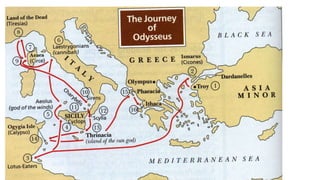
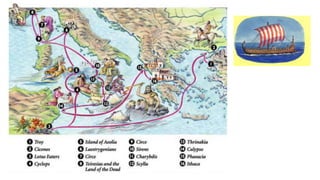
1: The Cicones
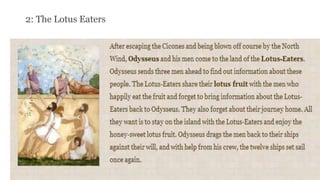
2: The Lotus Eaters
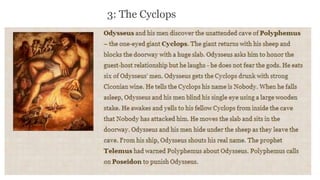
3: The Cyclops
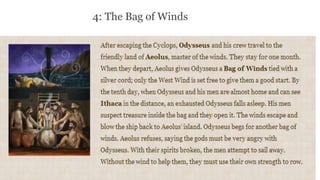
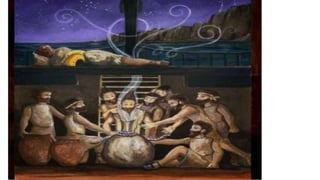
4: The Bag of Winds
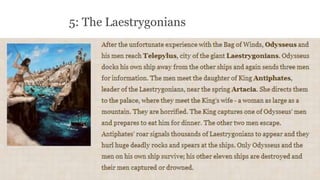
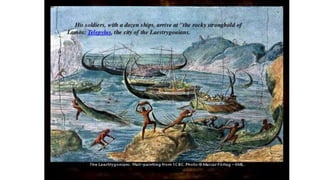
5: The Laestrygonians
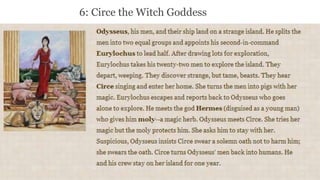
6: Circe the Witch Goddess
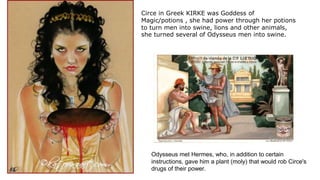
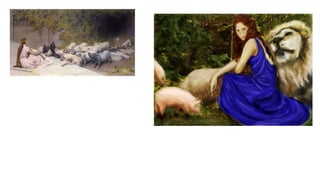
Circe in Greek KIRKE was Goddess of
Magic/potions , she had power through her potions
to turn men into swine, lions and other animals,
she turned several of Odysseus men into swine.
Odysseus met Hermes, who, in addition to certain
instructions, gave him a plant (moly) that would rob Circe's
drugs of their power.
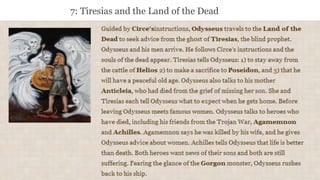
7: Tiresias and the Land of the Dead
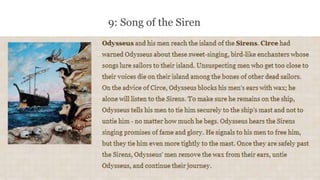
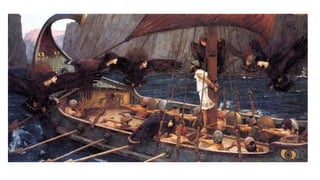
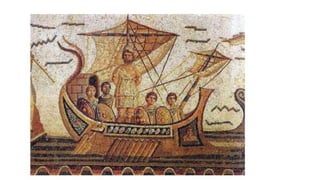
9: Song of the Siren
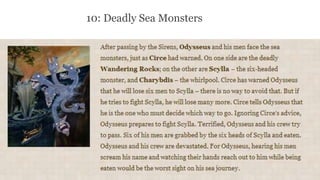
10: Deadly Sea Monsters
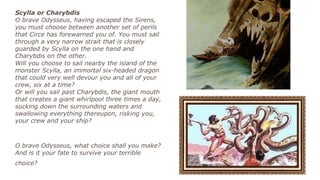
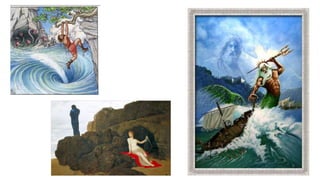
Scylla or Charybdis
O brave Odysseus, having escaped the Sirens,
you must choose between another set of perils
that Circe has forewarned you of. You must sail
through a very narrow strait that is closely
guarded by Scylla on the one hand and
Charybdis on the other.
Will you choose to sail nearby the island of the
monster Scylla, an immortal six-headed dragon
that could very well devour you and all of your
crew, six at a time?
Or will you sail past Charybdis, the giant mouth
that creates a giant whirlpool three times a day,
sucking down the surrounding waters and
swallowing everything thereupon, risking you,
your crew and your ship?
O brave Odysseus, what choice shall you make?
And is it your fate to survive your terrible
choice?
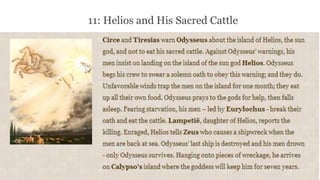
11: Helios and His Sacred Cattle
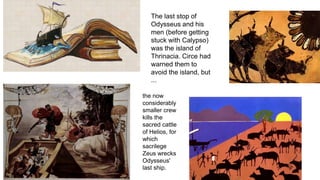
The last stop of
Odysseus and his
men (before getting
stuck with Calypso)
was the island of
Thrinacia. Circe had
warned them to
avoid the island, but
...
the now
considerably
smaller crew
kills the
sacred cattle
of Helios, for
which
sacrilege
Zeus wrecks
Odysseus'
last ship.
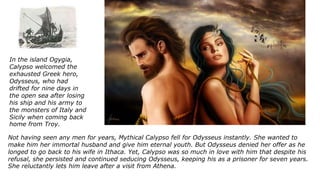
Not having seen any men for years, Mythical Calypso fell for Odysseus instantly. She wanted to
make him her immortal husband and give him eternal youth. But Odysseus denied her offer as he
longed to go back to his wife in Ithaca. Yet, Calypso was so much in love with him that despite his
refusal, she persisted and continued seducing Odysseus, keeping his as a prisoner for seven years.
She reluctantly lets him leave after a visit from Athena.
In the island Ogygia,
Calypso welcomed the
exhausted Greek hero,
Odysseus, who had
drifted for nine days in
the open sea after losing
his ship and his army to
the monsters of Italy and
Sicily when coming back
home from Troy.
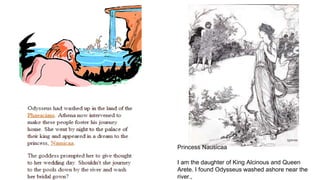
I am the daughter of King Alcinous and Queen
Arete. I found Odysseus washed ashore near the
river.,
Princess Nausicaa
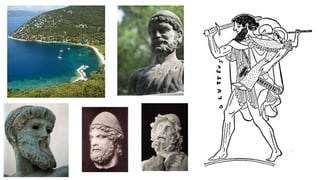
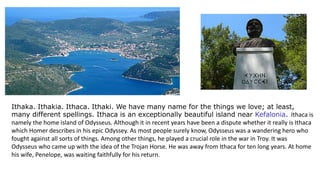
Ithaka. Ithakia. Ithaca. Ithaki. We have many name for the things we love; at least,
many different spellings. Ithaca is an exceptionally beautiful island near Kefalonia. Ithaca is
namely the home island of Odysseus. Although it in recent years have been a dispute whether it really is Ithaca
which Homer describes in his epic Odyssey. As most people surely know, Odysseus was a wandering hero who
fought against all sorts of things. Among other things, he played a crucial role in the war in Troy. It was
Odysseus who came up with the idea of the Trojan Horse. He was away from Ithaca for ten long years. At home
his wife, Penelope, was waiting faithfully for his return.
THE ODYSSEY: AN INTRODUCTION
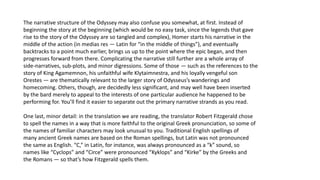
The Odyssey is one of the two great Greek epics attributed to the bard Homer, and is one of the
most revered and influential works of Western literature. An epic is a long narrative poem
usually about the deeds of a hero. This epic hero often embodies the goals and values of his or
her culture. Typically, epics are based in part on historical fact, blending legend with truth.
Background
In primitive societies, stories were passed from one person to another by word of mouth.
Storytellers, or bards, arriving in a village, court, or camp, would entertain eager listeners with
tales of the gods or great heroes. The longer stories, now called epics, might be told over a
series of days. To help the storytellers remember these lengthy pieces, the tales were composed
in poetic lines and were usually recited to the accompaniment of stringed instruments.
Although these stories were filled with incredible deeds and fantastic exploits, many were
based on historical events and were accepted as fact by the listeners. Two epics, the Iliad and
the Odyssey, had their roots in the events of the Trojan War, which occurred about 1200 B.C.
While legend credits the abduction of the Spartan queen Helen as the cause, most probably
economic conflict over control of trade in the Aegean Sea was the reason for the war.
The Iliad and the Odyssey were both passed down through word of mouth by wandering bards
for several centuries, until they were finally written down when the Greeks first developed an
alphabet, about 800 B.C. The author traditionally credited with assembling a number of earlier
and shorter narrative songs and putting them in their current, final form as epics was a bard
named Homer who hailed from the western coast of Asia Minor (modern-day Turkey).
According to tradition, he was blind (not a surprising disability to find in a bard, who would
have had a hard time finding other modes of employment). Modern scholars have found no
historical evidence that such an individual really existed. However, both the Iliad and the
Odyssey bear the marks of a single, unifying artistic intelligence which, for the sake of
convenience, we can attribute to an inspired bard named Homer.
Although a major purpose for telling and retelling the myths and legends was entertainment,
another goal was to teach important lessons about religion and society. Divine beings often
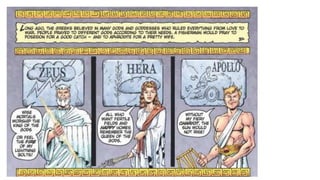
play a part in epics, guiding the hero or thwarting his actions. Myths about Zeus, Athena, and
Apollo were many, but there were also stories about great human heroes such as Hector,
Odysseus, and Penelope, who served as examples of ideal human qualities. In fact, Alexander
the Great credited Homer’s Iliad as the source of his ideas about valor and nobility.
As you read the Odyssey, remember that you are reading an epic that was composed to be heard
by an audience, so you might try reading some of the poem aloud. You may find a few areas
that cause difficulty when you read. The unfamiliarity as well as the sheer number of the Greek
names of the gods and humans might seem daunting at first. You may keep track of key
characters and place names on the back of your Odyssey Reading Assignments bookmark.
The poetic form of the Odyssey might also cause you some problems. Try reading the sentences
according to the punctuation, instead of line by line. Also remember that epics were composed
in an elevated style, which the translation you are reading attempts to reproduce. You’ll find
several distinct stylistic features which make epic poetry different from contemporary fiction,
such as:
• extended similes
• formal speeches instead of casual dialogue
• catalogues of names or objects
Perhaps the most noticeable stylistic feature of the Odyssey is its use of formulaic language.
Because the ancient bards relied on memory as well as improvisation in reciting their epics, they
often resorted to repetition of specific phrases or even whole passages to structure their recitals.
Many of these expressions are what are known as stock epithets —recurrent descriptive tags or
nicknames of character. Odysseus’s son Telemakhos, for instance, is frequently referred to as
“clear-headed”; Helen’s husband Menelaos is “the red-haired king.” Sunrise is almost always
described in the phrase “When Dawn stretched out her fingertips of rose.” Although modern
readers may find these formulaic expressions intrusive, ancient audiences saw them as artful
embellishments, and looked forward to hearing the familiar phrases the way modern viewers
enjoy the stock taglines of their favorite TV characters (“D’oh!”)
The narrative structure of the Odyssey may also confuse you somewhat, at first. Instead of
beginning the story at the beginning (which would be no easy task, since the legends that gave
rise to the story of the Odyssey are so tangled and complex), Homer starts his narrative in the
middle of the action (in medias res — Latin for “in the middle of things”), and eventually
backtracks to a point much earlier, brings us up to the point where the epic began, and then
progresses forward from there. Complicating the narrative still further are a whole array of
side-narratives, sub-plots, and minor digressions. Some of those — such as the references to the
story of King Agamemnon, his unfaithful wife Klytaimnestra, and his loyally vengeful son
Orestes — are thematically relevant to the larger story of Odysseus’s wanderings and
homecoming. Others, though, are decidedly less significant, and may well have been inserted
by the bard merely to appeal to the interests of one particular audience he happened to be
performing for. You’ll find it easier to separate out the primary narrative strands as you read.
One last, minor detail: in the translation we are reading, the translator Robert Fitzgerald chose
to spell the names in a way that is more faithful to the original Greek pronunciation, so some of
the names of familiar characters may look unusual to you. Traditional English spellings of
many ancient Greek names are based on the Roman spellings, but Latin was not pronounced
the same as English. “C,” in Latin, for instance, was always pronounced as a “k” sound, so
names like “Cyclops” and “Circe” were pronounced “Kyklops” and “Kirke” by the Greeks and
the Romans — so that’s how Fitzgerald spells them.
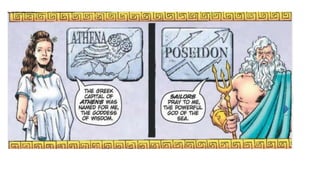
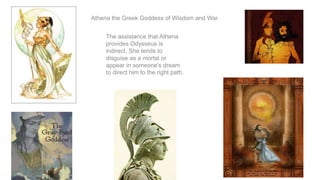
Athena the Greek Goddess of Wisdom and War.
The assistance that Athena
provides Odysseus is
indirect. She tends to
disguise as a mortal or
appear in someone's dream
to direct him to the right path.
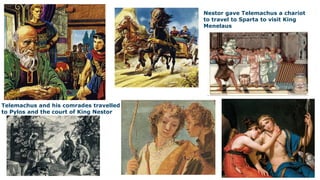
Telemachus and his comrades travelled
to Pylos and the court of King Nestor
Nestor gave Telemachus a chariot
to travel to Sparta to visit King
Menelaus
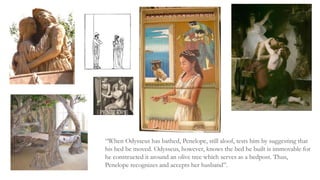
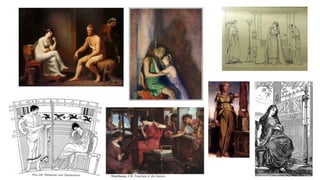
“When Odysseus has bathed, Penelope, still aloof, tests him by suggesting that
his bed be moved. Odysseus, however, knows the bed he built is immovable for
he constructed it around an olive tree which serves as a bedpost. Thus,
Penelope recognizes and accepts her husband”.
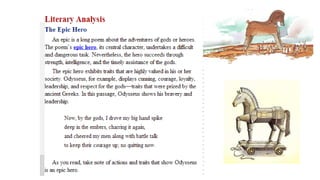
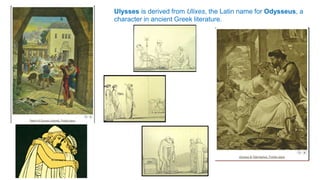
Ulysses is derived from Ulixes, the Latin name for Odysseus, a
character in ancient Greek literature.
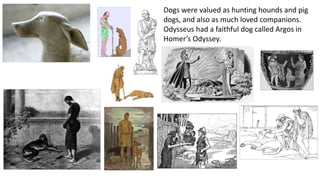
Dogs were valued as hunting hounds and pig
dogs, and also as much loved companions.
Odysseus had a faithful dog called Argos in
Homer’s Odyssey.
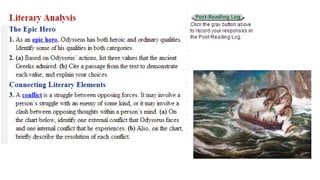
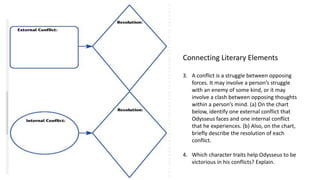
Connecting Literary Elements
3. A conflict is a struggle between opposing
forces. It may involve a person’s struggle
with an enemy of some kind, or it may
involve a clash between opposing thoughts
within a person’s mind. (a) On the chart
below, identify one external conflict that
Odysseus faces and one internal conflict
that he experiences. (b) Also, on the chart,
briefly describe the resolution of each
conflict.
4. Which character traits help Odysseus to be
victorious in his conflicts? Explain.
Ulysses
BY ALFRED, LORD TENNYSON
It little profits that an idle king,
By this still hearth, among these barren crags,
Match'd with an aged wife, I mete and dole
Unequal laws unto a savage race,
That hoard, and sleep, and feed, and know not me.
I cannot rest from travel: I will drink
Life to the lees: All times I have enjoy'd
Greatly, have suffer'd greatly, both with those
That loved me, and alone, on shore, and when
Thro' scudding drifts the rainy Hyades
Vext the dim sea: I am become a name;
For always roaming with a hungry heart
Much have I seen and known; cities of men
And manners, climates, councils, governments,
Myself not least, but honour'd of them all;
And drunk delight of battle with my peers,
Far on the ringing plains of windy Troy.
I am a part of all that I have met;
Yet all experience is an arch wherethro'
Gleams that untravell'd world whose margin fades
For ever and forever when I move.
How dull it is to pause, to make an end,
To rust unburnish'd, not to shine in use!
As tho' to breathe were life! Life piled on life
Were all too little, and of one to me
Little remains: but every hour is saved
From that eternal silence, something more,
A bringer of new things; and vile it were
For some three suns to store and hoard myself,
And this gray spirit yearning in desire
To follow knowledge like a sinking star,
Beyond the utmost bound of human thought.
This is my son, mine own Telemachus,
To whom I leave the sceptre and the isle,—
Well-loved of me, discerning to fulfil
This labour, by slow prudence to make mild
A rugged people, and thro' soft degrees
Subdue them to the useful and the good.
Most blameless is he, centred in the sphere
Of common duties, decent not to fail
In offices of tenderness, and pay
Meet adoration to my household gods,
When I am gone. He works his work, I mine.
There lies the port; the vessel puffs her sail:
There gloom the dark, broad seas. My mariners,
Souls that have toil'd, and wrought, and thought
with me—
That ever with a frolic welcome took
The thunder and the sunshine, and opposed
Free hearts, free foreheads—you and I are old;
Old age hath yet his honour and his toil;
Death closes all: but something ere the end,
Some work of noble note, may yet be done,
Not unbecoming men that strove with Gods.
The lights begin to twinkle from the rocks:
The long day wanes: the slow moon climbs: the deep
Moans round with many voices. Come, my friends,
'T is not too late to seek a newer world.
Push off, and sitting well in order smite
The sounding furrows; for my purpose holds
To sail beyond the sunset, and the baths
Of all the western stars, until I die.
It may be that the gulfs will wash us down:
It may be we shall touch the Happy Isles,
And see the great Achilles, whom we knew.
Tho' much is taken, much abides; and tho'
We are not now that strength which in old days
Moved earth and heaven, that which we are, we are;
One equal temper of heroic hearts,
Made weak by time and fate, but strong in will
To strive, to seek, to find, and not to yield.
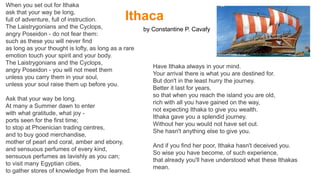
When you set out for Ithaka
ask that your way be long,
full of adventure, full of instruction.
The Laistrygonians and the Cyclops,
angry Poseidon - do not fear them:
such as these you will never find
as long as your thought is lofty, as long as a rare
emotion touch your spirit and your body.
The Laistrygonians and the Cyclops,
angry Poseidon - you will not meet them
unless you carry them in your soul,
unless your soul raise them up before you.
Ask that your way be long.
At many a Summer dawn to enter
with what gratitude, what joy -
ports seen for the first time;
to stop at Phoenician trading centres,
and to buy good merchandise,
mother of pearl and coral, amber and ebony,
and sensuous perfumes of every kind,
sensuous perfumes as lavishly as you can;
to visit many Egyptian cities,
to gather stores of knowledge from the learned.
Have Ithaka always in your mind.
Your arrival there is what you are destined for.
But don't in the least hurry the journey.
Better it last for years,
so that when you reach the island you are old,
rich with all you have gained on the way,
not expecting Ithaka to give you wealth.
Ithaka gave you a splendid journey.
Without her you would not have set out.
She hasn't anything else to give you.
And if you find her poor, Ithaka hasn't deceived you.
So wise you have become, of such experience,
that already you'll have understood what these Ithakas
mean.
Ithaca
by Constantine P. Cavafy
http://www.youtube.com/watch?v=rxRr2d7tR7A
http://www.tellmeomuse.com/stories
http://www.tripline.net/trip/Odysseus's_Journey-
5351562271041004BE8BA8776DC9D169
http://www.mythweb.com/odyssey/
http://www.learner.org/courses/worldlit/odyssey/watch/
http://www.travel-studies.com/travel-classics/odyssey-images
http://www.slideshare.net/angewoods/the-odysseygreek-
mythology-notes
http://www.slideshare.net/buyayenbells/the-iliad-by-homer-
yeng-bunsoy
http://www.slideshare.net/wendywarren1969/the-entire-
odyssey-notes-presentation
http://www.amazon.com/Childs-Introduction-Greek-
Mythology-
Goddesses/dp/157912867X/ref=sr_1_11?s=books&ie=UTF8&qi
d=1394324674&sr=1-11&keywords=polyphemus
http://www.amazon.com/Goddesses-Olympus-
Trophy-Picture-
Books/dp/0064461890/ref=pd_sim_b_1?ie=UT
F8&refRID=1YYGQW5FVYSJTKN8JJPC
http://www.amazon.com/Greek-Myths-Young-
Children-
Stories/dp/0746037252/ref=pd_sim_b_11?ie=
UTF8&refRID=1YYGQW5FVYSJTKN8JJPC
http://www.amazon.com/Tales-
Odyssey-Part-Mary-
Osborne/dp/1423128648/ref=pd_si
m_b_16?ie=UTF8&refRID=1YYGQW5
FVYSJTKN8JJPC
http://www.amazon.com/Greek-Gods-
Point-Bernard-
Evslin/dp/0590441108/ref=pd_sim_b_23?ie
=UTF8&refRID=1YYGQW5FVYSJTKN8JJPC
• http://www.amazon.com/Demigods-Monsters-Favorite-Riordans-
Olympians/dp/1937856364/ref=pd_sim_b_4?ie=UTF8&refRID=0DE63
PFQ1YSB55QX3AS4

The Odyssey

  • 2.
    Homer (800 B.C.) A legendarypoet and historian, Homer is credited with two of the most famous and enduring epics of all time: the Iliad and the Odyssey. Their impressive length and scope have resulted in the coining of an adjective from the author’s name: homeric, meaning “large-scale, massive, or enormous.” Facts about Homer’s life have been lost over time. Scholars even disagree about whether the Iliad and the Odyssey were written by the same person—and whether Homer existed at all! According to tradition, however, Homer was born in western Asia Minor, and he was blind. In later centuries, the Iliad and the Odyssey were the basis of Greek and Roman education. Character Study Odysseus is an epic hero who was admired by the ancient Greeks, but he may not be a good role model for people living today. In a character study, evaluate Odysseus’ status as a hero by analyzing his actions and motives. Support your analysis with examples and quotations from the epic.
  • 3.
    Archetype—a symbol across culturesand time Tragic or Fatal flaw— example: hubris (arrogance/pride) Hero— powerful and possibly magical Adventures—battles against real and imaginary monsters Qualities of an epic: 1. Invocation of Muse 2. Omniscient point of view 3. In Medias Res 4. Story of a hero and his adventures 5. Supernatural elements—gods, monsters, magic, etc. 6. Long, lofty speeches 7. Flashback—everything that went on before, like in the Iliad 8. Exposition—past, even the history of weapons 9. Heroic battles 10. Usually ends happily
  • 4.
  • 15.
    After ten longyears, the Trojan War is over. The Achaeans (a name for the Greeks) have defeated the Trojans. Odysseus, his men, and their twelve ships, begin their journey home to Ithaca. The storm winds take them to the land of the Cicones where Odysseus and his men sack the main city Ismarus, attack their people, and steal their possessions. Odysseus and each of his men share the stolen riches equally. Odysseus urges that they leave. The crew do not listen. They slaughter the Cicones’ sheep and cattle, and drink their wine. The Cicones call for help. Now stronger and larger in number, the Cicones fight back with force. Odysseus loses six men from each of his twelve ships. He feels he and his men are being punished by Zeus. Odysseus and the rest of his crew sail away before any more men are killed 1: The Cicones
  • 16.
  • 17.
  • 18.
    4: The Bagof Winds
  • 20.
  • 22.
    6: Circe theWitch Goddess
  • 23.
    Circe in GreekKIRKE was Goddess of Magic/potions , she had power through her potions to turn men into swine, lions and other animals, she turned several of Odysseus men into swine. Odysseus met Hermes, who, in addition to certain instructions, gave him a plant (moly) that would rob Circe's drugs of their power.
  • 25.
    7: Tiresias andthe Land of the Dead
  • 26.
    9: Song ofthe Siren
  • 29.
  • 30.
    Scylla or Charybdis Obrave Odysseus, having escaped the Sirens, you must choose between another set of perils that Circe has forewarned you of. You must sail through a very narrow strait that is closely guarded by Scylla on the one hand and Charybdis on the other. Will you choose to sail nearby the island of the monster Scylla, an immortal six-headed dragon that could very well devour you and all of your crew, six at a time? Or will you sail past Charybdis, the giant mouth that creates a giant whirlpool three times a day, sucking down the surrounding waters and swallowing everything thereupon, risking you, your crew and your ship? O brave Odysseus, what choice shall you make? And is it your fate to survive your terrible choice?
  • 32.
    11: Helios andHis Sacred Cattle
  • 33.
    The last stopof Odysseus and his men (before getting stuck with Calypso) was the island of Thrinacia. Circe had warned them to avoid the island, but ... the now considerably smaller crew kills the sacred cattle of Helios, for which sacrilege Zeus wrecks Odysseus' last ship.
  • 34.
    Not having seenany men for years, Mythical Calypso fell for Odysseus instantly. She wanted to make him her immortal husband and give him eternal youth. But Odysseus denied her offer as he longed to go back to his wife in Ithaca. Yet, Calypso was so much in love with him that despite his refusal, she persisted and continued seducing Odysseus, keeping his as a prisoner for seven years. She reluctantly lets him leave after a visit from Athena. In the island Ogygia, Calypso welcomed the exhausted Greek hero, Odysseus, who had drifted for nine days in the open sea after losing his ship and his army to the monsters of Italy and Sicily when coming back home from Troy.
  • 35.
    I am thedaughter of King Alcinous and Queen Arete. I found Odysseus washed ashore near the river., Princess Nausicaa
  • 38.
    Ithaka. Ithakia. Ithaca.Ithaki. We have many name for the things we love; at least, many different spellings. Ithaca is an exceptionally beautiful island near Kefalonia. Ithaca is namely the home island of Odysseus. Although it in recent years have been a dispute whether it really is Ithaca which Homer describes in his epic Odyssey. As most people surely know, Odysseus was a wandering hero who fought against all sorts of things. Among other things, he played a crucial role in the war in Troy. It was Odysseus who came up with the idea of the Trojan Horse. He was away from Ithaca for ten long years. At home his wife, Penelope, was waiting faithfully for his return.
  • 40.
    THE ODYSSEY: ANINTRODUCTION The Odyssey is one of the two great Greek epics attributed to the bard Homer, and is one of the most revered and influential works of Western literature. An epic is a long narrative poem usually about the deeds of a hero. This epic hero often embodies the goals and values of his or her culture. Typically, epics are based in part on historical fact, blending legend with truth. Background In primitive societies, stories were passed from one person to another by word of mouth. Storytellers, or bards, arriving in a village, court, or camp, would entertain eager listeners with tales of the gods or great heroes. The longer stories, now called epics, might be told over a series of days. To help the storytellers remember these lengthy pieces, the tales were composed in poetic lines and were usually recited to the accompaniment of stringed instruments. Although these stories were filled with incredible deeds and fantastic exploits, many were based on historical events and were accepted as fact by the listeners. Two epics, the Iliad and the Odyssey, had their roots in the events of the Trojan War, which occurred about 1200 B.C. While legend credits the abduction of the Spartan queen Helen as the cause, most probably economic conflict over control of trade in the Aegean Sea was the reason for the war.
  • 41.
    The Iliad andthe Odyssey were both passed down through word of mouth by wandering bards for several centuries, until they were finally written down when the Greeks first developed an alphabet, about 800 B.C. The author traditionally credited with assembling a number of earlier and shorter narrative songs and putting them in their current, final form as epics was a bard named Homer who hailed from the western coast of Asia Minor (modern-day Turkey). According to tradition, he was blind (not a surprising disability to find in a bard, who would have had a hard time finding other modes of employment). Modern scholars have found no historical evidence that such an individual really existed. However, both the Iliad and the Odyssey bear the marks of a single, unifying artistic intelligence which, for the sake of convenience, we can attribute to an inspired bard named Homer. Although a major purpose for telling and retelling the myths and legends was entertainment, another goal was to teach important lessons about religion and society. Divine beings often play a part in epics, guiding the hero or thwarting his actions. Myths about Zeus, Athena, and Apollo were many, but there were also stories about great human heroes such as Hector, Odysseus, and Penelope, who served as examples of ideal human qualities. In fact, Alexander the Great credited Homer’s Iliad as the source of his ideas about valor and nobility. As you read the Odyssey, remember that you are reading an epic that was composed to be heard by an audience, so you might try reading some of the poem aloud. You may find a few areas that cause difficulty when you read. The unfamiliarity as well as the sheer number of the Greek names of the gods and humans might seem daunting at first. You may keep track of key characters and place names on the back of your Odyssey Reading Assignments bookmark.
  • 42.
    The poetic formof the Odyssey might also cause you some problems. Try reading the sentences according to the punctuation, instead of line by line. Also remember that epics were composed in an elevated style, which the translation you are reading attempts to reproduce. You’ll find several distinct stylistic features which make epic poetry different from contemporary fiction, such as: • extended similes • formal speeches instead of casual dialogue • catalogues of names or objects Perhaps the most noticeable stylistic feature of the Odyssey is its use of formulaic language. Because the ancient bards relied on memory as well as improvisation in reciting their epics, they often resorted to repetition of specific phrases or even whole passages to structure their recitals. Many of these expressions are what are known as stock epithets —recurrent descriptive tags or nicknames of character. Odysseus’s son Telemakhos, for instance, is frequently referred to as “clear-headed”; Helen’s husband Menelaos is “the red-haired king.” Sunrise is almost always described in the phrase “When Dawn stretched out her fingertips of rose.” Although modern readers may find these formulaic expressions intrusive, ancient audiences saw them as artful embellishments, and looked forward to hearing the familiar phrases the way modern viewers enjoy the stock taglines of their favorite TV characters (“D’oh!”)
  • 43.
    The narrative structureof the Odyssey may also confuse you somewhat, at first. Instead of beginning the story at the beginning (which would be no easy task, since the legends that gave rise to the story of the Odyssey are so tangled and complex), Homer starts his narrative in the middle of the action (in medias res — Latin for “in the middle of things”), and eventually backtracks to a point much earlier, brings us up to the point where the epic began, and then progresses forward from there. Complicating the narrative still further are a whole array of side-narratives, sub-plots, and minor digressions. Some of those — such as the references to the story of King Agamemnon, his unfaithful wife Klytaimnestra, and his loyally vengeful son Orestes — are thematically relevant to the larger story of Odysseus’s wanderings and homecoming. Others, though, are decidedly less significant, and may well have been inserted by the bard merely to appeal to the interests of one particular audience he happened to be performing for. You’ll find it easier to separate out the primary narrative strands as you read. One last, minor detail: in the translation we are reading, the translator Robert Fitzgerald chose to spell the names in a way that is more faithful to the original Greek pronunciation, so some of the names of familiar characters may look unusual to you. Traditional English spellings of many ancient Greek names are based on the Roman spellings, but Latin was not pronounced the same as English. “C,” in Latin, for instance, was always pronounced as a “k” sound, so names like “Cyclops” and “Circe” were pronounced “Kyklops” and “Kirke” by the Greeks and the Romans — so that’s how Fitzgerald spells them.
  • 53.
    Athena the GreekGoddess of Wisdom and War. The assistance that Athena provides Odysseus is indirect. She tends to disguise as a mortal or appear in someone's dream to direct him to the right path.
  • 55.
    Telemachus and hiscomrades travelled to Pylos and the court of King Nestor Nestor gave Telemachus a chariot to travel to Sparta to visit King Menelaus
  • 56.
    “When Odysseus hasbathed, Penelope, still aloof, tests him by suggesting that his bed be moved. Odysseus, however, knows the bed he built is immovable for he constructed it around an olive tree which serves as a bedpost. Thus, Penelope recognizes and accepts her husband”.
  • 57.
    Ulysses is derivedfrom Ulixes, the Latin name for Odysseus, a character in ancient Greek literature.
  • 58.
    Dogs were valuedas hunting hounds and pig dogs, and also as much loved companions. Odysseus had a faithful dog called Argos in Homer’s Odyssey.
  • 60.
    Connecting Literary Elements 3.A conflict is a struggle between opposing forces. It may involve a person’s struggle with an enemy of some kind, or it may involve a clash between opposing thoughts within a person’s mind. (a) On the chart below, identify one external conflict that Odysseus faces and one internal conflict that he experiences. (b) Also, on the chart, briefly describe the resolution of each conflict. 4. Which character traits help Odysseus to be victorious in his conflicts? Explain.
  • 63.
    Ulysses BY ALFRED, LORDTENNYSON It little profits that an idle king, By this still hearth, among these barren crags, Match'd with an aged wife, I mete and dole Unequal laws unto a savage race, That hoard, and sleep, and feed, and know not me. I cannot rest from travel: I will drink Life to the lees: All times I have enjoy'd Greatly, have suffer'd greatly, both with those That loved me, and alone, on shore, and when Thro' scudding drifts the rainy Hyades Vext the dim sea: I am become a name; For always roaming with a hungry heart Much have I seen and known; cities of men And manners, climates, councils, governments, Myself not least, but honour'd of them all; And drunk delight of battle with my peers, Far on the ringing plains of windy Troy. I am a part of all that I have met; Yet all experience is an arch wherethro' Gleams that untravell'd world whose margin fades For ever and forever when I move. How dull it is to pause, to make an end, To rust unburnish'd, not to shine in use! As tho' to breathe were life! Life piled on life Were all too little, and of one to me Little remains: but every hour is saved From that eternal silence, something more, A bringer of new things; and vile it were For some three suns to store and hoard myself, And this gray spirit yearning in desire To follow knowledge like a sinking star, Beyond the utmost bound of human thought.
  • 64.
    This is myson, mine own Telemachus, To whom I leave the sceptre and the isle,— Well-loved of me, discerning to fulfil This labour, by slow prudence to make mild A rugged people, and thro' soft degrees Subdue them to the useful and the good. Most blameless is he, centred in the sphere Of common duties, decent not to fail In offices of tenderness, and pay Meet adoration to my household gods, When I am gone. He works his work, I mine. There lies the port; the vessel puffs her sail: There gloom the dark, broad seas. My mariners, Souls that have toil'd, and wrought, and thought with me— That ever with a frolic welcome took The thunder and the sunshine, and opposed Free hearts, free foreheads—you and I are old; Old age hath yet his honour and his toil; Death closes all: but something ere the end, Some work of noble note, may yet be done, Not unbecoming men that strove with Gods. The lights begin to twinkle from the rocks: The long day wanes: the slow moon climbs: the deep Moans round with many voices. Come, my friends, 'T is not too late to seek a newer world. Push off, and sitting well in order smite The sounding furrows; for my purpose holds To sail beyond the sunset, and the baths Of all the western stars, until I die. It may be that the gulfs will wash us down: It may be we shall touch the Happy Isles, And see the great Achilles, whom we knew. Tho' much is taken, much abides; and tho' We are not now that strength which in old days Moved earth and heaven, that which we are, we are; One equal temper of heroic hearts, Made weak by time and fate, but strong in will To strive, to seek, to find, and not to yield.
  • 66.
    When you setout for Ithaka ask that your way be long, full of adventure, full of instruction. The Laistrygonians and the Cyclops, angry Poseidon - do not fear them: such as these you will never find as long as your thought is lofty, as long as a rare emotion touch your spirit and your body. The Laistrygonians and the Cyclops, angry Poseidon - you will not meet them unless you carry them in your soul, unless your soul raise them up before you. Ask that your way be long. At many a Summer dawn to enter with what gratitude, what joy - ports seen for the first time; to stop at Phoenician trading centres, and to buy good merchandise, mother of pearl and coral, amber and ebony, and sensuous perfumes of every kind, sensuous perfumes as lavishly as you can; to visit many Egyptian cities, to gather stores of knowledge from the learned. Have Ithaka always in your mind. Your arrival there is what you are destined for. But don't in the least hurry the journey. Better it last for years, so that when you reach the island you are old, rich with all you have gained on the way, not expecting Ithaka to give you wealth. Ithaka gave you a splendid journey. Without her you would not have set out. She hasn't anything else to give you. And if you find her poor, Ithaka hasn't deceived you. So wise you have become, of such experience, that already you'll have understood what these Ithakas mean. Ithaca by Constantine P. Cavafy
  • 67.
    http://www.youtube.com/watch?v=rxRr2d7tR7A http://www.tellmeomuse.com/stories http://www.tripline.net/trip/Odysseus's_Journey- 5351562271041004BE8BA8776DC9D169 http://www.mythweb.com/odyssey/ http://www.learner.org/courses/worldlit/odyssey/watch/ http://www.travel-studies.com/travel-classics/odyssey-images http://www.slideshare.net/angewoods/the-odysseygreek- mythology-notes http://www.slideshare.net/buyayenbells/the-iliad-by-homer- yeng-bunsoy http://www.slideshare.net/wendywarren1969/the-entire- odyssey-notes-presentation http://www.amazon.com/Childs-Introduction-Greek- Mythology- Goddesses/dp/157912867X/ref=sr_1_11?s=books&ie=UTF8&qi d=1394324674&sr=1-11&keywords=polyphemus http://www.amazon.com/Goddesses-Olympus- Trophy-Picture- Books/dp/0064461890/ref=pd_sim_b_1?ie=UT F8&refRID=1YYGQW5FVYSJTKN8JJPC http://www.amazon.com/Greek-Myths-Young- Children- Stories/dp/0746037252/ref=pd_sim_b_11?ie= UTF8&refRID=1YYGQW5FVYSJTKN8JJPC http://www.amazon.com/Tales- Odyssey-Part-Mary- Osborne/dp/1423128648/ref=pd_si m_b_16?ie=UTF8&refRID=1YYGQW5 FVYSJTKN8JJPC http://www.amazon.com/Greek-Gods- Point-Bernard- Evslin/dp/0590441108/ref=pd_sim_b_23?ie =UTF8&refRID=1YYGQW5FVYSJTKN8JJPC
  • 68.