An Introduction to the  Odyssey An Introduction to the  Odyssey The War-Story Background Odysseus: A Hero in Trouble The Wooden-Horse Trick The Ancient World and Ours A Search for Their Places in Life Relationships with Gods Epic and Values The Telling of Epics Homer Feature Menu
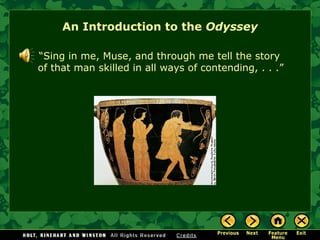
An Introduction to the  Odyssey “ Sing in me, Muse, and through me tell the story of that man skilled in all ways of contending, . . .”
An Introduction to the  Odyssey [End of Section] The  Odyssey  is a tale of a hero’s long and perilous journey home. But, it is also the story of a son in need of his father and of a faithful wife waiting for her husband’s return.
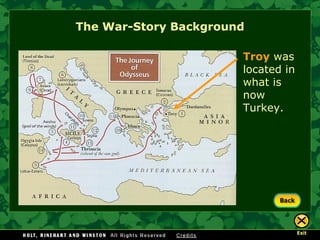
The War-Story Background The  Iliad  provides the background for Odysseus’s story and tells the tale of a ten-year war fought outside the walls of  Troy . In Homer’s  Iliad the Trojan War is in its tenth and final year the people of Troy are fighting an alliance of Greek kings because the world’s most beautiful woman, Helen, abandoned her husband,  Menelaus (a Greek king) and ran off with Paris, a prince of Troy
The War-Story Background The  Iliad  provides the background for Odysseus’s story and tells the tale of a ten-year war fought outside the walls of Troy. In Homer’s  Iliad the Greeks won the war, reduced the city of Troy to smoldering ruins, and butchered all the inhabitants, except for those they took as slaves back to Greece  [End of Section]
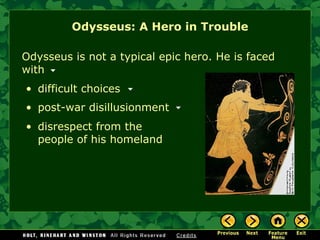
Odysseus: A Hero in Trouble Odysseus is not a typical  epic hero . He is faced with difficult choices post-war disillusionment disrespect from the people of his homeland
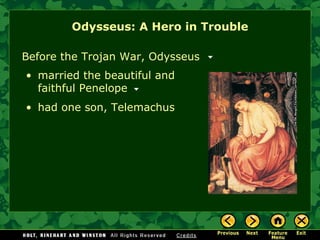
Odysseus: A Hero in Trouble Before the Trojan War, Odysseus married the beautiful and faithful Penelope had one son, Telemachus
Odysseus: A Hero in Trouble [End of Section] When called to serve in the Trojan War, Odysseus pretended to be insane so he wouldn’t have to go (he dressed as a peasant, plowed his field, and  sowed it with salt) revealed his sanity to save his son’s life (who was placed in front of the plow)
The Wooden-Horse Trick During the Trojan War, Odysseus performed extremely well as a soldier and commander thought of the famous wooden-horse trick that lead to the defeat of Troy
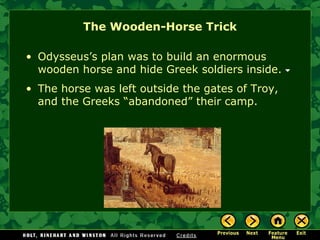
The Wooden-Horse Trick Odysseus’s plan was to build an enormous wooden horse and hide Greek soldiers inside. The horse was left outside the gates of Troy, and the Greeks “abandoned” their camp.
The Wooden-Horse Trick [End of Section] The Trojans thought the horse was a peace offering and brought it into the walled city. At night, the men hidden in the horse came out and opened the gates to the entire Greek army.
The Ancient World and Ours [End of Section] Odysseus’s world is harsh, violent, and primitive. The “palaces” that he and his men raid might have been nothing more than mud and stone farmhouses. The “worldly goods” they carry off from town might have been only pots and pans, cattle and sheep.
A Search for Their Places in Life The Theme of the  Odyssey Odysseus and his family are searching for  the right relationships with one another and the people around them their proper places in life
A Search for Their Places in Life The Structure of the  Odyssey The story begins with Telemachus, Odysseus’s  son. Telemachus is searching for his father  because he is being threatened by rude, powerful men who  want to marry his mother and rob Telemachus  of his inheritance  needs his father to return home and restore order
A Search for Their Places in Life [End of Section] The Structure of the  Odyssey Readers learn that Odysseus is stranded on an island, longing to get home has been gone for twenty years—he has spent ten years at war and ten years trying to get home is in the middle of a midlife crisis and searching for inner peace
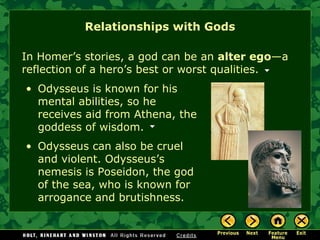
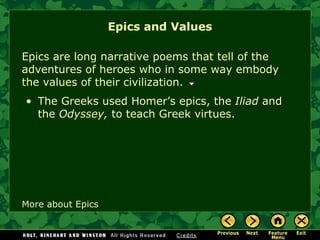
Relationships with Gods In Homer’s stories, a god can be an  alter ego —a reflection of a hero’s best or worst qualities. Odysseus is known for his mental abilities, so he receives aid from Athena, the goddess of wisdom. Odysseus can also be cruel and violent. Odysseus’s nemesis is Poseidon, the god of the sea, who is known for arrogance and brutishness.
Relationships with Gods [End of Section] Myths in the  Odyssey Greek  myths  plays an important role in the  Odyssey.  Homer is concerned with the relationship between human and gods.  For Homer, the gods control all things, including Odysseus’s fate.
Epics and Values Epics are long narrative poems that tell of the adventures of heroes who in some way embody the values of their civilization.  More about Epics The Greeks used Homer’s epics, the  Iliad  and the  Odyssey,  to teach Greek virtues.
Epics and Values [End of Section] The Epic Tradition All epic poems in the western world owe something to the basic patterns established in Homer’s epics. The  Iliad  is the primary model for an epic of war. The  Odyssey  is the model for an epic of the long  journey .
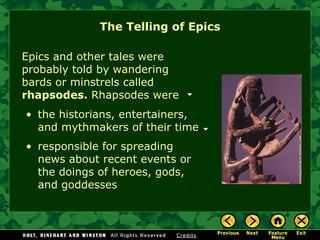
The Telling of Epics Epics and other tales were probably told by wandering bards or minstrels called  rhapsodes.  Rhapsodes were the historians, entertainers, and mythmakers of their time responsible for spreading news about recent events or the doings of heroes, gods, and goddesses
The Telling of Epics Epics were originally told aloud.  They followed basic story lines and incorporated  formulaic descriptions . Most of the words were improvised to fit a particular rhythm or meter. Epics included  Homeric, or epic, similes  that compare heroic events to easily understandable everyday events.
The Telling of Epics Epics such as the  Iliad  and  Odyssey  were probably told over a period of several days.  Singers might have summarized part of the tales, depending on how long they stayed in one community.  [End of Section]
Homer No one knows for sure who Homer was. Later Greeks believed he was a blind minstrel, or singer, from the island of Chios. One scholar suggests Homer was a woman because home and hearth played such an important role in his stories.  Some scholar think there were two Homers. Some think he was just a legend. [End of Section]
The End
The War-Story Background Troy  was located in what is now Turkey.
Odysseus: A Hero in Trouble Epic Hero In Homer’s time, epic heroes were placed somewhere the gods and ordinary human beings experienced pain and death were always true to themselves
Relationships with Gods Myths   are traditional stories, rooted in a particular culture, that usually explain a belief, a ritual, or a mysterious natural phenomenon. Myths are essentially religious because they are concerned with the relationship between human beings and the unknown or spiritual realm.
Epics and Values More About Epics Epics use elevated language and a serious tone and often include elements of myth, legend, folk tale, and history.
Epics and Values Journey The theme of the journey is found in many stories in western literature, including fairy tales novels, such as  The Incredible Journey, Moby-Dick,  and  The Hobbit movies, such as  The Wizard of Oz  and  Star Wars
The Telling of Epics Formulaic Descriptions Formulaic descriptions gave the singer time to think ahead to the next part of the story. The oral storyteller had formulas for the arrival and greeting of guests, eating of meals, and taking of baths describing the sea (“wine-dark”) and Athena (“gray-eyed Athena”)
The Telling of Epics Homeric, or Epic, Similes  In the  Iliad,  the singer uses a Homeric simile to describe how Athena prevents an arrow from striking Menelaus.  She brushed it away from his skin as lightly as when a  mother Brushes a fly away from her child who is lying in sweet  sleep.

The Odyssey

  • 1.
    An Introduction tothe Odyssey An Introduction to the Odyssey The War-Story Background Odysseus: A Hero in Trouble The Wooden-Horse Trick The Ancient World and Ours A Search for Their Places in Life Relationships with Gods Epic and Values The Telling of Epics Homer Feature Menu
  • 2.
    An Introduction tothe Odyssey “ Sing in me, Muse, and through me tell the story of that man skilled in all ways of contending, . . .”
  • 3.
    An Introduction tothe Odyssey [End of Section] The Odyssey is a tale of a hero’s long and perilous journey home. But, it is also the story of a son in need of his father and of a faithful wife waiting for her husband’s return.
  • 4.
    The War-Story BackgroundThe Iliad provides the background for Odysseus’s story and tells the tale of a ten-year war fought outside the walls of Troy . In Homer’s Iliad the Trojan War is in its tenth and final year the people of Troy are fighting an alliance of Greek kings because the world’s most beautiful woman, Helen, abandoned her husband, Menelaus (a Greek king) and ran off with Paris, a prince of Troy
  • 5.
    The War-Story BackgroundThe Iliad provides the background for Odysseus’s story and tells the tale of a ten-year war fought outside the walls of Troy. In Homer’s Iliad the Greeks won the war, reduced the city of Troy to smoldering ruins, and butchered all the inhabitants, except for those they took as slaves back to Greece [End of Section]
  • 6.
    Odysseus: A Heroin Trouble Odysseus is not a typical epic hero . He is faced with difficult choices post-war disillusionment disrespect from the people of his homeland
  • 7.
    Odysseus: A Heroin Trouble Before the Trojan War, Odysseus married the beautiful and faithful Penelope had one son, Telemachus
  • 8.
    Odysseus: A Heroin Trouble [End of Section] When called to serve in the Trojan War, Odysseus pretended to be insane so he wouldn’t have to go (he dressed as a peasant, plowed his field, and sowed it with salt) revealed his sanity to save his son’s life (who was placed in front of the plow)
  • 9.
    The Wooden-Horse TrickDuring the Trojan War, Odysseus performed extremely well as a soldier and commander thought of the famous wooden-horse trick that lead to the defeat of Troy
  • 10.
    The Wooden-Horse TrickOdysseus’s plan was to build an enormous wooden horse and hide Greek soldiers inside. The horse was left outside the gates of Troy, and the Greeks “abandoned” their camp.
  • 11.
    The Wooden-Horse Trick[End of Section] The Trojans thought the horse was a peace offering and brought it into the walled city. At night, the men hidden in the horse came out and opened the gates to the entire Greek army.
  • 12.
    The Ancient Worldand Ours [End of Section] Odysseus’s world is harsh, violent, and primitive. The “palaces” that he and his men raid might have been nothing more than mud and stone farmhouses. The “worldly goods” they carry off from town might have been only pots and pans, cattle and sheep.
  • 13.
    A Search forTheir Places in Life The Theme of the Odyssey Odysseus and his family are searching for the right relationships with one another and the people around them their proper places in life
  • 14.
    A Search forTheir Places in Life The Structure of the Odyssey The story begins with Telemachus, Odysseus’s son. Telemachus is searching for his father because he is being threatened by rude, powerful men who want to marry his mother and rob Telemachus of his inheritance needs his father to return home and restore order
  • 15.
    A Search forTheir Places in Life [End of Section] The Structure of the Odyssey Readers learn that Odysseus is stranded on an island, longing to get home has been gone for twenty years—he has spent ten years at war and ten years trying to get home is in the middle of a midlife crisis and searching for inner peace
  • 16.
    Relationships with GodsIn Homer’s stories, a god can be an alter ego —a reflection of a hero’s best or worst qualities. Odysseus is known for his mental abilities, so he receives aid from Athena, the goddess of wisdom. Odysseus can also be cruel and violent. Odysseus’s nemesis is Poseidon, the god of the sea, who is known for arrogance and brutishness.
  • 17.
    Relationships with Gods[End of Section] Myths in the Odyssey Greek myths plays an important role in the Odyssey. Homer is concerned with the relationship between human and gods. For Homer, the gods control all things, including Odysseus’s fate.
  • 18.
    Epics and ValuesEpics are long narrative poems that tell of the adventures of heroes who in some way embody the values of their civilization. More about Epics The Greeks used Homer’s epics, the Iliad and the Odyssey, to teach Greek virtues.
  • 19.
    Epics and Values[End of Section] The Epic Tradition All epic poems in the western world owe something to the basic patterns established in Homer’s epics. The Iliad is the primary model for an epic of war. The Odyssey is the model for an epic of the long journey .
  • 20.
    The Telling ofEpics Epics and other tales were probably told by wandering bards or minstrels called rhapsodes. Rhapsodes were the historians, entertainers, and mythmakers of their time responsible for spreading news about recent events or the doings of heroes, gods, and goddesses
  • 21.
    The Telling ofEpics Epics were originally told aloud. They followed basic story lines and incorporated formulaic descriptions . Most of the words were improvised to fit a particular rhythm or meter. Epics included Homeric, or epic, similes that compare heroic events to easily understandable everyday events.
  • 22.
    The Telling ofEpics Epics such as the Iliad and Odyssey were probably told over a period of several days. Singers might have summarized part of the tales, depending on how long they stayed in one community. [End of Section]
  • 23.
    Homer No oneknows for sure who Homer was. Later Greeks believed he was a blind minstrel, or singer, from the island of Chios. One scholar suggests Homer was a woman because home and hearth played such an important role in his stories. Some scholar think there were two Homers. Some think he was just a legend. [End of Section]
  • 24.
  • 25.
    The War-Story BackgroundTroy was located in what is now Turkey.
  • 26.
    Odysseus: A Heroin Trouble Epic Hero In Homer’s time, epic heroes were placed somewhere the gods and ordinary human beings experienced pain and death were always true to themselves
  • 27.
    Relationships with GodsMyths are traditional stories, rooted in a particular culture, that usually explain a belief, a ritual, or a mysterious natural phenomenon. Myths are essentially religious because they are concerned with the relationship between human beings and the unknown or spiritual realm.
  • 28.
    Epics and ValuesMore About Epics Epics use elevated language and a serious tone and often include elements of myth, legend, folk tale, and history.
  • 29.
    Epics and ValuesJourney The theme of the journey is found in many stories in western literature, including fairy tales novels, such as The Incredible Journey, Moby-Dick, and The Hobbit movies, such as The Wizard of Oz and Star Wars
  • 30.
    The Telling ofEpics Formulaic Descriptions Formulaic descriptions gave the singer time to think ahead to the next part of the story. The oral storyteller had formulas for the arrival and greeting of guests, eating of meals, and taking of baths describing the sea (“wine-dark”) and Athena (“gray-eyed Athena”)
  • 31.
    The Telling ofEpics Homeric, or Epic, Similes In the Iliad, the singer uses a Homeric simile to describe how Athena prevents an arrow from striking Menelaus. She brushed it away from his skin as lightly as when a mother Brushes a fly away from her child who is lying in sweet sleep.

Editor's Notes

  • #3 Audio Script: Sing in me, Muse, and through me tell the story of that man skilled in all ways of contending, the wanderer, harried for years on end, after he plundered the stronghold on the proud height of Troy. He saw the townlands and learned the minds of many distant men, and weathered many bitters nights and days in his deep heart at sea, while he fought only to save his life, to bring his shipmates home. But not by will nor valor could he save them, for their own recklessness destroyed them all—