Definition
Nursing process isa critical
thinking process that professional
nurses use to apply the best available
evidence to caregiving and promoting
human functions and responses to
health and illness (American Nurses
Association, 2010).
3.
• Nursing processis a systematic method
of providing care to clients.
• The nursing process is a
systematic method of planning
and providing individualized
nursing care.
4.
Purposes of nursingprocess
• To identify a client’s health status and
actual or potential health care
problems or needs.
• To establish plans to meet the
identified needs.
• To deliver specific nursing
interventions to meet those needs.
5.
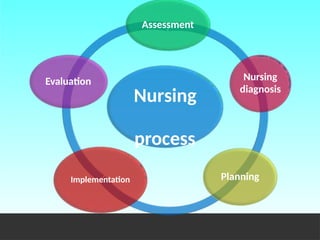
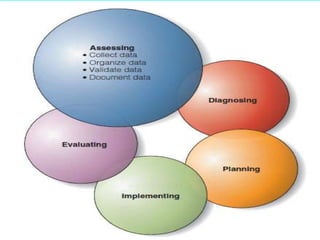
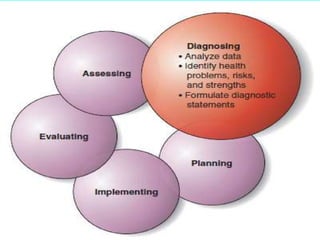
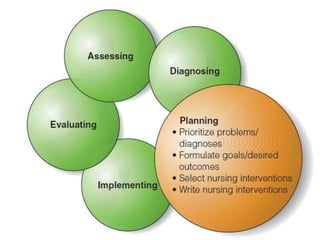
Components of nursingprocess
• It involves assessment (data
collection), nursing diagnosis,
planning, implementation, and
evaluation.
Characteristics of NursingProcess
• Cyclic
• Dynamic nature,
• Client centeredness
• Focus on problem solving and
decision making
• Interpersonal and collaborative style
• Universal applicability
• Use of critical thinking and clinical
reasoning.
Definition
Assessment is thesystematic and
continuous collection, organization,
validation, and documentation of data
(information).
11.
Types of assessment
Thefour different types of assessments
are;
1. Initial nursing assessment
2. Problem-focused assessment
3. Emergency assessment
4. Time-lapsed reassessment
12.
1. Initial nursingassessment:
Performed within specified time after
admission. To establish a complete
database for problem identification.
Eg: Nursing admission assessment
2. Problem-focused assessment : To
determine the status of a specific
problem identified in an earlier
assessment.
Eg: hourly checking of vital signs
of fever patient
13.
3. Emergency assessment:During
emergency situation to identify any
life threatening situation.
Eg: Rapid assessment of an
individual’s airway, breathing status,
and circulation during a cardiac arrest.
4. Time-lapsed reassessment: Several
months after initial assessment. To
compare the client’s current health
status with the data previously
obtained.
14.
Collection of data
Datacollection is the process of
gathering information about a client’s
health status. It includes the health
history, physical examination, results of
laboratory and diagnostic tests, and
material contributed by other health
personnel.
15.
Types of Data
Twotypes: subjective data and
objective data.
1. Subjective data, also referred to as
symptoms or covert data, are clear
only to the person affected and can
be described only by that person.
Itching, pain, and feelings of worry
are examples of subjective data.
16.
2. Objective data,also referred to as
signs or overt data, are detectable by
an observer or can be measured or
tested against an accepted standard.
They can be seen, heard, felt, or
smelled, and they are obtained by
observation or physical examination.
For example, a discoloration of the skin
or a blood pressure reading is objective
data.
17.
Sources of Data
Sourcesof data are primary or secondary.
1. Primary : It is the direct source of
information. The client is the primary
source of data.
2. Secondary: It is the indirect source of
information. All sources other than the
client are considered secondary sources.
Family members, health professionals,
records and reports, laboratory and
diagnostic results are secondary sources.
18.
Methods of data
collection
•The methods used to collect data are
observation, interview and
examination.
Observation : It is gathering data by
using the senses. Vision, Smell and
Hearing are used.
Interview : An interview is a
planned communication or a
conversation with a purpose.
19.
• There aretwo approaches to
interviewing:
directive and nondirective.
• The directive interview is highly
structured and directly ask the
questions. And the nurse controls the
interview.
• A nondirective interview, or rapport
building interview and the nurse allows
the client to control the interview.
20.
STAGES OF ANINTERVIEW
An interview has three major
stages:
1. The opening or introduction
2. The body or development
3. The closing
21.
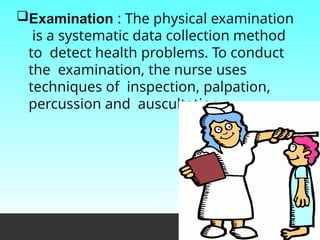
Examination : Thephysical examination
is a systematic data collection method
to detect health problems. To conduct
the examination, the nurse uses
techniques of inspection, palpation,
percussion and auscultation.
22.
Organization of data
Thenurse uses a format that
organizes the assessment data
systematically. This is often referred to as
nursing health history or nursing
assessment form.
23.
Validation of data
Theinformation gathered during
the assessment is “double-checked” or
verified to confirm that it is accurate
and complete.
24.
Documentation of data
Tocomplete the assessment
phase, the nurse records client data.
Accurate documentation is essential
and should include all data collected
about the client’s health status.
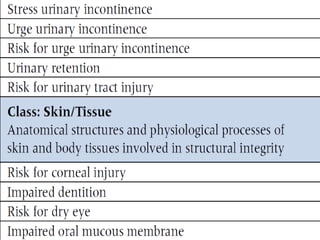
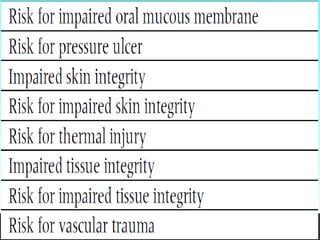
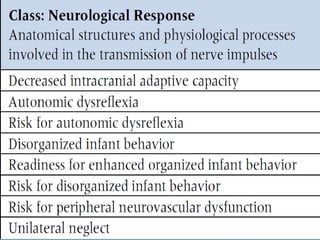
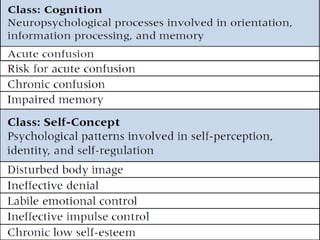
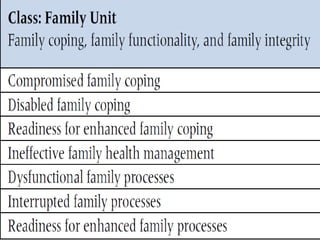
• Diagnosis isthe second phase of the
nursing process. In this phase, nurses use
critical thinking skills to interpret
assessment data to identify client
problems.
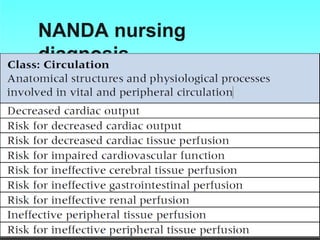
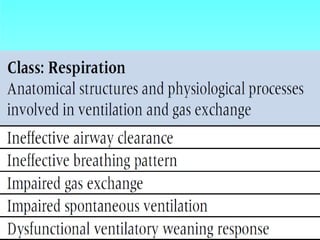
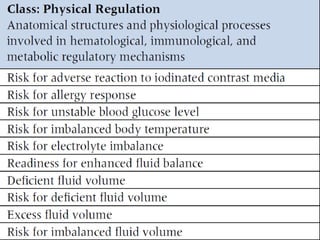
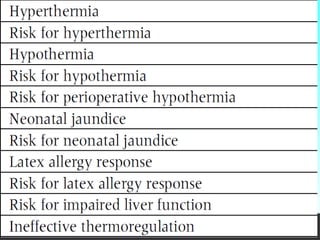
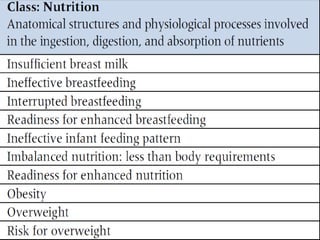
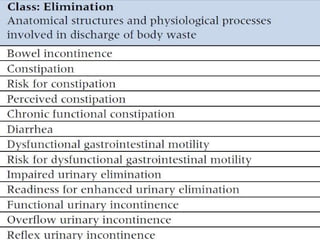
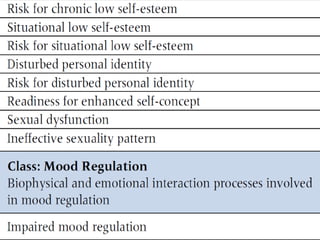
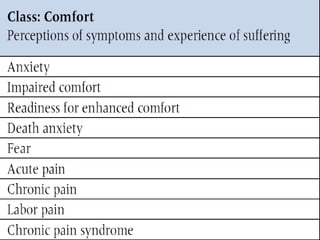
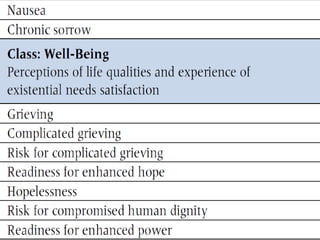
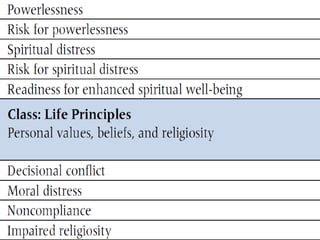
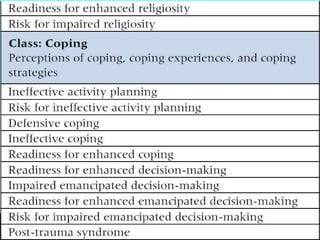
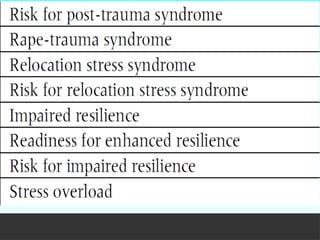
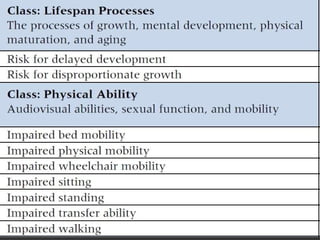
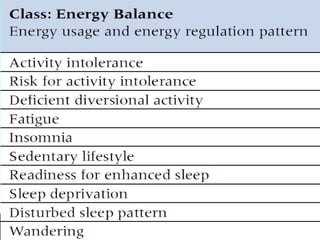
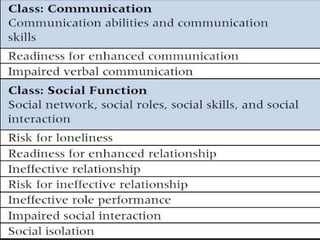
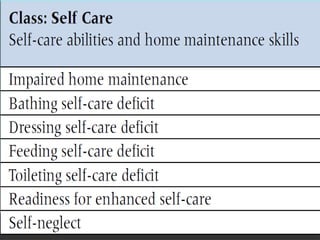
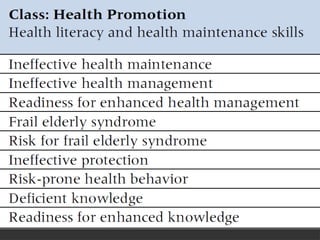
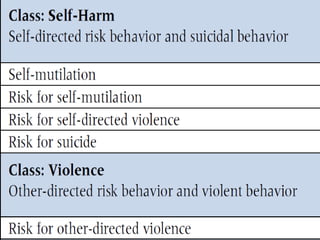
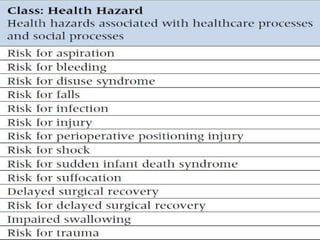
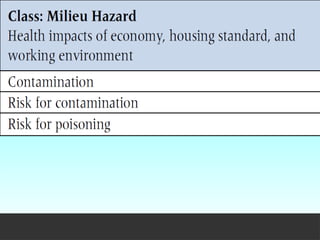
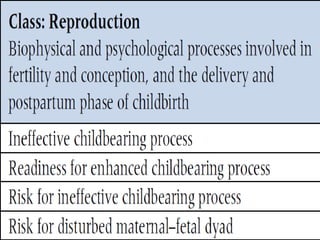
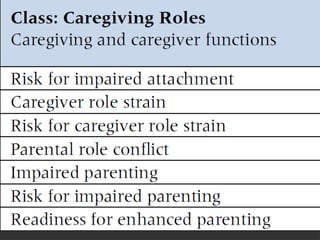
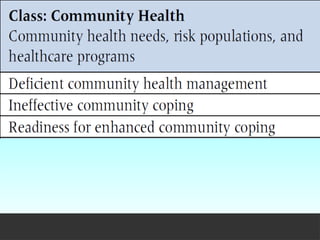
• North American Nursing Diagnosis
Association (NANDA) define or
refine nursing diagnosis.
28.
Definition
• The officialNANDA definition of a
nursing diagnosis is:
“a clinical judgment concerning a human
response to health conditions/life
processes, or a vulnerability for that
response, by an individual, family, group,
or community.”
29.
Status of theNursing Diagnosis
The status of nursing diagnosis are
actual, health promotion and risk.
1. An actual diagnosis is a client
problem that is present at the time
of the nursing assessment.
2. A health promotion diagnosis relates
to clients’ preparedness to improve
their health condition.
30.
• A risknursing diagnosis is a clinical
judgement that a problem does not
exist, but the presence of risk factors
indicates that a problem may develop
if adequate care is not given.
31.
Components of aNANDA
Nursing Diagnosis
A nursing diagnosis has three
components:
(1) The problem and its definition
(2) The etiology
(3) The defining characteristics.
32.
1. The problemstatement describes
the client’s health problem.
2. The etiology component of a nursing
diagnosis identifies causes of the
health problem.
3. Defining characteristics are the
cluster of signs and symptoms that
indicate the presence of health
problem.
33.
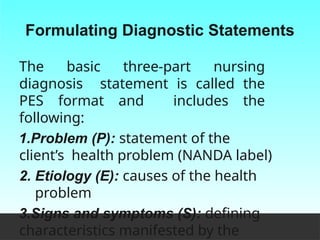
Formulating Diagnostic Statements
Thebasic three-part nursing
diagnosis statement is called the
PES format and includes the
following:
1.Problem (P): statement of the
client’s health problem (NANDA label)
2. Etiology (E): causes of the health
problem
3.Signs and symptoms (S): defining
characteristics manifested by the
34.
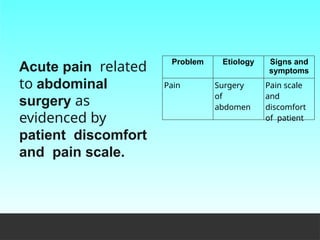
Acute pain related
toabdominal
surgery as
evidenced by
patient discomfort
and pain scale.
Problem Etiology Signs and
symptoms
Pain Surgery
of
abdomen
Pain scale
and
discomfort
of patient
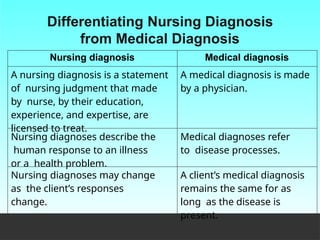
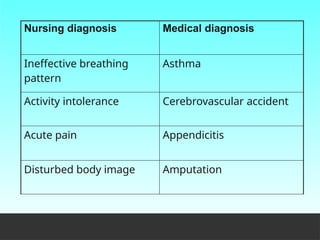
Differentiating Nursing Diagnosis
fromMedical Diagnosis
Nursing diagnosis Medical diagnosis
A nursing diagnosis is a statement
of nursing judgment that made
by nurse, by their education,
experience, and expertise, are
licensed to treat.
A medical diagnosis is made
by a physician.
Nursing diagnoses describe the
human response to an illness
or a health problem.
Medical diagnoses refer
to disease processes.
Nursing diagnoses may change
as the client’s responses
change.
A client’s medical diagnosis
remains the same for as
long as the disease is
present.
• Planning involvesdecision making
and problem solving.
• It is the process of formulating client
goals and designing the nursing
interventions required to prevent,
reduce, or eliminate the client’s health
problems.
1. Initial Planning: Planning which is
done after the initial assessment.
2. Ongoing Planning : It is a
continuous planning.
3. Discharge Planning : Planning for
needs after discharge
70.
Planning
process
Planning includes;
• Settingpriorities
• Establishing client goals/desired
outcomes
• Selecting nursing interventions
and activities
• Writing individualized nursing
interventions on care plans.
71.
Setting
priorities
• The nursebegin planning by deciding
which nursing diagnosis requires
attention first, which second, and so
on.
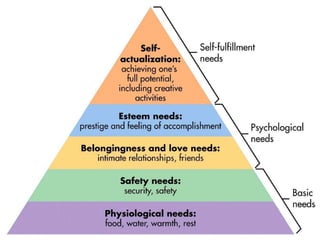
• Nurses frequently use Maslow’s
hierarchy of needs when setting
priorities.
TYPES OF NURSINGINTERVENTIONS
1. Independent interventions are those
activities that nurses are licensed to initiate
on the basis of their knowledge and skills.
2. Dependent interventions are activities
carried out under the orders or supervision
of a licensed physician.
3. Collaborative interventions are actions
the nurse carries out in collaboration
with other health team members
76.
Writing Individualized Nursing
Interventions
•After choosing the appropriate nursing
interventions, the nurse writes them on
the care plan.
• Nursing care plan is a written or
computerized information about
the client’s care.
• Evaluation isa planned, ongoing,
purposeful activity in which the
nurse determines
(a)the client’s progress toward
achievement of goals/outcomes and
(b)the effectiveness of the nursing care
plan.
82.
The evaluation includes;
•Comparing the data with
desired outcomes
• Continuing, modifying, or terminating
the nursing care plan.