HISTORY TAKING
SAPHAN C. AGABA
BScN, MSc. HPE
UGANDA CHRISTIAN UNIVERSITY
INTRODUCTION
• History taking skills are an essential
component in a nursing curriculum and
practice
• Forms the base for reaching a correct
diagnosis
Definition
•A patient narrative facilitated by a health
professional to obtain specific information about
the patient to aid in formulating a diagnosis and
decision making
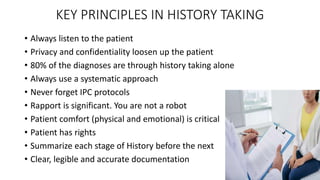
KEY PRINCIPLES IN HISTORY TAKING
• Always listen to the patient
• Privacy and confidentiality loosen up the patient
• 80% of the diagnoses are through history taking alone
• Always use a systematic approach
• Never forget IPC protocols
• Rapport is significant. You are not a robot
• Patient comfort (physical and emotional) is critical
• Patient has rights
• Summarize each stage of History before the next
• Clear, legible and accurate documentation
First Impression
“You never get a
second chance to
make a first
impression”-unkown
• MAKE A POSITIVE
FIRST IMPRESSION
• Appearance
• Body language
• Confidence
• Demeanor
STADARD FORMAT FOR HISTORY TAKING
1. Bio-data
2. Presenting/chief
complaint
3. History of Presenting
complaint
4. History of past
illnesses –medical &
Surgical.
5. Drug/ Medication
History
6. Family History
8. Social History
9. Review of systems
1. Bio-data
•Name
•Age & DOB
•Address
•Sex
•Tribe
•Religion
•Occupation
•Next of kin
•Contact information
•Who gave the
information (Primary
Vs Secondary source)
2. Chief complaint
• The single most critical concern to the patient
• What brings you to the hospital today?
• What seem to bother you today?
Critical Thinking?
Have I clearly understood the patient’s chief complaint?
What system could be affected?
Patient uses his own words to describe their reason for visiting the hospital
Record this complaint with its onset and duration
If patient has many complaints, you can ask… If I could make one thing better
for you today, what would it be?
3. HISTORY OF PRESENTING COMPLAINT(s)
SYMPTOM ANALYSIS
Details of the current complaint are expounded further.
How does the complaint affect Activities of daily living
SOCRATES
Site-Onset-Character-Radiation-Associated symptoms-Timing-
Exacerbating factors-Severity
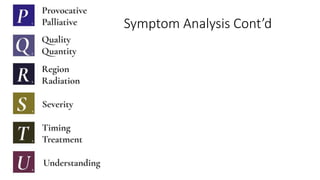
PQRST
OLDCARTS
Symptom Analysis Cont’d
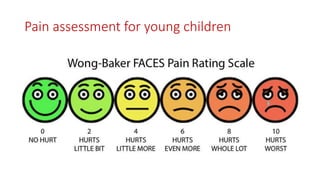
Pain assessment for young children
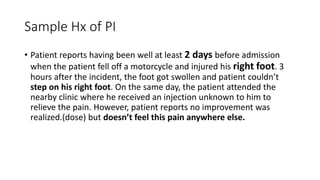
Sample Hx of PI
• Patient reports having been well at least 2 days before admission
when the patient fell off a motorcycle and injured his right foot. 3
hours after the incident, the foot got swollen and patient couldn’t
step on his right foot. On the same day, the patient attended the
nearby clinic where he received an injection unknown to him to
relieve the pain. However, patient reports no improvement was
realized.(dose) but doesn’t feel this pain anywhere else.
4. Past medical history
• Past Illnesses
• Any chronic illness
• Hospitalizations
• Operations
• Any past illnesses that could be related to today’s complain
• Any history of similar complaints in the past?
• Any allergies?
5. Medication History
• Current prescriptions and any other for longstanding illness
• An accurate medication history provides a foundation for assessing
the appropriateness of a patient’s current therapy and directing
future treatment choices.
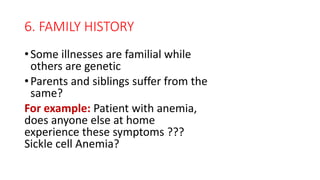
6. FAMILY HISTORY
•Some illnesses are familial while
others are genetic
•Parents and siblings suffer from the
same?
For example: Patient with anemia,
does anyone else at home
experience these symptoms ???
Sickle cell Anemia?
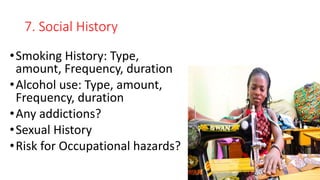
7. Social History
•Smoking History: Type,
amount, Frequency, duration
•Alcohol use: Type, amount,
Frequency, duration
•Any addictions?
•Sexual History
•Risk for Occupational hazards?
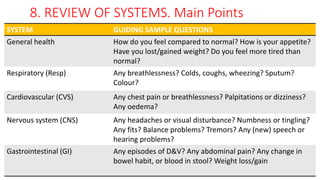
8. REVIEW OF SYSTEMS. Main Points
SYSTEM GUIDING SAMPLE QUESTIONS
General health How do you feel compared to normal? How is your appetite?
Have you lost/gained weight? Do you feel more tired than
normal?
Respiratory (Resp) Any breathlessness? Colds, coughs, wheezing? Sputum?
Colour?
Cardiovascular (CVS) Any chest pain or breathlessness? Palpitations or dizziness?
Any oedema?
Nervous system (CNS) Any headaches or visual disturbance? Numbness or tingling?
Any fits? Balance problems? Tremors? Any (new) speech or
hearing problems?
Gastrointestinal (GI) Any episodes of D&V? Any abdominal pain? Any change in
bowel habit, or blood in stool? Weight loss/gain
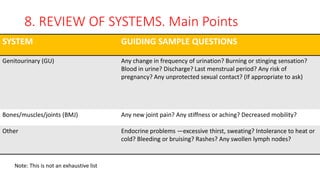
8. REVIEW OF SYSTEMS. Main Points
SYSTEM GUIDING SAMPLE QUESTIONS
Genitourinary (GU) Any change in frequency of urination? Burning or stinging sensation?
Blood in urine? Discharge? Last menstrual period? Any risk of
pregnancy? Any unprotected sexual contact? (If appropriate to ask)
Bones/muscles/joints (BMJ) Any new joint pain? Any stiffness or aching? Decreased mobility?
Other Endocrine problems —excessive thirst, sweating? Intolerance to heat or
cold? Bleeding or bruising? Rashes? Any swollen lymph nodes?
Note: This is not an exhaustive list
CONCLUDE THE HISTORY TAKING EXERCISE
•Give a summary to the patient
•Ask/check if you understood the information
correctly
•Any other information you would like me to
know? Ask the patient
•Advise on what the plan will be or next step
•Involve patient in planning
Common Pit falls
• Difficult patient
• Using a tone of voice that sends a wrong message..
What is your problem today, why did you come here
today?
Poor choice of words – Using jargons

History Taking 1.1.pptx

  • 1.
    HISTORY TAKING SAPHAN C.AGABA BScN, MSc. HPE UGANDA CHRISTIAN UNIVERSITY
  • 2.
    INTRODUCTION • History takingskills are an essential component in a nursing curriculum and practice • Forms the base for reaching a correct diagnosis
  • 3.
    Definition •A patient narrativefacilitated by a health professional to obtain specific information about the patient to aid in formulating a diagnosis and decision making
  • 4.
    KEY PRINCIPLES INHISTORY TAKING • Always listen to the patient • Privacy and confidentiality loosen up the patient • 80% of the diagnoses are through history taking alone • Always use a systematic approach • Never forget IPC protocols • Rapport is significant. You are not a robot • Patient comfort (physical and emotional) is critical • Patient has rights • Summarize each stage of History before the next • Clear, legible and accurate documentation
  • 5.
    First Impression “You neverget a second chance to make a first impression”-unkown • MAKE A POSITIVE FIRST IMPRESSION • Appearance • Body language • Confidence • Demeanor
  • 6.
    STADARD FORMAT FORHISTORY TAKING 1. Bio-data 2. Presenting/chief complaint 3. History of Presenting complaint 4. History of past illnesses –medical & Surgical. 5. Drug/ Medication History 6. Family History 8. Social History 9. Review of systems
  • 7.
    1. Bio-data •Name •Age &DOB •Address •Sex •Tribe •Religion •Occupation •Next of kin •Contact information •Who gave the information (Primary Vs Secondary source)
  • 8.
    2. Chief complaint •The single most critical concern to the patient • What brings you to the hospital today? • What seem to bother you today? Critical Thinking? Have I clearly understood the patient’s chief complaint? What system could be affected? Patient uses his own words to describe their reason for visiting the hospital Record this complaint with its onset and duration If patient has many complaints, you can ask… If I could make one thing better for you today, what would it be?
  • 9.
    3. HISTORY OFPRESENTING COMPLAINT(s) SYMPTOM ANALYSIS Details of the current complaint are expounded further. How does the complaint affect Activities of daily living SOCRATES Site-Onset-Character-Radiation-Associated symptoms-Timing- Exacerbating factors-Severity PQRST OLDCARTS
  • 10.
  • 11.
    Pain assessment foryoung children
  • 12.
    Sample Hx ofPI • Patient reports having been well at least 2 days before admission when the patient fell off a motorcycle and injured his right foot. 3 hours after the incident, the foot got swollen and patient couldn’t step on his right foot. On the same day, the patient attended the nearby clinic where he received an injection unknown to him to relieve the pain. However, patient reports no improvement was realized.(dose) but doesn’t feel this pain anywhere else.
  • 13.
    4. Past medicalhistory • Past Illnesses • Any chronic illness • Hospitalizations • Operations • Any past illnesses that could be related to today’s complain • Any history of similar complaints in the past? • Any allergies?
  • 14.
    5. Medication History •Current prescriptions and any other for longstanding illness • An accurate medication history provides a foundation for assessing the appropriateness of a patient’s current therapy and directing future treatment choices.
  • 15.
    6. FAMILY HISTORY •Someillnesses are familial while others are genetic •Parents and siblings suffer from the same? For example: Patient with anemia, does anyone else at home experience these symptoms ??? Sickle cell Anemia?
  • 16.
    7. Social History •SmokingHistory: Type, amount, Frequency, duration •Alcohol use: Type, amount, Frequency, duration •Any addictions? •Sexual History •Risk for Occupational hazards?
  • 17.
    8. REVIEW OFSYSTEMS. Main Points SYSTEM GUIDING SAMPLE QUESTIONS General health How do you feel compared to normal? How is your appetite? Have you lost/gained weight? Do you feel more tired than normal? Respiratory (Resp) Any breathlessness? Colds, coughs, wheezing? Sputum? Colour? Cardiovascular (CVS) Any chest pain or breathlessness? Palpitations or dizziness? Any oedema? Nervous system (CNS) Any headaches or visual disturbance? Numbness or tingling? Any fits? Balance problems? Tremors? Any (new) speech or hearing problems? Gastrointestinal (GI) Any episodes of D&V? Any abdominal pain? Any change in bowel habit, or blood in stool? Weight loss/gain
  • 18.
    8. REVIEW OFSYSTEMS. Main Points SYSTEM GUIDING SAMPLE QUESTIONS Genitourinary (GU) Any change in frequency of urination? Burning or stinging sensation? Blood in urine? Discharge? Last menstrual period? Any risk of pregnancy? Any unprotected sexual contact? (If appropriate to ask) Bones/muscles/joints (BMJ) Any new joint pain? Any stiffness or aching? Decreased mobility? Other Endocrine problems —excessive thirst, sweating? Intolerance to heat or cold? Bleeding or bruising? Rashes? Any swollen lymph nodes? Note: This is not an exhaustive list
  • 19.
    CONCLUDE THE HISTORYTAKING EXERCISE •Give a summary to the patient •Ask/check if you understood the information correctly •Any other information you would like me to know? Ask the patient •Advise on what the plan will be or next step •Involve patient in planning
  • 20.
    Common Pit falls •Difficult patient • Using a tone of voice that sends a wrong message.. What is your problem today, why did you come here today? Poor choice of words – Using jargons