Implants And Transdermal Patches
PRESENTED BY –
ANUP KUMAR RAY
B.PHARM. 3rd YEAR
DR. K. N. M. I. P. E. R.
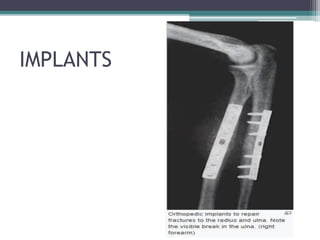
IMPLANTS
INTRODUCTION TO IMPLANTS
• In the past, drugs were frequently administered orally, as
liquids or in powder forms.
• To avoid problems incurred through the utilization of the
oral route of drug administration, new dosage forms
containing the drug(s) were introduced.
• As time progressed, there was a need for delivery
systems that could maintain a steady release of drug to
the specific site of action.
• Therefore, drug delivery systems were developed to
optimize the therapeutic properties of drug products and
render them more safe, effective, and reliable.
• Implantable drug delivery systems (IDDS) are an
example of such systems available for therapeutic use.
IMPLANT (DEFINITION)
• An implant is a medical device manufactured to replace a
missing biological structure, support a damaged biological
structure, or enhance an existing biological structure.
• Medical implants are man-made devices, in contrast to
a transplant, which is a transplanted biomedical tissue.
• The surface of implants that contact the body might be made
of a biomedical material such as titanium, silicone,
or apatite depending on what is the most functional.
• In some cases implants contain electronics e.g. artificial
pacemaker and cochlear implants.
• Some implants are bioactive, such as subcutaneous drug
delivery devices in the form of implantable pills or drug-
eluting stents
COMPONENTS OF IMPLANTS
•MICROPUMP
•RESERVOIR
•POWER MANAGEMENT
•CONTROL AND TELEMETRY
CIRCUITRY
The Advantages of implantation
therapy include.
•
Convenience:
Effective concentration of drug in the blood can
be maintained for longer period of time by
techniques such as continuous intravenous
infusion or repeated injections.
• Improved drug delivery:
The drug is distributed locally or in systemic
circulation with least interference by metabolic or
biological barriers.
• Compliance:
By allowing a reduction, or complete elimination, of
patient-involved dosing compliance is increased
hugely.
• Potential for controlled release:
Implants are available which deliver drugs by zeroorder
controlled release kinetics. The advantages of
zero order controlled release are:
• (a) Peaks (toxicity) and troughs (ineffectiveness) of
• conventional therapy is avoided,
• (b) Dosing frequency is reduced,
• (c)Patient compliance is increased.
• Potential for bio-responsive release:
Bio-responsive release from implantables is an
area of on-going research.
• Potential for intermittent release:
Intermittent release can be facilitated by
externally programmable pumps.
• Flexibility:
In the choice of materials, methods of
manufacture, degree of drug loading, drug
release rate etc. considerable flexibility is
possible.
The Disadvantages of implantables include:
• Invasive:
To initiate therapy either a minor or a major surgical
procedure is required to initiate therapy.
Appropriate surgical personnel is required for this,
and may be time-consuming,traumatic.
• Danger of device failure:
There is no associated danger with this treatment that
the device may for some reason fail to work. This
again requires surgical involvement to correct.
• Termination:
Osmotic pumps and non-biodegradable polymeric
implants also are surgically recovered at the end of
therapy. Although surgical recovery is not required
in biodegradable polymeric implants. Its on-going
biodegradation makes it difficult to end drug
delivery, or to maintain the accurate dose at the end
of its lifetime.
• Limited to potent drugs:
In order to minimize patient’s discomfort the size of
an implant is usually kept small. Therefore most
implants have a limited loading capacity so that
frequently only somewhat potent medicines such as
hormones may be appropriate for delivery by
implantable devices.
• Biocompatibility issues:
Concerns over body reactions to a foreign substance
often increase the issues of biocompatibility and
safety of an implant.
• Possibility of adverse reactions:
A high concentration of the drug delivered by an
implantable device at the implantation site may
produce adverse reactions.
• Commercial disadvantages:
An enormous amount of R&D investment,effort
and time is required in the development on an
IDDS.
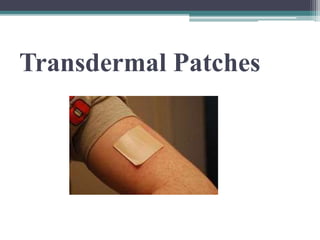
Transdermal Patches
Background
A Transdermal Patch is a medicated adhesive patch
that is placed on the skin to deliver a specific dose of
medication through the skin and into the bloodstream.
Often, this promotes healing to an injured area of the
body. An advantage of a transdermal drug delivery route
over other types of medication delivery such as oral,
topical, intravenous, intramuscular, etc. is that the patch
provides a controlled release of the medication into the
patient, usually through either a porous membrane
covering a reservoir of medication or through body heat
melting thin layers of medication embedded in the
adhesive.
1
3
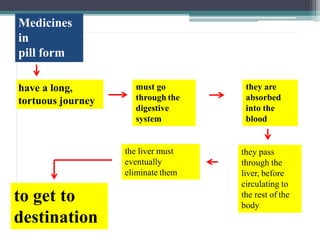
Medicines
in
pill form
have a long,
tortuous journey
to get to
destination
must go
through the
digestive
system
they are
absorbed
into the
blood
they pass
through the
liver, before
circulating to
the rest of the
body
the liver must
eventually
eliminate them
1
4
3
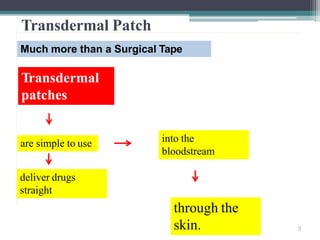
Transdermal Patch
Much more than a Surgical Tape
Transdermal
patches
are simple to use
deliver drugs
straight
into the
bloodstream
through the
skin.
The main
Componen ts
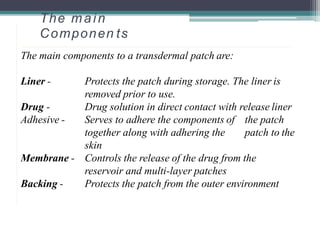
The main components to a transdermal patch are:
Liner - Protects the patch during storage. The liner is
removed prior to use.
Drug solution in direct contact with release linerDrug -
Adhesive - the patch
patch to the
Serves to adhere the components of
together along with adhering the
skin
Membrane -
Backing -
Controls the release of the drug from the
reservoir and multi-layer patches
Protects the patch from the outer environment
1
6
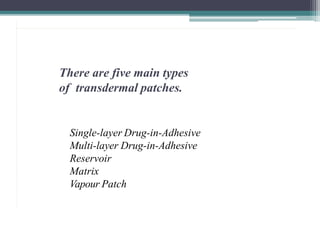
There are five main types
of transdermal patches.
Single-layer Drug-in-Adhesive
Multi-layer Drug-in-Adhesive
Reservoir
Matrix
Vapour Patch
1
7
Single-layer Drug-in-Adhesive
The adhesive layer of this system also contains the drug. In this
type of patch the adhesive layer not only serves to adhere the
various layers together, along with the entire system to the skin,
but is also responsible for the releasing of the drug. The
adhesive layer is surrounded by a temporary liner and a
backing.
1
8
Multi-layer Drug-in-Adhesive
The multi-layer drug-in adhesive patch is similar to the single-
layer system in that both adhesive layers are also responsible for
the releasing of the drug.One of the layers is for immediate
release of the drug and other layer is for control release of drug
from the reservoir. The multi-layer system is different however
that it adds another layer of drug-in-adhesive, usually separated
by a membrane (but not in all cases). This patch also has a
temporary liner-layer and a permanent backing.
Reservoir
Unlike the Single-layer and Multi-layer Drug-in-adhesive
systems the reservoir transdermal system has a separate drug
layer. The drug layer is a liquid compartment containing a drug
solution or suspension separated by the adhesive layer. This
patch is also backed by the backing layer. In this type of system
the rate of release is zero order.
2
0
Matrix
The Matrix system has a drug layer of a semisolid matrix
containing a drug solution or suspension. The adhesive layer in
this patch surrounds the drug layer partially overlaying it. Also
known as a monolithic device.
2
1
Vapour Patch
In this type of patch the adhesive layer not only serves to adhere
the various layers together but also to release vapour. The
vapour patches are new on the market and they release essential
oils for up to 6 hours. The vapour patches release essential oils
and are used in cases of decongestion mainly. Other vapour
patches on the market are controller vapour patches that
improve the quality of sleep. Vapour patches that reduce the
quantity of cigarettes that one smokes in a month are also
available on the market.
2
2
The Manufacturing
Process
2
3
 The preparation and homogeneity of the bulk
drug containing
or non bulk drug containing adhesive mass
 the coating process , including those
parameters to control layer thickness
 drying , curing and removal of residual
solvent
 lamination steps
 the storage and handling of intermediate rolls
 roll conversion to patches
 primary packing
Popular uses
The highest selling transdermal patch in USA is the
nicotine patch,
Hormonal patches
Estrogen patches
contraceptive patch
testosterone patches for both men and women
Nitroglycerin patches
Transdermal scopolamine
The anti-hypertensive drug Clonidine
Vitamin B12 may also be administered through a
transdermal patch.
2
4
Advantages of Transdermal Drug Delivery
 do not put too much load on digestive
system and liver
 avoid the pain on injection
 eliminate the adverse effects associated
with excessive absorption of drugs taken
orally
 thereby alleviate anxiety
 offer more comfort to patients
 produce excellent prolonged effects
 administration can be visually confirmed
DISADVANTAGES
Transdermal Drug Delivery patches
May cause side effects
 difficulty in breathing or swallowing
o light headedness
o dizziness
o redness or irritation of the skin ( covered by the
patch )
o flushing
some other side effects cab be serious
 slow or fast heart beat
 worsening chest pain
 fainting
 rash
 itching
1517-06-2013
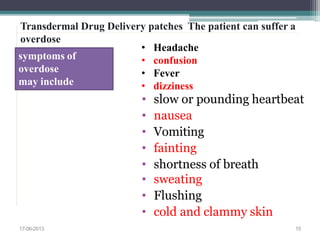
symptoms of
overdose
may include
Transdermal Drug Delivery patches The patient can suffer a
overdose
• Headache
• confusion
• Fever
• dizziness
• slow or pounding heartbeat
• nausea
• Vomiting
• fainting
• shortness of breath
• sweating
• Flushing
• cold and clammy skin
THANK YOU

Implants and transdermal patches

  • 1.
    Implants And TransdermalPatches PRESENTED BY – ANUP KUMAR RAY B.PHARM. 3rd YEAR DR. K. N. M. I. P. E. R.
  • 2.
  • 3.
    INTRODUCTION TO IMPLANTS •In the past, drugs were frequently administered orally, as liquids or in powder forms. • To avoid problems incurred through the utilization of the oral route of drug administration, new dosage forms containing the drug(s) were introduced. • As time progressed, there was a need for delivery systems that could maintain a steady release of drug to the specific site of action. • Therefore, drug delivery systems were developed to optimize the therapeutic properties of drug products and render them more safe, effective, and reliable. • Implantable drug delivery systems (IDDS) are an example of such systems available for therapeutic use.
  • 4.
    IMPLANT (DEFINITION) • Animplant is a medical device manufactured to replace a missing biological structure, support a damaged biological structure, or enhance an existing biological structure. • Medical implants are man-made devices, in contrast to a transplant, which is a transplanted biomedical tissue. • The surface of implants that contact the body might be made of a biomedical material such as titanium, silicone, or apatite depending on what is the most functional. • In some cases implants contain electronics e.g. artificial pacemaker and cochlear implants. • Some implants are bioactive, such as subcutaneous drug delivery devices in the form of implantable pills or drug- eluting stents
  • 5.
    COMPONENTS OF IMPLANTS •MICROPUMP •RESERVOIR •POWERMANAGEMENT •CONTROL AND TELEMETRY CIRCUITRY
  • 6.
    The Advantages ofimplantation therapy include. • Convenience: Effective concentration of drug in the blood can be maintained for longer period of time by techniques such as continuous intravenous infusion or repeated injections. • Improved drug delivery: The drug is distributed locally or in systemic circulation with least interference by metabolic or biological barriers.
  • 7.
    • Compliance: By allowinga reduction, or complete elimination, of patient-involved dosing compliance is increased hugely. • Potential for controlled release: Implants are available which deliver drugs by zeroorder controlled release kinetics. The advantages of zero order controlled release are: • (a) Peaks (toxicity) and troughs (ineffectiveness) of • conventional therapy is avoided, • (b) Dosing frequency is reduced, • (c)Patient compliance is increased.
  • 8.
    • Potential forbio-responsive release: Bio-responsive release from implantables is an area of on-going research. • Potential for intermittent release: Intermittent release can be facilitated by externally programmable pumps. • Flexibility: In the choice of materials, methods of manufacture, degree of drug loading, drug release rate etc. considerable flexibility is possible.
  • 9.
    The Disadvantages ofimplantables include: • Invasive: To initiate therapy either a minor or a major surgical procedure is required to initiate therapy. Appropriate surgical personnel is required for this, and may be time-consuming,traumatic. • Danger of device failure: There is no associated danger with this treatment that the device may for some reason fail to work. This again requires surgical involvement to correct.
  • 10.
    • Termination: Osmotic pumpsand non-biodegradable polymeric implants also are surgically recovered at the end of therapy. Although surgical recovery is not required in biodegradable polymeric implants. Its on-going biodegradation makes it difficult to end drug delivery, or to maintain the accurate dose at the end of its lifetime. • Limited to potent drugs: In order to minimize patient’s discomfort the size of an implant is usually kept small. Therefore most implants have a limited loading capacity so that frequently only somewhat potent medicines such as hormones may be appropriate for delivery by implantable devices. • Biocompatibility issues: Concerns over body reactions to a foreign substance often increase the issues of biocompatibility and safety of an implant.
  • 11.
    • Possibility ofadverse reactions: A high concentration of the drug delivered by an implantable device at the implantation site may produce adverse reactions. • Commercial disadvantages: An enormous amount of R&D investment,effort and time is required in the development on an IDDS.
  • 12.
  • 13.
    Background A Transdermal Patchis a medicated adhesive patch that is placed on the skin to deliver a specific dose of medication through the skin and into the bloodstream. Often, this promotes healing to an injured area of the body. An advantage of a transdermal drug delivery route over other types of medication delivery such as oral, topical, intravenous, intramuscular, etc. is that the patch provides a controlled release of the medication into the patient, usually through either a porous membrane covering a reservoir of medication or through body heat melting thin layers of medication embedded in the adhesive. 1 3
  • 14.
    Medicines in pill form have along, tortuous journey to get to destination must go through the digestive system they are absorbed into the blood they pass through the liver, before circulating to the rest of the body the liver must eventually eliminate them 1 4
  • 15.
    3 Transdermal Patch Much morethan a Surgical Tape Transdermal patches are simple to use deliver drugs straight into the bloodstream through the skin.
  • 16.
    The main Componen ts Themain components to a transdermal patch are: Liner - Protects the patch during storage. The liner is removed prior to use. Drug solution in direct contact with release linerDrug - Adhesive - the patch patch to the Serves to adhere the components of together along with adhering the skin Membrane - Backing - Controls the release of the drug from the reservoir and multi-layer patches Protects the patch from the outer environment 1 6
  • 17.
    There are fivemain types of transdermal patches. Single-layer Drug-in-Adhesive Multi-layer Drug-in-Adhesive Reservoir Matrix Vapour Patch 1 7
  • 18.
    Single-layer Drug-in-Adhesive The adhesivelayer of this system also contains the drug. In this type of patch the adhesive layer not only serves to adhere the various layers together, along with the entire system to the skin, but is also responsible for the releasing of the drug. The adhesive layer is surrounded by a temporary liner and a backing. 1 8
  • 19.
    Multi-layer Drug-in-Adhesive The multi-layerdrug-in adhesive patch is similar to the single- layer system in that both adhesive layers are also responsible for the releasing of the drug.One of the layers is for immediate release of the drug and other layer is for control release of drug from the reservoir. The multi-layer system is different however that it adds another layer of drug-in-adhesive, usually separated by a membrane (but not in all cases). This patch also has a temporary liner-layer and a permanent backing.
  • 20.
    Reservoir Unlike the Single-layerand Multi-layer Drug-in-adhesive systems the reservoir transdermal system has a separate drug layer. The drug layer is a liquid compartment containing a drug solution or suspension separated by the adhesive layer. This patch is also backed by the backing layer. In this type of system the rate of release is zero order. 2 0
  • 21.
    Matrix The Matrix systemhas a drug layer of a semisolid matrix containing a drug solution or suspension. The adhesive layer in this patch surrounds the drug layer partially overlaying it. Also known as a monolithic device. 2 1
  • 22.
    Vapour Patch In thistype of patch the adhesive layer not only serves to adhere the various layers together but also to release vapour. The vapour patches are new on the market and they release essential oils for up to 6 hours. The vapour patches release essential oils and are used in cases of decongestion mainly. Other vapour patches on the market are controller vapour patches that improve the quality of sleep. Vapour patches that reduce the quantity of cigarettes that one smokes in a month are also available on the market. 2 2
  • 23.
    The Manufacturing Process 2 3  Thepreparation and homogeneity of the bulk drug containing or non bulk drug containing adhesive mass  the coating process , including those parameters to control layer thickness  drying , curing and removal of residual solvent  lamination steps  the storage and handling of intermediate rolls  roll conversion to patches  primary packing
  • 24.
    Popular uses The highestselling transdermal patch in USA is the nicotine patch, Hormonal patches Estrogen patches contraceptive patch testosterone patches for both men and women Nitroglycerin patches Transdermal scopolamine The anti-hypertensive drug Clonidine Vitamin B12 may also be administered through a transdermal patch. 2 4
  • 25.
    Advantages of TransdermalDrug Delivery  do not put too much load on digestive system and liver  avoid the pain on injection  eliminate the adverse effects associated with excessive absorption of drugs taken orally  thereby alleviate anxiety  offer more comfort to patients  produce excellent prolonged effects  administration can be visually confirmed
  • 26.
  • 27.
    Transdermal Drug Deliverypatches May cause side effects  difficulty in breathing or swallowing o light headedness o dizziness o redness or irritation of the skin ( covered by the patch ) o flushing some other side effects cab be serious  slow or fast heart beat  worsening chest pain  fainting  rash  itching
  • 28.
    1517-06-2013 symptoms of overdose may include TransdermalDrug Delivery patches The patient can suffer a overdose • Headache • confusion • Fever • dizziness • slow or pounding heartbeat • nausea • Vomiting • fainting • shortness of breath • sweating • Flushing • cold and clammy skin
  • 29.