federal budget 101   Expected Future:  Security Implosion   Fiscal  +  Military  +  Economic
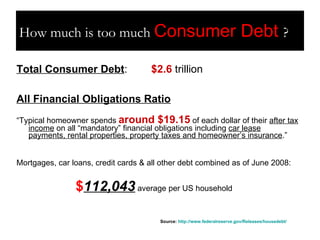
How much is too much  Consumer Debt  ? Total Consumer Debt :  $2.6  trillion All Financial Obligations Ratio   “ Typical homeowner spends  around $19.15  of each dollar of their  after tax income  on all “mandatory” financial obligations including  car lease payments, rental properties, property taxes and homeowner’s insurance .”  Mortgages, car loans, credit cards & all other debt combined as of June 2008: $ 112,043  average per US household    Source:  http://www.federalreserve.gov/Releases/housedebt/
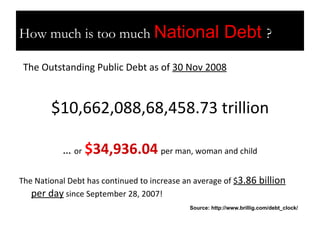
How much is too much? The Outstanding Public Debt as of  30 Nov 2008 $10,662,088,68,458.73 trillion …  or   $ 34,936.04   per man, woman and child The National Debt has continued to increase an average of  $ 3.86 billion per day  since September 28, 2007!  How much is too much  National Debt  ? Source: http://www.brillig.com/debt_clock/
 
U.S. Real GDP  + $11.5 trillion  U.S. National Debt  -  $ 10.6  trillion  [92% of GDP]   Real Median Income  +  $50,233 per Household Household Debt  -  $ 112,043  per Household  [2.2* income] Unfunded Government  -  $ 500,000  per Household  [10* income]   Financial Obligations    Source: “Taxpayers on the hook for $59 trillion” USA Today 5/29/2007 (2007 figures) How much is too much Unfunded? Reality Check
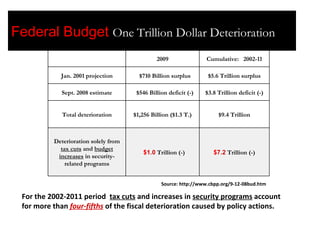
Source: http://www.cbpp.org/9-12-08bud.htm For the 2002-2011 period  tax cuts  and increases in  security programs  account  for more than  four-fifths  of the fiscal deterioration caused by policy actions.  Federal Budget  One Trillion Dollar Deterioration   $ 7.2   Trillion (-) $ 1.0  Trillion (-) Deterioration solely from  tax cuts  and  budget increases  in security-related programs $9.4 Trillion $1,256 Billion ($1.3 T.) Total deterioration $3.8 Trillion deficit (-) $546 Billion deficit (-) Sept. 2008 estimate $5.6 Trillion surplus $710 Billion surplus Jan. 2001 projection Cumulative:  2002-11 2009   The Trillion-Dollar Deterioration in the Budget (Based on CBO’s Jan 01 & Sept 08 Budget Projections)
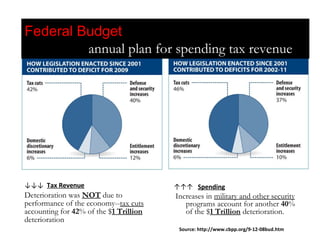
Federal Budget   annual plan for spending tax revenue ↑↑↑  Spending Increases in  military and other security  programs account for another  40 %  of the $ 1 Trillion  deterioration.   ↓↓↓  Tax Revenue Deterioration was  NOT  due to performance of the economy-- tax cuts  accounting for  42 % of the $ 1 Trillion  deterioration Source: http://www.cbpp.org/9-12-08bud.htm
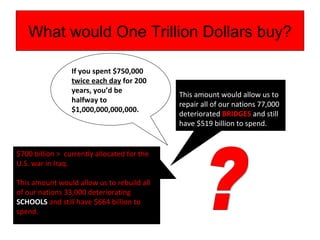
What would One Trillion Dollars buy? This amount would allow us to repair all of our nations 77,000 deteriorated  BRIDGES  and still have $519 billion to spend. If you spent $750,000  twice each day  for 200 years, you’d be halfway to $1,000,000,000,000. ? $700 billion >  currently allocated for the U.S. war in Iraq.   This amount would allow us to rebuild all of our nations 33,000 deteriorating  SCHOOLS  and still have $664 billion to spend. 
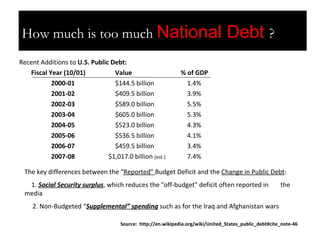
How much is too much? Recent Additions to  U.S. Public Debt: Fiscal Year (10/01)  Value   % of GDP 2000-01 $144.5 billion   1.4% 2001-02 $409.5 billion   3.9% 2002-03 $589.0 billion   5.5% 2003-04 $605.0 billion   5.3% 2004-05 $523.0 billion   4.3% 2005-06 $536.5 billion   4.1% 2006-07 $459.5 billion   3.4% 2007-08  $1,017.0 billion  (est.)   7.4% How much is too much  National Debt  ? Source:  http://en.wikipedia.org/wiki/United_States_public_debt#cite_note-46 The key differences between the “ Reported”  Budget Deficit and the  Change in Public Debt : 1.  Social Security surplus , which reduces the "off-budget" deficit often reported in  the media  2. Non-Budgeted “ Supplemental” spending  such as for the Iraq and Afghanistan wars
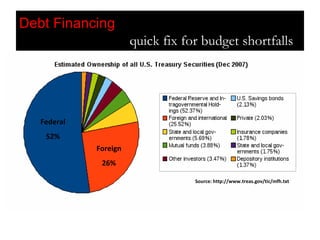
Debt Financing     quick fix for budget shortfalls Source: http://www.treas.gov/tic/mfh.txt Foreign 26% Federal 52%
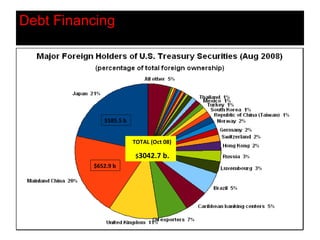
Debt Financing   $652.9 b $585.5 b TOTAL (Oct 08) $ 3042.7 b.
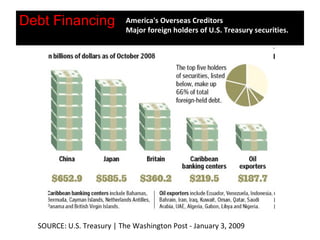
Debt Financing   America's Overseas Creditors Major foreign holders of U.S. Treasury securities.   SOURCE: U.S. Treasury | The Washington Post - January 3, 2009
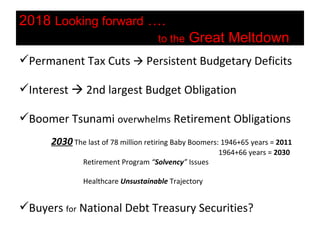
2018  Looking forward  ….   to the  Great Meltdown   Permanent Tax Cuts    Persistent Budgetary Deficits Interest    2nd largest Budget Obligation Boomer Tsunami  overwhelms  Retirement Obligations  2030  The last of 78 million retiring Baby Boomers: 1946+65 years =  2011     1964+66 years =  2030 Retirement Program  “ Solvency ”  Issues  Healthcare  Unsustainable   Trajectory Buyers  for  National Debt Treasury Securities?
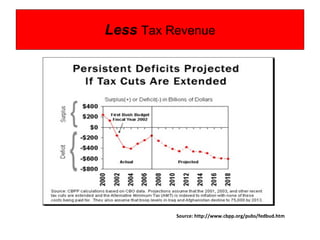
Less   Tax Revenue Source: http://www.cbpp.org/pubs/fedbud.htm
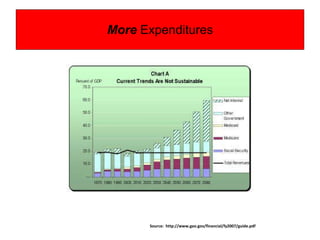
More  Expenditures Source:  http://www.gao.gov/financial/fy2007/guide.pdf
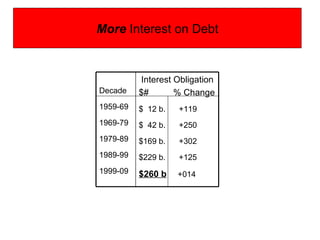
More  Interest on Debt Interest Obligation $#  % Change $  12 b.  +119 $  42 b.  +250 $169 b.  +302 $229 b.  +125 $260 b   +014  Decade 1959-69 1969-79 1979-89 1989-99 1999-09
Retiring Boomers  sell-off investment Assets to cover living expenses  [ ↓ price of assets?] KEY Dates For The Trust Fund  EXHAUSTION     OASI  DI  OASDI  HI First year Outgo > Income - Interest . . . 2018  2005  2017  2008 First year Outgo > Income + Interest . . .2028  2012  2027  2010 Year  Trust Fund Assets  exhausted . . . .  2042   2025  2041  2019 Assets end 2007 (in billions) . . . . . . . . . . .$2,023.6  $214.9  $42.9 Loss of Confidence   in  Solvency of US,  fewer foreign buyers, higher required yield/interest Fewer  Buyers for National Debt  ?
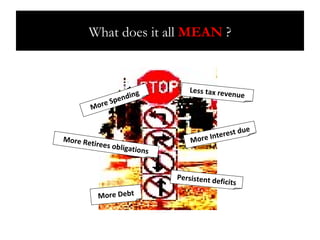
How much is too much? What does it all  MEAN  ? Less tax revenue More Spending More Debt More Interest due More Retirees obligations Persistent deficits
federal budget 101   Expected Future:  Security Implosion   Thank U for Listening! Kay E. Strong, PhD 10 Dec 08 Fiscal   IN -Security Economic   NON -Growth Military   UN -Sustainability

-Future Of US Budget-Expected Future

  • 1.
    federal budget 101 Expected Future: Security Implosion Fiscal + Military + Economic
  • 2.
    How much istoo much Consumer Debt ? Total Consumer Debt : $2.6 trillion All Financial Obligations Ratio “ Typical homeowner spends around $19.15 of each dollar of their after tax income on all “mandatory” financial obligations including car lease payments, rental properties, property taxes and homeowner’s insurance .” Mortgages, car loans, credit cards & all other debt combined as of June 2008: $ 112,043 average per US household   Source: http://www.federalreserve.gov/Releases/housedebt/
  • 3.
    How much istoo much? The Outstanding Public Debt as of 30 Nov 2008 $10,662,088,68,458.73 trillion … or $ 34,936.04 per man, woman and child The National Debt has continued to increase an average of $ 3.86 billion per day since September 28, 2007! How much is too much National Debt ? Source: http://www.brillig.com/debt_clock/
  • 4.
  • 5.
    U.S. Real GDP + $11.5 trillion U.S. National Debt - $ 10.6 trillion [92% of GDP] Real Median Income + $50,233 per Household Household Debt - $ 112,043 per Household [2.2* income] Unfunded Government - $ 500,000 per Household [10* income] Financial Obligations Source: “Taxpayers on the hook for $59 trillion” USA Today 5/29/2007 (2007 figures) How much is too much Unfunded? Reality Check
  • 6.
    Source: http://www.cbpp.org/9-12-08bud.htm Forthe 2002-2011 period tax cuts and increases in security programs account for more than four-fifths of the fiscal deterioration caused by policy actions. Federal Budget One Trillion Dollar Deterioration $ 7.2 Trillion (-) $ 1.0 Trillion (-) Deterioration solely from tax cuts and budget increases in security-related programs $9.4 Trillion $1,256 Billion ($1.3 T.) Total deterioration $3.8 Trillion deficit (-) $546 Billion deficit (-) Sept. 2008 estimate $5.6 Trillion surplus $710 Billion surplus Jan. 2001 projection Cumulative: 2002-11 2009   The Trillion-Dollar Deterioration in the Budget (Based on CBO’s Jan 01 & Sept 08 Budget Projections)
  • 7.
    Federal Budget annual plan for spending tax revenue ↑↑↑ Spending Increases in military and other security programs account for another 40 % of the $ 1 Trillion deterioration.  ↓↓↓ Tax Revenue Deterioration was NOT due to performance of the economy-- tax cuts accounting for 42 % of the $ 1 Trillion deterioration Source: http://www.cbpp.org/9-12-08bud.htm
  • 8.
    What would OneTrillion Dollars buy? This amount would allow us to repair all of our nations 77,000 deteriorated BRIDGES and still have $519 billion to spend. If you spent $750,000 twice each day for 200 years, you’d be halfway to $1,000,000,000,000. ? $700 billion > currently allocated for the U.S. war in Iraq.  This amount would allow us to rebuild all of our nations 33,000 deteriorating SCHOOLS and still have $664 billion to spend. 
  • 9.
    How much istoo much? Recent Additions to U.S. Public Debt: Fiscal Year (10/01) Value % of GDP 2000-01 $144.5 billion 1.4% 2001-02 $409.5 billion 3.9% 2002-03 $589.0 billion 5.5% 2003-04 $605.0 billion 5.3% 2004-05 $523.0 billion 4.3% 2005-06 $536.5 billion 4.1% 2006-07 $459.5 billion 3.4% 2007-08 $1,017.0 billion (est.) 7.4% How much is too much National Debt ? Source: http://en.wikipedia.org/wiki/United_States_public_debt#cite_note-46 The key differences between the “ Reported” Budget Deficit and the Change in Public Debt : 1. Social Security surplus , which reduces the "off-budget" deficit often reported in the media 2. Non-Budgeted “ Supplemental” spending such as for the Iraq and Afghanistan wars
  • 10.
    Debt Financing quick fix for budget shortfalls Source: http://www.treas.gov/tic/mfh.txt Foreign 26% Federal 52%
  • 11.
    Debt Financing $652.9 b $585.5 b TOTAL (Oct 08) $ 3042.7 b.
  • 12.
    Debt Financing America's Overseas Creditors Major foreign holders of U.S. Treasury securities. SOURCE: U.S. Treasury | The Washington Post - January 3, 2009
  • 13.
    2018 Lookingforward …. to the Great Meltdown Permanent Tax Cuts  Persistent Budgetary Deficits Interest  2nd largest Budget Obligation Boomer Tsunami overwhelms Retirement Obligations 2030 The last of 78 million retiring Baby Boomers: 1946+65 years = 2011 1964+66 years = 2030 Retirement Program “ Solvency ” Issues Healthcare Unsustainable Trajectory Buyers for National Debt Treasury Securities?
  • 14.
    Less Tax Revenue Source: http://www.cbpp.org/pubs/fedbud.htm
  • 15.
    More ExpendituresSource: http://www.gao.gov/financial/fy2007/guide.pdf
  • 16.
    More Intereston Debt Interest Obligation $# % Change $ 12 b. +119 $ 42 b. +250 $169 b. +302 $229 b. +125 $260 b +014 Decade 1959-69 1969-79 1979-89 1989-99 1999-09
  • 17.
    Retiring Boomers sell-off investment Assets to cover living expenses [ ↓ price of assets?] KEY Dates For The Trust Fund EXHAUSTION OASI DI OASDI HI First year Outgo > Income - Interest . . . 2018 2005 2017 2008 First year Outgo > Income + Interest . . .2028 2012 2027 2010 Year Trust Fund Assets exhausted . . . . 2042 2025 2041 2019 Assets end 2007 (in billions) . . . . . . . . . . .$2,023.6 $214.9 $42.9 Loss of Confidence in Solvency of US, fewer foreign buyers, higher required yield/interest Fewer Buyers for National Debt ?
  • 18.
    How much istoo much? What does it all MEAN ? Less tax revenue More Spending More Debt More Interest due More Retirees obligations Persistent deficits
  • 19.
    federal budget 101 Expected Future: Security Implosion Thank U for Listening! Kay E. Strong, PhD 10 Dec 08 Fiscal IN -Security Economic NON -Growth Military UN -Sustainability

Editor's Notes

  • #3 Total Consumer Debt : $2.6 trillion [Average per every man, woman & child $8500]
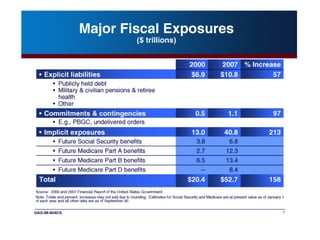
  • #5 Source: David Walker, Comptroller General, GAO-08-604CG (May 08) Major Fiscal Exposures (in trillions) The passage and signing of [Part D: Prescription Drug Benefits] bill increased the implicit exposure of the Federal government by $8.4 trillion, in present value terms (exceeding the liability associated with future Social Security benefits of $6.8 trillion). Source: General Accountability Office. [ Feb. 15, 2008] “ If the President would bother to read his mail, he'd find a letter dated December 17, 2007, from the Government Accountability Office (GAO), that states the following: "Considering (the) projected gap in social insurance, in addition to reported liabilities and other implicit commitments and contingencies that the federal government has pledged to support , the federal government's fiscal exposure totaled approximately $53 trillion..." "This translates into a current burden of about $175,000 per American or approximately $455,000 per American household ." In other words, this is what we owe to future generations .” [Source : http://www.cqpolitics.com/wmspage.cfm?parm1=2&docID=news-000002672472] Explicit : clearly stated/precisely known, defined~National Debt burden Implicit : not clearly stated/precisely known, but expected~obligations forward into the future
  • #6 Cost per U.S. Household : Source: “Taxpayers on the hook for $59 trillion” USA Today 5/29/2007 Medicare $255,280 Social Security $144,251 Military benefits $25,863 Federal civil- servant benefits $14,374 Other federal obligations $2,548 State and local debt $17,537 State and local retiree benefits $13,114
  • #10 Surplus or Deficit Reported on Budget in Economic Report of the President February 2008 <http://www.gpoaccess.gov/eop/tables08.html> 2000 $236.2 in billions 2001 $128.2 2002 $-157.8 2003 $-377.6 2004 $-412.7 2005 $-318.3 2006 $-248.2 2007 $-162.0 2008 $-410.0 (est. in 2007) 2009 $-407.4 (est. in 2007) Social Security (in billions) Tax Receipts Disbursements Difference 2000 652.9 409.4 243.5 2001 694.0 433.0 261.0 2002 700.8 456.0 244.8 2003 713.0 474.7 238.3 2004 733.4 495.5 237.9 2005 794.1 523.3 270.8 2006 837.8 548.5 289.3 2007 869.6 586.2 283.4 2008 910.1 615.3 294.8 2009 949.4 649.3 300.1
  • #11 Total National Debt $ * % = $ # Gross Federal Debt Held by Public (outside Federal Reserve +Federal Intra-governmental Accounts~ Trust Funds) 2000 $5,628.7 3,409.8 (in billions) 2001 $5,769.9 3,319.6 2002 $6,198.4 3,540.4 2003 $6,760.0 3,913.4 2004 $7,354.7 4,295.5 2005 $7,905.3 4,592.2 2006 $8,451.4 4,829.0 2007 $8,950.7 5,035.1 2008 $9,654.4 5,428.6 2009 $10,413.4 5,856.2 TRUST FUND Report <http://www.ssa.gov/OACT/TRSUM/trsummary.html> Assets end 2007 SS $2,023.6 (interest earned $97 billion) DI $214.9 (interest earned $31.2 billion) HI $42.9 (interest earned $16.5 billion) SMI (interest earned $2.2 billion) –NOT a trust fund
  • #12 Source: <http://www.ustreas.gov/tic/mfh.txt> updated Oct 08 MAJOR FOREIGN HOLDERS OF TREASURY SECURITIES (in billions of dollars) HOLDINGS 1*/ AT END OF PERIOD Sep Aug Jul Jun May Apr Mar Feb Jan Dec Nov Oct Sep Country 2008 2008 2008 2008 2008 2008 2008 2008 2008 2007 2007 2007 2007 ------ ------ ------ ------ ------ ------ ------ ------ ------ ------ ------ ------ ------ China, Mainland: 585.0 541.4 518.7 503.8 506.8 502.0 490.6 486.9 492.6 477.6 458.9 459.1 467.7 Japan: 573.2 586.0 593.4 583.8 578.7 592.2 600.7 586.6 586.9 581.2 590.9 601.7 591.9 United Kingdom: 338.4 308.1 291.5 280.4 272.5 247.8 201.1 181.1 161.9 158.2 174.3 155.0 120.3 Carib Bnkng Ctrs: 185.3 148.9 133.7 122.4 104.7 115.4 107.1 103.0 108.1 116.7 107.4 105.6 99.1 Oil Exporters: 182.2 180.6 173.9 170.4 164.3 153.9 150.8 146.1 140.9 137.9 138.7 141.6 137.1 Brazil: 141.9 146.2 148.4 151.6 151.4 149.5 149.1 146.6 141.7 129.9 121.7 113.9 110.5 Totals, Of which : Foreign Official 1821.7 1785.5 1767.6 1751.7 1743.9 1743.4 1706.6 1681.6 1688.0 1641.1 1619.1 1613.8 1607.7 Treasury Bills 276.8 245.6 232.5 226.6 220.0 215.7 201.3 204.3 207.1 196.3 185.3 180.4 178.3 T-Bonds & Notes 1544.9 1540.0 1535.1 1525.0 1523.9 1527.6 1505.3 1477.3 1480.9 1444.8 1433.8 1433.4 1429.4 Footnote : 1*/ Estimated foreign holdings of U.S. Treasury marketable and non-marketable bills, bonds, and notes reported under the Treasury International Capital (TIC) reporting system are based on annual Surveys of Foreign Holdings of U.S. Securities and on monthly data. People’s Bank of China: <http://www.pbc.gov.cn/english/diaochatongji/> CIA Factbook: <https://www.cia.gov/library/publications/the-world-factbook/geos/ch.html#Econ>
  • #13 Source: <http://www.ustreas.gov/tic/mfh.txt> updated SEP 08 MAJOR FOREIGN HOLDERS OF TREASURY SECURITIES (in billions of dollars) HOLDINGS 1*/ AT END OF PERIOD Sep Aug Jul Jun May Apr Mar Feb Jan Dec Nov Oct Sep Country 2008 2008 2008 2008 2008 2008 2008 2008 2008 2007 2007 2007 2007 ------ ------ ------ ------ ------ ------ ------ ------ ------ ------ ------ ------ ------ China, Mainland: 585.0 541.4 518.7 503.8 506.8 502.0 490.6 486.9 492.6 477.6 458.9 459.1 467.7 Japan: 573.2 586.0 593.4 583.8 578.7 592.2 600.7 586.6 586.9 581.2 590.9 601.7 591.9 United Kingdom: 338.4 308.1 291.5 280.4 272.5 247.8 201.1 181.1 161.9 158.2 174.3 155.0 120.3 Carib Bnkng Ctrs: 185.3 148.9 133.7 122.4 104.7 115.4 107.1 103.0 108.1 116.7 107.4 105.6 99.1 Oil Exporters: 182.2 180.6 173.9 170.4 164.3 153.9 150.8 146.1 140.9 137.9 138.7 141.6 137.1 Brazil: 141.9 146.2 148.4 151.6 151.4 149.5 149.1 146.6 141.7 129.9 121.7 113.9 110.5 Totals, Of which : Foreign Official 1821.7 1785.5 1767.6 1751.7 1743.9 1743.4 1706.6 1681.6 1688.0 1641.1 1619.1 1613.8 1607.7 Treasury Bills 276.8 245.6 232.5 226.6 220.0 215.7 201.3 204.3 207.1 196.3 185.3 180.4 178.3 T-Bonds & Notes 1544.9 1540.0 1535.1 1525.0 1523.9 1527.6 1505.3 1477.3 1480.9 1444.8 1433.8 1433.4 1429.4 Footnote : 1*/ Estimated foreign holdings of U.S. Treasury marketable and non-marketable bills, bonds, and notes reported under the Treasury International Capital (TIC) reporting system are based on annual Surveys of Foreign Holdings of U.S. Securities and on monthly data. People’s Bank of China: <http://www.pbc.gov.cn/english/diaochatongji/> CIA Factbook: <https://www.cia.gov/library/publications/the-world-factbook/geos/ch.html#Econ>
  • #15 ASSUMES TAX CUTS are EXTENDED! In June 2001 President Bush signed into law the Economic Growth and Tax Reform Reconciliation Act of 2001 (EGTRRA) involving a $1.35 trillion tax cut over ten years. In March 2002 President Bush signed into law the Job Creation and Workers Assistance Act of 2002 (JCWA) reducing taxes for depreciation and capital gains. In May 2003 President Bush signed into law The Jobs and Growth Tax Relief and Reconciliation Act of 2003 (JGTRRA) which included a $350 billion tax cut. In February of 2008 the US Congress approved a $168 billion economic stimulus plan involving tax rebates. Nearly all of the tax cuts enacted since 2001 expire at the end of 2010. In October 2008 the US Congress approved the $ 700 billion Troubled Asset Relief Programme (TARP) and the Federal Deposit Insurance Corporation. Dating for last downturn: March-Nov 2001 [ Source : http://wwwdev.nber.org/cycles/cyclesmain.html ] Between 2004 and 2007, the budget deficit narrowed from $413 billion to $162 billion in large part thanks to rapid growth in tax revenue. This was caused not just by rising incomes, but also by a shift in the distribution of incomes to the wealthy, who pay the highest tax rates. Much of that wealth came from the credit boom which drove up financial profits, salaries and bonuses as well as property and stock values and related capital gains. [ Source : http://www.economist.com/world/unitedstates/PrinterFriendly.cfm?story_id=12484798]
  • #17 % Change is with respect to previous 10 year period
  • #20 Can we really have it all?