By Professor Philip S. Ashley
The Problem With Too Much Debt
 Our daunting annual deficits and
 accumulated public debt constrain
 government actions.
 How much debt do we have, and how
 serious is it?
Article I, Section 8, Clause 2 of
the U.S. Constitution grants
Congress the authority “to
borrow money on the credit of
the United States.”
I wish it were possible to obtain
an additional article to our
Constitution . . . taking from the
Federal Government the power of
borrowing.
 -- Thomas Jefferson
versus
A national debt, if it is not
excessive, will be to us a national
blessing.
-- Alexander Hamilton
what’s really happening?
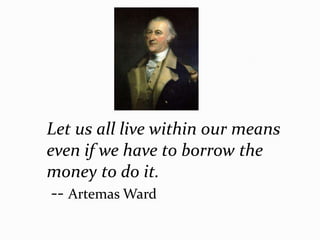
Let us all live within our means
even if we have to borrow the
money to do it.
 -- Artemas Ward
How much debt is “excessive?”
The annual deficit is the excess of government
expenditure over government revenue.

For 2001 the deficit was $342 billion.
For 2010 the deficit was $1.5 trillion.
For 2011 it was $1.3 trillion and
The 2012 estimate is also $1.3 trillion.

This shortfall required the government to borrow 40% of
its revenue last year!
An Inescapable Conclusion

  We simply want to live better
than our tax payments entitle us.
Putting the deficit into perspective
The 2011 deficit of $1.5 trillion, as a percentage
of Gross Domestic Product (GDP) = 10.9%
Comparison: During 1988-2008 the average
deficit was 2.86% of GDP.
Comparison: for 1943 the deficit hit 30.2%
The 2011 deficit is the highest since the end of
WWII.
The Debt
The debt is the sum of our annual deficits minus
repayments.

Public debt                     $10.3 trillion +
Intra-governmental holdings       4.7 trillion =
                                $15 trillion.

(Does not count unfunded obligations like government
pensions = $5 trillion, etc.)
How serious is the debt?
Currently the debt = 102% of GDP. The
highest it has ever been is 108.6% at the end
of WWII.

We are nearing historical levels and will
exceed them soon if present trends continue.
Three Strategies for Recovery
1) Cut spending to balance the budget
2) Increase taxes to balance the budget
3) Expand the economy to balance the
   budget while avoiding deep spending
   cuts and sharp tax increases.
Strategy #1: Cut Spending
How Mandatory Programs
        Swallow the Budget
Currently, Social Security, Medicare and Medicaid
account for 55% of federal spending; that proportion
is increasing faster than inflation and the rate of
population growth.

Specifically, they cost $2 trillion out of our $3.6
trillion total budget. Thus, cutting $1.2 trillion to
balance the budget would wipe out almost every
other government program including defense.
The easy cuts have already been made.

Making further meaningful cuts will be
very difficult because they will be
strenuously resisted by those who will be
hurt by their repeal.

Some proposed cuts include:
Repealing some or all “tax
       expenditures.”
A tax expenditure is a spending program
run through the tax code, usually in the
form of a deduction.
Tax expenditures currently cost $1
trillion our of our total federal budget of
$3.6 trillion.
Typical Tax Expenditures
1) Deduction for home mortgage interest -- $98 billion
2) Deduction for state and local income taxes -- $48
  billion
3) Deduction of charitable contributions -- $43 billion
4) Exclusion of interest on state and municipal bonds -
  - $37 billion
5) Deduction for property taxes on homes – $25 billion
6) Deductibility of medical expenses -- $10 billion
Possible Spending Cuts
1) Deduction for interest on a home mortgage
(I.R.C. §163) presently costs $98 billion/year.
It has not raised the homeownership rate and
may have even made buying a home more
expensive for lower -income taxpayers.
Canada repealed its home ownership
mortgage interest deduction without serious
long-term harm to its housing market.
A Cut that Should be Resisted
2) Deductions for charitable giving (§170).
Current cost $54 billion/year.
Even deduction caps on wealthy donors would
hurt:
taxpayers with over $200,000 (top 2%)
account for 53% of giving by individuals and
38% of total giving.
Why?
Philanthropy is the very possibility of doing
something different than government can
do, of creating an institution free to make
choices government cannot [make] without
having to provide a justification that will be
examined in a court of law.*

*Friendly, “The Dartmouth College Case and the Public-
Private Penumbra”, 12 TaxesQ. (2d Supp) 141, 171 (1969).
The institutional landscape of America is . . .
teeming with
nongovernmental, noncommercial, organizations
from [world class]educational institutions to
garden clubs. . . . This vast and varied array had
widely been recognized as part of the very fabric
of American life. It reflects the national belief in
the philosophy of pluralism and in the
importance to society of individual initiative.
”The Commission On Private Philanthropy and Public
Needs, Giving In America – Towards A Stonger Voluntary Sector.
The Filer Commission Report,” (1975).
Another Cut to Resist
3) Inflation Indexing

Current cost $0.

Future cost unknown… but potentially
devastating to middle- and lower-
income taxpayers.
35%
           Tax Brackets for an
    33%   Unmarried Taxpayer


R
    28%
A
T
E   25%

S
    15%


    0%
          $22,100     $53,500    $115,000   $250,000   $250,000+

                            TAXABLE INCOME
Repeal of indexing would be a tax
increase and tax increases are usually
justified on the ground of “ability to
pay.” But that repeal of indexing
would harm those whose ability to
pay is already compromised.
Strategy #2: Increase Taxes
1) Consumer spending accounts for 70% of our
economy but higher taxes would take money out of
consumers’ pockets.

2) There aren’t enough millionaires to make a
serious dent. Last year 384,000 returns showed $1
million or more in adjusted gross income. If each of
those taxpayers paid another $100,000 in taxes, that
would only raise $384 billion. Compared to our $1.2
trillion deficit, that’s a small amount.
The “Laffer Curve”
Laffer predicted that lowering taxes would
increase federal revenue . The empirical
data, however, is inconsistent and difficult
to analyze, because other factors besides tax
rates affect federal revenues.

Lowering taxes did result in the upper 5%
of taxpayers paying a higher percentage of
total taxes but total revenue did not
increase.
Strategy #3: Expand the Economy
Difficulties:
1) As noted, consumer spending = 70%
  of the economy. As long as
  unemployment is up and households
  are paying down debt, consumer
  spending will continue to be lower
  than pre-recession levels.
2) Many of our overseas customers
 are in financial trouble
 (Europe, Japan)
3) Higher taxes, if they are
   enacted, will reduce
   entrepreneurial activity.
4) Government borrowing
  will crowd out business
  borrowing.
The Danger of Government Borrowing
For fiscal 2009, 40% of government revenue
was borrowed, which was about $1.5 trillion.
At the same time, corporations borrow
about $21 billion.
However, analysts estimate that between
2012- 2014, corporate borrowing needs will
rise to $700 billion! Where will the money
come from to support this unprecedented
level of borrowing?
The High Cost of Waiting
Typically, Congress doesn’t “rock the
boat” in election years; the radical tax
reform that we need will probably be
postponed to 2013.
Waiting, however, will make getting out
of debt even more difficult.
For fiscal 2010, the government paid $454
billion just in interest on our national debt.
That was 12.3% of government spending. Is that
a lot?

By comparison, NASA’s budget was $6 billion
and the Department of Education spent $31
billion.

Not only is the interest becoming one of the
government’s largest costs, but it is expected to
greatly increase when interest rates come off
their historic lows, as they inevitably will.
Ashley dsol

Ashley dsol

  • 1.
  • 2.
    The Problem WithToo Much Debt Our daunting annual deficits and accumulated public debt constrain government actions. How much debt do we have, and how serious is it?
  • 3.
    Article I, Section8, Clause 2 of the U.S. Constitution grants Congress the authority “to borrow money on the credit of the United States.”
  • 4.
    I wish itwere possible to obtain an additional article to our Constitution . . . taking from the Federal Government the power of borrowing. -- Thomas Jefferson
  • 5.
  • 6.
    A national debt,if it is not excessive, will be to us a national blessing. -- Alexander Hamilton
  • 7.
  • 8.
    Let us alllive within our means even if we have to borrow the money to do it. -- Artemas Ward
  • 9.
    How much debtis “excessive?” The annual deficit is the excess of government expenditure over government revenue. For 2001 the deficit was $342 billion. For 2010 the deficit was $1.5 trillion. For 2011 it was $1.3 trillion and The 2012 estimate is also $1.3 trillion. This shortfall required the government to borrow 40% of its revenue last year!
  • 10.
    An Inescapable Conclusion We simply want to live better than our tax payments entitle us.
  • 11.
    Putting the deficitinto perspective The 2011 deficit of $1.5 trillion, as a percentage of Gross Domestic Product (GDP) = 10.9% Comparison: During 1988-2008 the average deficit was 2.86% of GDP. Comparison: for 1943 the deficit hit 30.2% The 2011 deficit is the highest since the end of WWII.
  • 13.
    The Debt The debtis the sum of our annual deficits minus repayments. Public debt $10.3 trillion + Intra-governmental holdings 4.7 trillion = $15 trillion. (Does not count unfunded obligations like government pensions = $5 trillion, etc.)
  • 14.
    How serious isthe debt? Currently the debt = 102% of GDP. The highest it has ever been is 108.6% at the end of WWII. We are nearing historical levels and will exceed them soon if present trends continue.
  • 15.
    Three Strategies forRecovery 1) Cut spending to balance the budget 2) Increase taxes to balance the budget 3) Expand the economy to balance the budget while avoiding deep spending cuts and sharp tax increases.
  • 16.
  • 17.
    How Mandatory Programs Swallow the Budget Currently, Social Security, Medicare and Medicaid account for 55% of federal spending; that proportion is increasing faster than inflation and the rate of population growth. Specifically, they cost $2 trillion out of our $3.6 trillion total budget. Thus, cutting $1.2 trillion to balance the budget would wipe out almost every other government program including defense.
  • 18.
    The easy cutshave already been made. Making further meaningful cuts will be very difficult because they will be strenuously resisted by those who will be hurt by their repeal. Some proposed cuts include:
  • 19.
    Repealing some orall “tax expenditures.” A tax expenditure is a spending program run through the tax code, usually in the form of a deduction. Tax expenditures currently cost $1 trillion our of our total federal budget of $3.6 trillion.
  • 20.
    Typical Tax Expenditures 1)Deduction for home mortgage interest -- $98 billion 2) Deduction for state and local income taxes -- $48 billion 3) Deduction of charitable contributions -- $43 billion 4) Exclusion of interest on state and municipal bonds - - $37 billion 5) Deduction for property taxes on homes – $25 billion 6) Deductibility of medical expenses -- $10 billion
  • 21.
    Possible Spending Cuts 1)Deduction for interest on a home mortgage (I.R.C. §163) presently costs $98 billion/year. It has not raised the homeownership rate and may have even made buying a home more expensive for lower -income taxpayers. Canada repealed its home ownership mortgage interest deduction without serious long-term harm to its housing market.
  • 22.
    A Cut thatShould be Resisted 2) Deductions for charitable giving (§170). Current cost $54 billion/year. Even deduction caps on wealthy donors would hurt: taxpayers with over $200,000 (top 2%) account for 53% of giving by individuals and 38% of total giving.
  • 23.
    Why? Philanthropy is thevery possibility of doing something different than government can do, of creating an institution free to make choices government cannot [make] without having to provide a justification that will be examined in a court of law.* *Friendly, “The Dartmouth College Case and the Public- Private Penumbra”, 12 TaxesQ. (2d Supp) 141, 171 (1969).
  • 24.
    The institutional landscapeof America is . . . teeming with nongovernmental, noncommercial, organizations from [world class]educational institutions to garden clubs. . . . This vast and varied array had widely been recognized as part of the very fabric of American life. It reflects the national belief in the philosophy of pluralism and in the importance to society of individual initiative. ”The Commission On Private Philanthropy and Public Needs, Giving In America – Towards A Stonger Voluntary Sector. The Filer Commission Report,” (1975).
  • 25.
    Another Cut toResist 3) Inflation Indexing Current cost $0. Future cost unknown… but potentially devastating to middle- and lower- income taxpayers.
  • 26.
    35% Tax Brackets for an 33% Unmarried Taxpayer R 28% A T E 25% S 15% 0% $22,100 $53,500 $115,000 $250,000 $250,000+ TAXABLE INCOME
  • 27.
    Repeal of indexingwould be a tax increase and tax increases are usually justified on the ground of “ability to pay.” But that repeal of indexing would harm those whose ability to pay is already compromised.
  • 28.
    Strategy #2: IncreaseTaxes 1) Consumer spending accounts for 70% of our economy but higher taxes would take money out of consumers’ pockets. 2) There aren’t enough millionaires to make a serious dent. Last year 384,000 returns showed $1 million or more in adjusted gross income. If each of those taxpayers paid another $100,000 in taxes, that would only raise $384 billion. Compared to our $1.2 trillion deficit, that’s a small amount.
  • 29.
  • 30.
    Laffer predicted thatlowering taxes would increase federal revenue . The empirical data, however, is inconsistent and difficult to analyze, because other factors besides tax rates affect federal revenues. Lowering taxes did result in the upper 5% of taxpayers paying a higher percentage of total taxes but total revenue did not increase.
  • 32.
    Strategy #3: Expandthe Economy Difficulties: 1) As noted, consumer spending = 70% of the economy. As long as unemployment is up and households are paying down debt, consumer spending will continue to be lower than pre-recession levels.
  • 33.
    2) Many ofour overseas customers are in financial trouble (Europe, Japan)
  • 34.
    3) Higher taxes,if they are enacted, will reduce entrepreneurial activity.
  • 35.
    4) Government borrowing will crowd out business borrowing.
  • 36.
    The Danger ofGovernment Borrowing For fiscal 2009, 40% of government revenue was borrowed, which was about $1.5 trillion. At the same time, corporations borrow about $21 billion. However, analysts estimate that between 2012- 2014, corporate borrowing needs will rise to $700 billion! Where will the money come from to support this unprecedented level of borrowing?
  • 37.
    The High Costof Waiting Typically, Congress doesn’t “rock the boat” in election years; the radical tax reform that we need will probably be postponed to 2013. Waiting, however, will make getting out of debt even more difficult.
  • 40.
    For fiscal 2010,the government paid $454 billion just in interest on our national debt. That was 12.3% of government spending. Is that a lot? By comparison, NASA’s budget was $6 billion and the Department of Education spent $31 billion. Not only is the interest becoming one of the government’s largest costs, but it is expected to greatly increase when interest rates come off their historic lows, as they inevitably will.