THE MOBIUS FUNCTION AND
THE MOBIUS INVERSION
FORMULA
MULTIPLICATIVE NUMBER THEORETIC FUNCTIONS
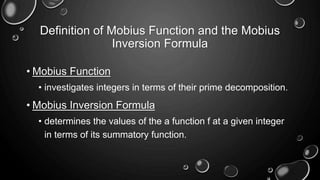
Definition of Mobius Function and the Mobius
Inversion Formula
• Mobius Function
• investigates integers in terms of their prime decomposition.
• Mobius Inversion Formula
• determines the values of the a function f at a given integer
in terms of its summatory function.
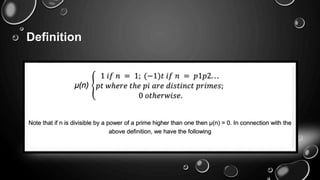
Definition
µ(n)
1 𝑖𝑓 𝑛 = 1; (−1)𝑡 𝑖𝑓 𝑛 = 𝑝1𝑝2. . .
𝑝𝑡 𝑤ℎ𝑒𝑟𝑒 𝑡ℎ𝑒 𝑝𝑖 𝑎𝑟𝑒 𝑑𝑖𝑠𝑡𝑖𝑛𝑐𝑡 𝑝𝑟𝑖𝑚𝑒𝑠;
0 𝑜𝑡ℎ𝑒𝑟𝑤𝑖𝑠𝑒.
Note that if n is divisible by a power of a prime higher than one then µ(n) = 0. In connection with the
above definition, we have the following
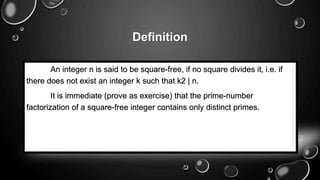
Definition
An integer n is said to be square-free, if no square divides it, i.e. if
there does not exist an integer k such that k2 | n.
It is immediate (prove as exercise) that the prime-number
factorization of a square-free integer contains only distinct primes.
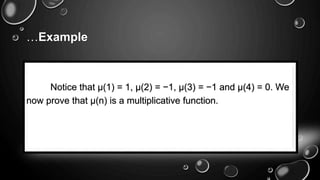
…Example
Notice that µ(1) = 1, µ(2) = −1, µ(3) = −1 and µ(4) = 0. We
now prove that µ(n) is a multiplicative function.
THE MOBIUS FUNCTION
Theorem
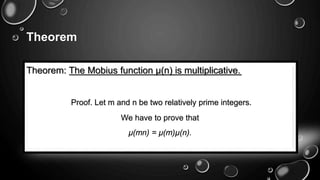
Theorem: The Mobius function µ(n) is multiplicative.
Proof. Let m and n be two relatively prime integers.
We have to prove that
µ(mn) = µ(m)µ(n).
THE MOBIUS INVERSION FORMULA
Theorem
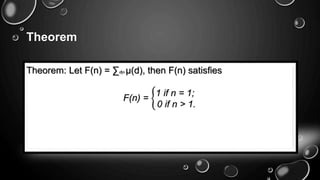
Theorem: Let F(n) = ∑d|n µ(d), then F(n) satisfies
F(n) =
1 if n = 1;
0 if n > 1.
…Proof
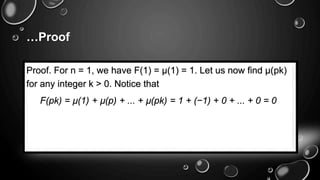
Proof. For n = 1, we have F(1) = µ(1) = 1. Let us now find µ(pk)
for any integer k > 0. Notice that
F(pk) = µ(1) + µ(p) + ... + µ(pk) = 1 + (−1) + 0 + ... + 0 = 0
Theorem
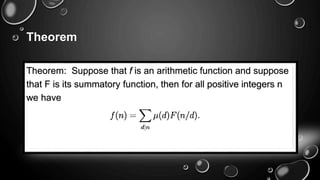
Theorem: Suppose that f is an arithmetic function and suppose
that F is its summatory function, then for all positive integers n
we have
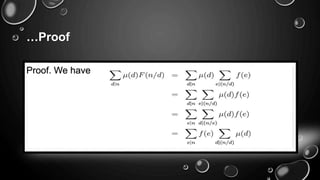
…Proof
Proof. We have
…Example
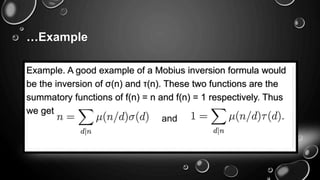
Example. A good example of a Mobius inversion formula would
be the inversion of σ(n) and τ(n). These two functions are the
summatory functions of f(n) = n and f(n) = 1 respectively. Thus
we get
and
The mobius function and the mobius inversion formula

The mobius function and the mobius inversion formula

  • 1.
    THE MOBIUS FUNCTIONAND THE MOBIUS INVERSION FORMULA MULTIPLICATIVE NUMBER THEORETIC FUNCTIONS
  • 2.
    Definition of MobiusFunction and the Mobius Inversion Formula • Mobius Function • investigates integers in terms of their prime decomposition. • Mobius Inversion Formula • determines the values of the a function f at a given integer in terms of its summatory function.
  • 3.
    Definition µ(n) 1 𝑖𝑓 𝑛= 1; (−1)𝑡 𝑖𝑓 𝑛 = 𝑝1𝑝2. . . 𝑝𝑡 𝑤ℎ𝑒𝑟𝑒 𝑡ℎ𝑒 𝑝𝑖 𝑎𝑟𝑒 𝑑𝑖𝑠𝑡𝑖𝑛𝑐𝑡 𝑝𝑟𝑖𝑚𝑒𝑠; 0 𝑜𝑡ℎ𝑒𝑟𝑤𝑖𝑠𝑒. Note that if n is divisible by a power of a prime higher than one then µ(n) = 0. In connection with the above definition, we have the following
  • 4.
    Definition An integer nis said to be square-free, if no square divides it, i.e. if there does not exist an integer k such that k2 | n. It is immediate (prove as exercise) that the prime-number factorization of a square-free integer contains only distinct primes.
  • 5.
    …Example Notice that µ(1)= 1, µ(2) = −1, µ(3) = −1 and µ(4) = 0. We now prove that µ(n) is a multiplicative function.
  • 6.
  • 7.
    Theorem Theorem: The Mobiusfunction µ(n) is multiplicative. Proof. Let m and n be two relatively prime integers. We have to prove that µ(mn) = µ(m)µ(n).
  • 8.
  • 9.
    Theorem Theorem: Let F(n)= ∑d|n µ(d), then F(n) satisfies F(n) = 1 if n = 1; 0 if n > 1.
  • 10.
    …Proof Proof. For n= 1, we have F(1) = µ(1) = 1. Let us now find µ(pk) for any integer k > 0. Notice that F(pk) = µ(1) + µ(p) + ... + µ(pk) = 1 + (−1) + 0 + ... + 0 = 0
  • 11.
    Theorem Theorem: Suppose thatf is an arithmetic function and suppose that F is its summatory function, then for all positive integers n we have
  • 12.
  • 13.
    …Example Example. A goodexample of a Mobius inversion formula would be the inversion of σ(n) and τ(n). These two functions are the summatory functions of f(n) = n and f(n) = 1 respectively. Thus we get and