At the endof the lesson learners will be
able to:
define Arithmetic and multiplicative function
differentiate multiplicative function and
completely multiplicative function.
solve problems involving multiplicative
functions.
solve problems involving Tau, Sigma and Mobius
Function as multiplicative function.
Arithmetic Function
a functionof the form f : →
•Arithmetic function maps positive integers to complex numbers, crucial in
number theory
•Domain consists of positive integers (natural numbers), forming the input set
•Codomain encompasses complex numbers, representing possible output values
•Bounded function maintains outputs within a fixed range, never exceeding
certain limits
29.
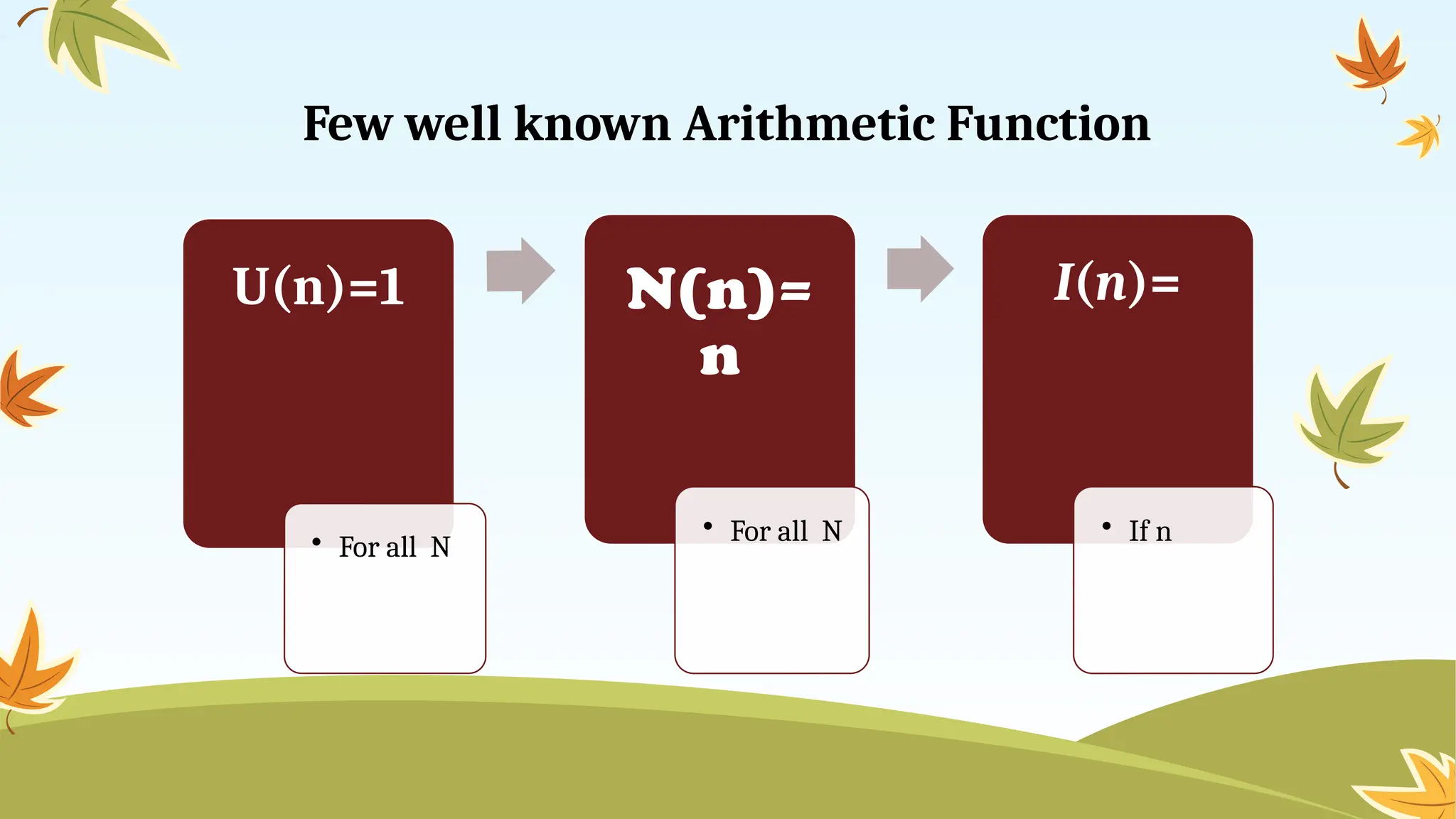
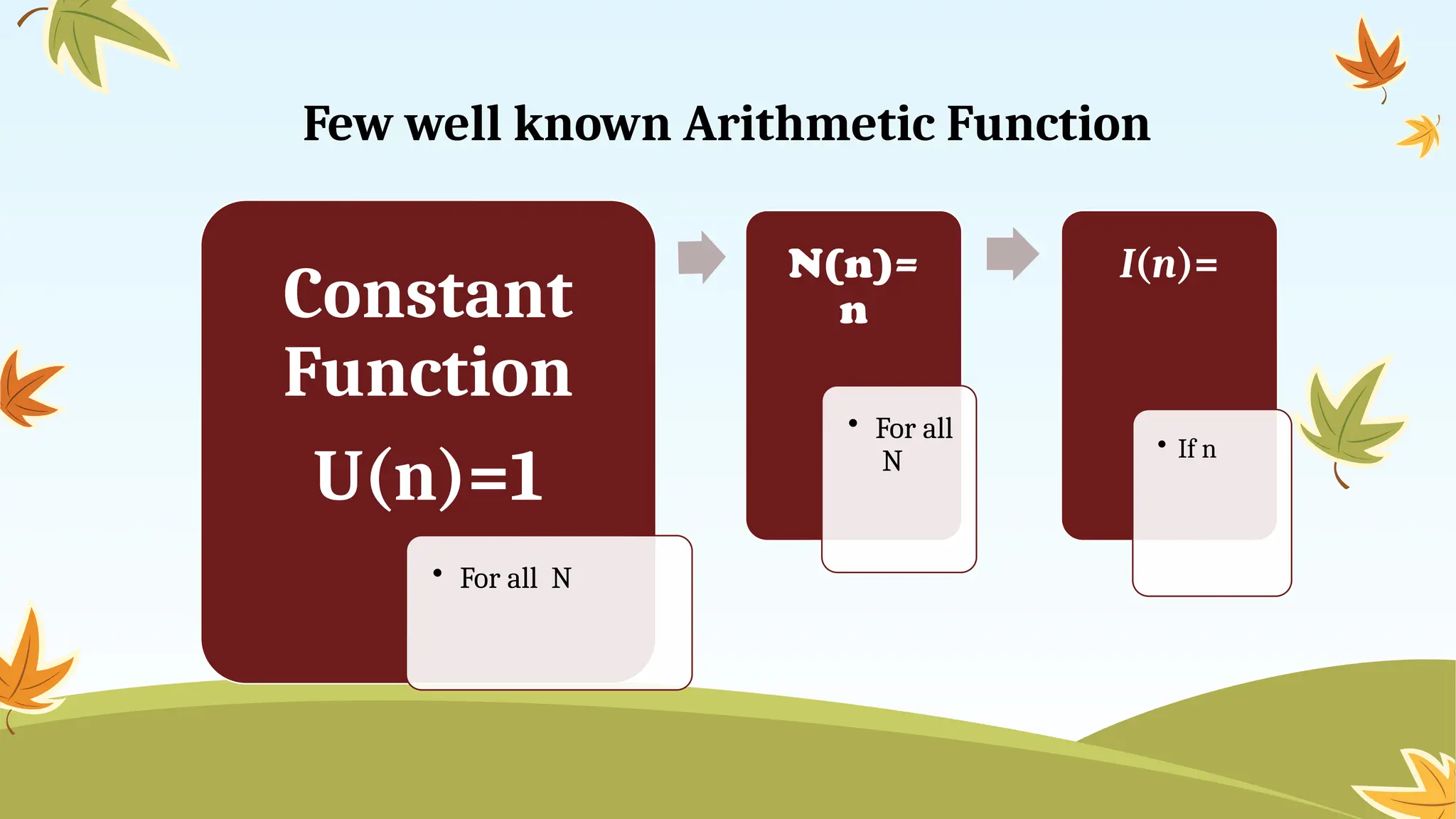
Few well knownArithmetic Function
U(n)=1
• For all N
N(n)=
n
• For all N
I(n)=
• If n
30.
Few well knownArithmetic Function
Constant
Function
U(n)=1
• For all N
N(n)=
n
• For all
N
I(n)=
• If n
31.
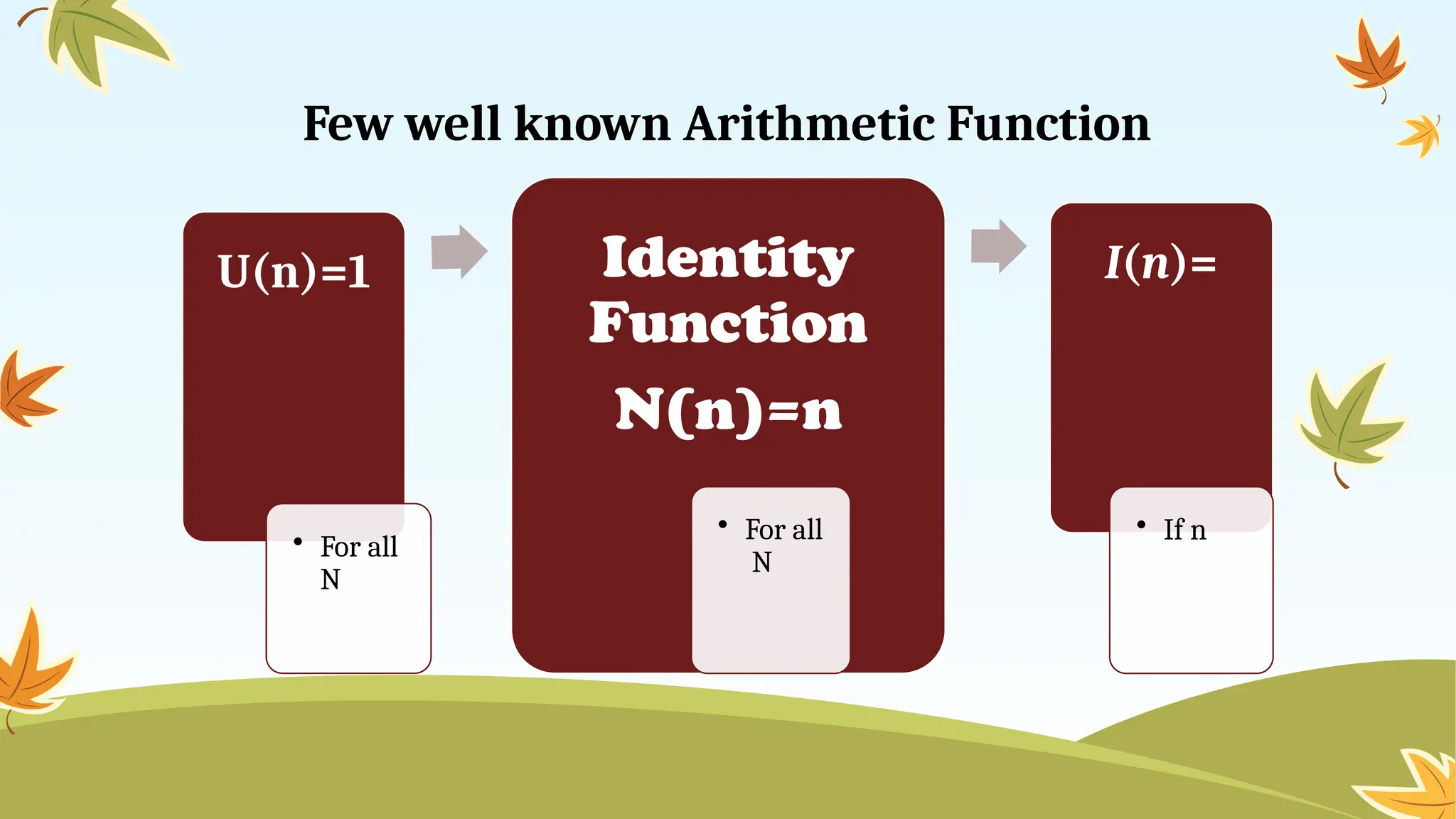
Few well knownArithmetic Function
U(n)=1
• For all
N
Identity
Function
N(n)=n
• For all
N
I(n)=
• If n
32.
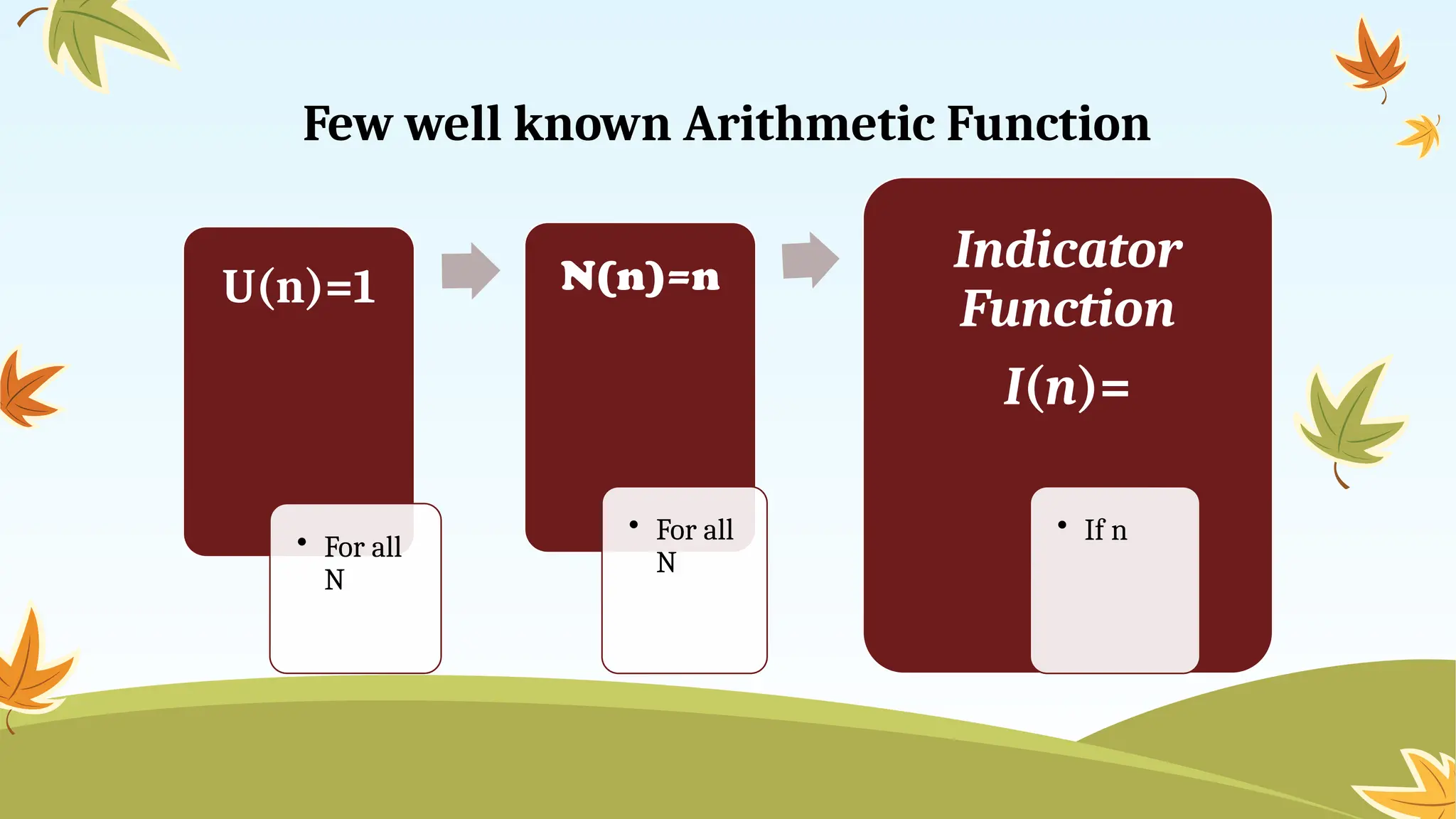
Few well knownArithmetic Function
U(n)=1
• For all
N
N(n)=n
• For all
N
Indicator
Function
I(n)=
• If n
33.
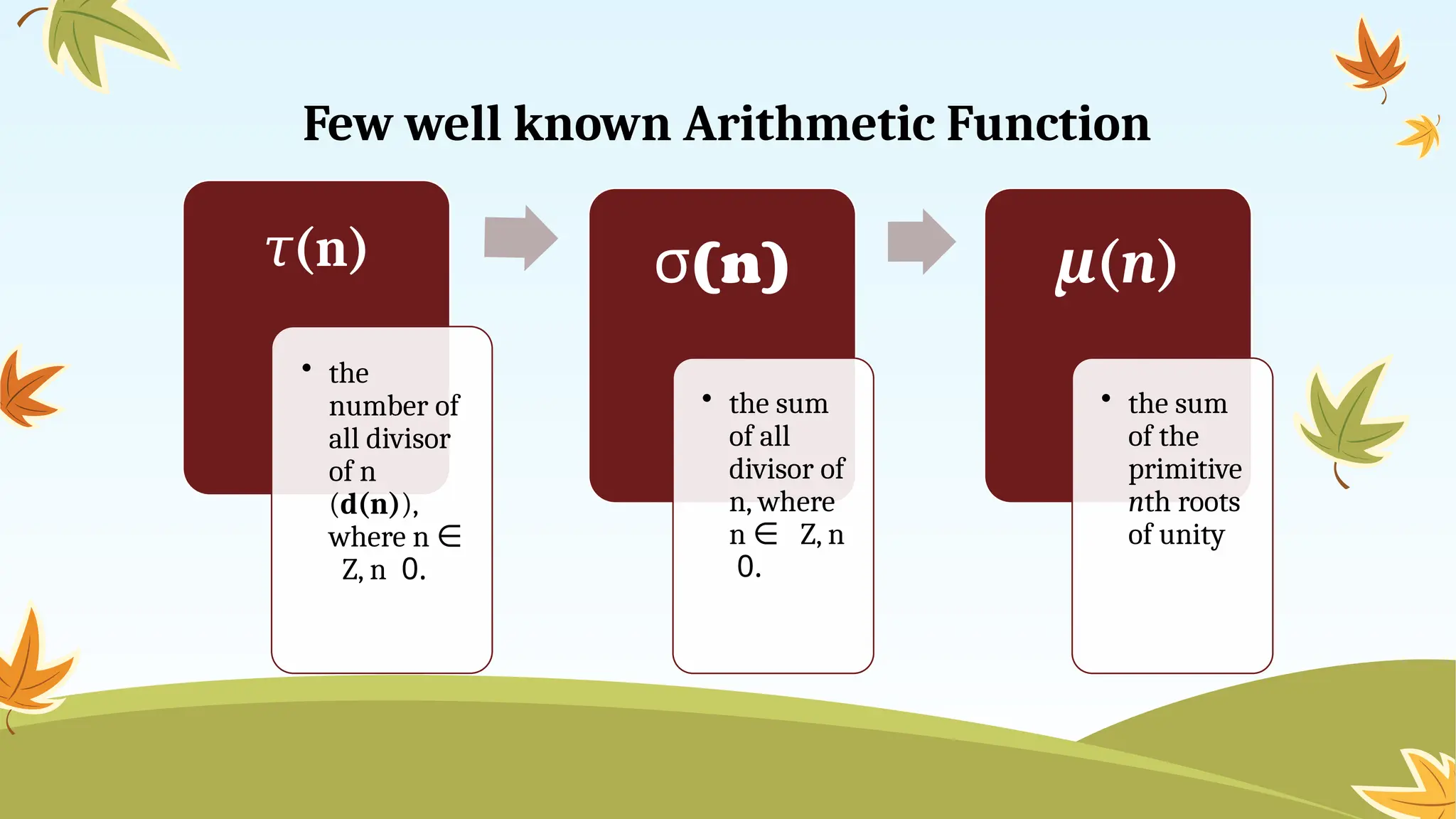
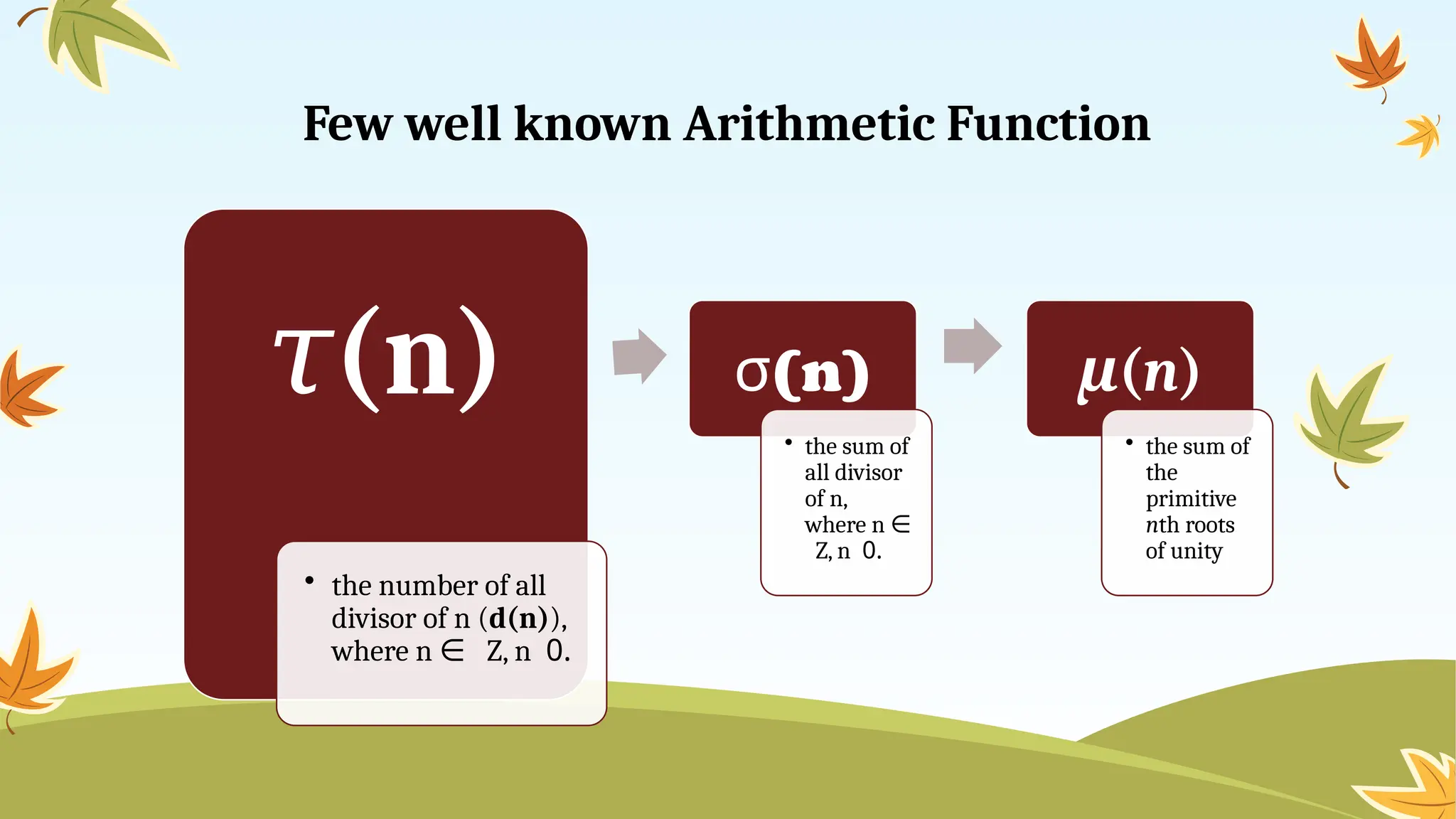
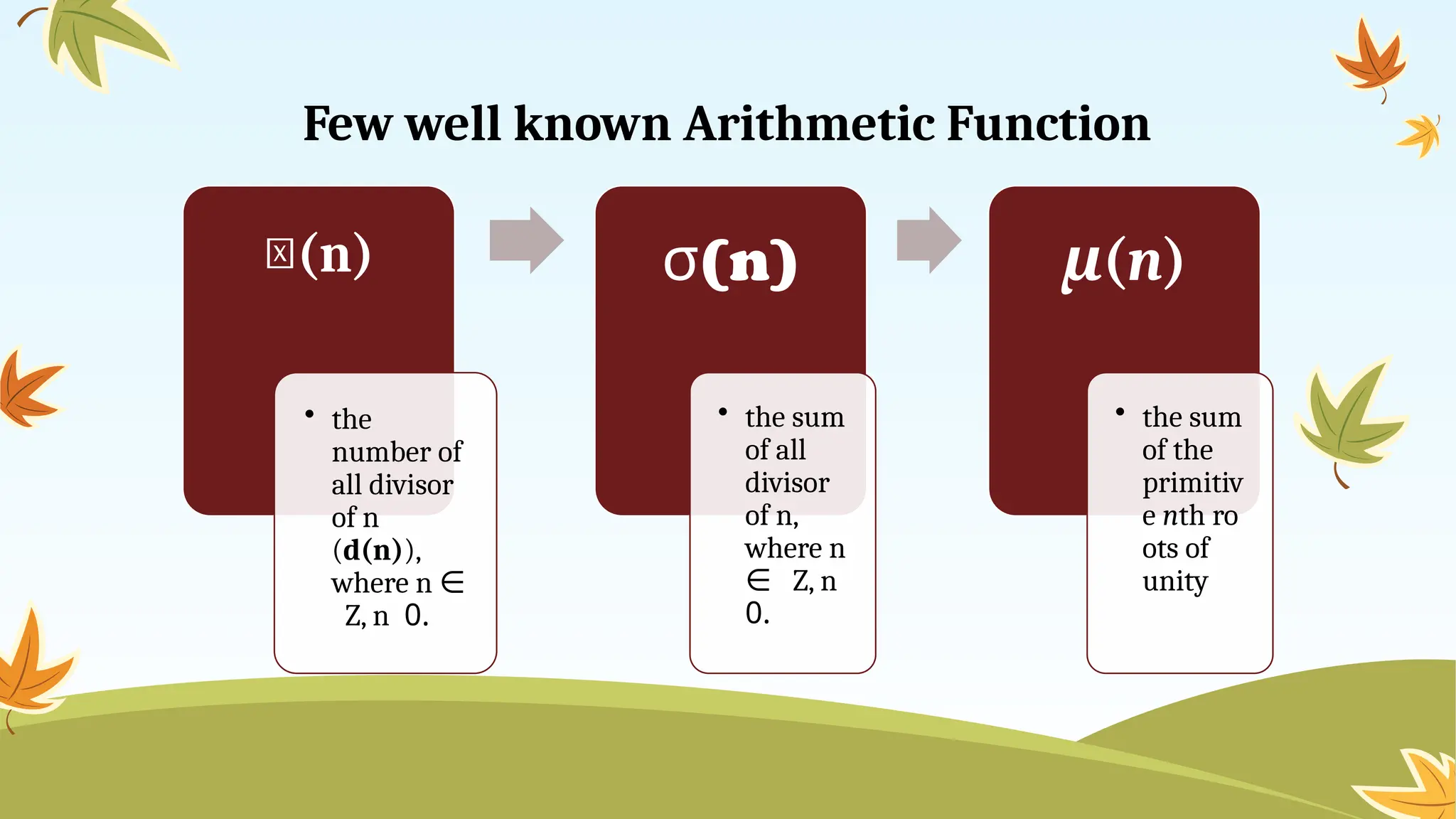
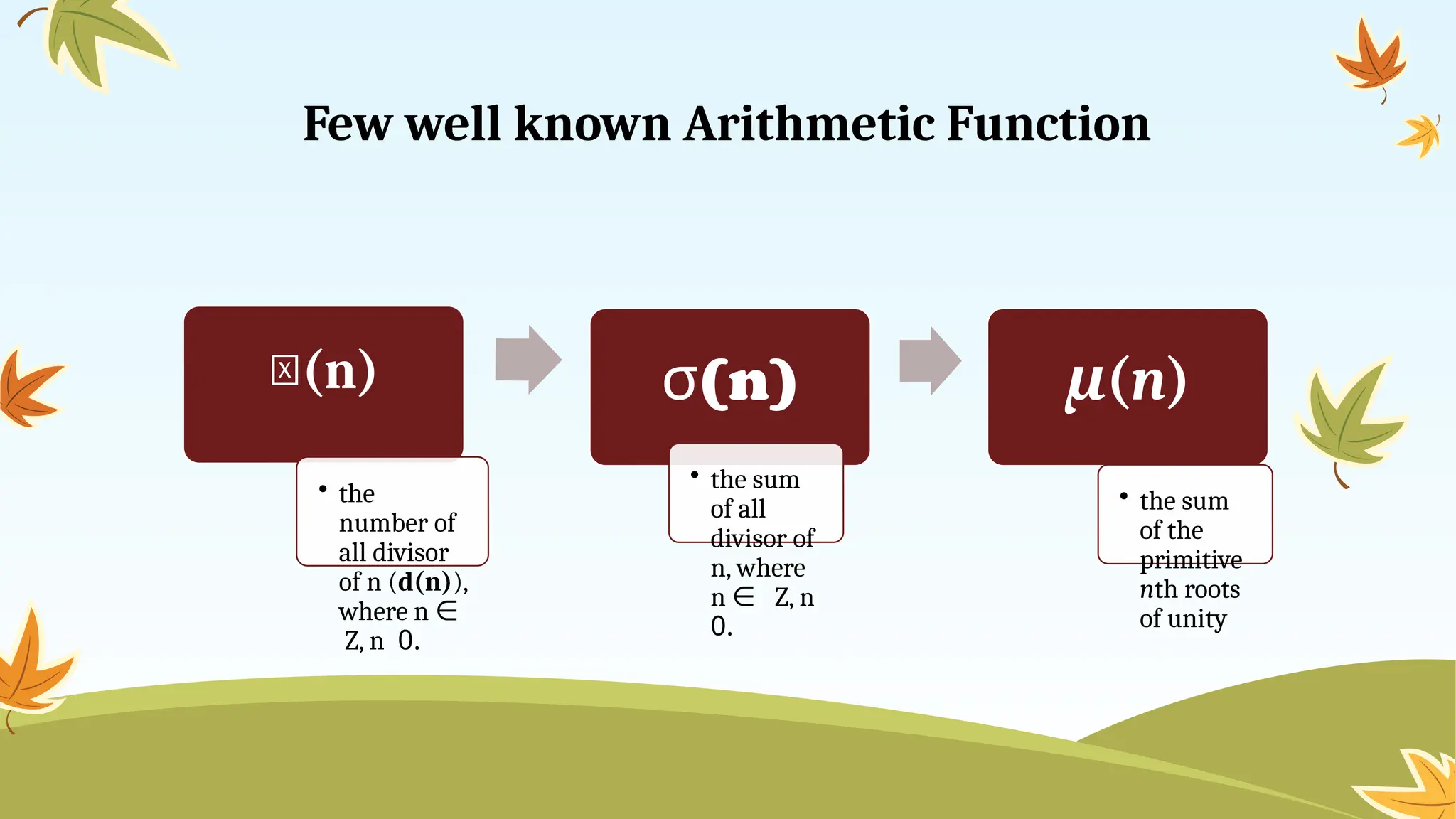
Few well knownArithmetic Function
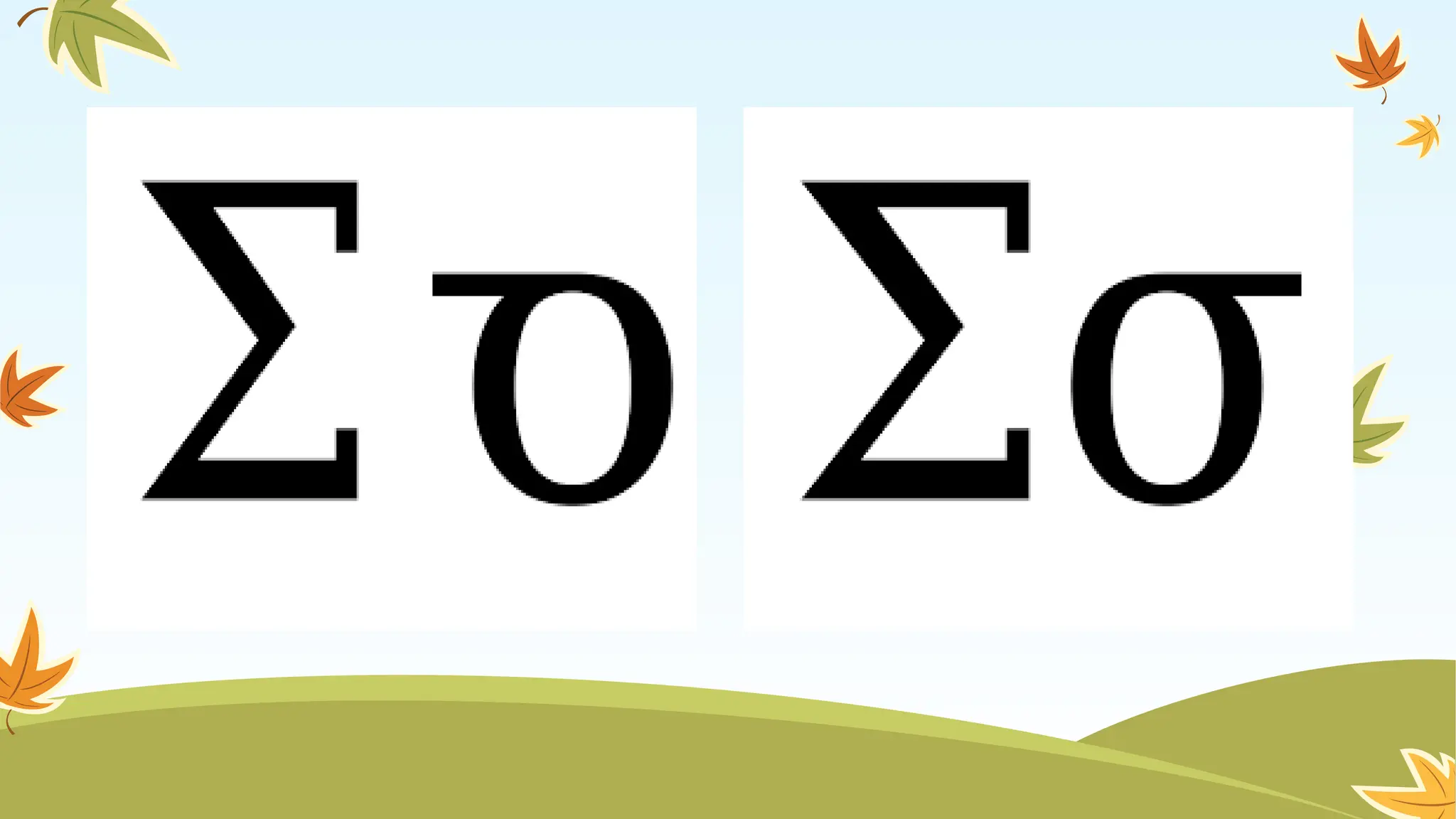
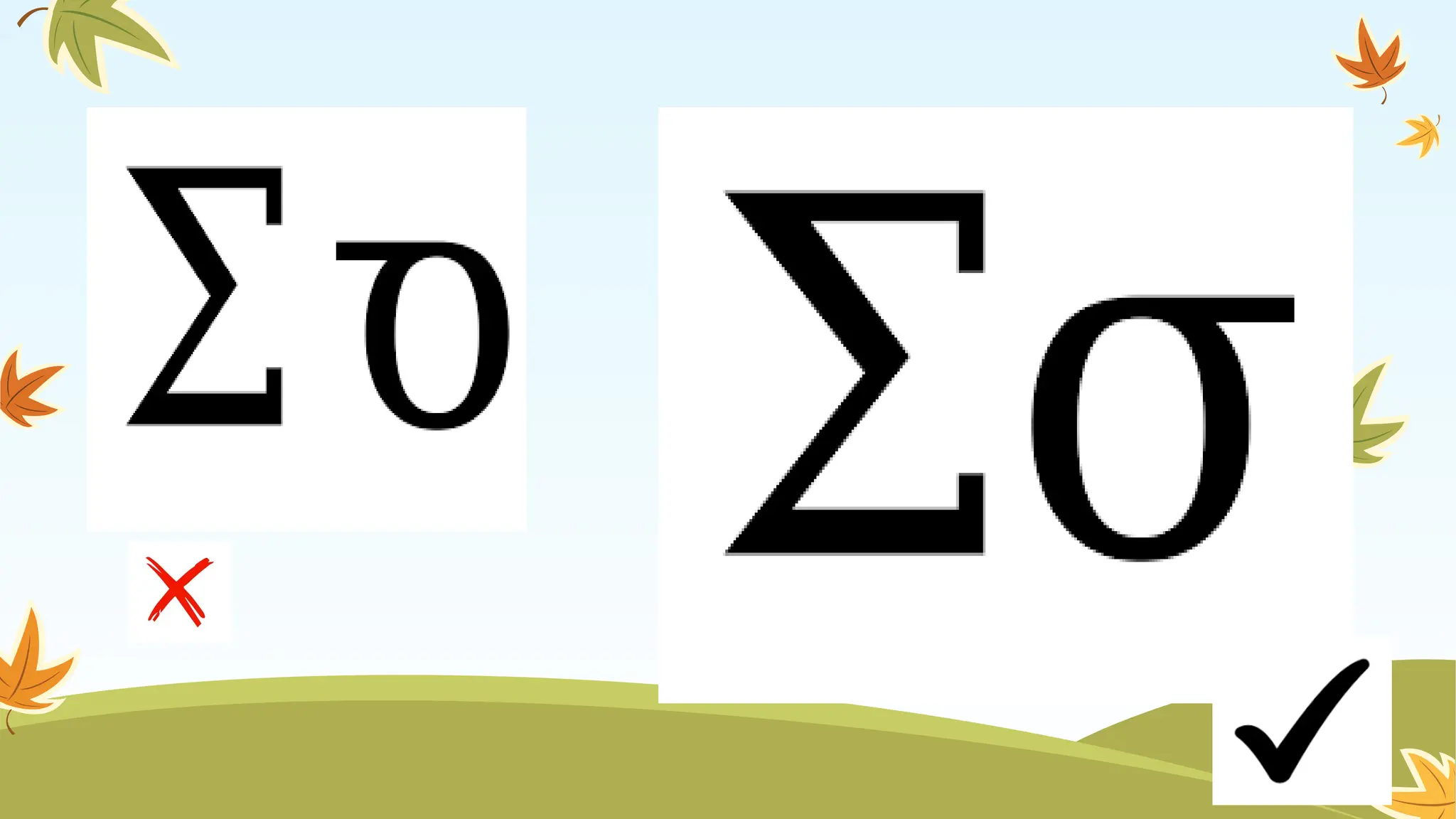
𝜏(n)
• the
number of
all divisor
of n
(d(n)),
where n ∈
Z, n 0.
(
σ n)
• the sum
of all
divisor of
n, where
n ∈ Z, n
0.
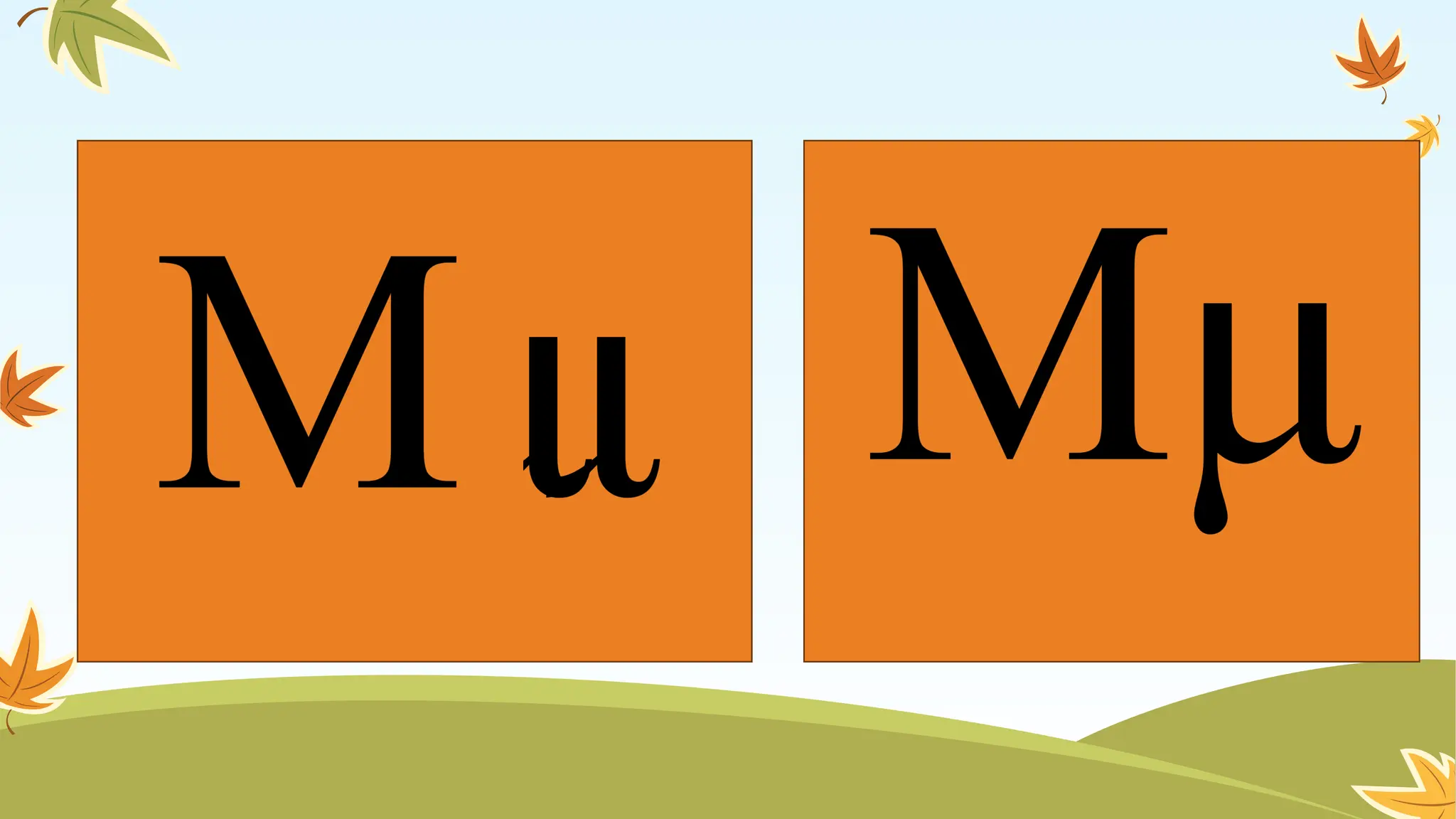
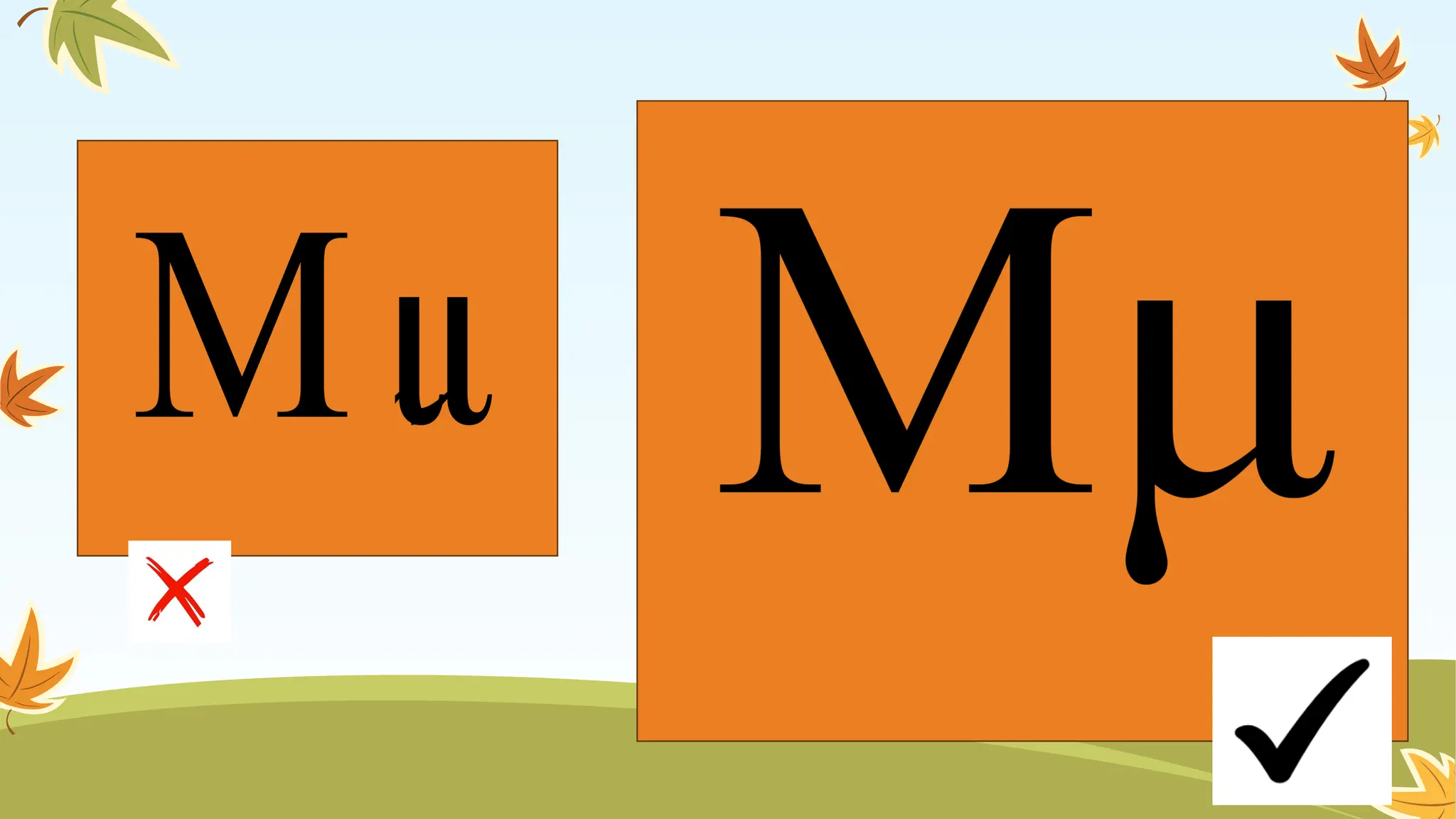
μ(n)
• the sum
of the
primitive
nth roots
of unity
34.
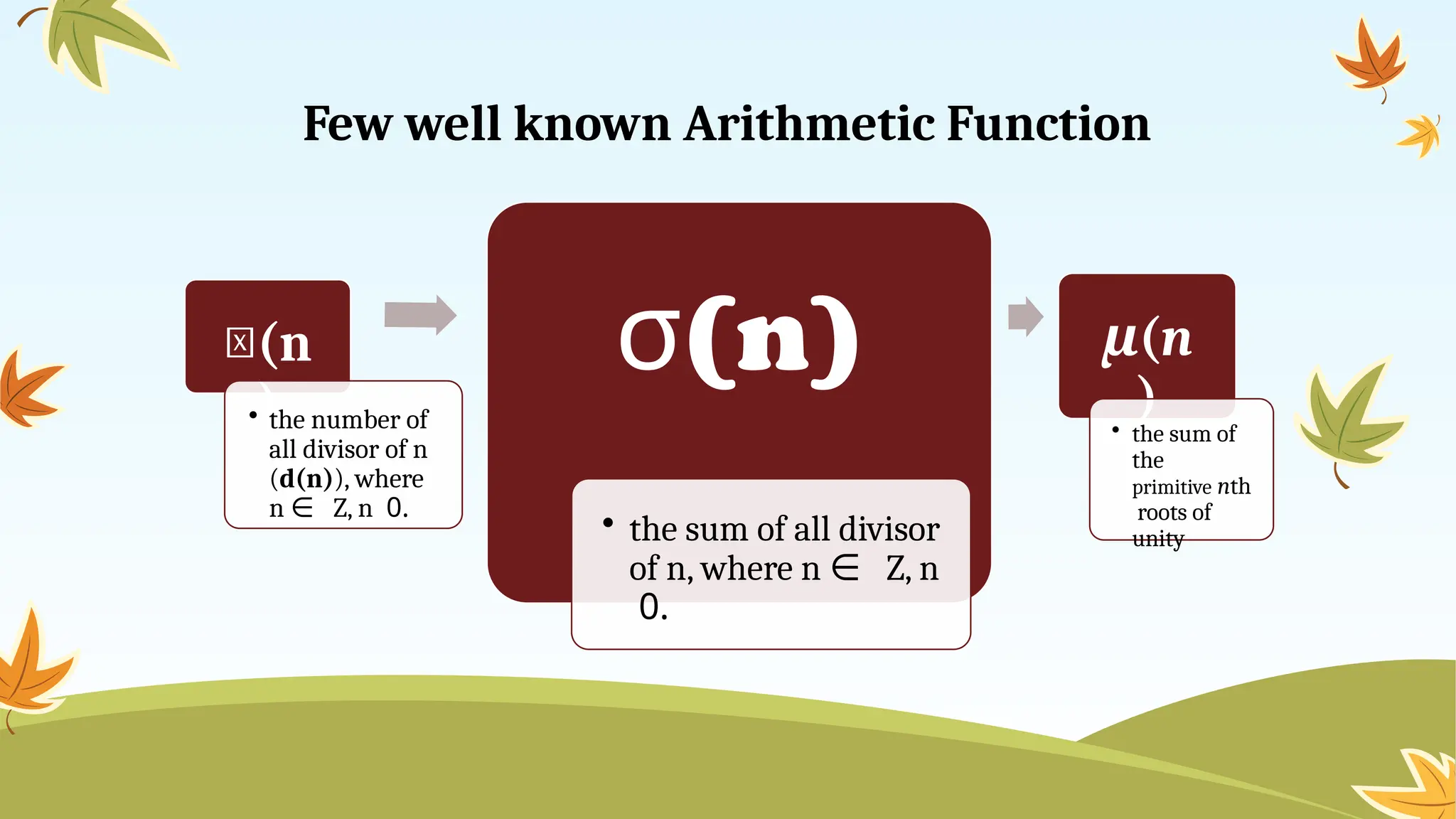
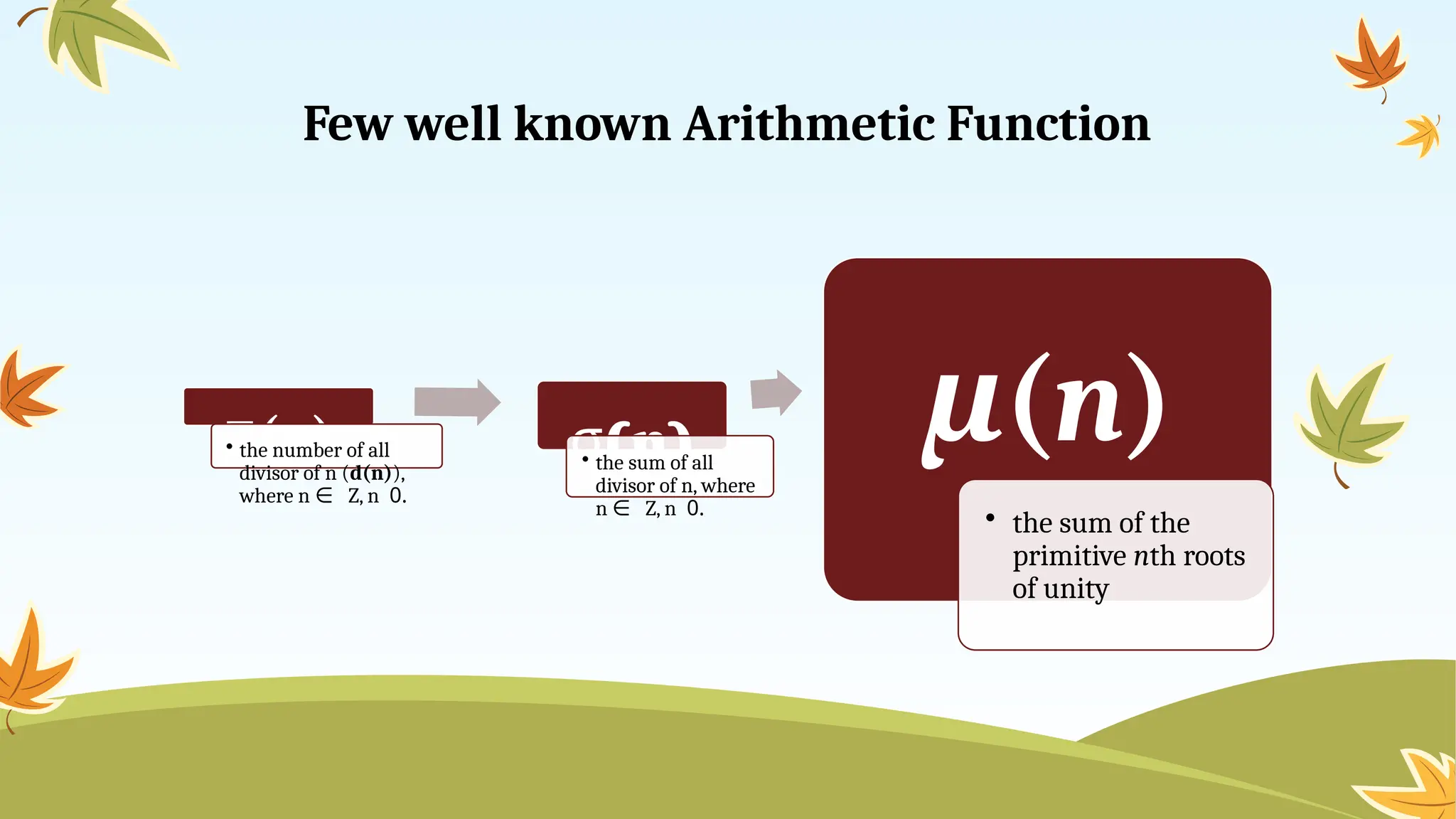
Few well knownArithmetic Function
𝜏(n)
• the number of all
divisor of n (d(n)),
where n ∈ Z, n 0.
(
σ n)
• the sum of
all divisor
of n,
where n ∈
Z, n 0.
μ(n)
• the sum of
the
primitive
nth roots
of unity
35.
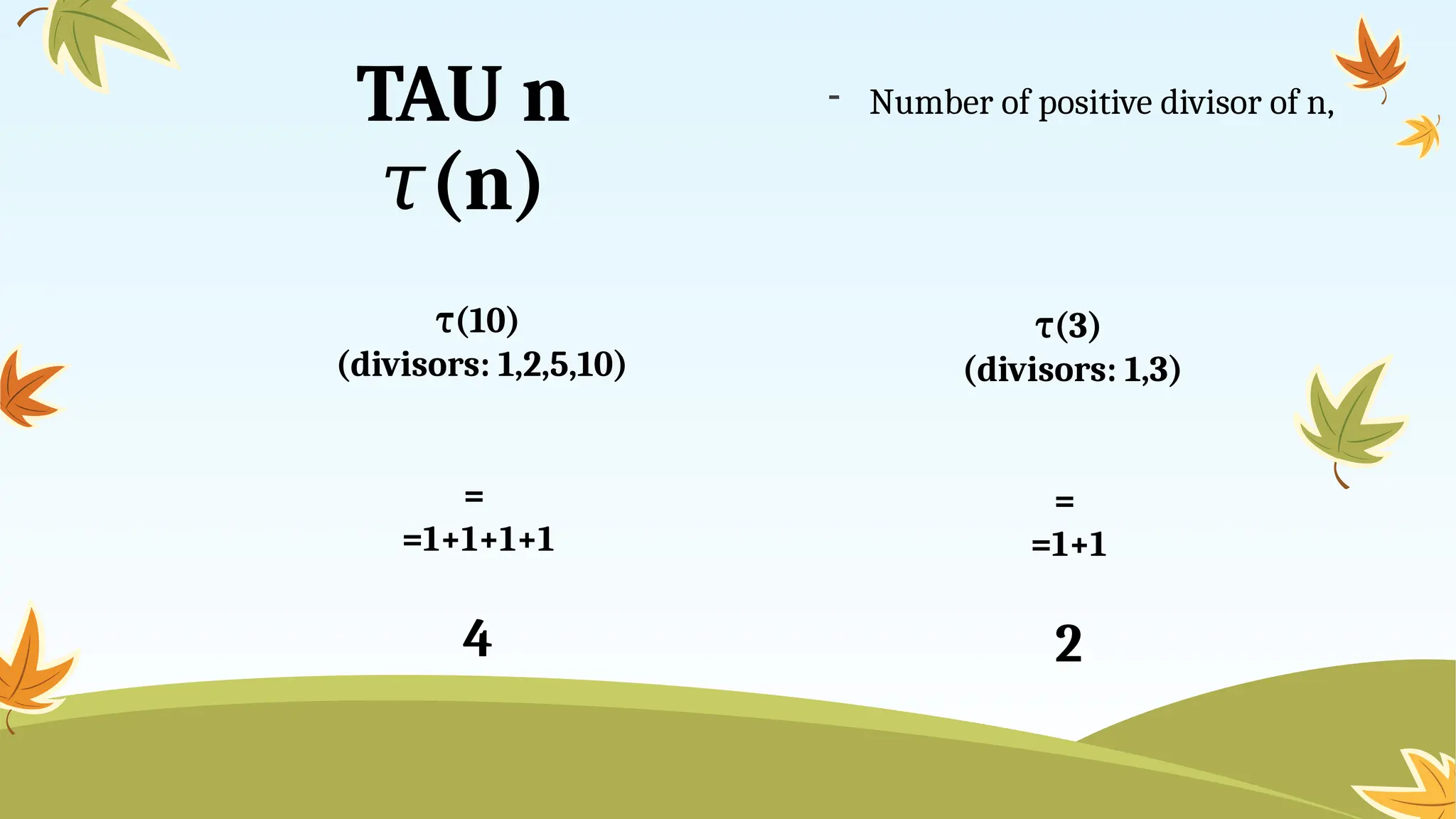
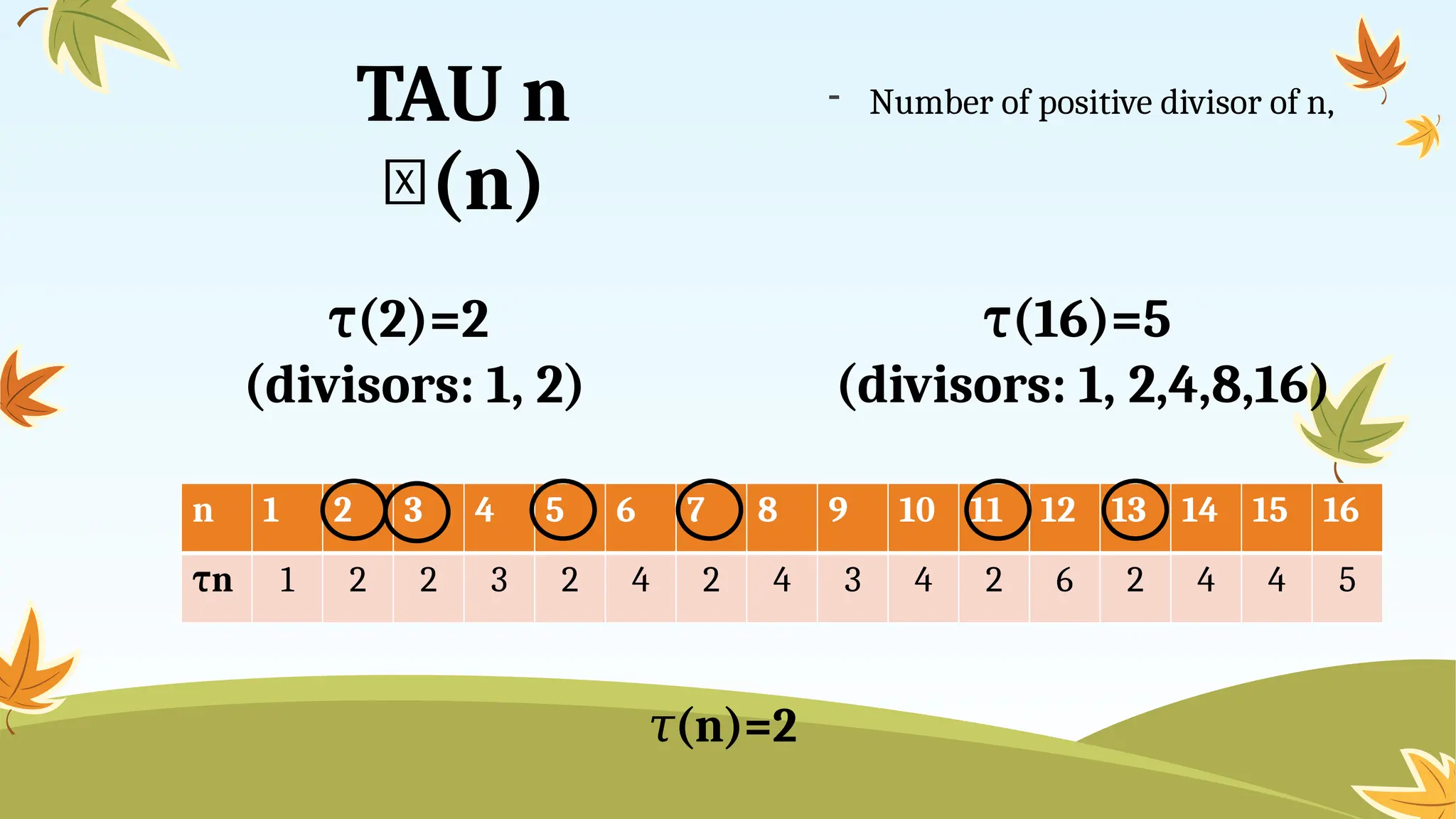
TAU n
(n)
𝜏
- Numberof positive divisor of n,
(10)
τ
(divisors: 1,2,5,10)
=
=1+1+1+1
4
(
τ 3)
(divisors: 1,3)
=
=1+1
2
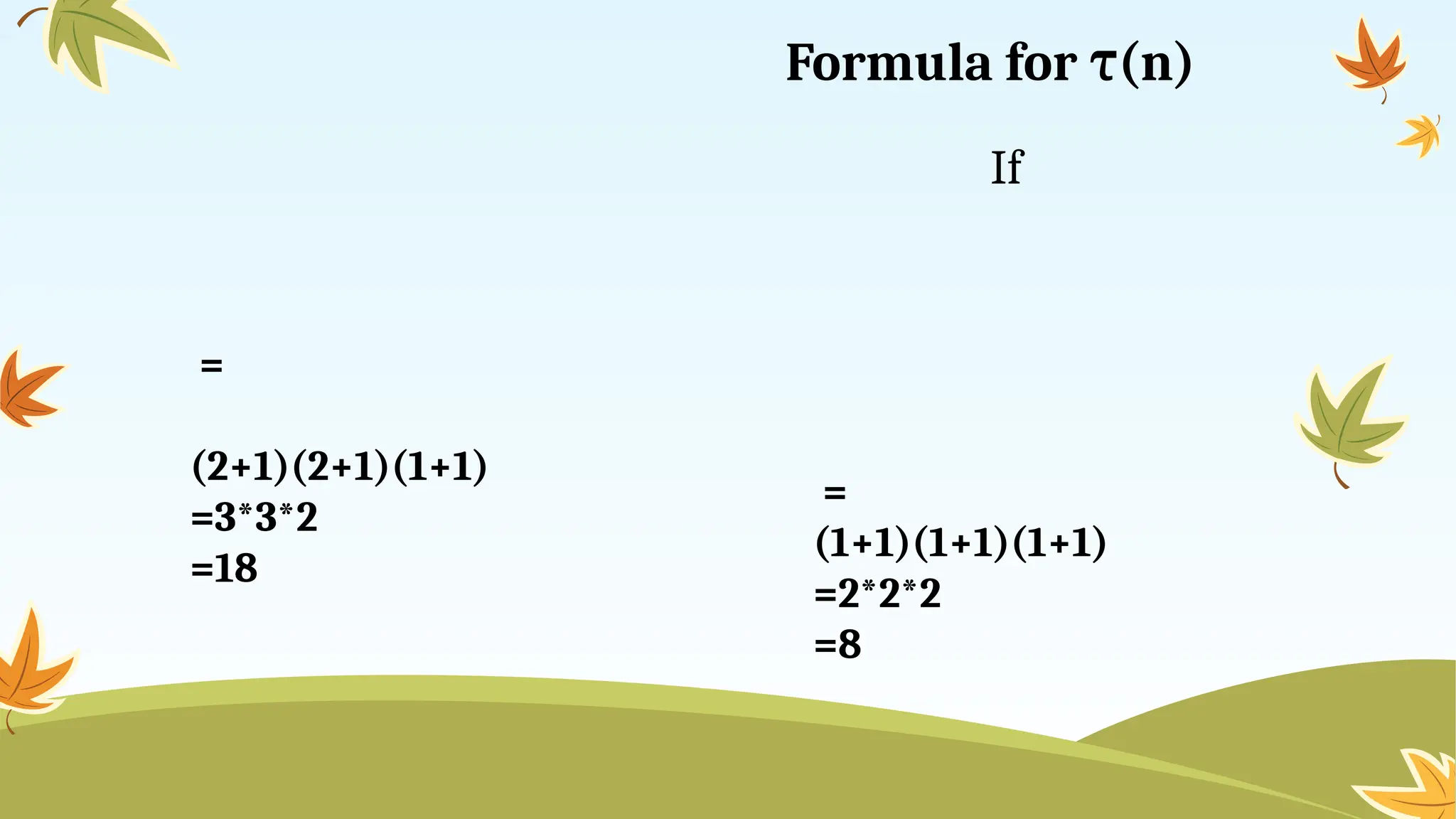
Formula for (
τn)
If
=
(2+1)(2+1)(1+1)
=3*3*2
=18
=
(1+1)(1+1)(1+1)
=2*2*2
=8
38.
Few well knownArithmetic Function
𝜏(n)
• the
number of
all divisor
of n
(d(n)),
where n ∈
Z, n 0.
(
σ n)
• the sum
of all
divisor
of n,
where n
∈ Z, n
0.
μ(n)
• the sum
of the
primitiv
e nth ro
ots of
unity
39.
Few well knownArithmetic Function
𝜏(n
)
• the number of
all divisor of n
(d(n)), where
n ∈ Z, n 0.
(
σ n)
• the sum of all divisor
of n, where n ∈ Z, n
0.
μ(n
)
• the sum of
the
primitive nth
roots of
unity
Few well knownArithmetic Function
𝜏(n)
• the
number of
all divisor
of n (d(n)),
where n ∈
Z, n 0.
(
σ n)
• the sum
of all
divisor of
n, where
n ∈ Z, n
0.
μ(n)
• the sum
of the
primitive
nth roots
of unity
45.
Few well knownArithmetic Function
𝜏(n)
• the number of all
divisor of n (d(n)),
where n ∈ Z, n 0.
(
σ n)
• the sum of all
divisor of n, where
n ∈ Z, n 0.
μ(n)
• the sum of the
primitive nth roots
of unity
46.
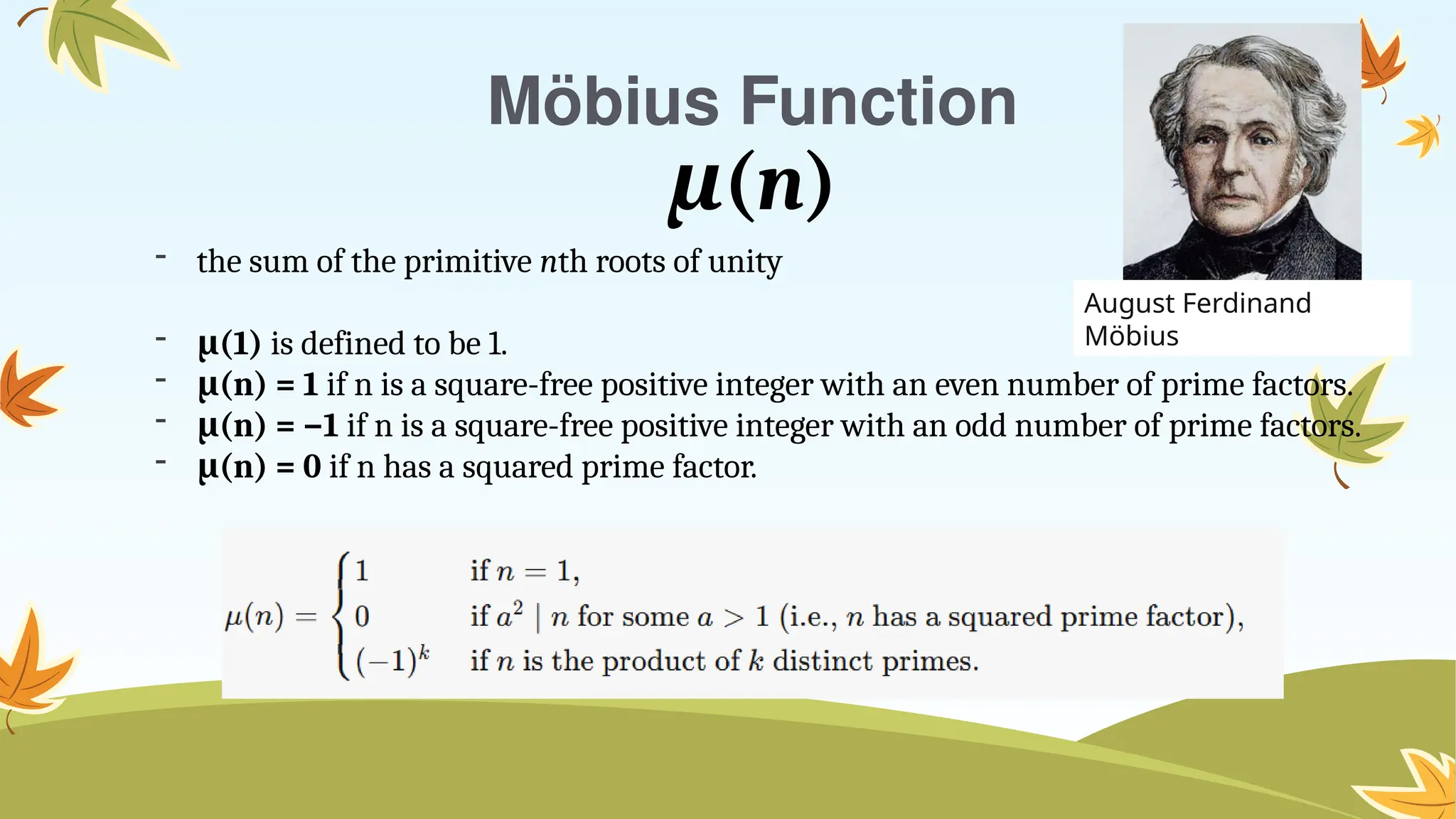
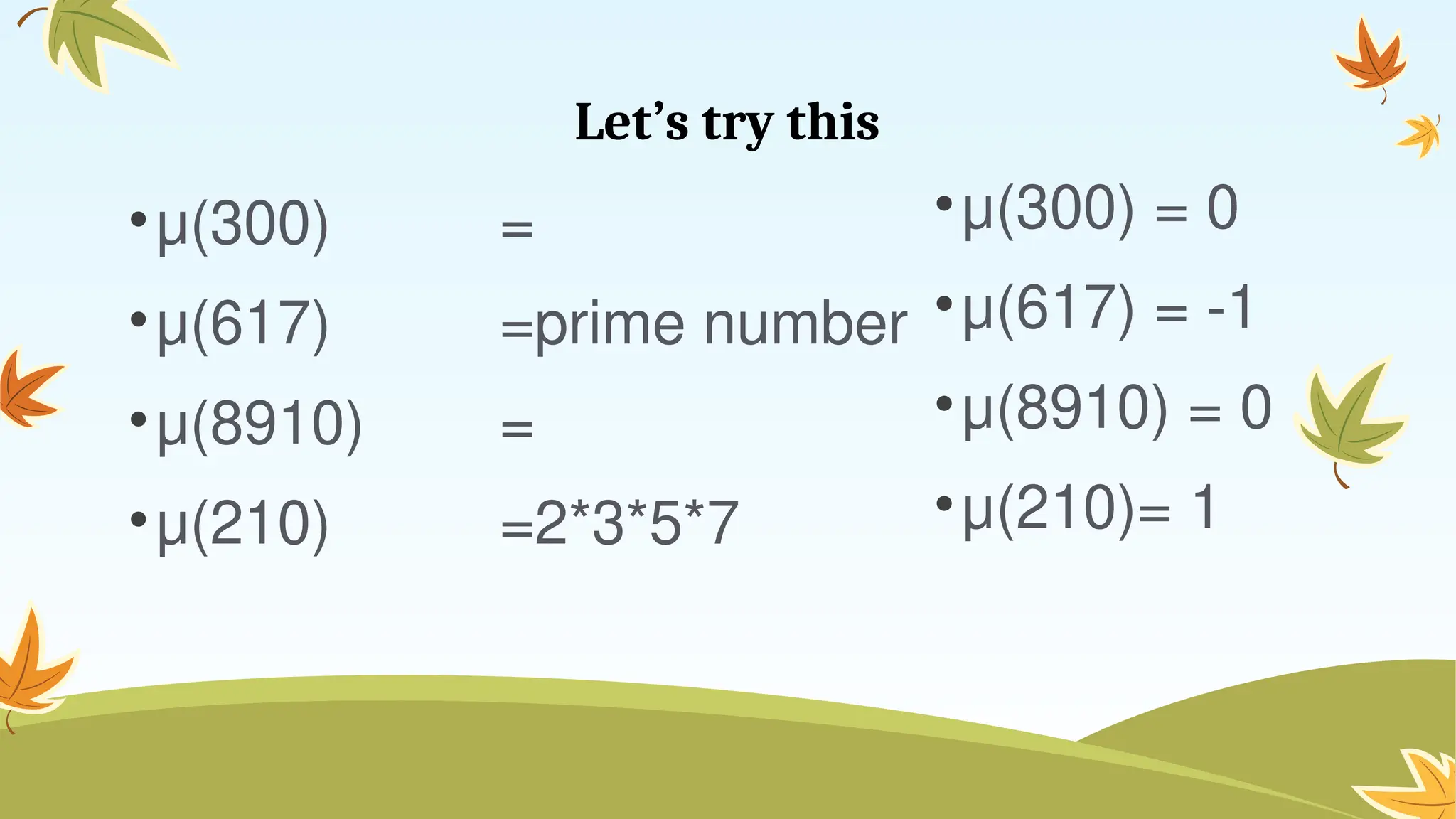
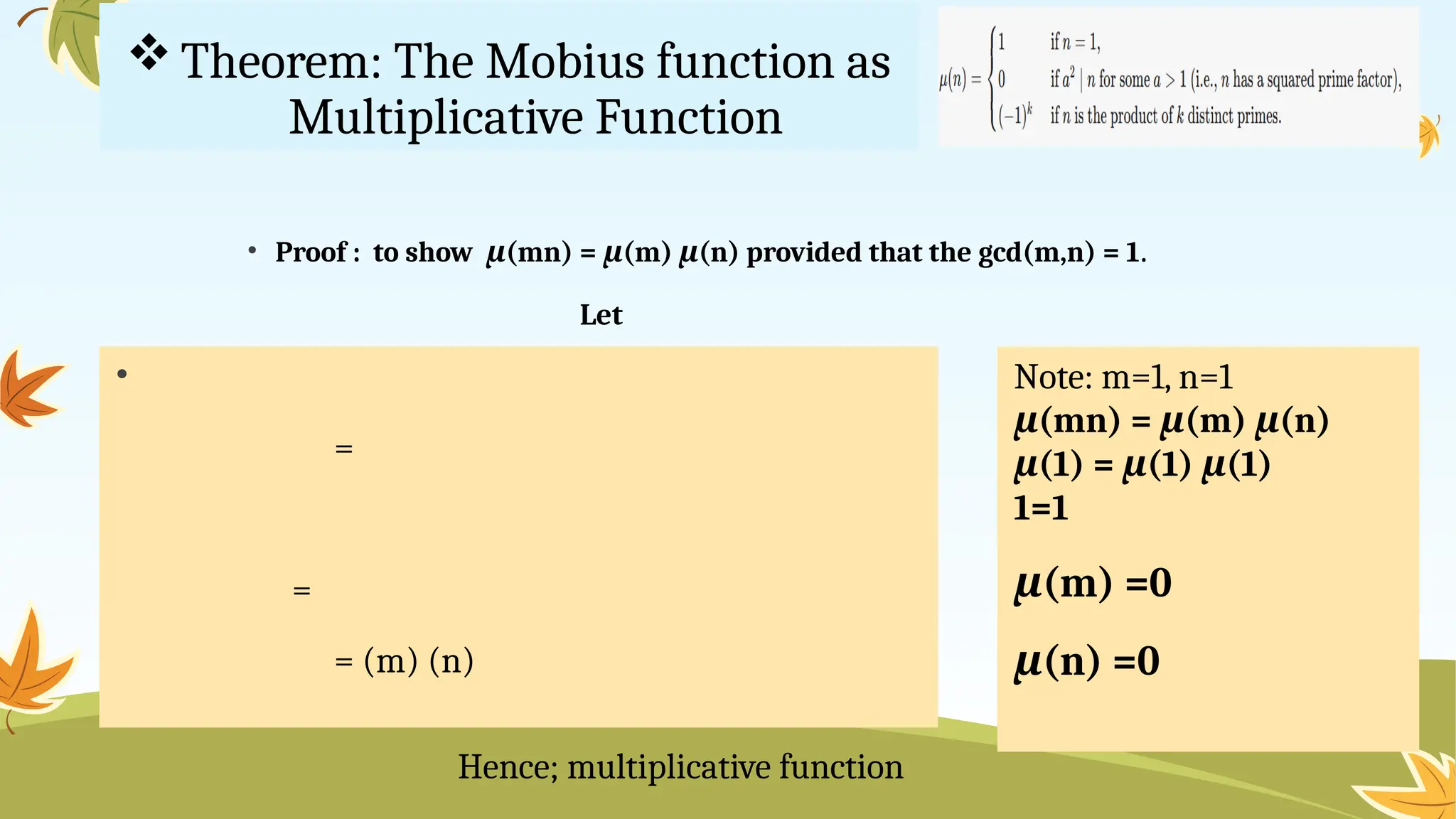
Möbius Function
μ(n)
- thesum of the primitive nth roots of unity
- (1)
μ is defined to be 1.
- (n) = 1
μ if n is a square-free positive integer with an even number of prime factors.
- (n) = −1
μ if n is a square-free positive integer with an odd number of prime factors.
- (n) = 0
μ if n has a squared prime factor.
August Ferdinand
Möbius
47.
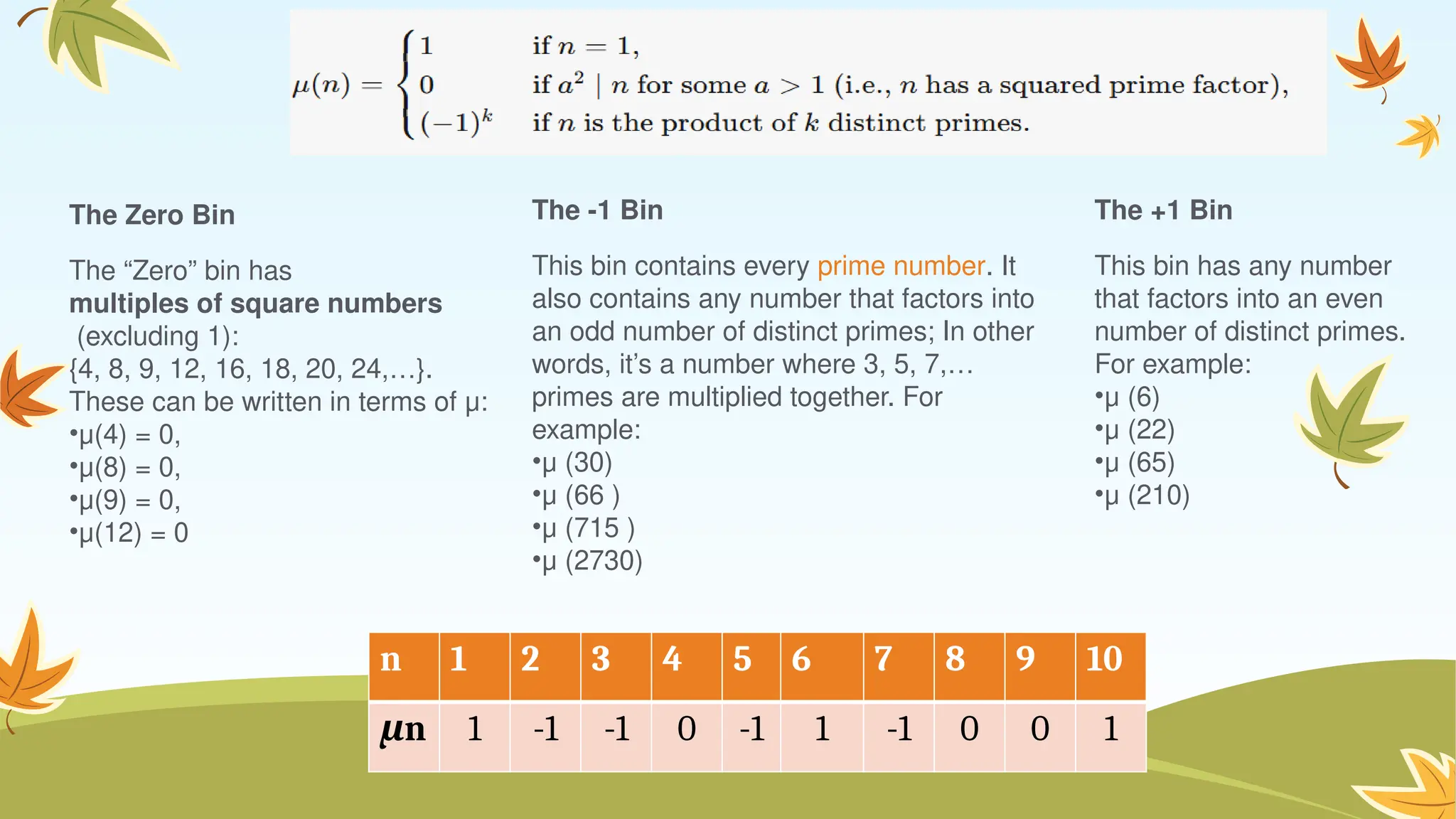
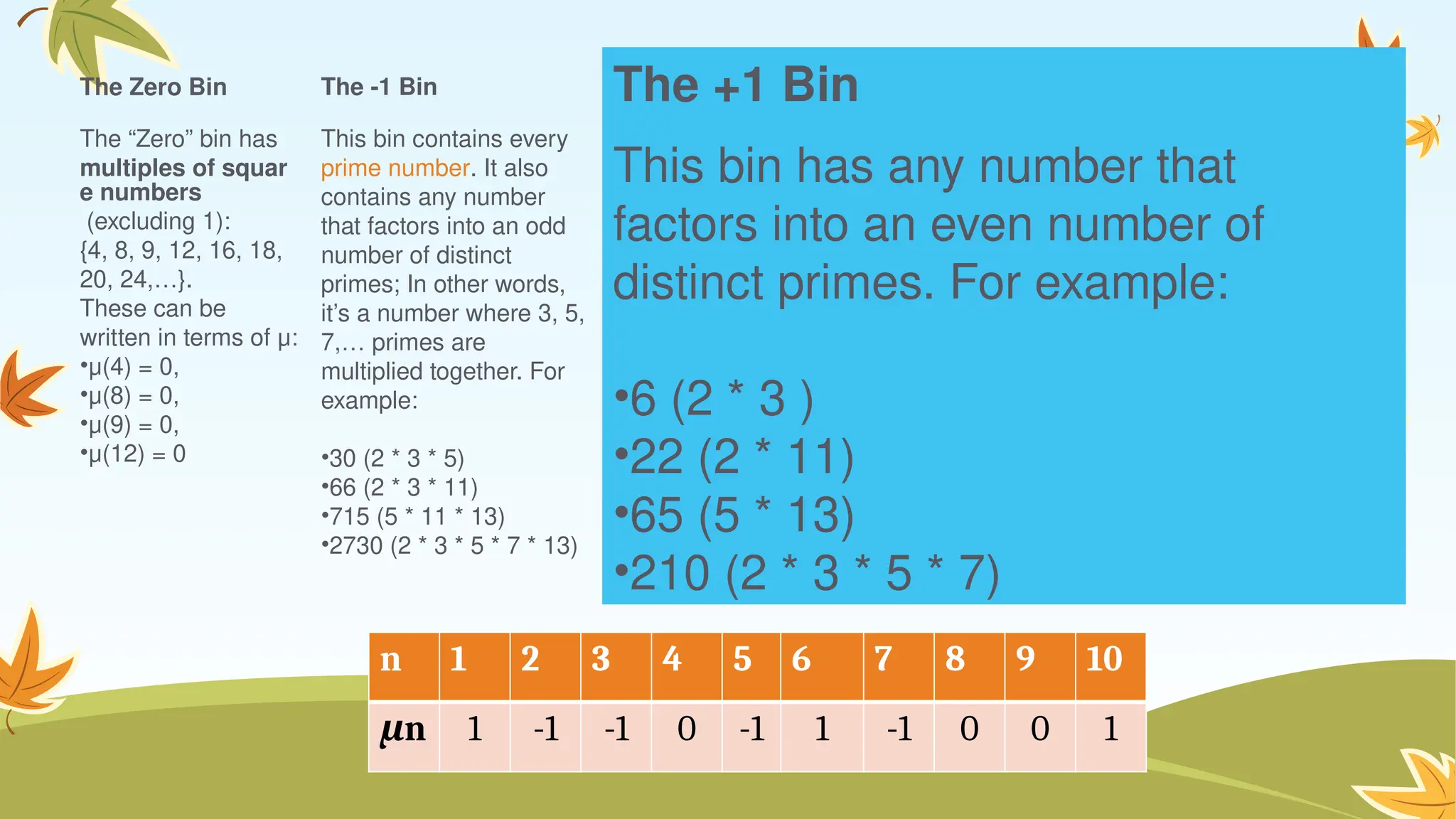
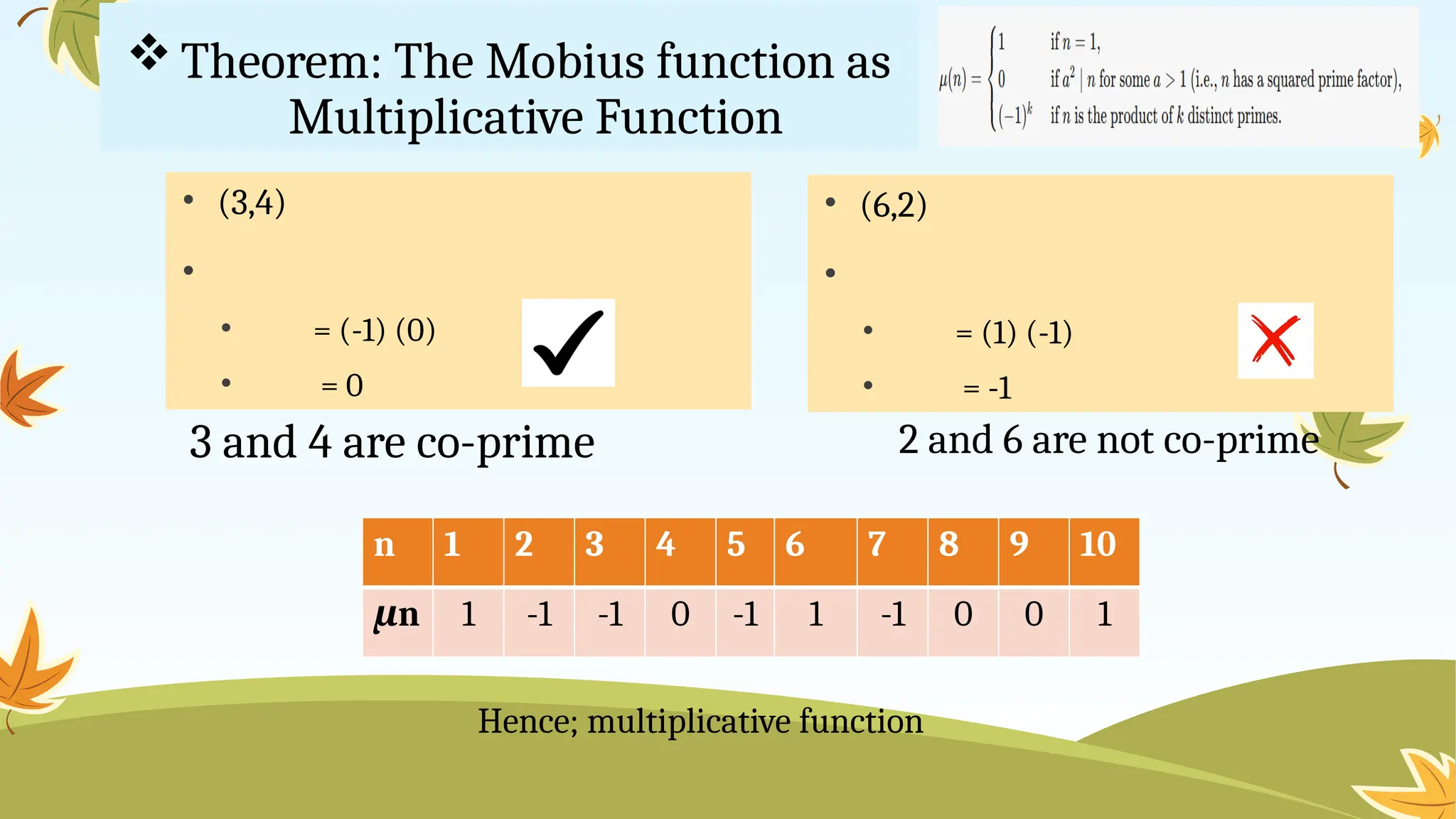
n 1 23 4 5 6 7 8 9 10
μn 1 -1 -1 0 -1 1 -1 0 0 1
The Zero Bin
The “Zero” bin has
multiples of square numbers
(excluding 1):
{4, 8, 9, 12, 16, 18, 20, 24,…}.
These can be written in terms of μ:
•μ(4) = 0,
•μ(8) = 0,
•μ(9) = 0,
•μ(12) = 0
The -1 Bin
This bin contains every prime number. It
also contains any number that factors into
an odd number of distinct primes; In other
words, it’s a number where 3, 5, 7,…
primes are multiplied together. For
example:
•μ (30)
•μ (66 )
•μ (715 )
•μ (2730)
The +1 Bin
This bin has any number
that factors into an even
number of distinct primes.
For example:
•μ (6)
•μ (22)
•μ (65)
•μ (210)
48.
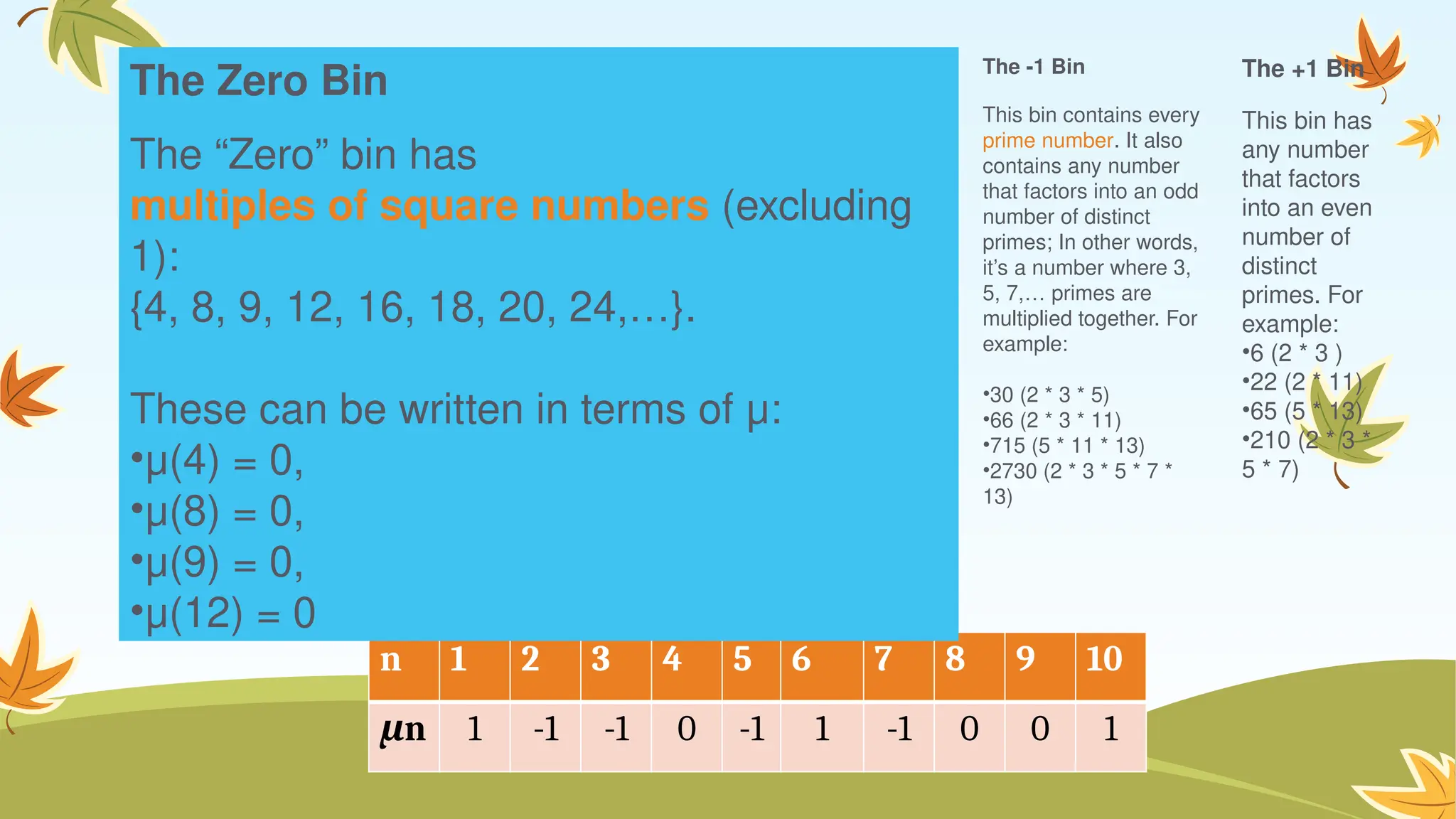
n 1 23 4 5 6 7 8 9 10
μn 1 -1 -1 0 -1 1 -1 0 0 1
The Zero Bin
The “Zero” bin has
multiples of square numbers (excluding
1):
{4, 8, 9, 12, 16, 18, 20, 24,…}.
These can be written in terms of μ:
•μ(4) = 0,
•μ(8) = 0,
•μ(9) = 0,
•μ(12) = 0
The +1 Bin
This bin has
any number
that factors
into an even
number of
distinct
primes. For
example:
•6 (2 * 3 )
•22 (2 * 11)
•65 (5 * 13)
•210 (2 * 3 *
5 * 7)
The -1 Bin
This bin contains every
prime number. It also
contains any number
that factors into an odd
number of distinct
primes; In other words,
it’s a number where 3,
5, 7,… primes are
multiplied together. For
example:
•30 (2 * 3 * 5)
•66 (2 * 3 * 11)
•715 (5 * 11 * 13)
•2730 (2 * 3 * 5 * 7 *
13)
49.
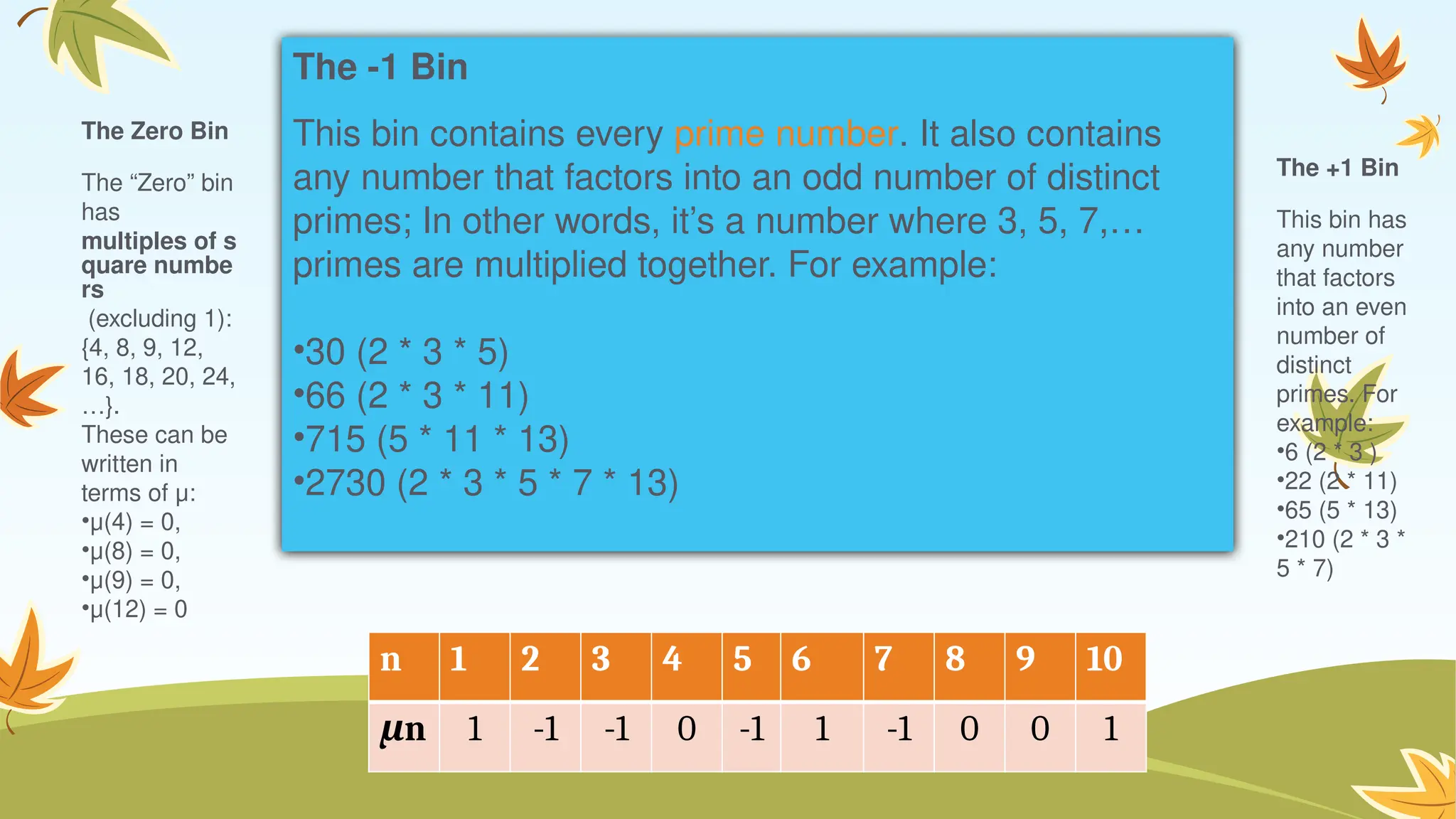
n 1 23 4 5 6 7 8 9 10
μn 1 -1 -1 0 -1 1 -1 0 0 1
The Zero Bin
The “Zero” bin
has
multiples of s
quare numbe
rs
(excluding 1):
{4, 8, 9, 12,
16, 18, 20, 24,
…}.
These can be
written in
terms of μ:
•μ(4) = 0,
•μ(8) = 0,
•μ(9) = 0,
•μ(12) = 0
The +1 Bin
This bin has
any number
that factors
into an even
number of
distinct
primes. For
example:
•6 (2 * 3 )
•22 (2 * 11)
•65 (5 * 13)
•210 (2 * 3 *
5 * 7)
The -1 Bin
This bin contains every prime number. It also contains
any number that factors into an odd number of distinct
primes; In other words, it’s a number where 3, 5, 7,…
primes are multiplied together. For example:
•30 (2 * 3 * 5)
•66 (2 * 3 * 11)
•715 (5 * 11 * 13)
•2730 (2 * 3 * 5 * 7 * 13)
50.
n 1 23 4 5 6 7 8 9 10
μn 1 -1 -1 0 -1 1 -1 0 0 1
The Zero Bin
The “Zero” bin has
multiples of squar
e numbers
(excluding 1):
{4, 8, 9, 12, 16, 18,
20, 24,…}.
These can be
written in terms of μ:
•μ(4) = 0,
•μ(8) = 0,
•μ(9) = 0,
•μ(12) = 0
The +1 Bin
This bin has any number that
factors into an even number of
distinct primes. For example:
•6 (2 * 3 )
•22 (2 * 11)
•65 (5 * 13)
•210 (2 * 3 * 5 * 7)
The -1 Bin
This bin contains every
prime number. It also
contains any number
that factors into an odd
number of distinct
primes; In other words,
it’s a number where 3, 5,
7,… primes are
multiplied together. For
example:
•30 (2 * 3 * 5)
•66 (2 * 3 * 11)
•715 (5 * 11 * 13)
•2730 (2 * 3 * 5 * 7 * 13)
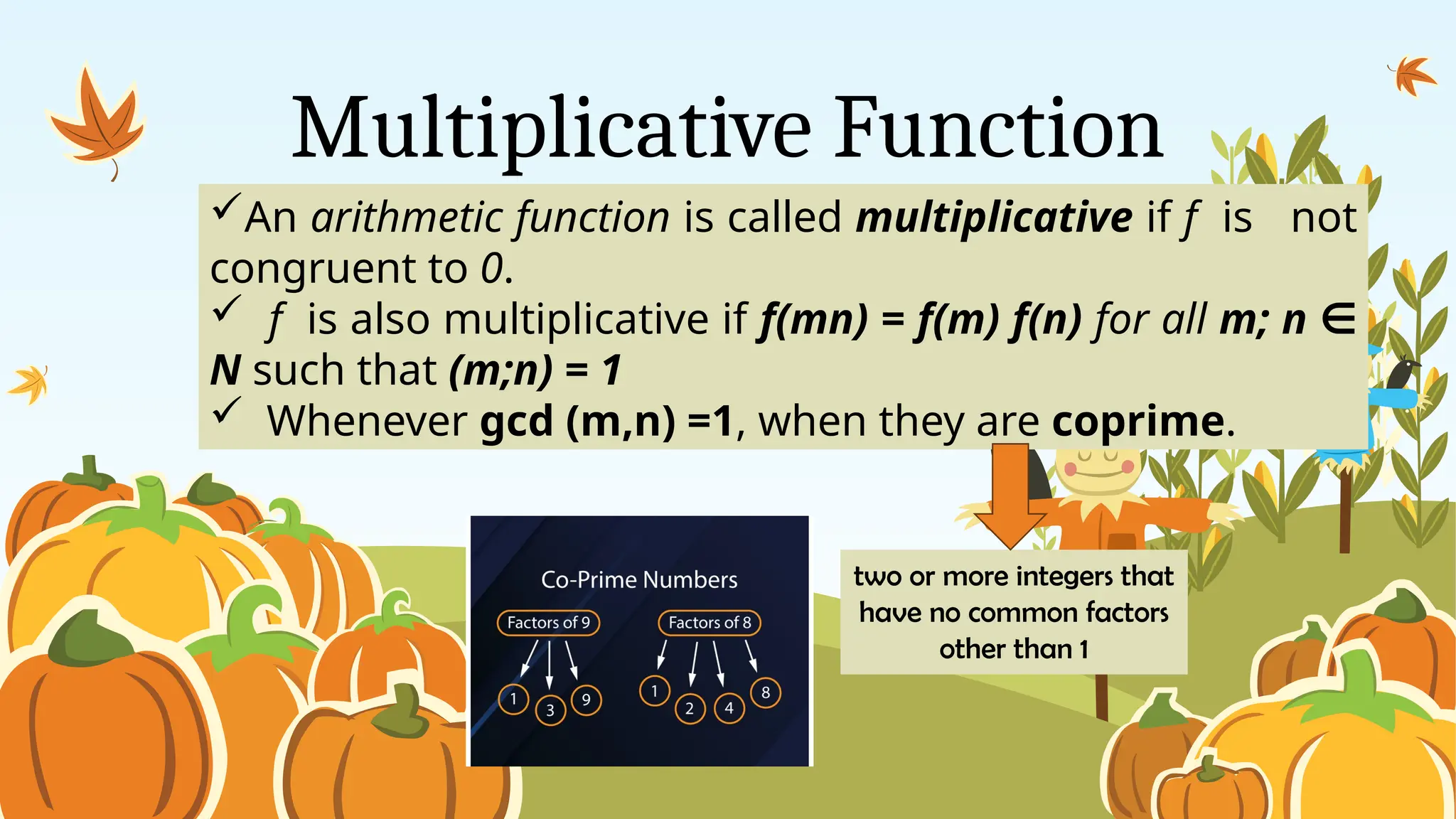
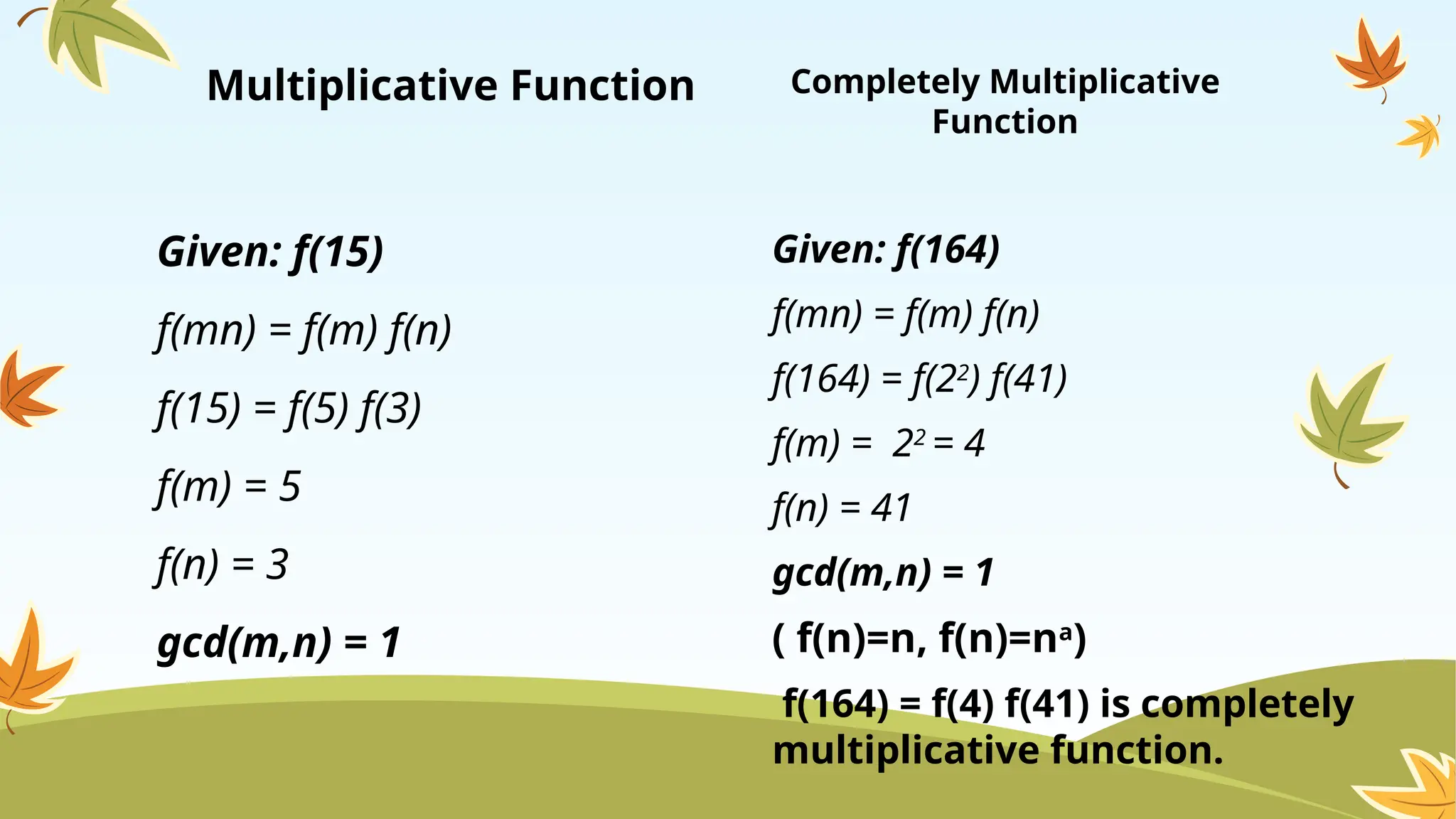
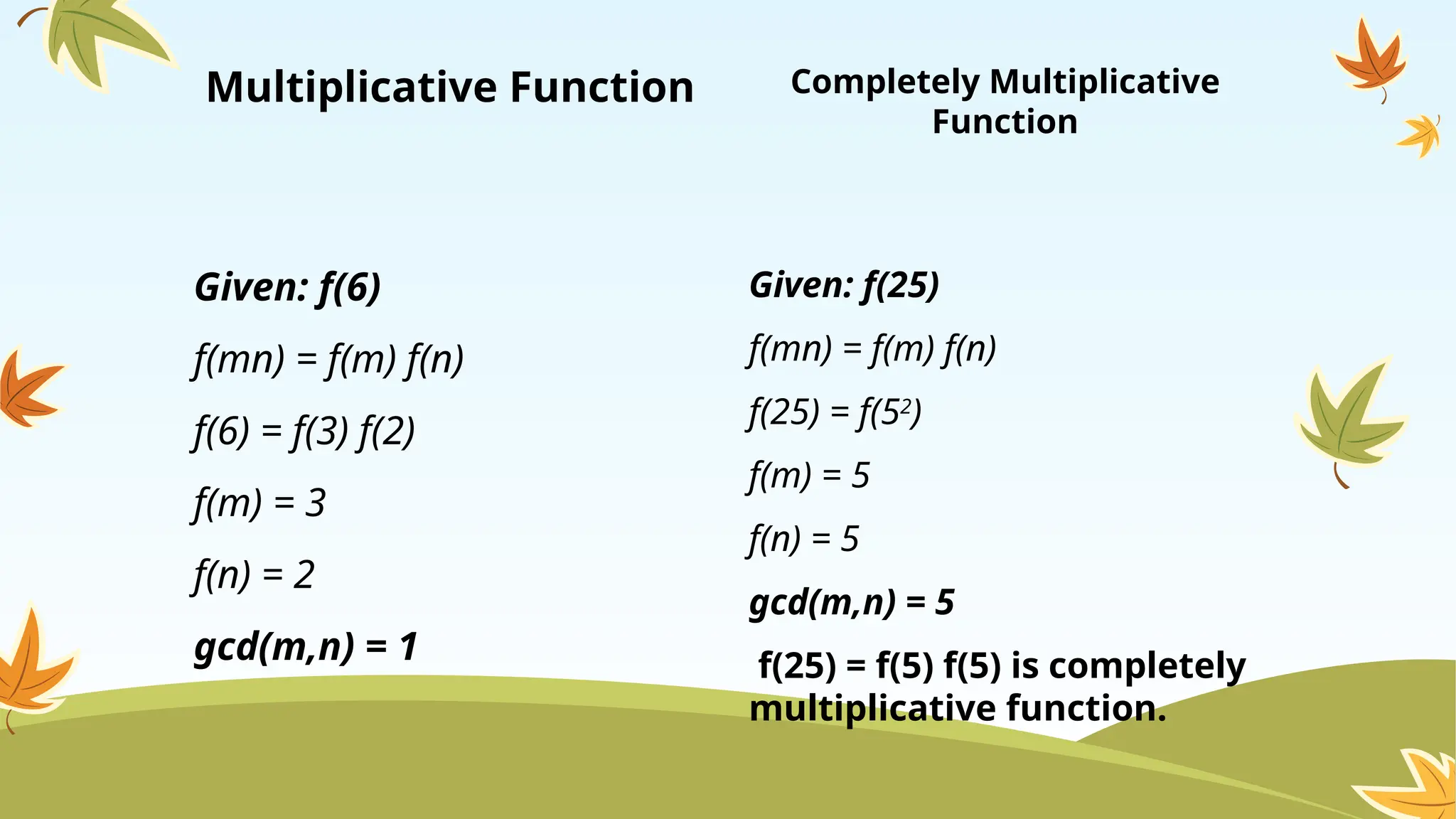
Multiplicative Function
An arithmeticfunction is called multiplicative if f is not
congruent to 0.
f is also multiplicative if f(mn) = f(m) f(n) for all m; n ∈
N such that (m;n) = 1
Whenever gcd (m,n) =1, when they are coprime.
two or more integers that
have no common factors
other than 1
53.
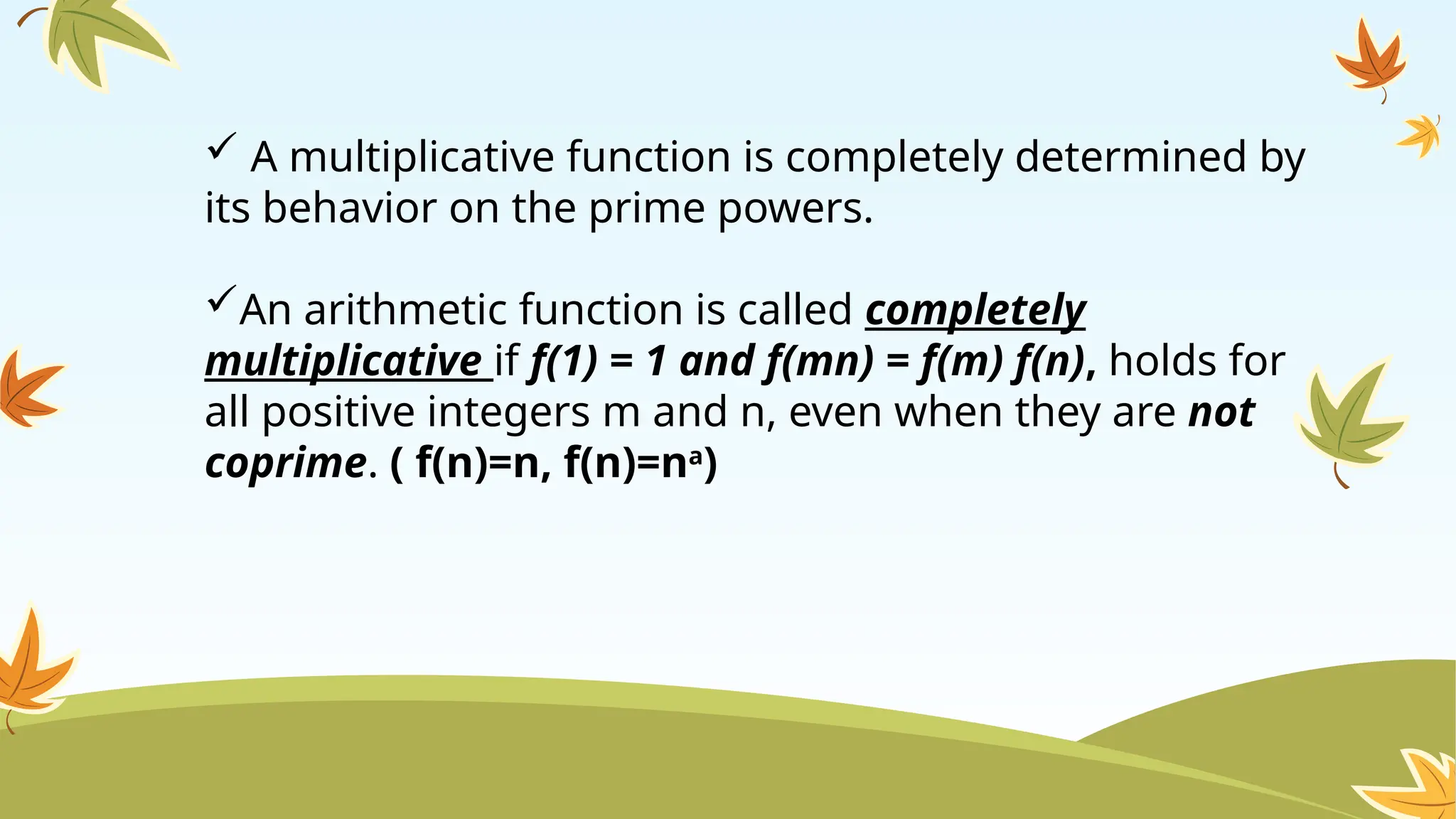
A multiplicativefunction is completely determined by
its behavior on the prime powers.
An arithmetic function is called completely
multiplicative if f(1) = 1 and f(mn) = f(m) f(n), holds for
all positive integers m and n, even when they are not
coprime. ( f(n)=n, f(n)=na
)
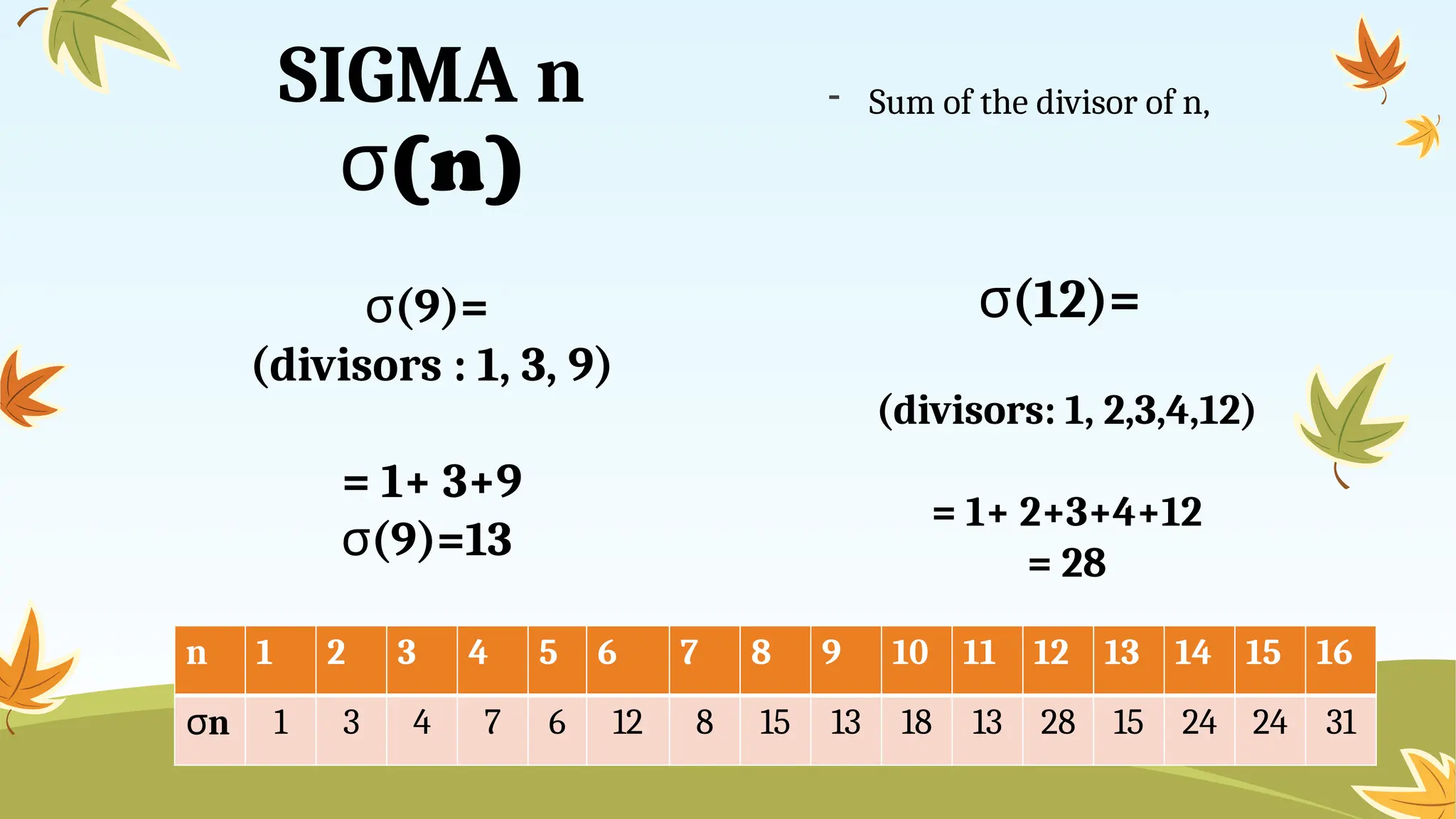
Tau( ) ,Sigma (
𝜏 ) and
σ
Mobius Function (μ) as
Multiplicative Function
57.
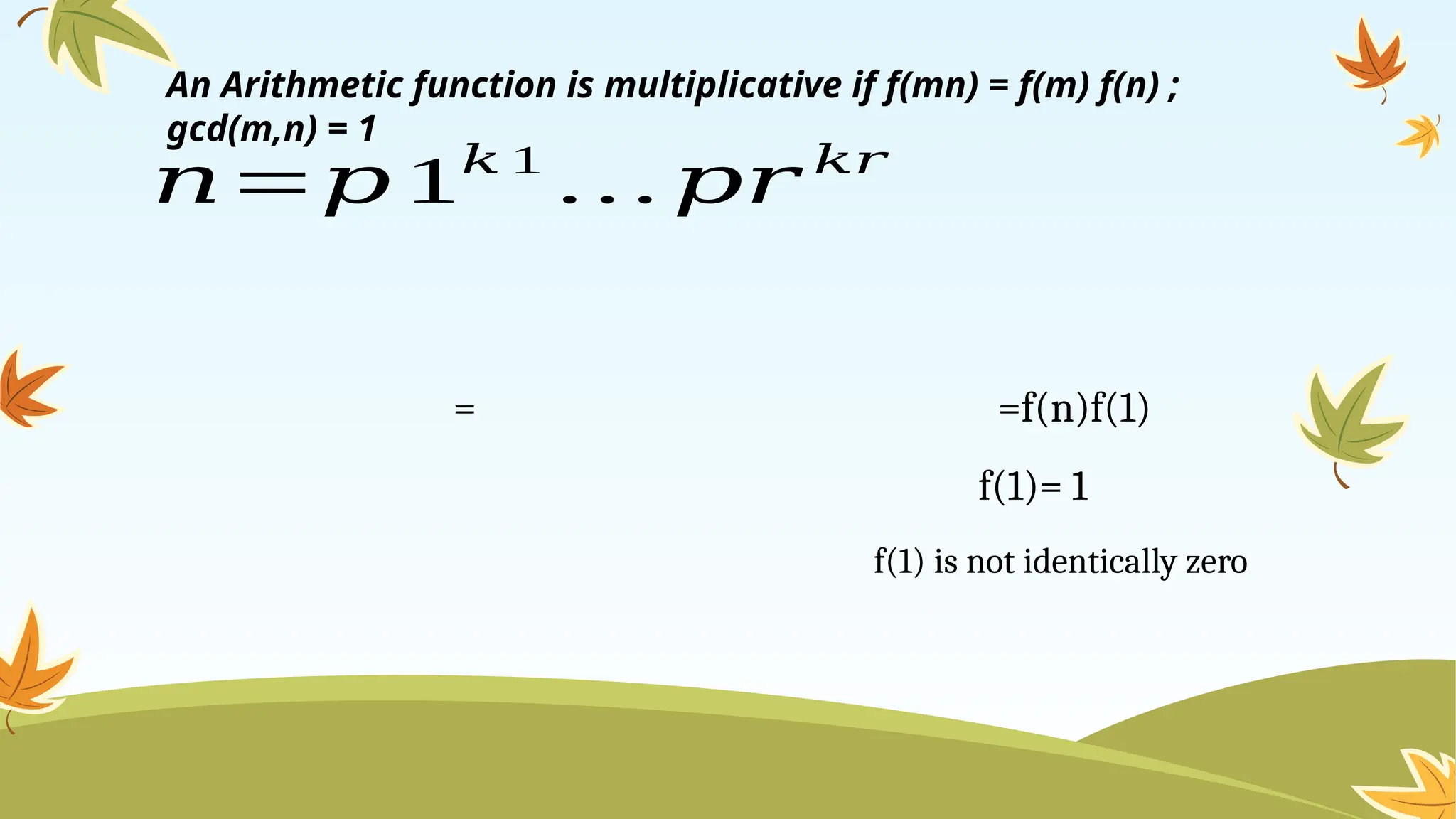
𝑛=𝑝 1𝑘 1
…𝑝𝑟 𝑘𝑟
= =f(n)f(1)
f(1)= 1
f(1) is not identically zero
An Arithmetic function is multiplicative if f(mn) = f(m) f(n) ;
gcd(m,n) = 1
58.
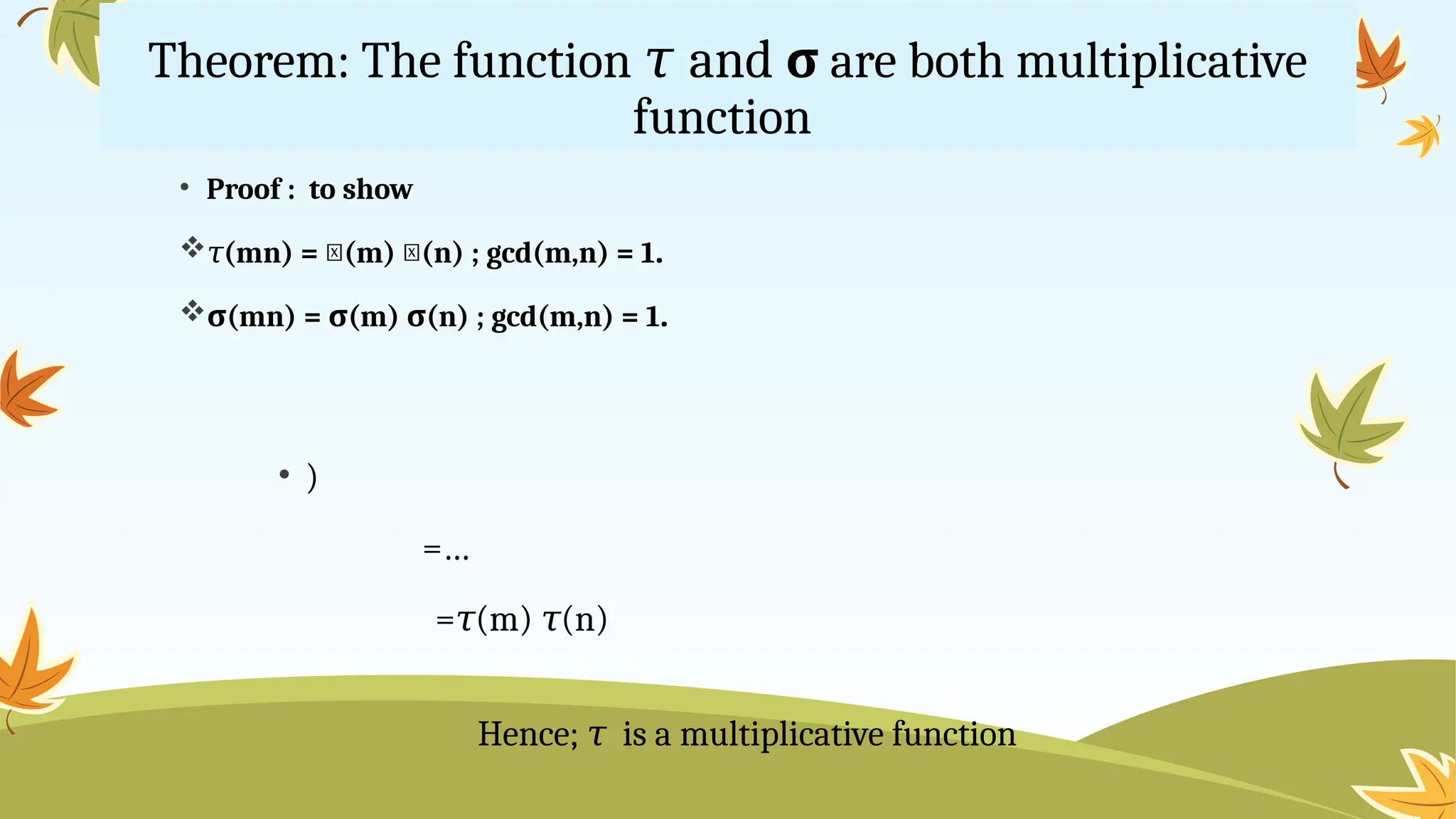
Theorem: The functionand
𝜏 σ are both multiplicative
function
• Proof : to show
𝜏(mn) = 𝜏(m) 𝜏(n) ; gcd(m,n) = 1.
σ(mn) = σ(m) σ(n) ; gcd(m,n) = 1.
• )
=…
= (m) (n)
𝜏 𝜏
Hence; is a
𝜏 multiplicative function
59.
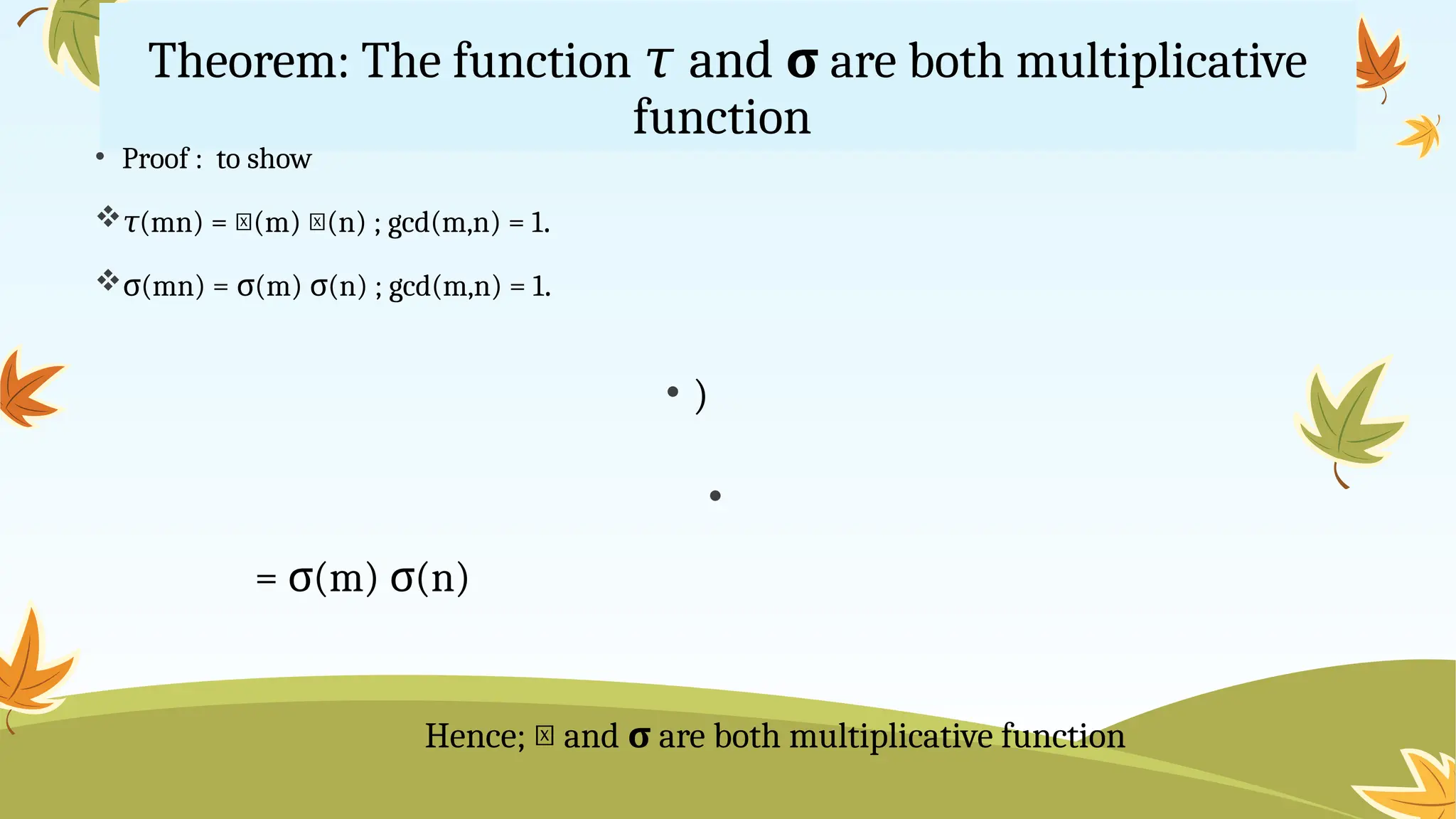
Theorem: The functionand
𝜏 σ are both multiplicative
function
• Proof : to show
𝜏(mn) = 𝜏(m) 𝜏(n) ; gcd(m,n) = 1.
σ(mn) = σ(m) σ(n) ; gcd(m,n) = 1.
• )
•
= σ(m) σ(n)
Hence; 𝜏 and σ are both multiplicative function
60.
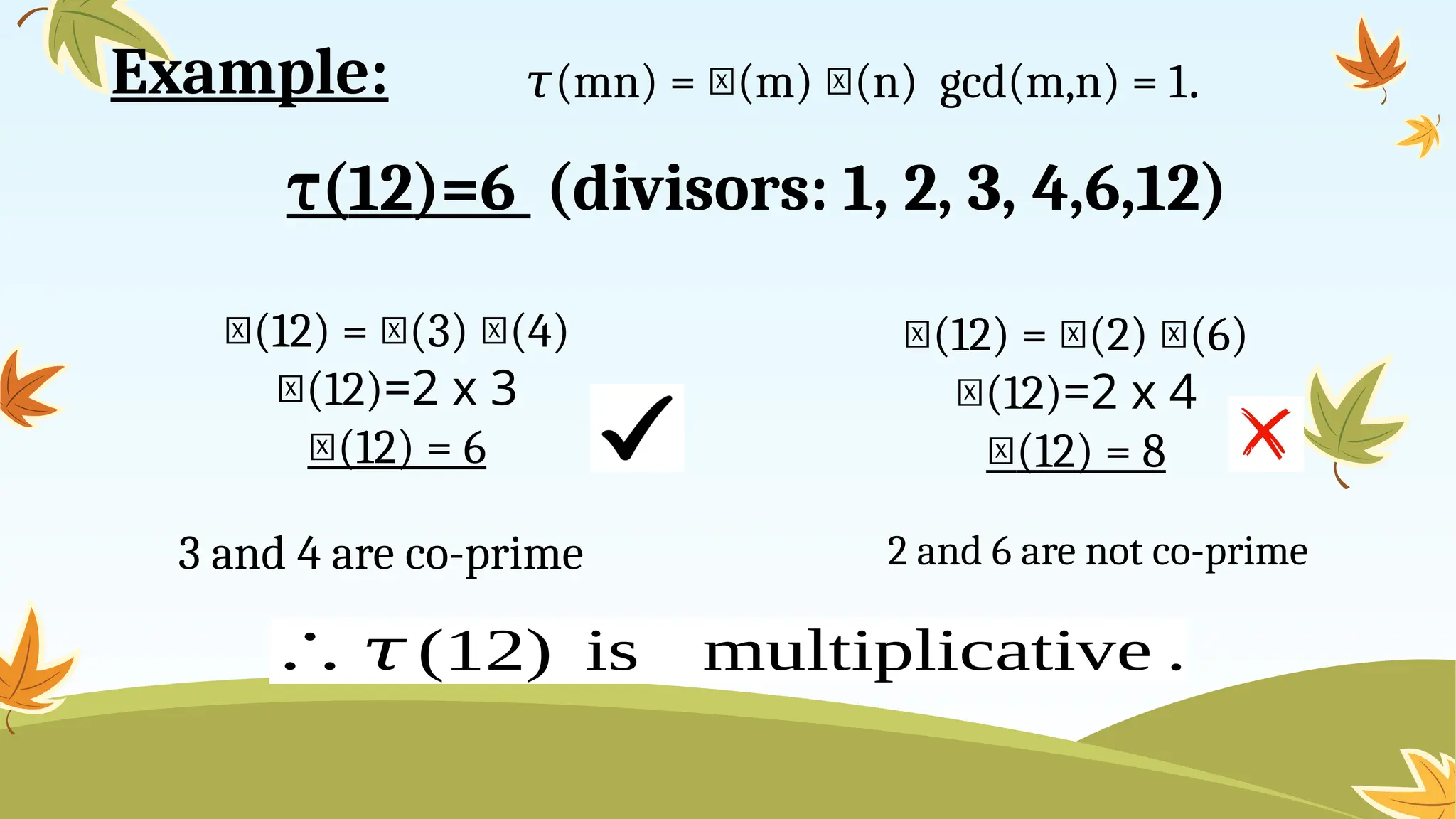
3 and 4are co-prime
(
τ 12)=6 (divisors: 1, 2, 3, 4,6,12)
𝜏(mn) = 𝜏(m) 𝜏(n) gcd(m,n) = 1.
𝜏(12) = 𝜏(3) 𝜏(4)
𝜏(12)=2 x 3
𝜏(12) = 6
𝜏(12) = 𝜏(2) 𝜏(6)
𝜏(12)=2 x 4
𝜏(12) = 8
2 and 6 are not co-prime
∴ 𝜏 (12) is multiplicative .
Example:
Multiplicative functionsserve as fundamental tools in number
theory, particularly in analytic number theory, where they are
used to study properties of integers and their relationships.
It reveal the structure of integers through prime factorization and
provide powerful tools for studying various number-theoretic
problems.
The multiplicative property significantly simplifies calculations by
reducing the need to compute the function's value for large
integers. Instead, we can compute it for prime powers and then
combine these values to obtain the function's value for any
integer.




















![101 math short cuts [www.onlinebcs.com]](https://cdn.slidesharecdn.com/ss_thumbnails/101mathshortcutswww-210201035025-thumbnail.jpg?width=640&height=640&fit=bounds)


