Recognize the major categories of
biomolecules such as carbohydrates, lipids,
proteins and nucleic acid.
- is any molecule that is produced by a living
organisms, including large macromolecules such as
proteins, polysaccharides, lipids and nucleic acids.
• Carbohydrates
• Proteins
• Lipids
• Nucleic Acid
BIOMOLECULES
• Most common biomolecule.
• Primary energy source of our body.
• Building block/ monomer: monosaccharides
CARBOHYDRATES
• Formula: (CH₂O)ₙ where n is the
number of molecules.
• Elements : C – H - O
• Classifications :
1. Monosaccharides
2. Disaccharides
3. Polysaccharides
MONOSACCHARIDES
• Simplest sugar (C₆H₁₂O₆)
Glucose
(blood sugar)
Fructose
(fruit sugar)
Galactose
(found in milk and
glucose
DISACCHARIDES
• Double sugar (C₁₂H₂₂O₁₁)
Maltose
(malt sugar)
Lactose
(milk sugar)
Sucrose
(table sugar)
POLYSACCHARIDES
• Complex sugar (C₆H₁₀O₅)ₙ where n is the
number of carbon atoms.
• Examples:
1. Starch
2. Glycogen
3. Cellulose
4. Chitin
1. Starch
• Used for energy storage in plants.
• They provide a quick form of energy for the
body.
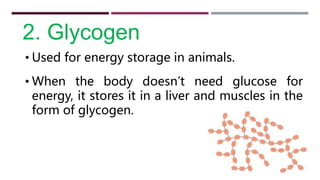
2. Glycogen
• Used for energy storage in animals.
• When the body doesn’t need glucose for
energy, it stores it in a liver and muscles in the
form of glycogen.
3. Cellulose
• Found in plants, cell walls and bark of trees.
• Gives us fiber.
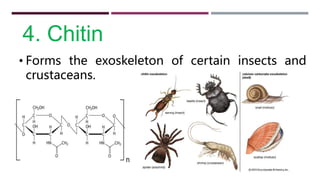
4. Chitin
• Forms the exoskeleton of certain insects and
crustaceans.
TEST FOR CARBOHYDRATES
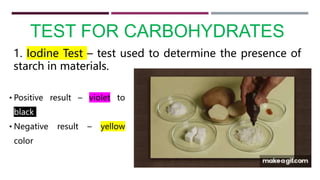
1. Iodine Test – test used to determine the presence of
starch in materials.
• Positive result – violet to
black
• Negative result – yellow
color
TEST FOR CARBOHYDRATES
2. Benedict’s Test – test used for simple carbohydrates.
• Green – 0.1 – 0.5 % sugar in solution
• Yellow – 0.5 – 1 % sugar is present
• Orange – 1 – 1.5 % sugar is present
• Red – 1.5 – 2.0 % sugar is present
• Brick red – more than 2 % of sugar is
present.
PROTEINS
• Body building molecules which
will help us grow.
• Transport molecules in and out of
the cell.
• Control the speed of chemical
reactions.
• Use for growth and repair.
PROTEINS
• Building blocks: amino acid
• General Formula: RCH(NH₂)COOH. R is a side
chain, usually an amino acid.
• Elements: C – H – O - N
Hemoglobin
Albumin
PROTEINS
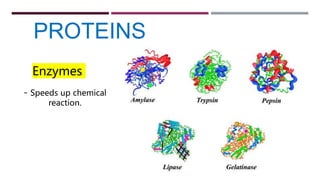
- Speeds up chemical
reaction.
Enzymes
TEST FOR PROTEINS
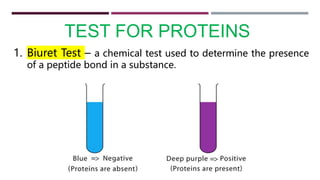
1. Biuret Test – a chemical test used to determine the presence
of a peptide bond in a substance.
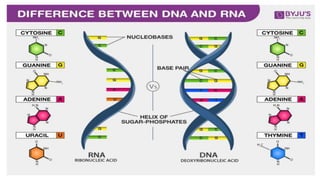
NUCLEIC ACIDS
• These molecules are not
necessarily from food.
• Biomolecular components of
hereditary material are present
in DNA.
• Building blocks: nucleotides
• Elements: C – H – O – N - P
LIPIDS
• Energy – giving molecules, but they are more
commonly referred as the stored – energy molecules.
• They store more energy than carbohydrates and
proteins.
• Building blocks: fatty acids.
• General Formula: CH₃(CH₂)ₙ COOH
LIPIDS
• Elements – C – H - O
• Lipids provide mechanical
protection for the internal
organs of the body and
serve as the water proof
covering in some plants and
animals.
LIPIDS
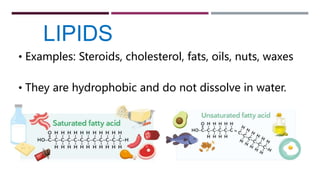
• Examples: Steroids, cholesterol, fats, oils, nuts, waxes
• They are hydrophobic and do not dissolve in water.
TEST FOR LIPIDS
1. Ethanol Emulsion
- ethanol is added to the
sample. Lipids are not present
if the substance remains
colorless. Lipids are present if a
layer of cloudy white
suspension forms above the
solution.
Activity 2
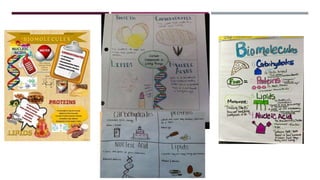
In a long bond paper, draw a box showing the picture of four categories of
biomolecules. Include a title or heading in each box. Each picture must
include color.
CARBON COMPOUNDS IN LIVING THINGS
Description
Required Elements: (35)
The poster include all required elements as well as additional information.
Graphics Relevance: (30)
All graphics are related to the topic and make it easier to understand.
Attractiveness: (35)
The poster is exceptionally attractive in terms of design, layout, and neatness.
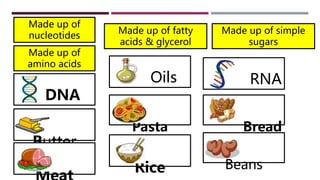
Match Me Up!
Match the picture with its corresponding definition.
Made up of
nucleotides
Made up of fatty
acids & glycerol
Made up of simple
sugars
Made up of
amino acids
Oils RNA
Butter
Bread
Rice
Pasta
Beans
DNA

BIOMOLECULE.pptx

  • 2.
    Recognize the majorcategories of biomolecules such as carbohydrates, lipids, proteins and nucleic acid.
  • 5.
    - is anymolecule that is produced by a living organisms, including large macromolecules such as proteins, polysaccharides, lipids and nucleic acids. • Carbohydrates • Proteins • Lipids • Nucleic Acid BIOMOLECULES
  • 7.
    • Most commonbiomolecule. • Primary energy source of our body. • Building block/ monomer: monosaccharides CARBOHYDRATES
  • 8.
    • Formula: (CH₂O)ₙwhere n is the number of molecules. • Elements : C – H - O • Classifications : 1. Monosaccharides 2. Disaccharides 3. Polysaccharides
  • 9.
    MONOSACCHARIDES • Simplest sugar(C₆H₁₂O₆) Glucose (blood sugar) Fructose (fruit sugar) Galactose (found in milk and glucose
  • 10.
    DISACCHARIDES • Double sugar(C₁₂H₂₂O₁₁) Maltose (malt sugar) Lactose (milk sugar) Sucrose (table sugar)
  • 11.
    POLYSACCHARIDES • Complex sugar(C₆H₁₀O₅)ₙ where n is the number of carbon atoms. • Examples: 1. Starch 2. Glycogen 3. Cellulose 4. Chitin
  • 12.
    1. Starch • Usedfor energy storage in plants. • They provide a quick form of energy for the body.
  • 13.
    2. Glycogen • Usedfor energy storage in animals. • When the body doesn’t need glucose for energy, it stores it in a liver and muscles in the form of glycogen.
  • 14.
    3. Cellulose • Foundin plants, cell walls and bark of trees. • Gives us fiber.
  • 15.
    4. Chitin • Formsthe exoskeleton of certain insects and crustaceans.
  • 16.
    TEST FOR CARBOHYDRATES 1.Iodine Test – test used to determine the presence of starch in materials. • Positive result – violet to black • Negative result – yellow color
  • 17.
    TEST FOR CARBOHYDRATES 2.Benedict’s Test – test used for simple carbohydrates. • Green – 0.1 – 0.5 % sugar in solution • Yellow – 0.5 – 1 % sugar is present • Orange – 1 – 1.5 % sugar is present • Red – 1.5 – 2.0 % sugar is present • Brick red – more than 2 % of sugar is present.
  • 19.
    PROTEINS • Body buildingmolecules which will help us grow. • Transport molecules in and out of the cell. • Control the speed of chemical reactions. • Use for growth and repair.
  • 20.
    PROTEINS • Building blocks:amino acid • General Formula: RCH(NH₂)COOH. R is a side chain, usually an amino acid. • Elements: C – H – O - N Hemoglobin Albumin
  • 21.
    PROTEINS - Speeds upchemical reaction. Enzymes
  • 22.
    TEST FOR PROTEINS 1.Biuret Test – a chemical test used to determine the presence of a peptide bond in a substance.
  • 24.
    NUCLEIC ACIDS • Thesemolecules are not necessarily from food. • Biomolecular components of hereditary material are present in DNA. • Building blocks: nucleotides • Elements: C – H – O – N - P
  • 27.
    LIPIDS • Energy –giving molecules, but they are more commonly referred as the stored – energy molecules. • They store more energy than carbohydrates and proteins. • Building blocks: fatty acids. • General Formula: CH₃(CH₂)ₙ COOH
  • 28.
    LIPIDS • Elements –C – H - O • Lipids provide mechanical protection for the internal organs of the body and serve as the water proof covering in some plants and animals.
  • 29.
    LIPIDS • Examples: Steroids,cholesterol, fats, oils, nuts, waxes • They are hydrophobic and do not dissolve in water.
  • 30.
    TEST FOR LIPIDS 1.Ethanol Emulsion - ethanol is added to the sample. Lipids are not present if the substance remains colorless. Lipids are present if a layer of cloudy white suspension forms above the solution.
  • 32.
    Activity 2 In along bond paper, draw a box showing the picture of four categories of biomolecules. Include a title or heading in each box. Each picture must include color. CARBON COMPOUNDS IN LIVING THINGS Description Required Elements: (35) The poster include all required elements as well as additional information. Graphics Relevance: (30) All graphics are related to the topic and make it easier to understand. Attractiveness: (35) The poster is exceptionally attractive in terms of design, layout, and neatness.
  • 34.
    Match Me Up! Matchthe picture with its corresponding definition.
  • 35.
    Made up of nucleotides Madeup of fatty acids & glycerol Made up of simple sugars Made up of amino acids Oils RNA Butter Bread Rice Pasta Beans DNA

Editor's Notes

  • #5 The food you eat affects you. If you eat unhealthy food, you will also have unhealthy body. Bakit puro pagkain? because we will try to classify food according to the biomolecules that you can get from them.
  • #11 Maltose – glucose + glucose Lactose – glucose + galactose Sucrose – fructose + galactose
  • #21 Usually obtained in food like meat, fish, beans
  • #28 Made up of fatty acids and glycerol
  • #30  A type of fat with certain chemical properties that is usually solid at room temperature. Most saturated fats come from animal food products, but some plant oils, such as palm and coconut oil, also contain high levels. Unsaturated fats, which are liquid at room temperature, are considered beneficial fats because they can improve blood cholesterol levels such as olive, safflower, and sunflower oil. High concentrations of unsaturated fats are also found in olives, avocados, nuts, and seeds.