Creating the Workplace of the Future [email_address] June 18, 2001
Overview Who I am Objectives Approach  Desired outcomes
Objectives Stimulate and provoke thought Destroy any remaining illusions about “going back to normal” Introduce three overarching principles for the new world of work  Explore approaches based on these principles “ Check out” the principles in action - understand why and how they will become primary tools
Agenda Introduction & Basic Assumptions Theory Burst, 5 Key Drivers Tapping the Collective Wisdom - What Do You Think  Decoding the Future – What Does This Mean To You?
Desired Outcomes Deliver some core messages: An unpredictable future Rapidly increasing complexity No one-stop solutions; customization is the key Principles work, prescriptions don’t Clarify the challenges ahead
The Changing Nature of Change  “In the past, change was a periodic event in organizations, and now… organization is a periodic event.” Student in eMBA class
5 Key Drivers of Ongoing Change Demographics Service/Stakeholder Expectations Values Technology Pace of Change
Demographics Change Obvious Issues Baby Boomers still in place & in charge Aging workforce, looming retirements Shortages and increased competition for people (the war for talent) “ Lag” effects of plateauing Increasing workforce diversity Less Obvious Issues Changed & changing nature of work Emergence of generation D (for digital) It takes a long time for change to happen quickly Values shift ??
Service/Stakeholder Expectations Increase “ I’m the customer,  “dammit”  !!! “ Raising the Bar” – cumulative effect of TQM/drive for excellence, global competition, trade liberalization, increased mobility, and so on) More people, diverse needs, do more with less Informed and demanding customers Accountability issues Social/environmental awareness and responsibility
Values Shift Multiple sources and symptoms of massive values shift Amongst others: Increasingly strident demands for: flexibility, personal freedom and choice, involvement, consultation Changing social fabric: blended families, same-sex marriages and rights, “singlehood”, ethnic/cultural diversity A fundamental “New Deal” at work Cumulative effect -  30 years of McLuhan, Warhol, the Beatles, the birth-control pill, the Vietnam War, cheap travel around the world
Technology Evolves PC’s to LAN’s to WAN’s to Internet Internet, Intranet, Extranet, Metanet, social nets, etc.net Remote devices, handhelds, wireless Biotechnology Artificial Intelligence New materials Synthesis of intelligence and materials – new characteristics
Pace of Change Accelerates Creates complexity Enhances uncertainty Increases in intensity Cycles more frequent Sharper, harder impacts
Change Ain’t What It Used To Be From: Discrete events Time to adjust & absorb Relatively predictable outcomes Sense of the future as a continuation of the present (orderly) To: Continuous process Adjust “on the fly” Almost impossible to predict outcomes The future as highly complex and uncertain (chaotic)
What Do You Think? “ Everybody Knows”
A Systems Approach What I Think It Means – The Principles 1. Increasing Complexity & Uncertainty  2. Mass Customization of Work 3. Wirearchy Or … What’s Happening Because of All That Change We Just Looked At ?
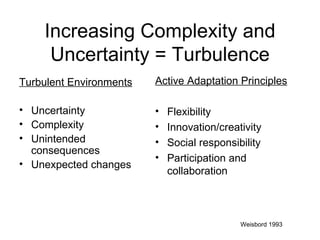
Increasing Complexity and Uncertainty = Turbulence Turbulent Environments Uncertainty Complexity Unintended consequences Unexpected changes Active Adaptation Principles Flexibility Innovation/creativity Social responsibility Participation and collaboration Weisbord 1993
Mass Customization of Work Mass Customization Adapting to custom specifications products, services or activities that are used or carried out by large numbers of people A necessary response to environment & changing conditions (values, demographics, technology, expectations) Concept popularized by Pine & Gilmour and Stan Davis
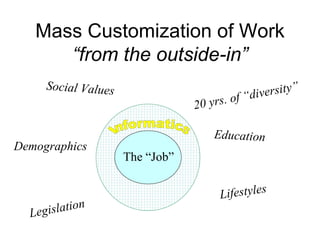
Mass Customization of Work “from the outside-in” The   “Job” 20 yrs. of “diversity” Social Values Legislation Lifestyles Demographics Informatics Education
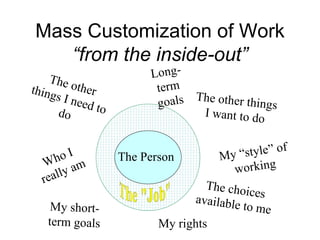
Mass Customization of Work “from the inside-out” The Person The "Job" My “style” of working The other things I want to do The other things I need to do Who I really am Long-term goals My short-term goals The choices available to me My rights
Mass Customization of Work Two basic types of work Work that completes a step in a process, or Work that involves/completes a transaction ( will be   standardized and/or codified, throughout the 1 st  World) Work that synthesizes, or  Work that generates ideas, additional knowledge ( involves   proactive, transformative skills such as thinking, writing, imagining, and communication
Mass Customization of Work In the 2nd type, pressure for performance has  led to people insisting on  “personalizing” the work - doing it their way This is a broad underlying - and enduring - trend The pressures, and the overall trend, are only likely to increase in scope and intensity
Wirearchy “ Archy”  –  Greek root meaning “First Principle” Other types of “archy”: Monarchy  (single owner/source of power) Hierarchy  (vertical ascending power) Anarchy  (no central source of power, random distribution) Patriarchy (Governed by father archetype) Matriarchy (Governed by mother archetype) Oligarchy (rule of the powerful few) Archy - the source of organization, the rules, the “first principle”
Wirearchy Today, “archy” refers to responsibility for or sources of power such as: Vision and Values Chain of decision-making command Ability to mobilize  Seniority In the Industrial Age, Hierarchy is / was the rule
Wirearchy Now, It’s an Information/Knowledge Age A new set of conditions New (emerging) interactional dynamics between people and organizations, based on interrelationships in networks “ If Knowledge is Power, then…” Knowledge is distributed in both diffuse & precise ways, thus it requires context
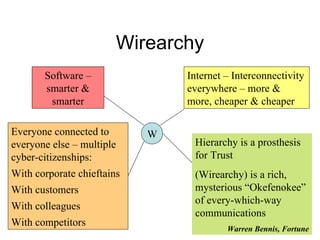
Wirearchy Software – smarter & smarter Internet – Interconnectivity everywhere – more & more, cheaper & cheaper Everyone connected to everyone else – multiple cyber-citizenships: With corporate chieftains With customers With colleagues With competitors Hierarchy is a prosthesis for Trust (Wirearchy) is a rich, mysterious “Okefenokee” of every-which-way communications Warren Bennis, Fortune W
Wirearchy Business strategy is the core and the centrifugal force Information and knowledge are bundled and strung together in meaningful ways in order to synthesize/generate value… Decision-making & control, stretched out along the value-chain, creates centripetal force
Wirearchy Many responses to the ways “work” has been structured and managed, e.g. Employee Portals Team and Project-based work Emotional Intelligence Coaching Integrated “Smartware” tools   And so on….
Wirearchy A Polarity:  Very hi-tech, very hi-touch “ Wirearchy” – or interaction supported by technology & based on trust, meaning and credibility - rather than on traditional methods of direction and control   Represents a significant change in human interactions Observable emerging in new social dynamics of work  - otherwise called collaboration
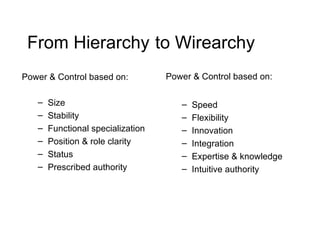
From Hierarchy  to Wirearchy Power & Control based on: Size  Stability  Functional specialization Position & role clarity Status Prescribed authority Power & Control based on: Speed Flexibility Innovation Integration Expertise & knowledge Intuitive authority
Why You’ll Need to Understand Mass Customization & Wirearchy “ …  even now, organization is a periodic event….”  “ In the future…. “ You Ain’t Seen Nothin’ Yet !” Alvin & Heidi Toffler
The 90s Are Gone - Get Over It We cannot afford to keep thinking of technology as just a tool for us to use Each new medium has been additive - Print, electronic, multimedia - Communication theories stayed the same Technology is not a new medium - It’s a new age, a new paradigm - Agrarian --> Industrial --> Information - Communication theories must change
The Web: From Novelty to Fad to Essential Tool Five years of explosive growth & change Just the beginning…. Integration into every organization & activity Not about “web-sites” (or the web) anymore Transforming entire sectors Requires new thinking, new structures
The Web - A Symbol of the Age Interaction among workers replaces command and control from managers Direction from the top gives way to collaborative teams for innovation The “chain of command” will be a web of peers and customers Executives and communicators will fail if they ignore what it means to live and work in a web environment ... life just not the same
What the “Near” Future Holds More ( many more ) people on-line Faster connections More convergence More smart tools More interwoven interconnectedness More computer-savvy people More competitive pressures
And…”So What…..?” Really “getting it” means understanding that we are moving from organizing by Hierarchy ... to organizing by Wirearchy “ A dynamic flow of power, authority and decision-making authority based on trust, credibility and a focus on results, enabled by interconnected people, information and knowledge”
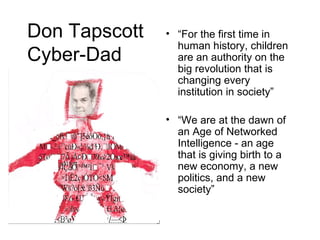
Don Tapscott Cyber-Dad “ For the first time in human history, children are an authority on the big revolution that is changing every institution in society” “ We are at the dawn of an Age of Networked Intelligence - an age that is giving birth to a new economy, a new politics, and a new society”
Design Principles – Creating the Workplace of the Future Focus on a preferred future  Empowerment, participation & inclusion Create common strategic information Create community (mutual awareness, ownership, interest in success) Seek common ground (shared vision & values) Make things happen in “Real Time” (speed)

The Future of Work - 2001 Presentation

  • 1.
    Creating the Workplaceof the Future [email_address] June 18, 2001
  • 2.
    Overview Who Iam Objectives Approach Desired outcomes
  • 3.
    Objectives Stimulate andprovoke thought Destroy any remaining illusions about “going back to normal” Introduce three overarching principles for the new world of work Explore approaches based on these principles “ Check out” the principles in action - understand why and how they will become primary tools
  • 4.
    Agenda Introduction &Basic Assumptions Theory Burst, 5 Key Drivers Tapping the Collective Wisdom - What Do You Think Decoding the Future – What Does This Mean To You?
  • 5.
    Desired Outcomes Deliversome core messages: An unpredictable future Rapidly increasing complexity No one-stop solutions; customization is the key Principles work, prescriptions don’t Clarify the challenges ahead
  • 6.
    The Changing Natureof Change “In the past, change was a periodic event in organizations, and now… organization is a periodic event.” Student in eMBA class
  • 7.
    5 Key Driversof Ongoing Change Demographics Service/Stakeholder Expectations Values Technology Pace of Change
  • 8.
    Demographics Change ObviousIssues Baby Boomers still in place & in charge Aging workforce, looming retirements Shortages and increased competition for people (the war for talent) “ Lag” effects of plateauing Increasing workforce diversity Less Obvious Issues Changed & changing nature of work Emergence of generation D (for digital) It takes a long time for change to happen quickly Values shift ??
  • 9.
    Service/Stakeholder Expectations Increase“ I’m the customer, “dammit” !!! “ Raising the Bar” – cumulative effect of TQM/drive for excellence, global competition, trade liberalization, increased mobility, and so on) More people, diverse needs, do more with less Informed and demanding customers Accountability issues Social/environmental awareness and responsibility
  • 10.
    Values Shift Multiplesources and symptoms of massive values shift Amongst others: Increasingly strident demands for: flexibility, personal freedom and choice, involvement, consultation Changing social fabric: blended families, same-sex marriages and rights, “singlehood”, ethnic/cultural diversity A fundamental “New Deal” at work Cumulative effect - 30 years of McLuhan, Warhol, the Beatles, the birth-control pill, the Vietnam War, cheap travel around the world
  • 11.
    Technology Evolves PC’sto LAN’s to WAN’s to Internet Internet, Intranet, Extranet, Metanet, social nets, etc.net Remote devices, handhelds, wireless Biotechnology Artificial Intelligence New materials Synthesis of intelligence and materials – new characteristics
  • 12.
    Pace of ChangeAccelerates Creates complexity Enhances uncertainty Increases in intensity Cycles more frequent Sharper, harder impacts
  • 13.
    Change Ain’t WhatIt Used To Be From: Discrete events Time to adjust & absorb Relatively predictable outcomes Sense of the future as a continuation of the present (orderly) To: Continuous process Adjust “on the fly” Almost impossible to predict outcomes The future as highly complex and uncertain (chaotic)
  • 14.
    What Do YouThink? “ Everybody Knows”
  • 15.
    A Systems ApproachWhat I Think It Means – The Principles 1. Increasing Complexity & Uncertainty 2. Mass Customization of Work 3. Wirearchy Or … What’s Happening Because of All That Change We Just Looked At ?
  • 16.
    Increasing Complexity andUncertainty = Turbulence Turbulent Environments Uncertainty Complexity Unintended consequences Unexpected changes Active Adaptation Principles Flexibility Innovation/creativity Social responsibility Participation and collaboration Weisbord 1993
  • 17.
    Mass Customization ofWork Mass Customization Adapting to custom specifications products, services or activities that are used or carried out by large numbers of people A necessary response to environment & changing conditions (values, demographics, technology, expectations) Concept popularized by Pine & Gilmour and Stan Davis
  • 18.
    Mass Customization ofWork “from the outside-in” The “Job” 20 yrs. of “diversity” Social Values Legislation Lifestyles Demographics Informatics Education
  • 19.
    Mass Customization ofWork “from the inside-out” The Person The "Job" My “style” of working The other things I want to do The other things I need to do Who I really am Long-term goals My short-term goals The choices available to me My rights
  • 20.
    Mass Customization ofWork Two basic types of work Work that completes a step in a process, or Work that involves/completes a transaction ( will be standardized and/or codified, throughout the 1 st World) Work that synthesizes, or Work that generates ideas, additional knowledge ( involves proactive, transformative skills such as thinking, writing, imagining, and communication
  • 21.
    Mass Customization ofWork In the 2nd type, pressure for performance has led to people insisting on “personalizing” the work - doing it their way This is a broad underlying - and enduring - trend The pressures, and the overall trend, are only likely to increase in scope and intensity
  • 22.
    Wirearchy “ Archy” – Greek root meaning “First Principle” Other types of “archy”: Monarchy (single owner/source of power) Hierarchy (vertical ascending power) Anarchy (no central source of power, random distribution) Patriarchy (Governed by father archetype) Matriarchy (Governed by mother archetype) Oligarchy (rule of the powerful few) Archy - the source of organization, the rules, the “first principle”
  • 23.
    Wirearchy Today, “archy”refers to responsibility for or sources of power such as: Vision and Values Chain of decision-making command Ability to mobilize Seniority In the Industrial Age, Hierarchy is / was the rule
  • 24.
    Wirearchy Now, It’san Information/Knowledge Age A new set of conditions New (emerging) interactional dynamics between people and organizations, based on interrelationships in networks “ If Knowledge is Power, then…” Knowledge is distributed in both diffuse & precise ways, thus it requires context
  • 25.
    Wirearchy Software –smarter & smarter Internet – Interconnectivity everywhere – more & more, cheaper & cheaper Everyone connected to everyone else – multiple cyber-citizenships: With corporate chieftains With customers With colleagues With competitors Hierarchy is a prosthesis for Trust (Wirearchy) is a rich, mysterious “Okefenokee” of every-which-way communications Warren Bennis, Fortune W
  • 26.
    Wirearchy Business strategyis the core and the centrifugal force Information and knowledge are bundled and strung together in meaningful ways in order to synthesize/generate value… Decision-making & control, stretched out along the value-chain, creates centripetal force
  • 27.
    Wirearchy Many responsesto the ways “work” has been structured and managed, e.g. Employee Portals Team and Project-based work Emotional Intelligence Coaching Integrated “Smartware” tools And so on….
  • 28.
    Wirearchy A Polarity: Very hi-tech, very hi-touch “ Wirearchy” – or interaction supported by technology & based on trust, meaning and credibility - rather than on traditional methods of direction and control Represents a significant change in human interactions Observable emerging in new social dynamics of work - otherwise called collaboration
  • 29.
    From Hierarchy to Wirearchy Power & Control based on: Size Stability Functional specialization Position & role clarity Status Prescribed authority Power & Control based on: Speed Flexibility Innovation Integration Expertise & knowledge Intuitive authority
  • 30.
    Why You’ll Needto Understand Mass Customization & Wirearchy “ … even now, organization is a periodic event….” “ In the future…. “ You Ain’t Seen Nothin’ Yet !” Alvin & Heidi Toffler
  • 31.
    The 90s AreGone - Get Over It We cannot afford to keep thinking of technology as just a tool for us to use Each new medium has been additive - Print, electronic, multimedia - Communication theories stayed the same Technology is not a new medium - It’s a new age, a new paradigm - Agrarian --> Industrial --> Information - Communication theories must change
  • 32.
    The Web: FromNovelty to Fad to Essential Tool Five years of explosive growth & change Just the beginning…. Integration into every organization & activity Not about “web-sites” (or the web) anymore Transforming entire sectors Requires new thinking, new structures
  • 33.
    The Web -A Symbol of the Age Interaction among workers replaces command and control from managers Direction from the top gives way to collaborative teams for innovation The “chain of command” will be a web of peers and customers Executives and communicators will fail if they ignore what it means to live and work in a web environment ... life just not the same
  • 34.
    What the “Near”Future Holds More ( many more ) people on-line Faster connections More convergence More smart tools More interwoven interconnectedness More computer-savvy people More competitive pressures
  • 35.
    And…”So What…..?” Really“getting it” means understanding that we are moving from organizing by Hierarchy ... to organizing by Wirearchy “ A dynamic flow of power, authority and decision-making authority based on trust, credibility and a focus on results, enabled by interconnected people, information and knowledge”
  • 36.
    Don Tapscott Cyber-Dad“ For the first time in human history, children are an authority on the big revolution that is changing every institution in society” “ We are at the dawn of an Age of Networked Intelligence - an age that is giving birth to a new economy, a new politics, and a new society”
  • 37.
    Design Principles –Creating the Workplace of the Future Focus on a preferred future Empowerment, participation & inclusion Create common strategic information Create community (mutual awareness, ownership, interest in success) Seek common ground (shared vision & values) Make things happen in “Real Time” (speed)