





Technological Initiatives for Social Empowerment Design experiments in technology-supported youth participation and local civic engagement Leo Burd PhD Thesis Defense MIT Media Lab - May 4 th , 2007
Mitchel Resnick LEGO Papert Professor of Learning Research, MIT Roger Hart Affiliated Professor, City University of New York Lorlene M. Hoyt Assistant Professor of Technology and Planning, MIT Alexander Pentland Toshiba Professor of Media Arts and Sciences thesis committee
motivation research approach the Young Activists Network initiative the What’s Up Lawrence initiative conclusions and next steps contents
Sao Paulo, Brazil
 
In order to foster democratic and participatory societies, it is important to create  innovative learning initiatives in which, from a very young age people are motivated to investigate their communities and do something about matters that affect their lives. motivation (Hart 1997- Children’s Participation: The theory and practice of involving young citizens in community development and environmental care - pg. 9)
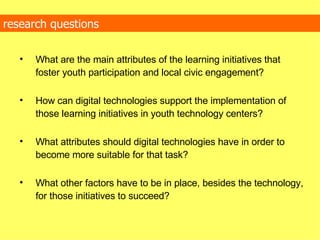
research questions What are the main attributes of the learning initiatives that foster youth participation and local civic engagement? How can digital technologies support the implementation of those learning initiatives in youth technology centers? What attributes should digital technologies have in order to become more suitable for that task? What other factors have to be in place, besides the technology, for those initiatives to succeed?
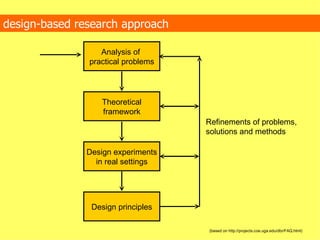
design-based research approach Analysis of  practical problems Theoretical framework Design experiments in real settings Design principles Refinements of problems,  solutions and methods (based on http://projects.coe.uga.edu/dbr/FAQ.html)
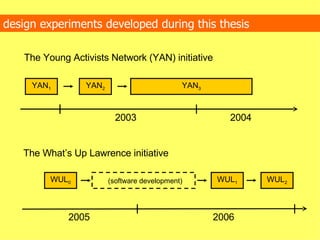
design experiments developed during this thesis The Young Activists Network (YAN) initiative The What’s Up Lawrence initiative YAN 1 YAN 2 YAN 3 WUL 0 WUL 1 WUL 2 (software development) 2003 2004 2005 2006
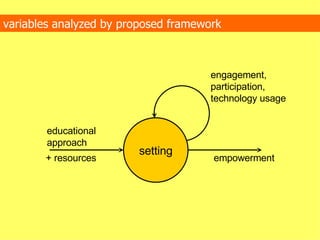
variables analyzed by proposed framework setting educational approach + resources empowerment engagement, participation,  technology usage
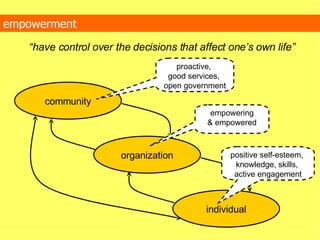
empowerment community organization individual “ have control over the decisions that affect one’s own life” proactive,  good services,  open government positive self-esteem,  knowledge, skills,  active engagement empowering & empowered
the Young Activists Network initiative the Young Activists Network (YAN)
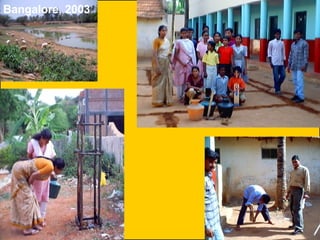
Bangalore, 2003
Children’s Rights Flyer  (Charlestown 2003)
Teen Pregnancy Event  (Chelsea 2004)
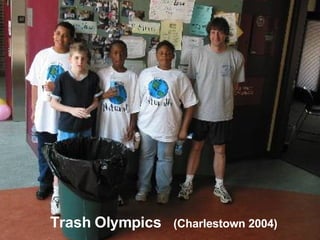
Trash Olympics  (Charlestown 2004)
 
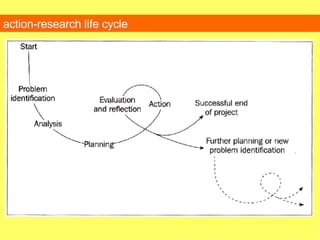
action-research life cycle
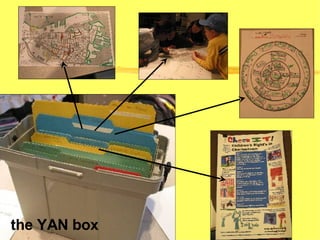
the YAN box
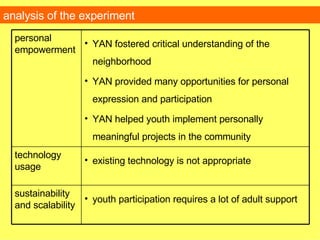
analysis of the experiment youth participation requires a lot of adult support sustainability and scalability existing technology is not appropriate technology usage YAN fostered critical understanding of the neighborhood YAN provided many opportunities for personal expression and participation YAN helped youth implement personally meaningful projects in the community personal empowerment
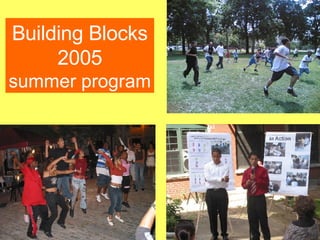
Building Blocks 2005 summer program
 
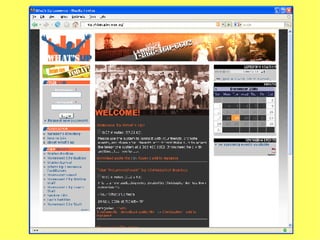
Helping young people organize personally meaningful community events may overcome some of the barriers present in other more traditional approaches to youth participation and local civic engagement. A telephone-based community system can bring great value to the above mentioned initiative. what’s up-related hypotheses
why telephones? easily accessible easy to use low-cost can be integrated with computers and the Internet (VoIP)
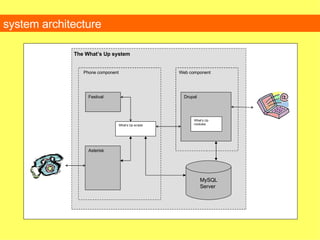
System architecture The What’s Up system What’s Up  modules Drupal Web component What’s Up scripts MySQL Server system architecture Festival Asterisk Phone component
 
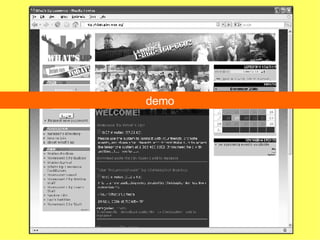
demo
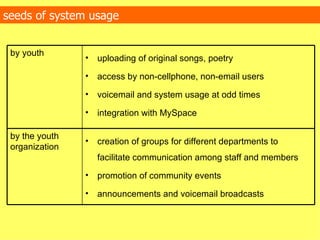
seeds of system usage creation of groups for different departments to facilitate communication among staff and members promotion of community events announcements and voicemail broadcasts by the youth organization uploading of original songs, poetry access by non-cellphone, non-email users voicemail and system usage at odd times integration with MySpace by youth
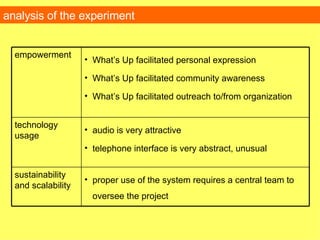
analysis of the experiment proper use of the system requires a central team to oversee the project sustainability and scalability audio is very attractive telephone interface is very abstract, unusual technology usage What’s Up facilitated personal expression What’s Up facilitated community awareness What’s Up facilitated outreach to/from organization empowerment
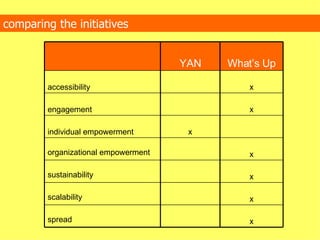
comparing the initiatives x spread x scalability sustainability organizational empowerment individual empowerment engagement accessibility x x YAN x x x What’s Up
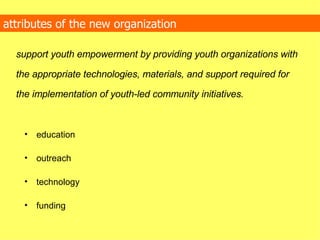
attributes of the new organization support youth empowerment by providing youth organizations with the appropriate technologies, materials, and support required for the implementation of youth-led community initiatives. education outreach technology funding
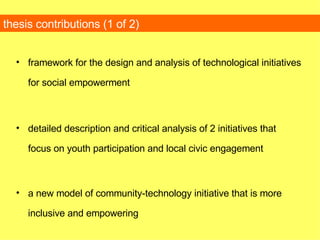
thesis contributions (1 of 2) framework for the design and analysis of technological initiatives for social empowerment  detailed description and critical analysis of 2 initiatives that focus on youth participation and local civic engagement  a new model of community-technology initiative that is more inclusive and empowering
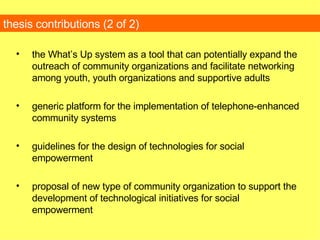
thesis contributions (2 of 2) the What’s Up system as a tool that can potentially expand the outreach of community organizations and facilitate networking among youth, youth organizations and supportive adults generic platform for the implementation of telephone-enhanced community systems guidelines for the design of technologies for social empowerment proposal of new type of community organization to support the development of technological initiatives for social empowerment
future directions release What’s Up system as open-source modules enhance tool based on findings test framework with different settings, audiences disseminate findings and promote discussion
acknowledgements my thesis committee lorlene, roger and sandy my family m ãe, pai, meus super irmãos e cunhadas barbara and norty noah
acknowledgements the computer clubhouse network gail, ingeborg, patricia, stina the yan team danielle, heidi, kate, pascha, rebecca,   tasha adetunji, juliet, jayson, leah kristen, claire, katie   ana maria,  perola, pedro, carlos, ricardo lourdes, raul, baghya, sandhya luis lach, adelmar, pablo carolina, oswaldo, tripti the what’s up lawrence team misael, rasec, jessica, joel the staff and members of movement city and lcw
acknowledgements the llk team robbin, eleonora, bakhtiar, michelle,  diane, margarita, michael, liz, evelyn andres, amon, chris, john, natalie, jay, tammy, lis, oren  the media lab andrea and thomaz, ariane and laird, fernanda and dani, claudia, josh, tad, juan carlos, nitin, shani, toshi, yumi  linda, kevin, jon, steve,will, paula other good friends and inspirations geetha, ed, kobashi, catau, rosângela, rogério and vanessa, matthias and petra, jochen, alan, dana and dirk, melina, maria, tony, nivaldo, amy, sally, moshe  ernie, mike, valente, gerhard, irene
acknowledgements my advisor mitch my wife rachel

20070504 Thesis Defense V4 Public

  • 1.
    Technological Initiatives forSocial Empowerment Design experiments in technology-supported youth participation and local civic engagement Leo Burd PhD Thesis Defense MIT Media Lab - May 4 th , 2007
  • 2.
    Mitchel Resnick LEGOPapert Professor of Learning Research, MIT Roger Hart Affiliated Professor, City University of New York Lorlene M. Hoyt Assistant Professor of Technology and Planning, MIT Alexander Pentland Toshiba Professor of Media Arts and Sciences thesis committee
  • 3.
    motivation research approachthe Young Activists Network initiative the What’s Up Lawrence initiative conclusions and next steps contents
  • 4.
  • 5.
  • 6.
    In order tofoster democratic and participatory societies, it is important to create innovative learning initiatives in which, from a very young age people are motivated to investigate their communities and do something about matters that affect their lives. motivation (Hart 1997- Children’s Participation: The theory and practice of involving young citizens in community development and environmental care - pg. 9)
  • 7.
    research questions Whatare the main attributes of the learning initiatives that foster youth participation and local civic engagement? How can digital technologies support the implementation of those learning initiatives in youth technology centers? What attributes should digital technologies have in order to become more suitable for that task? What other factors have to be in place, besides the technology, for those initiatives to succeed?
  • 8.
    design-based research approachAnalysis of practical problems Theoretical framework Design experiments in real settings Design principles Refinements of problems, solutions and methods (based on http://projects.coe.uga.edu/dbr/FAQ.html)
  • 9.
    design experiments developedduring this thesis The Young Activists Network (YAN) initiative The What’s Up Lawrence initiative YAN 1 YAN 2 YAN 3 WUL 0 WUL 1 WUL 2 (software development) 2003 2004 2005 2006
  • 10.
    variables analyzed byproposed framework setting educational approach + resources empowerment engagement, participation, technology usage
  • 11.
    empowerment community organizationindividual “ have control over the decisions that affect one’s own life” proactive, good services, open government positive self-esteem, knowledge, skills, active engagement empowering & empowered
  • 12.
    the Young ActivistsNetwork initiative the Young Activists Network (YAN)
  • 13.
  • 14.
    Children’s Rights Flyer (Charlestown 2003)
  • 15.
    Teen Pregnancy Event (Chelsea 2004)
  • 16.
    Trash Olympics (Charlestown 2004)
  • 17.
  • 18.
  • 19.
  • 20.
    analysis of theexperiment youth participation requires a lot of adult support sustainability and scalability existing technology is not appropriate technology usage YAN fostered critical understanding of the neighborhood YAN provided many opportunities for personal expression and participation YAN helped youth implement personally meaningful projects in the community personal empowerment
  • 21.
    Building Blocks 2005summer program
  • 22.
  • 23.
    Helping young peopleorganize personally meaningful community events may overcome some of the barriers present in other more traditional approaches to youth participation and local civic engagement. A telephone-based community system can bring great value to the above mentioned initiative. what’s up-related hypotheses
  • 24.
    why telephones? easilyaccessible easy to use low-cost can be integrated with computers and the Internet (VoIP)
  • 25.
    System architecture TheWhat’s Up system What’s Up modules Drupal Web component What’s Up scripts MySQL Server system architecture Festival Asterisk Phone component
  • 26.
  • 27.
  • 28.
    seeds of systemusage creation of groups for different departments to facilitate communication among staff and members promotion of community events announcements and voicemail broadcasts by the youth organization uploading of original songs, poetry access by non-cellphone, non-email users voicemail and system usage at odd times integration with MySpace by youth
  • 29.
    analysis of theexperiment proper use of the system requires a central team to oversee the project sustainability and scalability audio is very attractive telephone interface is very abstract, unusual technology usage What’s Up facilitated personal expression What’s Up facilitated community awareness What’s Up facilitated outreach to/from organization empowerment
  • 30.
    comparing the initiativesx spread x scalability sustainability organizational empowerment individual empowerment engagement accessibility x x YAN x x x What’s Up
  • 31.
    attributes of thenew organization support youth empowerment by providing youth organizations with the appropriate technologies, materials, and support required for the implementation of youth-led community initiatives. education outreach technology funding
  • 32.
    thesis contributions (1of 2) framework for the design and analysis of technological initiatives for social empowerment detailed description and critical analysis of 2 initiatives that focus on youth participation and local civic engagement a new model of community-technology initiative that is more inclusive and empowering
  • 33.
    thesis contributions (2of 2) the What’s Up system as a tool that can potentially expand the outreach of community organizations and facilitate networking among youth, youth organizations and supportive adults generic platform for the implementation of telephone-enhanced community systems guidelines for the design of technologies for social empowerment proposal of new type of community organization to support the development of technological initiatives for social empowerment
  • 34.
    future directions releaseWhat’s Up system as open-source modules enhance tool based on findings test framework with different settings, audiences disseminate findings and promote discussion
  • 35.
    acknowledgements my thesiscommittee lorlene, roger and sandy my family m ãe, pai, meus super irmãos e cunhadas barbara and norty noah
  • 36.
    acknowledgements the computerclubhouse network gail, ingeborg, patricia, stina the yan team danielle, heidi, kate, pascha, rebecca, tasha adetunji, juliet, jayson, leah kristen, claire, katie ana maria, perola, pedro, carlos, ricardo lourdes, raul, baghya, sandhya luis lach, adelmar, pablo carolina, oswaldo, tripti the what’s up lawrence team misael, rasec, jessica, joel the staff and members of movement city and lcw
  • 37.
    acknowledgements the llkteam robbin, eleonora, bakhtiar, michelle, diane, margarita, michael, liz, evelyn andres, amon, chris, john, natalie, jay, tammy, lis, oren the media lab andrea and thomaz, ariane and laird, fernanda and dani, claudia, josh, tad, juan carlos, nitin, shani, toshi, yumi linda, kevin, jon, steve,will, paula other good friends and inspirations geetha, ed, kobashi, catau, rosângela, rogério and vanessa, matthias and petra, jochen, alan, dana and dirk, melina, maria, tony, nivaldo, amy, sally, moshe ernie, mike, valente, gerhard, irene
  • 38.
    acknowledgements my advisormitch my wife rachel