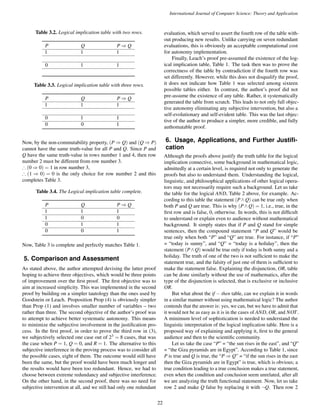
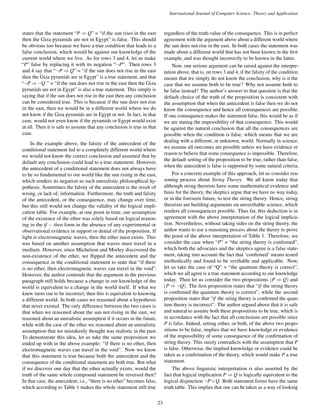
Vol. 1, No. 2, July 2014 
The Logical Implication Table in Binary Propositional 
Calculus: Justification, Proof Automatability, and Effect 
on Scientific Reasoning 
Ahmed Shawky Moussa 
Department of Computer Science, Cairo University, Cairo, Egypt 
Email: a.moussa@fci-cu.edu.eg 
ABSTRACT 
Logic is the discipline concerned with providing valid general rules on which scientific reasoning and the resulting 
propositions are based. To evaluate the validity of sentences in propositional calculus, we, typically, perform a 
complete case analysis of all the possible truth-values assigned to the sentence’s propositional variables. Truth 
tables provide a systematic method for performing such analysis in order to determine whether the sentence is valid, 
satisfiable, contradictory, consistent, etc. However, in order to validate logical statements, we have to use valid truth 
tables, i.e., truth tables that are provably consistent and justifiable by some natural criteria. The justification of the 
truth table of some logical connectives is straightforward, due to the support of the table in everyday applications. 
Nevertheless, the justification of one of the logical connectives, namely, the implication operator, has always been 
difficult to build and understand. Though, the logical implication is arguably the most important operator because 
of its applications as an inference engine for reasoning in science in general and control engineering in particular. 
In this paper, the author presents this problem introducing a non-exhaustive proof, which justifies the logical 
implication’s truth table in one phase. The author then proposes another optimal proof, discussing the points of 
optimization and the effects of the resulting linguistic and philosophical interpretation on the scientific reasoning 
processes. Finally, the paper envisions possible extension of the proposed methodology to solve similar problems 
in various types of logic. 
KEYWORDS 
Logical Implication – Propositional Calculus – Scientific Reasoning. 

c 2014 by Orb Academic Publisher. All rights reserved. 
1. Introduction 
Logical reasoning has been the main pillar on which science is 
constructed. In some times and some cases in history, logical 
reasoning was the only pillar. The ancient Greek scientists relied 
almost exclusively on logical reasoning in building their knowl-edge 
and formulating their theories, as other scientific methods 
were not yet technically developed to a satisfactory degree of 
maturity and reliability. This resulted in a large repertoire of 
theoretical science, some of which remains to be foundation for 
sciences and mathematics until today; other turned out to be false 
philosophical speculations. 
The advent of the experimental paradigm of science and its in-tegration 
with logical reasoning enabled the production of sound 
science and, to a great extend, clarified the distinction between 
science and philosophy. Today, computational methods have 
emerged as the new major paradigm for scientific research, result-ing 
in the classification of the scientific endeavors into three main 
categories: theoretical, experimental, and computational science. 
Regardless of the choice of methodology, logical reasoning 
and mathematical logic remain to be the cornershotnes for all 
the three main paradigms. After all, computation, at the bottom, 
is automated logical reasoning and mathematical models and 
techniques are tools for formulating and quantifying the reasoning 
process. 
The above introduction signifies the importance of forming, 
producing, and validating logical propositions in science. The val-idation 
process involves the evaluation of the validity of sentences 
in propositional logic, which, in turn, involves the evaluation of 
the statement’s truth function under all possible interpretations. 
For example, a proposition P is said to be valid, also called a 
tautology, if it is evaluated to be true under every possible inter-pretation 
of P. On the other hand, P is said to be contradictory 
if it is false under all possible interpretations. In between the 
two extremes, there are different degrees of validity leading to 
evaluating the sentence as satisfiable, consistent, etc. [1]. 
The validation process requires a complete analysis of all 
the possible truth-values under all possible interpretations of the 
18
International Journal of Computer Science: Theory and Application 
proposition to construct the truth function for that proposition. 
This is typically performed by constructing truth tables, which list 
all the possible truth-values for the proposition currently under 
evaluation [2]. The use of truth tables is an important outcome of 
the development of the theory of symbolic logic, which was initi-ated 
by George Boole [3], who formulated the logic of Aristotle 
as algebra of classes [4], [5]. The integration of symbolic logic 
with the semantic theory of logic resulted in mathematical logic 
and propositional calculus, which have had significant effect on 
the development of science in general and the information and 
computation theories in particular. 
This section provided the necessary background for the cur-rent 
paper, signifying the necessity of a sound validation process 
for logical propositions, which are the building blocks of science 
and knowledge. The next section presents the particular prob-lem 
of justifying the logical implication table, states a possible 
disadvantageous solution, and provides motivation for the need 
for new proofs. Section three includes the author’s presentation 
of an unpublished proof by Dr. Stephen Leach of Florida State 
University based on the requirement specified by R. L. Goodstein 
[6]. In section four, the author introduces his new automatable 
proof based on incremental constructive reasoning. Section five, 
then, includes a comparison between the two proofs pointing out 
how the latter is advantageous over the other proofs. Section six 
discusses the linguistic, philosophical, and scientific implications 
and consequences of the table. Finally, section seven concludes 
the paper and provides pointers to possible future follow up re-search. 
2. The Research Problem 
The truth tables for many logical connectives used in constructing 
compound propositions seem justifiable and easy to accept, even 
without a mathematical proof. They simply go with the natural 
intuition and make sense in daily applications. Propositional con-nectives 
that fall into this category are the negation operator (NOT 
connective, denoted as :), the conjunction operator (AND con-nective, 
denoted as ^), and the logical equivalence, also known 
as the biconditional, operator (,) – that is the if  and  only  
if form (iff ). The disjunction operator (OR connective, denoted 
as _) may seem a little more problematic until the type of the 
intended disjunction, exclusive or inclusive, is determined. Once 
this determination is made, the problem disappears. However, 
one propositional connective, namely the logical implication ()), 
also known as the conditional operator and the i f then form, has 
always been harder to justify and understand. Goodstein explains 
this exceptional difficulty by arguing that the “everyday usage 
[of the i f then form] is inadequate to determine the table for 
[the logical] implication since it serves only to tell us that a true 
sentence does not imply a false one, but is silent on the question 
of what is implied by a false sentence” [6]. The truth table for the 
logical implication is illustrated in Table 1. In the table, P and Q 
are sentence variables, 1 represents true, and 0 represents false. 
It is important here to note that the current treatment of the if 
then form is only concerned with the truth function of the resulting 
compound proposition. A compound sentence is considered to 
be truth-functional, only if the truth-value of the sentence is a 
function of the truth-value of its constituent sentence variables 
Table 1. Truth table for logical implication. 
P Q P)Q 
1 1 1 
1 0 0 
0 1 1 
0 0 1 
[7]. It is needless to say that the everyday use of the if  then 
form is not limited to the truth- functional applications. 
Even after we limit our discussion to the truth-functional if 
 then statements, when we look at Table 1, we see that each 
cell in the third column could have been assigned any one of 
the two values, 0 or 1, i.e., false or true, respectively. With four 
rows representing all the possible combinations of the sentences 
P and Q, then Table 1 is one of a total of 24 = 16 possible tables. 
Now we find ourselves obligated to answer the question: why 
should we believe that this table is the right one? The necessity 
of answering the question is further amplified by the fact that 
the resulting linguistic implication of the compound proposition 
may not be so obvious or supported by the natural and intuitive 
everyday usage of the sentence form. 
Let us present the problem further by a concrete example. Let 
the sentence variable P stands for the proposition “electromag-netic 
waves travel in the void”, and let Q represents the sentence 
“the ether exists”. Now, the compound proposition S1 = P)Q 
stands for “if electromagnetic waves travel in the void, then the 
ether exists”. Let us also consider the compound proposition 
S2 = :P):Q, which represents the proposition “if electromag-netic 
waves do not travel in the void, then the ether does not exist”. 
According to Table 1, the statement S1 is false but S2 is true. This 
is not an obvious conclusion to many people. Both propositions 
include one true and one false statement. In S1, the antecedent is 
true and the consequence is false while S2 is vice versa. 
Although the logical implication operator is the most con-troversial 
among logical connectives, it is arguably the most 
important in science and engineering applications. The addi-tional 
importance of the conditional connective is attributed to 
two sources. Firstly, it is inherently the building block for sci-entific 
reasoning and the inference mechanisms necessary for 
constructing proofs and drawing conclusions. A comprehensive 
look at how the modern science developed at the dawn of the 
twentieth century reveals a development pattern where the out-come 
of experiments is used as the antecedent for an if  then – 
i.e., a logical implication – statement. The consequence of the 
if  then form comes then as a new theory, model, proposition, 
or even a postulate, or set of postulates, that would lead later 
to a new scientific discovery. This is how we established the 
fact that light waves are electromagnetic waves and the fact that 
electromagnetic waves travel in the void as a consequence of the 
outcome of Michelson-Morley experiment. It is also how the 
special theory of relativity based on the universality of the laws of 
physics and the speed of light evolved. Similarly was the rational 
for the development of quantum mechanics, the series of models 
for the atomic structure, the De Broglie’s hypothesis, and many 
other discoveries that redefined the modern science. They all 
19
International Journal of Computer Science: Theory and Application 
were compound propositions of the “if P then Q” form (P)Q 
in symbolic notation) with different degrees of complexity. If we 
take P to be the outcome of the experiment of Hans Geiger and 
Ernest Marsden and Q to be the Rutherford model of the atom, 
we get one of the most famous examples of the dependence of 
science on the above reasoning process in the if  then form [8]. 
Secondly, among all the logical operators, the if  then form is of 
exceptionally intensive and extensive use in system control theory 
and applications. Many control systems, regardless of the type 
of logic they utilize, rely on the automation of a set of if  then 
rules for adaptive system control [9]. 
This discussion of the merits and criticality of the logical 
implication makes it clear that it is of fundamental necessity 
that the controversy about the if  then sentence form be solved 
preferably through a solid mathematical proof, since obviously 
other tools are not adequate or sufficient. The necessity here is 
not for specialized logicians. The need is rather for students to 
understand, applied scientists to use, and automated reasoning 
practitioners to program. 
A rather na¨ıve way to prove the correctness of Table 1 is to 
generate all the possible sixteen tables and systematically prove 
by contradiction the invalidity of each and every one of them, 
except the one represented by Table 1. This would be a tedious 
and very lengthy proof, which, consequently, would not contribute 
significantly to the realization of the linguistic and philosophical 
implications and the practical applications of Table 1. The next 
two sections present alternate proofs to this exhaustive search 
methodology. Both proofs assume that the tables for all other 
logical operators are correct and can be used. Table 2 represents 
the table for the logical conjunction operator since it will be 
particularly used in both proofs. 
Table 2. Truth Table for Logical Conjunction. 
P Q P^Q 
1 1 1 
1 0 0 
0 1 0 
0 0 0 
3. A Proof by Incremental Constructive Rea-soning 
This proof was proposed by Dr. Stephen Leach at Florida State 
University in the late 1970’s. The proof is unpublished and the 
current presentation and mathematical formulation of the proof 
are made by the author. Leach’s proof is based on the criteria set 
by Goodstein [6], which states that a valid logical implication 
table must preserve two properties, that is, it must be transitive 
and non-commutative. Based on these criteria, Leach uses his 
own mathematical logical formula to incrementally construct the 
table, one row at a time, showing, in one phase, that Table 1 is the 
only table that can be constructed without having to visit all or 
any of the other fifteen tables. 
The proof 
In order for the table to be transitive, we want the proposition 
Prop (1) below to be a tautology. 
Prop (1) 
[(P)Q)^(Q)R)])(P)R) 
The proposition Prop (1) being a tautology means, in words, 
that if P always implies Q and Q always implies R, then we 
can conclude that P always implies R. The non-commutability 
property means that P)Q and Q)P and cannot have the same 
truth-value. This is important because if they do, the logical 
implication ()) becomes a logical equivalence (,). Using these 
two properties and assuming the correctness of the other truth 
tables, Leach proceeds to justify the logical implication table, 
starting by proving the last row of Table 1 by contradiction as 
follows: 
Suppose the last row of the table was as follows, in contradiction 
with Table 1: 
P Q P)Q 
0 0 0 
If we substitute Q for R in Prop (1) we get 
Prop (2) 
f[(P)Q)^(Q)Q)])(P)Q)g = 1 
 * (P)Q) = 0 by the contradictory assumption, 
† ) f[0^0)])0g = 0 by substituting 0 for each direct implica-tion 
in Prop (2), 
) f0)0g = 0 by substituting from the fourth row of Table 2, but 
this contradicts with Prop (2) = 1 and the requirement that Prop 
(1) is a tautology. Then, the contradictory assumption is incorrect 
and the fourth row of Table 1 is correct. 
) 0)0 = 1 (1) 
Now, * (0)0) = 1 and since Prop (1) is a tautology, 
) f[(0)0)^(0)0)])(0)0)g = 1 
) f[1^1])1g = 1 by substituting from (1) 
) f1)1g = 1 by substituting from the first row of Table 2. This 
proves the first row of Table 1. 
This proves the first row of Table 1. 
) 1)1 = 1 (2) 
Now, by the second property of the table as required by Goodstein 
to be non-commutative, (1 ) 0) and (0 ) 1), which are the 
second and third rows of the table, cannot have the same truth-values. 
Then, from the second and third row of Table 2 for the 
logical conjunction we get, 
Prop (3) 
f(1)0)^(0)1)g = 0 
Since Prop (1) is a tautology, it should be true regardless of the 
truth-values assigned to P, Q, and R. Then we are justified when 
 * is symbolic notation for “since”. 
† ) is symbolic notation for “then”. 
20
International Journal of Computer Science: Theory and Application 
we pick any combination of truth-value assignments. Hence, we 
consider the case when P = 1, Q = 0, and R = 1. 
) f[(1)0)^(0)1)])(1)1)g = 1 since Prop (1) is a tau-tology. 
) f(0)(1)1)g = 1 from Prop (3). 
) f(0)1g = 1 by application of (2), and this proves the third 
row of Table 1. 
) 0)1 = 1 (3) 
Now, by the non-commutability property, rows two and three of 
Table 1 must have different truth-values. 
) 1)0 = 0 (4) 
By (1), (2), (3), and (4), Table 1 is justified and complete. 
4. Alternate Automatable Proof 
In this section, the author proposes a different proof, which is still 
based on incremental constructive reasoning. Although the above 
proof indeed inspired the new one, but the author developed the 
new proof in an attempt to achieve three additional advantages: 
1. Increased simplicity. The fundamental idea of both proofs 
is to build on some natural criteria to which we want the 
logical implication table to conform. However, the simpler 
the criterion form and structure, the easier it is to under-stand 
the table and its applications. After all, the logical 
implication is not meant to be used only by mathematical 
logicians. 
2. Better systematic autonomy. Although relying on selected 
natural criteria for justification has the advantage of provid-ing 
support and acceptability for applications in reasoning 
processes of any field, but we hope the proof itself is sys-tematically 
automatable. This would have the advantage of 
the proof being programmable into autonomous reasoning 
and inference systems. 
3. Self-evolution and self-evidence. Although the previous 
proof followed incremental constructive reasoning to justify 
the table one row at a time, it started by assuming the 
existence of the table. This does not invalidate the proof 
itself. However, it poses a big obstacle to achieving full 
autonomy of the proving mechanism, since it does not 
answer the question of how we generated the table to start 
with. It seems to be subjectively selected from the sixteen 
possible ones. A proof that generates the table from scratch 
in a self-evolutionary self-evident manner would definitely 
be a big plus from the points of credibility, simplicity, and 
automatability. 
The Proof 
The logical implication table, to be correct, is expected to satisfy 
the following two conditions: 
 1. For any two sentence variables P and Q, we want the 
following proposition Prop (4) to be a tautology [1]. 
Prop (4) 
(P^Q))P 
 2. As required by Goodstein, the table is non-commutative, 
that is P)Q and Q)P cannot have the same truth-value 
for all P and Q [6]. 
The first condition is necessary to maintain the compatibility with 
the logical conjunction table, Table 2. The second is to distinguish 
the logical implication from the logical equivalence, as explained 
in the previous proof. Then, the reasoning process proceeds as 
follows: 
Since proposition Prop (4) is a tautology, (P^Q))P is true, 
regardless of the truth-values of P^Q and P. Then we consider 
all the possible cases for P ^Q. We have two cases: Case 1: 
P^Q = 1 and Case 2: P^Q = 0. 
Case 1: P^Q = 1 iff P = 1 and Q = 1 from Table 2. 
) [(1^1))1] = 1 since the proposition is a tautology. 
) (1)1) = 1 from the first row of Table 2. This is the case of 
row number one of Table 1 and we encode it into a new table, 
Table 3. To follow the evolution of the table, we encode one phase 
of the table at a time with the table number as Table 3–i, where i 
represents the number of rows filled to the current phase. 
Table 3.1. Logical implication table with one row. 
P Q P)Q 
1 1 1 
Case 2: P^Q = 0. According to Table 2, this can happen in any 
one of three subcases: 
Case 2.1: when P = 1 and Q = 0. 
) [(1^0))1] = 1 since the proposition is a tautol-ogy. 
) [0)1] = 1 from the second row of Table 2. This 
is the case for row number three of Table 1. Then we 
have the first and third rows thus far as in Table 3–2. 
Case 2.2: when P = 0 and Q = 1. 
) [(0^1))0] = 1 since the proposition is a tautol-ogy. 
) [0)0] = 1 from the third row of Table 2. This is 
the case for row number four of Table 1. Then we 
have rows number 1, 3, and 4 thus far as in Table 
3–3. 
Case 2.3: when P = 0 and Q = 0. 
) [(0^0))0] = 1 since the proposition is a tautol-ogy. 
) [0)0] = 1 from the fourth row of Table 2. How-ever, 
this does not produce any new result but the 
redundant outcome asserts the case of row 4 in Table 
3. 
21
International Journal of Computer Science: Theory and Application 
Table 3.2. Logical implication table with two rows. 
P Q P)Q 
1 1 1 
0 1 1 
Table 3.3. Logical implication table with three rows. 
P Q P)Q 
1 1 1 
0 1 1 
0 0 1 
Now, by the non-commutability property, (P)Q) and (Q)P) 
cannot have the same truth-value for all P and Q. Since P and 
Q have the same truth-value in rows number 1 and 4, then row 
number 2 must be different from row number 3. 
) (0)0) = 1 in row number 3, 
) (1 ) 0) = 0 is the only choice for row number 2 and this 
completes Table 3. 
Table 3.4. The Logical implication table complete. 
P Q P)Q 
1 1 1 
1 0 0 
0 1 1 
0 0 1 
Now, Table 3 is complete and perfectly matches Table 1. 
5. Comparison and Assessment 
As stated above, the author attempted devising the latter proof 
hoping to achieve three objectives, which would be three points 
of improvement over the first proof. The first objective was to 
aim at increased simplicity. This was implemented in the second 
proof by building on a simpler tautology than the ones used by 
Goodstein or Leach. Proposition Prop (4) is obviously simpler 
than Prop (1) and involves smaller number of variables – two 
rather than three. The second objective of the author’s proof was 
to attempt to achieve better systematic autonomy. This means 
to minimize the subjective involvement in the justification pro-cess. 
In the first proof, in order to prove the third row in (3), 
we subjectively selected one case out of 23 = 8 cases, that was 
the case when P = 1, Q = 0, and R = 1. The alternative to this 
subjective interference in the proving process was to consider all 
the possible cases, eight of them. The outcome would still have 
been the same, but the proof would have been much longer and 
the results would have been too redundant. Hence, we had to 
choose between extreme redundancy and subjective interference. 
On the other hand, in the second proof, there was no need for 
subjective intervention at all, and we still had only one redundant 
evaluation, which served to assert the fourth row of the table with-out 
producing new results. Unlike carrying on seven redundant 
evaluations, this is obviously an acceptable computational cost 
for autonomy implementation. 
Finally, Leach’s proof pre-assumed the existence of the log-ical 
implication table, Table 1. The task then was to prove the 
correctness of the table by contradiction if the fourth row was 
set differently. However, while this does not disqualify the proof, 
it does not indicate how Table 1 was selected among sixteen 
possible tables either. In contrast, the author’s proof did not 
pre-assume the existence of any table. Rather, it systematically 
generated the table from scratch. This leads to not only full objec-tive 
autonomy eliminating any subjective intervention, but also a 
self-evolutionary and self-evident table. This was the last objec-tive 
of the author to produce a simpler, more credible, and fully 
authomatable proof. 
6. Usage, Applications, and Further Justifi-cation 
Although the proofs above justify the truth table for the logical 
implication connective, some background in mathematical logic, 
admittedly at a certain level, is required not only to generate the 
proofs but also to understand them. Understanding the logical, 
linguistic, and philosophical applications of other logical opera-tors 
may not necessarily require such a background. Let us take 
the table for the logical AND, Table 2 above, for example. Ac-cording 
to this table the statement (P^Q) can be true only when 
both P and Q are true. This is why (P^Q) = 1, i.e., true, in the 
first row and is false, 0, otherwise. In words, this is not difficult 
to understand or explain even to audience without mathematical 
background. It simply states that if P and Q stand for simple 
sentences, then the compound statement “P and Q” would be 
true only when both “P” and “Q” are true. For instance, if “P” 
= “today is sunny”, and “Q” = “today is a holiday”, then the 
statement (P^Q) would be true only if today is both sunny and a 
holiday. The truth of one of the two is not sufficient to make the 
statement true, and the falsity of just one of them is sufficient to 
make the statement false. Explaining the disjunction, OR, table 
can be done similarly without the use of mathematics, after the 
type of the disjunction is selected, that is exclusive or inclusive 
OR. 
But what about the if  then table, can we explain it in words 
in a similar manner without using mathematical logic? The author 
contends that the answer is: yes, we can, but we have to admit that 
it would not be as easy as it is in the cases of AND, OR, and NOT. 
A minimum level of sophistication is needed to understand the 
linguistic interpretation of the logical implication table. Here is a 
proposed way of explaining and applying it, first to the general 
audience and then to the scientific community. 
Let us take the case “P” = “the sun rises in the east”, and “Q” 
= “the Giza pyramids are in Egypt”. According to Table 1, since 
P is true and Q is true, the “P)Q” = “if the sun rises in the east 
then the Giza pyramids are in Egypt” is true, which is obvious; a 
true condition leading to a true conclusion makes a true statement, 
even when the condition and conclusion seem unrelated, after all 
we are analyzing the truth functional statement. Now, let us take 
row 2 and make Q false by replacing it with :Q. Then row 2 
22
International Journal of Computer Science: Theory and Application 
states that the statement “P)Q” = “if the sun rises in the east 
then the Giza pyramids are not in Egypt” is false. This should 
be obvious too because we have a true condition that leads to a 
false conclusion, which would be against our knowledge of the 
current world where we live. As for rows 3 and 4, let us make 
“P” false by replacing it with its negation “:P”. Then rows 3 
and 4 say that “:P)Q” = “if the sun does not rise in the east 
then the Giza pyramids are in Egypt” is a true statement, and that 
“:P):Q ” = “if the sun does not rise in the east then the Giza 
pyramids are not in Egypt” is also a true statement. This simply is 
saying that if the sun does not rise in the east then any conclusion 
can be considered true. This is because if the sun does not rise 
in the east, then we would be in a different world where we do 
not know if the Giza pyramids are in Egypt or not. In fact, in that 
case, would not even know if the pyramids or Egypt would exist 
at all. Then it is safe to assume that any conclusion is true in that 
case. 
In the example above, the falsity of the antecedent of the 
conditional statement led to a completely different world where 
we would not know the correct conclusion and assumed that by 
default any conclusion could lead to a true statement. However, 
the antecedent of a conditional statement does not always have 
to be so fundamental to our world like the sun rising in the east, 
which renders its negation as such unrealistic philosophical hy-pothesis. 
Sometimes the falsity of the antecedent is the result of 
wrong, or lack of, information. Furthermore, the truth and falsity 
of the antecedent, or the consequence, may change over time, 
but this still would not change the validity of the logical impli-cation 
table. For example, at one point in time, our assumption 
of the existence of the ether was solely based on logical reason-ing 
in the if  then form in the absence of any experimental or 
observational evidence in support or denial of the proposition. If 
light is electromagnetic waves, then the ether must exists. This 
was based on another assumption that waves must travel in a 
medium. However, since Michelson and Morley discovered the 
non-existence of the ether, we flipped the antecedent and the 
consequence in the conditional statement to state that “if there 
is no ether, then electromagnetic waves can travel in the void”. 
However, the author contends that the argument in the previous 
paragraph still holds because a change in our knowledge of the 
world is equivalent to a change in the world itself. If what we 
knew turns out to be incorrect, then this is equivalent to knowing 
a different world. In both cases we reasoned about a hypothesis 
that never existed. The only difference between the two cases is 
that when we reasoned about the sun not rising in the east, we 
reasoned about an unrealistic assumption if it occurs in the future, 
while with the case of the ether we reasoned about an unrealistic 
assumption that we mistakenly thought was realistic in the past. 
To demonstrate this idea, let us take the same proposition we 
ended up with in the above example: “if there is no ether, then 
electromagnetic waves can travel in the void”. Now we know 
that this statement is true because both the antecedent and the 
consequence of the conditional statement are both true. But what 
if we discover one day that the ether actually exists, would the 
truth of the same whole compound statement be reversed then? 
In that case, the antecedent, i.e., “there is no ether” becomes false, 
which according to Table 1 makes the whole statement still true 
regardless of the truth-value of the consequence. This is in perfect 
agreement with the argument above about a different world where 
the sun does not rise in the east. In both cases the statement was 
made about a different world that has not been known in the first 
example, and was thought incorrectly to be known in the latter. 
Now, one serious argument can be raised against the interpre-tation 
above, that is, on rows 3 and 4, if the falsity of the condition 
means that we simply do not know the conclusion, why is it the 
case that we assume both to be true? Why not assume both to 
be false instead? The author’s answer to that question is that the 
default choice of the truth of the proposition is consistent with 
the assumption that when the antecedent is false then we do not 
know the consequence and hence all consequences are possible. 
If one consequence makes the statement false, this would be as if 
we are stating the impossibility of that consequence. This would 
be against the natural conclusion that all the consequences are 
possible when the condition is false, which means that we are 
dealing with a different, or unknown, world. Normally in science, 
we assume all outcomes are possible unless we have evidence or 
reason to believe that some consequence is impossible. Therefore, 
the default setting of the proposition to be true, rather than false, 
when the antecedent is false is supported by some natural criteria. 
For a concrete example of this approach, let us consider rea-soning 
process about String Theory. We all know today that 
although string theorists have some mathematical evidence and 
basis for the theory, the skeptics argue that we have no way today, 
or in the foreseen future, to test the string theory. Hence, string 
theorists are building arguments on unverifiable science, which 
renders all consequences possible. Thus far, this deduction is in 
agreement with the above interpretation of the logical implica-tion. 
Nevertheless, without taking sides on the string theory, the 
author wants to use a reasoning process about the theory to prove 
the point of the above interpretation of Table 1. Therefore, we 
consider the case when “P” = “the string theory is confirmed”, 
which both the advocates and the skeptics agree is a false state-ment, 
taking into account the fact that ‘confirmed’ means tested 
methodically and found to be verifiable and applicable. Now, 
let us take the case of “Q” = “the quantum theory is correct”, 
which we all agree is a true statement according to our knowledge 
today. Then let us consider the two propositions (P)Q) and 
(P):Q). The first proposition states that “if the string theory 
is confirmed the quantum theory is correct”, while the second 
proposition states that “if the string theory is confirmed the quan-tum 
theory is incorrect”. The author argued above that it is safe 
and natural to assume both these propositions to be true, which is 
in accordance with the fact that all conclusions are possible since 
P is false. Indeed, setting either, or both, of the above two propo-sitions 
to be false, implies that we have knowledge or evidence 
of the impossibility of some consequence of the confirmation of 
string theory. This surely contradicts with the assumption that P 
is false. Otherwise, the implied knowledge or evidence could be 
taken as a confirmation of the theory, which would make P a true 
statement. 
The above linguistic interpretation is also asserted by the 
fact that logical implication P)Q is logically equivalent to the 
logical disjunction :P_Q. Both statement forms have the same 
truth table. This implies that one can be taken as a way of looking 
23
International Journal of Computer Science: Theory and Application 
at the other. The logical equivalence between the two implies 
that for the “if P then Q” to be true, P must be false, or Q must 
be true. When P is false, the statement will be true regardless of 
the truth-value of Q. When Q is true, the statement will be true 
regardless of the truth-value of P. This goes in perfect agreement 
with the preceding linguistic interpretation. 
7. Conclusion and Future Vision 
It is possible to justify the logical implication table of proposi-tional 
calculus without having to perform exhaustive search of 
all possible sixteen tables. This paper presented two methods of 
proof by incremental constructive reasoning: one is an unpub-lished 
proof by Dr. Stephen Leach of Florida State University, 
and one made by the author. In each proof, one row of the table 
is either proved – as in the first proof – or generated – as in the 
second. Once a row is proven or generated, it can be used to gen-erate 
another, which in turn is used again until the entire table is 
constructed in one phase as a single solution with no alternatives. 
The author devised the second proof to achieve three objectives: 
develop a simpler proof, implement full autonomy, and build a 
self-evolutionary, self-evident table. 
The logical implication is of great importance in all types of 
logic because of its use in scientific reasoning and developing 
inference and control systems. Hence, a systematic method of 
justification based on defined natural criteria is essential to the 
understanding, functionality, and utilization of the table. The de-velopment 
of the second proof contributes to the understanding of 
the linguistic interpretation of the table. In addition, the resulting 
automatable proof is necessary for designing logical systems and 
computing with words 
Acknowledgments 
The author wishes to thank Dr. Stephen Leach for his permission 
to use his unpublished proof in this paper. The author also wishes 
to acknowledge that Dr. Leach’s proof inspired the author and 
without it a new proof by the author may have not been possible. 
The author acknowledges that both proofs were produced at the 
mathematical logic class of Professor Hilbert Levitz and under 
his guidance. Finally, the author thanks Professor Michael Kasha 
and the Department of Chemistry and Biochemistry at Florida 
State University for their tremendous support and funding of this 
research. 
References 
[1] MENDELSON, Elliot. Introduction to Mathematical Logic. 
Chapman  Hall, 1997. 
[2] MANNA, Zohar, WALDINGER, Richard. The Logical Basis 
for Computer Programming. Vol. 1: Deductive Reasoning. 
Addison-Wesley, 1985. 
[3] ROUVRAY, Dennis. Fuzzy Logic in Chemistry. Academic 
Press 1992. p. 19-20. 
[4] BOOL, George. An Investigation of the Laws of Thought. 
Walton and Maberley 1854. Cited in [3], [6]. 
[5] BOOL, George. The Mathematical Analysis of Logic. 1847. 
Cited in [6]. 
[6] GOODSTEIN, R. L. Development of Mathematical Logic. 
Springer-Verlag 1971. p4. 
[7] BAKER, Stephen. The Elements of Logic, 4th Ed. McGraw- 
Hill 1985. pp. 100 - 107. 
[8] KRANE, Kenneth. Modern Physics, 2nd Ed. John Wiley and 
Sons 1996. 
[9] KLIR, George, YUAN, Bo. Fuzzy Sets and Fuzzy Logic: 
Theory and Applications. Prentice Hall 1995. 
24

The Logical Implication Table in Binary Propositional Calculus: Justification, Proof Automatability, and Effect on Scientific Reasoning, International Journal of Computer Science: Theory and Application

  • 1.
    Vol. 1, No.2, July 2014 The Logical Implication Table in Binary Propositional Calculus: Justification, Proof Automatability, and Effect on Scientific Reasoning Ahmed Shawky Moussa Department of Computer Science, Cairo University, Cairo, Egypt Email: a.moussa@fci-cu.edu.eg ABSTRACT Logic is the discipline concerned with providing valid general rules on which scientific reasoning and the resulting propositions are based. To evaluate the validity of sentences in propositional calculus, we, typically, perform a complete case analysis of all the possible truth-values assigned to the sentence’s propositional variables. Truth tables provide a systematic method for performing such analysis in order to determine whether the sentence is valid, satisfiable, contradictory, consistent, etc. However, in order to validate logical statements, we have to use valid truth tables, i.e., truth tables that are provably consistent and justifiable by some natural criteria. The justification of the truth table of some logical connectives is straightforward, due to the support of the table in everyday applications. Nevertheless, the justification of one of the logical connectives, namely, the implication operator, has always been difficult to build and understand. Though, the logical implication is arguably the most important operator because of its applications as an inference engine for reasoning in science in general and control engineering in particular. In this paper, the author presents this problem introducing a non-exhaustive proof, which justifies the logical implication’s truth table in one phase. The author then proposes another optimal proof, discussing the points of optimization and the effects of the resulting linguistic and philosophical interpretation on the scientific reasoning processes. Finally, the paper envisions possible extension of the proposed methodology to solve similar problems in various types of logic. KEYWORDS Logical Implication – Propositional Calculus – Scientific Reasoning. c 2014 by Orb Academic Publisher. All rights reserved. 1. Introduction Logical reasoning has been the main pillar on which science is constructed. In some times and some cases in history, logical reasoning was the only pillar. The ancient Greek scientists relied almost exclusively on logical reasoning in building their knowl-edge and formulating their theories, as other scientific methods were not yet technically developed to a satisfactory degree of maturity and reliability. This resulted in a large repertoire of theoretical science, some of which remains to be foundation for sciences and mathematics until today; other turned out to be false philosophical speculations. The advent of the experimental paradigm of science and its in-tegration with logical reasoning enabled the production of sound science and, to a great extend, clarified the distinction between science and philosophy. Today, computational methods have emerged as the new major paradigm for scientific research, result-ing in the classification of the scientific endeavors into three main categories: theoretical, experimental, and computational science. Regardless of the choice of methodology, logical reasoning and mathematical logic remain to be the cornershotnes for all the three main paradigms. After all, computation, at the bottom, is automated logical reasoning and mathematical models and techniques are tools for formulating and quantifying the reasoning process. The above introduction signifies the importance of forming, producing, and validating logical propositions in science. The val-idation process involves the evaluation of the validity of sentences in propositional logic, which, in turn, involves the evaluation of the statement’s truth function under all possible interpretations. For example, a proposition P is said to be valid, also called a tautology, if it is evaluated to be true under every possible inter-pretation of P. On the other hand, P is said to be contradictory if it is false under all possible interpretations. In between the two extremes, there are different degrees of validity leading to evaluating the sentence as satisfiable, consistent, etc. [1]. The validation process requires a complete analysis of all the possible truth-values under all possible interpretations of the 18
  • 2.
    International Journal ofComputer Science: Theory and Application proposition to construct the truth function for that proposition. This is typically performed by constructing truth tables, which list all the possible truth-values for the proposition currently under evaluation [2]. The use of truth tables is an important outcome of the development of the theory of symbolic logic, which was initi-ated by George Boole [3], who formulated the logic of Aristotle as algebra of classes [4], [5]. The integration of symbolic logic with the semantic theory of logic resulted in mathematical logic and propositional calculus, which have had significant effect on the development of science in general and the information and computation theories in particular. This section provided the necessary background for the cur-rent paper, signifying the necessity of a sound validation process for logical propositions, which are the building blocks of science and knowledge. The next section presents the particular prob-lem of justifying the logical implication table, states a possible disadvantageous solution, and provides motivation for the need for new proofs. Section three includes the author’s presentation of an unpublished proof by Dr. Stephen Leach of Florida State University based on the requirement specified by R. L. Goodstein [6]. In section four, the author introduces his new automatable proof based on incremental constructive reasoning. Section five, then, includes a comparison between the two proofs pointing out how the latter is advantageous over the other proofs. Section six discusses the linguistic, philosophical, and scientific implications and consequences of the table. Finally, section seven concludes the paper and provides pointers to possible future follow up re-search. 2. The Research Problem The truth tables for many logical connectives used in constructing compound propositions seem justifiable and easy to accept, even without a mathematical proof. They simply go with the natural intuition and make sense in daily applications. Propositional con-nectives that fall into this category are the negation operator (NOT connective, denoted as :), the conjunction operator (AND con-nective, denoted as ^), and the logical equivalence, also known as the biconditional, operator (,) – that is the if and only if form (iff ). The disjunction operator (OR connective, denoted as _) may seem a little more problematic until the type of the intended disjunction, exclusive or inclusive, is determined. Once this determination is made, the problem disappears. However, one propositional connective, namely the logical implication ()), also known as the conditional operator and the i f then form, has always been harder to justify and understand. Goodstein explains this exceptional difficulty by arguing that the “everyday usage [of the i f then form] is inadequate to determine the table for [the logical] implication since it serves only to tell us that a true sentence does not imply a false one, but is silent on the question of what is implied by a false sentence” [6]. The truth table for the logical implication is illustrated in Table 1. In the table, P and Q are sentence variables, 1 represents true, and 0 represents false. It is important here to note that the current treatment of the if then form is only concerned with the truth function of the resulting compound proposition. A compound sentence is considered to be truth-functional, only if the truth-value of the sentence is a function of the truth-value of its constituent sentence variables Table 1. Truth table for logical implication. P Q P)Q 1 1 1 1 0 0 0 1 1 0 0 1 [7]. It is needless to say that the everyday use of the if then form is not limited to the truth- functional applications. Even after we limit our discussion to the truth-functional if then statements, when we look at Table 1, we see that each cell in the third column could have been assigned any one of the two values, 0 or 1, i.e., false or true, respectively. With four rows representing all the possible combinations of the sentences P and Q, then Table 1 is one of a total of 24 = 16 possible tables. Now we find ourselves obligated to answer the question: why should we believe that this table is the right one? The necessity of answering the question is further amplified by the fact that the resulting linguistic implication of the compound proposition may not be so obvious or supported by the natural and intuitive everyday usage of the sentence form. Let us present the problem further by a concrete example. Let the sentence variable P stands for the proposition “electromag-netic waves travel in the void”, and let Q represents the sentence “the ether exists”. Now, the compound proposition S1 = P)Q stands for “if electromagnetic waves travel in the void, then the ether exists”. Let us also consider the compound proposition S2 = :P):Q, which represents the proposition “if electromag-netic waves do not travel in the void, then the ether does not exist”. According to Table 1, the statement S1 is false but S2 is true. This is not an obvious conclusion to many people. Both propositions include one true and one false statement. In S1, the antecedent is true and the consequence is false while S2 is vice versa. Although the logical implication operator is the most con-troversial among logical connectives, it is arguably the most important in science and engineering applications. The addi-tional importance of the conditional connective is attributed to two sources. Firstly, it is inherently the building block for sci-entific reasoning and the inference mechanisms necessary for constructing proofs and drawing conclusions. A comprehensive look at how the modern science developed at the dawn of the twentieth century reveals a development pattern where the out-come of experiments is used as the antecedent for an if then – i.e., a logical implication – statement. The consequence of the if then form comes then as a new theory, model, proposition, or even a postulate, or set of postulates, that would lead later to a new scientific discovery. This is how we established the fact that light waves are electromagnetic waves and the fact that electromagnetic waves travel in the void as a consequence of the outcome of Michelson-Morley experiment. It is also how the special theory of relativity based on the universality of the laws of physics and the speed of light evolved. Similarly was the rational for the development of quantum mechanics, the series of models for the atomic structure, the De Broglie’s hypothesis, and many other discoveries that redefined the modern science. They all 19
  • 3.
    International Journal ofComputer Science: Theory and Application were compound propositions of the “if P then Q” form (P)Q in symbolic notation) with different degrees of complexity. If we take P to be the outcome of the experiment of Hans Geiger and Ernest Marsden and Q to be the Rutherford model of the atom, we get one of the most famous examples of the dependence of science on the above reasoning process in the if then form [8]. Secondly, among all the logical operators, the if then form is of exceptionally intensive and extensive use in system control theory and applications. Many control systems, regardless of the type of logic they utilize, rely on the automation of a set of if then rules for adaptive system control [9]. This discussion of the merits and criticality of the logical implication makes it clear that it is of fundamental necessity that the controversy about the if then sentence form be solved preferably through a solid mathematical proof, since obviously other tools are not adequate or sufficient. The necessity here is not for specialized logicians. The need is rather for students to understand, applied scientists to use, and automated reasoning practitioners to program. A rather na¨ıve way to prove the correctness of Table 1 is to generate all the possible sixteen tables and systematically prove by contradiction the invalidity of each and every one of them, except the one represented by Table 1. This would be a tedious and very lengthy proof, which, consequently, would not contribute significantly to the realization of the linguistic and philosophical implications and the practical applications of Table 1. The next two sections present alternate proofs to this exhaustive search methodology. Both proofs assume that the tables for all other logical operators are correct and can be used. Table 2 represents the table for the logical conjunction operator since it will be particularly used in both proofs. Table 2. Truth Table for Logical Conjunction. P Q P^Q 1 1 1 1 0 0 0 1 0 0 0 0 3. A Proof by Incremental Constructive Rea-soning This proof was proposed by Dr. Stephen Leach at Florida State University in the late 1970’s. The proof is unpublished and the current presentation and mathematical formulation of the proof are made by the author. Leach’s proof is based on the criteria set by Goodstein [6], which states that a valid logical implication table must preserve two properties, that is, it must be transitive and non-commutative. Based on these criteria, Leach uses his own mathematical logical formula to incrementally construct the table, one row at a time, showing, in one phase, that Table 1 is the only table that can be constructed without having to visit all or any of the other fifteen tables. The proof In order for the table to be transitive, we want the proposition Prop (1) below to be a tautology. Prop (1) [(P)Q)^(Q)R)])(P)R) The proposition Prop (1) being a tautology means, in words, that if P always implies Q and Q always implies R, then we can conclude that P always implies R. The non-commutability property means that P)Q and Q)P and cannot have the same truth-value. This is important because if they do, the logical implication ()) becomes a logical equivalence (,). Using these two properties and assuming the correctness of the other truth tables, Leach proceeds to justify the logical implication table, starting by proving the last row of Table 1 by contradiction as follows: Suppose the last row of the table was as follows, in contradiction with Table 1: P Q P)Q 0 0 0 If we substitute Q for R in Prop (1) we get Prop (2) f[(P)Q)^(Q)Q)])(P)Q)g = 1 * (P)Q) = 0 by the contradictory assumption, † ) f[0^0)])0g = 0 by substituting 0 for each direct implica-tion in Prop (2), ) f0)0g = 0 by substituting from the fourth row of Table 2, but this contradicts with Prop (2) = 1 and the requirement that Prop (1) is a tautology. Then, the contradictory assumption is incorrect and the fourth row of Table 1 is correct. ) 0)0 = 1 (1) Now, * (0)0) = 1 and since Prop (1) is a tautology, ) f[(0)0)^(0)0)])(0)0)g = 1 ) f[1^1])1g = 1 by substituting from (1) ) f1)1g = 1 by substituting from the first row of Table 2. This proves the first row of Table 1. This proves the first row of Table 1. ) 1)1 = 1 (2) Now, by the second property of the table as required by Goodstein to be non-commutative, (1 ) 0) and (0 ) 1), which are the second and third rows of the table, cannot have the same truth-values. Then, from the second and third row of Table 2 for the logical conjunction we get, Prop (3) f(1)0)^(0)1)g = 0 Since Prop (1) is a tautology, it should be true regardless of the truth-values assigned to P, Q, and R. Then we are justified when * is symbolic notation for “since”. † ) is symbolic notation for “then”. 20
  • 4.
    International Journal ofComputer Science: Theory and Application we pick any combination of truth-value assignments. Hence, we consider the case when P = 1, Q = 0, and R = 1. ) f[(1)0)^(0)1)])(1)1)g = 1 since Prop (1) is a tau-tology. ) f(0)(1)1)g = 1 from Prop (3). ) f(0)1g = 1 by application of (2), and this proves the third row of Table 1. ) 0)1 = 1 (3) Now, by the non-commutability property, rows two and three of Table 1 must have different truth-values. ) 1)0 = 0 (4) By (1), (2), (3), and (4), Table 1 is justified and complete. 4. Alternate Automatable Proof In this section, the author proposes a different proof, which is still based on incremental constructive reasoning. Although the above proof indeed inspired the new one, but the author developed the new proof in an attempt to achieve three additional advantages: 1. Increased simplicity. The fundamental idea of both proofs is to build on some natural criteria to which we want the logical implication table to conform. However, the simpler the criterion form and structure, the easier it is to under-stand the table and its applications. After all, the logical implication is not meant to be used only by mathematical logicians. 2. Better systematic autonomy. Although relying on selected natural criteria for justification has the advantage of provid-ing support and acceptability for applications in reasoning processes of any field, but we hope the proof itself is sys-tematically automatable. This would have the advantage of the proof being programmable into autonomous reasoning and inference systems. 3. Self-evolution and self-evidence. Although the previous proof followed incremental constructive reasoning to justify the table one row at a time, it started by assuming the existence of the table. This does not invalidate the proof itself. However, it poses a big obstacle to achieving full autonomy of the proving mechanism, since it does not answer the question of how we generated the table to start with. It seems to be subjectively selected from the sixteen possible ones. A proof that generates the table from scratch in a self-evolutionary self-evident manner would definitely be a big plus from the points of credibility, simplicity, and automatability. The Proof The logical implication table, to be correct, is expected to satisfy the following two conditions: 1. For any two sentence variables P and Q, we want the following proposition Prop (4) to be a tautology [1]. Prop (4) (P^Q))P 2. As required by Goodstein, the table is non-commutative, that is P)Q and Q)P cannot have the same truth-value for all P and Q [6]. The first condition is necessary to maintain the compatibility with the logical conjunction table, Table 2. The second is to distinguish the logical implication from the logical equivalence, as explained in the previous proof. Then, the reasoning process proceeds as follows: Since proposition Prop (4) is a tautology, (P^Q))P is true, regardless of the truth-values of P^Q and P. Then we consider all the possible cases for P ^Q. We have two cases: Case 1: P^Q = 1 and Case 2: P^Q = 0. Case 1: P^Q = 1 iff P = 1 and Q = 1 from Table 2. ) [(1^1))1] = 1 since the proposition is a tautology. ) (1)1) = 1 from the first row of Table 2. This is the case of row number one of Table 1 and we encode it into a new table, Table 3. To follow the evolution of the table, we encode one phase of the table at a time with the table number as Table 3–i, where i represents the number of rows filled to the current phase. Table 3.1. Logical implication table with one row. P Q P)Q 1 1 1 Case 2: P^Q = 0. According to Table 2, this can happen in any one of three subcases: Case 2.1: when P = 1 and Q = 0. ) [(1^0))1] = 1 since the proposition is a tautol-ogy. ) [0)1] = 1 from the second row of Table 2. This is the case for row number three of Table 1. Then we have the first and third rows thus far as in Table 3–2. Case 2.2: when P = 0 and Q = 1. ) [(0^1))0] = 1 since the proposition is a tautol-ogy. ) [0)0] = 1 from the third row of Table 2. This is the case for row number four of Table 1. Then we have rows number 1, 3, and 4 thus far as in Table 3–3. Case 2.3: when P = 0 and Q = 0. ) [(0^0))0] = 1 since the proposition is a tautol-ogy. ) [0)0] = 1 from the fourth row of Table 2. How-ever, this does not produce any new result but the redundant outcome asserts the case of row 4 in Table 3. 21
  • 5.
    International Journal ofComputer Science: Theory and Application Table 3.2. Logical implication table with two rows. P Q P)Q 1 1 1 0 1 1 Table 3.3. Logical implication table with three rows. P Q P)Q 1 1 1 0 1 1 0 0 1 Now, by the non-commutability property, (P)Q) and (Q)P) cannot have the same truth-value for all P and Q. Since P and Q have the same truth-value in rows number 1 and 4, then row number 2 must be different from row number 3. ) (0)0) = 1 in row number 3, ) (1 ) 0) = 0 is the only choice for row number 2 and this completes Table 3. Table 3.4. The Logical implication table complete. P Q P)Q 1 1 1 1 0 0 0 1 1 0 0 1 Now, Table 3 is complete and perfectly matches Table 1. 5. Comparison and Assessment As stated above, the author attempted devising the latter proof hoping to achieve three objectives, which would be three points of improvement over the first proof. The first objective was to aim at increased simplicity. This was implemented in the second proof by building on a simpler tautology than the ones used by Goodstein or Leach. Proposition Prop (4) is obviously simpler than Prop (1) and involves smaller number of variables – two rather than three. The second objective of the author’s proof was to attempt to achieve better systematic autonomy. This means to minimize the subjective involvement in the justification pro-cess. In the first proof, in order to prove the third row in (3), we subjectively selected one case out of 23 = 8 cases, that was the case when P = 1, Q = 0, and R = 1. The alternative to this subjective interference in the proving process was to consider all the possible cases, eight of them. The outcome would still have been the same, but the proof would have been much longer and the results would have been too redundant. Hence, we had to choose between extreme redundancy and subjective interference. On the other hand, in the second proof, there was no need for subjective intervention at all, and we still had only one redundant evaluation, which served to assert the fourth row of the table with-out producing new results. Unlike carrying on seven redundant evaluations, this is obviously an acceptable computational cost for autonomy implementation. Finally, Leach’s proof pre-assumed the existence of the log-ical implication table, Table 1. The task then was to prove the correctness of the table by contradiction if the fourth row was set differently. However, while this does not disqualify the proof, it does not indicate how Table 1 was selected among sixteen possible tables either. In contrast, the author’s proof did not pre-assume the existence of any table. Rather, it systematically generated the table from scratch. This leads to not only full objec-tive autonomy eliminating any subjective intervention, but also a self-evolutionary and self-evident table. This was the last objec-tive of the author to produce a simpler, more credible, and fully authomatable proof. 6. Usage, Applications, and Further Justifi-cation Although the proofs above justify the truth table for the logical implication connective, some background in mathematical logic, admittedly at a certain level, is required not only to generate the proofs but also to understand them. Understanding the logical, linguistic, and philosophical applications of other logical opera-tors may not necessarily require such a background. Let us take the table for the logical AND, Table 2 above, for example. Ac-cording to this table the statement (P^Q) can be true only when both P and Q are true. This is why (P^Q) = 1, i.e., true, in the first row and is false, 0, otherwise. In words, this is not difficult to understand or explain even to audience without mathematical background. It simply states that if P and Q stand for simple sentences, then the compound statement “P and Q” would be true only when both “P” and “Q” are true. For instance, if “P” = “today is sunny”, and “Q” = “today is a holiday”, then the statement (P^Q) would be true only if today is both sunny and a holiday. The truth of one of the two is not sufficient to make the statement true, and the falsity of just one of them is sufficient to make the statement false. Explaining the disjunction, OR, table can be done similarly without the use of mathematics, after the type of the disjunction is selected, that is exclusive or inclusive OR. But what about the if then table, can we explain it in words in a similar manner without using mathematical logic? The author contends that the answer is: yes, we can, but we have to admit that it would not be as easy as it is in the cases of AND, OR, and NOT. A minimum level of sophistication is needed to understand the linguistic interpretation of the logical implication table. Here is a proposed way of explaining and applying it, first to the general audience and then to the scientific community. Let us take the case “P” = “the sun rises in the east”, and “Q” = “the Giza pyramids are in Egypt”. According to Table 1, since P is true and Q is true, the “P)Q” = “if the sun rises in the east then the Giza pyramids are in Egypt” is true, which is obvious; a true condition leading to a true conclusion makes a true statement, even when the condition and conclusion seem unrelated, after all we are analyzing the truth functional statement. Now, let us take row 2 and make Q false by replacing it with :Q. Then row 2 22
  • 6.
    International Journal ofComputer Science: Theory and Application states that the statement “P)Q” = “if the sun rises in the east then the Giza pyramids are not in Egypt” is false. This should be obvious too because we have a true condition that leads to a false conclusion, which would be against our knowledge of the current world where we live. As for rows 3 and 4, let us make “P” false by replacing it with its negation “:P”. Then rows 3 and 4 say that “:P)Q” = “if the sun does not rise in the east then the Giza pyramids are in Egypt” is a true statement, and that “:P):Q ” = “if the sun does not rise in the east then the Giza pyramids are not in Egypt” is also a true statement. This simply is saying that if the sun does not rise in the east then any conclusion can be considered true. This is because if the sun does not rise in the east, then we would be in a different world where we do not know if the Giza pyramids are in Egypt or not. In fact, in that case, would not even know if the pyramids or Egypt would exist at all. Then it is safe to assume that any conclusion is true in that case. In the example above, the falsity of the antecedent of the conditional statement led to a completely different world where we would not know the correct conclusion and assumed that by default any conclusion could lead to a true statement. However, the antecedent of a conditional statement does not always have to be so fundamental to our world like the sun rising in the east, which renders its negation as such unrealistic philosophical hy-pothesis. Sometimes the falsity of the antecedent is the result of wrong, or lack of, information. Furthermore, the truth and falsity of the antecedent, or the consequence, may change over time, but this still would not change the validity of the logical impli-cation table. For example, at one point in time, our assumption of the existence of the ether was solely based on logical reason-ing in the if then form in the absence of any experimental or observational evidence in support or denial of the proposition. If light is electromagnetic waves, then the ether must exists. This was based on another assumption that waves must travel in a medium. However, since Michelson and Morley discovered the non-existence of the ether, we flipped the antecedent and the consequence in the conditional statement to state that “if there is no ether, then electromagnetic waves can travel in the void”. However, the author contends that the argument in the previous paragraph still holds because a change in our knowledge of the world is equivalent to a change in the world itself. If what we knew turns out to be incorrect, then this is equivalent to knowing a different world. In both cases we reasoned about a hypothesis that never existed. The only difference between the two cases is that when we reasoned about the sun not rising in the east, we reasoned about an unrealistic assumption if it occurs in the future, while with the case of the ether we reasoned about an unrealistic assumption that we mistakenly thought was realistic in the past. To demonstrate this idea, let us take the same proposition we ended up with in the above example: “if there is no ether, then electromagnetic waves can travel in the void”. Now we know that this statement is true because both the antecedent and the consequence of the conditional statement are both true. But what if we discover one day that the ether actually exists, would the truth of the same whole compound statement be reversed then? In that case, the antecedent, i.e., “there is no ether” becomes false, which according to Table 1 makes the whole statement still true regardless of the truth-value of the consequence. This is in perfect agreement with the argument above about a different world where the sun does not rise in the east. In both cases the statement was made about a different world that has not been known in the first example, and was thought incorrectly to be known in the latter. Now, one serious argument can be raised against the interpre-tation above, that is, on rows 3 and 4, if the falsity of the condition means that we simply do not know the conclusion, why is it the case that we assume both to be true? Why not assume both to be false instead? The author’s answer to that question is that the default choice of the truth of the proposition is consistent with the assumption that when the antecedent is false then we do not know the consequence and hence all consequences are possible. If one consequence makes the statement false, this would be as if we are stating the impossibility of that consequence. This would be against the natural conclusion that all the consequences are possible when the condition is false, which means that we are dealing with a different, or unknown, world. Normally in science, we assume all outcomes are possible unless we have evidence or reason to believe that some consequence is impossible. Therefore, the default setting of the proposition to be true, rather than false, when the antecedent is false is supported by some natural criteria. For a concrete example of this approach, let us consider rea-soning process about String Theory. We all know today that although string theorists have some mathematical evidence and basis for the theory, the skeptics argue that we have no way today, or in the foreseen future, to test the string theory. Hence, string theorists are building arguments on unverifiable science, which renders all consequences possible. Thus far, this deduction is in agreement with the above interpretation of the logical implica-tion. Nevertheless, without taking sides on the string theory, the author wants to use a reasoning process about the theory to prove the point of the above interpretation of Table 1. Therefore, we consider the case when “P” = “the string theory is confirmed”, which both the advocates and the skeptics agree is a false state-ment, taking into account the fact that ‘confirmed’ means tested methodically and found to be verifiable and applicable. Now, let us take the case of “Q” = “the quantum theory is correct”, which we all agree is a true statement according to our knowledge today. Then let us consider the two propositions (P)Q) and (P):Q). The first proposition states that “if the string theory is confirmed the quantum theory is correct”, while the second proposition states that “if the string theory is confirmed the quan-tum theory is incorrect”. The author argued above that it is safe and natural to assume both these propositions to be true, which is in accordance with the fact that all conclusions are possible since P is false. Indeed, setting either, or both, of the above two propo-sitions to be false, implies that we have knowledge or evidence of the impossibility of some consequence of the confirmation of string theory. This surely contradicts with the assumption that P is false. Otherwise, the implied knowledge or evidence could be taken as a confirmation of the theory, which would make P a true statement. The above linguistic interpretation is also asserted by the fact that logical implication P)Q is logically equivalent to the logical disjunction :P_Q. Both statement forms have the same truth table. This implies that one can be taken as a way of looking 23
  • 7.
    International Journal ofComputer Science: Theory and Application at the other. The logical equivalence between the two implies that for the “if P then Q” to be true, P must be false, or Q must be true. When P is false, the statement will be true regardless of the truth-value of Q. When Q is true, the statement will be true regardless of the truth-value of P. This goes in perfect agreement with the preceding linguistic interpretation. 7. Conclusion and Future Vision It is possible to justify the logical implication table of proposi-tional calculus without having to perform exhaustive search of all possible sixteen tables. This paper presented two methods of proof by incremental constructive reasoning: one is an unpub-lished proof by Dr. Stephen Leach of Florida State University, and one made by the author. In each proof, one row of the table is either proved – as in the first proof – or generated – as in the second. Once a row is proven or generated, it can be used to gen-erate another, which in turn is used again until the entire table is constructed in one phase as a single solution with no alternatives. The author devised the second proof to achieve three objectives: develop a simpler proof, implement full autonomy, and build a self-evolutionary, self-evident table. The logical implication is of great importance in all types of logic because of its use in scientific reasoning and developing inference and control systems. Hence, a systematic method of justification based on defined natural criteria is essential to the understanding, functionality, and utilization of the table. The de-velopment of the second proof contributes to the understanding of the linguistic interpretation of the table. In addition, the resulting automatable proof is necessary for designing logical systems and computing with words Acknowledgments The author wishes to thank Dr. Stephen Leach for his permission to use his unpublished proof in this paper. The author also wishes to acknowledge that Dr. Leach’s proof inspired the author and without it a new proof by the author may have not been possible. The author acknowledges that both proofs were produced at the mathematical logic class of Professor Hilbert Levitz and under his guidance. Finally, the author thanks Professor Michael Kasha and the Department of Chemistry and Biochemistry at Florida State University for their tremendous support and funding of this research. References [1] MENDELSON, Elliot. Introduction to Mathematical Logic. Chapman Hall, 1997. [2] MANNA, Zohar, WALDINGER, Richard. The Logical Basis for Computer Programming. Vol. 1: Deductive Reasoning. Addison-Wesley, 1985. [3] ROUVRAY, Dennis. Fuzzy Logic in Chemistry. Academic Press 1992. p. 19-20. [4] BOOL, George. An Investigation of the Laws of Thought. Walton and Maberley 1854. Cited in [3], [6]. [5] BOOL, George. The Mathematical Analysis of Logic. 1847. Cited in [6]. [6] GOODSTEIN, R. L. Development of Mathematical Logic. Springer-Verlag 1971. p4. [7] BAKER, Stephen. The Elements of Logic, 4th Ed. McGraw- Hill 1985. pp. 100 - 107. [8] KRANE, Kenneth. Modern Physics, 2nd Ed. John Wiley and Sons 1996. [9] KLIR, George, YUAN, Bo. Fuzzy Sets and Fuzzy Logic: Theory and Applications. Prentice Hall 1995. 24