THE LEANING TOWER OF PISA
THE GEOTECHNICAL ISSUES AND LESSONS.
GROUP 2
GROUP MEMBERS
1. RUHANGAYEBARE HILARY 22/U/21085/PS
2. ONDOGA JOHN BISMARK 21/U/19904/PS
3. AMPUIRE IGNATIUS 22/U/5767
4. MUSIIME SOLOMON 20/U/19688/PS
5. ASIIMWE ANNAH 22/U/5813
6. OJOK OSCAR BRIAN 22/U/21082/PS
7. KYABANDIHO VICTOR 22/U/21070/PS
INTRODUCTION
• Known as the Bell Tower of
Piazza del Duomo in Pisa
(Italy) .
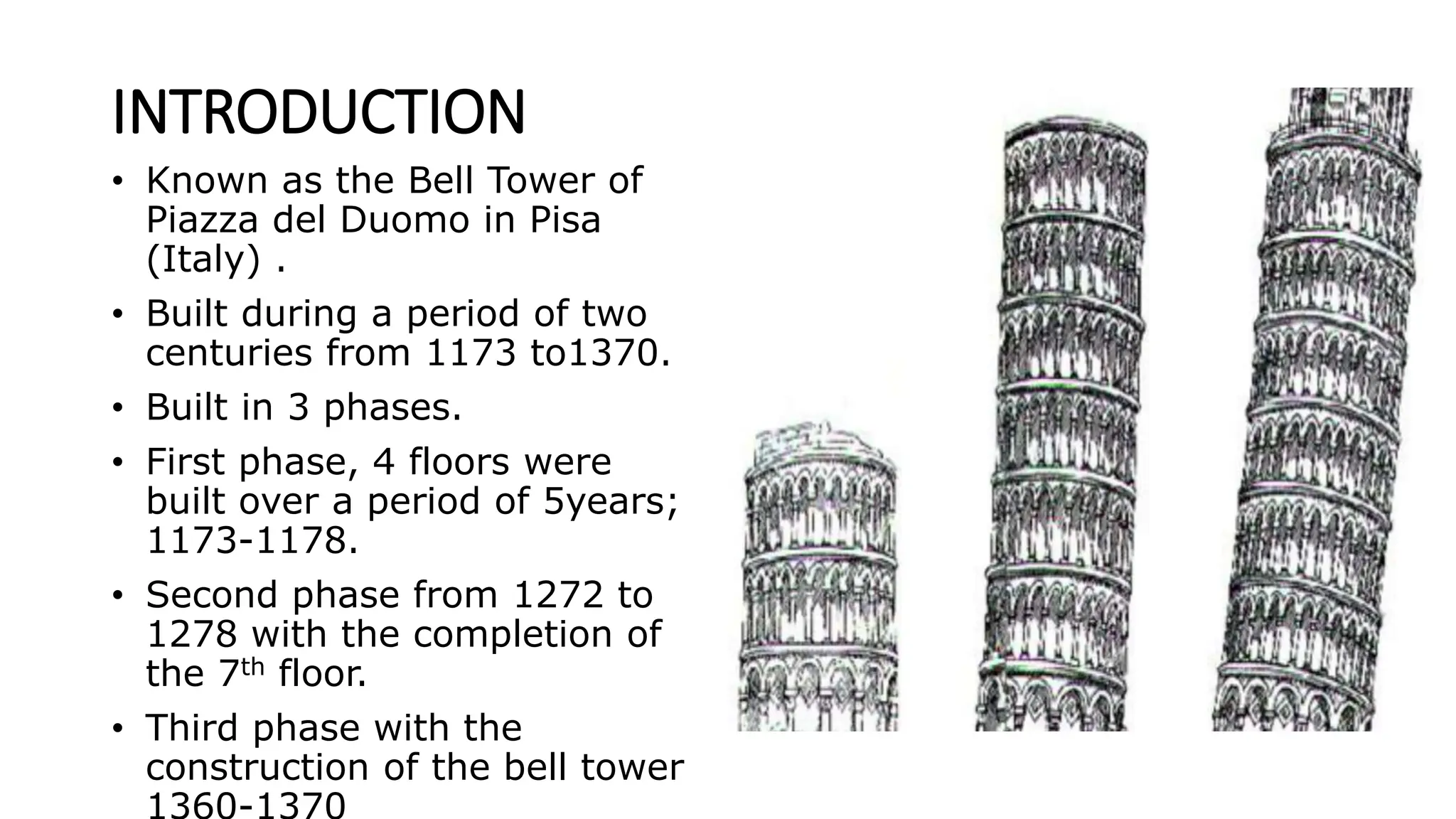
• Built during a period of two
centuries from 1173 to1370.
• Built in 3 phases.
• First phase, 4 floors were
built over a period of 5years;
1173-1178.
• Second phase from 1272 to
1278 with the completion of
the 7th floor.
• Third phase with the
construction of the bell tower
INTRODUCTION
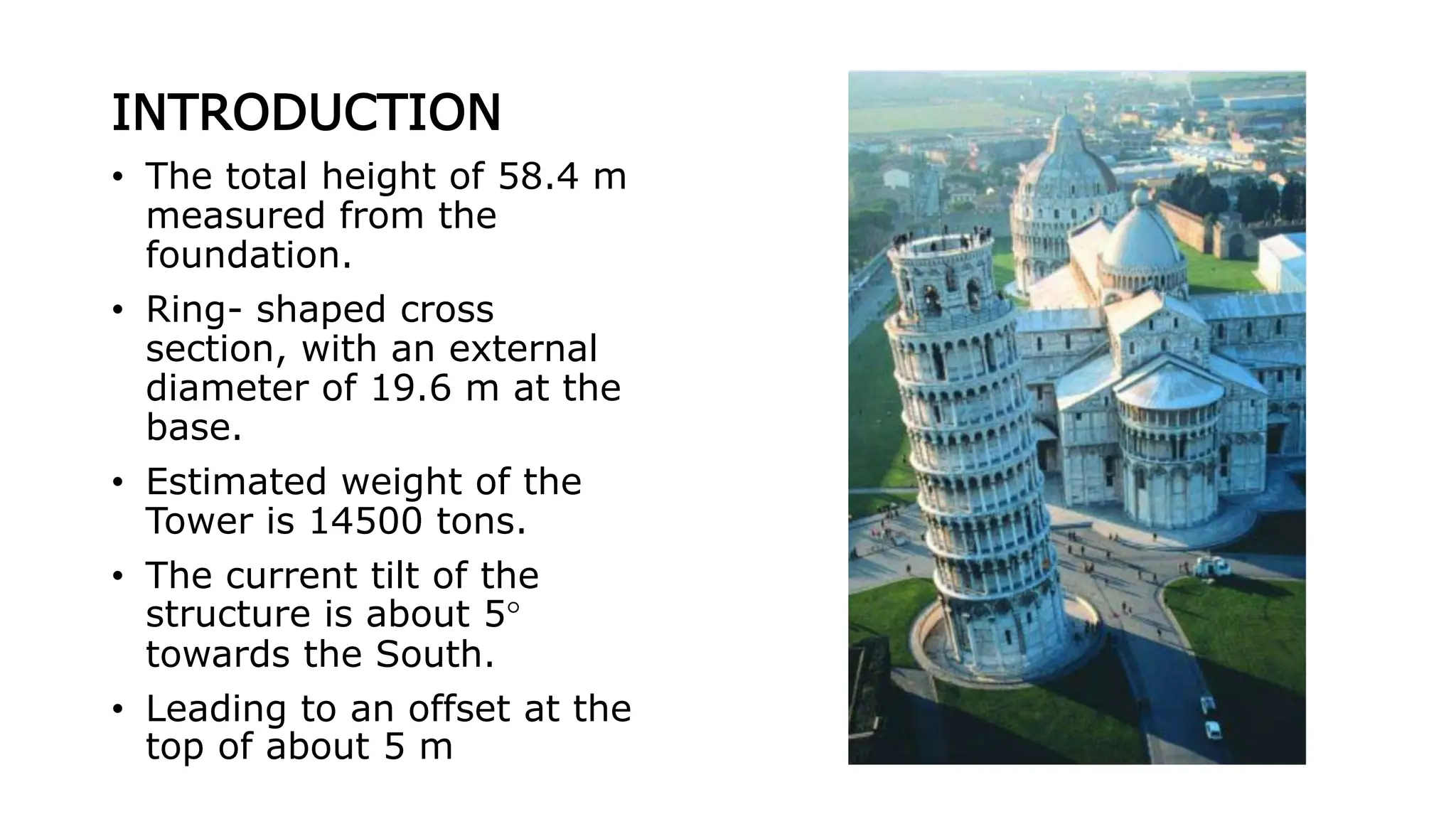
• The total height of 58.4 m
measured from the
foundation.
• Ring- shaped cross
section, with an external
diameter of 19.6 m at the
base.
• Estimated weight of the
Tower is 14500 tons.
• The current tilt of the
structure is about 5°
towards the South.
• Leading to an offset at the
top of about 5 m
The Leaning
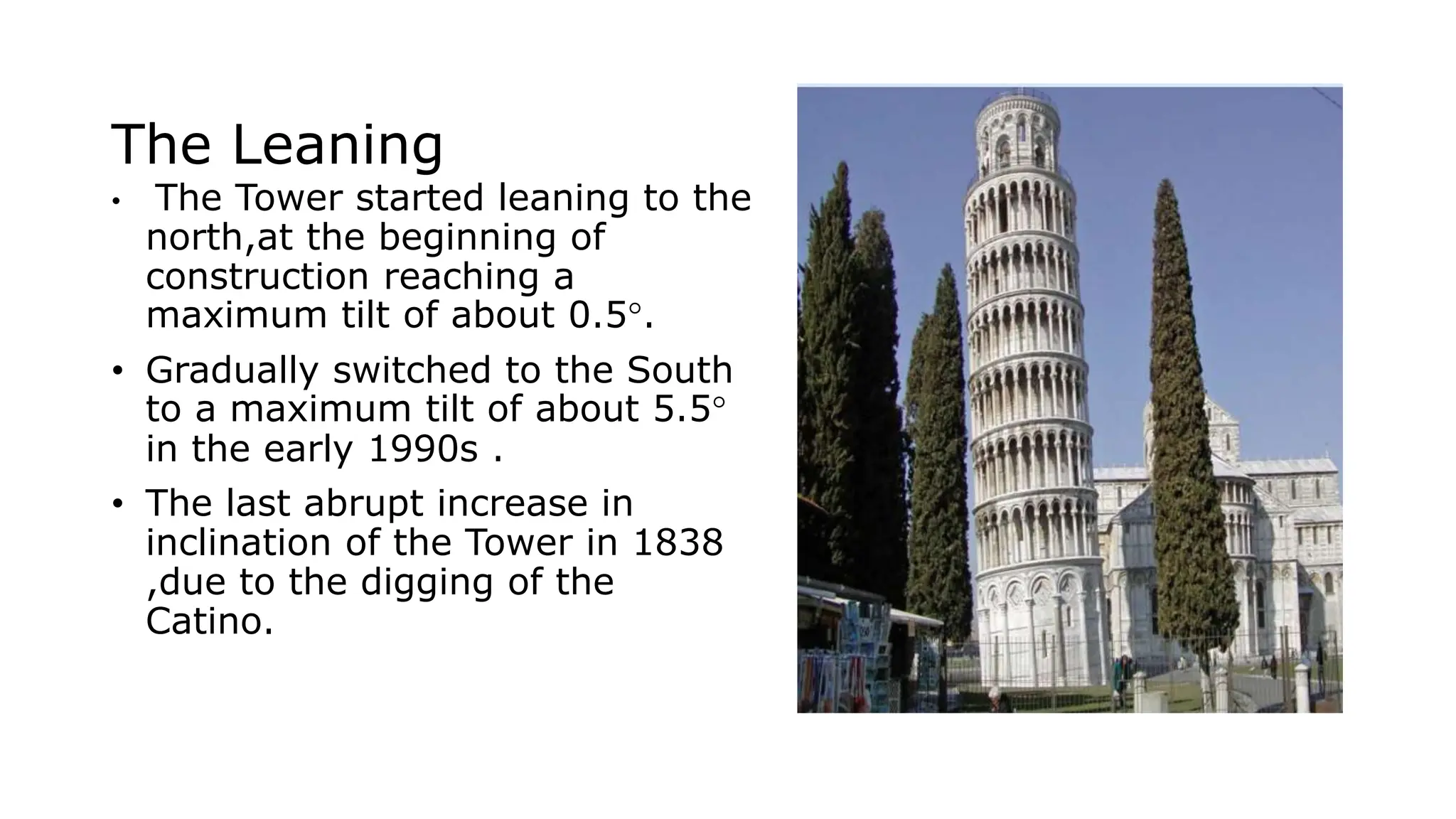
• The Tower started leaning to the
north,at the beginning of
construction reaching a
maximum tilt of about 0.5°.
• Gradually switched to the South
to a maximum tilt of about 5.5°
in the early 1990s .
• The last abrupt increase in
inclination of the Tower in 1838
,due to the digging of the
Catino.
GEOTECHNICAL
ISSUES
SOIL CONDITIONS
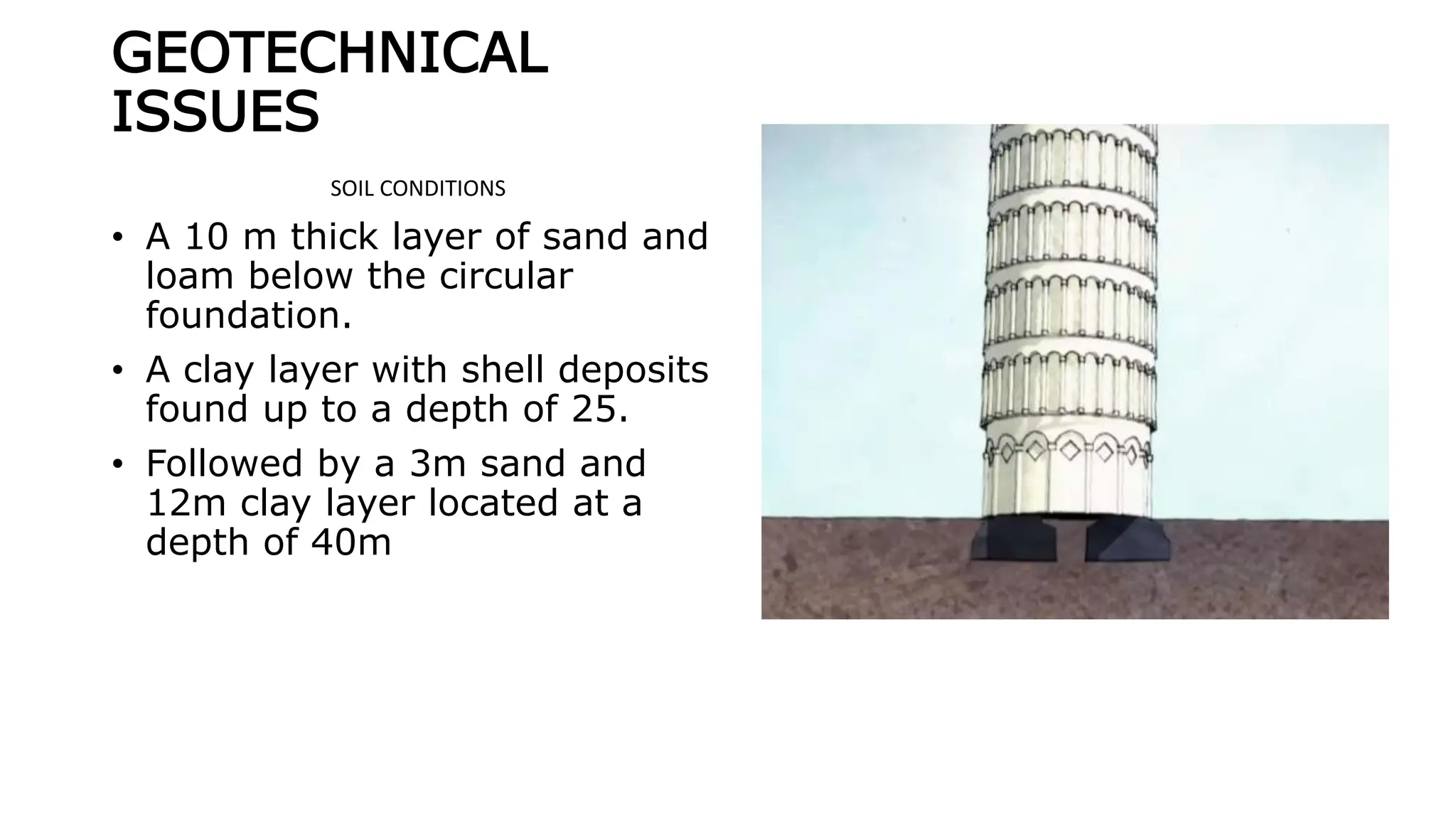
• A 10 m thick layer of sand and
loam below the circular
foundation.
• A clay layer with shell deposits
found up to a depth of 25.
• Followed by a 3m sand and
12m clay layer located at a
depth of 40m
GEOTHECHNICAL
ISSUES
SUB SOIL
• The subsoil of the Leaning Tower of Pisa belongs to the
alluvial deposits.
• A geological profile at a depth greater than 60m has been
defined into three horizon.
1.Horizon A: upper variable deposits from 3 to 10m
2.Horizon B: clayey deposits from 10 to 40m
3.Horizon C: lower sand deposits from 40 to 60 m
GEOTHECHNICAL
ISSUES
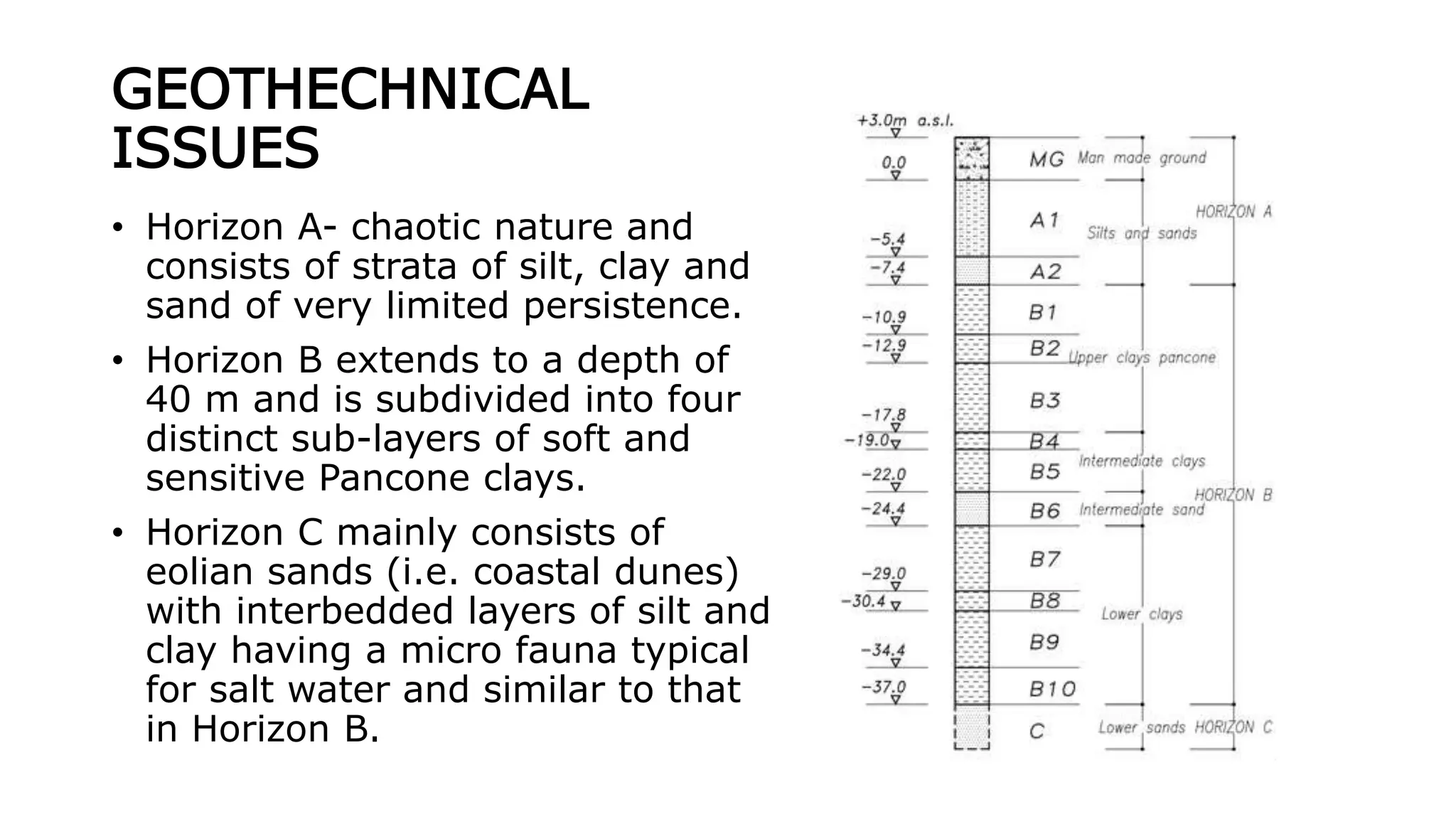
• Horizon A- chaotic nature and
consists of strata of silt, clay and
sand of very limited persistence.
• Horizon B extends to a depth of
40 m and is subdivided into four
distinct sub-layers of soft and
sensitive Pancone clays.
• Horizon C mainly consists of
eolian sands (i.e. coastal dunes)
with interbedded layers of silt and
clay having a micro fauna typical
for salt water and similar to that
in Horizon B.
GEOTHECHNICAL ISSUES
• Available data representative of soil parameters
from laboratory tests.
 Stiffness modulus, Es=2-19MN/m²
 Coefficient of permeability, k=10^9-10^11 m/s
 Undrained cohesion, Cu=40-60 kN/m²
The soil could barely carry one half of the present
weight of the tower
(tower weight W= 145 MN, mean foundation stress
δ=480 kN/m²).
GEOTHECHNICAL ISSUES
DURING CONSTRUCTION
1 Foundation instability
• The tower being built on a shallow foundation
(3m) on soft, compressible soil, resulted in
differential settlementt.
• Managed by altering the design of the upper
floors to compensate for the lean and prevent the
tower from toppling over
2 Soil composition.
• Complex mixture of clay, sand, and gravel
underneath the tower posed challenges in
predicting soil behaviour and stability.
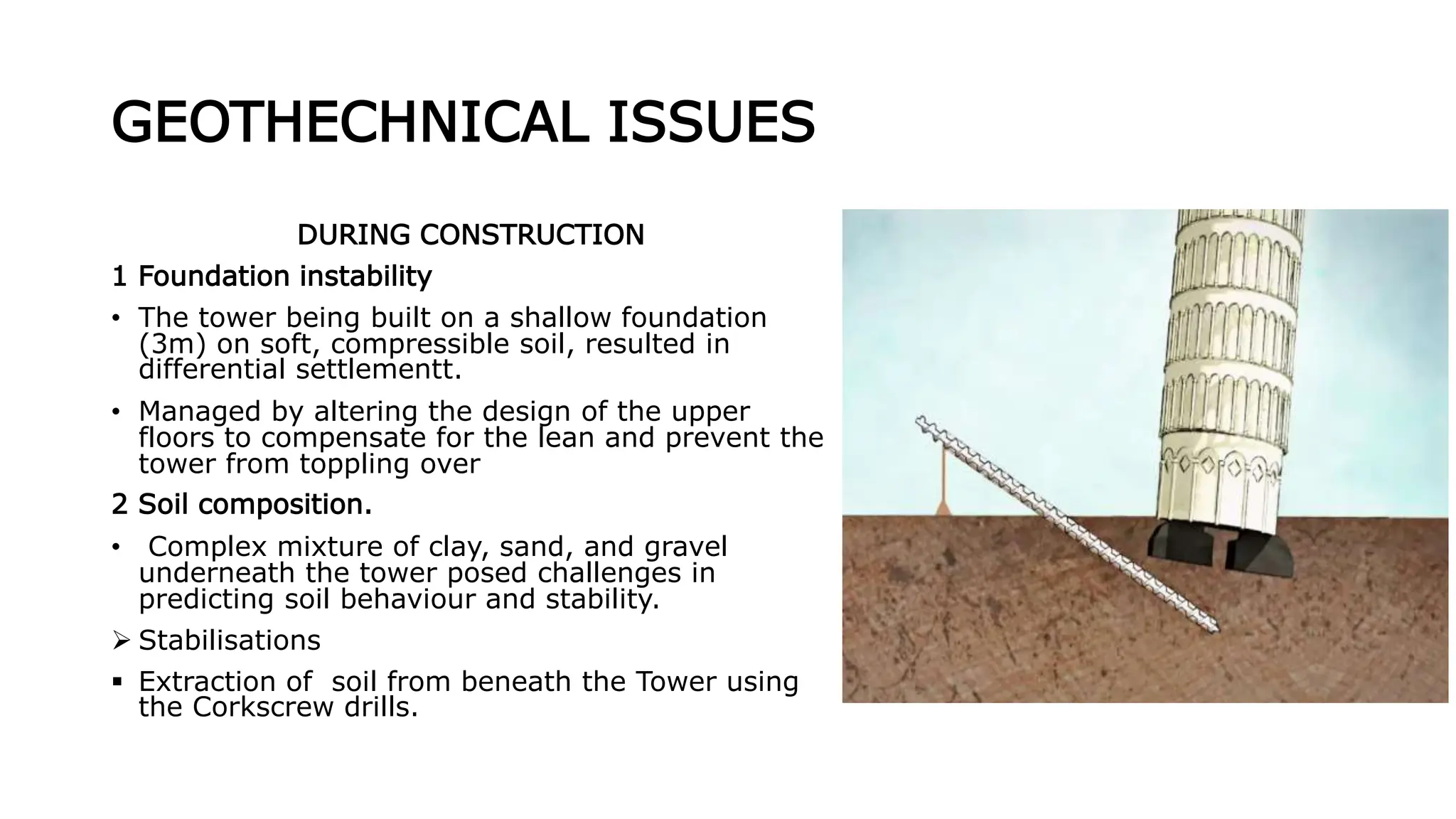
 Stabilisations
 Extraction of soil from beneath the Tower using
the Corkscrew drills.
GEOTHECHNICAL ISSUES
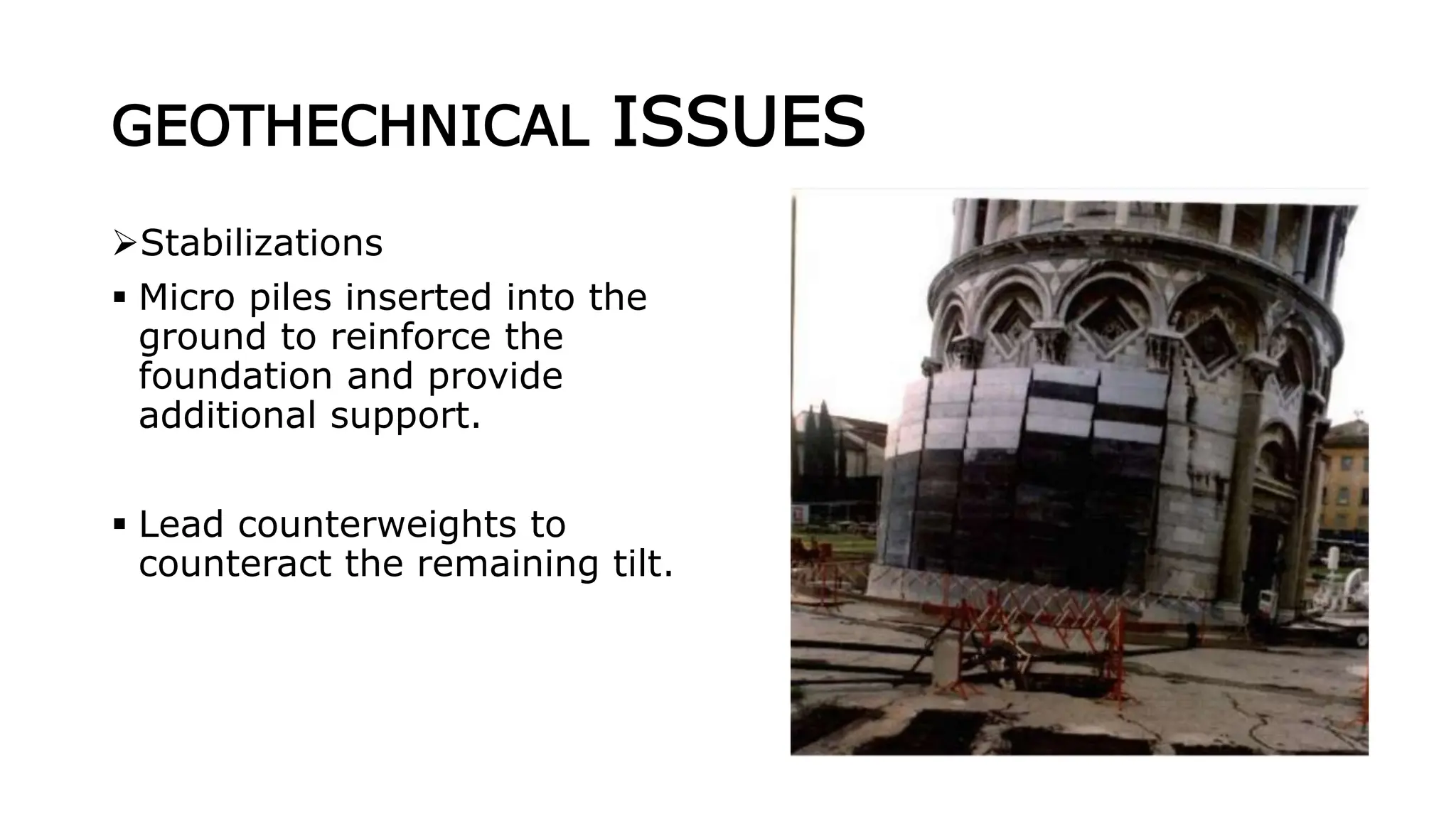
Stabilizations
 Micro piles inserted into the
ground to reinforce the
foundation and provide
additional support.
 Lead counterweights to
counteract the remaining tilt.
LESSONS
• Importance of thorough geotechnical investigations.
• Understanding soil properties and behavior is crucial.
• Deep foundations are essential for heavy structures.
• Structural monitoring and maintenance are vital for long-term
stability

The Leaning Tower of Pisa. The Geotechnical issues and lessons

  • 1.
    THE LEANING TOWEROF PISA THE GEOTECHNICAL ISSUES AND LESSONS. GROUP 2
  • 2.
    GROUP MEMBERS 1. RUHANGAYEBAREHILARY 22/U/21085/PS 2. ONDOGA JOHN BISMARK 21/U/19904/PS 3. AMPUIRE IGNATIUS 22/U/5767 4. MUSIIME SOLOMON 20/U/19688/PS 5. ASIIMWE ANNAH 22/U/5813 6. OJOK OSCAR BRIAN 22/U/21082/PS 7. KYABANDIHO VICTOR 22/U/21070/PS
  • 3.
    INTRODUCTION • Known asthe Bell Tower of Piazza del Duomo in Pisa (Italy) . • Built during a period of two centuries from 1173 to1370. • Built in 3 phases. • First phase, 4 floors were built over a period of 5years; 1173-1178. • Second phase from 1272 to 1278 with the completion of the 7th floor. • Third phase with the construction of the bell tower
  • 4.
    INTRODUCTION • The totalheight of 58.4 m measured from the foundation. • Ring- shaped cross section, with an external diameter of 19.6 m at the base. • Estimated weight of the Tower is 14500 tons. • The current tilt of the structure is about 5° towards the South. • Leading to an offset at the top of about 5 m
  • 5.
    The Leaning • TheTower started leaning to the north,at the beginning of construction reaching a maximum tilt of about 0.5°. • Gradually switched to the South to a maximum tilt of about 5.5° in the early 1990s . • The last abrupt increase in inclination of the Tower in 1838 ,due to the digging of the Catino.
  • 6.
    GEOTECHNICAL ISSUES SOIL CONDITIONS • A10 m thick layer of sand and loam below the circular foundation. • A clay layer with shell deposits found up to a depth of 25. • Followed by a 3m sand and 12m clay layer located at a depth of 40m
  • 7.
    GEOTHECHNICAL ISSUES SUB SOIL • Thesubsoil of the Leaning Tower of Pisa belongs to the alluvial deposits. • A geological profile at a depth greater than 60m has been defined into three horizon. 1.Horizon A: upper variable deposits from 3 to 10m 2.Horizon B: clayey deposits from 10 to 40m 3.Horizon C: lower sand deposits from 40 to 60 m
  • 8.
    GEOTHECHNICAL ISSUES • Horizon A-chaotic nature and consists of strata of silt, clay and sand of very limited persistence. • Horizon B extends to a depth of 40 m and is subdivided into four distinct sub-layers of soft and sensitive Pancone clays. • Horizon C mainly consists of eolian sands (i.e. coastal dunes) with interbedded layers of silt and clay having a micro fauna typical for salt water and similar to that in Horizon B.
  • 9.
    GEOTHECHNICAL ISSUES • Availabledata representative of soil parameters from laboratory tests.  Stiffness modulus, Es=2-19MN/m²  Coefficient of permeability, k=10^9-10^11 m/s  Undrained cohesion, Cu=40-60 kN/m² The soil could barely carry one half of the present weight of the tower (tower weight W= 145 MN, mean foundation stress δ=480 kN/m²).
  • 10.
    GEOTHECHNICAL ISSUES DURING CONSTRUCTION 1Foundation instability • The tower being built on a shallow foundation (3m) on soft, compressible soil, resulted in differential settlementt. • Managed by altering the design of the upper floors to compensate for the lean and prevent the tower from toppling over 2 Soil composition. • Complex mixture of clay, sand, and gravel underneath the tower posed challenges in predicting soil behaviour and stability.  Stabilisations  Extraction of soil from beneath the Tower using the Corkscrew drills.
  • 11.
    GEOTHECHNICAL ISSUES Stabilizations  Micropiles inserted into the ground to reinforce the foundation and provide additional support.  Lead counterweights to counteract the remaining tilt.
  • 12.
    LESSONS • Importance ofthorough geotechnical investigations. • Understanding soil properties and behavior is crucial. • Deep foundations are essential for heavy structures. • Structural monitoring and maintenance are vital for long-term stability