Ancient American Civilizations By: Nathalie Aspajo Ruiz First Middle
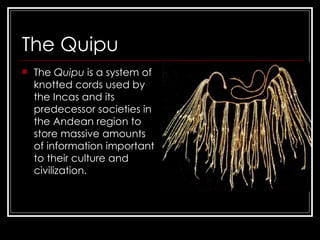
The Quipu The  Quipu  is a system of knotted cords used by the Incas   and its predecessor societies in the Andean region to store massive amounts of information important to their culture and civilization.
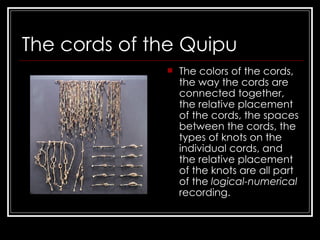
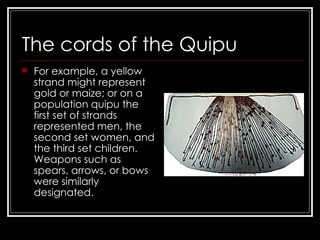
The cords of the Quipu The colors of the cords, the way the cords are connected together, the relative placement of the cords, the spaces between the cords, the types of knots on the individual cords, and the relative placement of the knots are all part of the  logical-numerical  recording.
The cords of the Quipu For example, a yellow strand might represent gold or maize; or on a population quipu the first set of strands represented men, the second set women, and the third set children. Weapons such as spears, arrows, or bows were similarly designated.
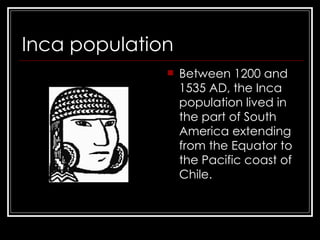
Inca population Between 1200 and 1535 AD, the Inca population lived in the part of South America extending from the Equator to the Pacific coast of Chile.
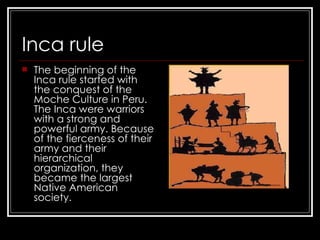
Inca rule The beginning of the Inca rule started with the conquest of the Moche Culture in Peru. The Inca were warriors with a strong and powerful army. Because of the fierceness of their army and their hierarchical organization, they became the largest Native American society .
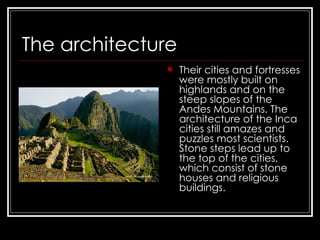
The architecture   Their cities and fortresses were mostly built on highlands and on the steep slopes of the Andes Mountains. The architecture of the Inca cities still amazes and puzzles most scientists. Stone steps lead up to the top of the cities, which consist of stone houses and religious buildings.
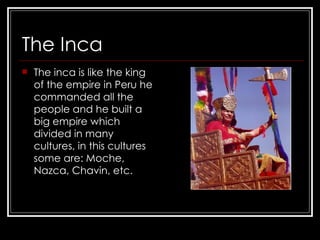
The Inca The inca is like the king of the empire in Peru he commanded all the people and he built a big empire which divided in many cultures, in this cultures some are: Moche, Nazca, Chavin, etc.

The Incas

  • 1.
    Ancient American CivilizationsBy: Nathalie Aspajo Ruiz First Middle
  • 2.
    The Quipu The Quipu is a system of knotted cords used by the Incas and its predecessor societies in the Andean region to store massive amounts of information important to their culture and civilization.
  • 3.
    The cords ofthe Quipu The colors of the cords, the way the cords are connected together, the relative placement of the cords, the spaces between the cords, the types of knots on the individual cords, and the relative placement of the knots are all part of the logical-numerical recording.
  • 4.
    The cords ofthe Quipu For example, a yellow strand might represent gold or maize; or on a population quipu the first set of strands represented men, the second set women, and the third set children. Weapons such as spears, arrows, or bows were similarly designated.
  • 5.
    Inca population Between1200 and 1535 AD, the Inca population lived in the part of South America extending from the Equator to the Pacific coast of Chile.
  • 6.
    Inca rule Thebeginning of the Inca rule started with the conquest of the Moche Culture in Peru. The Inca were warriors with a strong and powerful army. Because of the fierceness of their army and their hierarchical organization, they became the largest Native American society .
  • 7.
    The architecture Their cities and fortresses were mostly built on highlands and on the steep slopes of the Andes Mountains. The architecture of the Inca cities still amazes and puzzles most scientists. Stone steps lead up to the top of the cities, which consist of stone houses and religious buildings.
  • 8.
    The Inca Theinca is like the king of the empire in Peru he commanded all the people and he built a big empire which divided in many cultures, in this cultures some are: Moche, Nazca, Chavin, etc.