Hyperledger Indy
Public Blockchain
Presented by Alexander Shcherbakov
Released under a Creative Commons license. (CC BY-SA 4.0). SSIMeetup.org
1. Empower global SSI communities
2. Open to everyone interested in SSI
3. All content is shared with CC BY SA
SSIMeetup.org
Alex Preukschat @SSIMeetup @AlexPreukschat
Coordinating Node SSIMeetup.org
https://creativecommons.org/licenses/by-sa/4.0/
SSIMeetup objectives
● Indy has its own implementation of Distributed
Ledger not dependent on any other blockchain
platform
● Indy has its own implementation of a PBFT-like
consensus protocol
Released under a Creative Commons license. (CC BY-SA 4.0). SSIMeetup.org
● Indy is one of active Hyperledger projects
● Indy deployment (Sovrin) is in production for
more than 2 years
Sovrin Networks:
● Builder Net
● Staging Net
● Main Net
Released under a Creative Commons license. (CC BY-SA 4.0). SSIMeetup.org
Agenda
1. SSI and Public Blockchain
2. Indy-Plenum and Indy-Node
3. Architecture Overview
4. Ledger
5. Consensus Protocol
○ RBFT
○ Moving to Aardvark
○ Plenum protocol specific
6. Summary and Key Features
Released under a Creative Commons license. (CC BY-SA 4.0). SSIMeetup.org
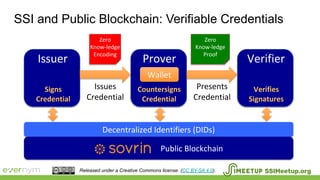
SSI and Public Blockchain: Verifiable Credentials
ProverIssuer Verifier
Issues
Credential
Presents
Credential
Decentralized Identifiers (DIDs)
Signs
Credential
Countersigns
Credential
Verifies
Signatures
Wallet
Zero
Know-ledge
Encoding
Zero
Know-ledge
Proof
Public Blockchain
Released under a Creative Commons license. (CC BY-SA 4.0). SSIMeetup.org
SSI and Public Blockchain: Why?
● Why Blockchain?
○ Decentralized source of trust for publicly available information
● Why Blockchain is Public?
○ Anyone in the ecosystem need to be able to read data (such as public keys, schemas, etc.)
Released under a Creative Commons license. (CC BY-SA 4.0). SSIMeetup.org
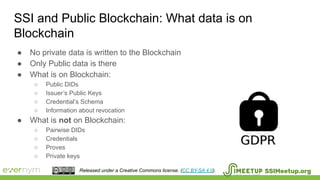
SSI and Public Blockchain: What data is on
Blockchain
● No private data is written to the Blockchain
● Only Public data is there
● What is on Blockchain:
○ Public DIDs
○ Issuer’s Public Keys
○ Credential’s Schema
○ Information about revocation
● What is not on Blockchain:
○ Pairwise DIDs
○ Credentials
○ Proves
○ Private keys
Released under a Creative Commons license. (CC BY-SA 4.0). SSIMeetup.org
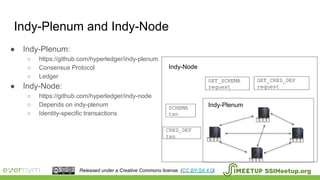
Indy-Plenum and Indy-Node
● Indy-Plenum:
○ https://github.com/hyperledger/indy-plenum
○ Consensus Protocol
○ Ledger
● Indy-Node:
○ https://github.com/hyperledger/indy-node
○ Depends on indy-plenum
○ Identity-specific transactions
Indy-Plenum
Indy-Node
SCHEMA
txn
CRED_DEF
txn
GET_SCHEMA
request
GET_CRED_DEF
request
Released under a Creative Commons license. (CC BY-SA 4.0). SSIMeetup.org
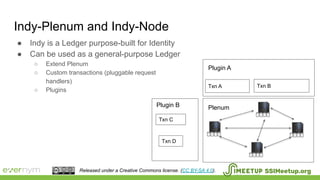
Indy-Plenum and Indy-Node
● Indy is a Ledger purpose-built for Identity
● Can be used as a general-purpose Ledger
○ Extend Plenum
○ Custom transactions (pluggable request
handlers)
○ Plugins
Plenum
Plugin A
Txn C
Txn D
Txn A Txn B
Plugin B
Released under a Creative Commons license. (CC BY-SA 4.0). SSIMeetup.org
Indy-Plenum and Indy-Node
● Written in Python
● Depends on
○ ZMQ
○ Indy-crypto (Hyperledger Ursa)
○ Libsodium
● Message-driven and modular architecture
○ Recent refactorings improved this
● Extensive test coverage
○ TDD
○ Unit tests
○ Integration tests
○ Property-based and simulation tests
○ System tests
○ Load tests (usually 25 Nodes)
Released under a Creative Commons license. (CC BY-SA 4.0). SSIMeetup.org
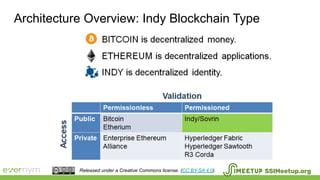
Architecture Overview: Indy Blockchain Type
Released under a Creative Commons license. (CC BY-SA 4.0). SSIMeetup.org
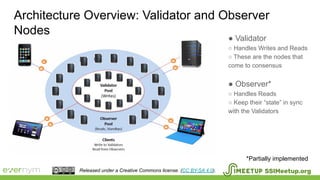
Architecture Overview: Validator and Observer
Nodes
● Validator
○ Handles Writes and Reads
○ These are the nodes that
come to consensus
● Observer*
○ Handles Reads
○ Keep their “state” in sync
with the Validators
*Partially implemented
Released under a Creative Commons license. (CC BY-SA 4.0). SSIMeetup.org
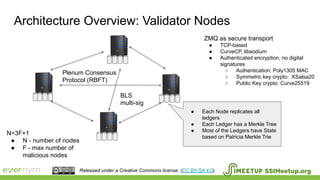
Architecture Overview: Validator Nodes
Plenum Consensus
Protocol (RBFT)
● Each Node replicates all
ledgers
● Each Ledger has a Merkle Tree
● Most of the Ledgers have State
based on Patricia Merkle Trie
ZMQ as secure transport
● TCP-based
● CurveCP, libsodium
● Authenticated encryption, no digital
signatures
○ Authentication: Poly1305 MAC
○ Symmetric key crypto: XSalsa20
○ Public Key crypto: Curve25519
N=3F+1
● N - number of nodes
● F - max number of
malicious nodes
BLS
multi-sig
Released under a Creative Commons license. (CC BY-SA 4.0). SSIMeetup.org
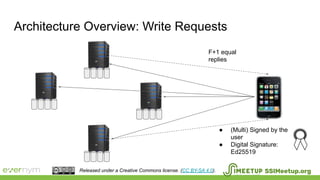
Architecture Overview: Write Requests
● (Multi) Signed by the
user
● Digital Signature:
Ed25519
F+1 equal
replies
Released under a Creative Commons license. (CC BY-SA 4.0). SSIMeetup.org
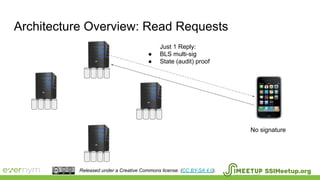
Architecture Overview: Read Requests
Just 1 Reply:
● BLS multi-sig
● State (audit) proof
No signature
Released under a Creative Commons license. (CC BY-SA 4.0). SSIMeetup.org
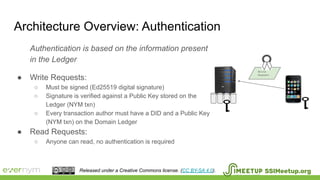
Architecture Overview: Authentication
Authentication is based on the information present
in the Ledger
● Write Requests:
○ Must be signed (Ed25519 digital signature)
○ Signature is verified against a Public Key stored on the
Ledger (NYM txn)
○ Every transaction author must have a DID and a Public Key
(NYM txn) on the Domain Ledger
● Read Requests:
○ Anyone can read, no authentication is required
Write
Request
Released under a Creative Commons license. (CC BY-SA 4.0). SSIMeetup.org
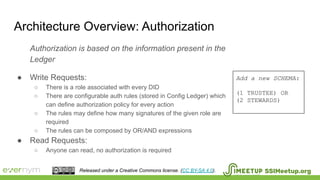
Architecture Overview: Authorization
Authorization is based on the information present in the
Ledger
● Write Requests:
○ There is a role associated with every DID
○ There are configurable auth rules (stored in Config Ledger) which
can define authorization policy for every action
○ The rules may define how many signatures of the given role are
required
○ The rules can be composed by OR/AND expressions
● Read Requests:
○ Anyone can read, no authorization is required
Add a new SCHEMA:
(1 TRUSTEE) OR
(2 STEWARDS)
Released under a Creative Commons license. (CC BY-SA 4.0). SSIMeetup.org
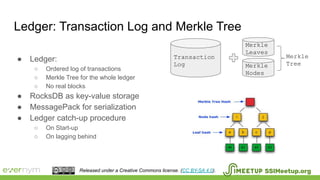
Ledger: Transaction Log and Merkle Tree
● Ledger:
○ Ordered log of transactions
○ Merkle Tree for the whole ledger
○ No real blocks
● RocksDB as key-value storage
● MessagePack for serialization
● Ledger catch-up procedure
○ On Start-up
○ On lagging behind
Transaction
Log
Merkle
Leaves
Merkle
Nodes
Merkle
Tree
Released under a Creative Commons license. (CC BY-SA 4.0). SSIMeetup.org
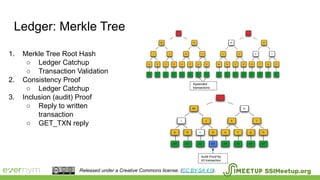
Ledger: Merkle Tree
1. Merkle Tree Root Hash
○ Ledger Catchup
○ Transaction Validation
2. Consistency Proof
○ Ledger Catchup
3. Inclusion (audit) Proof
○ Reply to written
transaction
○ GET_TXN reply
Audit Proof for
d3 transaction
Appended
transactions
Released under a Creative Commons license. (CC BY-SA 4.0). SSIMeetup.org
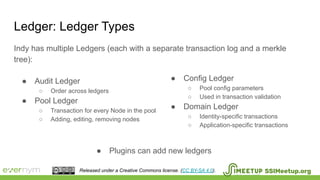
Ledger: Ledger Types
Indy has multiple Ledgers (each with a separate transaction log and a merkle
tree):
● Audit Ledger
○ Order across ledgers
● Pool Ledger
○ Transaction for every Node in the pool
○ Adding, editing, removing nodes
● Config Ledger
○ Pool config parameters
○ Used in transaction validation
● Domain Ledger
○ Identity-specific transactions
○ Application-specific transactions
● Plugins can add new ledgers
Released under a Creative Commons license. (CC BY-SA 4.0). SSIMeetup.org
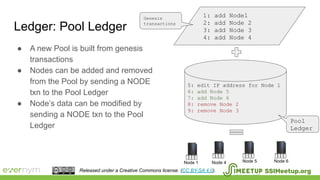
Ledger: Pool Ledger
● A new Pool is built from genesis
transactions
● Nodes can be added and removed
from the Pool by sending a NODE
txn to the Pool Ledger
● Node’s data can be modified by
sending a NODE txn to the Pool
Ledger
1: add Node1
2: add Node 2
3: add Node 3
4: add Node 4
5: edit IP address for Node 1
6: add Node 5
7: add Node 6
8: remove Node 2
9: remove Node 3
Node 1 Node 4 Node 5 Node 6
Pool
Ledger
Genesis
transactions
Released under a Creative Commons license. (CC BY-SA 4.0). SSIMeetup.org
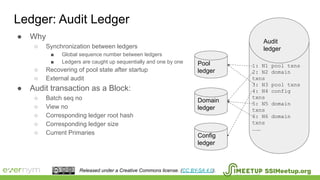
Ledger: Audit Ledger
● Why
○ Synchronization between ledgers
■ Global sequence number between ledgers
■ Ledgers are caught up sequentially and one by one
○ Recovering of pool state after startup
○ External audit
● Audit transaction as a Block:
○ Batch seq no
○ View no
○ Corresponding ledger root hash
○ Corresponding ledger size
○ Current Primaries
1: N1 pool txns
2: N2 domain
txns
3: N3 pool txns
4: N4 config
txns
5: N5 domain
txns
6: N6 domain
txns
…..
Pool
ledger
Domain
ledger
Config
ledger
Audit
ledger
Released under a Creative Commons license. (CC BY-SA 4.0). SSIMeetup.org
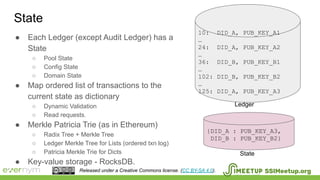
State
● Each Ledger (except Audit Ledger) has a
State
○ Pool State
○ Config State
○ Domain State
● Map ordered list of transactions to the
current state as dictionary
○ Dynamic Validation
○ Read requests.
● Merkle Patricia Trie (as in Ethereum)
○ Radix Tree + Merkle Tree
○ Ledger Merkle Tree for Lists (ordered txn log)
○ Patricia Merkle Trie for Dicts
● Key-value storage - RocksDB.
10: DID_A, PUB_KEY_A1
…
24: DID_A, PUB_KEY_A2
…
36: DID_B, PUB_KEY_B1
…
102: DID_B, PUB_KEY_B2
…
125: DID_A, PUB_KEY_A3
{DID_A : PUB_KEY_A3,
DID_B : PUB_KEY_B2}
Ledger
State
Released under a Creative Commons license. (CC BY-SA 4.0). SSIMeetup.org
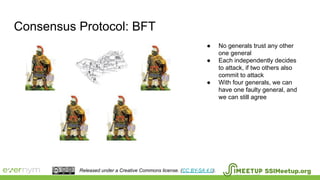
Consensus Protocol: BFT
● No generals trust any other
one general
● Each independently decides
to attack, if two others also
commit to attack
● With four generals, we can
have one faulty general, and
we can still agree
Released under a Creative Commons license. (CC BY-SA 4.0). SSIMeetup.org
Consensus Protocol: RBFT
● Byzantine Fault Tolerance
○ Built on RBFT: Redundant Byzantine Fault Tolerance.
○ Improves over PBFT (by Miguel Castro and Barbara Liskov) by executing several protocol
instances in parallel
● Better throughput, lower latency than proof-of-work
● Performs better compared to its predecessors under dynamic load and under
attack
Released under a Creative Commons license. (CC BY-SA 4.0). SSIMeetup.org
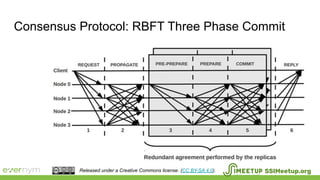
Consensus Protocol: RBFT Three Phase Commit
Released under a Creative Commons license. (CC BY-SA 4.0). SSIMeetup.org
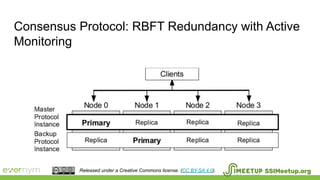
Consensus Protocol: RBFT Redundancy with Active
Monitoring
Released under a Creative Commons license. (CC BY-SA 4.0). SSIMeetup.org
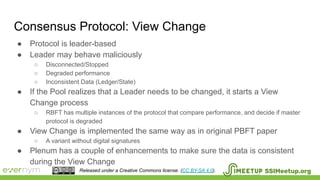
Consensus Protocol: View Change
● Protocol is leader-based
● Leader may behave maliciously
○ Disconnected/Stopped
○ Degraded performance
○ Inconsistent Data (Ledger/State)
● If the Pool realizes that a Leader needs to be changed, it starts a View
Change process
○ RBFT has multiple instances of the protocol that compare performance, and decide if master
protocol is degraded
● View Change is implemented the same way as in original PBFT paper
○ A variant without digital signatures
● Plenum has a couple of enhancements to make sure the data is consistent
during the View Change
Released under a Creative Commons license. (CC BY-SA 4.0). SSIMeetup.org
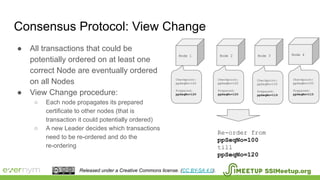
Consensus Protocol: View Change
● All transactions that could be
potentially ordered on at least one
correct Node are eventually ordered
on all Nodes
● View Change procedure:
○ Each node propagates its prepared
certificate to other nodes (that is
transaction it could potentially ordered)
○ A new Leader decides which transactions
need to be re-ordered and do the
re-ordering
Node 1 Node 2 Node 3 Node 4
Checkpoint:
ppSeqNo=100
Prepared:
ppSeqNo=120
Checkpoint:
ppSeqNo=100
Prepared:
ppSeqNo=120
Checkpoint:
ppSeqNo=100
Prepared:
ppSeqNo=119
Checkpoint:
ppSeqNo=100
Prepared:
ppSeqNo=115
Re-order from
ppSeqNo=100
till
ppSeqNo=120
Released under a Creative Commons license. (CC BY-SA 4.0). SSIMeetup.org
Consensus Protocol: Moving to Aardvark
● Although RBFT protocol may be quite sensitive to malicious Leaders in some
conditions, it’s slower than other PBFT-like protocols
○ N^3 vs N^2
● We are expecting to change consensus protocol to Aardvark
○ PBFT-like protocol with the same view change implementation
○ Has just 1 protocol instance (like in PBFT and unlike RBFT)
○ Does regular View Changes
○ Probability of View Change depends on the Leader’s performance
Released under a Creative Commons license. (CC BY-SA 4.0). SSIMeetup.org
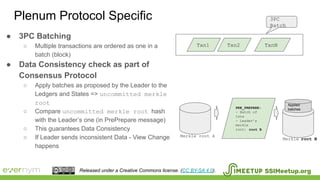
Plenum Protocol Specific
● 3PC Batching
○ Multiple transactions are ordered as one in a
batch (block)
● Data Consistency check as part of
Consensus Protocol
○ Apply batches as proposed by the Leader to the
Ledgers and States => uncommitted merkle
root
○ Compare uncommitted merkle root hash
with the Leader’s one (in PrePrepare message)
○ This guarantees Data Consistency
○ If Leader sends inconsistent Data - View Change
happens
Txn1 Txn2 TxnN
Applied
batches
Merkle root A
PRE_PREPARE:
- Batch of
txns
- Leader’s
merkle
root: root B
Merkle root B
3PC
Batch
Released under a Creative Commons license. (CC BY-SA 4.0). SSIMeetup.org
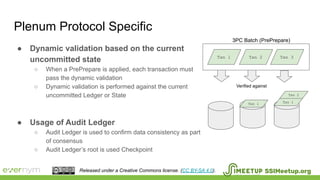
Plenum Protocol Specific
● Dynamic validation based on the current
uncommitted state
○ When a PrePrepare is applied, each transaction must
pass the dynamic validation
○ Dynamic validation is performed against the current
uncommitted Ledger or State
● Usage of Audit Ledger
○ Audit Ledger is used to confirm data consistency as part
of consensus
○ Audit Ledger’s root is used Checkpoint
Txn 1 Txn 2 Txn 3
3PC Batch (PrePrepare)
Txn 1 Txn 1
Txn 2
Verified against
Released under a Creative Commons license. (CC BY-SA 4.0). SSIMeetup.org
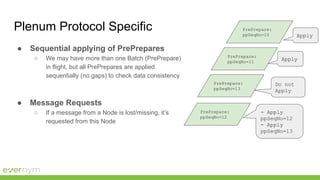
Plenum Protocol Specific
● Sequential applying of PrePrepares
○ We may have more than one Batch (PrePrepare)
in flight, but all PrePrepares are applied
sequentially (no gaps) to check data consistency
● Message Requests
○ If a message from a Node is lost/missing, it’s
requested from this Node
PrePrepare:
ppSeqNo=10
PrePrepare:
ppSeqNo=11
PrePrepare:
ppSeqNo=13
PrePrepare:
ppSeqNo=12
Apply
Apply
Do not
Apply
- Apply
ppSeqNo=12
- Apply
ppSeqNo=13
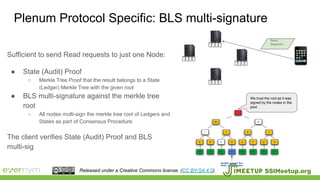
Plenum Protocol Specific: BLS multi-signature
Sufficient to send Read requests to just one Node:
● State (Audit) Proof
○ Merkle Tree Proof that the result belongs to a State
(Ledger) Merkle Tree with the given root
● BLS multi-signature against the merkle tree
root
○ All nodes multi-sign the merkle tree root of Ledgers and
States as part of Consensus Procedure
The client verifies State (Audit) Proof and BLS
multi-sig
We trust the root as it was
signed by the nodes in the
pool
Read
Request
Released under a Creative Commons license. (CC BY-SA 4.0). SSIMeetup.org
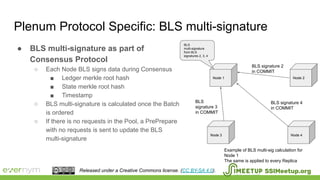
Plenum Protocol Specific: BLS multi-signature
● BLS multi-signature as part of
Consensus Protocol
○ Each Node BLS signs data during Consensus
■ Ledger merkle root hash
■ State merkle root hash
■ Timestamp
○ BLS multi-signature is calculated once the Batch
is ordered
○ If there is no requests in the Pool, a PrePrepare
with no requests is sent to update the BLS
multi-signature
Node 1 Node 2
Node 3 Node 4
BLS signature 2
in COMMIT
BLS signature 4
in COMMIT
BLS
signature 3
in COMMIT
BLS
multi-signature
from BLS
signatures 2, 3, 4
Example of BLS multi-sig calculation for
Node 1
The same is applied to every Replica
Released under a Creative Commons license. (CC BY-SA 4.0). SSIMeetup.org
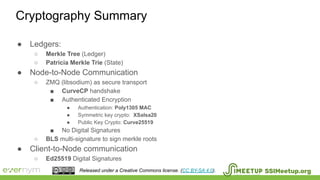
Cryptography Summary
● Ledgers:
○ Merkle Tree (Ledger)
○ Patricia Merkle Trie (State)
● Node-to-Node Communication
○ ZMQ (libsodium) as secure transport
■ CurveCP handshake
■ Authenticated Encryption
● Authentication: Poly1305 MAC
● Symmetric key crypto: XSalsa20
● Public Key Crypto: Curve25519
■ No Digital Signatures
○ BLS multi-signature to sign merkle roots
● Client-to-Node communication
○ Ed25519 Digital Signatures
Released under a Creative Commons license. (CC BY-SA 4.0). SSIMeetup.org
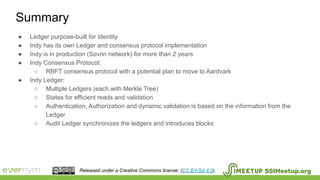
Summary
● Ledger purpose-built for Identity
● Indy has its own Ledger and consensus protocol implementation
● Indy is in production (Sovrin network) for more than 2 years
● Indy Consensus Protocol:
○ RBFT consensus protocol with a potential plan to move to Aardvark
● Indy Ledger:
○ Multiple Ledgers (each with Merkle Tree)
○ States for efficient reads and validation
○ Authentication, Authorization and dynamic validation is based on the information from the
Ledger
○ Audit Ledger synchronizes the ledgers and introduces blocks
Released under a Creative Commons license. (CC BY-SA 4.0). SSIMeetup.org
Summary
● Efficient Read
○ Read data from one Node due to BLS multi-signatures and state proofs
● Specific of the Protocol:
○ 3PC Batching
○ Data Consistency check as part of Consensus Protocol
○ Dynamic validation based on the current uncommitted state
○ Usage of Audit Ledger
○ Sequential applying of PrePrepares
○ BLS multi-signature as part of Consensus Protocol
Released under a Creative Commons license. (CC BY-SA 4.0). SSIMeetup.org
Links
● Plenum and Node:
○ https://github.com/hyperledger/indy-plenum/blob/master/README.md
○ https://github.com/hyperledger/indy-plenum/tree/master/docs/source
○ https://github.com/hyperledger/indy-node/blob/master/README.md
○ https://github.com/hyperledger/indy-node/tree/master/docs/source
● RBFT:
○ https://pakupaku.me/plaublin/rbft/5000a297.pdf
● Aardvark:
○ https://www.usenix.org/legacy/events/nsdi09/tech/full_papers/clement/clement.pdf
● PBFT:
○ https://www.microsoft.com/en-us/research/wp-content/uploads/2017/01/p398-castro-bft-tocs.p
df
Released under a Creative Commons license. (CC BY-SA 4.0). SSIMeetup.org
https://www.manning.com/books/self-sovereign-identity (mlpreukschat - 50% off all
formats until 31 December 2020)
Released under a Creative Commons license. (CC BY-SA 4.0). SSIMeetup.org
Hyperledger Indy
Public Blockchain
Presented by Alexander Shcherbakov
Released under a Creative Commons license. (CC BY-SA 4.0). SSIMeetup.org

The Hyperledger Indy Public Blockchain Node

  • 1.
    Hyperledger Indy Public Blockchain Presentedby Alexander Shcherbakov Released under a Creative Commons license. (CC BY-SA 4.0). SSIMeetup.org
  • 2.
    1. Empower globalSSI communities 2. Open to everyone interested in SSI 3. All content is shared with CC BY SA SSIMeetup.org Alex Preukschat @SSIMeetup @AlexPreukschat Coordinating Node SSIMeetup.org https://creativecommons.org/licenses/by-sa/4.0/ SSIMeetup objectives
  • 3.
    ● Indy hasits own implementation of Distributed Ledger not dependent on any other blockchain platform ● Indy has its own implementation of a PBFT-like consensus protocol Released under a Creative Commons license. (CC BY-SA 4.0). SSIMeetup.org
  • 4.
    ● Indy isone of active Hyperledger projects ● Indy deployment (Sovrin) is in production for more than 2 years Sovrin Networks: ● Builder Net ● Staging Net ● Main Net Released under a Creative Commons license. (CC BY-SA 4.0). SSIMeetup.org
  • 5.
    Agenda 1. SSI andPublic Blockchain 2. Indy-Plenum and Indy-Node 3. Architecture Overview 4. Ledger 5. Consensus Protocol ○ RBFT ○ Moving to Aardvark ○ Plenum protocol specific 6. Summary and Key Features Released under a Creative Commons license. (CC BY-SA 4.0). SSIMeetup.org
  • 6.
    SSI and PublicBlockchain: Verifiable Credentials ProverIssuer Verifier Issues Credential Presents Credential Decentralized Identifiers (DIDs) Signs Credential Countersigns Credential Verifies Signatures Wallet Zero Know-ledge Encoding Zero Know-ledge Proof Public Blockchain Released under a Creative Commons license. (CC BY-SA 4.0). SSIMeetup.org
  • 7.
    SSI and PublicBlockchain: Why? ● Why Blockchain? ○ Decentralized source of trust for publicly available information ● Why Blockchain is Public? ○ Anyone in the ecosystem need to be able to read data (such as public keys, schemas, etc.) Released under a Creative Commons license. (CC BY-SA 4.0). SSIMeetup.org
  • 8.
    SSI and PublicBlockchain: What data is on Blockchain ● No private data is written to the Blockchain ● Only Public data is there ● What is on Blockchain: ○ Public DIDs ○ Issuer’s Public Keys ○ Credential’s Schema ○ Information about revocation ● What is not on Blockchain: ○ Pairwise DIDs ○ Credentials ○ Proves ○ Private keys Released under a Creative Commons license. (CC BY-SA 4.0). SSIMeetup.org
  • 9.
    Indy-Plenum and Indy-Node ●Indy-Plenum: ○ https://github.com/hyperledger/indy-plenum ○ Consensus Protocol ○ Ledger ● Indy-Node: ○ https://github.com/hyperledger/indy-node ○ Depends on indy-plenum ○ Identity-specific transactions Indy-Plenum Indy-Node SCHEMA txn CRED_DEF txn GET_SCHEMA request GET_CRED_DEF request Released under a Creative Commons license. (CC BY-SA 4.0). SSIMeetup.org
  • 10.
    Indy-Plenum and Indy-Node ●Indy is a Ledger purpose-built for Identity ● Can be used as a general-purpose Ledger ○ Extend Plenum ○ Custom transactions (pluggable request handlers) ○ Plugins Plenum Plugin A Txn C Txn D Txn A Txn B Plugin B Released under a Creative Commons license. (CC BY-SA 4.0). SSIMeetup.org
  • 11.
    Indy-Plenum and Indy-Node ●Written in Python ● Depends on ○ ZMQ ○ Indy-crypto (Hyperledger Ursa) ○ Libsodium ● Message-driven and modular architecture ○ Recent refactorings improved this ● Extensive test coverage ○ TDD ○ Unit tests ○ Integration tests ○ Property-based and simulation tests ○ System tests ○ Load tests (usually 25 Nodes) Released under a Creative Commons license. (CC BY-SA 4.0). SSIMeetup.org
  • 12.
    Architecture Overview: IndyBlockchain Type Released under a Creative Commons license. (CC BY-SA 4.0). SSIMeetup.org
  • 13.
    Architecture Overview: Validatorand Observer Nodes ● Validator ○ Handles Writes and Reads ○ These are the nodes that come to consensus ● Observer* ○ Handles Reads ○ Keep their “state” in sync with the Validators *Partially implemented Released under a Creative Commons license. (CC BY-SA 4.0). SSIMeetup.org
  • 14.
    Architecture Overview: ValidatorNodes Plenum Consensus Protocol (RBFT) ● Each Node replicates all ledgers ● Each Ledger has a Merkle Tree ● Most of the Ledgers have State based on Patricia Merkle Trie ZMQ as secure transport ● TCP-based ● CurveCP, libsodium ● Authenticated encryption, no digital signatures ○ Authentication: Poly1305 MAC ○ Symmetric key crypto: XSalsa20 ○ Public Key crypto: Curve25519 N=3F+1 ● N - number of nodes ● F - max number of malicious nodes BLS multi-sig Released under a Creative Commons license. (CC BY-SA 4.0). SSIMeetup.org
  • 15.
    Architecture Overview: WriteRequests ● (Multi) Signed by the user ● Digital Signature: Ed25519 F+1 equal replies Released under a Creative Commons license. (CC BY-SA 4.0). SSIMeetup.org
  • 16.
    Architecture Overview: ReadRequests Just 1 Reply: ● BLS multi-sig ● State (audit) proof No signature Released under a Creative Commons license. (CC BY-SA 4.0). SSIMeetup.org
  • 17.
    Architecture Overview: Authentication Authenticationis based on the information present in the Ledger ● Write Requests: ○ Must be signed (Ed25519 digital signature) ○ Signature is verified against a Public Key stored on the Ledger (NYM txn) ○ Every transaction author must have a DID and a Public Key (NYM txn) on the Domain Ledger ● Read Requests: ○ Anyone can read, no authentication is required Write Request Released under a Creative Commons license. (CC BY-SA 4.0). SSIMeetup.org
  • 18.
    Architecture Overview: Authorization Authorizationis based on the information present in the Ledger ● Write Requests: ○ There is a role associated with every DID ○ There are configurable auth rules (stored in Config Ledger) which can define authorization policy for every action ○ The rules may define how many signatures of the given role are required ○ The rules can be composed by OR/AND expressions ● Read Requests: ○ Anyone can read, no authorization is required Add a new SCHEMA: (1 TRUSTEE) OR (2 STEWARDS) Released under a Creative Commons license. (CC BY-SA 4.0). SSIMeetup.org
  • 19.
    Ledger: Transaction Logand Merkle Tree ● Ledger: ○ Ordered log of transactions ○ Merkle Tree for the whole ledger ○ No real blocks ● RocksDB as key-value storage ● MessagePack for serialization ● Ledger catch-up procedure ○ On Start-up ○ On lagging behind Transaction Log Merkle Leaves Merkle Nodes Merkle Tree Released under a Creative Commons license. (CC BY-SA 4.0). SSIMeetup.org
  • 20.
    Ledger: Merkle Tree 1.Merkle Tree Root Hash ○ Ledger Catchup ○ Transaction Validation 2. Consistency Proof ○ Ledger Catchup 3. Inclusion (audit) Proof ○ Reply to written transaction ○ GET_TXN reply Audit Proof for d3 transaction Appended transactions Released under a Creative Commons license. (CC BY-SA 4.0). SSIMeetup.org
  • 21.
    Ledger: Ledger Types Indyhas multiple Ledgers (each with a separate transaction log and a merkle tree): ● Audit Ledger ○ Order across ledgers ● Pool Ledger ○ Transaction for every Node in the pool ○ Adding, editing, removing nodes ● Config Ledger ○ Pool config parameters ○ Used in transaction validation ● Domain Ledger ○ Identity-specific transactions ○ Application-specific transactions ● Plugins can add new ledgers Released under a Creative Commons license. (CC BY-SA 4.0). SSIMeetup.org
  • 22.
    Ledger: Pool Ledger ●A new Pool is built from genesis transactions ● Nodes can be added and removed from the Pool by sending a NODE txn to the Pool Ledger ● Node’s data can be modified by sending a NODE txn to the Pool Ledger 1: add Node1 2: add Node 2 3: add Node 3 4: add Node 4 5: edit IP address for Node 1 6: add Node 5 7: add Node 6 8: remove Node 2 9: remove Node 3 Node 1 Node 4 Node 5 Node 6 Pool Ledger Genesis transactions Released under a Creative Commons license. (CC BY-SA 4.0). SSIMeetup.org
  • 23.
    Ledger: Audit Ledger ●Why ○ Synchronization between ledgers ■ Global sequence number between ledgers ■ Ledgers are caught up sequentially and one by one ○ Recovering of pool state after startup ○ External audit ● Audit transaction as a Block: ○ Batch seq no ○ View no ○ Corresponding ledger root hash ○ Corresponding ledger size ○ Current Primaries 1: N1 pool txns 2: N2 domain txns 3: N3 pool txns 4: N4 config txns 5: N5 domain txns 6: N6 domain txns ….. Pool ledger Domain ledger Config ledger Audit ledger Released under a Creative Commons license. (CC BY-SA 4.0). SSIMeetup.org
  • 24.
    State ● Each Ledger(except Audit Ledger) has a State ○ Pool State ○ Config State ○ Domain State ● Map ordered list of transactions to the current state as dictionary ○ Dynamic Validation ○ Read requests. ● Merkle Patricia Trie (as in Ethereum) ○ Radix Tree + Merkle Tree ○ Ledger Merkle Tree for Lists (ordered txn log) ○ Patricia Merkle Trie for Dicts ● Key-value storage - RocksDB. 10: DID_A, PUB_KEY_A1 … 24: DID_A, PUB_KEY_A2 … 36: DID_B, PUB_KEY_B1 … 102: DID_B, PUB_KEY_B2 … 125: DID_A, PUB_KEY_A3 {DID_A : PUB_KEY_A3, DID_B : PUB_KEY_B2} Ledger State Released under a Creative Commons license. (CC BY-SA 4.0). SSIMeetup.org
  • 25.
    Consensus Protocol: BFT ●No generals trust any other one general ● Each independently decides to attack, if two others also commit to attack ● With four generals, we can have one faulty general, and we can still agree Released under a Creative Commons license. (CC BY-SA 4.0). SSIMeetup.org
  • 26.
    Consensus Protocol: RBFT ●Byzantine Fault Tolerance ○ Built on RBFT: Redundant Byzantine Fault Tolerance. ○ Improves over PBFT (by Miguel Castro and Barbara Liskov) by executing several protocol instances in parallel ● Better throughput, lower latency than proof-of-work ● Performs better compared to its predecessors under dynamic load and under attack Released under a Creative Commons license. (CC BY-SA 4.0). SSIMeetup.org
  • 27.
    Consensus Protocol: RBFTThree Phase Commit Released under a Creative Commons license. (CC BY-SA 4.0). SSIMeetup.org
  • 28.
    Consensus Protocol: RBFTRedundancy with Active Monitoring Released under a Creative Commons license. (CC BY-SA 4.0). SSIMeetup.org
  • 29.
    Consensus Protocol: ViewChange ● Protocol is leader-based ● Leader may behave maliciously ○ Disconnected/Stopped ○ Degraded performance ○ Inconsistent Data (Ledger/State) ● If the Pool realizes that a Leader needs to be changed, it starts a View Change process ○ RBFT has multiple instances of the protocol that compare performance, and decide if master protocol is degraded ● View Change is implemented the same way as in original PBFT paper ○ A variant without digital signatures ● Plenum has a couple of enhancements to make sure the data is consistent during the View Change Released under a Creative Commons license. (CC BY-SA 4.0). SSIMeetup.org
  • 30.
    Consensus Protocol: ViewChange ● All transactions that could be potentially ordered on at least one correct Node are eventually ordered on all Nodes ● View Change procedure: ○ Each node propagates its prepared certificate to other nodes (that is transaction it could potentially ordered) ○ A new Leader decides which transactions need to be re-ordered and do the re-ordering Node 1 Node 2 Node 3 Node 4 Checkpoint: ppSeqNo=100 Prepared: ppSeqNo=120 Checkpoint: ppSeqNo=100 Prepared: ppSeqNo=120 Checkpoint: ppSeqNo=100 Prepared: ppSeqNo=119 Checkpoint: ppSeqNo=100 Prepared: ppSeqNo=115 Re-order from ppSeqNo=100 till ppSeqNo=120 Released under a Creative Commons license. (CC BY-SA 4.0). SSIMeetup.org
  • 31.
    Consensus Protocol: Movingto Aardvark ● Although RBFT protocol may be quite sensitive to malicious Leaders in some conditions, it’s slower than other PBFT-like protocols ○ N^3 vs N^2 ● We are expecting to change consensus protocol to Aardvark ○ PBFT-like protocol with the same view change implementation ○ Has just 1 protocol instance (like in PBFT and unlike RBFT) ○ Does regular View Changes ○ Probability of View Change depends on the Leader’s performance Released under a Creative Commons license. (CC BY-SA 4.0). SSIMeetup.org
  • 32.
    Plenum Protocol Specific ●3PC Batching ○ Multiple transactions are ordered as one in a batch (block) ● Data Consistency check as part of Consensus Protocol ○ Apply batches as proposed by the Leader to the Ledgers and States => uncommitted merkle root ○ Compare uncommitted merkle root hash with the Leader’s one (in PrePrepare message) ○ This guarantees Data Consistency ○ If Leader sends inconsistent Data - View Change happens Txn1 Txn2 TxnN Applied batches Merkle root A PRE_PREPARE: - Batch of txns - Leader’s merkle root: root B Merkle root B 3PC Batch Released under a Creative Commons license. (CC BY-SA 4.0). SSIMeetup.org
  • 33.
    Plenum Protocol Specific ●Dynamic validation based on the current uncommitted state ○ When a PrePrepare is applied, each transaction must pass the dynamic validation ○ Dynamic validation is performed against the current uncommitted Ledger or State ● Usage of Audit Ledger ○ Audit Ledger is used to confirm data consistency as part of consensus ○ Audit Ledger’s root is used Checkpoint Txn 1 Txn 2 Txn 3 3PC Batch (PrePrepare) Txn 1 Txn 1 Txn 2 Verified against Released under a Creative Commons license. (CC BY-SA 4.0). SSIMeetup.org
  • 34.
    Plenum Protocol Specific ●Sequential applying of PrePrepares ○ We may have more than one Batch (PrePrepare) in flight, but all PrePrepares are applied sequentially (no gaps) to check data consistency ● Message Requests ○ If a message from a Node is lost/missing, it’s requested from this Node PrePrepare: ppSeqNo=10 PrePrepare: ppSeqNo=11 PrePrepare: ppSeqNo=13 PrePrepare: ppSeqNo=12 Apply Apply Do not Apply - Apply ppSeqNo=12 - Apply ppSeqNo=13
  • 35.
    Plenum Protocol Specific:BLS multi-signature Sufficient to send Read requests to just one Node: ● State (Audit) Proof ○ Merkle Tree Proof that the result belongs to a State (Ledger) Merkle Tree with the given root ● BLS multi-signature against the merkle tree root ○ All nodes multi-sign the merkle tree root of Ledgers and States as part of Consensus Procedure The client verifies State (Audit) Proof and BLS multi-sig We trust the root as it was signed by the nodes in the pool Read Request Released under a Creative Commons license. (CC BY-SA 4.0). SSIMeetup.org
  • 36.
    Plenum Protocol Specific:BLS multi-signature ● BLS multi-signature as part of Consensus Protocol ○ Each Node BLS signs data during Consensus ■ Ledger merkle root hash ■ State merkle root hash ■ Timestamp ○ BLS multi-signature is calculated once the Batch is ordered ○ If there is no requests in the Pool, a PrePrepare with no requests is sent to update the BLS multi-signature Node 1 Node 2 Node 3 Node 4 BLS signature 2 in COMMIT BLS signature 4 in COMMIT BLS signature 3 in COMMIT BLS multi-signature from BLS signatures 2, 3, 4 Example of BLS multi-sig calculation for Node 1 The same is applied to every Replica Released under a Creative Commons license. (CC BY-SA 4.0). SSIMeetup.org
  • 37.
    Cryptography Summary ● Ledgers: ○Merkle Tree (Ledger) ○ Patricia Merkle Trie (State) ● Node-to-Node Communication ○ ZMQ (libsodium) as secure transport ■ CurveCP handshake ■ Authenticated Encryption ● Authentication: Poly1305 MAC ● Symmetric key crypto: XSalsa20 ● Public Key Crypto: Curve25519 ■ No Digital Signatures ○ BLS multi-signature to sign merkle roots ● Client-to-Node communication ○ Ed25519 Digital Signatures Released under a Creative Commons license. (CC BY-SA 4.0). SSIMeetup.org
  • 38.
    Summary ● Ledger purpose-builtfor Identity ● Indy has its own Ledger and consensus protocol implementation ● Indy is in production (Sovrin network) for more than 2 years ● Indy Consensus Protocol: ○ RBFT consensus protocol with a potential plan to move to Aardvark ● Indy Ledger: ○ Multiple Ledgers (each with Merkle Tree) ○ States for efficient reads and validation ○ Authentication, Authorization and dynamic validation is based on the information from the Ledger ○ Audit Ledger synchronizes the ledgers and introduces blocks Released under a Creative Commons license. (CC BY-SA 4.0). SSIMeetup.org
  • 39.
    Summary ● Efficient Read ○Read data from one Node due to BLS multi-signatures and state proofs ● Specific of the Protocol: ○ 3PC Batching ○ Data Consistency check as part of Consensus Protocol ○ Dynamic validation based on the current uncommitted state ○ Usage of Audit Ledger ○ Sequential applying of PrePrepares ○ BLS multi-signature as part of Consensus Protocol Released under a Creative Commons license. (CC BY-SA 4.0). SSIMeetup.org
  • 40.
    Links ● Plenum andNode: ○ https://github.com/hyperledger/indy-plenum/blob/master/README.md ○ https://github.com/hyperledger/indy-plenum/tree/master/docs/source ○ https://github.com/hyperledger/indy-node/blob/master/README.md ○ https://github.com/hyperledger/indy-node/tree/master/docs/source ● RBFT: ○ https://pakupaku.me/plaublin/rbft/5000a297.pdf ● Aardvark: ○ https://www.usenix.org/legacy/events/nsdi09/tech/full_papers/clement/clement.pdf ● PBFT: ○ https://www.microsoft.com/en-us/research/wp-content/uploads/2017/01/p398-castro-bft-tocs.p df Released under a Creative Commons license. (CC BY-SA 4.0). SSIMeetup.org
  • 41.
    https://www.manning.com/books/self-sovereign-identity (mlpreukschat -50% off all formats until 31 December 2020) Released under a Creative Commons license. (CC BY-SA 4.0). SSIMeetup.org
  • 42.
    Hyperledger Indy Public Blockchain Presentedby Alexander Shcherbakov Released under a Creative Commons license. (CC BY-SA 4.0). SSIMeetup.org