Decentralized Digital Currencies

Bitcoin and Beyond
Presented by Alex Akselrod
Why Digital Currency?
●

Cash for the Internet
–
–

Privacy

–
●

Security
Crypto-anarchy

Examples
–

Digicash – one of the very first cryptocurrencies

–

PayPal

–

eGold

–

Liberty Reserve
How they work
●

●

●

●

Digicash used Chaumian blind signatures and
a mint to check for double spends
PayPal and Liberty Reserve balance/d user
deposits against deposits with partner
institutions
eGold kept bullion in a vault and balanced
user deposits against that
Centralized ledgers – single point of failure
Decentralization
●

A public ledger so everyone plays by the rules
–

●

Each full peer verifies all transactions

Timestamps to prevent double-spending
–
–

●

Miners operate distributed timestamp server
Proof of work = lottery

Initial distribution
–

Mining rewards

–

“Scamcoins” often “pre-mine” - SolidCoin
The Nitty Gritty - Transactions
●

Each transaction is a set of ledger entries

●

Two lists
–

–

●

●

Outputs consist of amount and condition to redeem that
money - debit
Inputs consist of pointer to previous output and script that
makes the condition return true - credit

Total input amount >= total output amount, the
remainder is miner fees
All outputs are fully used up when used as inputs,
change outputs to new “address” help preserve privacy
Transaction Diagram

By Matthäus Wander (Own work) [CC-BY-SA-3.0 (http://creativecommons.org/licenses/bysa/3.0)], via Wikimedia Commons
http://commons.wikimedia.org/wiki/File%3ABitcoin_Transaction_Inputs_and_Outputs.png
Blocks
●
●

●
●

Each block contains header and list of Txes
Header contains hash of last header, timestamp,
target, root of TX Merkle tree, nonce, and TX count is
replaced with padding
Arranged in a TREE of possible TX orderings
Hash of the block being less than the target is proof of
work – like HashCash, but reusable

●

First TX is the “coinbase” - trustless inflation

●

Until a TX is in a block, no work secures it
Blockchain
●
●

The blockchain is a ledger, blocks are pages
Longest branch of block tree by cumulative
proof of work is blockchain

●

Represents current network consensus state

●

Parameters change to keep time, limit supply
–

difficulty retargeting every 2016 blocks

–

subsidy halves every 210,000 blocks
Blockchain Diagram

By Matthäus Wander (Own work) [CC-BY-SA-3.0 (http://creativecommons.org/licenses/bysa/3.0)], via Wikimedia Commons
http://commons.wikimedia.org/wiki/File%3ABitcoin_Block_Data.svg
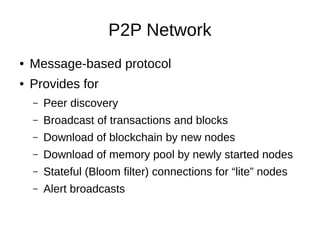
P2P Network
●

Message-based protocol

●

Provides for
–

Peer discovery

–

Broadcast of transactions and blocks

–

Download of blockchain by new nodes

–

Download of memory pool by newly started nodes

–

Stateful (Bloom filter) connections for “lite” nodes

–

Alert broadcasts
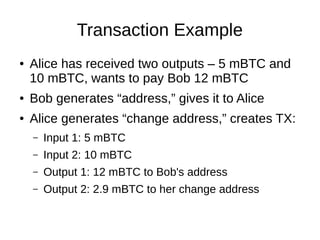
Transaction Example
●

Alice has received two outputs – 5 mBTC and
10 mBTC, wants to pay Bob 12 mBTC

●

Bob generates “address,” gives it to Alice

●

Alice generates “change address,” creates TX:
–

Input 1: 5 mBTC

–

Input 2: 10 mBTC

–

Output 1: 12 mBTC to Bob's address

–

Output 2: 2.9 mBTC to her change address
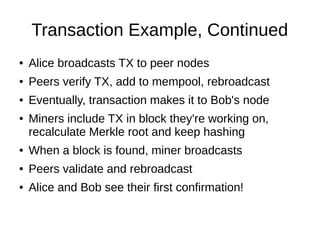
Transaction Example, Continued
●

Alice broadcasts TX to peer nodes

●

Peers verify TX, add to mempool, rebroadcast

●

Eventually, transaction makes it to Bob's node

●

Miners include TX in block they're working on,
recalculate Merkle root and keep hashing

●

When a block is found, miner broadcasts

●

Peers validate and rebroadcast

●

Alice and Bob see their first confirmation!
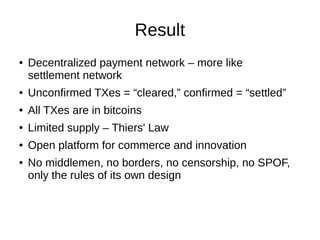
Result
●

Decentralized payment network – more like
settlement network

●

Unconfirmed TXes = “cleared,” confirmed = “settled”

●

All TXes are in bitcoins

●

Limited supply – Thiers' Law

●

Open platform for commerce and innovation

●

No middlemen, no borders, no censorship, no SPOF,
only the rules of its own design
The Future Is Here
●

●

●

Criteria for redemption can specify complex
contracts using scripts
Scripts can check signatures, hashes, m-of-n
signatures, and transactions can enforce
nLockTime and limited selection of
input/output combinations
Applications include deposits, assurance
contracts, escrow, micropayments, bets
Caveats
●

Privacy is user-defined

●

Scalability
–
–

UTXO indexing/blockchain pruning, SPV

–

Off-chain transactions, centralized and not

–
●

Block size – CPU, network, storage

Off-chain bets and other complex contracts

Transaction malleability
–

Important to contracts with refund failsafes

–

Cause of the latest ruckus
Alt-coins
●

●

Many use same technology but alter
parameters like hash algorithm, block
frequency, monetary policy – Litecoin, Freicoin,
Dogecoin
Some use unique concepts – proof of stake,
additional scripting and data storage
capabilities – PPCoin, NXT, Ethereum,
Mastercoin
Bitcoin Mining
●
●

Progression: CPU, GPU, FPGA, ASIC
Mining chip manufacturers include KnC,
CoinTerra, Butterfly Labs, ASICMiner, BitFury,
Avalon – caveat emptor

●

Mining software includes cgminer, bfgminer

●

Pools include Eligius, Slush

●

Please consider P2Pool – peer-to-peer
decentralized pool - http://p2pool.in/
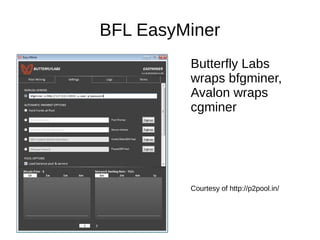
BFL EasyMiner
Butterfly Labs
wraps bfgminer,
Avalon wraps
cgminer

Courtesy of http://p2pool.in/
Alt-coin mining
●

●

Bitcoin mining software and ASICs can often
be adapted for SHA256-based coins
Litecoin and other scrypt-based coins are still
using GPUs, though ASICs are rumored
–
–

●

cgminer for AMD GPUs
cudaMiner for Nvidia GPUs

P2Pool supports Litecoin as well (maybe not
any more?)
Getting and Using Bitcoins
●

●

●

●

Buy from Coinbase, LocalBitcoins, or exchange –
caveat emptor
Sell goods or services for Bitcoin – Coinbase and
BitPay make it easy, or use FOSS
Trade for altcoins at Cryptsy and other
exchanges
Buy from many Coinbase and BitPay enabled
merchants like Overstock.com, Gyft.com,
fiverr.com, and adafruit.com
Desktop Bitcoin Wallets
●

Multibit – simple, SPV wallet

●

Electrum – uses a blockchain server

●

Hive – SPV wallet for Mac OS X

●

Bitcoin-QT and bitcoind – the full node

●

Armory – advanced security features, requires
bitcoind
Android and Web Bitcoin Wallets
●

Bitcoin Wallet by Andreas Schildbach – SPV

●

Mycelium – Android, uses a blockchain server

●

Blockchain.info – web-based and Android app

●

Coinbase – web-based and Android app

●

CoinKite – web wallet and debit card/terminal

Fredericksburg LUG Bitcoin slides

  • 1.
    Decentralized Digital Currencies Bitcoinand Beyond Presented by Alex Akselrod
  • 2.
    Why Digital Currency? ● Cashfor the Internet – – Privacy – ● Security Crypto-anarchy Examples – Digicash – one of the very first cryptocurrencies – PayPal – eGold – Liberty Reserve
  • 3.
    How they work ● ● ● ● Digicashused Chaumian blind signatures and a mint to check for double spends PayPal and Liberty Reserve balance/d user deposits against deposits with partner institutions eGold kept bullion in a vault and balanced user deposits against that Centralized ledgers – single point of failure
  • 4.
    Decentralization ● A public ledgerso everyone plays by the rules – ● Each full peer verifies all transactions Timestamps to prevent double-spending – – ● Miners operate distributed timestamp server Proof of work = lottery Initial distribution – Mining rewards – “Scamcoins” often “pre-mine” - SolidCoin
  • 5.
    The Nitty Gritty- Transactions ● Each transaction is a set of ledger entries ● Two lists – – ● ● Outputs consist of amount and condition to redeem that money - debit Inputs consist of pointer to previous output and script that makes the condition return true - credit Total input amount >= total output amount, the remainder is miner fees All outputs are fully used up when used as inputs, change outputs to new “address” help preserve privacy
  • 6.
    Transaction Diagram By MatthäusWander (Own work) [CC-BY-SA-3.0 (http://creativecommons.org/licenses/bysa/3.0)], via Wikimedia Commons http://commons.wikimedia.org/wiki/File%3ABitcoin_Transaction_Inputs_and_Outputs.png
  • 7.
    Blocks ● ● ● ● Each block containsheader and list of Txes Header contains hash of last header, timestamp, target, root of TX Merkle tree, nonce, and TX count is replaced with padding Arranged in a TREE of possible TX orderings Hash of the block being less than the target is proof of work – like HashCash, but reusable ● First TX is the “coinbase” - trustless inflation ● Until a TX is in a block, no work secures it
  • 8.
    Blockchain ● ● The blockchain isa ledger, blocks are pages Longest branch of block tree by cumulative proof of work is blockchain ● Represents current network consensus state ● Parameters change to keep time, limit supply – difficulty retargeting every 2016 blocks – subsidy halves every 210,000 blocks
  • 9.
    Blockchain Diagram By MatthäusWander (Own work) [CC-BY-SA-3.0 (http://creativecommons.org/licenses/bysa/3.0)], via Wikimedia Commons http://commons.wikimedia.org/wiki/File%3ABitcoin_Block_Data.svg
  • 10.
    P2P Network ● Message-based protocol ● Providesfor – Peer discovery – Broadcast of transactions and blocks – Download of blockchain by new nodes – Download of memory pool by newly started nodes – Stateful (Bloom filter) connections for “lite” nodes – Alert broadcasts
  • 11.
    Transaction Example ● Alice hasreceived two outputs – 5 mBTC and 10 mBTC, wants to pay Bob 12 mBTC ● Bob generates “address,” gives it to Alice ● Alice generates “change address,” creates TX: – Input 1: 5 mBTC – Input 2: 10 mBTC – Output 1: 12 mBTC to Bob's address – Output 2: 2.9 mBTC to her change address
  • 12.
    Transaction Example, Continued ● Alicebroadcasts TX to peer nodes ● Peers verify TX, add to mempool, rebroadcast ● Eventually, transaction makes it to Bob's node ● Miners include TX in block they're working on, recalculate Merkle root and keep hashing ● When a block is found, miner broadcasts ● Peers validate and rebroadcast ● Alice and Bob see their first confirmation!
  • 13.
    Result ● Decentralized payment network– more like settlement network ● Unconfirmed TXes = “cleared,” confirmed = “settled” ● All TXes are in bitcoins ● Limited supply – Thiers' Law ● Open platform for commerce and innovation ● No middlemen, no borders, no censorship, no SPOF, only the rules of its own design
  • 14.
    The Future IsHere ● ● ● Criteria for redemption can specify complex contracts using scripts Scripts can check signatures, hashes, m-of-n signatures, and transactions can enforce nLockTime and limited selection of input/output combinations Applications include deposits, assurance contracts, escrow, micropayments, bets
  • 15.
    Caveats ● Privacy is user-defined ● Scalability – – UTXOindexing/blockchain pruning, SPV – Off-chain transactions, centralized and not – ● Block size – CPU, network, storage Off-chain bets and other complex contracts Transaction malleability – Important to contracts with refund failsafes – Cause of the latest ruckus
  • 16.
    Alt-coins ● ● Many use sametechnology but alter parameters like hash algorithm, block frequency, monetary policy – Litecoin, Freicoin, Dogecoin Some use unique concepts – proof of stake, additional scripting and data storage capabilities – PPCoin, NXT, Ethereum, Mastercoin
  • 17.
    Bitcoin Mining ● ● Progression: CPU,GPU, FPGA, ASIC Mining chip manufacturers include KnC, CoinTerra, Butterfly Labs, ASICMiner, BitFury, Avalon – caveat emptor ● Mining software includes cgminer, bfgminer ● Pools include Eligius, Slush ● Please consider P2Pool – peer-to-peer decentralized pool - http://p2pool.in/
  • 18.
    BFL EasyMiner Butterfly Labs wrapsbfgminer, Avalon wraps cgminer Courtesy of http://p2pool.in/
  • 19.
    Alt-coin mining ● ● Bitcoin miningsoftware and ASICs can often be adapted for SHA256-based coins Litecoin and other scrypt-based coins are still using GPUs, though ASICs are rumored – – ● cgminer for AMD GPUs cudaMiner for Nvidia GPUs P2Pool supports Litecoin as well (maybe not any more?)
  • 20.
    Getting and UsingBitcoins ● ● ● ● Buy from Coinbase, LocalBitcoins, or exchange – caveat emptor Sell goods or services for Bitcoin – Coinbase and BitPay make it easy, or use FOSS Trade for altcoins at Cryptsy and other exchanges Buy from many Coinbase and BitPay enabled merchants like Overstock.com, Gyft.com, fiverr.com, and adafruit.com
  • 21.
    Desktop Bitcoin Wallets ● Multibit– simple, SPV wallet ● Electrum – uses a blockchain server ● Hive – SPV wallet for Mac OS X ● Bitcoin-QT and bitcoind – the full node ● Armory – advanced security features, requires bitcoind
  • 22.
    Android and WebBitcoin Wallets ● Bitcoin Wallet by Andreas Schildbach – SPV ● Mycelium – Android, uses a blockchain server ● Blockchain.info – web-based and Android app ● Coinbase – web-based and Android app ● CoinKite – web wallet and debit card/terminal