OpenID Connect for SSI
Kristina Yasuda, Microsoft
Dr. Torsten Lodderstedt, yes.com
v.02
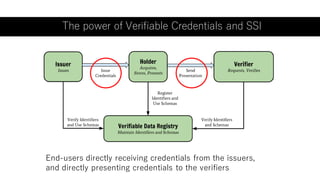
The power of Verifiable Credentials and SSI
End-users directly receiving credentials from the issuers,
and directly presenting credentials to the verifiers
The Problem
Verifiable Credentials is only a data model…
… How to transport Verifiable Credentials
when implementing?
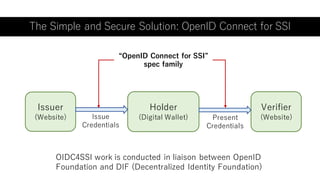
The Simple and Secure Solution: OpenID Connect for SSI
Issuer
(Website)
Verifier
(Website)
Holder
(Digital Wallet)
Issue
Credentials
Present
Credentials
“OpenID Connect for SSI”
spec family
OIDC4SSI work is conducted in liaison between OpenID
Foundation and DIF (Decentralized Identity Foundation)
- Provide the community with a solution for SSI applications
leveraging the simplicity and security of OpenID Connect
- Security of OpenID Connect has been test and formally
analysed
- Allow existing OpenID Connect RPs to access SSI credential
Why extend OpenID Connect to support SSI?
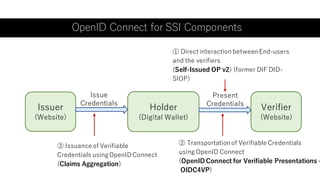
① Direct interaction between End-users
and the verifiers
(Self-Issued OP v2) (former DIF DID-
SIOP)
OpenID Connect for SSI Components
Issuer
(Website)
Verifier
(Website)
Holder
(Digital Wallet)
Issue
Credentials
Present
Credentials
② Transportation of Verifiable Credentials
using OpenID Connect
(OpenID Connect for Verifiable Presentations -
OIDC4VP)
③ Issuance of Verifiable
Credentials usingOpenIDConnect
(Claims Aggregation)
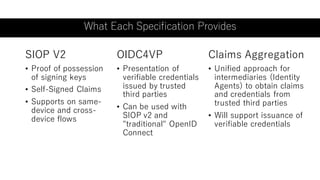
What Each Specification Provides
SIOP V2
• Proof of possession
of signing keys
• Self-Signed Claims
• Supports on same-
device and cross-
device flows
OIDC4VP
• Presentation of
verifiable credentials
issued by trusted
third parties
• Can be used with
SIOP v2 and
"traditional" OpenID
Connect
Claims Aggregation
• Unified approach for
intermediaries (Identity
Agents) to obtain claims
and credentials from
trusted third parties
• Will support issuance of
verifiable credentials
SIOP v2
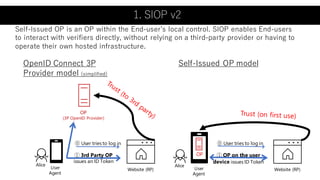
1. SIOP v2
OpenID Connect 3P
Provider model (simplified)
Self-Issued OP model
⓪ User tries to log in
Website (RP)
User
Agent
OP
(3P OpenID Provider)
Alice
① 3rd Party OP
issues an ID Token
⓪ User tries to log in
Website (RP)
User
Agent
OP ① OP on the user
device issues ID Token
Alice
Self-Issued OP is an OP within the End-user’s local control. SIOP enables End-users
to interact with verifiers directly, without relying on a third-party provider or having to
operate their own hosted infrastructure.
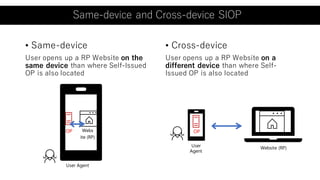
• Same-device
User opens up a RP Website on the
same device than where Self-Issued
OP is also located
• Cross-device
User opens up a RP Website on a
different device than where Self-
Issued OP is also located
Webs
ite (RP)
User Agent
OP
Same-device and Cross-device SIOP
Website (RP)
User
Agent
OP
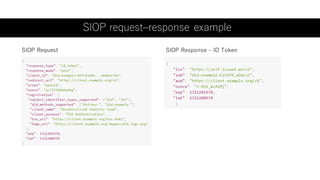
SIOP request–response example
SIOP Response – ID Token
SIOP Request
OpenID Connect 4 Verifiable
Presentations
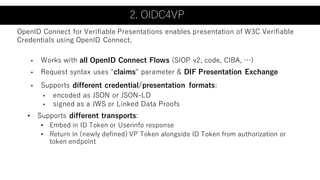
• Works with all OpenID Connect Flows (SIOP v2, code, CIBA, …)
• Request syntax uses "claims" parameter & DIF Presentation Exchange
• Supports different credential/presentation formats:
• encoded as JSON or JSON-LD
• signed as a JWS or Linked Data Proofs
• Supports different transports:
• Embed in ID Token or Userinfo response
• Return in (newly defined) VP Token alongside ID Token from authorization or
token endpoint
OpenID Connect for Verifiable Presentations enables presentation of W3C Verifiable
Credentials using OpenID Connect.
2. OIDC4VP
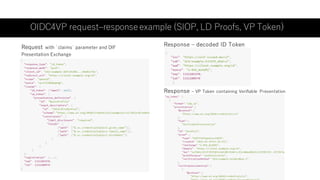
Response – decoded ID Token
OIDC4VP request–response example (SIOP, LD Proofs, VP Token)
Request with `claims` parameter and DIF
Presentation Exchange
Response – VP Token containing Verifiable Presentation
DEMO
Bringing it all together ...
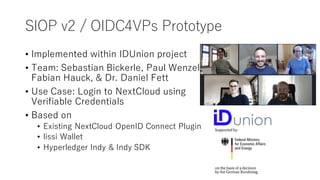
SIOP v2 / OIDC4VPs Prototype
• Implemented within IDUnion project
• Team: Sebastian Bickerle, Paul Wenzel,
Fabian Hauck, & Dr. Daniel Fett
• Use Case: Login to NextCloud using
Verifiable Credentials
• Based on
• Existing NextCloud OpenID Connect Plugin
• lissi Wallet
• Hyperledger Indy & Indy SDK
DEMO
• On device: https://youtu.be/gDg2ma7TwWU
• Cross device: https://youtu.be/hC3VQE-vMnQ
Details & Findings
• SIOP instead of DIDComm
• No separate connection establishment step required
• On device:
• Direct communication between verifier and wallet w/o cloud
agent/network communication
• Cross device:
• Additional backend call from wallet to verifier (HTTPS POST)
• QR Code pretty huge
Next Steps
• SIOP v2
• Resolvable client ids (DIDs, Entity Statements)
• OP Discovery
• Security Analysis
• OIDC4VP
• Integration of presentation submissions
• Additional Security Considerations
• Gather Implementors Feedback
• Claims Aggregation
• Request by credential type
• Proof of possession of key material (vs client authentication)
• Use with other grant type than "code"
If you want to learn more
Backup
3. Claims Aggregation
- Under Development (merged with Credential Provider draft)
Enables Holder to obtain Verifiable Credentials from the Issuer(s).
3. Claims Aggregation
Status and Topics being worked on
- Adoption
- Prototypes
- Open Topics
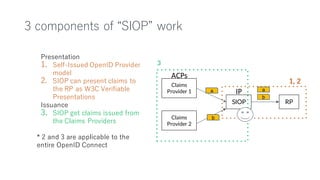
3 components of “SIOP” work
Presentation
1. Self-Issued OpenID Provider
model
2. SIOP can present claims to
the RP as W3C Verifiable
Presentations
Issuance
3. SIOP get claims issued from
the Claims Providers
* 2 and 3 are applicable to the
entire OpenID Connect
Claims
Provider 1
SIOP RP
a
b
a
b
1, 2
3
Claims
Provider 2
ACPs
IP
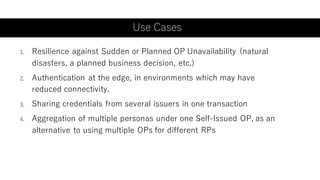
1. Resilience against Sudden or Planned OP Unavailability (natural
disasters, a planned business decision, etc.)
2. Authentication at the edge, in environments which may have
reduced connectivity.
3. Sharing credentials from several issuers in one transaction
4. Aggregation of multiple personas under one Self-Issued OP, as an
alternative to using multiple OPs for different RPs
Use Cases
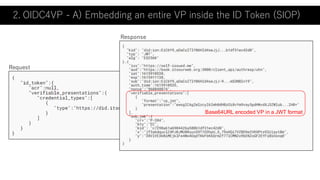
Base64URL encoded VP in a JWT format
Request
Response
2. OIDC4VP - A) Embedding an entire VP inside the ID Token (SIOP)
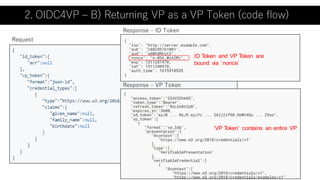
ID T
oken and VP Token are
bound via `nonce`
‘VP T
oken’ contains an entire VP
2. OIDC4VP – B) Returning VP as a VP Token (code flow)
Request
Response – ID Token
Response – VP Token
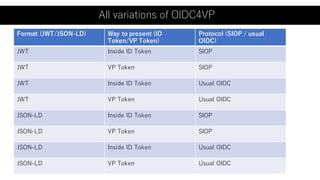
Format (JWT/JSON-LD) Way to present (ID
Token/VP Token)
Protocol (SIOP / usual
OIDC)
JWT Inside ID Token SIOP
JWT VP Token SIOP
JWT Inside ID Token Usual OIDC
JWT VP Token Usual OIDC
JSON-LD Inside ID Token SIOP
JSON-LD VP Token SIOP
JSON-LD Inside ID Token Usual OIDC
JSON-LD VP Token Usual OIDC
All variations of OIDC4VP

OpenID Connect 4 SSI (at EIC 2021)

  • 1.
    OpenID Connect forSSI Kristina Yasuda, Microsoft Dr. Torsten Lodderstedt, yes.com v.02
  • 2.
    The power ofVerifiable Credentials and SSI End-users directly receiving credentials from the issuers, and directly presenting credentials to the verifiers
  • 3.
    The Problem Verifiable Credentialsis only a data model… … How to transport Verifiable Credentials when implementing?
  • 4.
    The Simple andSecure Solution: OpenID Connect for SSI Issuer (Website) Verifier (Website) Holder (Digital Wallet) Issue Credentials Present Credentials “OpenID Connect for SSI” spec family OIDC4SSI work is conducted in liaison between OpenID Foundation and DIF (Decentralized Identity Foundation)
  • 5.
    - Provide thecommunity with a solution for SSI applications leveraging the simplicity and security of OpenID Connect - Security of OpenID Connect has been test and formally analysed - Allow existing OpenID Connect RPs to access SSI credential Why extend OpenID Connect to support SSI?
  • 6.
    ① Direct interactionbetween End-users and the verifiers (Self-Issued OP v2) (former DIF DID- SIOP) OpenID Connect for SSI Components Issuer (Website) Verifier (Website) Holder (Digital Wallet) Issue Credentials Present Credentials ② Transportation of Verifiable Credentials using OpenID Connect (OpenID Connect for Verifiable Presentations - OIDC4VP) ③ Issuance of Verifiable Credentials usingOpenIDConnect (Claims Aggregation)
  • 7.
    What Each SpecificationProvides SIOP V2 • Proof of possession of signing keys • Self-Signed Claims • Supports on same- device and cross- device flows OIDC4VP • Presentation of verifiable credentials issued by trusted third parties • Can be used with SIOP v2 and "traditional" OpenID Connect Claims Aggregation • Unified approach for intermediaries (Identity Agents) to obtain claims and credentials from trusted third parties • Will support issuance of verifiable credentials
  • 8.
  • 9.
    1. SIOP v2 OpenIDConnect 3P Provider model (simplified) Self-Issued OP model ⓪ User tries to log in Website (RP) User Agent OP (3P OpenID Provider) Alice ① 3rd Party OP issues an ID Token ⓪ User tries to log in Website (RP) User Agent OP ① OP on the user device issues ID Token Alice Self-Issued OP is an OP within the End-user’s local control. SIOP enables End-users to interact with verifiers directly, without relying on a third-party provider or having to operate their own hosted infrastructure.
  • 10.
    • Same-device User opensup a RP Website on the same device than where Self-Issued OP is also located • Cross-device User opens up a RP Website on a different device than where Self- Issued OP is also located Webs ite (RP) User Agent OP Same-device and Cross-device SIOP Website (RP) User Agent OP
  • 11.
    SIOP request–response example SIOPResponse – ID Token SIOP Request
  • 12.
    OpenID Connect 4Verifiable Presentations
  • 13.
    • Works withall OpenID Connect Flows (SIOP v2, code, CIBA, …) • Request syntax uses "claims" parameter & DIF Presentation Exchange • Supports different credential/presentation formats: • encoded as JSON or JSON-LD • signed as a JWS or Linked Data Proofs • Supports different transports: • Embed in ID Token or Userinfo response • Return in (newly defined) VP Token alongside ID Token from authorization or token endpoint OpenID Connect for Verifiable Presentations enables presentation of W3C Verifiable Credentials using OpenID Connect. 2. OIDC4VP
  • 14.
    Response – decodedID Token OIDC4VP request–response example (SIOP, LD Proofs, VP Token) Request with `claims` parameter and DIF Presentation Exchange Response – VP Token containing Verifiable Presentation
  • 15.
  • 16.
    SIOP v2 /OIDC4VPs Prototype • Implemented within IDUnion project • Team: Sebastian Bickerle, Paul Wenzel, Fabian Hauck, & Dr. Daniel Fett • Use Case: Login to NextCloud using Verifiable Credentials • Based on • Existing NextCloud OpenID Connect Plugin • lissi Wallet • Hyperledger Indy & Indy SDK
  • 17.
    DEMO • On device:https://youtu.be/gDg2ma7TwWU • Cross device: https://youtu.be/hC3VQE-vMnQ
  • 18.
    Details & Findings •SIOP instead of DIDComm • No separate connection establishment step required • On device: • Direct communication between verifier and wallet w/o cloud agent/network communication • Cross device: • Additional backend call from wallet to verifier (HTTPS POST) • QR Code pretty huge
  • 19.
    Next Steps • SIOPv2 • Resolvable client ids (DIDs, Entity Statements) • OP Discovery • Security Analysis • OIDC4VP • Integration of presentation submissions • Additional Security Considerations • Gather Implementors Feedback • Claims Aggregation • Request by credential type • Proof of possession of key material (vs client authentication) • Use with other grant type than "code"
  • 20.
    If you wantto learn more
  • 21.
  • 22.
    3. Claims Aggregation -Under Development (merged with Credential Provider draft) Enables Holder to obtain Verifiable Credentials from the Issuer(s). 3. Claims Aggregation
  • 23.
    Status and Topicsbeing worked on - Adoption - Prototypes - Open Topics
  • 24.
    3 components of“SIOP” work Presentation 1. Self-Issued OpenID Provider model 2. SIOP can present claims to the RP as W3C Verifiable Presentations Issuance 3. SIOP get claims issued from the Claims Providers * 2 and 3 are applicable to the entire OpenID Connect Claims Provider 1 SIOP RP a b a b 1, 2 3 Claims Provider 2 ACPs IP
  • 25.
    1. Resilience againstSudden or Planned OP Unavailability (natural disasters, a planned business decision, etc.) 2. Authentication at the edge, in environments which may have reduced connectivity. 3. Sharing credentials from several issuers in one transaction 4. Aggregation of multiple personas under one Self-Issued OP, as an alternative to using multiple OPs for different RPs Use Cases
  • 26.
    Base64URL encoded VPin a JWT format Request Response 2. OIDC4VP - A) Embedding an entire VP inside the ID Token (SIOP)
  • 27.
    ID T oken andVP Token are bound via `nonce` ‘VP T oken’ contains an entire VP 2. OIDC4VP – B) Returning VP as a VP Token (code flow) Request Response – ID Token Response – VP Token
  • 28.
    Format (JWT/JSON-LD) Wayto present (ID Token/VP Token) Protocol (SIOP / usual OIDC) JWT Inside ID Token SIOP JWT VP Token SIOP JWT Inside ID Token Usual OIDC JWT VP Token Usual OIDC JSON-LD Inside ID Token SIOP JSON-LD VP Token SIOP JSON-LD Inside ID Token Usual OIDC JSON-LD VP Token Usual OIDC All variations of OIDC4VP