Intro To Web3
@harpaljadeja11
Agenda
Characterisitcs of Web3
What is Blockchain?
How to get started?
Sectors (DeFi, NFTs, DAOs)
Some Noteworthy DApps.
Web3 Tech Stack
Next Frontier
@harpaljadeja11
Characteristics of Web3
De-centralization
Trust-less
Permission-less
@harpaljadeja11
Decentralization
Decentralization is not same as Distributed.
Network of Participants working towards providing service.
Network is operated by Consensys algorithm (PoW, PoS).
Extreme Fault tolerance.
Availibility of the network increases as Participants increase.
@harpaljadeja11
Trust-less
"Humans are not trust-worthy"
We may not trust the engineers but we can trust their code.
Code and the transactions on the blockchain are immutable and
irreversible.
Assuming you know how code works and there is no security vulnerability your funds won't be
compromised.
@harpaljadeja11
Permissionless
Neither the participants nor the users of the network need
permissions from any central authority or organization.
Anyone can deploy any amount of DApps on any blockchain (except
Bitcoin).
@harpaljadeja11
What is Blockchain?
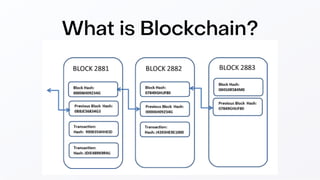
What is Blockchain?
A chain of blocks. In technical terms, public distributed ledger.
Blocks contains transactions which are mined by miners in case of
PoW.
Blocks are produced by a randomly selected validator and the other
participants attest it in PoS.
Proof - of - Work (PoW)
Proof - of - Stake (PoS)
Why was Bitcoin created?
Remove third-party intermediaries involved in digital monetary
transfers.
The cost incurred can be significant and can be a reason to restrict
transaction below a certain size.
Created right after the financial crisis of 2008.
Often considered as Hedge towards Inflation.
@harpaljadeja11
Why was Ethereum created?
Ethereum is a Programmable blockchain.
Making it possible to build apps that leverage blockchain
technology.
Transactions on ethereum are not just value transfer (like bitcoin)
but can also be code execution.
@harpaljadeja11
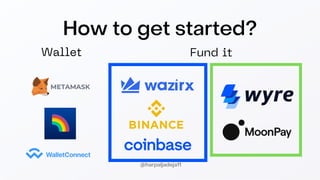
How to get started?
Wallet Fund it
@harpaljadeja11
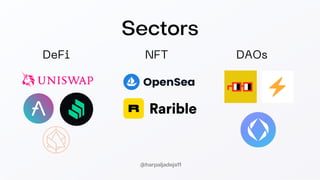
Sectors
DeFi NFT DAOs
@harpaljadeja11
Uniswap
Uniswap was one of the early DeFi Protocols.
Uniswap is an AMM (Automated Market Maker).
Unlike traditional exchanges with order books.
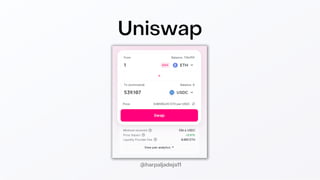
Uniswap uses pools which holds both tokens of the pair.
Instead of order matching it simply lets you swap tokens and
depending on the ratio of token reserve in the pool the price of the
assets fluctuate.
@harpaljadeja11
Uniswap
@harpaljadeja11
Uniswap
Anybody can create pools for any token pair.
Contracts are non-upgradable and forever persistent (until ethereum
exists).
Users can also provide liquidity to the pools in exchange to earn
fees for the trades in that particular pair.
v1 only lets you have ERC20-ETH pairs, v2 allowed ERC20-ERC20
pairs.
@harpaljadeja11
Uniswap
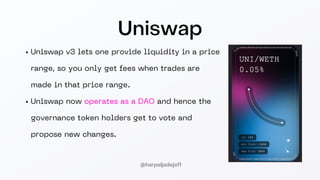
Uniswap v3 lets one provide liquidity in a price
range, so you only get fees when trades are
made in that price range.
Uniswap now operates as a DAO and hence the
governance token holders get to vote and
propose new changes.
@harpaljadeja11
@harpaljadeja11
Compound
Compound is a lending and borrowing protocol.
You can lend / lock your assets with Compound and earn interest on
it. (just like savings account)
You can also borrow assets against your lended assets. However,
compound has collateralization ratios which decide how much you
can borrow against your assets.
@harpaljadeja11
Compound
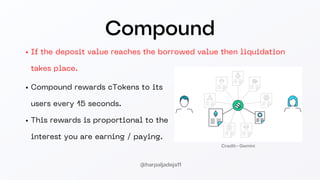
If the deposit value reaches the borrowed value then liquidation
takes place.
Compound rewards cTokens to its
users every 15 seconds.
This rewards is proportional to the
interest you are earning / paying.
Credit:- Gemini
@harpaljadeja11
Compound
Compound's cToken is the governance token.
User holding the cToken have a say in the governance of the
protocol.
Compound governance works on 3-day voting period. So the users
get 2 days to close any open positions before the change is
implemented.
All this is on-chain and decentralized.
@harpaljadeja11
Aave
Aave is also a lending and borrowing protocol.
Borrowing against Aave token has discounts.
Aave was the first protocol to introduce "Flash Loans".
Flash loans lets you borrow assets without Collateral.
Flash loans take advantage of the nature of transactions.
Flash loans are borrowed and settled in the same transaction along
with 0.09% fee.
@harpaljadeja11
Aave
The flash loans can be used for arbitrage purposes.
Aave has pool-to-peer lending borrowing which means are assets
are accumulated in a pool.
Lenders get respective aTokens for lending (aUSDT for USDT etc...)
These tokens represent your position, however you can also use those
tokens for are other DeFi purposes.
Hence, not only you are earning interest but you also have liquidity.
@harpaljadeja11
Alchemix
Alchemix gives you self-repaying loans 🤯.
Alchemix lets you take 50% loan on your collateral.
Borrowing from yourselves.
Alchemix rather than charging interest on your loan uses your
collateral to earn interest and pay back your loan using that
interest.
@harpaljadeja11
Alchemix
Alchemix takes your collateral and uses Yearn Finance vaults to earn
interest on your collateral and pay back your loan.
At the time of making this slide Alchemix has $673.1M locked.
https://every.to/almanack/alchemix-self-paying-loans
@harpaljadeja11
1Inch
1inch is a DEX aggregator that picks and chooses the cheapest crypto
prices across decentralized exchanges.
1inch tries to get you the tokens for the best rate.
It was one of the first to offer limit orders on-chain.
Supports 5 networks and has 81 liquidity sources.
@harpaljadeja11
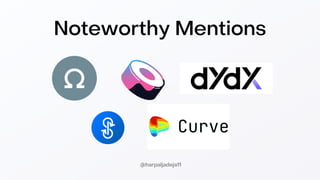
Noteworthy Mentions
@harpaljadeja11
NFTs
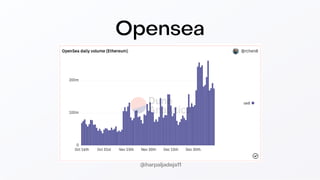
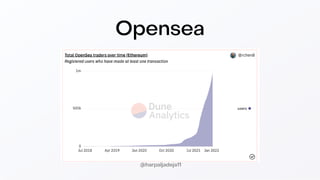
Opensea
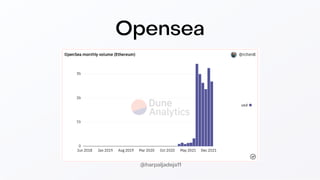
OpenSea is a decentralized non-fungible token (NFT) marketplace
for buying, selling, and trading NFTs.
Some big-name players like Mark Cuban, Gary Vaynerchuk, and
Chamath Palihapitiya have recently expressed interest in the space.
Opensea is also the google for NFTs.
@harpaljadeja11
Opensea
@harpaljadeja11
Opensea
@harpaljadeja11
Opensea
@harpaljadeja11
Ethereum Name Service
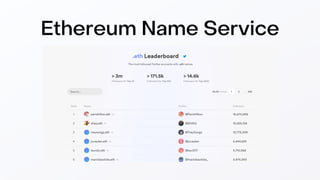
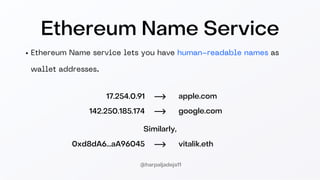
Ethereum Name service lets you have human-readable names as
wallet addresses.
17.254.0.91 apple.com
142.250.185.174 google.com
Similarly,
0xd8dA6...aA96045 vitalik.eth
@harpaljadeja11
Ethereum Name Service
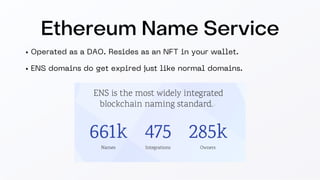
Operated as a DAO. Resides as an NFT in your wallet.
ENS domains do get expired just like normal domains.
Ethereum Name Service
Web3 Tech Stack
How to build your own DApps?
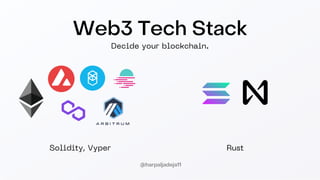
Web3 Tech Stack
Decide your blockchain.
Solidity, Vyper Rust
@harpaljadeja11
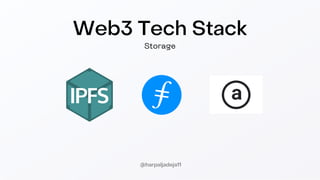
Web3 Tech Stack
Storage
@harpaljadeja11
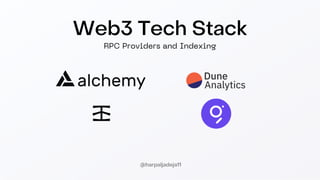
Web3 Tech Stack
RPC Providers and Indexing
@harpaljadeja11
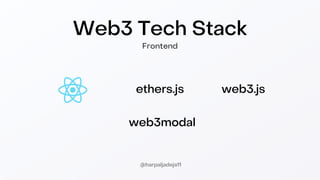
Web3 Tech Stack
Frontend
ethers.js web3.js
web3modal
@harpaljadeja11
Web3 Tech Stack
Developer Tools (Testing & Deployment)
@harpaljadeja11
Web3 Tech Stack
Off-Chain Computation & Data
@harpaljadeja11
Chainlink VRF, Chainlink Keepers, Chainlink External Adapters, and
Chainlink CCIP.
Next Frontier
What's Next?
Centrifuge is working on bringing real world assets into DeFi.
Assets like Invoices, Real Estate and royalties.
Investors invest to get stable returns and Asset originators get to
finance their assets.
Fractionalized Real Estate by Labs Group lets anyone invest as little
as $100 in any property listed on their platform.
Real World DeFi
@harpaljadeja11
Decentraland and Sandbox are the major players.
Opportunity for VR Developers, Game developers, and 3d Modellers.
Facebook changed their company name to Meta.
Social interactions, Education, Research, Entertainment and Events
pretty much everything will happen in the Metaverse.
Metaverse
@harpaljadeja11
Metaverse
@harpaljadeja11
Metaverse
zk (Zero-Knowledge Proofs)
Current implementations of blockchain are not private in any sense.
A zero-knowledge proof or zero-knowledge protocol is a method by
which one party (the prover) can prove to another party (the verifier)
that a given statement is true while the prover avoids conveying any
additional information apart from the fact that the statement is
indeed true.
@harpaljadeja11
zk (Zero-Knowledge Proofs)
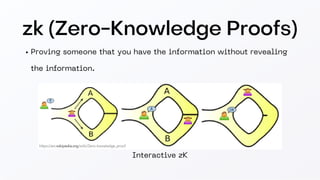
Proving someone that you have the information without revealing
the information.
Interactive zK
ING bank uses zK that allows its users to prove that their secret
number (salary) lies within in a known range using which a user can
prove its eligibility for a loan.
zK can be used for Login.
ZCash is a zk-SNARK based blockchain.
Researchers and Machine learning engineers can convince others the
results of their models without revealing the underlying work.
zk (Zero-Knowledge Proofs)
@harpaljadeja11
Questions?
@harpaljadeja11 - twitter
Thank You!

Intro to Web3

  • 1.
  • 2.
    Agenda Characterisitcs of Web3 Whatis Blockchain? How to get started? Sectors (DeFi, NFTs, DAOs) Some Noteworthy DApps. Web3 Tech Stack Next Frontier @harpaljadeja11
  • 3.
  • 4.
    Decentralization Decentralization is notsame as Distributed. Network of Participants working towards providing service. Network is operated by Consensys algorithm (PoW, PoS). Extreme Fault tolerance. Availibility of the network increases as Participants increase. @harpaljadeja11
  • 5.
    Trust-less "Humans are nottrust-worthy" We may not trust the engineers but we can trust their code. Code and the transactions on the blockchain are immutable and irreversible. Assuming you know how code works and there is no security vulnerability your funds won't be compromised. @harpaljadeja11
  • 6.
    Permissionless Neither the participantsnor the users of the network need permissions from any central authority or organization. Anyone can deploy any amount of DApps on any blockchain (except Bitcoin). @harpaljadeja11
  • 7.
  • 8.
    What is Blockchain? Achain of blocks. In technical terms, public distributed ledger. Blocks contains transactions which are mined by miners in case of PoW. Blocks are produced by a randomly selected validator and the other participants attest it in PoS. Proof - of - Work (PoW) Proof - of - Stake (PoS)
  • 9.
    Why was Bitcoincreated? Remove third-party intermediaries involved in digital monetary transfers. The cost incurred can be significant and can be a reason to restrict transaction below a certain size. Created right after the financial crisis of 2008. Often considered as Hedge towards Inflation. @harpaljadeja11
  • 10.
    Why was Ethereumcreated? Ethereum is a Programmable blockchain. Making it possible to build apps that leverage blockchain technology. Transactions on ethereum are not just value transfer (like bitcoin) but can also be code execution. @harpaljadeja11
  • 11.
    How to getstarted? Wallet Fund it @harpaljadeja11
  • 12.
  • 14.
    Uniswap Uniswap was oneof the early DeFi Protocols. Uniswap is an AMM (Automated Market Maker). Unlike traditional exchanges with order books. Uniswap uses pools which holds both tokens of the pair. Instead of order matching it simply lets you swap tokens and depending on the ratio of token reserve in the pool the price of the assets fluctuate. @harpaljadeja11
  • 15.
  • 16.
    Uniswap Anybody can createpools for any token pair. Contracts are non-upgradable and forever persistent (until ethereum exists). Users can also provide liquidity to the pools in exchange to earn fees for the trades in that particular pair. v1 only lets you have ERC20-ETH pairs, v2 allowed ERC20-ERC20 pairs. @harpaljadeja11
  • 17.
    Uniswap Uniswap v3 letsone provide liquidity in a price range, so you only get fees when trades are made in that price range. Uniswap now operates as a DAO and hence the governance token holders get to vote and propose new changes. @harpaljadeja11
  • 18.
  • 19.
    Compound Compound is alending and borrowing protocol. You can lend / lock your assets with Compound and earn interest on it. (just like savings account) You can also borrow assets against your lended assets. However, compound has collateralization ratios which decide how much you can borrow against your assets. @harpaljadeja11
  • 20.
    Compound If the depositvalue reaches the borrowed value then liquidation takes place. Compound rewards cTokens to its users every 15 seconds. This rewards is proportional to the interest you are earning / paying. Credit:- Gemini @harpaljadeja11
  • 21.
    Compound Compound's cToken isthe governance token. User holding the cToken have a say in the governance of the protocol. Compound governance works on 3-day voting period. So the users get 2 days to close any open positions before the change is implemented. All this is on-chain and decentralized. @harpaljadeja11
  • 23.
    Aave Aave is alsoa lending and borrowing protocol. Borrowing against Aave token has discounts. Aave was the first protocol to introduce "Flash Loans". Flash loans lets you borrow assets without Collateral. Flash loans take advantage of the nature of transactions. Flash loans are borrowed and settled in the same transaction along with 0.09% fee. @harpaljadeja11
  • 24.
    Aave The flash loanscan be used for arbitrage purposes. Aave has pool-to-peer lending borrowing which means are assets are accumulated in a pool. Lenders get respective aTokens for lending (aUSDT for USDT etc...) These tokens represent your position, however you can also use those tokens for are other DeFi purposes. Hence, not only you are earning interest but you also have liquidity. @harpaljadeja11
  • 26.
    Alchemix Alchemix gives youself-repaying loans 🤯. Alchemix lets you take 50% loan on your collateral. Borrowing from yourselves. Alchemix rather than charging interest on your loan uses your collateral to earn interest and pay back your loan using that interest. @harpaljadeja11
  • 27.
    Alchemix Alchemix takes yourcollateral and uses Yearn Finance vaults to earn interest on your collateral and pay back your loan. At the time of making this slide Alchemix has $673.1M locked. https://every.to/almanack/alchemix-self-paying-loans @harpaljadeja11
  • 29.
    1Inch 1inch is aDEX aggregator that picks and chooses the cheapest crypto prices across decentralized exchanges. 1inch tries to get you the tokens for the best rate. It was one of the first to offer limit orders on-chain. Supports 5 networks and has 81 liquidity sources. @harpaljadeja11
  • 30.
  • 31.
  • 33.
    Opensea OpenSea is adecentralized non-fungible token (NFT) marketplace for buying, selling, and trading NFTs. Some big-name players like Mark Cuban, Gary Vaynerchuk, and Chamath Palihapitiya have recently expressed interest in the space. Opensea is also the google for NFTs. @harpaljadeja11
  • 34.
  • 35.
  • 36.
  • 38.
    Ethereum Name Service EthereumName service lets you have human-readable names as wallet addresses. 17.254.0.91 apple.com 142.250.185.174 google.com Similarly, 0xd8dA6...aA96045 vitalik.eth @harpaljadeja11
  • 39.
    Ethereum Name Service Operatedas a DAO. Resides as an NFT in your wallet. ENS domains do get expired just like normal domains.
  • 40.
  • 41.
    Web3 Tech Stack Howto build your own DApps?
  • 42.
    Web3 Tech Stack Decideyour blockchain. Solidity, Vyper Rust @harpaljadeja11
  • 43.
  • 44.
    Web3 Tech Stack RPCProviders and Indexing @harpaljadeja11
  • 45.
    Web3 Tech Stack Frontend ethers.jsweb3.js web3modal @harpaljadeja11
  • 46.
    Web3 Tech Stack DeveloperTools (Testing & Deployment) @harpaljadeja11
  • 47.
    Web3 Tech Stack Off-ChainComputation & Data @harpaljadeja11 Chainlink VRF, Chainlink Keepers, Chainlink External Adapters, and Chainlink CCIP.
  • 48.
  • 49.
    Centrifuge is workingon bringing real world assets into DeFi. Assets like Invoices, Real Estate and royalties. Investors invest to get stable returns and Asset originators get to finance their assets. Fractionalized Real Estate by Labs Group lets anyone invest as little as $100 in any property listed on their platform. Real World DeFi @harpaljadeja11
  • 50.
    Decentraland and Sandboxare the major players. Opportunity for VR Developers, Game developers, and 3d Modellers. Facebook changed their company name to Meta. Social interactions, Education, Research, Entertainment and Events pretty much everything will happen in the Metaverse. Metaverse @harpaljadeja11
  • 51.
  • 52.
  • 53.
    zk (Zero-Knowledge Proofs) Currentimplementations of blockchain are not private in any sense. A zero-knowledge proof or zero-knowledge protocol is a method by which one party (the prover) can prove to another party (the verifier) that a given statement is true while the prover avoids conveying any additional information apart from the fact that the statement is indeed true. @harpaljadeja11
  • 54.
    zk (Zero-Knowledge Proofs) Provingsomeone that you have the information without revealing the information. Interactive zK
  • 55.
    ING bank useszK that allows its users to prove that their secret number (salary) lies within in a known range using which a user can prove its eligibility for a loan. zK can be used for Login. ZCash is a zk-SNARK based blockchain. Researchers and Machine learning engineers can convince others the results of their models without revealing the underlying work. zk (Zero-Knowledge Proofs) @harpaljadeja11
  • 56.
  • 57.