The
Human
Experience
Process
Up, up & away
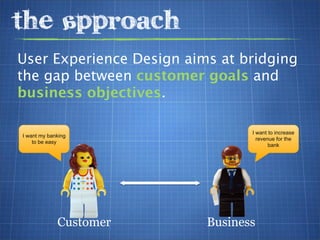
The Approach
Experience Design aims at bridging the
gap between customer goals and
business objectives.

                                    I just want
 I want a                             to make
good deal                              money


       Customer          Business
Our Vision How we get there
 We strive to create a useful, memorable &
  valuable customer experience through basing
  our designs on real people with real
  needs, frustrations and desires.

 We keep it real - involving customers and
  business stakeholders throughout the entire
  process.
* Get a process
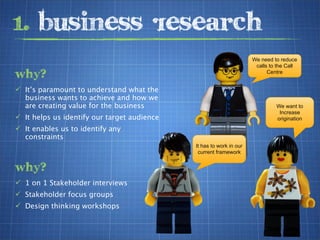
1. Business Research
                                                                    We need to
                                                                 reduce calls to the
Why?                                                                Call Centre

 It’s paramount to understand what the
  business wants to achieve and how we
  are creating value for the business
                                                                           We want to
 It helps us identify our target audience                                  Increase
                                                                           origination
 It enables us to identify any constraints
                                               We can only do
                                              so much with the
                                               technology we
                                                   have
How?
 1 on 1 Stakeholder interviews
 Stakeholder focus groups
 Design thinking & innovation
  workshops
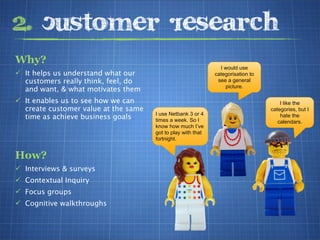
2. Customer Research
Why?
                                                                I just want to
 It helps us understand what our                              make sure my
                                                              family is looked
  customers really think, feel, do and                               after
  want, & what motivates them
 It enables us to see how we can                                                I’m sick of
  create customer value at the same                                              working for
  time as achieve business goals                                                   idiots…
                                         OMG yesterday I
                                         broke a nail and I
                                           nearly cried!


How?
 Co-design
 Contextual Inquiry
 Interviews & surveys
 Focus groups
 Cognitive walkthroughs
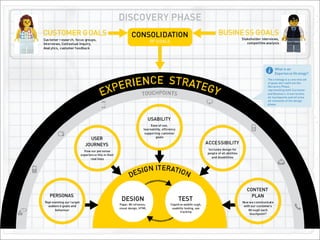
3. Experience Strategy
How do customer and business goals align?
   Customer
    Goals


              Access   Discover   Learn     Manage
   Business
    Goals


                       Expose     Educate   Guide    Grow


This strategy becomes the incontrovertible truth we design to
4. Personas
What is it?
 A representation of a real life
  customer
 Represents the goals, behaviours,
  skills, attitudes and environment of
  a real group of customers
 Based on customer research
 Guides the design process so that
  we remain true to customer needs


How?
 Use affinity diagramming to map customer verbatims from research sessions into
  personas
 Determine the number of personas needed
 Personalise & prioritise
5. User journeys
What is it?
 Explores a user’s thought
  processes, emotional
  states, behavioral patterns & paths
 Validates if our customer needs
  match our business needs


How?
 Starts with a persona’s primary need or goal that can be broken down into smaller
  needs to be met along to way
 Set the scene – put the persona in a real world time based scenario. Stand in their
  shoes. Role play
 Ends after the primary goal is met through a sequence of interactions with the service
  (across any number of touchpoints)
6. Design thinking
Now we know our customer and business goals, we undertake
rapid low fidelity concept prototyping to see how we might
meet those goals…

We involve customers and stakeholders in co-design sessions
and innovation workshops…
7. Prototypes
What is it?
 It is the physical artifact that the
  user will interact with
 It could be anything from a
  cardboard product prototype to
  a clickable wireframe


How?
 The prototype arises from
  concept sketches
 We try and involve the customer
  and business in creating the
  prototype
8. Testing
Why?
 Evaluate our designs with real people
 Iterative testing allows us to               Test   Design
  constantly improve the design


How?
 Create a screener to define our
  participants’ characteristics which should
  be close to our Personas’
 Write the test script (or test objectives)
 Test artifacts can be anything from hi-fi
  design to low-fi paper prototypes
9. Visual design
Now we have prototyped and tested the
experience, it’s time to apply the paint.
Why?
 Visual design and aesthetics affect
  confidence and comfort with a
  product.
 The visual design allows us to
  represent the Brand


How?
 We create a contemporary visual style that
  adheres to the Brand and appeals to
  customers
 We define and apply design principles
 We develop a visual language that we
  translate into a Style Guide.
10. Content strategy
You probably know that content is king, or queen, or some
sort of royalty.
No matter how good the design is, if the content sucks, the
experience dies
What is it?
 A content strategy plans for the creation, delivery and
  governance of useful usable content.

How?
 Conduct a content audit
 Define key messages, voice /
  tone
 Figure out the where, what and
  how we communicate
 Create a content plan and a
  governance model
11. Accessibility
We need to make sure our design
solutions are accessible to people
with disabilities including those
who are:
 visually impaired,
 older,
 restricted by motor disabilities,
 speech impaired,
 living with cognitive and
  neurological disabilities

The Human Experience Process

  • 1.
  • 2.
    The Approach Experience Designaims at bridging the gap between customer goals and business objectives. I just want I want a to make good deal money Customer Business
  • 3.
    Our Vision Howwe get there  We strive to create a useful, memorable & valuable customer experience through basing our designs on real people with real needs, frustrations and desires.  We keep it real - involving customers and business stakeholders throughout the entire process.
  • 4.
    * Get aprocess
  • 5.
    1. Business Research We need to reduce calls to the Why? Call Centre  It’s paramount to understand what the business wants to achieve and how we are creating value for the business We want to  It helps us identify our target audience Increase origination  It enables us to identify any constraints We can only do so much with the technology we have How?  1 on 1 Stakeholder interviews  Stakeholder focus groups  Design thinking & innovation workshops
  • 6.
    2. Customer Research Why? I just want to  It helps us understand what our make sure my family is looked customers really think, feel, do and after want, & what motivates them  It enables us to see how we can I’m sick of create customer value at the same working for time as achieve business goals idiots… OMG yesterday I broke a nail and I nearly cried! How?  Co-design  Contextual Inquiry  Interviews & surveys  Focus groups  Cognitive walkthroughs
  • 7.
    3. Experience Strategy Howdo customer and business goals align? Customer Goals Access Discover Learn Manage Business Goals Expose Educate Guide Grow This strategy becomes the incontrovertible truth we design to
  • 8.
    4. Personas What isit?  A representation of a real life customer  Represents the goals, behaviours, skills, attitudes and environment of a real group of customers  Based on customer research  Guides the design process so that we remain true to customer needs How?  Use affinity diagramming to map customer verbatims from research sessions into personas  Determine the number of personas needed  Personalise & prioritise
  • 9.
    5. User journeys Whatis it?  Explores a user’s thought processes, emotional states, behavioral patterns & paths  Validates if our customer needs match our business needs How?  Starts with a persona’s primary need or goal that can be broken down into smaller needs to be met along to way  Set the scene – put the persona in a real world time based scenario. Stand in their shoes. Role play  Ends after the primary goal is met through a sequence of interactions with the service (across any number of touchpoints)
  • 10.
    6. Design thinking Nowwe know our customer and business goals, we undertake rapid low fidelity concept prototyping to see how we might meet those goals… We involve customers and stakeholders in co-design sessions and innovation workshops…
  • 11.
    7. Prototypes What isit?  It is the physical artifact that the user will interact with  It could be anything from a cardboard product prototype to a clickable wireframe How?  The prototype arises from concept sketches  We try and involve the customer and business in creating the prototype
  • 12.
    8. Testing Why?  Evaluateour designs with real people  Iterative testing allows us to Test Design constantly improve the design How?  Create a screener to define our participants’ characteristics which should be close to our Personas’  Write the test script (or test objectives)  Test artifacts can be anything from hi-fi design to low-fi paper prototypes
  • 13.
    9. Visual design Nowwe have prototyped and tested the experience, it’s time to apply the paint. Why?  Visual design and aesthetics affect confidence and comfort with a product.  The visual design allows us to represent the Brand How?  We create a contemporary visual style that adheres to the Brand and appeals to customers  We define and apply design principles  We develop a visual language that we translate into a Style Guide.
  • 14.
    10. Content strategy Youprobably know that content is king, or queen, or some sort of royalty. No matter how good the design is, if the content sucks, the experience dies What is it?  A content strategy plans for the creation, delivery and governance of useful usable content. How?  Conduct a content audit  Define key messages, voice / tone  Figure out the where, what and how we communicate  Create a content plan and a governance model
  • 15.
    11. Accessibility We needto make sure our design solutions are accessible to people with disabilities including those who are:  visually impaired,  older,  restricted by motor disabilities,  speech impaired,  living with cognitive and neurological disabilities

Editor's Notes

  • #3 Understanding business goals is paramount – we need to create value for customer and business
  • #8 Ensures we stay true to our customers, but also our business goals