THE GOLD
STANDARD
Positive Money Hackney 13.04.2015
CONS
Why Gold
 The idea of the Gold Standard is to fix the quantity of
money by pegging its issue to a scarce resource –
gold.
 Scarce resource relatively rare
 With a known mine supply
 ± stable behaviour in the market
 Malleable
 Heavy
 Difficult to counterfeit
 Difficult to destroy
The Gold Standard’s
 Classical Gold Standard 1815-1914
 What most people may think the gold standard is?
 Gold-Exchange Standard 1926-1931
 {gold  $} {$  £} {£  European currencies )
 New Gold-Exchange Standard 1945-1968
 Bretton Woods Agreement 1945
 $ is the only key currency
Classical Gold Standard
 Currency  weight of gold
 1$ = 1/20 oz
 1£  1/4 oz
 The price of gold was fix
  exchange rates between currencies were fix
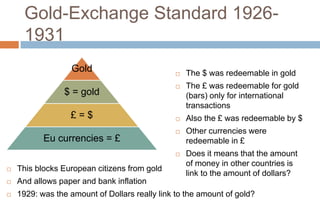
Gold-Exchange Standard 1926-
1931
Gold
$ = gold
£ = $
Eu currencies = £
 The $ was redeemable in gold
 The £ was redeemable for gold
(bars) only for international
transactions
 Also the £ was redeemable by $
 Other currencies were
redeemable in £
 Does it means that the amount
of money in other countries is
link to the amount of dollars?
 This blocks European citizens from gold
 And allows paper and bank inflation
 1929: was the amount of Dollars really link to the amount of gold?
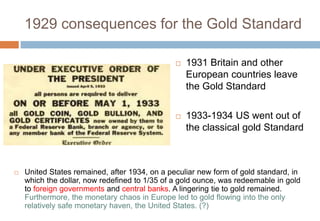
1929 consequences for the Gold Standard
 1931 Britain and other
European countries leave
the Gold Standard
 1933-1934 US went out of
the classical gold Standard
 United States remained, after 1934, on a peculiar new form of gold standard, in
which the dollar, now redefined to 1/35 of a gold ounce, was redeemable in gold
to foreign governments and central banks. A lingering tie to gold remained.
Furthermore, the monetary chaos in Europe led to gold flowing into the only
relatively safe monetary haven, the United States. (?)
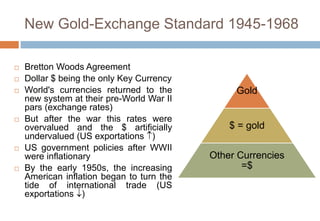
New Gold-Exchange Standard 1945-1968
 Bretton Woods Agreement
 Dollar $ being the only Key Currency
 World's currencies returned to the
new system at their pre-World War II
pars (exchange rates)
 But after the war this rates were
overvalued and the $ artificially
undervalued (US exportations )
 US government policies after WWII
were inflationary
 By the early 1950s, the increasing
American inflation began to turn the
tide of international trade (US
exportations )
Gold
$ = gold
Other Currencies
=$
How it works? Classical Gold Standard
 Country situation:
 A country decides to print more paper money
  Inflation   imports   exports
   deficit in the balance of payments with other countries
 Payments between countries are settle in gold
  outflow of gold for this country
 Will force them to correct the situation to stop the loss of gold
 Bank situation:
 A bank issues to many deposits (loans)
 All the above happens
 Foreigners (banks or gov’s? costumers?) call upon to redeem their
deposits
  BANKRUPTCY
 The fear of bankruptcy will make them behave
Money functions in the economy
 1 - As a means of exchange / deference of
payment
 2 - As a store of value
 3 - As a unit of account
Pros
 Very good store of value
 Controls inflation
 Compare to “paper money” that is inflationary
 Deflation
 Same amount of money buys more goods
 Controls deficit as governments will try to avoid
outflow of gold
 Force bankers to be more carful about the risks they
take to avoid bankrupcy
 Stabilize the money supply
Cons
 Deflationary crash
 Favours the function “store of value” over “means
of exchange
 Does not allow demurrage of inflation (because it
does not degrade)
 Works against producers of goods and services
 Creates inequality: it tends to increase even further
the privileges of those with money, allowing them
to accumulate for themselves even more
excessive wealth
Deflationary crash
 If Gold Standard was suddenly brought back:
 In today’s economy there is lots of debt (almost all money
is debt).
 Because debt is fixed, deflation would make debts harder
to pay, debtors would need more goods and services to
pay their debts.
 meaning if the Gold Standard were implemented
wholesale tomorrow, it would probably cause a
gigantic debt deflationary crash! So just as with the
Positive Money system, anyone advocating the Gold
Standard should have a gradual, stable transition to a
largely debt-free economy in mind.
Conflict between store of value and means of
exchange
 Gold does not degrade over time (no devaluation)
 Other goods do (clothes, food...)
 Favours the user of goods against the producer of them
 When money does not rust, those with money have a store
of value immune to deterioration, while those holding
goods do not. Hence those with money will have superior
bargaining power to those with goods.
 Making money (gold) preferable to goods, will favour
people tendency to keep it (store of value) instead of use it
(exchange of means)
 Making money and end instead of a tool
 Gold gives money intrinsic value
 As a mean of exchange, value is subjective
Gessel
 Must money, as a commodity, be superior to
the commodities which, as medium of exchange, it
is meant to serve ? ... Let us, then, make an end of
the privileges of money. Nobody, not even savers,
speculators, or capitalists, must find money, as a
commodity, preferable to the contents of the
markets, shops, and warehouses. If money is not
to hold sway over goods, it must deteriorate, as
they do.
Should we go back to it? My questions
 Which Gold Standard?
 Classical Gold Standard
 Would that be fair for countries with no gold?
 What price will have? How it would affect market price?
 Would it not benefit people owning big amount of gold (meaning
the already rich becoming richer?)
 What about undeveloped countries with gold? Would they suffer
wars, as oil wars in order for western countries to control the
supply?
 Gold-Exchange and New Gold-Exchange Standards?
 Definitely NOT! Why should $ be the only Key Currency related
to gold?
 With FRACTIONAL RESERVE LENDING policies,
would that really work?
Conclusions
 With proper checks and balances in place the
benefits of ‘paper money’ over gold outweigh the
risks.
 As Positive Money advocates via the Monetary
Policy Committee – manipulation of currency and
conflicts of interest can be held in check.
 In conclusion then, ‘fiat’ money can accomplish the
aims of the Gold Standard (stabilising the money
supply) without its drawbacks, providing it is
made accountable to the public.
 Quote: https://www.youtube.com/watch?v=a7GJb0kufQI
 Friedman on gold standard
https://www.youtube.com/watch?v=MvBCDS-y8vc
 Bill Still https://www.youtube.com/watch?v=Qz8Kh3FtuCY
 Why the U.S. Left the Gold Standard: Origins, Benefits,
Drawbacks (2012)
https://www.youtube.com/watch?v=JEPBbaK8sVI
 http://www.positivemoney.org/2012/03/fiat-money-or-gold-
standard/

The gold standard

  • 1.
    THE GOLD STANDARD Positive MoneyHackney 13.04.2015 CONS
  • 2.
    Why Gold  Theidea of the Gold Standard is to fix the quantity of money by pegging its issue to a scarce resource – gold.  Scarce resource relatively rare  With a known mine supply  ± stable behaviour in the market  Malleable  Heavy  Difficult to counterfeit  Difficult to destroy
  • 3.
    The Gold Standard’s Classical Gold Standard 1815-1914  What most people may think the gold standard is?  Gold-Exchange Standard 1926-1931  {gold  $} {$  £} {£  European currencies )  New Gold-Exchange Standard 1945-1968  Bretton Woods Agreement 1945  $ is the only key currency
  • 4.
    Classical Gold Standard Currency  weight of gold  1$ = 1/20 oz  1£  1/4 oz  The price of gold was fix   exchange rates between currencies were fix
  • 6.
    Gold-Exchange Standard 1926- 1931 Gold $= gold £ = $ Eu currencies = £  The $ was redeemable in gold  The £ was redeemable for gold (bars) only for international transactions  Also the £ was redeemable by $  Other currencies were redeemable in £  Does it means that the amount of money in other countries is link to the amount of dollars?  This blocks European citizens from gold  And allows paper and bank inflation  1929: was the amount of Dollars really link to the amount of gold?
  • 8.
    1929 consequences forthe Gold Standard  1931 Britain and other European countries leave the Gold Standard  1933-1934 US went out of the classical gold Standard  United States remained, after 1934, on a peculiar new form of gold standard, in which the dollar, now redefined to 1/35 of a gold ounce, was redeemable in gold to foreign governments and central banks. A lingering tie to gold remained. Furthermore, the monetary chaos in Europe led to gold flowing into the only relatively safe monetary haven, the United States. (?)
  • 9.
    New Gold-Exchange Standard1945-1968  Bretton Woods Agreement  Dollar $ being the only Key Currency  World's currencies returned to the new system at their pre-World War II pars (exchange rates)  But after the war this rates were overvalued and the $ artificially undervalued (US exportations )  US government policies after WWII were inflationary  By the early 1950s, the increasing American inflation began to turn the tide of international trade (US exportations ) Gold $ = gold Other Currencies =$
  • 10.
    How it works?Classical Gold Standard  Country situation:  A country decides to print more paper money   Inflation   imports   exports    deficit in the balance of payments with other countries  Payments between countries are settle in gold   outflow of gold for this country  Will force them to correct the situation to stop the loss of gold  Bank situation:  A bank issues to many deposits (loans)  All the above happens  Foreigners (banks or gov’s? costumers?) call upon to redeem their deposits   BANKRUPTCY  The fear of bankruptcy will make them behave
  • 11.
    Money functions inthe economy  1 - As a means of exchange / deference of payment  2 - As a store of value  3 - As a unit of account
  • 12.
    Pros  Very goodstore of value  Controls inflation  Compare to “paper money” that is inflationary  Deflation  Same amount of money buys more goods  Controls deficit as governments will try to avoid outflow of gold  Force bankers to be more carful about the risks they take to avoid bankrupcy  Stabilize the money supply
  • 13.
    Cons  Deflationary crash Favours the function “store of value” over “means of exchange  Does not allow demurrage of inflation (because it does not degrade)  Works against producers of goods and services  Creates inequality: it tends to increase even further the privileges of those with money, allowing them to accumulate for themselves even more excessive wealth
  • 14.
    Deflationary crash  IfGold Standard was suddenly brought back:  In today’s economy there is lots of debt (almost all money is debt).  Because debt is fixed, deflation would make debts harder to pay, debtors would need more goods and services to pay their debts.  meaning if the Gold Standard were implemented wholesale tomorrow, it would probably cause a gigantic debt deflationary crash! So just as with the Positive Money system, anyone advocating the Gold Standard should have a gradual, stable transition to a largely debt-free economy in mind.
  • 15.
    Conflict between storeof value and means of exchange  Gold does not degrade over time (no devaluation)  Other goods do (clothes, food...)  Favours the user of goods against the producer of them  When money does not rust, those with money have a store of value immune to deterioration, while those holding goods do not. Hence those with money will have superior bargaining power to those with goods.  Making money (gold) preferable to goods, will favour people tendency to keep it (store of value) instead of use it (exchange of means)  Making money and end instead of a tool  Gold gives money intrinsic value  As a mean of exchange, value is subjective
  • 16.
    Gessel  Must money,as a commodity, be superior to the commodities which, as medium of exchange, it is meant to serve ? ... Let us, then, make an end of the privileges of money. Nobody, not even savers, speculators, or capitalists, must find money, as a commodity, preferable to the contents of the markets, shops, and warehouses. If money is not to hold sway over goods, it must deteriorate, as they do.
  • 17.
    Should we goback to it? My questions  Which Gold Standard?  Classical Gold Standard  Would that be fair for countries with no gold?  What price will have? How it would affect market price?  Would it not benefit people owning big amount of gold (meaning the already rich becoming richer?)  What about undeveloped countries with gold? Would they suffer wars, as oil wars in order for western countries to control the supply?  Gold-Exchange and New Gold-Exchange Standards?  Definitely NOT! Why should $ be the only Key Currency related to gold?  With FRACTIONAL RESERVE LENDING policies, would that really work?
  • 18.
    Conclusions  With properchecks and balances in place the benefits of ‘paper money’ over gold outweigh the risks.  As Positive Money advocates via the Monetary Policy Committee – manipulation of currency and conflicts of interest can be held in check.  In conclusion then, ‘fiat’ money can accomplish the aims of the Gold Standard (stabilising the money supply) without its drawbacks, providing it is made accountable to the public.
  • 19.
     Quote: https://www.youtube.com/watch?v=a7GJb0kufQI Friedman on gold standard https://www.youtube.com/watch?v=MvBCDS-y8vc  Bill Still https://www.youtube.com/watch?v=Qz8Kh3FtuCY  Why the U.S. Left the Gold Standard: Origins, Benefits, Drawbacks (2012) https://www.youtube.com/watch?v=JEPBbaK8sVI  http://www.positivemoney.org/2012/03/fiat-money-or-gold- standard/

Editor's Notes

  • #13 ‘paper money’ (all notes, coins and digital bank deposits which are not backed by any commodity)