CURRENCY CRISIS

Dr. Archana Pillai

Avinash | Tanay
Financial Crisis


A situation in which the supply of money is outpaced by
the demand for money. This means that liquidity is
quickly evaporated because available money is
withdrawn from banks, forcing banks either
to sell other investments to make up for the shortfall or
to collapse.
Financial Crisis


A situation in
which the
value of
financial
institutions or
assets drops
rapidly
Currency crisis




A currency crisis is brought on by a decline in the value of a country's
currency. This decline in value negatively affects an economy by creating
instabilities in exchange rates, meaning that one unit of the currency no
longer buys as much as it used to in another
Currency crisis, which is also called a balance-of-payments crisis, is a
sudden devaluation of a currency which often ends in a speculative
attack in the foreign exchange market
Currency crisis


A currency crisis may
result from chronic
balance-of-payments
deficits or from market
speculation about the
ability of a government
to back its currency
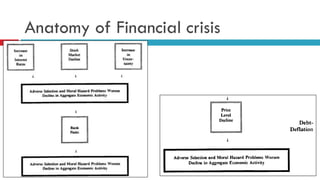
Anatomy of Financial crisis
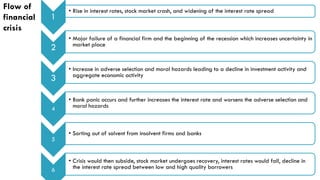
Flow of
financial
crisis

1

2
3
4

5

6

• Rise in interest rates, stock market crash, and widening of the interest rate spread

• Major failure of a financial firm and the beginning of the recession which increases uncertainty in
market place

• Increase in adverse selection and moral hazards leading to a decline in investment activity and
aggregate economic activity

• Bank panic occurs and further increases the interest rate and worsens the adverse selection and
moral hazards

• Sorting out of solvent from insolvent firms and banks

• Crisis would then subside, stock market undergoes recovery, interest rates would fall, decline in
the interest rate spread between low and high quality borrowers
Major causes of Currency crisis
Inflation
 Current account deficit
 Collapse of confidence
 Lower growth and lower interest rates
 Price of commodities

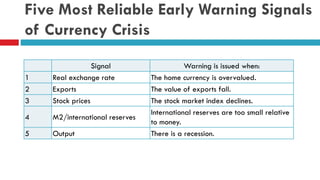
Five Most Reliable Early Warning Signals
of Currency Crisis
1
2
3

Signal
Real exchange rate
Exports
Stock prices

4

M2/international reserves

5

Output

Warning is issued when:
The home currency is overvalued.
The value of exports fall.
The stock market index declines.
International reserves are too small relative
to money.
There is a recession.
Models of currency crisis
First generation models:
 Motivated by the collapse in the price of gold, an
important nominal anchor before the floating of
exchange rates in the 1970s
 These models are from seminal papers by Krugman
(1979) and Flood and Garber (1984), and hence
called “KFG” models
First generation models






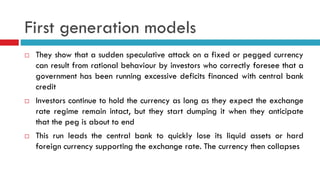
They show that a sudden speculative attack on a fixed or pegged currency
can result from rational behaviour by investors who correctly foresee that a
government has been running excessive deficits financed with central bank
credit
Investors continue to hold the currency as long as they expect the exchange
rate regime remain intact, but they start dumping it when they anticipate
that the peg is about to end
This run leads the central bank to quickly lose its liquid assets or hard
foreign currency supporting the exchange rate. The currency then collapses
Second generation models




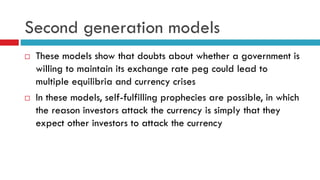
These models show that doubts about whether a government is
willing to maintain its exchange rate peg could lead to
multiple equilibria and currency crises
In these models, self-fulfilling prophecies are possible, in which
the reason investors attack the currency is simply that they
expect other investors to attack the currency
Second generation models






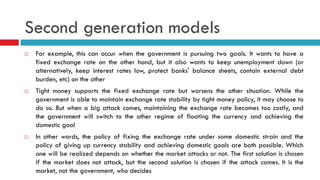
For example, this can occur when the government is pursuing two goals. It wants to have a
fixed exchange rate on the other hand, but it also wants to keep unemployment down (or
alternatively, keep interest rates low, protect banks' balance sheets, contain external debt
burden, etc) on the other
Tight money supports the fixed exchange rate but worsens the other situation. While the
government is able to maintain exchange rate stability by tight money policy, it may choose to
do so. But when a big attack comes, maintaining the exchange rate becomes too costly, and
the government will switch to the other regime of floating the currency and achieving the
domestic goal
In other words, the policy of fixing the exchange rate under some domestic strain and the
policy of giving up currency stability and achieving domestic goals are both possible. Which
one will be realized depends on whether the market attacks or not. The first solution is chosen
if the market does not attack, but the second solution is chosen if the attack comes. It is the
market, not the government, who decides
Third generation models




These models explores how rapid deteriorations of balance
sheets associated with fluctuations in asset prices, including
exchange rates, can lead to currency crises
These models are largely motivated by the Asian crises of the
late 1990s. In the case of Asian countries, macroeconomic
imbalances were small before the crisis – fiscal positions were
often in surplus and current account deficits appeared to be
manageable, but vulnerabilities associated with financial and
corporate sectors were large
Third generation models






Models show how balance sheets mismatches in these
sectors can give rise to currency crises
This generation of models also considers the roles
played by banks and the self-fulfilling nature of crises
McKinnon and Pill (1996), Krugman (1998), and
Corsetti, Pesenti, and Roubini (1998) suggest that overborrowing by banks can arise due to government
subsidies (to the extent that governments would bail out
failing banks)
Third generation models




In turn, vulnerabilities stemming from over-borrowing can
trigger currency crises

Burnside, Eichenbaum, and Rebelo (2001 and 2004)
argue that crises can be self-fulfilling because of fiscal
concerns and volatile real exchange rate movements
(when the banking system has such a government
guarantee, a good and/or a bad equilibrium can result)
Third generation models


Radelet and Sachs (1998) argue more generally
that self-fulfilling panics hitting financial
intermediaries can force liquidation of assets, which
then confirms the panic and leads to a currency
crisis
Mexican currency crisis








Sexenio
Pegged peso
Trade Deficit – subsequent financing
Tesobonos
Forex Reserves
Devaluation
Bailout
Asian currency crisis


http://www.youtube.com/watch?v=vpyvrg5aS4A
The Argentine Peso Crisis




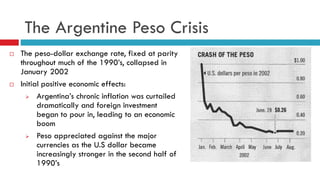
The peso-dollar exchange rate, fixed at parity
throughout much of the 1990’s, collapsed in
January 2002
Initial positive economic effects:
 Argentina’s chronic inflation was curtailed
dramatically and foreign investment
began to pour in, leading to an economic
boom
 Peso appreciated against the major
currencies as the U.S dollar became
increasingly stronger in the second half of
1990’s
The Argentine Peso Crisis
Reason and effects:




A strong peso hurt exports from Argentina and caused a protracted
economic downturn that eventually led to the abandonment of peso-dollar
parity in January 2002

This downturn, in turn, caused severe economic and political distress in the
country. The unemployment rate rose above 20 percent and inflation
reached a monthly rate of about 20 percent in April 2002
Major causes






Lack of fiscal discipline
Labour market inflexibility
Contagion from the financial crisis of Brazil and Russia
The federal Government of Argentina borrowed heavily in
dollars throughout 1990’s. There was an increase in public
sector indebtedness.
The Argentine Peso Crisis






As the economy entered a recession in the late 1990’s, the
Government encountered an increasing difficulty in raising
debts, eventually defaulting on its internal and external debts.
The hard fixed exchange rate that Argentina adopted made it
impossible to restore competitiveness by a traditional currency
depreciation
A powerful labour union also made it difficult to lower wages
and thus cut production costs
The Argentine Peso Crisis






The situation worsened by a slowdown of international capital
inflows following the financial crisis in Russia and Brazil
A sharp depreciation of Brazil real in 1999 hampered exports
from Argentina
The government of Argentina ceased all debt payments in
December 2001 in the wake of persistent recession and rising
social and political unrest. It represents the largest sovereign
default in history
After the Crisis




The Argentine Government made an offer amounting to a
75% reduction in the net present value of the debt. But the
Foreign bond holders rejected the offer
Argentina began a process of debt restructuring on January
14, 2005, that allowed it to resume payment on the majority
of the USD82 billion in sovereign bonds that defaulted in
2002 at the depth of the worst economic crisis in the country's
history. A second debt restructuring in 2010 brought the
percentage of bonds out of default to 93%
Thank You

Currecny crisis

  • 1.
    CURRENCY CRISIS Dr. ArchanaPillai Avinash | Tanay
  • 2.
    Financial Crisis  A situationin which the supply of money is outpaced by the demand for money. This means that liquidity is quickly evaporated because available money is withdrawn from banks, forcing banks either to sell other investments to make up for the shortfall or to collapse.
  • 3.
    Financial Crisis  A situationin which the value of financial institutions or assets drops rapidly
  • 4.
    Currency crisis   A currencycrisis is brought on by a decline in the value of a country's currency. This decline in value negatively affects an economy by creating instabilities in exchange rates, meaning that one unit of the currency no longer buys as much as it used to in another Currency crisis, which is also called a balance-of-payments crisis, is a sudden devaluation of a currency which often ends in a speculative attack in the foreign exchange market
  • 5.
    Currency crisis  A currencycrisis may result from chronic balance-of-payments deficits or from market speculation about the ability of a government to back its currency
  • 6.
  • 7.
    Flow of financial crisis 1 2 3 4 5 6 • Risein interest rates, stock market crash, and widening of the interest rate spread • Major failure of a financial firm and the beginning of the recession which increases uncertainty in market place • Increase in adverse selection and moral hazards leading to a decline in investment activity and aggregate economic activity • Bank panic occurs and further increases the interest rate and worsens the adverse selection and moral hazards • Sorting out of solvent from insolvent firms and banks • Crisis would then subside, stock market undergoes recovery, interest rates would fall, decline in the interest rate spread between low and high quality borrowers
  • 8.
    Major causes ofCurrency crisis Inflation  Current account deficit  Collapse of confidence  Lower growth and lower interest rates  Price of commodities 
  • 9.
    Five Most ReliableEarly Warning Signals of Currency Crisis 1 2 3 Signal Real exchange rate Exports Stock prices 4 M2/international reserves 5 Output Warning is issued when: The home currency is overvalued. The value of exports fall. The stock market index declines. International reserves are too small relative to money. There is a recession.
  • 10.
    Models of currencycrisis First generation models:  Motivated by the collapse in the price of gold, an important nominal anchor before the floating of exchange rates in the 1970s  These models are from seminal papers by Krugman (1979) and Flood and Garber (1984), and hence called “KFG” models
  • 11.
    First generation models    Theyshow that a sudden speculative attack on a fixed or pegged currency can result from rational behaviour by investors who correctly foresee that a government has been running excessive deficits financed with central bank credit Investors continue to hold the currency as long as they expect the exchange rate regime remain intact, but they start dumping it when they anticipate that the peg is about to end This run leads the central bank to quickly lose its liquid assets or hard foreign currency supporting the exchange rate. The currency then collapses
  • 12.
    Second generation models   Thesemodels show that doubts about whether a government is willing to maintain its exchange rate peg could lead to multiple equilibria and currency crises In these models, self-fulfilling prophecies are possible, in which the reason investors attack the currency is simply that they expect other investors to attack the currency
  • 13.
    Second generation models    Forexample, this can occur when the government is pursuing two goals. It wants to have a fixed exchange rate on the other hand, but it also wants to keep unemployment down (or alternatively, keep interest rates low, protect banks' balance sheets, contain external debt burden, etc) on the other Tight money supports the fixed exchange rate but worsens the other situation. While the government is able to maintain exchange rate stability by tight money policy, it may choose to do so. But when a big attack comes, maintaining the exchange rate becomes too costly, and the government will switch to the other regime of floating the currency and achieving the domestic goal In other words, the policy of fixing the exchange rate under some domestic strain and the policy of giving up currency stability and achieving domestic goals are both possible. Which one will be realized depends on whether the market attacks or not. The first solution is chosen if the market does not attack, but the second solution is chosen if the attack comes. It is the market, not the government, who decides
  • 14.
    Third generation models   Thesemodels explores how rapid deteriorations of balance sheets associated with fluctuations in asset prices, including exchange rates, can lead to currency crises These models are largely motivated by the Asian crises of the late 1990s. In the case of Asian countries, macroeconomic imbalances were small before the crisis – fiscal positions were often in surplus and current account deficits appeared to be manageable, but vulnerabilities associated with financial and corporate sectors were large
  • 15.
    Third generation models    Modelsshow how balance sheets mismatches in these sectors can give rise to currency crises This generation of models also considers the roles played by banks and the self-fulfilling nature of crises McKinnon and Pill (1996), Krugman (1998), and Corsetti, Pesenti, and Roubini (1998) suggest that overborrowing by banks can arise due to government subsidies (to the extent that governments would bail out failing banks)
  • 16.
    Third generation models   Inturn, vulnerabilities stemming from over-borrowing can trigger currency crises Burnside, Eichenbaum, and Rebelo (2001 and 2004) argue that crises can be self-fulfilling because of fiscal concerns and volatile real exchange rate movements (when the banking system has such a government guarantee, a good and/or a bad equilibrium can result)
  • 17.
    Third generation models  Radeletand Sachs (1998) argue more generally that self-fulfilling panics hitting financial intermediaries can force liquidation of assets, which then confirms the panic and leads to a currency crisis
  • 19.
    Mexican currency crisis        Sexenio Peggedpeso Trade Deficit – subsequent financing Tesobonos Forex Reserves Devaluation Bailout
  • 20.
  • 21.
    The Argentine PesoCrisis   The peso-dollar exchange rate, fixed at parity throughout much of the 1990’s, collapsed in January 2002 Initial positive economic effects:  Argentina’s chronic inflation was curtailed dramatically and foreign investment began to pour in, leading to an economic boom  Peso appreciated against the major currencies as the U.S dollar became increasingly stronger in the second half of 1990’s
  • 22.
    The Argentine PesoCrisis Reason and effects:   A strong peso hurt exports from Argentina and caused a protracted economic downturn that eventually led to the abandonment of peso-dollar parity in January 2002 This downturn, in turn, caused severe economic and political distress in the country. The unemployment rate rose above 20 percent and inflation reached a monthly rate of about 20 percent in April 2002
  • 23.
    Major causes     Lack offiscal discipline Labour market inflexibility Contagion from the financial crisis of Brazil and Russia The federal Government of Argentina borrowed heavily in dollars throughout 1990’s. There was an increase in public sector indebtedness.
  • 24.
    The Argentine PesoCrisis    As the economy entered a recession in the late 1990’s, the Government encountered an increasing difficulty in raising debts, eventually defaulting on its internal and external debts. The hard fixed exchange rate that Argentina adopted made it impossible to restore competitiveness by a traditional currency depreciation A powerful labour union also made it difficult to lower wages and thus cut production costs
  • 25.
    The Argentine PesoCrisis    The situation worsened by a slowdown of international capital inflows following the financial crisis in Russia and Brazil A sharp depreciation of Brazil real in 1999 hampered exports from Argentina The government of Argentina ceased all debt payments in December 2001 in the wake of persistent recession and rising social and political unrest. It represents the largest sovereign default in history
  • 26.
    After the Crisis   TheArgentine Government made an offer amounting to a 75% reduction in the net present value of the debt. But the Foreign bond holders rejected the offer Argentina began a process of debt restructuring on January 14, 2005, that allowed it to resume payment on the majority of the USD82 billion in sovereign bonds that defaulted in 2002 at the depth of the worst economic crisis in the country's history. A second debt restructuring in 2010 brought the percentage of bonds out of default to 93%
  • 27.