The future (of learning) will be telepathic and telekinetic Inge de Waard This is a powerpoint narration
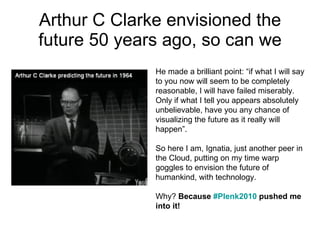
Arthur C Clarke envisioned the future 50 years ago, so can we He made a brilliant point: “if what I will say to you now will seem to be completely reasonable, I will have failed miserably. Only if what I tell you appears absolutely unbelievable, have you any chance of visualizing the future as it really will happen”.  So here I am, Ignatia, just another peer in the Cloud, putting on my time warp goggles to envision the future of humankind, with technology.  Why?  Because  #Plenk2010  pushed me into it!
My starting point:   in 50 years time humans will be telepathic and telekinetic Why?  Let me take you on my narrative powerpoint journey into the future.
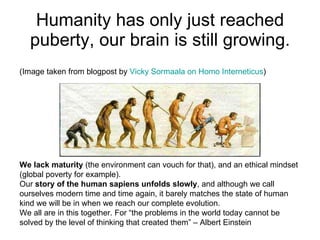
Humanity has only just reached puberty, our brain is still growing. (Image taken from blogpost by  Vicky  Sormaala  on Homo  Interneticus ) We lack maturity  (the environment can vouch for that), and an ethical mindset (global poverty for example). Our  story of the human sapiens unfolds slowly , and although we call ourselves modern time and time again, it barely matches the state of human kind we will be in when we reach our complete evolution.  We all are in this together. For “the problems in the world today cannot be solved by the level of thinking that created them” – Albert Einstein
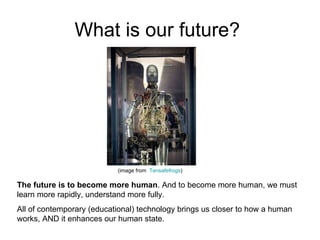
What is our future?  (image from  Tensafefrogs ) The future is to become more human . And to become more human, we must learn more rapidly, understand more fully.  All of contemporary (educational) technology brings us closer to how a human works, AND it enhances our human state.
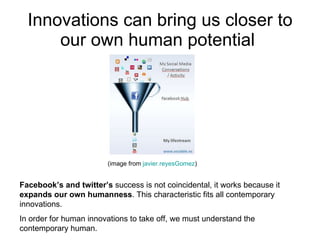
Innovations can bring us closer to our own human potential  (image from  javier.reyesGomez ) Facebook’s and twitter’s  success is not coincidental, it works because it  expands our own humanness . This characteristic fits all contemporary innovations.  In order for human innovations to take off, we must understand the contemporary human.
So … what is human?
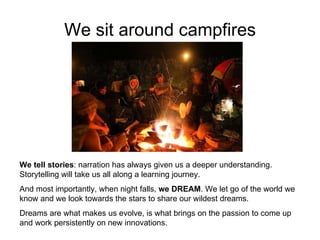
We sit around campfires We tell stories : narration has always given us a deeper understanding. Storytelling will take us all along a learning journey.  And most importantly, when night falls,  we DREAM . We let go of the world we know and we look towards the stars to share our wildest dreams.  Dreams are what makes us evolve, is what brings on the passion to come up and work persistently on new innovations.
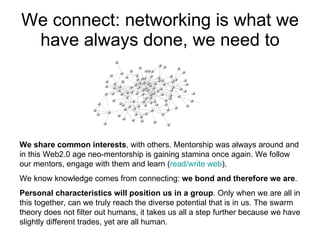
We connect: networking is what we have always done, we need to We share common interests , with others. Mentorship was always around and in this Web2.0 age neo-mentorship is gaining stamina once again. We follow our mentors, engage with them and learn ( read/write web ). We know knowledge comes from connecting:  we bond and therefore we are . Personal characteristics will position us in a group . Only when we are all in this together, can we truly reach the diverse potential that is in us. The swarm theory does not filter out humans, it takes us all a step further because we have slightly different trades, yet are all human.
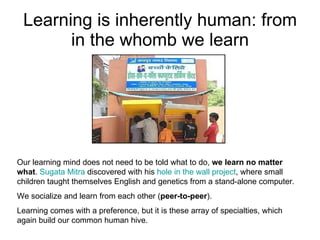
Learning is inherently human: from in the whomb we learn Our learning mind does not need to be told what to do,  we learn no matter what .  Sugata   Mitra   discovered with his  hole in the wall project , where small children taught themselves English and genetics from a stand-alone computer.  We socialize and learn from each other ( peer-to-peer ).  Learning comes with a preference, but it is these array of specialties, which again build our common human hive.
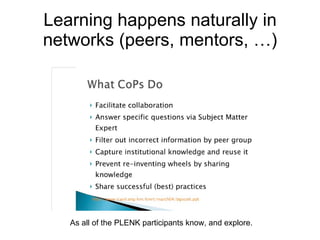
Learning happens naturally in networks (peers, mentors, …) As all of the PLENK participants know, and explore.
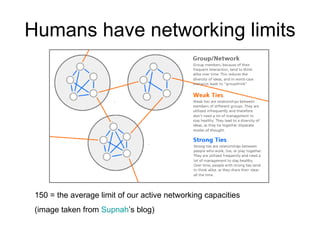
Humans have networking limits 150 = the average limit of our active networking capacities (image taken from  Supnah ’s blog)
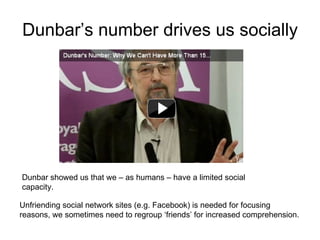
Dunbar’s number drives us socially Unfriending social network sites (e.g. Facebook) is needed for focusing reasons, we sometimes need to regroup ‘friends’ for increased comprehension.  Dunbar showed us that we – as humans – have a limited social capacity.
Friends are not always needed Sometimes loose dots, outside of our network will do.  We look outside of our networked brain, and roam coincidental peers whose ideas connect with our temporary context or location (peer information on vacation).  And yes, they might only have ‘ 6 degrees of separation ’ between them.
A big step forward occurs in the  interdisciplinary realm Great innovations arise from interdisciplinary cross-pollination . The Flemish school of painters, could only come of age, because painters started to work with glass/mirror makers (according to the  Hockney-Falco  thesis ).  Tolerance, sharing of knowledge  always adds to new ways of thinking and new era’s of enlightenment. We look across borders to learn ( Spanish golden age ).
All of these characteristics are human, we build upon them, but… T
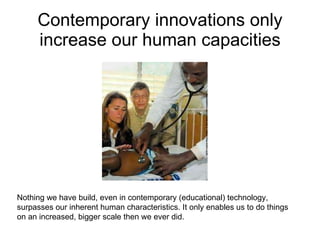
Contemporary innovations only increase our human capacities Nothing we have build, even in contemporary (educational) technology, surpasses our inherent human characteristics. It only enables us to do things on an increased, bigger scale then we ever did.
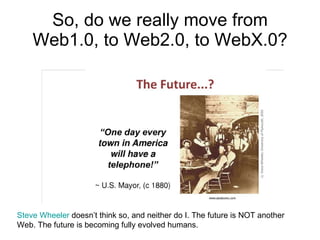
So, do we really move from Web1.0, to Web2.0, to WebX.0? Steve Wheeler   doesn’t think so, and neither do I. The future is NOT another Web. The future is becoming fully evolved humans.
Let’s look at the latest group of technologies
The semantic web is opening up Google results differ according to search history.
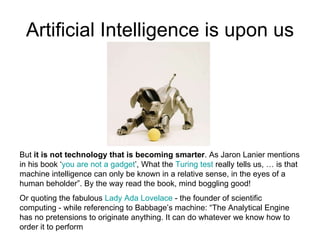
Artificial Intelligence is upon us But  it is not technology that is becoming smarter . As Jaron Lanier mentions in his book ‘ you are not a gadget ’, What the  Turing test   really tells us, … is that machine intelligence can only be known in a relative sense, in the eyes of a human beholder”. By the way read the book, mind boggling good! Or quoting the fabulous  Lady  Ada  Lovelace   - the founder of scientific computing - while referencing to Babbage’s machine: “The Analytical Engine has no pretensions to originate anything. It can do whatever we know how to order it to perform
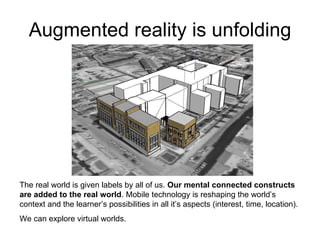
Augmented reality is unfolding The real world is given labels by all of us.  Our mental connected constructs are added to the real world . Mobile technology is reshaping the world’s context and the learner’s possibilities in all it’s aspects (interest, time, location).  We can explore virtual worlds.
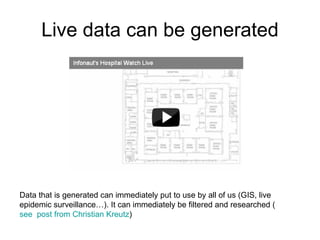
Live data can be generated Data that is generated can immediately put to use by all of us (GIS, live epidemic surveillance…). It can immediately be filtered and researched ( see  post from Christian  Kreutz )
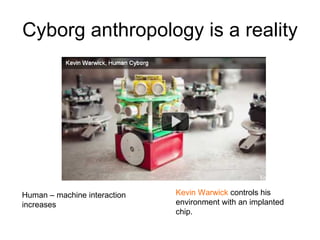
Cyborg anthropology is a reality Human – machine interaction increases Kevin Warwick  controls his environment with an implanted chip.
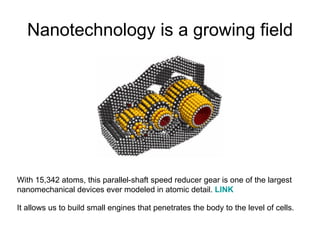
Nanotechnology is a growing field With 15,342 atoms, this parallel-shaft speed reducer gear is one of the largest nanomechanical devices ever modeled in atomic detail.  LINK   It allows us to build small engines that penetrates the body to the level of cells.
Okay, I hear you say,  but what about the future?
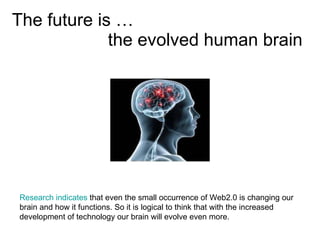
The future is …  the evolved human brain Research indicates   that even the small occurrence of Web2.0 is changing our brain and how it functions. So it is logical to think that with the increased development of technology our brain will evolve even more.
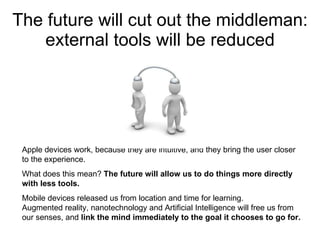
The future will cut out the middleman: external tools will be reduced Apple devices work, because they are intuitive, and they bring the user closer to the experience.  What does this mean?  The future will allow us to do things more directly with less tools.  Mobile devices released us from location and time for learning.  Augmented reality, nanotechnology and Artificial Intelligence will free us from our senses, and  link the mind immediately to the goal it chooses to go for.
So yes, the future within 50 years is  telepathic and telekinetic
It is simple,    just visualize and you will see We will know where we are in the world, because we can tap into the livestream of our peers (e.g.  foursquare   galore) We will travel the world, simply by locking into the extended Google Earth. We will share our thoughts, simply by thinking them .
How can any of us add to this future? Innovations never stand on their own, so connect to others: Stephen Downes connective intelligence ( http://www.downes.ca/post/43456 ). Look around and then build your vision, follow it with passion.  Do not dig yourself in production work: take time off. Dreaming passionately is the source of any innovation. And dreams consist of theta waves, slow waves that only occur if you allow your conscious brain some time off. Take time off, it will increase your ideas.  Do not ponder on whether what you think is original, no invention was ever invented by only one person. Originality does not exist we all build on one another, but passionate accomplishment will brighten up any inventors life.
This powerpoint narration was brought to you by Ignatia / Inge de Waard E-mail:  idewaard@ itg.be   Blog:  ignatiawebs.blogspot.com   Twitter:  http://twitter.com/Ignatia   Slideshare (ppt):   http:// www.slideshare.net/ignatia linkedIn:  http:// www.linkedin.com/in/ingedewaard

The future of human telepathy final

  • 1.
    The future (oflearning) will be telepathic and telekinetic Inge de Waard This is a powerpoint narration
  • 2.
    Arthur C Clarkeenvisioned the future 50 years ago, so can we He made a brilliant point: “if what I will say to you now will seem to be completely reasonable, I will have failed miserably. Only if what I tell you appears absolutely unbelievable, have you any chance of visualizing the future as it really will happen”. So here I am, Ignatia, just another peer in the Cloud, putting on my time warp goggles to envision the future of humankind, with technology. Why? Because #Plenk2010 pushed me into it!
  • 3.
    My starting point: in 50 years time humans will be telepathic and telekinetic Why? Let me take you on my narrative powerpoint journey into the future.
  • 4.
    Humanity has onlyjust reached puberty, our brain is still growing. (Image taken from blogpost by Vicky Sormaala on Homo Interneticus ) We lack maturity (the environment can vouch for that), and an ethical mindset (global poverty for example). Our story of the human sapiens unfolds slowly , and although we call ourselves modern time and time again, it barely matches the state of human kind we will be in when we reach our complete evolution. We all are in this together. For “the problems in the world today cannot be solved by the level of thinking that created them” – Albert Einstein
  • 5.
    What is ourfuture? (image from Tensafefrogs ) The future is to become more human . And to become more human, we must learn more rapidly, understand more fully. All of contemporary (educational) technology brings us closer to how a human works, AND it enhances our human state.
  • 6.
    Innovations can bringus closer to our own human potential (image from javier.reyesGomez ) Facebook’s and twitter’s success is not coincidental, it works because it expands our own humanness . This characteristic fits all contemporary innovations. In order for human innovations to take off, we must understand the contemporary human.
  • 7.
    So … whatis human?
  • 8.
    We sit aroundcampfires We tell stories : narration has always given us a deeper understanding. Storytelling will take us all along a learning journey. And most importantly, when night falls, we DREAM . We let go of the world we know and we look towards the stars to share our wildest dreams. Dreams are what makes us evolve, is what brings on the passion to come up and work persistently on new innovations.
  • 9.
    We connect: networkingis what we have always done, we need to We share common interests , with others. Mentorship was always around and in this Web2.0 age neo-mentorship is gaining stamina once again. We follow our mentors, engage with them and learn ( read/write web ). We know knowledge comes from connecting: we bond and therefore we are . Personal characteristics will position us in a group . Only when we are all in this together, can we truly reach the diverse potential that is in us. The swarm theory does not filter out humans, it takes us all a step further because we have slightly different trades, yet are all human.
  • 10.
    Learning is inherentlyhuman: from in the whomb we learn Our learning mind does not need to be told what to do, we learn no matter what . Sugata Mitra discovered with his hole in the wall project , where small children taught themselves English and genetics from a stand-alone computer. We socialize and learn from each other ( peer-to-peer ). Learning comes with a preference, but it is these array of specialties, which again build our common human hive.
  • 11.
    Learning happens naturallyin networks (peers, mentors, …) As all of the PLENK participants know, and explore.
  • 12.
    Humans have networkinglimits 150 = the average limit of our active networking capacities (image taken from Supnah ’s blog)
  • 13.
    Dunbar’s number drivesus socially Unfriending social network sites (e.g. Facebook) is needed for focusing reasons, we sometimes need to regroup ‘friends’ for increased comprehension. Dunbar showed us that we – as humans – have a limited social capacity.
  • 14.
    Friends are notalways needed Sometimes loose dots, outside of our network will do. We look outside of our networked brain, and roam coincidental peers whose ideas connect with our temporary context or location (peer information on vacation). And yes, they might only have ‘ 6 degrees of separation ’ between them.
  • 15.
    A big stepforward occurs in the interdisciplinary realm Great innovations arise from interdisciplinary cross-pollination . The Flemish school of painters, could only come of age, because painters started to work with glass/mirror makers (according to the Hockney-Falco thesis ). Tolerance, sharing of knowledge always adds to new ways of thinking and new era’s of enlightenment. We look across borders to learn ( Spanish golden age ).
  • 16.
    All of thesecharacteristics are human, we build upon them, but… T
  • 17.
    Contemporary innovations onlyincrease our human capacities Nothing we have build, even in contemporary (educational) technology, surpasses our inherent human characteristics. It only enables us to do things on an increased, bigger scale then we ever did.
  • 18.
    So, do wereally move from Web1.0, to Web2.0, to WebX.0? Steve Wheeler doesn’t think so, and neither do I. The future is NOT another Web. The future is becoming fully evolved humans.
  • 19.
    Let’s look atthe latest group of technologies
  • 20.
    The semantic webis opening up Google results differ according to search history.
  • 21.
    Artificial Intelligence isupon us But it is not technology that is becoming smarter . As Jaron Lanier mentions in his book ‘ you are not a gadget ’, What the Turing test really tells us, … is that machine intelligence can only be known in a relative sense, in the eyes of a human beholder”. By the way read the book, mind boggling good! Or quoting the fabulous Lady Ada Lovelace - the founder of scientific computing - while referencing to Babbage’s machine: “The Analytical Engine has no pretensions to originate anything. It can do whatever we know how to order it to perform
  • 22.
    Augmented reality isunfolding The real world is given labels by all of us. Our mental connected constructs are added to the real world . Mobile technology is reshaping the world’s context and the learner’s possibilities in all it’s aspects (interest, time, location). We can explore virtual worlds.
  • 23.
    Live data canbe generated Data that is generated can immediately put to use by all of us (GIS, live epidemic surveillance…). It can immediately be filtered and researched ( see post from Christian Kreutz )
  • 24.
    Cyborg anthropology isa reality Human – machine interaction increases Kevin Warwick controls his environment with an implanted chip.
  • 25.
    Nanotechnology is agrowing field With 15,342 atoms, this parallel-shaft speed reducer gear is one of the largest nanomechanical devices ever modeled in atomic detail. LINK It allows us to build small engines that penetrates the body to the level of cells.
  • 26.
    Okay, I hearyou say, but what about the future?
  • 27.
    The future is… the evolved human brain Research indicates that even the small occurrence of Web2.0 is changing our brain and how it functions. So it is logical to think that with the increased development of technology our brain will evolve even more.
  • 28.
    The future willcut out the middleman: external tools will be reduced Apple devices work, because they are intuitive, and they bring the user closer to the experience. What does this mean? The future will allow us to do things more directly with less tools. Mobile devices released us from location and time for learning. Augmented reality, nanotechnology and Artificial Intelligence will free us from our senses, and link the mind immediately to the goal it chooses to go for.
  • 29.
    So yes, thefuture within 50 years is telepathic and telekinetic
  • 30.
    It is simple, just visualize and you will see We will know where we are in the world, because we can tap into the livestream of our peers (e.g. foursquare galore) We will travel the world, simply by locking into the extended Google Earth. We will share our thoughts, simply by thinking them .
  • 31.
    How can anyof us add to this future? Innovations never stand on their own, so connect to others: Stephen Downes connective intelligence ( http://www.downes.ca/post/43456 ). Look around and then build your vision, follow it with passion. Do not dig yourself in production work: take time off. Dreaming passionately is the source of any innovation. And dreams consist of theta waves, slow waves that only occur if you allow your conscious brain some time off. Take time off, it will increase your ideas. Do not ponder on whether what you think is original, no invention was ever invented by only one person. Originality does not exist we all build on one another, but passionate accomplishment will brighten up any inventors life.
  • 32.
    This powerpoint narrationwas brought to you by Ignatia / Inge de Waard E-mail: idewaard@ itg.be Blog: ignatiawebs.blogspot.com Twitter: http://twitter.com/Ignatia Slideshare (ppt): http:// www.slideshare.net/ignatia linkedIn: http:// www.linkedin.com/in/ingedewaard